Synthesis and Supramolecular Assembly of
Highly Planar Amphiphilic Porphyrin Complexes
Masafumi Oda
DOCTOR OF PHILOSOPHY
Department of Structural Molecular Science
School of Physical Sciences
Contents
Chapter 1. General Introduction...1
1-1 Supramolecular Integration of Porphyrin and its Derivatives...2
1-2 Amphiphilic Motives with Rigid π-Cores...7
1-3 Design and Synthetic Strategy of a Porphyrin in order to Accomplish Densely Packed Nanostructures...9
1-3-1 meso-Aryl Type vs. β-Alkyl Type Porphyrins...9
1-3-2 Design of Amphiphilic β-Alkylporphyrin Complexes...10
1-3-3 Retrosynthetic Analysis of the Target Porphyrin...12
1-4 References...13
Chapter 2. Syntheses of Triethyleneglycol(TEG)-Tethered and Alkyl-Tethered Dipyrromethanes...16
2-1 Synthesis of a Triethyleneglycol(TEG)-Tethered Dipyrromethane...17
2-2 Synthesis of an Alkyl-Tethered Dipyrromethane...19
2-2-1 Route 1: From Barton–Zard Pyrrole Synthesis...20
2-2-2 Route 2: From Friedel–Crafts Reaction...22
2-3 Conclusion...23
2-4 Experimental Section...23
2-5 References...32
Chapter 3. Syntheses of Amphiphilic β-Alkylporphyrin Complexes...34
3-1 Possible Synthetic Routes of Target Porphyrin...35
3-4 Discussion of Scrambling Reaction...40
3-5 Third Condition...42
3-6 Fourth Condition...43
3-7 Preparative Syntheses of Target Porphyrin Complexes...46
3-8 Conclusion...50
3-9 Experimental Section...50
3-10 References...56
Chapter 4. Supramolecular Integration of Porphyrins in Polar Solvents...58
4-1 UV-Vis Spectral Changes in the Process of Self-Assembly of H2- and Cu-Porphyrins...59
4-2 SEM and TEM Observations of H2- and Cu-Porphyrins Aggregates...61
4-3 XRD Analyses of H2- and Cu-Porphyrins Aggregates...64
4-4 Thermal Magnetic Behaviors of Cu-Porphyrin Aggregates with SQUID Measurements...68
4-5 Conclusion...70
4-6 Experimental Section...70
4-7 References...71 Chapter 5. Supramolecular Integration of Porphyrins by Slow Cooling from Melting
5-6 References...80
Chapter 6. Summary and Perspectives...81
Abbreviation...83
List of Publications and Presentations...84
Acknowledgment...86
Chapter 1. General Introduction
Chapter 1.
General Introduction
Chapter 1. General Introduction
1-1 Supramolecular Integration of Porphyrin and its Derivatives
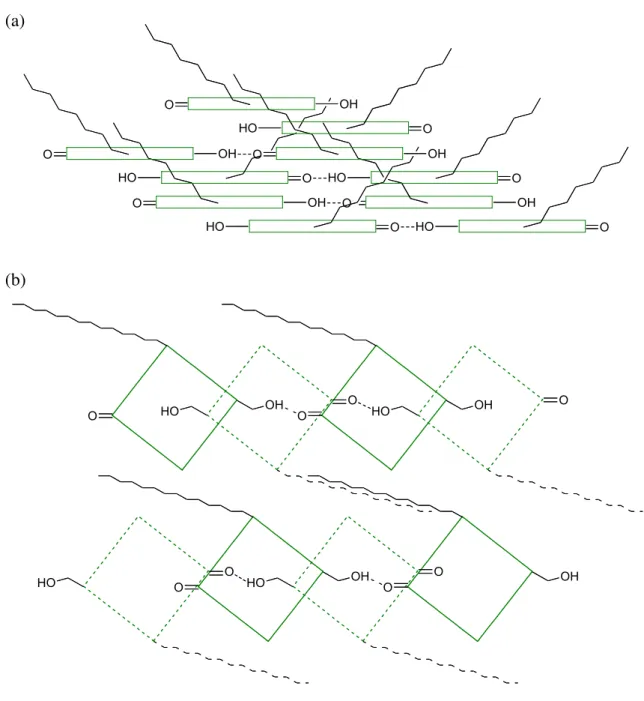
The supramolecular integration of porphyrin and the derivatives has obtained great attention because of the relevance to the natural photosynthetic systems, where a large number of chromophores are spatially aligned and the mutual distances are completely controlled (Figure 1-1).1 For example, light-harvesting antenna in photosynthetic purple bacteria have been extensively investigated because of interest in the structures and the photophysical properties. At the membrane of purple bacteria, bacterio- chlorophylls (BChl) are arranged into cyclic structures, so-called LH1 and LH2 (Figure 1-2), where light energy absorbed is transferred efficiently from the smaller LH2 ring to the larger LH1 and finally delivered to the reaction center (RC). Green photosynthetic bacteria utilize chlorosomes as the main light harvesting system,2 which includes the most efficient antenna known so far and a lamellar organization of a large number of pigments (BChl) has been proposed to the antenna by Tuma et al. in 2004 (Figure 1-3).2c
These studies mentioned above have revealed the important correlation between molecular arrangements of chromophores and the physical properties, which motivated us to investigate the potentials of porphyrin aggregates for useful applications.
Chapter 1. General Introduction
Figure 1-1. The structure of (a) porphyrin skeleton and (b) BChl a.
(a) (b)
N
N N
N M
N
N N
N Mg O
O H
H H3C
H
H
H
O O
H
H CH3 CH3
O O H3C
Chapter 1. General Introduction
Figure 1-3. Schematic model of the BChl aggregates in the chlorosome. (a) Model of one plane of BChl aggregate with antiparallel pigment configuration. (b) Top view of chlorin (green) planes (antiparallel configuration) associated via interdigitated esterifying alcohol tails (black). An underlying layer of BChl molecules is shown dotted.
O OH O OH
O HO
O HO
O HO
O HO
O OH O OH
O OH
HO O
O
OH O
O OH HO
O HO
O
OH O
O OH HO
O HO
(a)
(b)
Chapter 1. General Introduction
In order to obtain well-defined porphyrin aggregates,3 many types of the molecule have been designed and synthesized for these years. Not only covalent bonding4 but metal coordination,5 hydrogen-bonding6 and van der Waals interaction7 have been utilized and the obtained integrated structures have been employed for application in the fields of sensors, field-effect transistors and photovoltaic cells, etc.3b,8
Construction of porphyrin-based macrorings as model compounds of natural light-harvesting antenna has been a challenging target to find a solution of their excellent energy transfer properties. Wheel-like dendritic molecules appended with multiple porphyrin units have been synthesized and the electron transfer reaction between fullerene units as an accepter has been studied by Jiang and Aida et al. (Figure 1-4(a)).4d Kobuke et al. have developed metal-coordination methodology for construction of macrorings with two imidazolylporphyrinatozinc combined together through appropriate linker (Figure 1-4(b)).5e,f Meanwhile, lamellar organization of porphyrins like chlorosomes has also been researched widely and this type of self-assembly of porphyrins requires non-covalent interactions between the side groups and π-π stacking between porphyrin cores. Huijser et al. have studied relationship between self-assembled structures and the transportation ability of excitons for porphyrin derivatives, and demonstrated the importance of ordered structure leading to
Chapter 1. General Introduction
Porphyrin is one of good building blocks for that kind of studies because of its abundant past studies and the feasibility of various molecular designs.
Figure 1-4. The porphyrin macrorings synthesized (a) from a dendritic scaffold and (b) by mutual coordination.
(a) (b)
(a)
(b)
O
O
O O O
O O
O
O O O
O O O
O O
O
O O O O O
O O O
O O
O O
O
O
O
O
O
O
O O
O
O O O O O O O O O
O O
O O
O
O
O O
O O O O O
O O
O O
O O
O
O
O O
O O O O O O O O O O OO
O O
N N N N
Zn
N N
N N Zn
N N
N N Zn
N N
N ZnN
N N
N N Zn
N N N
N Zn
N N N
N Zn
N N N N Zn
N N
N N Zn
N N
N N Zn
N N
N N Zn
NN N N N N Zn
N N Zn N N
N N
Zn N
N
N N
Zn N
N
N N
Zn N
N N NZn N
N N NZn
N N N N Zn
N N N N Zn
N N N
N Zn
N N N
N Zn
N N N
N Zn
N N N
N Zn
OO O
O O
O
OO O
O O
O
O O O
O O
O
O O O
O
O
O
O O O
O
O
O
O O
O O
O O
O O O
O
O O
O O O
O
O O
O O
O
O
O O
O O
O
O
O O O O
O
O O O O
O O
O O O O O
O
O O O O O
O
O O O O O
O
O O
O O O
O O O
O O O
O O O
O O O
O O O
O O O
O O O
O O
O
O O
O O
O O
O O
O O
O O O O
O O
O O O O
O
O OO O O
O
O
S R R
N N
N N Zn N
N
N N
N ZnN
N N
S R R
N N N
NZn N N
N N N N Zn N N
S R
R N N
N ZnN N N
NN
NN Zn
NN
S R R NN
NN Zn NN
N N
N N Zn
N N S R
R NN N N Zn NN
N N N
N Zn N
N S
R R
N N N N Zn
N N N N
NN Zn NN
S R R
N N N NZn
NN N
N NN Zn
NN R S
R
NN NN Zn
NN N
N N N Zn
N N
n-7 (n >7)
Hydrogen-bonding
& π-π stacking
N N
N N M
R R
R
R
R = O
O H NC12H25
O N
H NH O
C12H25
Chapter 1. General Introduction
1-2 Amphiphilic Motives with Rigid π -Cores
Amphiphiles are quite known to form well-ordered aggregates spontaneously and this ability has been used for cell walls or surface-active agents, etc. Recently, amphiphilic motives with rigid π-cores have been well employed to obtain excellent optoelectronic properties associated with the characteristic nanostructures.9 For example, one of the most famous works of that kind of study is self-assembled amphiphilic hexabenzocoronene nanotubes with photochemical properties by Aida et al (Figure 1-6(a)).9b,c Tashiro and Aida et al. have reported interesting liquid crystalline properties of an amphiphilic fully-fused porphyrin dimer, affiliated with the electric conductivity (Figure 1-6 (b)).9h Ishizuka and Jiang et al. have also investigated the semiconducting conductivity and intermolecular magnetic interaction of a one-dimensional molecular wire consisted of amphiphilic dinuclear schiff-base complexes which show a remarkable H-aggregated state in a polar solvent. Because of the high planarity of these complexes, they can be integrated densely packed nanostructures leading to unique characteristics (Figure 1-6 (c)).9i
Because of the potentials of this type of molecules for nanoscience, amphiphilic π-conjugated systems are worth examining not only for fundamental studies but also for
Chapter 1. General Introduction
N
N N
N N
N N
N
Cu Cu
C12H25O C12H25O C12H25O
C12H25O OC12H25
OC12H25TEGO OTEG
OTEG
OTEG OTEG OTEG OTEG
OTEG OC12H25TEGO
OC12H25 C12H25O
OTEG = O O O O
Figure 1-6. Amphiphilic motives with rigid π-cores; the core parts are (a) (b)
(c)
H-aggregation
(a)
O O
O
O O
O O O
Tubular assembly
Liquid crystal
M2
N N
N N
O O
OC12H25 C12H25O
M1 O O
OTEG TEGO
OTEG = O O O O O
• •
•
•
•
• M2
O O
M1
•
• O O
O O O
O
O O O O
• •
•
•
•
• M2
O O
M1
•
• O O
O O O
O
O O O O
• •
•
•
•
• M2
O O
M1
•
• O O
O O O
O
O O O O
• •
•
•
•
• M2
O O
M1
•
• O O
O O O
O
O O
O O
• •
•
•
•
• M2
O O
M1
•
• O O
O O O
O
O O
O O
• •
•
•
•
• M2
O O
M1
•
• O O
O O O
O
O O
O O
• •
•
•
•
• M2
O O
M1
•
• O O
O O O
O
O O
O O
• •
•
•
•
• M2
O O
M1
•
• O O
O O O
O
O O
O O
Chapter 1. General Introduction
1-3 Design and Synthetic Strategy of a Porphyrin in order to
Accomplish Densely Packed Nanostructures
Amphiphilic porphyrin complexes are quite interesting synthetic target because they can be integrated well-ordered supramolecules and they are also useful to reveal the relationship between the spatial arrangement and the physical properties of the molecules.
1-3-1 meso-Aryl Type vs. β-Alkyl Type Porphyrins
Generally, synthetic porphyrins are classified into two species; one is called
"meso-aryl type" and the other is "β-alkyl type" (Figure 1-7). Meso-aryl porphyrin is used more frequently for researches in recent years than β-alkylporphyrin because it can be synthesized with shorter reaction steps and thus more complicated modification is also possible. This porphyrin, however, includes larger steric bulkiness caused by the aromatic rings at the meso-positions. On the other hand, β-alkylporphyrin is difficult to be synthesized, especially for asymmetrically substituted ones, but it has no bulky groups at the periphery. Therefore, porphyrin molecule is highly planar. In this
Chapter 1. General Introduction
1-3-2 Design of Amphiphilic β-Alkylporphyrin Complexes
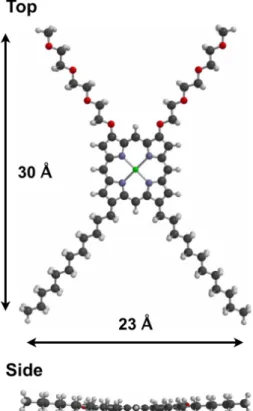
Here, a novel amphiphilic β-alkylporphyrin complex 1-M is designed, which tethered alkyl and triethyleneglycol (TEG) chains as hydrophobic and hydrophilic components, respectively (Figure 1-8). For this porphyrin 1-M, Israelachvili’s critical packing parameter (Pc) is calculated to be less than 1/3, implying that spherical micelles should be favorably formed in polar solvents.9e,10 From the optimized structure at AM1 level, compound 1-M is much planar and less bulky to be assembled in densely packed supramolecules (Figure 1-9). In addition, the empty β-positions may support high reactivity of the meso-positions for substitution reactions with functional groups, and furthermore it can be applied to meso-meso-linked porphyrin arrays.11
Figure 1-7. Conventional pophyrins; (a) meso-aryl type and (b) β-alkyl type pophyrin.
(a) (b)
N MNN N
N N MN N
Chapter 1. General Introduction
Figure 1-8. Amphiphilic β-alkylporphyrin complex 1-M. N
N N
N M
TEGO OTEG
C12H25 C12H25
OTEG = O O O O
Chapter 1. General Introduction
1-3-3 Retrosynthetic Analysis of the Target Porphyrin
To obtain the amphiphilic β-alkylporphyrin complexes 1-M, the synthetic route have been analyzed retrosynthetically (Scheme 1-1). The target porphyrin 1-M can be synthesized by the condensation reaction of TEG-tethered and alkyl-tethered dipyrromethanes. These can be obtained from 4-position substituted ethyl pyrrole-2(and 3)-carboxylate by the dimerization and the decarboxylation. Consequently, the first key subjects are syntheses of these pyrroles.
Scheme 1-1. Retrosynthetic analysis for target porphyrin 1-M.
N
N N
N M
TEGO OTEG
C12H25
C12H25
OTEG = O O O O NH
NH HN
HN
TEGO OTEG
C12H25 C12H25
+
N H TEGO
CO2Et
N H C12H25
CO2Et
Chapter 1. General Introduction
1-4 References
1. (a) McDermott, G.; Prince, S. M.; Freer, A. A.; Hawthornthwaite-Lawless, A. M.; Papiz, M. Z.; Cogdell, R. J.; Isaacs, N. W. Nature, 1995, 374, 517-521. (b) Hu, X.; Damjanovic, A.; Ritz, T.; Schulten, K. Proc. Natl. Acad. Sci. USA, 1998, 95, 5935-5941. (c) Roszak, A. W.; Howard, T. D.; Southall, J.; Gardiner, A. T.; Law, C. J.; Isaacs, N. W.; Cogdell, R. J. Science, 2003, 302, 1969-1972.
2. (a) Staehelin, L. A.; Golecki, J. R.; Fuller, R. C.; Drews, G. Arch. Microbiol. 1978, 119, 269-277. (b) Frigaard, N. U.; Bryant, D. A. Arch. Microbiol. 2004, 182,
265-276. (c) Psencik, J.; Ikonen, T. P.; Laurinmaki, P.; Merckel, M. C.; Butcher, S. J.; Serimaa, R. E.; Tuma, R. Biophys. J. 2004, 87, 1165-1172.
3. Recent reviews: (a) Balaban, T. S. Acc. Chem. Res. 2005, 38, 612-623. (b) Elemans, J. A. A. W.; van Hameren, R.; Nolte, R. J. M.; Rowan, A. E. Adv. Mater. 2006, 18, 1251-1266.
4. (a) Aratani, N.; Osuka, A.; Kim, Y. H.; Jeong, D. H.; Kim, D. Angew. Chem. Int. Ed. 2000, 39, 1458-1462. (b) Tsuda, A.; Osuka, A. Science, 2001, 293, 79-82. (c) Duncan, T. V.; Susumu, K.; Sinks, L. E.; Therien, M. J. J. Am. Chem. Soc. 2006, 128, 9000-9001. (d) Li, W.-S.; Kim, K. S.; Jiang, D.-L.; Tanaka, H.; Kawai, T.;
Chapter 1. General Introduction
2817-2821. (d) Gao, Y; Zhang, X.; Ma, C.; Li, X.; Jiang, J. J. Am. Chem. Soc. 2008, 130, 17044-17052. (e) Hajjaj, F.; Yoon, Z. S.; Yoon, M.-C.; Park, J.; Satake, A.; Kim, D.; Kobuke, Y. J. Am. Chem. Soc. 2006, 128, 4612-4623. (f) Fujisawa, K.; Satake, A.; Hirota, S.; Kobuke, Y. Chem. Eur. J. 2008, 14, 10735-10744.
6. (a) Kishida, T.; Fujita, N.; Sada, K.; Shinkai, S. J. Am. Chem. Soc. 2005, 127, 7298-7299. (b) Shirakawa, M.; Kawano, S.; Fujita, N.; Sada, K.; Shinkai, S. J. Org. Chem. 2003, 68, 5037-5044. (c) Kawano, S.; Tamaru, S.; Fujita, N.; Shinkai,
S. Chem. Eur. J. 2004, 10, 343-351.
7. (a) Escudero, C.; Crusats, J.; Díez-Pérez, I.; El-Hachemi, Z.; Ribó, J. M. Angew. Chem. Int. Ed. 2006, 45, 8032-8035. (b) Lee, S. J.; Malliakas, C. D.; Kanatzidis,
M. G.; Hupp, J. T.; Nguyen, S. T. Adv. Mater. 2008, 20, 3543-3549. (c) Kano, K.; Fukuda, K.; Wakami, H.; Nishiyabu, R.; Pasternack, R. F. J. Am. Chem. Soc. 2000, 122, 7494-7502. (d) van Hameren, R.; Schön, P.; van Buul, A. M.; Hoogboom,
J.; Lazarenko, S. V.; Gerritsen, J. W.; Engelkamp, H.; Christianen, P. C. M.; Heus, H. A.; Maan, J. C.; Rasing, T.; Speller, S.; Rowan, A. E.; Elemans, J. A. A. W.; Nolte, R. J. M. Science, 2006, 314, 1433-1436.
8. The Porphyrin Handbook, Vol. 6, Kadish, K. M.; Smith, K. M.; Guilard, R. Eds.; Academic Press; Sandiego, 2000.
9. (a) Shimizu, T.; Masuda, M.; Minamikawa, H. Chem. Rev. 2005, 105, 1401-1443. (b) Hill, J. P.; Jin, W.; Kosaka, A.; Fukushima, T.; Ichihara, H.; Shimomura, T.; Ito, K.; Hashizume, T.; Ishii, N.; Aida, T. Science, 2004, 304, 1481-1483. (c)
Chapter 1. General Introduction
Hamaoui, B.; Zhi, L.; Pisula, W.; Kolb, U.; Wu, J.; Müllen, K. Chem. Commun. 2007, 2384-2386. (e) Zhang, X.; Chen, Z.; Würthner, F. J. Am. Chem. Soc. 2007, 129, 4886-4887. (f) Che, Y.; Datar, A.; Balakrishnan, K.; Zang, L. J. Am. Chem. Soc. 2007, 129, 7234-7235. (g) Kim, J.-K.; Lee, E.; Lee, M. Angew. Chem. Int. Ed. 2006, 45, 7195-7198. (h) Sakurai, T.; Shi, K.; Sato, H.; Tashiro, K.; Osuka,
A.; Saeki, A.; Seki, S.; Tagawa, S.; Sasaki, S.; Masunaga, H.; Osaka, K.; Takata, M.; Aida, T. J. Am. Chem. Soc. 2008, 130, 13812-13813. (i) Ishizuka, T.; Isono, Y.; Jiang, D.-L.; Tanaka, H. submitted.
10. (a) Israelachvili, J. Intermolecular and Surface Forces, 2nd ed.; Academic Press: San Diego, CA, 1991. (b) Pc = v/al, where v is the effective molecular volume, a is the occupied area by hydrophilic chains, and l is optimal molecular length. 11. (a) Osuka, A.; Shimidzu, H. Angew. Chem. Int. Ed. Engl. 1997, 36, 135-137. (b)
Aratani, N.; Takagi, A.; Yanagawa, Y.; Matsumoto, T.; Kawai, T.; Yoon, Z.S.; Kim, D.; Osuka, A. Chem. Eur. J. 2005, 11, 3389-3404.
Chapter 2. Syntheses of TEG-Tethered and Alkyl-Tethered Dipyrromethanes
Chapter 2.
Syntheses of Triethyleneglycol(TEG)-Tethered and
Alkyl-Tethered Dipyrromethanes
Published in Tetrahedron Lett. 2009, 50, 7137–7140.
Masafumi Oda, Tomoya Ishizuka, Shigeo Arai, Atsushi Takano, and Donglin Jiang
Chapter 2. Syntheses of TEG-Tethered and Alkyl-Tethered Dipyrromethanes
2-1 Synthesis of a Triethyleneglycol(TEG)-Tethered Dipyrromethane
The synthesis of 3,7-bis(TEGO)dipyrromethane 6 has been accomplished from N-tosylglycine as the starting material (Scheme 2-1). As shown in Scheme 1-1, the most critical step of this procedure is the pyrrole cyclization reaction but the synthesis of ethyl 4-alkoxy-pyrrole-2(and 3)-carboxylate has been rarely investigated. Recently, Vyas et al. have reported a newly-developed one-pot synthesis of 4-alkoxypyrrole with intramolecular Wittig reaction from a corresponding N-tosyl derivative of an α-amino acid ester,1 and this method is employed for the synthesis of a key intermediate, diethyl 4-(TEGO)-pyrrole-2,3-dicarboxylate 4. The reaction yield of the synthesis of 4 was quite good (83%) and only 2 steps are required for obtaining the TEG-tethered pyrrole. 1,2,8,9-tetrakis(ethoxycarbonyl)-3,7-bis(TEGO)dipyrromethane 5 was obtained by the condensation reaction of pyrrole 4,2 and the synthesis of the target TEG tethered-dipyrromethane 6 was accomplished by two-step decarboxylation, hydrolysis under basic condition and subsequent heating.3 Noteworthy, the decarboxylated dipyrromethane 6 was not so unstable even in air and can be kept during several months in refrigerator at -40 ºC. Vilsmeier formylation of 6 did not give 1,9-formyl-3,7-bis(TEGO)dipyrromethane to be a reaction intermediate for synthesis of
Chapter 2. Syntheses of TEG-Tethered and Alkyl-Tethered Dipyrromethanes
S O
O NH
HO2C S
O
O NH TEGO2C
NH TEGO CO2Et
CO2Et
i ii
HN OTEG
CO2Et NH
TEGO
EtO2C
EtO2C CO2Et
HN OTEG
NH iv, v TEGO
iii
3
4 5 6
OTEG = O O O O
Scheme 2-1. Synthesis of TEG-tethered dipyrromethane 6. (i) CH3(OCH2CH2)3OH, p-TsOH, xylene, reflux, 7 h, 89%.; (ii) 1) PPh3, diethyl acetylenedicarboxylate, dioxane, r. t., 1 h then reflux, 12 h.; 2) DBU, 90 ºC, 2 h, 83%.; (iii) BF3OEt2, CH2(OMe)2, CH2Cl2, r. t., 16 h, 94%.; (iv) NaOH (aq), EtOH, reflux, 5 h.; (v) H2N(CH2)2OH, 120 ºC, 2 h, 2 steps: 49%.
Chapter 2. Syntheses of TEG-Tethered and Alkyl-Tethered Dipyrromethanes
2-2 Synthesis of an Alkyl-Tethered Dipyrromethane
The synthesis of the key intermediate of ethyl 4-dodecyl-pyrrole-2-carboxylate 10 for the synthesis of 3,7-bis(dodecyl)dipyrromethane 12 has been carried out by two different routes; one is traditional Barton–Zard reaction (Route 1) and the other is based on Friedel–Crafts reaction (Route 2; Scheme 2-2). In this time, because Route 2 could not be employed for target porphyrin synthesis due to the technical problem occurred in the following reaction, the porphyrin was synthesized by a tough procedure of Route 1.
C13H27Br
4 steps
NH C12H25
CO2Et HN
C12H25
NH C12H25 2 steps
10 12
N H
CO2Et
2 steps Route 1
Route 2
Scheme 2-2. Two different synthetic routes for compound 10 and 12.
Chapter 2. Syntheses of TEG-Tethered and Alkyl-Tethered Dipyrromethanes
2-2-1 Route 1: From Barton–Zard Pyrrole Synthesis
I employed the reported procedure of 1-nitrotridecane 7 from 1-bromotridecane,4 and Henry reaction and following acetylation afforded 2-nitrotetradecan-1-ol 8 and 2-nitrotetradecyl acetate 9, respectively. 5 Unfortunately, ethyl 4-dodecyl- pyrrole-2-carboxylate 10 was obtained in only 26% yield despite of various efforts, although the Barton–Zard synthesis usually give a target pyrrole in more than 60% yield.5, 6 3,7-Bis(dodecyl)dipyrromethane 12 was synthesized by acid catalyzed condensation of alkyl-tethered pyrrole 10 with dimethoxymethane2 and subsequent decarboxylation7 but this alkyl-tethered dipyrromethane 12 was a little unstable in air and thus it had to be used immediately after synthesis for next step. Dipyrromethane 12 was functionalized at the α-positions for the synthesis of the target asymmetric porphyrin and the functionalization started from formylation reaction.8 In this case, Vilsmeier reaction gave 3,7-didodecyl-1,9-diformyldipyrromethane 13 in 83% yield and then formyl groups were transformed into hydroxymethyl (Chapter 3-5) or imino groups (15).9
Chapter 2. Syntheses of TEG-Tethered and Alkyl-Tethered Dipyrromethanes
C13H27NO2 C13H27Br
C12H25 NO2 HO ii
i
C12H25 NO2 AcO
iii
N H C12H25
CO2Et iv
HN C12H25
CO2Et NH
C12H25
EtO2C
HN C12H25
NH C12H25
HN C12H25
NH C12H25
OHC CHO
v
vii
vi
HN C12H25
NH C12H25
N N
Pr Pr
viii
7 8
9 10 11
12 13 15
Scheme 2-3. Synthesis of alkyl-tethered dipyrromethane 15 (Roure 1). (i) AgNO2, Et2O, r. t., 4 days, 76%.; (ii) Et3N, HCHO (aq), CH3CN, 0 ºC, 30 min then r. t., 15 h, 62%.; (iii) pyridine, Ac2O, 1 h, 99%.; (iv) EtO2CCH2NC, K2CO3, THF, EtOH, 60 ºC, 65 h, 26%.; (v) BF3·OEt2, CH2(OMe)2, CH2Cl2, 0 ºC, 36 h, 55%.; (vi) NaOH (aq), (CH2OH)2, 180 ºC, 1 h, 83%.; (vii) 1) POCl3, DMF, CH2Cl2, 0 ºC, 3 h.; 2) Na2CO3 (aq), r. t., 15.5 h, 83%.; (viii) n-PrNH2, THF, r. t., 1 h, 99%.
Chapter 2. Syntheses of TEG-Tethered and Alkyl-Tethered Dipyrromethanes
2-2-2 Route 2: From Friedel–Crafts Reaction
Murakami et al. have reported β-acylation of ethyl pyrrole-2-carboxylate by Friedel–Crafts acylation and reduction of acylpyrrole with triethylsilane in trifluoroacetic acid.10 Ethyl 4-dodecyl-pyrrole-2-carboxylate 10 was also obtained from this synthetic methodology in very good yield (total 98% in 2 steps, Scheme 2-4). However, 3,7-Bis(dodecyl)dipyrromethane 12 obtained from this procedure could not be fomylated with same procedure as Route 1. This problem is probably just technical matter and Route 2 must be utilized for porphyrin synthesis if this is cleared.*
* The elemental analysis data for dipyrromethane 11 obtained from this route matches to the theoretical value (vide infra), which indicates the high purity of the dipyrro- methane.
Scheme 2-4. Synthesis of alkyl-tethered dipyrromethane 12 (Route 2). (i)
NH C12H25
CO2Et ii
HN C12H25
NH C12H25
OHC CHO
2 steps
10
13 N
H
CO2Et
NH
CO2Et C11H23 i O
HN C12H25
NH C12H25
12
16
X
Chapter 2. Syntheses of TEG-Tethered and Alkyl-Tethered Dipyrromethanes
2-3 Conclusion
The syntheses of TEG-tethered and alkyl-tethered dipyrromethanes was successfully accomplished but the synthetic route of alkyl-tethered one needs further improvement on the total reaction yield and the number of steps. The present methodology should be valuable for preparing various molecular designs for β-substituted porphyrin complexes.
2-4 Experimental Section
General. THF was freshly distilled over benzophenone ketyl under Ar before use. Diethyl ether, dioxane, 1,2-dichloroethane, dichloromethane and ethanol were distilled over calcium hydride under Ar. DMF was distilled over anhydrous magnesium sulfate in vacuo and methanol was distilled under Ar before use. Potassium carbonate was grinded and dried at 120 ºC for 3 days. Triphenylphosphine, triethyl silane, 1-bromotridecane, triethyleneglycol monomethylether and boron trifluoride
Chapter 2. Syntheses of TEG-Tethered and Alkyl-Tethered Dipyrromethanes
sodium hydroxide were obtained from Wako Pure Chemical Industries. Silver nitrite, aluminum chloride, ethyl isocyanoacetate, 37% formaldehyde (aq), 1,8-diazabicyclo[5.4.0]undec-7-ene (DBU), trifluoroacetic acid and glacial acetic acid were purchased from Aldrich. n-Propylamine, acetic anhydride, sodium sulfate, sodium bicarbonate and ammonium chloride were obtained from Nacalai Tesque. Column chromatography was performed on the bench top, using silica gel (Wakogel C–300HG) or aluminum oxide (Gamma alumina KCG-1525W). All deuterated solvents for NMR measurement were used as received from Cambridge Isotope Laboratories, Inc. 1-Nitrotridecane 7 were prepared according to a reported procedure.4
1H NMR spectrum were recorded on a JEOL model JNM–LA400 or JNM-LA500 NMR spectrometer, where chemical shifts (δ in ppm) were determined with residual proton signals of the solvent as standard. All J values are reported in Hertz. Matrix–assisted laser desorption ionization time–of–flight mass (MALDI–TOF MS) spectroscopic data were obtained with an Applied Biosystems BioSpectrometry model Voyager–DE–STR spectrometer in reflector or linear mode. Samples were prepared as micromolar solutions in dichloromethane or THF, and dithranol (Aldrich) was utilized as the matrix. Fast atom bombardment mass spectra (FAB-MS) and high-resolution mass spectra were recorded on a JEOL model JMS-700 spectrometer in the positive ion mode with a xenon primary atom beam with 3-nitrobenzylalcohol matrix. Infrared (IR) spectra were recorded on a JASCO model FT IR–6100 Fourier transform infrared
Chapter 2. Syntheses of TEG-Tethered and Alkyl-Tethered Dipyrromethanes
ether (16.0 mL, 102 mmol), and p-toluenesulfonic acid monohydrate (0.1619 g, 0.8511 mmol) in xylene (39 mL) was refluxed for 7 h under Ar. After cooling to room temperature, the reaction mixture was washed with sat. sodium bicarbonate (aq), and the aqueous phase was extracted with toluene. The combined organic phase was dried over sodium sulfate, filtered, and evaporated in vacuo. The residue was purified by column chromatography on silica gel eluted with ethyl acetate, the first fraction was collected, and the solvent was evaporated under vacuum to afford the product 3 (5.6764 g, 15.119 mmol) as a pale yellow liquid in 89% yield. 1H NMR (CDCl3): δ 7.75 (d, 2H, J = 8.3 Hz), 7.31 (d, 2H, J = 8.5 Hz), 5.21 (t, 1H, J = 5.4 Hz), 4.18 (t, 2H, J = 4.8 Hz),
3.81 (d, 2H, J = 5.6 Hz), 3.64-3.61 (m, 8H), 3.55-3.53 (m, 2H), 3.37 (s, 3H), 2.42 (s, 3H). HRMS: m/z = 376.1437 (calcd. for C16H26NO7S [M+H]+ = 376.1430).
Diethyl 4-(2-(2-(2-methoxyethoxy)ethoxy)ethoxy)-1H-pyrrole-2,3- dicarboxylate (4). To a predried mixture of 3 (0.8128 g, 2.165 mmol) and triphenylphosphine (0.7101 g, 2.707 mmol) in a 50 mL round bottom flask was injected dry dioxane (4.33 mL) under Ar. Diethyl acetylenedicarboxylate (0.42 mL, 2.6 mmol) was added dropwise to the reaction mixture at 0 ºC and then the ice bath was removed to allow the mixture to warm up to room temperature. After stirring for 1 h, the mixture was brought to reflux and kept at the temperature for 12 h. The temperature
Chapter 2. Syntheses of TEG-Tethered and Alkyl-Tethered Dipyrromethanes
6.61 (d, 1H, J = 3.2 Hz), 4.35-4.31 (m, 4H), 4.07 (t, 2H, J = 4.9 Hz), 3.80 (t, 2H, J = 4.9 Hz), 3.71-3.70 (m, 2H), 3.66-3.64 (m, 4H), 3.57-3.55 (m, 2H), 3.39 (s, 3H), 1.36-1.33 (m, 6H). HRMS: m/z = 373.1744 (calcd. for C17H27NO8 [M]+ = 373.1737).
1,2,8,9-Tetrakis(ethoxycarbonyl)-3,7-bis(2-(2-(2-methoxyethoxy)ethoxy)
ethoxy)dipyrromethane (5). To the predried 4 (0.25 g, 0.67 mmol) in a 50 mL round bottom flask were injected dry dichloromethane (6.1 mL) and dimethoxymethane (0.29 mL, 3.3 mmol) under Ar. Boron trifluoride diethyletherate (0.05 mL, 0.4 mmol) was added and the reaction mixture was stirred at room temperature for 16 h. The solvent was removed under vacuum, and the residue was added to sat. sodium bicarbonate (aq) (20 mL) and extracted with dichloromethane (20 mL, 3 times). The combined organic phase was dried over anhydrous sodium sulfate, filtered, and the solvent was evaporated in vacuo to afford the product 5 (0.2394 g, 0.3155 mmol) as a yellow liquid in 94%
yield. 1H NMR (CDCl3): δ 10.67 (bs, 2H), 4.31-4.26 (m, 8H), 4.15-4.13 (m, 4H), 3.98 (s, 2H), 3.84-3.82 (m, 8H), 3.75-3.73 (m, 4H), 3.55-3.54 (m, 4H), 3.40-3.39 (m, 4H), 3.29 (s, 6H), 1.34-1.30 (m, 12H). HRMS: m/z = 758.3483 (calcd. for C35H54N2O16 [M]+ = 758.3473).
3,7-Bis(2-(2-(2-methoxyethoxy)ethoxy)ethoxy)dipyrromethane (6). To the predried 5 (0.4296 g, 0.5661 mmol) in a 50 mL round bottom flask were injected ethanol (6.58 mL) and 7.5 M sodium hydroxide (aq) (0.66 mL, 4.9 mmol) under Ar. The reaction mixture was refluxed for 5 h and then allowed to cool to room temperature, and glacial acetic acid (0.34 mL, 5.9 mmol) was added to the mixture at 0 ºC. The
Chapter 2. Syntheses of TEG-Tethered and Alkyl-Tethered Dipyrromethanes
mixture was extracted with ethyl acetate (25 mL, 3 times). The combined organic phase was dried over anhydrous sodium sulfate, filtered, and the volatiles were evaporated in vacuo. The crude material was purified by column chromatography on aluminum oxide (activity III) eluted with ethyl acetate, and the first fraction was collected and the solvent was removed under vacuum to afford the product 6 (0.1292 g, 0.2746 mmol) as a brown liquid in 49% yield. 1H NMR (CDCl3): δ 9.03 (bs, 2H), 6.38 (t, 2H, J = 3.1 Hz), 5.83 (t, 2H, J = 2.9 Hz), 4.08-4.06 (m, 4H), 3.84 (s, 2H), 3.77-3.73 (m, 12H), 3.65-3.64 (m, 4H), 3.53-3.51 (m, 4H), 3.34 (s, 6H). HRMS: m/z = 470.2627 (calcd. for C23H38N2O8 [M]+ = 470.2628).
2-Nitrotetradecan-1-ol (8). 1-Nitrotridecane 7 was prepared from 1-bromotridecane with silver(I) nitrite in dry diethyl ether according to the literature procedure.1,2 To a stirred solution of 7 (34.15 g, 148.9 mmol) in acetonitrile (60.7 mL) were added dropwise the acetonitrile solution (86.4 mL) of triethylamine (2.1 mL, 15 mmol) and 37% formaldehyde (aq) (11.1 mL, 149 mmol) at 0 ºC under Ar. Thirty min later, ice bath was removed to allow the mixture to warm up to room temperature and the reaction mixture was stirred for further 15 h. The mixture was poured into sat. ammonium chloride (aq) (400 mL) and extracted with hexane (600 mL, 3 times). The combined organic phase was washed with brine, dried over anhydrous sodium sulfate,
Chapter 2. Syntheses of TEG-Tethered and Alkyl-Tethered Dipyrromethanes
1H), 1.25 (bs, 20H), 0.88 (t, 3H, J = 6.7 Hz). HRMS: m/z = 260.2218 (calcd. for C14H30NO3 [M+H]+ = 260.2226). FTIR (KBr): ν [cm-1] 3386, 2925, 2854, 1555, 1467, 1363, 1332, 1061, 862, 721.
2-Nitrotetradecyl acetate (9). To a stirred solution of 8 (23.88 g, 92.06 mmol) in acetic anhydride (94.5 mL) were added dropwise pyridine (7.3 mL, 92 mmol) at 0 ºC under Ar. One hour later, the reaction mixture was poured into sat. sodium bicarbonate (aq) (500 mL) at 0 ºC and extracted with hexane (500 mL, 3 times). The combined organic phase was washed with sat. sodium bicarbonate (aq) and brine, dried over anhydrous sodium sulfate, filtered, and evaporated in vacuo to give the product 9 (27.54 g, 91.37 mmol) as a colorless liquid in 99% yield. 1H NMR (CDCl3): δ 4.74-4.68 (m, 1H), 4.41-4.37(m, 2H), 2.06 (s, 3H), 2.00-1.90 (m, 1H), 1.75-1.72 (m, 1H), 1.25 (bs, 20H), 0.88 (t, 3H, J = 6.8 Hz). HRMS: m/z = 302.2328 (calcd. for C16H32NO4 [M+H]+
= 302.2331). FTIR (KBr): ν [cm-1] 2925, 2855, 1751, 1558, 1456, 1368, 1226, 1048. Ethyl 4-dodecyl-1H-pyrrole-2-carboxylate (10).
<Route 1> To a predried 9 (6.22 g, 20.6 mmol) in a 100 mL round bottom flask were injected dry THF (25 mL) and dry ethanol (25 mL) under Ar. Ethyl isocyanoacetate (2.3 mL, 21 mmol) and grinded potassium carbonate (5.69 g, 41.2 mmol) were added and then the reaction mixture was stirred at 60 ºC for 78 h. After cooling to room temperature, the mixture was poured into water (160 mL), neutralized by addition of 1 M hydrochloric acid at 0 ºC, and extracted with diethyl ether (200 mL, 3 times). The combined organic phase was dried over anhydrous sodium sulfate,
Chapter 2. Syntheses of TEG-Tethered and Alkyl-Tethered Dipyrromethanes
product 10 (1.67 g, 5.43 mmol) as a pale yellow solid in 26% yield.
<Route 2> To a stirred solution of 16 (4.50 g, 14.0 mmol) in trifluoroacetic acid (56.4 mL) were added dropwise triethyl silane (8.72 mL, 54.6 mmol) at room temperature under Ar. Four hours later, half amount of the solvent was evaporated and the mixture was poured into sat. sodium bicarbonate (aq) (650 mL). The mixture was extracted with ethyl acetate (150 mL, 3 times) and the combined organic phase was washed with brine, dried over anhydrous sodium sulfate, filtered, and evaporated in vacuo. The residue was purified by column chromatography on silica gel eluted with
hexane-ethyl acetate whose ratio was gradually changed from 15:0 to 15:1. The second fraction was collected and the solvent was evaporated under vacuum to afford the product 10 (4.23 g, 13.8 mmol) as a pale orange solid in 98% yield.
1H NMR (CDCl3): δ 8.86 (bs, 1H), 6.76 (s, 1H), 6.72 (s, 1H), 4.30 (q, 2H, J = 7.2 Hz), 2.44 (t, 2H, J = 7.7 Hz), 1.57-1.54 (m, 2H), 1.36-1.25 (m, 21H), 0.88 (t, 3H, J = 6.8 Hz). HRMS: m/z = 307.2517 (calcd. for C19H33NO2 [M]+ = 307.2511).
3,7-Didodecyl-1,9-bis(ethoxycarbonyl)dipyrromethane (11). To a predried 10 obtained from Route 1 (2.11 g, 6.86 mmol) in a 200 mL round bottom flask were injected dry dichloromethane (62 mL) and dimethoxymethane (3.0 mL, 34 mmol) under Ar. Boron trifluoride diethyletherate (0.53 mL, 4.2 mmol) was added at 0 °C and the
Chapter 2. Syntheses of TEG-Tethered and Alkyl-Tethered Dipyrromethanes
Hz), 4.26 (q, 4H, J = 7.1 Hz), 3.89 (s, 2H), 2.38 (t, 4H, J = 7.7 Hz), 1.52-1.50 (m, 4H), 1.30-1.28 (m, 42H), 0.88 (t, 6H, J = 6.8 Hz). HRMS: m/z = 626.5011 (calcd. for C39H66N2O4 [M]+ = 626.5023). Pyrrole 10 obtained from Route 2 was also condensed with dimethoxymethane to afford same product 11. Elemental analysis of this product was examined. Anal.: calcd. for C39H66N2O4; C, 74.71. H, 10.61. N, 4.47. found; C, 74.65. H, 10.71. N, 4.46.
3,7-Bis(dodecyl)dipyrromethane (12). To the solution of 11 obtained from Route 1 (0.4034 g, 0.6434 mmol) in ethylene glycol (3.2 mL) in a 50 mL round bottom flask was added 20 M sodium hydroxide (aq) (0.4 mL), and the mixture was degassed by repeated freeze-pump-thaw cycles, and stirred at 180 ºC for 1 h under Ar. Water (30 mL) was added to quench the reaction, and the reaction mixture was neutralized into pH 7 by addition of 1 M hydrochloric acid (aq) at 0 ºC and extracted with chloroform (60 mL, 3 times). The combined organic phase was washed with brine, dried over anhydrous sodium sulfate, filtered, and evaporated in vacuo to give a brown solid of 12 (0.2584 g, 0.5352 mmol) in 83% yield. Dipyrromethane 11 obtained from Route 2 was also decarboxylated with the same procedure and the result of this synthesis was almost identical. The obtained 12 was used without further purification. 1H NMR (CDCl3): δ 7.61 (bs, 2H), 6.58 (t, 2H, J = 2.7 Hz), 6.05 (t, 2H, J = 2.7 Hz), 3.85 (s, 2H), 2.43 (t, 4H, J = 7.7 Hz), 1.57-1.53 (m, 4H), 1.26 (bs, 36H), 0.88 (t, 6H, J = 6.8 Hz). HRMS: m/z = 481.4535 (calcd. for C33H57N2 [M-H]+ = 481.4522).
3,7-Didodecyl-1,9-diformyldipyrromethane (13). A Vilsmeier reagent was
Chapter 2. Syntheses of TEG-Tethered and Alkyl-Tethered Dipyrromethanes
injected dry dichloromethane (1.0 mL) under Ar, subsequently cooled to 0 °C, and then to the solution was added dropwise the Vilsmeier reagent. The reaction mixture was stirred at 0 ºC for 3 h and sat. sodium carbonate (aq) (3.3 mL) was added and the ice bath was removed to allow the mixture to warm up to room temperature. After stirring for 4.5 h, sodium carbonate (0.3570 g) was added and the mixture was stirred for further 11 h. The suspension was extracted with dichloromethane (10 mL, 3 times) and the organic phase was washed with water, dried over anhydrous sodium sulfate, and filtered. The solvent was evaporated in vacuo to afford the product 13 (40.0 mg, 74.2 µmol) as a brown solid in 83% yield. Dipyrromethane 12 obtained from Route 2 could not be transformed into 13 from the same procedure and the reaction just resulted in the decomposition of the starting material. 1H NMR (CDCl3): δ 10.67 (bs, 2H), 9.37 (s, 2H), 6.80 (s, 2H), 3.98 (s, 2H), 2.45 (t, 4H, J = 7.8 Hz), 1.55 (t, 4H, J = 7.0 Hz), 1.26 (bs, 36H), 0.88 (t, 6H, J = 6.8 Hz). HRMS: m/z = 538.4484 (calcd. for C35H58N2O2 [M]+ = 538.4498).
3,7-Didodecyl-1,9-bis[(propylimino)methyl]dipyrromethane (15). A solution of 13 (20.0 mg, 37.1 µmol) and n-propylamine (7.6 µL, 92 µmol) in dry THF (0.19 mL) was stirred at room temperature for 1.5 h under nitrogen. Removal of the solvent and excess n-propylamine in vacuo gave the product 15 (22.8 mg, 36.7 µmol) as a brown
Chapter 2. Syntheses of TEG-Tethered and Alkyl-Tethered Dipyrromethanes
aluminum chloride (14.13 g, 106 mmol) and lauroyl chloride (24.5 mL, 106 mmol) in dry 1,2-dichloroethane (70.6 mL) were added dropwise the dry 1,2-dichloroethane solution (70.6 mL) of ethyl pyrrole-2-carboxylate (3.69 g, 26.5 mmol) at 0 ºC under Ar and the mixture was refluxed for 1 h. The mixture was poured into sat. sodium bicarbonate (aq) (700 mL) and the colorless solid was removed by vacuum filtration. The filtrate was extracted with ethyl acetate (400 mL, 4 times) and the combined organic phase was washed with sat. sodium bicarbonate (aq), water and brine. The mixture was dried over anhydrous sodium sulfate, filtered and evaporated in vacuo, and the residual solid was purified by column chromatography on silica gel eluted with dichloromethane-methanol whose ratio was gradually changed from 50:0 to 50:1. The second fraction was collected and the solvent was evaporated under vacuum to afford the product 16 (9.21 g, 28.7 mmol) as a pale yellow solid in quantitative yield. 1H NMR (CDCl3): δ 9.53 (bs, 1H), 7.53 (dd, 1H, J = 3.2, 1.7 Hz), 7.29 (dd, 1H, J = 2.4, 1.7 Hz), 4.35 (q, 2H, J = 7.2 Hz), 2.75 (t, 2H, J = 7.5 Hz), 1.70-1.64 (m, 2H), 1.34-1.30 (m, 19H), 0.87 (t, 3H, J = 6.8 Hz). HRMS: m/z = 322.2385 (calcd. for C19H32NO3 [M+H]+
= 322.2382).
2-5 References
1. Mastalerz, H.; Gavai, A. V.; Fink, B.; Struzynski, C.; Tarrant, J.; Vite, G. D.; Wong,
Chapter 2. Syntheses of TEG-Tethered and Alkyl-Tethered Dipyrromethanes
3. Abdalmuhdi, I.; Chang, C. K. J. Org. Chem. 1985, 50, 411-413.
4. (a) Woodcock, S. R.; Marwitz, A. J. V.; Bruno, P.; Branchaud, B. P. Org. Lett. 2006, 8, 3931-3934. (b) White, A. D.; Purchase, C. F. II; Picard, J. A.; Anderson, M. K.;
Mueller, S. B.; Bocan, T. M. A.; Bousley, R. F.; Hamelehle, K. L.; Krause, B. R.; Lee, P.; Stanfield, R. L.; Reindel, J. F. J. Med. Chem. 1996, 39, 3908-3919.
5. Fumoto, Y.; Eguchi, T.; Uno, H.; Ono, N. J. Org. Chem. 1999, 64, 6518-6521. 6. Roth, S. D.; Shkindel, T.; Lightner, D. A. Tetrahedron 2007, 63, 11030-11039. 7. Chang, C. J.; Deng, Y.; Peng, S.-M.; Lee, G.-H.; Yeh, C.-Y.; Nocera, D. G. Inorg.
Chem. 2002, 41, 3008-3016.
8. Wickramasinghe, A.; Jaquinod, L.; Nurco, D. J.; Smith, K. M. Tetrahedron 2001, 57, 4261-4269.
9. Taniguchi, M.; Balakumar, A.; Fan, D.; McDowell, B. E.; Lindsey, J. S. J. Porphyrins Phthalocyanines 2005, 9, 554-574.
10. (a) Tani, M.; Ariyasu, T.; Nishiyama, C.; Hagiwara, H.; Watanabe, T.; Yokoyama, Y.; Murakami, Y. Chem. Pharm. Bull. 1996, 44, 48-54. (b) Tani, M.; Ariyasu, T.; Ohtsuka, M.; Koga, T.; Ogawa, Y.; Yokoyama, Y.; Murakami, Y. Chem. Pharm. Bull. 1996, 44, 55-61.
Chapter 3. Syntheses of Amphiphilic β-Alkylporphyrin Complexes
Chapter 3.
Syntheses of Amphiphilic β-Alkylporphyrin
Complexes
Published in Tetrahedron Lett. 2009, 50, 7137–7140.
Masafumi Oda, Tomoya Ishizuka, Shigeo Arai, Atsushi Takano, and Donglin Jiang