Japan Advanced Institute of Science and Technology
JAIST Repository
https://dspace.jaist.ac.jp/Title
高耐久性リチウムイオン二次電池用高分子化イオン液
体バインダー
Author(s)
PINDI JAYAKUMAR, TEJKIRAN
Citation
Issue Date
2020-09
Type
Thesis or Dissertation
Text version
ETD
URL
http://hdl.handle.net/10119/17011
Rights
氏 名 Tejkiran Pindi Jayakumar 学 位 の 種 類 学 位 記 番 号 学 位 授 与 年 月 日 博士(マテリアルサイエンス) 博材第 502 号 令和 2 年 9 月 24 日
論 文 題 目 Poly(ionic liquid) Based Binders for Highly Durable Li-ion Secondary Batteries 論 文 審 査 委 員 主査 松見紀佳(北陸先端科学技術大学院大学 先端科学技術研究科教授) 大島義文(北陸先端科学技術大学院大学 先端科学技術研究科教授) 長尾祐樹(北陸先端科学技術大学院大学 先端科学技術研究科准教授) 西村俊 (北陸先端科学技術大学院大学 先端科学技術研究科准教授) 松本一 (産業技術総合研究所関西センター電池技術研究部門上級主任研究員) 論文の内容の要旨 Research Content
The current thesis is based on the design and development of poly(ionic liquid) (PIL) based materials for Li-ion secondary battery (LiB) applications. Most of the commercial LiBs have graphite-based anodes. The performance and safety of these LiBs depend predominantly on the electrode-electrolyte interface,
generally referred to as the solid electrolyte interface (SEI). Hence, it is very crucial to tune the SEI both
compositionally and morphologically to enhance the
performance of LiBs. PILs is a class of innovative polymers which combines the properties of ionic liquids such as ionic conductivity, electrochemical and chemical stability and non-flammability with
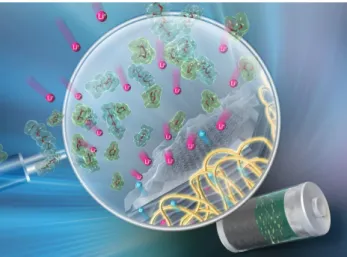
the mechanical toughness and processability of polymers. Ohno et al. have explored the use of PILs as in the energy application as electrolytes and have derived very promising results. Yuan et al. have reported the ability of the PIL to enhance the charge carrier ability at the electrode-electrolyte interface by creating a PIL/electrolyte heterojunction. This ability of PILs can be exploited to enhance the interfacial properties of the electrodes. The availability of a plethora of structurally diverse PILs allows for interfacial tuning to obtain the desired properties. This thesis explores the interfacial tuning using PIL PVBCAImTFSIFigure 1. Graphical abstract of the current research
based binders and surface modification of the active material by PILs as shown in Figure 1. The relation of PIL structure vis-à-vis its performance has been investigated to understand the role of the substituent and the counter-ion.
Chapter 2: Allylimidazolium Based Poly(ionic liquid) Anodic Binder for Lithium-ion Batteries with Enhanced Cyclability.
In this chapter, the design and synthesis of an allylimidazolium based PIL as a binder for graphite anode were carried out. Engineering the structure and HOMO-LUMO levels of the binder is very crucial in tuning its properties. Though the binder constitutes a very small fraction of the gravimetric weight of the electrode, it can have a great effect on the performance of
the LiB. Poly(vinylbenzylallylimidazolium bis(trifluoromethane)sulfonylimide) (PVBCAImTFSI) comprising an imidazole heterocycle and allyl substituent (Figure 2) was used as a binder for graphite anodes in lithium-ion batteries. DFT based theoretical studies also speculated the suppression in the electrolyte degradation in the case of PVBCAImTFSI binder due to the positioning of its HOMO-LUMO levels as compared to the electrolyte. As predicted, anodes with the PVBCAImTFSI binder exhibited lesser electrolyte degradation, decrease in
intercalation-deintercalation, over potential and higher lithium-ion diffusion. Electrochemical Impedance Spectroscopy (EIS) results showed decreased interfacial and diffusion resistance for PVBCAImTFSI based electrodes after cycling. Dynamic Electrochemical Impedance Spectroscopy (DEIS) results indicated that the SEI resistance for the PVBCAImTFSI based anodes to be three times lesser than the PVDF based anodes. A reversible discharge capacity of 210 mAh/g was obtained for
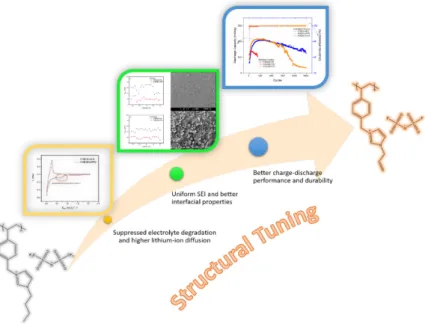
PVBCAImTFSI based half-cells at 1C rate as compared to the 140 mAh/g obtained for PVDF based anodic half-cells. After 500 cycles, 95% retention in the discharge capacity was observed. Also, PVBCAImTFSI based anodes exhibited better charge-discharge stability than the PVDF based anodes. Suppression of electrolyte degradation, reduction in the interfacial resistance, enhanced wettability and optimal SEI layer formed in the case of PVBCAImTFSI based anodes cumulatively led to enhanced stability and cyclability during the charge-discharge studies as compared to the commercially employed PVDF based anodes. Thus, the tuning of the interfacial properties leads to the improvement in the
Figure 3. Graphical abstract of the functioning of PVBCAImTFSI binder
performance of the lithium-ion batteries with PVBCAImTFSI as a binder. A graphical representation of the functioning of the binder is shown in Figure 3. However, it is crucial to understand the effect of the substituent and the counter-ion on the PIL vis-à-vis its performance as a binder. This is investigated in the next chapter by evaluating the performance of the PILs with different substituent and counter-ion.
Chapter 3: Effect of the PIL Binder Structure on the Performance of the Lithium-ion Batteries. Two structurally varying
poly(ionic liquid)s were synthesized to understand the effect of the PIL structure on its performance as a binder in LiBs. This will help in the tuning of the polymer structure to optimize its performance in LiBs. The properties of ionic liquids such as ion conductivity, glass transition temperature, viscosity etc. can be tuned by a simple modification of the side-chain or changing the counter-ion. Side-chains such as allyl group increases the ionic
conductivity and decreases the viscosity of the ionic liquids. Counter-ions especially FSI assists in the formation of a better electrode-electrolyte interface. Therefore, in this study, the design of PILs was carried such that one of the PILs PVBCAImFSI contain both the allyl side-chain and FSI anion. The other PIL PVBCBImTFSI has an alkyl chain and TFSI anion. Cyclic voltammetry studies indicated a suppressed electrolyte degradation for PVBCAImFSI based anodes leading to the formation of a better interface. This was supported by the DEIS measurements whose results indicated lesser RSEI values for
the PVBCAImFSI based anodes. Also, the lithium-ion diffusion kinetics was found to be better in these electrodes. The charge-discharge measurements were carried out to evaluate the durability and stability of the electrodes. Half-cells with PVBCAImFSI based graphite anodes showed enhanced durability up to 1500 cycles with a 60% capacity retention. By changing the TFSI anion to FSI in PVBCAImTFSI, a 400% increase in capacity retention was observed after 1500 cycles. Whereas PVBCBImTFSI based LiBs showed lower capacities with lesser durability. The current study highlights the importance of the side-chain and the counter-ion present on the PIL vis-à-vis its performance as a binder in LiBs as shown in Figure 4.
Chapter 4: Surface Tethered Poly(ionic liquid) for Silicon Nanoparticles in Li-ion Battery Composite Anodes.
Figure 4. Graphical abstract showing the effect of tuning of PIL structure on its performance
The above results show the ability of the PILs to tune the electrode-electrolyte interfacial properties. This led us further to design surface-modified silicon nanoparticles for composite anodes to obtain higher capacities than the conventional graphite anodes. In this chapter, poly(ionic liquid) (PIL) tethered silicon nanoparticles were investigated (Figure 5) as active material in combination with graphite for lithium-ion battery composite anodes. The results obtained are encouraging and calls for more optimization of functionalization
and PIL structure. Silicon falls into the category of high energy density materials with a gravimetric energy density of over 4000 mAh/g, has immense potential to plug the current energy demand. However, due to the inherent volumetric changes researchers have failed in many attempts to commercialize silicon anode based lithium-ion batteries. Formation of a passivation layer (SEI) at the
electrode-electrolyte interface is very crucial in preventing the damage to the electrode in the harsh cycling conditions. An ideal SEI layer must be ionically conductive and electronically non-conducting. The PILs are known to possess good ionic conductivity and can act as interface enhancing agents to design a better interface. In this work, PIL functionalized silicon nanoparticles were prepared by esterification of poly[1-(5-carboxypentyl)-3-vinyl-1H-imidazol-3-ium bromide] with hydroxyl functionalized silicon nanoparticles. Cyclic voltammetry studies of PIL functionalized silicon nanoparticles based composite anodes indicated an increase in the lithiation-delithiation currents with the cycling. They also exhibited a very high lithium-ion diffusion coefficient of about 1.01*10-8 cm/s which
indicated a robust and conducive SEI formation. These electrodes exhibited about 735 mAh/g of reversible discharge capacity after 34 cycles. This chapter presents preliminary results and performance of the anodes can be improved by more fine-tuning of the PIL structure and functionalization.
Keywords: Poly(ionic liquid)s, lithium-ion batteries, graphite anodes, binders, interfacial tuning, surface-functionalized silicon nanoparticles, structure-activity relationship.
論文審査の結果の要旨
本論文においては、リチウムイオン二次電池用の負極バインダーとして各種イミダゾリウム型高分子 Figure 5. Summary of Surface Tethered Poly(ionic liquid) for Silicon
化イオン液体バインダーを適用してその特性を評価している。高分子化イオン液体はクロロメチルスチ レンを出発物質としてイミダゾール化合物の四級化反応及びイオン交換反応を経て合成した。まずアリ ルイミダゾリウム構造を有する高分子をグラファイト負極のバインダーとして適用したところ、汎用の PVDF を使用した場合とは大きく挙動が異なり、アノード型ハーフセルの充放電サイクル後に観測される 内部抵抗が大幅に低減することが分かった。このことは良質な SEI(固体電解質界面)の形成を示唆して いる。加えて、アリルイミダゾリウム構造は PVDF やエチレンカーボネート系電解液よりも LUMO が低い ため、負極側でエチレンカーボネートが還元的に電気分解するよりも先にイミダゾリウムが還元される。 その結果エチレンカーボネートの負極近傍での過剰な還元分解が抑制され、より薄い SEI が形成され、 その結果が前述の低い内部抵抗に結び付いている。さらにサイクリックボルタンメトリーにおいてはリチ ウムのグラファイトへの挿入/脱挿入に相当するピークの電位差(オーバーポテンシャル)は高分子化イ オン液体を用いた場合には顕著に低減した。結果として、高分子化イオン液体を用いて構築したアノー ド型ハーフセルは PVDF を用いた場合よりも大幅に優れた充放電サイクル特性を示した。また本バイン ダーが充放電サイクル中の LiF の生成を大幅に抑制することも明らかとなった。 また、高分子化イオン液体の構造(アリルイミダゾリウム、ブチルイミダゾリウム)、アニオン構造(TFSI、 FSI)に関しても検討した結果、イオン液体構造としてはアリルイミダゾリウム、アニオン構造としては FSI がより好ましい結果を与えた。 高分子化イオン液体を炭素/シリコン複合電極のバインダーとして適用する試みも行った。アノード型 ハーフセルを用いて各種の電気化学測定、充放電測定を行った結果、PVDF の場合とは異なり安定し た充放電サイクルを示すに至った。750 mAhg-1 程度の放電容量など、従来のグラファイト負極系で実 現されない高性能を発現するに至った。 以上のように、新規なリチウムイオン二次電池用負極バインダー材料として高分子化イオン液体の有 効性が明らかとなり、構造特性の相関が明らかとなったほか、性能の向上のみならず、その支配因子に ついても知見が得られ、さらなる電池性能の向上につながりうる学術的知見につながった。一連の研究 は学術、実学の両面において価値が認められることから、博士(マテリアルサイエンス)の学位の授与に 相応しいと判断するに至った。