Studies on Haploid Breeding in Wheat
2008. 3
Science of Plant and Animal Production
United Graduate School of Agricultural Science
Tokyo University of Agriculture and Technology
本論文は,長野県農事試験場に在職する著者が,大学院設置基準第 14 条に基づく教育方法の特例を受 けて行った博士課程での成果をそれまでの研究結果も含めてとりまとめたものであり,以下に発表した.
Tomohiko Ushiyama, Takao Shimizu and Tatsuo Kuwabara 1991. High Frequency of 1)
Haploid Production of Wheat through Intergeneric Cross with Teosinte. Japanese Journal of Breeding 41: 353-357.
2) Tomohiko Ushiyama, Tatsuo Kuwabara and Tomohiko Yoshida 2006. Effect of 2,4-Dichlorophenoxyacetic Acid on the Efficiency of Wheat Haploid Production by the
Method. Plant Production Science 9:0206-211.
Hordeum bulbosum
3) Tomohiko Ushiyama, Tatsuo Kuwabara and Tomohiko Yoshida 2007. Effects of Various Phytohormones on Haploid Wheat Production in Wheat x Maize Crosses. Plant Production Science 10:36-41.
4 Tomohiko Ushiyama and Tomohiko Yoshida 2008. Response to GA and Variation of the Culm)
Plant Production Science in press.
Length in Doubled Haploid Lines of Wheat.
5) Tomohiko Ushiyama, Kazuhiro Nakamura and Tomohiko Yoshida 2008. Pedigree Analysis of Wheat Cultivars Developed at Nagano Agricultural Experiment Station. Plant Production Science in progress.
Contents
General Summary ・・・・・・・・・・・・・・・・・・・・・・・・・・・・・・・・・・・ 1
Summary ・・・・・・・・・・・・・・・・・・・・・・・・・・・・・・・・・・・・・・・ 2
Chapter 1. Introduction ・・・・・・・・・・・・・・・・・・・・・・・・・・・・・・・・ 6
Chapter 2. Pedigree Analysis of Wheat Cultivars in Nagano Prefecture ・・・・・・・・・・ 11 1. The Maximum Generation Traced in the Pedigree and the Number
of Ancestors in the Pedigree ・・・・・・・・・・・・・・・・・・・・・・・ 13
2. Contribution of Ancestors to the Gene Pool ・・・・・・・・・・・・・・・・・ 15
3. Cultivars Related to Tozan Lines ・・・・・・・・・・・・・・・・・・・・・ 18
4. The relationship between the Performance of Cultivars and Kinship
to a Specific Cultivar ・・・・・・・・・・・・・・・・・・・・・・・・・・・ 20
Chapter 3. Haploid Breeding by Bulbosum Method ・・・・・・・・・・・・・・・・・・・ 26
1. Utilization of Non-crossable Wheat Genotype with Hordeum bulbosum ・・・・ 27 2. Effect of 2,4-Dichlorophenoxyacetic Acid on the Efficiency of Wheat
Haploid Production ・・・・・・・・・・・・・・・・・・・・・・・・・・・・ 31
Chapter 4. Haploid Breeding by Maize Method ・・・・・・・・・・・・・・・・・・・・・ 39
1. Effect of Phytohormones on Haploid Production ・・・・・・・・・・・・・・・ 40 2. Optimum Concentration of 2,4-Dichlorophenoxyacetic Acid for Wheat
Haploid Production ・・・・・・・・・・・・・・・・・・・・・・・・・・・・ 42
3. Concentration of 2,4-Dichlorophenoxyacetic Acid in the Spikes ・・・・・・・・ 45 4. High Frequency of Haploid Production of Wheat through Intergeneric
Chapter 5. Haploid Breeding in Comparison with Bulk Method ・・・・・・・・・・・・・・ 53
1. Bulbosum Method in Comparison with Bulk Method・ ・・・・・・・・・・・・ 54
2. Maize Method in Comparison withBulbosum Method by
Response to Gibberellic Acid ・・・・・・・・・・・・・・・・・・・・・・・・ 56
Chapter 6. Development of New Cultivars by Haploid Method ・・・・・・・・・・・・・・ 65 1. Characteristics of Doubled Haploid Lines Derived from Hybridization
of Soft Wheat and Extra Hard Wheat and Breeding of Strong Wheat ・・・・・ 66 2. New Cultivars Released by Haploid Breeding Method ・・・・・・・・・・・・ 74
Chapter 7. General Discussion ・・・・・・・・・・・・・・・・・・・・・・・・・・・・・ 80
References ・・・・・・・・・・・・・・・・・・・・・・・・・・・・・・・・・・・・・・ 85
Acknowledgment ・・・・・・・・・・・・・・・・・・・・・・・・・・・・・・・・・・・・ 92
General Summary
New cultivars are strongly expected for the stable domestic supply of wheat and the cultivars must have high productivity and high quality.
In the pedigree analysis for wheat cultivars developed by Nagano Agricultural Experiment Station (Tozan line , seven ancestors, collectively, contributed 51.5% to the gene pool.) Fukuhokomugi, which was a high yield cultivar and often used as a cross parent, did not contribute to high flour protein.
Haploid breeding was applied for developing new wheat cultivars. In this method wheat was crossed withHordeum bulbosum or maize, following the elimination of the chromosomes and by doubling the chromosomes, a doubled haploid (DH) plant, which was completely homozygous, could be obtained immediately.
Tozan lines produced haploid embryo withbulbosum method. The treatment with 2,4-D at 25 - 100 mg L was effective for-1 bulbosum method. For maize method, 2,4-D at 50 - 100 mg L was-1
optimum. Teosinte also could be used effectively for haploid breeding of wheat.
In DH - DH populations by the3 6 bulbosummethod, the frequency distribution of culm length showed two peaks, though that in F -F from the same F hybrid showed a continual normal3 6 1
distribution. DH lines by the two methods were treated with GA. The scatter diagram of the sensitivity to GA plotted against culm length was divided into three groups. The segregation ratio was close to the expected ratio; 1:2:1 in both DH lines, suggesting the useful selecting of the medium culm-length of DH lines than the conventional bulk method in addition of examining GA sensitivity.
'Kinuhime' was developed by bulbosum method. 'Yumeasahi' and 'Hanamanten' were developed by maize method. The latters were developed in 8 - 9 years after initial crossing. In conventional method, it took usually 12 - 16 years, showing that haploid breeding could shorten the time considerably.
Applying the haploid breeding method, the author could develop new cultivars relatively in a short time and the new cultivars had good agronomic characters and high flour quality, which had been considered very difficult for a long time to combine.
Summary
1. For Tozan lines (wheat cultivars developed by Nagano Agricultural Experiment Station) released recently, the pedigree became more complicated than old Tozan lines, and it must be traced to the oldest ancestor up to 13 generations. It had more than or nearly 200 total ancestors in the pedigree though the number was reduced to about half when common ones were excluded. Half of lines from Tozan 26 to Tozan 46 had more than 100 total ancestors though Tozan 1 (Zenkojikomugi)- Tozan 25 had less than 100 ancestors.
2. The average value of coefficients of parentage between Chunaga and Tozan lines was as high as 0.240, which showed that Chunaga alone contributed 24.0% to the genetic background of Tozan lines. Chunaga was often used as a cross parent in early wheat breeding and produced many good cultivars including Norin 61, which has been grown in wide areas.
3. The highest mean value of the coefficients of parentage to Tozan lines was 0.216 for Hiyokukomugi, followed by Kinuiroha (0.213), Norin 61 (0.206), Mikunikomugi (0.205) and Tokai 80 (0.194). The cultivars developed in the Kanto + Tokai region showed a relatively high kinship to Tokai lines, though the values of coefficient of parentage were not so high.
4. Tozan lines more related to cultivars in the Tohoku region tended to be late heading and more cold-tolerant. Tozan lines more related to Ayahikari or Kinuazuma tended to be early maturing. Fukuhokomugi, which was a high yield cultivar and often used as a cross parent did not contribute to high flour protein. In general, Tozan lines had no specific cultivars used extensively as a cross parent having significant influence on yield or flour quality.
5. Haploid breeding method was applied for developing new wheat cultivars with good agronomic
Hordeum
characteristics and high flour quality. In this method, wheat is wide-crossed with pollen of
( method), maize (teosinte) (maize method), etc. All chromosomes of a pollen
bulbosum bulbosum
plant, which has only wheat chromosomes, can be obtained. By doubling the chromosome number, a doubled haploid (DH) plant, which is completely homozygous, can be obtained immediately. Fourteen
2 1 1
lines of 21 Tozan lines was able to produce haploid embryo with bulbosum method. In F and B F derived from crossable and non-crossable parent, seeds of DH were set with frequency from 2.9% to 8.4%.
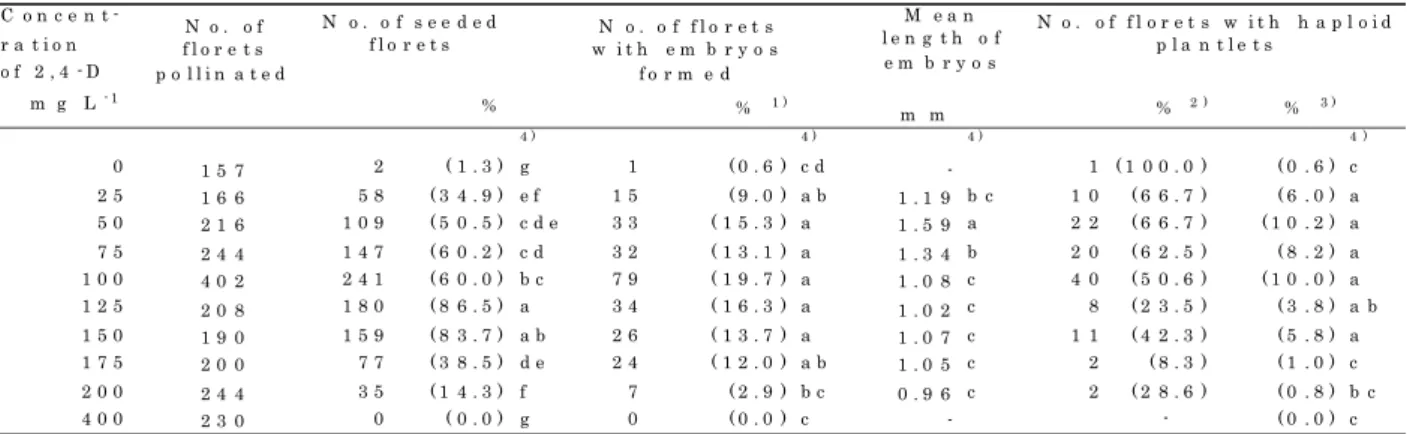
6. The percentage of florets from which haploid plantlets were developed by embryo culture was slightly increased by the treatment of the spikes with 25-100 mg L 2,4-D, but significantly reduced-1
by 125-175 mg L 2,4-D. It suggested that treatment with 2,4-D at 25-1 100 mg L would be-1
~ effective for haploid wheat production bybulbosummethod.
7. 2,4-D was more useful for haploid wheat production than either NAA, IAA, kinetin or BA. In addition, the present results indicated that 2,4-D and NAA, namely synthetic auxin, might be more effective for haploid wheat production than cytokinin.
8. The treatment with 50 mg L 2,4-D increased the embryo size, but the treatments with above 75- 1
mg L 2,4-D inhibited the development of the embryo.-1
9. The percentage of florets developing into haploid plants was increased by the treatment with 100 mg L 2,4-D. The concentration of 2,4-D in the seed was increased to 9.24 ppm by the treatment- 1
with 100 mg L 2,4-D, a further increase of 2,4-D concentration in the medium having no effect. On- 1
the other hand, the concentration of 2,4-D in the glumes and rachis increased up to 12.72 and 41.55 ppm by the treatment with 100 and 150 mg L 2,4-D, respectively. The treatments with 2,4-D at a-1
concentration higher than 100 mg L inhibited embryo development. It suggested that 2,4-D at the- 1
concentrations from 50 to 100 mg L would be optimum for haploid wheat production by maize-1
method.
10. The frequency distribution of culm length in DH , DH , DH and DH populations from DH lines3 4 5 6
produced by the bulbosum method showed two peaks, though that in F , F , F and F populations3 4 5 6
ratio of individuals with a shorter culm length to those with a longer culm length in DH lines was close to the expected ratio; 1:3. The frequency distribution of culm length in F was significantly6
different from that in F -F populations, indicating an unintentional selection during the generation3 5
of the self-pollinated hybrid, but the frequency of short culm relative to long culm individuals was lower in F -F populations than in DH lines.3 6
11. Using an F hybrid with the semi dwarf genes,1 Rht1andRht2,by bulbosum and maize method, DH lines were produced, and 102 seedlings of each DH line produced by the two methods were treated with GA. The sensitivity to GA was shown by the GA index GAI which is length of the( ) ( first leaf sheath LS of GA-treated seedlings / length of LS of GA-non-treated seedlings x 100.( ) ) The scatter diagram of GAI plotted against culm length was divided into three groups, low, medium and high GAI groups. The segregation ratio of these gametophytic phenotypes was close to the expected ratio; 1:2:1 = Rht1Rht2 : (Rht1rht2 rht1Rht2+ ) : rht1rht2, in both DH lines produced by the two methods. It suggests the usefulness of selecting the medium culm-length lines in the DH lines produced by thebulbosum or maize method in addition of examining the GA sensitivity GAI .( )
12. Wheat x teosinte cross was the highest in frequency of embryo obtained 38.5% and in haploid( ) frequency per pollinated florets (31.5% . Teosinte can be used effectively in haploid breeding) programs of wheat.
13. From the cross of soft wheat / extra hard wheat, maize method was applied. As for DH lines, the3
distribution of the rank of agriculture and flour quality characteristics did not have skewness. If the frequency of hard flour or high over-wintering ability in early heading lines was low, new cultivars might not be selected.
14. 'Kinuhime', a soft red winter wheat cultivar, was developed withbulbosum method and released in 1998. 'Kinuhime' was selected from DH lines derived from the cross 'Kanto95' / 'Tozan18' // 'Nishikazekomugi'. 'Kinuhime' has the very early maturity, high yielding, sprouting resistance and lodging resistance, adapted for production in the cold climate southern region in Japan.
15. 'Yumeasahi' and 'Hanamanten' were developed through maize method derived from the cross 'Saikai179' / 'KS831957'. Yumeasahi has medium maturity, many ears, high tolerance to soil upheaval, slightly high sprouting resistance and good baking quality. Hanamanten has early maturity, many ears, high tolerance to soil upheaval, slightly high sprouting resistance and good quality for Chinese noodle.
16. By applying haploid breeding method, the author showed that new cultivars with good agronomic characters and high flour quality, which had been considered very difficult for a long time to combine, could be developed relatively in a short time. Results obtained in this thesis showed that the author established the new wheat breeding method, and new cultivars developed using the method could contribute wheat production considerably.
Chapter 1.
Introduction
Japan imports more than 5000 thousand tons of wheat from abroad every year. The wheat self-sufficiency ratio was only 14% according to the Ministry of Agriculture, Forestry and Fisheries of Japan. Improvement of the self-sufficiency rate is an urgent problem. However, the planted area of wheat does not increase enough. The government had purchased all wheat produced in the country with a source of revenue by the duty cost pool method . This method has failed owing to a( ) financial difficulty, and the purchase of wheat has shifted to the private circulation. Since production cost of wheat is considerably high, producers do not make a enough profit without the grant from the government.
The price difference from the imported wheat is still large. The government encourages wheat production because of the over-production of paddy-rice, thus, wheat is produced as the substitute crops for paddy-rice. The yearly deficit-covering by the government of wheat purchase under the general account was 200 - 500 million yen and the new system was proposed to cut the cost.
In this system, the rank of the grant is decided by the planting situation of wheat of the past three years, resulting that acreage of wheat does not increase as expected. On the other hand, Japan imports most wheat from U.S.A., Canada and Australia, but wheat in Australia has failed this year owing to the drought. In addition, since the wheat acreage was substituted for the production of bio-ethanol, the international price of wheat has been rising. As a result, the price of imported wheat rose, and almost all flour milling industry decided the price raise of the product.
Thus, both of flour milling industry and public consumers expect the domestic wheat production. New cultivars are strongly expected for the stable supply, and the cultivars must have high productivity and high quality. Especially, developing a new cultivar in a short period is urgently expected for a cultivar with high quality for bread making, which had been possible only in Hokkaido.
The meteorological characteristic of Nagano has severe winter. The growth of wheat is restrained by snow blight, freeze, cold wind and frost heave. Main objectives of wheat breeding in Nagano Agricultural Experiment Station are early maturity with winter habit, high yield, freezing hardiness, snow endurance, heaving resistance, resistance to pre-harvest sprouting and high flour quality.
mainly used as a gene source for the resistance to pre-harvest sprouting. New cultivars with higher quality and higher yielding should have been developed successively and quickly. To develop a new cultivar, conventional cross breeding had been employed at Nagano Agricultural Experiment Station, but to develop a new cultivar more rapidly, haploid breeding must be useful for fixation genetically. Since the first paper on pollen embryo genesis in anther culture of Dature innoxia was reported by Guha and Maheswari 1964 , many studies have been carried out using various plant( ) species and this method was applied to breeding of tobacco (Nakata and Tanaka, 1968 , rice) (Niizeki and Oono, 1968 , mishimasaiko Shon and Yoshida, 1997 , Sorghum Can et al., 1998) ( ) ( ) and pearl millet Shigemune and Yoshida, 2000 .( )
Through anther culture, haploid plants are obtained and the homozygous plants, which can be obtained immediately by doubling their chromosome number, are used as inbred lines in a hybrid breeding program. This method is named haploid breeding. These doubled haploid DH plants can( ) be selected without segregation of later generations. DH plants may also contribute to the genetic studies of various plant species.
In barley, Kasha and Kao (1970 reported another haploid breeding method, in which) barley haploids could be produced through the wide cross with Hordeum bulbosum, following the chromosome elimination of the H. bulbosum in the developing embryo and the homozygous plants can be obtained also immediately by doubling their chromosome number.
Selection of Hordeum bulbosum clones adapted for a breeding program was attempted Furusho et al., 1980; Furusho et al., 1992 and a high quality malting barley cultivar was released
( )
using this method Furusho et al., 1999 .( )
Kadotani and Nakata 1983 reviewed that haploid breeding method was useful to reach( ) breeding object when genes concerning the characters in breeding plan was a few though a breeding scale with haploid breeding must be larger than conventional cross breeding. However, so far to develop a new wheat cultivar, a lot of DH lines had not been produced and useful selection methods had not been developed.
In wheat, three alternative haploid breeding systems are now available, i.e., anther culture Buyser et al., 1981; Winzeler et al., 1987 , crossing with Sitch and Snape,
( ) Hordeum bulbosum (
1986a; Snape et al., 1988)(bulbosum method and crossing with maize) (Zea mays L.) (Suenaga and Nakajima, 1989; Ushiyama et al., 1991 maize method .)( )
An application of the bulbosummethod for wheat haploid production is restricted due to the presence of non-crossability genes, Kr1 and/or Kr2, in wheat genotypes (Snape et al. 1979 .) However, Inagaki and Snape 1982 reported that seven of the eight Japanese cultivars examined( ) were developed into haploid wheat plants with bulbosum method and bulbosum method can be promising for wheat breeding programs in Japan. But no one applied this bulbosummethod, and no cultivar was developed by this method. And whether or not a genetic variation occurs in the progeny of the DH lines has not been tested.
On the other hand, Laurie and Bennett 1988 observed that the wheat genotypes carrying( ) gene s could produce haploid plants by maize method. The frequency of haploid production was
Kr ( )
increased by treatment with 2,4-dichlorophenoxyacetic acid 2,4-D( ) (Suenaga and Nakajima 1989; Inagaki and Tahir 1990 . However, Ushiyama et al. 1990 reported that wheat florets crossed with) ( )
bulbosum
maize pollen contained many seeds lacking embryos as compared with those of the
method. In the crosses of wheat x maize, 2,4-D treatment promoted seed setting and embryo formation Kisana et al., 1993; Laurie and Bennett, 1988; Riera-Lizarazu and Mujeeb-Kazi, 1990;( Suenaga and Nakajima 1989 , but the optimum concentration of 2,4-D for embryo differentiation) and the production of haploid wheat have not been determined. And whether or not a genetic variation occurs in the progeny of the DH lines had not been tested with maze method, too. No new cultivar had been released by maize method.
In this thesis, firstly, the author will examine the pedigree record of wheat cultivars developed by Nagano Agricultural Experiment Station. Number of parents in the pedigree tree, number of generations retrieved, contribution of ancestor cultivars to modern cultivars and the relationship between the kinship to major cultivars and performance of the cultivars are described. This pedigree analysis could give valuable information for breeding cultivars with more high performance.
The author will apply, secondly, and examine the haploid breeding for developing a new
bulbosum
cultivar adapted in Nagano and other areas. To produce DH lines of wheat effectively by
method and maize method, one of the key factors is 2,4-D application. The effects of 2,4-D on the growth of the haploid embryos and their development into plantlets in both methods are described. Thirdly, haploid breeding method and conventional balk method are compared. Genetic variation among the DH lines, which theoretically have no bias if no gametophytic selection occurs,
will be also discussed for the future use of the breeding program.
Lastly, the new wheat cultivars released by haploid breeding will be described. The author tried to develop a new cultivar with early heading time, sprouting resistance, lodging resistance and good flour quality for Japanese noodles and hard wheat for bread from DH lines derived from soft wheat/extra hard wheat crossing.
Chapter 2.
Pedigree Analysis of Wheat Cultivars
in Nagano Prefecture
Nagano prefecture in Japan is located near Kanto and Tohoku regions. The meteorological characteristic of Nagano is severe winters, and it becomes suddenly warm in early spring. The growth of wheat is restrained markedly during the winter season by snow blight, freeze, cold wind and frost column. Nagano has a rainy season. These weather factors cause pre-harvest sprouting Kuwabara 1993 . Therefore, the main objectives of wheat breeding at Nagano Agricultural
( )
Experiment Station are early maturity with winter habit, high yield, freezing hardiness, snow endurance, heaving resistance, resistance to pre-harvest sprouting and high flour quality. The first cultivar released at this station was Zenkojikomugi name of breeding line was Tozan 1, 1965 ,( ) which was mainly used as a gene source for the resistance to pre-harvest sprouting. New cultivars with higher yield, higher flour quality and wider adaptability are awaited.
Pedigree analysis, which is the study of breeding records of crop cultivars, of the breeding materials could give valuable information for breeding cultivars with higher performance. However, the pedigree record of recently released cultivars, which are developed after many crossings among promising parents, is very complicated and it is almost impossible to understand the records without proper numerical analysis.
A computer program for the pedigree analysis, i.e., drawing a pedigree tree, calculating the maximum generation traced in the pedigree (generations to the furthest last ancestor in the pedigree tree , total number of ancestors in the pedigree, number of ancestors except common ones) and coefficients of parentage among any cultivars, has been written in Prolog, a programming language with logical operations for artificial intelligence and data retrieval applications Mizuta et( al., 1996; Yoshida, 2004 . Using this program, the genetic background of rice cultivars developed in) Fukuoka prefecture Yoshida and Imabayashi, 1998 , in Kanto Ohta et al., 2006 , in Fukushima( ) ( ) Sato and Yoshida, 2007 and in Hokuriku Shigemune et al., 2006 , and of barley cultivars in
( ) ( )
Fukuoka (Mizuta et al., 1996 were analyzed and the relation to the agronomic and quality) characters were studied.
For rice cultivars in Fukuoka, Oosato and Yoshida (1996 showed that cultivars more) related to Koshihikari had higher eating quality but Sato and Yoshida 2007 found no relationship( ) between them in cultivars in Fukushima. Mizuta et al. 1996 found that malting barley cultivars( ) more related to Harunanijo had higher malting quality. Yoshida and Oosato (1998 showed the) relationship between the rate of rice root regeneration from embryo callus and the genetic
background. These data show that cross combinations with high performance can be partially estimated in advance by computing the coefficients of parentage, which will lead to the planning of more reasonable and theoretical breeding strategy.
In wheat cultivars developed in Kyushu the genetic background was narrow, the number of ancestors was relatively small, and Norin 61, the main cultivar in Kyushu, had no contribution to yield and quality Mizuta and Yoshida, 1996 . The genetic background of cultivars in Kyushu and( ) Nagano might be different and pedigree analysis should be conducted at each breeding station. Therefore, pedigree analysis of wheat cultivars developed at Nagano Agricultural Experiment Station Tozan lines was attempted.( )
1. The Maximum Generation Traced in the Pedigree and the Number of
Ancestors in the Pedigree
In this section, to find the general aspect of the pedigree tree, the author counted the maximum generation traced in the pedigree and the number of ancestors in the pedigree of Tozan lines.
Materials and Methods
A computer program for the pedigree analysis in Prolog Mizuta et al., 1996 modified for( ) Windows AZ-Prolog for Win32, Sofnec co. Ltd., Yoshida, 2004 was used. The 46 Tozan lines shown( ) in Table 1 were studied. Pedigree trees of all cultivars computed were drawn and checked for the accuracy of the record. A cultivar originating from a mutation or pure line selection was considered as an original cultivar. Even if there is some discrepancy in the early crossing record, the values of coefficient of parentage have little difference Yoshida, 1998 .( )
The maximum generation traced in the pedigree, the total number of ancestors and the total number of ancestors except common ones in the pedigree tree was counted for each Tozan line.
Results and Discussion
Total Except common ones Tozan 1 1966 2 6 3 Tozan 2 1967 5 26 21 Tozan 3 1975 3 10 4 Tozan 4 1975 5 18 17 Tozan 5 1976 5 20 18 Tozan 6 1976 5 16 15 Tozan 7 1977 5 20 18 Tozan 8 1977 5 16 15 Tozan 9 1978 6 74 45 Tozan 10 1978 3 6 6 Tozan 11 1978 6 44 28 Tozan 12 1979 6 44 28 Tozan 13 1979 7 78 49 Tozan 14 1979 6 74 45 Tozan 15 1980 6 44 28 Tozan 16 1980 7 78 49 Tozan 17 1980 7 78 49 Tozan 18 1981 7 78 49 Tozan 19 1982 9 96 45 Tozan 20 1982 6 62 41 Tozan 21 1983 8 50 34 Tozan 22 1984 6 40 26 Tozan 23 1984 6 32 25 Tozan 24 1985 6 32 25 Tozan 25 1987 6 32 31 Tozan 26 1987 9 138 71 Tozan 27 1988 9 60 31 Tozan 28 1989 10 198 72 Tozan 29 1991 9 138 71 Tozan 30 1994 10 210 82 Tozan 31 1995 7 74 45 Tozan 32 1996 9 106 45 Tozan 33 1997 9 98 41 Tozan 34 1998 9 98 41 Tozan 35 1999 9 98 43 Tozan 36 1999 8 80 51 Tozan 37 2000 9 98 43 Tozan 38 2001 12 196 79 Tozan 39 2001 12 196 79 Tozan 40 2002 12 196 79 Tozan 41 2003 13 192 59 Tozan 42 2004 11 128 75 Tozan 43 2004 9 126 79 Tozan 44 2005 9 94 58 Tozan 45 2006 7 34 27 Tozan 46 2006 11 222 94 7.5 83.8 43.0 Mean
Table 1. Maximum generation traced in the pedigree, total number of ancestors and number of ancestors except common ones of Tozan lines.
Tozan line Year of release Maximum generation in the pedigree Number of ancestors
ancestors in the pedigree and the total number of ancestors except common ones, of the Tozan lines. In Tozan 3, the numbers were 3, 10 and 4, respectively, and in Tozan 46, the numbers were 11, 222 and 94, respectively. For Tozan lines released recently, the pedigree became more complicated than old Tozan lines, and it must be traced to the oldest ancestor up to 13 generations. It had more than or nearly 200 total ancestors in the pedigree though the number was reduced to about half when common ones were excluded. Half of lines from Tozan 26 to Tozan 46 had more than 100 total ancestors in total though Tozan 1 Zenkojikomugi( ) - Tozan 25 had less than 100 ancestors.
In rice in Fukuoka, the maximum generation traced in the pedigree, the total number of ancestors in the pedigree and the total number of ancestors except common ones were reported to be 17, 1238 and 119, respectively Oosato and Yoshida, 1996 . In barley in Fukuoka, they were 10, 196( ) and 47, respectively Mizuta and Yoshida, 1994 , and in wheat in Kyushu, they were up to 9, 138( ) and 66, respectively Mizuta and Yoshida 1996 . In wheat of Tozan lines, they were fewer than in( ) rice, showing that the wheat pedigree is more simple than the rice pedigree. Though wheat lines in Kyushu computed were older, the pedigree of Tozan lines had more ancestors and was more complicated than Kyushu lines.
l
2. Contribution of Ancestors to the Gene Poo
To determine the genetic background, the contribution of ancestors to the gene pool of Tozan lines was also examined.
Coefficients of parentage show the kinship between two cultivars. It is defined as the probability that a random gene from X is identical by descent with a random gene from Y, considering two individuals, X and Y (Kempthorne, 1969 . By using these values, we could) numerically characterize recent cultivars with a very complicated pedigree record. The coefficient of parentage for a last ancestor having no further ancestors can be considered as the genetical( ) contribution the value multiplied by 100 to % of the ancestor to the gene pool Mizuta et al.,( ) ( 1996 .)
The coefficients of parentage between Tozan lines and the oldest cultivars, i.e. the contribution of ancestors to the gene pool, were computed to find the genetic background of Tozan lines.
Results and Discussion
Table 2 shows the contribution of ancestors to the gene pool of Tozan lines. The average value of coefficients of parentage between Chunaga and Tozan lines was as high as 0.240, which showed that Chunaga alone contributed 24.0% to the genetic background of Tozan lines. It was followed by Igatikugo 0.067 , Eshima 0.049 , Oregon 0.048 , Goshu 13 0.047 , Yaru Waizen( ) ( ) ( ) ( ) 0.035 and Shirochabo 0.028 . It shows that only a few ancestors contributed to the gene pool.
( ) ( )
Seven ancestors, collectively, contributed 51.5% to the gene pool. It also shows the necessity of widening the genetic background to overcome the "genetic vulnerability" Walsh 1981 .( )
In wheat cultivars in Kyushu, Chunaga contributed 39.3% to the gene pool Mizuta and( Yoshida 1996 , which was higher than that in Tozan lines. Chunaga was often used as a cross) parent in early wheat breeding and produced many good cultivars including Norin 61, which has been grown in wide areas. This is the reason for the high contribution of Chunaga to wheat cultivars even at present.
Five ancestors of rice, 3 of malting barley and 5 of wheat, collectively, contributed 62.5, 71.8 and 59.4 % to the gene pool, respectively Oosato and Yoshida, 1996; Mizuta and Yoshida, 1994;( Mizuta and Yoshida, 1996 . The value in Tozan lines for the top 5 ancestors was 45.2 Table 2 and) ( ) lower than that in cultivars in Kyushu, but it still shows the narrow genetic background of Tozan lines.
Table 2. Ancestors contributing to the gene pool of Tozan lines. No. Ancestors Mean coefficient of parentage* Accumulated contribution to gene pool (%) 1 Chunaga 0.240 24.0 2 Igatikugo 0.067 30.8 3 Eshima 0.049 35.7 4 Oregon 0.048 40.5 5 Goshu 13 0.047 45.2 6 Yaru waizen 0.035 48.7 7 Shirochabo 0.028 51.5 8 Garenet ott 652 0.027 54.2 9 Ridet 0.026 56.8 10 Shirasaya 0.023 59.1 11 Odeskaya 51 0.022 61.3 12 Hayakomugi 0.021 63.4 13 Sinriki 0.021 65.5 14 Sirodaruma 0.020 67.5 15 Berubetto 0.020 69.5 16 Yushoki 0.019 71.4 17 Hirosimasipure 3 0.019 73.3 18 Asahi 0.016 74.9 19 Martins amber 0.015 76.4 20 Gaines 0.015 77.9 21 Turkey red 2 0.014 79.3 22 Hizakiri 0.014 80.8 23 Akabozu 0.014 82.2 24 d.w.sel.no71 0.012 83.4 25 Srai 1970 0.011 84.5 26 Srai 1900 0.011 85.6 27 Pekin 11 0.011 86.7 28 Karl 0.011 87.7 29 Aroona 0.011 88.8 30 Sojukuakage 0.010 89.8 31 Calfornia 0.010 90.8
3. Cultivars Related to Tozan Lines
The coefficients of parentage between Tozan lines and main cultivars were also examined. The coefficients of parentage estimated from pedigree record and the genetic distance estimated from DNA polymorphism had significant correlations in malting barley Uchimura et al.,( 2004 and in barley and wheat Kobayashi and Yoshida, 2006 . This shows that the coefficients of) ( ) parentage, which are calculated assuming that cultivars derived from the crossing have half of the genetic materials of each cross parent, is related to the genetic distance estimated from DNA polymorphism.
Materials and Methods
The coefficients of parentage between Tozan lines and main cultivars were computed to find the genetic background of Tozan lines. The main cultivars included 51 main cultivars and 82 cultivars having Norin number Norin 76 Yuyakekomugi - Norin 165 Hanamanten except 8( ( ) ( ) cultivars which were developed in Nagano .)
Results and Discussion
Table 3 shows the top 10 cultivars most related to Tozan lines. The table shows the mean values of the coefficients of parentage to Tozan lines. The highest value was 0.216 for Hiyokukomugi, followed by Kinuiroha 0.213 , Norin 61 0.206 , Mikunikomugi 0.205 and Tokai( ) ( ) ( ) 80 0.194 . Among the cultivars developed in a cold climate, the rank of the highest was 49th in( ) Hokuriku 49 0.142 , followed by Yukichabo 56th, 0.114 and Norin 27 57th, 0.105 Table not( ) ( ) ( )( shown .)
For 82 cultivars having a Norin number, the coefficients of parentage to Tozan lines were computed. They were divided into five groups depending on the region where they were developed; Hokkaido (region with severely cold in winter , Tohoku) (northern cold region , Hokuriku) southern cold region , Kanto + Tokai eastern mild climate region , Kinki + Chugoku + Shikoku
( ) ( )
region, western mild climate region and Kyushu region warm region .( ) ( )
Table 4 shows the mean values and standard deviations of the coefficients of parentage between the Tozan lines and cultivars having a Norin number in each region. The mean values of
No.
Cultivar
Mean of
coefficient of
parentage*
Region
1 Hiyokukomugi
0.216
Kyushu
2 Kinuiroha
0.213
Kyushu
3 Norin 61
0.206
Kyushu
4 Mikunikomugi
0.205
Kanto
5 Tokai 80
0.194
Tokai
6 Iwainodaiti
0.194
Kyushu
7 Gunma w10
0.193
Kanto
8 Junreikomugi
0.192
Shikoku
9 Ayahikari
0.192
Kanto
10 Ushiokomugi
0.188
Chugoku
* Average of 46 Tozan lines.
Table 3. Top 10 cultivars related to Tozan lines.
Region
Number
of
cultivars
Mean of
coefficient of
parentage*
Standard
deviation of
coefficient of
parentage*
Hokkaido
13
0.022
0.014
Tohoku
19
0.045
0.028
Hokuriku
4
0.046
0.045
Kanto and Tokai
13
0.165
0.024
Kinki, Chugoku
and Shikoku
8
0.155
0.042
Kyushu
25
0.157
0.043
Table 4. The means and standard deviation of coefficients
of parentage between Tozan lines and cultivars having
Norin number in each region.
the coefficient of parentage in Kanto + Tokai region, Kyushu region and Kinki + Chugoku + Shikoku region were 0.165, 0.157 and 0.155, respectively. The values in the Tohoku, Hokuriku and Hokkaido regions were 0.045, 0.046 and 0.022, respectively. The standard deviation of the values was the lowest 0.024 in the Kanto + Tokai region. Thus, the cultivars developed in the Kanto + Tokai( ) region showed a relatively high kinship to Tokai lines, though the values of coefficient of parentage were not so high.
Among the cultivars developed in Kyushu, the cultivar most related to Tozan lines was Asakazekomugi and the mean coefficient of parentage was as high as 0.478, followed by Hiyokukomugi (0.373 , Chunaga) (0.359 and Shiroganekomugi) (0.359) (Mizuta and Yoshida 1996 showing that a specific cultivar contributed to cultivars developed in Kyushu), .For Tokai lines, it seems that a specific cultivar did not contribute to Tozan lines in comparison to cultivars developed in Kyushu.
4. The Relationship between the Performance of Cultivars and Kinship to
a Specific Cultivar
The relationship between coefficients of parentage and agronomic or flour quality characters was studied.
Coefficients of parentage of crop cultivars had been computed using a conventional computer program for soybean Delannay et al., 1983 , rice Dilday, 1990; Lin, 1991,1992 and( ) ( ) spring bread wheat Smale et al., 2002 . However, these reports did not mention the relationship( ) with agronomic characters.
Materials and Methods
To determine the relationship between the genetic background and performance, The author computed the correlations between the kinship of a cultivar (coefficient of parentage and) agronomic or flour characters. The characters examined were heading time, maturity data, milling score, crude ash content, crude protein, L* value, a* value, and b* value of 60% flour. The values were scored as a deviation from Shiranekomugi. These data were collected following the standard method of Nagano Agricultural Experiment Station. Potential yield was calculated as the percentage
of weight of whole grains per area to that of a standard cultivar (Shiranekomugi . Sprouting) resistance was scored as 3: hardly sprouting, 5: intermediate and 7: easily sprouting. Grade of spring habit was scored as 1: spring habit, 3: intermediate, and 5: winter habit. Cold tolerance, heaving resistance and snow-mold tolerance were scored as 3: high, 5: intermediate, and 7: low based on the rate of winter killing and the degree of damage after over-wintering in Hara village 1080m above( sea , Shiojiri city 760m , and Iiyama city 300m .) ( ) ( )
The means of several replications from 1983 to 2007 were used. Since data was lacking for some Tozan lines, 28 lines Shiranekomugi Standard cultivar , Tozan 18, and Tozan 22 - 46 were( ( ) ) used in the correlation studies.
Results and Discussion
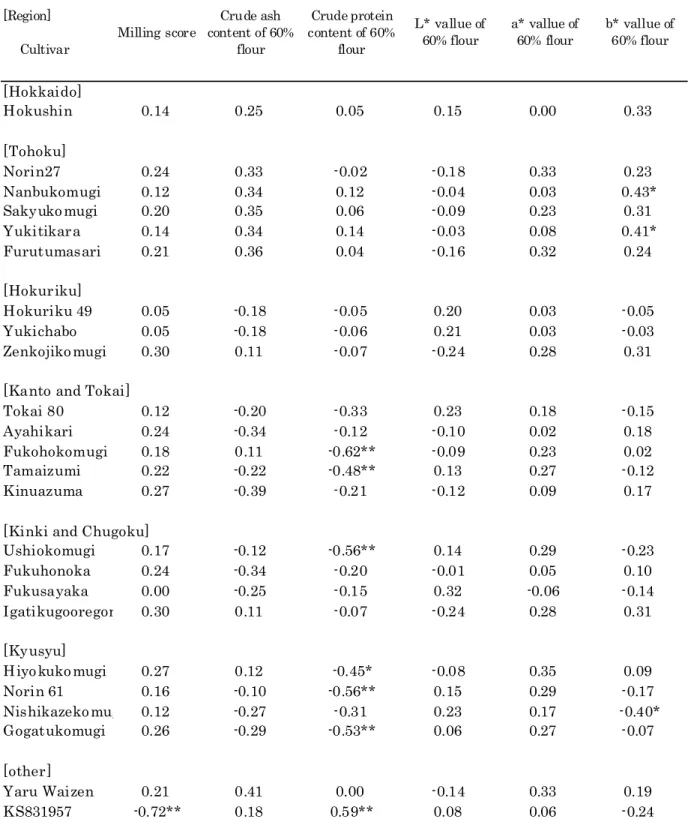
Tables 5 and 6 show the correlation of agronomic characters and flour quality with the coefficient of parentage to a specific cultivar among Tozan lines, respectively. In the tables, only the cultivars having statistically significant differences are shown.
Significant positive correlations (from 0.43 to 0.48 were found between the coefficient of) parentage and heading time in cultivars in the Tohoku region, showing that Tozan lines more related to cultivars in Tohoku region tended to be late heading. Also significant negative correlations from -0.38 to -0.45 between the coefficient of parentage and cold tolerance were found, showing
( )
that Tozan lines more related to cultivars in Tohoku region tended to be more cold-tolerant. On the other hand, significant negative correlations -0.46, -0.49 were found between the coefficient of( ) parentage and maturity data for cultivars in the Kanto region Ayahikari, Kinuazuma , showing( ) that Tozan lines more related to Ayahikari or Kinuazuma tended to be early maturing. In the same cultivars, the grade of spring habit showed a negative correlation (-0.38,-0.41), and snow mold tolerance showed a significant positive correlation 0.41,0.43 with the coefficient of parentage. A( ) significant negative correlation -0.47 with maturity data and a significant positive correlation( )
0.50 with heaving resistance were found in Gogatukomugi developed in Kyushu.
( )
Except sprouting resistance, it seems that there are no cultivars having a high performance as a cross parent in Hokuriku. However, a significant positive correlation 0.68, 0.67 was found in( ) the sprouting resistance of cultivars in Hokuriku Hokuriku 49, Yukichabo , showing that Hokuriku( ) 49 and Yukichabo had good combining ability for sprouting resistance. However, a negative
[Region] Cultivar Mean coefficient of parentage Heading time Maturity data Potential yield Cold tolerance1) Heaving resistance1) Snow mold tolerance1) Sprouting resistance2) Grade of spring habit3) [Hokkaido] Hokushin 0.031 0.39 0.25 0.16 -0.28 -0.20 -0.40* -0.07 0.27 [Tohoku] Norin27 0.105 0.46* 0.32 0.26 -0.39* -0.05 -0.30 -0.30 0.15 Nanbukomugi 0.081 0.44* 0.28 0.11 -0.38* -0.21 -0.43* -0.31 0.29 Sakyukomugi 0.075 0.48* 0.33 0.20 -0.44* -0.13 -0.41* -0.27 0.25 Yukitikara 0.051 0.43* 0.29 0.13 -0.45* -0.17 -0.47* -0.28 0.31 Furutumasari 0.029 0.46* 0.32 0.23 -0.45* -0.06 -0.36 -0.32 0.20 [Hokuriku] Hokuriku 49 0.142 -0.05 0.04 0.05 0.04 0.03 -0.10 0.68** 0.11 Yukichabo 0.114 -0.04 0.05 0.06 0.03 0.03 -0.11 0.67** 0.11 Zenkojikomugi 0.105 0.29 0.10 0.33 -0.24 0.07 -0.07 -0.35 -0.05
[Kanto and Tokai]
Tokai 80 0.194 -0.18 -0.13 0.25 0.17 0.24 0.02 0.54** 0.05
Ayahikari 0.192 -0.21 -0.46* 0.21 0.21 0.19 0.41* -0.41* -0.38*
Fukohokomugi 0.184 -0.17 -0.22 0.52** 0.44* 0.52** 0.24 0.21 -0.07
Tamaizumi 0.151 -0.32 -0.44* 0.42 0.26 0.43* 0.23 -0.16 -0.14
Kinuazuma 0.150 -0.26 -0.49** 0.31 0.24 0.30 0.43* -0.41* -0.41*
[Kinki and Chugoku]
Ushiokomugi 0.188 -0.30 -0.31 0.44* 0.27 0.48** 0.11 0.13 0.01 Fukuhonoka 0.168 -0.25 -0.50** 0.24 0.24 0.22 0.39 -0.40* -0.35 Fukusayaka 0.166 -0.29 -0.39 0.02 0.12 0.03 0.17 -0.42* -0.15 Igatikugooregon 0.105 0.29 0.10 0.33 -0.24 0.07 -0.07 -0.35 -0.05 [Kyushu] Hiyokukomugi 0.216 0.03 -0.14 0.47* 0.13 0.32 0.11 -0.15 -0.07 Norin 61 0.206 -0.27 -0.26 0.44* 0.22 0.44 0.08 0.14 0.02 Nishikazekomugi0.173 -0.37 -0.44* 0.19 0.25 0.31 0.15 -0.15 -0.03 Gogatukomugi 0.166 -0.35 -0.47* 0.49** 0.30 0.50** 0.30 -0.14 -0.21 [other] Yaru Waizen 0.04 0.50** 0.39* 0.22 -0.43* -0.10 -0.37 -0.27 0.23 KS831957 0.043 -0.15 -0.06 -0.65** 0.13 -0.36* 0.20 -0.05 -0.35
*: Significant at 5 % level. **: Significant at 1 % level. 1) 3:High, 5:Intermediate, 7:Low.
2) 3:Difficult, 5:Intermediate, 7:Easy. 3) 1:Spring habit, 5:Winter habit.
Table 5. Correlations between agronomic characters and coefficient of parentage to a specific cultivar among Tozan lines.
[Region] Cultivar Milling score Crude ash content of 60% flour Crude protein content of 60% flour L* vallue of 60% flour a* vallue of 60% flour b* vallue of 60% flour [Hokkaido] Hokushin 0.14 0.25 0.05 0.15 0.00 0.33 [Tohoku] Norin27 0.24 0.33 -0.02 -0.18 0.33 0.23 Nanbukomugi 0.12 0.34 0.12 -0.04 0.03 0.43* Sakyukomugi 0.20 0.35 0.06 -0.09 0.23 0.31 Yukitikara 0.14 0.34 0.14 -0.03 0.08 0.41* Furutumasari 0.21 0.36 0.04 -0.16 0.32 0.24 [Hokuriku] Hokuriku 49 0.05 -0.18 -0.05 0.20 0.03 -0.05 Yukichabo 0.05 -0.18 -0.06 0.21 0.03 -0.03 Zenkojikomugi 0.30 0.11 -0.07 -0.24 0.28 0.31
[Kanto and Tokai]
Tokai 80 0.12 -0.20 -0.33 0.23 0.18 -0.15
Ayahikari 0.24 -0.34 -0.12 -0.10 0.02 0.18
Fukohokomugi 0.18 0.11 -0.62** -0.09 0.23 0.02
Tamaizumi 0.22 -0.22 -0.48** 0.13 0.27 -0.12
Kinuazuma 0.27 -0.39 -0.21 -0.12 0.09 0.17
[Kinki and Chugoku]
Ushiokomugi 0.17 -0.12 -0.56** 0.14 0.29 -0.23 Fukuhonoka 0.24 -0.34 -0.20 -0.01 0.05 0.10 Fukusayaka 0.00 -0.25 -0.15 0.32 -0.06 -0.14 Igatikugooregon 0.30 0.11 -0.07 -0.24 0.28 0.31 [Kyusyu] Hiyokukomugi 0.27 0.12 -0.45* -0.08 0.35 0.09 Norin 61 0.16 -0.10 -0.56** 0.15 0.29 -0.17 Nishikazekomugi 0.12 -0.27 -0.31 0.23 0.17 -0.40* Gogatukomugi 0.26 -0.29 -0.53** 0.06 0.27 -0.07 [other] Yaru Waizen 0.21 0.41 0.00 -0.14 0.33 0.19 KS831957 -0.72** 0.18 0.59** 0.08 0.06 -0.24
*: Significant at 5 % level. **: Significant at 1 % level.
Table 6. Correlations between flour quality and coefficient of parentage to a specific cultivar among Tozan lines.
correlation (-0.41,-0.41, -0.40 and -0.42 was found for sprouting resistance in Ayahikari,) Kinuazuma, Fukuhonoka and Fukusayaka.
In Fukuhokomugi, Tamaizumi, Ushiokomugi, Hiyokukomugi, Norin 61 and Gogatukomugi, the crude protein content of the 60% flour showed a significant negative correlation, -0.62, -0.48, -0.56, -0.45, -0.56 and -0.53, respectively, though potential yield showed a significant positive correlation, 0.52, 0.42, 0.44, 0.47, 0.44 and 0.49, respectively, with the coefficient of parentage. It shows the difficulty of developing cultivars having both high yield and high quality. Though Fukuhokomugi was a high yield cultivar and often used as a cross parent average coefficient of( parentage was 0.184 , it did not produce a high protein cultivar. Only KS831957 showed a positive) correlation 0.59 for crude protein content of 60% flour. It is used extensively as a cross parent( ) recently as a strong flour wheat, but a significant negative correlation (-0.65 was found for) potential yield.
Mizuta and Yoshida 1996 showed that cultivars in Kyushu related to Asakazekomugi had( ) a low value of flour whiteness, showing that Asakazekomugi had a poor combining ability in quality though it was a high-yield cultivar and often used as a cross parent there. Cultivars related to Kanto 107 had high maximum viscosity values. Cultivars related to Siroganekomugi had a high protein content, showing that Kanto 107 and Siroganekomugi might have good combining ability for flour quality. There seems to be no cultivar of Tozan lines used extensively as a cross parent for high quality. No significant correlation with crude ash content, L* and a* value of 60% flour was found.
In general, Tozan lines related to earlier maturity cultivars had low over-wintering ability and low grade of spring habit. Tozan lines related to high potential yield cultivars had a low protein content of flour protein, and were not related to milling score. However, in comparison with cultivars developed in Kyushu, there seem to be no specific cultivars in the Tozan lines used extensively as a cross parent having significant influence to yield or flour quality as in the case of Koshihikari in rice or Harunanijo in malting barley.
The author has already developed cultivars with early maturity, high winter habit and high yield. Further efforts for developing cultivars with these characters and high over-wintering ability are necessary. Generally, it is very difficult to develop cultivars with a high protein content, early maturity and high yield. In this study, some cultivars were found to be potentially promising cross parents for high flour quality, which could be used more extensively as a cross parent.
In comparison with rice, the maximum generation traced in the pedigree and the number of ancestors in the pedigree of wheat are far smaller, though total number of ancestors in the pedigree of Tozan lines exceeded 100, showing that more aggressive and shortening of crossing interval might be necessary. In addition to the haploid breeding method, gathering a lot of major genes with high yield and high quality by conventional cross breeding method is necessary. Pedigree trees of modern cultivars are very complicated and it is almost impossible to evaluate the performance and the combining ability of the cultivar from the pedigree tree. Pedigree analysis conducted in this study could assist constructing a more reasonable strategy for developing cultivars with higher yield and higher quality.
Summary
Pedigree analysis was conducted for wheat cultivars developed at Nagano Agricultural Experiment Station Tozan lines . For a recently released Tozan line, the maximum generation( ) traced in the pedigree, total number of ancestors in the pedigree and total number of ancestors except common ones was 13, 222 and 94, respectively. Chunaga contributed 24.0 % of the genetic background of Tozan lines. Seven ancestors, collectively, contributed 51.5% to the gene pool. Hiyokukomugi had the highest mean coefficient of parentage to Tozan lines and the mean value was 0.216. Tozan lines more related to cultivars in the Tohoku region tended to be late heading and more cold-tolerant. Tozan lines more related to Ayahikari or Kinuazuma tended to be early maturing. Fukuhokomugi, which was a high yield cultivar and often used as a cross parent did not contribute to high flour protein. KS831957 showed a positive effect on the crude protein content of flour. In general, Tozan lines had no specific cultivars used extensively as a cross parent having significant influence on yield or flour quality.
Chapter 3
Hordeum
In haploid breeding method of wheat, F plants are wide-crossed with pollens of1
, maize, etc. All chromosomes of a pollen parent are eliminated during the development of
bulbosum
embryo, leaving only a haploid set of chromosomes from wheat. The haploid embryos are cultured and doubled by colchicine or other means, giving complete homozygous plants immediately, instead of several year's selfings to require for homozygosity by conventional breeding method.
In this chapter,bulbosummethod was applied.
Hordeum bulbosum
1. Utilization of Non-crossable Wheat Genotype with
( )
Intergeneric cross was applied between wheat and Hordeum bulbosum bulbosum method to a development of new cultivars. Haploid wheat is produced from the intergeneric cross between wheat and H. bulbosum (Barclay, 1975 .) H. bulbosum appears to be sensitive to the action of dominant alleles at the wheat crossability genes(Kr) (Snape et al.,1979; Sitch et al.,1985 . Though) most of the world's wheat cultivars have these alleles which reduce the frequency of fertilization in wheat x H. bulbosum, Inagaki and Snape 1986 reported that seven of eight Japanese cultivars( ) examined were crossable with H. bulbosum. Thus the author investigated whether Tozan lines had the non-crossability gene and tried to develop new cultivars with thebulbosum method.
Materials and Methods
Tozan lines, from Tozan 1 (Zenkoujikomugi to Tozan 21, were used as female male) parents in crosses. One clone H. bulbosum (2n=4X=28), that was selected from the Nagano Agricultural Experiment Station collection nursery, was used in this study as a pollen source. It was
H .
originally selected from induction number 55-347-28 of National Agriculture Research Center. bulbs were transplanted in September and the seedlings were grown for more than one
bulbosum
month in a cold chamber kept at 5-10℃ under an 8-hour photoperiod as a clone bank. Thereafter, they were vernalized in a greenhouse kept at 5-10℃ under a 12-h photoperiod under artificial light for eight weeks. Wheat seeds were seeded every other day from October to February and placed in the above greenhouse for six weeks for vernalization. These plant materials after the vernalization were grown in a greenhouse kept at a minimum temperature of 15℃ under natural day length conditions from November to March and flowering occurred after 4 to 5 weeks.
Two or three days before anthesis, the apical and basal spikelets of wheat, and all florets except for the two outermost florets on the remaining spikelets were removed, and the remaining florets were emasculated. Ten to fifteen spikes (approximately 200 florets) per replication were pollinated with fresh pollens of tetraploidH. bulbosum. These pollinated spikes with stems were cut at the middle of the third internode and covered with a vinyl bag. Leaf blades were removed. The basal part of such detached spike was put into a conical beaker filled with culture solution described below.
Spikes were cultured in the solution containing 10.0 mL L ethanol, 0.8 mL L sulfurous- 1 -1
acid (about 6% assay), 40 g L sucrose. One day after pollination, the spikes were sprayed with 75- 1
mg L gibberellic acid solution and transferred into a growth chamber controlled at 22-1 under a ℃
12-h photoperiod under artificial light. The vinyl bag was replaced by a paper bag at this time. Fourteen days after pollination, seed set was scored.
H. bulbosum
F and F seeds derived from Fukuhokomugi which has the crossability with1 2
Inagaki and Snape 1982 / Tozan non-crossable lines with and B F seeds derived
( ) H. bulbosum 1 1
from Fukuhokomugi / Tozan non-crossable lines // Fukuhokomugi were produced according to breeding program of Nagano Agricultural Experiment Station. The wheat haploids were obtained from the cross of these F and F plants with1 2 H. bulbosum.
Fourteen days after pollination with H. bulbosum, seeds were collected and surface-sterilized in a test tube with 1% sodium hypochlorite solution for 10 minutes, and then with 80% ethyl alcohol solution for one minute. The embryos were isolated from the caryopses that grew over two third of the glume length. Immature embryos were transferred on agar B medium in5
℃ plastic petri dishes. The dishes were placed in a culture cabinet with 10 hour day length at 20/15
day/night under 3000 lux light intensity. The regenerated plants were treated with colchicine
( )
solution at 4 weeks after culture.
Results and Discussion
The crossabilities of Tozan lines were shown in Table 7. Tozan 9, Tozan 10 and Tozan 14 were highly crossable and their percentage of florets from which embryo developed were 15%, 29% and 25%, respectively. Eleven Tozan lines had middle crossability from 1% to 9% . Crossability of( ) F , F and B F was shown in Table 8. Fukuhokomugi produced embryos of 19.9% per florets but1 2 1 2
Tozan 16 and Shiranekomugi Tozan 17 produced no seeds. F produced no plantlet, too. However,( ) 1
F derived from Fukuhokomugi / Tozan 16 and Fukuhokomugi / Shiranekomugi produced less2
haploid embryo than Fukuhokomugi with frequency of 10.2% and 7.2%, respectively, of florets, and seed set with frequency of 2.9% and 3.4%, respectively, of florets. B F derived from Fukuhokomugi /1 1
Tozan 16 // Fukuhokomugi and Fukuhokomugi / Shiranekomugi // Fukuhokomugi produced haploid embryo with frequency of 15.3% and 16.2%, respectively, of florets, and seed set with frequency of 7.5% and 8.4%, respectively, of florets. These results suggested that it was possible to develop new cultivars withbulbosum method.
Tozan 1 Zenkojikomugi Mutation of Igatikugooregon 6
Tozan 2 Hokuriku41/Hokuriku22 3 Tozan 3 Zenkojikomugi/Igatikugooregon 0 Tozan 4 Norin61/Mikunikomugi 1 Tozan 5 Mikunikomugi/Sirasagikomugi 0 Tozan 6 Mikunikomugi/Norin27 0 Tozan 7 Mikunikomugi/Sirasagikomugi 8 Tozan 8 Mikunikomugi/Norin27 3 Tozan 9 Hokuriku49/Sakigakekomugi 15 Tozan 10 Ridet/Norin68 29 Tozan 11 Hokuriku49/Chugoku103 9 Tozan 12 Hokuriku49/Chugoku103 2 Tozan 13 Hokuriku49/Tokai80 2 Tozan 14 Hokuriku49/Sakigakekomugi 25 Tozan 15 Hokuriku49/Chugoku103 0 Tozan 16 Hokuriku49/Tokai80 0
Tozan 17 Siranekomugi Hokuriku49/Tokai80 0
Tozan 18 Hokuriku49/Tokai80 6
Tozan 19 Mikunikomugi/Chugoku114 1
Tozan 20 Tozankeisyo47/Sakigakekomugi 0
Tozan 21 Kanto85/Tozan6 4
Table 7. Frequency of haploid embryo production in the cross Tozan limes / H. bulbosum.
Breeding lines Cultivars Cross parents
Percentage of florets with haploid embryo
Wheat No. of floretspollinated Percentage of florets from wh ich haploid plan ts developed Percen tage of florets from which
doubled h aploid seeds set (%) (%) (%) Parent Fukuh okomugi 331 66 (19.9) Tozan 16 106 0 (0) Shiran ekomugi 136 0 (0) F1
Fukuh okomugi / Tozan16 605 1 (0.2) (0.2) (0)
Fukuh okomugi / Shiranekomugi 495 0 (0) (0) (0)
F2
Fukuh okomugi / Tozan16 2143 219 (10.2) (4.0) (2.9)
Fukuh okomugi / Shiranekomugi 1384 100 (7.2) (4.0) (3.4)
B1F1
Fukuh okomugi / Tozan16
// F ukuh okomu gi 2899 444 (15.3) (7.6) (7.5)
Fukuh okomugi / Shiranekomugi
//Fuku hok omugi 3010 489 (16.2) (10.1) (8.4)
Table 8. Frequency of haploid production in the cross, wheat cu ltivars 'Fu kuhokomugi', 'Tozan 16', 'Sh iranekomu gi', F1, F2, an d B1F1 / H. bulbosum.
No. of florets with embryos formed
2. Effect of 2,4-Dichlorophenoxyacetic Acid on the Efficiency of Wheat Haploid Production
For haploid breeding, wheat plants had been pollinated with some Gramineae species: (Barclay, 1975), maize ( L.) (Laurie and Bennett, 1988), pearl millet
Hordeum bulbosum Zea mays
(Pennisetum americanum L.) (Ahmad and Comeau, 1990), teosinte (Zea mays ssp. mexicana)
(Ushiyama et al., 1991) and sorghum (Sorghum bicolorL.) (Ohkawa et al., 1992). Treatment with
H.
2,4-D at a concentration of 100 mg L increased embryo formation in crosses of wheat x-1
(Inagaki, 1986) and wheat x maize (Suenaga, 1990). However, the concentration of 2,4-D
bulbosum
suitable for embryo development and the production of haploid wheat has not been determined. The action ofKralleles cannot prevent embryo formation in the presence of 2,4-D treatment when maize is used as the male parent (Laurie and Bennett, 1987, 1988; Suenaga and Nakajima, 1989).
On the other hand, in crosses of wheat x H. bulbosum, haploid embryos were formed and developed into plants in the absence of 2,4-D although a few haploid plants if any were obtained from the crosses between wheat cultivars having Kr allele (s) (Snape et al., 1979, 1980; Sitch et al., 1985). In this section, the author describes the effects of 2,4-D on the growth of the haploid embryos and their development into plantlets inbulbosummethod.
Materials and Methods
(2n=4X=28) described in the previous section was used in this study as a
H. bulbosum
pollen source. Two Japanese wheat cultivars, Nishikazekomugi and Zenkojikomugi, were used as female parents. When these two cultivars were crossed with H. bulbosum in the absence of treatment with 2,4-D, the frequencies of plant development from the embryos markedly differed with the cultivar; 19.0% in Nishikazekomugi and 2.8% in Zenkojikomugi Ushiyama et al., 1990).(
Crosses described in the previous section were carried out three times (the first in January 1990, the second in March 1990 and the third in January 1991), except pollinated spikes were cultured in the solution containing 10.0 mL L ethanol, 0.8 mL L sulfurous acid (about 6% assay),-1 -1
40 g L sucrose and 2,4-D at 0, 25, 50, 75, 100, 125, 150, and 175 mg L .-1 -1
Embryo sizes (maximum length) were measured in the second and the third experiments. The number of plants developed was counted one month after embryo rescue.
The frequency of seed setting, embryo formation, and the percentages of embryos and florets developing into plantlets were measured in every replication. All the percentages were
calculated by arcsine square root transformation. The data were subjected to analysis of variance as the general two-factor experiment for every parameter and subjected to Duncan's multiple range tests using the result shown by the analysis of variance.
The size of the embryo at two weeks after pollination was determined and classified according to the capability of developing into a plantlet into two categories, i.e., embryos developing and those not developing into plants. Mean lengths of embryos were calculated as the average of the two replications. Embryo sizes in each category and each cultivar were subjected to one-way analysis of variance and subjected to Duncan's multiple range tests using the result of the analysis of variance. The difference between the mean lengths of embryos in the two cultivars was analyzed by the -test.t
Results
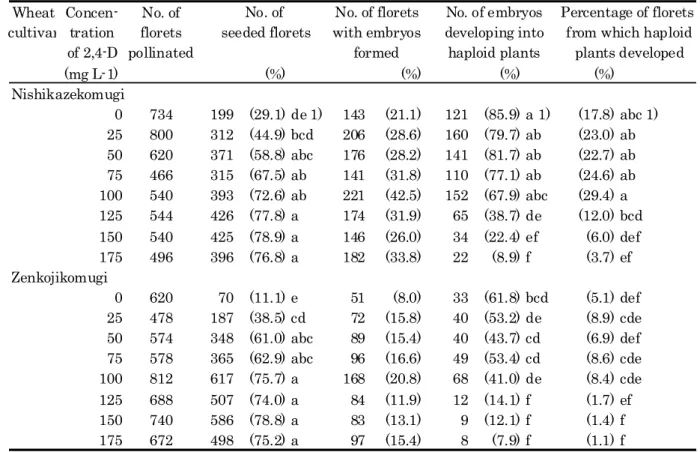
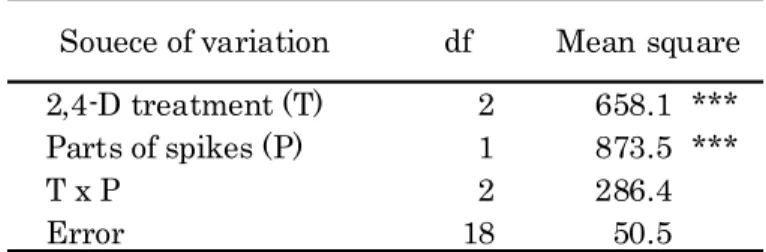
Table 9 shows the effects of the treatment with 2,4-D on haploid production in the two wheat cultivars, Nishikazekomugi and Zenkojikomugi, crossed with H. bulbosum. Table 10 shows the results of the analyses of variance.
1 Frequency of seed setting)
In the absence of 2,4-D, the percentage of seed setting in the pollinated florets was 29.1 and 11.1% in Nishikazekomugi and Zenkojikomugi, respectively, and 2.4-D treatment increased the percentage Table 9 . The analysis of variance showed a significant difference at 0.1% level among( ) the treatments with 2,4-D at various concentrations, but no significant difference between the wheat genotypes Table 10 . Analysis using Duncan's multiple range tests showed that the percentage of( ) seed setting was significantly increased by the treatment with 2,4-D at 50 mg L or higher-1
concentrations in both cultivars Table 9 .( )
In the cross of Nishikazekomugi x H. bulbosum, the percentage of seed setting was increased to 77.8% by the treatment with 125 mg L-1 2,4-D, but further increase in 2,4-D concentration had only a slight effect. In Zenkojikomugi x H. bulbosum, the percentage of seed setting was increased to 75.7% by the treatment with 2,4-D at 100 mg L 2,4-D, and further- 1
Wheat Concen- No. of cultivar tration florets
of 2,4-D pollinated (mg L-1) (%) (%) (%) (%) Nishikazekomugi 0 734 199 (29.1) de 1) 143 (21.1) 121 (85.9) a 1) (17.8) abc 1) 25 800 312 (44.9) bcd 206 (28.6) 160 (79.7) ab (23.0) ab 50 620 371 (58.8) abc 176 (28.2) 141 (81.7) ab (22.7) ab 75 466 315 (67.5) ab 141 (31.8) 110 (77.1) ab (24.6) ab 100 540 393 (72.6) ab 221 (42.5) 152 (67.9) abc (29.4) a 125 544 426 (77.8) a 174 (31.9) 65 (38.7) de (12.0) bcd 150 540 425 (78.9) a 146 (26.0) 34 (22.4) ef (6.0) def 175 496 396 (76.8) a 182 (33.8) 22 (8.9) f (3.7) ef Zenkojikomugi 0 620 70 (11.1) e 51 (8.0) 33 (61.8) bcd (5.1) def 25 478 187 (38.5) cd 72 (15.8) 40 (53.2) de (8.9) cde 50 574 348 (61.0) abc 89 (15.4) 40 (43.7) cd (6.9) def 75 578 365 (62.9) abc 96 (16.6) 49 (53.4) cd (8.6) cde 100 812 617 (75.7) a 168 (20.8) 68 (41.0) de (8.4) cde 125 688 507 (74.0) a 84 (11.9) 12 (14.1) f (1.7) ef 150 740 586 (78.8) a 83 (13.1) 9 (12.1) f (1.4) f 175 672 498 (75.2) a 97 (15.4) 8 (7.9) f (1.1) f
1) Percentages followed by same letters in each column are not significantly different
at the 5% probability level by Duncan's multiple range test with arcsine transformed data . Table 9. Frequency of haploid production in the cross, wheat cultivars 'Nishikazekomugi' and 'Zenkojikomugi' x H. bulbosum after treatment with 2,4-D at various concentrations.
Percentage of florets from which haploid No. of seeded florets plants developed formed No. of embryos developing into haploid plants No. of florets with embryos Source of df variation 2,4-D treatments 7 1027.646 *** 75.923 1727.536 *** 252.023 ** Wheat cultivars 1 80.920 1493.078 *** 2326.353 *** 1473.831 *** Interactions 7 34.587 7.102 86.004 24.509 Error 32 92.533 41.605 52.636 25.740
Frequencies(%) are calculated after transformed to angles.
** and *** indicate significant difference at the 1% and 0.1% level of probability, respectively. Mean square Percentage of embryos developing into plants Mean Mean square Percentage of seed setting Mean square square Percentage of embryo formation
Table 10. Analysis of variance for the frequency of haploid production in two wheat cultivars /
H. bulbosum
.Percentage of florets developing into haploid plants
2 Frequency of embryo formation)
The percentage of florets that formed embryos was significantly higher in Nishikazekomugi than in Zenkojikomugi p 0.001( < ) (Tables 9 and 10 . On the other hand, the difference in the) frequencies of embryo formation among the 2,4-D treatments at various concentrations was not significant. The highest percentage of embryo formation was observed in the florets on the spikes treated with 100 mg L 2,4-D in both cultivars-1 42.5% in Nishikazekomugi and 20.8% in
(
Zenkojikomugi and the percentage tended to decrease at higher concentrations of 2,4-D Table 9 .) ( ) 3 Frequency of plant development)
Significant variation at the 0.1% level in the percentage of embryos developing into plantlets was observed among the 2,4-D treatments at various concentrations Table 10 . The( ) percentage in the absence of 2,4-D was 85.9% in Nishikazekomugi and 61.8% in Zenkojikomugi, and the percentage tended to decrease as the concentration of 2,4-D increased Table 9 . When the( ) concentration of 2,4-D was increased from 100 to 175 mg L , the percentage of embryos developing-1
into plantlets markedly decreased from 67.9% to 8.9% in Nishikazekomugi and from 41.0% to 7.9% in Zenkojikomugi.
The percentage of florets developing into plantlets significantly varied with the concentration of 2,4-D, at 0.1% level Table 10 . The percentage was slightly increased by the( ) treatment with 100 mg L 2,4-D, from 17.8 to 29.4% in Nishikazekomugi and from 5.1 to 8.4% in-1
Zenkojikomugi. However, the treatment with 2,4-D at 125 mg L-1 or higher concentrations significantly decreased the percentage of florets developing into plantlets.
The percentages of embryos and florets developing into plantlets were significantly higher in Nishikazekomugi than in Zenkojikomugi p 0.001( < ) (Table 10 . Duncan's multiple range tests) showed that the percentage of embryos or florets developing into plantlets was significantly higher in Nishikazekomugi than in Zenkojikomugi after the treatment with 2,4-D at the concentrations lower than 125 mg L .-1
4 Embryo size)
Table 11 shows the relationship between the size and the ability to develop into plantlets of embryos. Analysis of variance for the size of embryo developing and not developing into plantlets in Nishikazekomugi showed significant difference among 2,4-D treatments at various concentrations M.S. = 22.66, p 0.001 and M.S.=5.40, p <0.001). There were also significant differences in embryo
size among 2,4-D treatments in Zenkojikomugi (for embryos developing into plants, M.S.=3.89, p <0.01, and for those not developing into plants, M.S.=10.63, p <0.01).
Embryos developing Embryos not developing
Concentration into plants into plants
of 2,4-D Number Mean Number Mean
of length of length
(mg L-1) embryos (a) (mm) embryos (b) (mm) Nishikazekomugi 0 81 1.87 a 1) 13 1.36 a 1) *** 25 111 1.82 a 13 1.26 ab *** 50 87 1.46 c 14 1.28 ab * 75 77 1.53 b 18 1.42 a 100 92 1.45 cd 49 1.11 bc *** 125 41 1.30 d 54 1.10 bc * 150 30 1.45 cd 96 1.14 bc *** 175 22 1.21 e 139 1.04 d *** Zenkojikomugi 0 10 1.61 a 12 1.32 bc * 25 19 1.62 a 20 1.54 a 50 29 1.48 ab 34 1.39 ab 75 35 1.24 bc 21 1.18 cd 100 48 1.26 bc 75 1.13 de * 125 10 0.94 c 59 1.00 de 150 6 1.18 bc 60 0.97 e 175 3 1.04 c 57 0.93 e
*,** and *** indicate significant differences between (a)and (b) at the 5%,1% and 0.1% levels of probability, respectively by t-test between two wheat cultivars at every concentration. 1) Values followed by same letters in each column and each wheat cultivar are not significantly different at the 5% level of probability by Duncan's multiple range test.
Analysis of variance for the size of embryos developing into plants : M.S.=3.24(7df), V.R.=24.96, p<0.001.
Analysis of variance for the size of embryos not developing into plants: M.S.=0.56(7df), V.R.=5.19, p<0.001.
Table 11. Mean length of embryos in two wheat cultivars at two weeks after pollination with H. bulbosum.
Wheat cultivar
Duncan's multiple range tests showed that the sizes of embryos developing into plantlets in the florets treated with 2,4-D at the concentration above 50 mg L in Nishikazekomugi and above 75- 1
mg L in Zenkojikomugi were smaller (p <0.05) than those without 2,4-D treatment; 1.87 mm and-1
1.61 mm in Nishikazekomugi and Zenkojikomugi, respectively. The treatment with 2,4-D at a concentration above 75 mg L also reduced the sizes of embryos not developing into plants.-1
In Nishikazekomugi, the size of embryos developing into plants was significantly larger than that of embryos not developing into plants except for the florets on the spikes treated with 75 mg L 2,4-D. On the other hand, in Zenkojikomugi, there was no difference in size between embryos-1
developing and not developing into plants, except for those formed on the spikes treated with 0 (control) and 100 mg L 2,4-D.-1
Discussion
Marshall et al.(1983) indicated that application of 2,4-D to ovules increased ovule size in wheat (cv. Cook). Inagaki (1986) showed that the injection of 100 mg L 2,4-D into the culm-1
internode significantly increased the frequencies of seed setting in the crosses of two wheat cultivars (Fukuhokomugi and Haruhikari) with H. bulbosum. In the present study, the treatment with 2,4-D at 50 mg L to 175 mg L increased the percentage of seed setting.-1 -1
Thus, it is clear that seed setting is promoted by treating spikes with 2,4-D. The two wheat cultivars, Nishikazekomugi and Zenkojikomugi, used in this work did not show significant differences in the frequency of seed setting at all 2,4-D concentrations tested. On the other hand, Inagaki (1986) indicated that the frequency of seed setting in Fukuhokomugi (87.9%) was much higher than that in Haruhikari (2.5 %) when crossed with H. bulbosum. This discrepancy may be due to the difference in the method of treatment with 2,4-D and/or in the wheat cultivars.
Inagaki 1986 reported that the treatment with 100 mg L 2,4-D significantly increased( ) -1
H.
the frequency of embryo formation in the cross of a crossable cultivar Fukuhokomugi with , but only slightly in the cross of non-crossable cultivar Haruhikari with . In
bulbosum H. bulbosum
the present experiment, although there were no significant differences among the frequencies of embryo formation in the florets treated with various concentrations of 2,4-D, the highest frequency was observed by the treatment with 2,4-D at 100 mg L .-1
two wheat cultivars crossed with H. bulbosum in the percentage of embryos developing into plantlets. Therefore, it is likely that embryo formation was stimulated by 2,4-D treatment through increased number of seeds. In addition, Suenaga 1990 showed that treatment with 10 and 1000( ) mg L 2,4-D affected the frequency of embryo formation only slightly but that with 100 mg L 2,4-D-1 -1
greatly increased the frequency, in wheat x maize crosses.
Furusho et al. 1991 reported that 2,4-D at 75 mg L was most effective for obtaining the( ) -1
embryos and plantlets, and that of 50 mg L and 100 mg L was less effective. In previous reports,- 1 - 1
it was not stated whether or not the treatment with 2,4-D had significant effect on the development of haploid wheat embryos into plantlets. In the present work, however, the treatment with 2,4-D at higher than 125 mg L clearly reduced the percentage of embryos developing into plantlets,-1
although the effect of 2,4-D at a concentration below 100 mg L was not significant.-1
Inagaki (1985 reported that the optimum size of wheat haploid embryo for plant) development was 1.4 mm in length at two weeks after pollination , and 96.6% of such embryos( ) developed into plantlets at three weeks after pollination in the absence of 2,4-D. When the embryo size became larger 2.28 mm , the frequency of plant development was lower 16.6% . Sitch and( ) ( ) Snape 1986b reported that embryos developing into haploid plantlets in the absence of 2,4-D were( ) 1.19 mm in length on the average, and those failed to develop into plantlets and those formed calli were 0.61 and 0.67 mm in mean length, respectively.
In the present investigation, the embryos including those capable and incapable of developing into plantlets had a mean length between 1.87 and 0.93 mm, which were smaller than the overgrowing embryos 2.28 mm( ) (Inagaki 1985 and larger than the embryos immature for the) embryo culture 0.61 or 0.67 mm( ) (Sitch and Snape, 1986b . Therefore, the treatment with 2,4-D is) considered to inhibit the growth of embryos.
In conclusion, above three factors (frequency of seed setting, embryo formation and development of embryo into plantlets play important roles in the production of haploid plants. The) examination of these factors is indispensable to plan the DH production for wheat breeding. Although it is not known whether or not 2,4-D treatment has an effect on the crossabilities in intergeneric crosses between wheat and H. bulbosum, this study revealed that 2,4-D treatment at the concentration of 100 mg L or lower had a promotive effect on the wheat haploid production.-1