DOCTORAL THESIS
Study on Preparation and Characterization of New
Bismuth
Oxides by Hydrothermal Reactions
By
Md Saiduzzaman
A DISSERTATION
Presented to the Faculty of the Graduate School of
Engineering
University of Yamanashi, Japan
In Partial Fulfillment of the Requirements for the Degree of
DOCTOR OF ENGINEERING
University of Yamanashi
September 2019
Study on Preparation and Characterization of New
Bismuth
Oxides by Hydrothermal Reactions
APPROVED BY
SUPERVISING COMMITTEE:
i
Acknowledgements
First and foremost, I would like to express my sincere gratitude to my advisor Prof. Nobuhiro Kumada, who gave me opportunity as a part of their research group. My heartfelt gratitude to him for his neverending supports of my Ph.D. study and related research, for his patience, motivation, immense knowledge and dynamic guidance.His guidance helped me in all the time of research and writing of this thesis. The author would like to express thanks and sincere gratitude to Professor Takahiro Takei and Dr. Sayaka Yanagida for their experimental help and valuable advices during the research work.
Next, I would like to convey my sincere gratitude to Professor Satoshi Wada and Professor Isao Tanaka for their kind advices and honest comments during my preliminary presentation phase. This work also involved several collaborations which were concluded by some of the reported results. I would therefore like to acknowledge my indebtedness to Professor Masaki Azuma, Professor Yoshihiro Kuroiwa, Professor Chikako Moriyoshi, and Dr. Hena Das for providing experimental facilities and their precious advices and explanations on the research data.
I would also like to express sincere gratitude to all the professors associated with Center for Crystal Science and Technology of the University of Yamanashi. Thanks and gratitude to all students who studied in my group and in this research center since 2016 to till date for their help and assistance in many ways regarding the research work to personal dealings. Especially to my tutor Mr. Yamamoto Yo.
Biggest thanks to the “MEXT Program” supported by the Ministry of Education, Culture, Sports, Science and Technology, Japan for providing financial support.
ii
Last but not least, my deepest gratitude goes to my beloved parents Md Abdul Hafiz Ferdous, Shamsun Nahar and my M.Sc. supervisor Md Asadul Hoque as well as to all my families and friends for their endless love, prayers, and encouragement.
Abstract
Beside searching for new materials, new processes for material preparation and synthesis also is an important part. Among the various synthesis methods, hydrothermal reaction is a lowenergy consumption with effective and environmentally friendly method. It possesses some advantages such as fast reaction time, effective control of particle shape and size, low incorporation of impurities into the compounds or particles. In the hydrothermal synthesis the crystal size, morphology, and agglomeration of ceramic oxides can be controlled by adjusting the ratio of starting materials, pH of the reaction system, time, and temperature of the reactions.
In this research two new pyrochloretype and one highly crystalline pentavlent bismuthates were synthesized by hydrothermal reactions. Many pentavalent bismuthates were hydrothermally synthesized by using NaBiO3.nH2O as starting material. However, the accurate crystal structure of
this starting compound was unknown for a long time. In the year 1955 Bengt Aurivillius proposed that NaBiO3.nH2O possessed hexagonal crystal structure from Xray diffraction with lattice
parameter a = 5.605 Å, c = 7.425 Å and space group P3 (143).
In my first study, the crystal structure of NaBiO3.nH2O was successfully determined as trigonal
unit cell (space group 3 ) using synchrotron Xray diffraction. The dehydration process of NaBiO3.nH2O to NaBiO3 was clearly understood. During dehydration a intermediate phase was
observed. Both compounds exhibited similar photocatalytic activity for phenol degradation due to the almost similar band gap and same type of sp hybridization between Bi 6s and O 2p.
iii
In the second study, two new pyrochloretype Ca2Bi2O7 and Sr2Bi2O7 were synthesized by
hydrothermal reactions. These two compounds are the first example of pyrochloretype compound, where only Bi5+ occupies in the B site. The crystal structures of these compounds were refined
using synchrotron powder Xray diffraction data. The cell parameters were found to be a = 10.75021 (5) Å and 10.94132 (6) Å for Ca2Bi2O7 and Sr2Bi2O7, respectively. Density functional
theory calculations showed the metallic band structure, but the negligible mixing of O2 2p bands with the Asite alkalineearthmetal states and weak overlap with the conduction bands result in the semiconducting behavior. Both compound did not exhibit photocatalytic activity but adsorption.
Finally, high crystalline BaBi2O6 was prepared by hydrothermal reactions using NaBiO3.nH2O and
Ba(OH).8H
2O as starting materials. Previously BaCl2.8H2O was used instead of Ba(OH).8H2O
which produced low crystalline of BaBi2O6 due to the low solubility. The photocatalytic activity
for phenol degradation of BaBi2O6 and NaBiO3 were similar due to almost similar and gap and
iv
Contents
List of Tables………..vi
List of Figures…...………..vi
Chapter 1 INTRODUCTION...Page no. 1.1 Hydrothermal synthesis…...1
1.2 Crystal structure of pentavalet bismuthates...7
REFERENCES………..12
Chapter 2 Crystal Structure, Thermal Behavior, and Photocatalytic Activity of NaBiO3.nH2O 2.1 Introduction...17
2.2 Experimental Section...18
2.3 Results and discussion…...19
2.4 Conclusions………...29
REFERENCES...30
Chapter 3 Hydrothermal Synthesis of New PyrochloreType Pentavalent Bismuthates Ca2Bi2O7 and Sr2Bi2O7 2.1 Introduction...35
2.2 Experimental Section...36
2.3 Results and discussion…...38
2.4 Conclusions………...54
REFERENCES...55
Chapter 4 Hydrothermal Synthesis, Crystal Structure, and VisibleRegion Photocatalytic Activity of BaBi2O6 2.1 Introduction...62
v
2.3 Results and discussion…...64
2.4 Conclusions………...71
REFERENCES...73
Chapter 5 Summery and Prospects...76
vi
List of Tables
Table 1-1 Synthesis conditions, crystal structure, refinement data of pentavalent bismuthates
synthesized by hydrothermal methods. 9
Table 2-1: Crystal data for NaBiO3.nH2O. 20
Table 2-2 Structural parameters and bond valence sum of NaBiO3.nH2O. 21
Table 2-3 Selected interatomic distances (Å) for NaBiO3.nH2O. 21
Table 3-1 Rietveld Refinement crystal data for Ca2Bi2O7 using Synchrotron Radiation. 42
Table 3-2 Structural parameters for Ca2Bi2O7. 43
Table 3-3 Rietveld Refinement crystal data for Sr2Bi2O7 using Synchrotron Radiation. 43
Table 3-4 Structural parameters for Sr2Bi2O7. 43
Table 4-1 Rietveld Refinement crystal data for BaBi2O6 using Synchrotron Radiation. 66
Table 4-2 Atomic Coordinates, Occupancies and Isotropic displacement parameters as determined by Rietveld Refinement of Synchrotron Xray Diffraction Data for BaBi2O6. 66
List of Figures
Figure 1.1 Application fields of hydrothermal method. 2Figure 1.2 Schematic of hydrothermal method equipment. 3
vii
Figure 1.4 Phase diagram of water. 5
Figure 1.5 Volume (density) / temperature dependence of water. 5
Figure 1.6 Variation of dielectric constant of water with temperature and pressure. 6
Figure 1.7 Pressure/temperature relation of water for different degrees of reaction vessel filling. 7 Figure 1.8 Crystal structure of various pentavalent bismuthates. MgBi2O6 withtrirutiletype (a), LiBiO3 with LiSbO3related structure (b), AgBiO3 with ilmenitetype (c), SrBi2O6 with PbSb2O6 type structure (d). CdBi2O6 with MnSb2O6type structure (e), □ )( ) ( ) with pyrochloretype structure (f). 9
Figure 1.9 Crystal structure of dehydrate phase of NaBiO3 as ilmenite structure. 10
Figure 2.1. Crystal structure of dehydrate phase of NaBiO3 as ilmenite structure. 18
Figure 2.2 Rietveld refinement patterns from the synchrotron powder diffraction data for NaBiO3.nH2O. The markers and solid lines denote the experimental and calculated profiles, respectively. In the middle portion, the short vertical lines denote the positions of possible Bragg reflections. 20
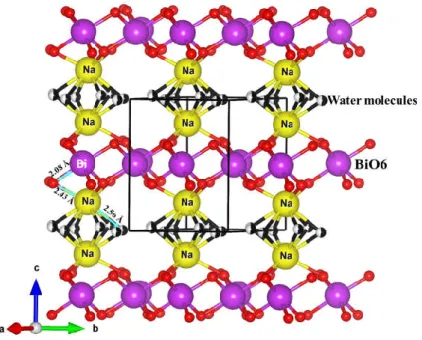
Figure 2.3 NaBiO3.nH2O crystal structure and average bond lengths between elements. 22
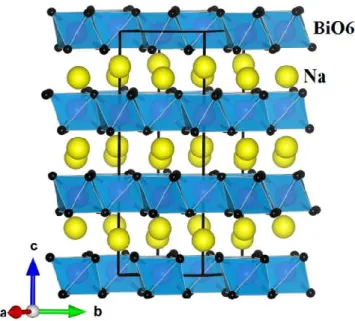
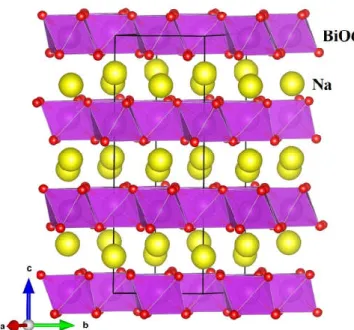
Figure 2.4 Crystal structure of NaBiO3.nH2O (a) and NaBiO3 (b) along the c axis. 22
Figure 2.5 TGDTA curve of NaBiO3.nH2O up to 500 °C. 24
viii
Figure 2.7 SPXRD patterns of NaBiO3.nH2O show removal of crystal water by the absence of
peak around 2θ = 3.2o at above175oC. 25
Figure 2.8 Crystal structure transformation from the hydrated to the dehydrated phase of NaBiO3.
25
Figure 2.9 SPXRD patterns of NaBiO3.nH2O at various temperatures. 26
Figure 2.10 UVVis absorption spectra for NaBiO3.nH2O and NaBiO3. 27
Figure 2.11 Tauc plot for the estimation of the band gap for NaBiO3.nH2O and NaBiO3. 27
Figure 2.12 Time dependence of the photocatalytic degradation of phenol using NaBiO3 and
NaBiO3.nH2O. 28
Figure 2.13 DOS curves simulated by firstprinciple DFT calculations for NaBiO3 (a) and
NaBiO3.nH2O (b). 29
Figure 3.1 XRD patterns of Ca2Bi2O7 and Sr2Bi2O7 at 80 ºC, 48 hours. 38
Figure 3.2 XRD patterns of starting materials with various reaction times for Sr2Bi2O7 at 80 ºC.
39
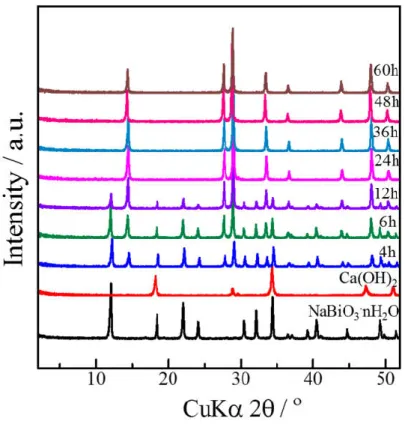
Figure 3.3 XRD patterns of starting materials with various reaction times for Ca2Bi2O7 at 80 ºC.
39
Figure 3.4 Scanning electron micrograph of Ca2Bi2O7 (a) and Sr2Bi2O7 (b). 40
Figure 3.5. Rietveld refinement patterns from the synchrotron powder diffraction data for
ix
profiles, respectively. In the middle portion, the short vertical lines denote the positions of possible
Bragg reflections. 41
Figure 3.6. Unit cell volume vs the sum of ionic radii of A and B cations for and pyrochloretype structures. 42
Figure 3.7 Unit cell of Ca2Bi2O7 (a) and Sr2Bi2O7 (b). 44
Figure 3.8 Polyhedral structures of Ca2Bi2O7 (a) and Sr2Bi2O7 (b). 45
Figure 3.9 TGDTA curves of hydrothermally prepared Ca2Bi2O7 (a) and Sr2Bi2O7 (b) at 80 ºC. 46
Figure 3.10 Temperature dependent gas evolved measurement by TGMS of Ca2Bi2O7 and Sr2Bi2O7 in a steam of He. 47
Figure 3.11 XRD patterns before and after 600 ºC of Ca2Bi2O7 (a) and Sr2Bi2O7 (b). 47
Figure 3.12 UV−vis. absorption spectra of Ca2Bi2O7 and Sr2Bi2O7. 48
Figure 3.13 Tauc plot for the estimation of the band gap for Ca2Bi2O7 and Sr2Bi2O7. 48
Figure 3.14 Calculated density of states (DOS) for Ca2Bi2O7 (a) and Sr2Bi2O7 (b) using HSE06 functional. 50
Figure 3.15 Calculated density of states (DOS) for Ca2Bi2O7 (a) and Sr2Bi2O7 (b) using GGA PBE functional. 51
Figure 3.16 Calculated electron localization function (ELF) for Ca2Bi2O7 (a) and Sr2Bi2O7 (b) projected on the (101) plane. 52
x
Figure 3.17 Temperature dependence of resistivity of Ca2Bi2O7 (a)and Sr2Bi2O7 (b) between 1.8
K to 300 K. 53
Figure 3.18 Temperature dependent magnetic susceptibility of Ca2Bi2O7 and Sr2Bi2O7 between 2
K to 400 K. 54
Figure 4.1 XRD patterns low crystalline (a) and high crystalline BaBi2O6 sample. 64
Figure 4.2 Figure 4.2 XRD patterns of starting materials with various reaction times for BaBi2O6 at 120
ºC.
65
Figure 4.3 Resultant Rietveld refinement pattern from the synchrotron powder diffraction data for
BaBi2O6. The markers and solid lines are for the experimental and calculated profiles, respectively.
In the middle portion, the short vertical lines denote the positions of possible Bragg reflections. 65
Figure 4.4 Crystal structure of BaBi2O6. Alternative layers (a) and hexagonal tunnel (b). 67
Figure 4.5 TGDTA curve of hydrothermally prepared BaBi2O6 sample at 120 °C. 68
Figure 4.6 UV−Vis absorption spectra for NaBiO3, BaBi2O6, PbSb2O6 and BaSb2O6. 68
Figure 4.7 Tauc plot for the estimation of the band gap for BaBi2O6, NaBiO3, PbSb2O6 and
BaSb2O6. 69
Figure 4.8 Time dependence of photocatalytic degradation of phenol under visible radiation (λ >
420 nm) for BaBi2O6. 70
Figure 4.9 Time dependence of photocatalytic degradation of phenol under UVVis irradiation for
xi
Figure 4.10 DOS curves simulated by firstprinciple DFT calculation for BaBi2O6 (a), NaBiO3 (b),
1 | P a g e
Chapter 1
Introduction
1.1 Hydrothermal Synthesis
During the process of continuous development of materials science, the research and development of new processes for material preparation and synthesis has always been an important part. For a long time, researchers have been searching for a material synthesis method with limited pollution, easy operation, excellent product performance, and low production cost.1–3 Liquid phase synthesis methods (hydrothermal, precipitation, colloidal, solgel) could
offers these above mentioned advantages over conventional synthesis methods. Control of the particle size, purity, and morphology of powder is very difficult using the solid phase method.4– 8 However, liquid phase methods are convenient operation, simple synthesis process, and
controllable particle size.In case of hydrothermal synthesis, the crystal size, morphology, and agglomeration of ceramic oxides can be controlled by adjusting the ratio of starting materials, pH of the reaction system, time, and temperature of the reactions.916 It is a technologically
important method for the synthesis of new materials with useful properties such as photocatalysts,916 thermoelectric,17 conducting,18 superconducting,1922 magnetic,23 dielectic,24
photovoltaic.25
The Hydrothermal Technique has been gathering interest from scientists and technologists of different branches of science and technology, covering a range of fields, such as materials science, earth science, metallurgy, physics, chemistry, biology, etc. (Figure 1.1).
2 | P a g e
The word “hydrothermal” has geological origin. A selfexplanatory word, “hydro” meaning water and “thermal” meaning heat. British Geologist, Sir Roderick Murchison (1792– 1871) was the first to use this word, to describe the action of water at elevated temperature and pressure in bringing about changes in the earth’s crust leading to the formation of various rocks and minerals.26 There is also a lot of confusion associated with the term hydrothermal. Instead
of the word “hydrothermal” chemists prefer the term solvothermal meaning any chemical reaction. Most of the solvothermal processes are carried out in water, thus the processes are termed hydrothermal. There are different definitions proposed by various scientists for hydrothermal method in literature. In 1913 Morey and Niggli defined27 hydrothermal synthesis
as “In the hydrothermal method the components are subjected to the action of water, at temperatures generally near though often considerably above the critical temperature of water (~370°C) in closed bombs, and therefore, under the corresponding high pressures developed by such solutions.” Also, according to Byrappa (1992) defines hydrothermal synthesis as any heterogenous reaction in an aqueous media carried out above room temperature and at pressure greater than 1 atm.28 On the other hand according to Roy (1994) hydrothermal synthesis
involves water as a catalyst and occasionally as a component of solid phases in the synthesis at
3 | P a g e
elevated temperature (>100°C) and pressure (greater than a few atmospheres).29 Yoshimura
(1994) proposed the following definition: reactions occurring under the conditions of high temperature–highpressure (>100°C, >1 atm) in aqueous solutions in a closed system.30 All
definitions include lower limit for the temperature and pressure but there is no exact value for this conditions. The majority of the authors fix the hydrothermal synthesis, for example, at above 100 °C temperature and above 1 atm. But, due to the vast number of publications under mild hydrothermal conditions, Byrappa and Yoshimura (2001)31 again proposed to define
hydrothermal reaction as “any heterogenous chemical reaction in the presence of a solvent (whether aqueous or nonaqueous) above room temperature and at pressure greater than 1 atm in a closed system.”
Thus, hydrothermal method refers to the use of an aqueous solution as a reaction system in a special closed reaction vessel (Figure 1.2) to create a hightemperature, highpressure reaction environment by heating the reaction system and pressurizing it (or the vapor pressure generated by itself). The general preparation steps of the hydrothermal method are shown in
Figure 1.3.
4 | P a g e
Water is used in hydrothermal synthesis and it is one of the most important solvent present in nature in abundant amount and has remarkable properties as a reaction medium under hydrothermal conditions.One of the biggest advantages of using water is the environmental benefit and cheaper than other solvents, and it can act as a catalyst for the formation of desired materials by tuning the temperature and the pressure. It is nontoxic, nonflammable, noncarcinogenic, nonmutagenic, and thermodynamically stable. Another advantage is that water is very volatile, so it can be removed from the product very easily.32 The water is utilized
under pressure and at elevated temperature above its boiling point to speed up the reaction between the solid particles in a closed system. The critical temperature and pressure of water are 374 ºC and 218 atm and the solvent properties for supercritical water (dielectric constant and solubility) changes rather than the properties of water under normal conditions which is shown in Figure 1.4. Water is defined as being supercritical if it is at conditions above its
5 | P a g e
Figure 1.4 Phase diagram of water.34
critical temperature and pressure. It exhibits unique properties, especially under supercritical conditions.33 At supercritical conditions superfluid is formed which is neither a liquid nor gas
above its critical point, and both phases become indistinguishable having properties between a gas and liquid. With increasing temperature, the liquid form becomes less dense because of thermal expansion and at the same time the gas form becomes denser. At the critical point Tc,
both phases coexist in equilibrium and one density as shown in Figure 1.5.
6 | P a g e
The dielectric constant of water is 78 at room temperature, so polar inorganic salts can be soluble in water at this temperature. The density and dielectric constant of water decrease when temperature increases and pressure decreases as shown in Figure 1.6. The dielectric constant of supercritical water is below 10, so the addition of the dielectric constant to the reaction rates becomes remarkable in terms of the electrostatic theory. So that, a favorable reaction field for particle formation was given by water under supercritical conditions.
Hydrothermal synthesis takes place in closed vessel whose pressure is determined by the temperature and the degree of filling in most of the experiments. A detailed study of pressuretemperature behavior of water was reported by Laudise.37 At 32% filling, the water
will expand to fill the autoclave at the critical temperature. At higher filling degrees, the water will expand to fill the autoclave at temperatures below the critical temperature shown in Figure
1.7. This will result in a steep increase in the pressure inside the autoclave, due to differences
in compressibility of gas and liquid.37
7 | P a g e
1.2 Crystal structure of Pentavalent Bismuthates
Bismuth based oxides can possess trivalent bismuth (Bi3+) or pentavalent bismth (Bi5+)
or mixed valent of bismth (Bi3+/ Bi5+). Previously, Kumada et al. hydrothemally synthesized
the first pentavalent bismuthate was LiBiO3.38 After that he successfully prepared many
pentavalent bismuthates AgBiO3, MgBi2O6, ZnBi2O6, BaBi2O6, SrBi2O6, PbBi2O6, CaBi2O6,
CdBi2O6 by hydrothermal reactions.3944 These pentavalent bismuthates never obtained by solid
state reactions due to instability of Bi5+ at high temperatures. Besides, pentavalent bismuthates
he prepared trivalent bismuth oxides (Bi2O3, HBi3(CrO4)2O3, Bi8(CrO4)O11, Bi3.33(VO4)2O2,
(Ln,Bi)OOH (Ln = La, Nd)),4550 as well as mixed valence state (Bi3+/Bi5+) compounds
(( Ca/Sr Bi □ )(Bi Bi ) O (CO ) , Bi2O4, (Ba0.75K0.14H0.11)BiO3·nH2O,
(Na0.25K0.45)(Ba1.00)3(Bi1.00)4O12, (K1.00)(Ba1.00)3(Bi0.89Na0.11)4O12, (Ba0.82K0.18)(Bi0.53 Pb0.47)O3,
(Ba0.62K0.38)(Bi0.92Mg0.08)O3).1922,5153
Kumada et al. tried to synthesized pyrochloretype pentavalent bismuthates of alkaline earth elements (Ca, Sr) having only Bi5+, however he was not successfully prepared instead of he
8 | P a g e
prepared mixed valent state pyrochloretype bismuthates ( Ca/ Sr Bi □ )(Bi Bi ) O (CO )).51
Interestingly, pentavalent bismuthates possessed different types of crystal structures for example LiSbO3related structure,38 ilmenitetype,39 trirutiletype,40 PbSb2O6type structure,42 43 MnSb
2O6type structure44 and pyrochloretype51 as shown in Figure 1.8. Synthesis
conditions, crystal structure, refinement data of pentavalent bismuthates synthesized by hydrothermal methods shown in Table 1-1.
9 | P a g e
Figure 1.8 Crystal structure of various pentavalent bismuthates. MgBi2O6 withtrirutiletype (a), LiBiO3
with LiSbO3related structure (b), AgBiO3 with ilmenitetype (c), SrBi2O6 with PbSb2O6type structure (d).
CdBi2O6 with MnSb2O6type structure (e), □ )( ) ( ) with
pyrochloretype structure (f). Starting materials Molar ratio Water volume Synthesis temp. Synthesi s time Product Chemical composition Crystal structure Refinement data NaBiO3.nH2O + LiOH 1 : 4 30 ml 120 ºC 2d LiBiO3 LiSbO3 type Neutron Diffraction NaBiO3.nH2O + MgCl2 1 : 4 30 ml 120 ºC 2d MgBi2O6 PbSb2O6 type Neutron Diffraction NaBiO3.nH2O + Zn(NO3)2 1 : 1 30 ml 90 ºC 2d ZnBi2O6 PbSb2O6 type NaBiO3.nH2O + AgNO3 1 : 2 30 ml 70 ºC 1d ABiO3 Ilminite type Neutron Diffraction NaBiO3.nH2O + SrCl2 1 : 4 30 ml 90 ºC 7d SrBi2O6 PbSb2O6 type Neutron Diffraction NaBiO3.nH2O + Cd(NO3)2 1 : 2 30 ml 110 ºC 4d CdBi2O6 MnSb2O6 type Neutron Diffraction Table 1-1 Synthesis conditions, crystal structure, refinement data of pentavalent bismuthates synthesized by hydrothermal methods.
10 | P a g e
All these trivalent (Bi3+),4550 pentavalent (Bi5+)3844 and mixed valent (Bi3+/Bi5+)
compounds19,21,5153 were hydrothermally synthesized by using NaBiO
3.nH2O as the starting
material. Unfortunately, its precise crystal structure was unknown for the long time. However, Bengt Aurivillius55 proposed that NaBiO
3.nH2O possessed hexagonal crystal structure from X
ray diffraction with lattice parameter a = 5.605 Å, c = 7.425 Å and space group P3 (143). While, dehydrate phase NaBiO3 crystal structure was precisely determined by neutron Xray
diffraction as illuminate phase37 shown in Figure 1.9. We successfully determined the crystal
structure of NaBiO3.nH2O. Which we will described in chapter 2.
In our research for the first time we have synthesized two new pyrochloretype alkaline earth bismuthates (Ca2Bi2O7 and Sr2Bi2O7), where Bsite of pyrochlore possessed only Bi5+.
Details investigation of crystal structure and properties of both pyrochloretype (Ca2Bi2O7 and
Sr2Bi2O7) compounds describe in chapter 3.
We also synthesized highly crystalline BaBi2O6 sample, whereas previously BaBi2O6 was
synthesized with low crystallinity.41 Crystal structure and properties of this highly crystalline
BaBi2O6 sample were described in chapter 4. Crystal structure of these three pentavalent
11 | P a g e
bismuthates (Ca2Bi2O7, Sr2Bi2O7, BaBi2O6) were refined from the synchrotron Xray
diffraction data. These two pyrochloretype bismuthates do not possessed photocatalytic activity but adsorption in the dark condition of phenol. However, BaBi2O6 showed good
photocatalytic activity for the phenol degradation, almost similar to NaBiO3. All three
12 | P a g e
REFERENCES
[1] Anyalebechi, P. Essentials of Materials Science and Engineering; Padnos College of Engineering and Computing: Grand Rapids, MI, USA, 2006.
[2] Cahn, R.W. The Coming of Materials Science; Pergamon Press: Oxford, UK, 2001.
[3] Callister, W.D. Fundamentals of Materials Science and Engineering; Wiley: London, UK, 2000; Volume 471660817.
[4] Yang, G.; Yang, J.; Zhang, L. Formation mechanism of spinel LiTi2O4 prepared by carbon
thermal reduction reaction. RSC Adv. 2015, 5, 97720–97723.
[5] Ye, X.R.; Jia, D.Z.; Yu, J.Q.; Xin, X.Q.; Xue, Z. OneStep SolidState Reactions at Ambient Temperatures—A Novel Approach to Nanocrystal Synthesis. Adv. Mater. 1999, 11, 941–942. [6] Li, J.; Jin, Y.L.; Zhang, X.G.; Yang, H. Microwave solidstate synthesis of spinel Li4Ti5O12 nanocrystallites as anode material for lithiumion batteries. Solid State Ion. 2007, 178, 1590– 1594.
[7] Izquierdo, M.; Turan, A.; Garcia, S.; MarotoValer, M. Optimization of Li4SiO4 synthesis conditions by a solid state method for maximum CO2 capture at high temperature. J. Mater.
Chem. A 2018, 6, 3249–3257.
[8] AlMamun, M.; Wang, Y.; Liu, P.; Zhong, Y.L.; Yin, H.; Su, X.; Zhang, H.; Yang, H.; Wang, D.; Tang, Z. Onestep solid phase synthesis of a highly efficient and robust cobalt pentlandite electrocatalyst for the oxygen evolution reaction. J. Mater. Chem. A 2016, 4, 18314–18321. [9] Lu, H.; Wang, S.; Zhao, L.; Dong, B.; Xu, Z.; Li, J. Surfactantassisted hydrothermal synthesis
of Bi2O3 nano/microstructures with tunable size. RSC Adv. 2012, 2, 33743378.
[10] Yan, Y.; Wu, Y.; Yan, Y.; Guan, W.; Shi, W. InorganicSaltAssisted Morphological Evolution and VisibleLightDriven Photocatalytic Performance of Bi2WO6 Nanostructures. J. Phys.
Chem. C. 2013, 117, 20017–20028.
[11] Yu, J.; Kudo, A.; Effects of Structural Variation on the Photocatalytic Performance of Hydrothermally Synthesized BiVO4. Adv. Funct. Mater. 2016, 16, 21632169.
13 | P a g e
[12] Obregón, S.; Caballero, A.; Colón, G. Hydrothermal synthesis of BiVO4: Structural and
morphological influence on the photocatalytic activity. Appl Catal B. 2012, 117, 5966. [13] Zhang, A.; Zhang, J.; Cui, N.; Tie, X.; An, Y.; Li, L. Effects of pH on hydrothermal synthesis
and characterization of visiblelightdriven BiVO4 photocatalyst. J. Mol. Catal. A-Chem. 2009,
304, 2832.
[14] Fan, H.; Wang, D.; Wang, L.; Li, H; Wang, P.; Jiang, T. Xie, T. Hydrothermal synthesis and photoelectric properties of BiVO4 with different morphologies: An efficient visiblelight
photocatalyst. Appl. Surf. Sci. 2011, 257, 77587762.
[15] Ruan, Q. J.; Zhang, W. D. Tunable Morphology of Bi2Fe4O9 Crystals for Photocatalytic
Oxidation. J. Phys. Chem. C, 2009, 113, 4168–4173.
[16] Zhang, Y.; Xie, Y.; Li, J.; Yang, G.; Bai, T.; Wang, J. Effects of synthetic conditions on the morphology and catalytic properties of hierarchical CuBi2O4 nanoflowers grown by low
temperature solution process. J. Alloy Compd. 2013, 580, 172175.
[17] Gharleghi, A.; Chu, Y.; Lin, F.; Yang, Z.; Pai, Y.; Liu, C. Optimization and Analysis of Thermoelectric Properties of Unfilled Co1–x–yNixFeySb3 Synthesized via a Rapid Hydrothermal
Procedure. ACS Appl. Mater. Interfaces. 2016, 8, 5205–5215.
[18] Liu, C.; Wang, Z.; Shi, C.; Liu, E.; He, C.; Zhao, N. Nanostructured Hybrid LayeredSpinel Cathode Material Synthesized by Hydrothermal Method for LithiumIon Batteries. ACS Appl.
Mater. Interfaces, 2014, 6, 8363–8368.
[19] Rubel, M. H. K.; Miura, A.; Takei, T.; Kumada, N.; Ali, M. M.; Nagao, M.; Watauchi, S.; Tanaka, I.; Azuma, M.; Magome, E.; Moriyoshi, C.; Kuroiwa, Y.; Azharul Islam, A. K. M.Superconducting Double Perovskite Bismuth Oxide Prepared by a LowTemperature Hydrothermal Reaction. Angew. Chem. Int. Ed. 2014, 53, 3599–3603.
[20] Rubel, M. H. K.; Takei, T.; Kumada, N.; Ali, M. M.; Miura, A.; Tadanaga, K.; Oka, K.; Azuma, M.; Magomae, E.; Moriyoshi, C.; Kuroiwa, Y. Hydrothermal synthesis of a new Bibased (Ba0.82K0.18)(Bi0.53 Pb0.47)O3 superconductor. J. Alloys Compd. 2015, 634, 208−214.
[21] Rubel, M. H. K.; Takei, T.; Kumada, N.; Ali, M. M.; Miura, A.; Tadanaga, K.; Oka, K. ; Azuma, M.; Yashima, M.; Fujii, K.; Magome, E.; Moriyoshi, C.; Kuroiwa, Y.; Hester, J. R.;Avdeev, M.
14 | P a g e
Hydrothermal Synthesis, Crystal Structure, and Superconductivity of a DoublePerovskite Bi Oxide. Chem. Mater. 2016, 28, 459465.
[22] Rubel, M. H. K.; Takei, T.; Kumada, N.; Ali, M. M.; Miura, A.; Tadanaga, K.; Oka, K. ; Azuma, M.; Magome, E.; Moriyoshi, C.; Kuroiwa, Y. Hydrothermal Synthesis, Structure, and Superconductivity of Simple Cubic Perovskite (Ba0.62K0.38)(Bi0.92Mg0.08)O3 with Tc∼ 30 K.
Inorg. Chem. 2017, 56, 3174–3181.
[23] Liu, X.; Wang, J.; Gan, L. M.; Ng, S. Improving the magnetic properties of hydrothermally synthesized barium ferrite. J. Magn. Magn. Mater. 1999, 195, 452459.
[24] Krishnamoorthy, K.; Veerasubramani, G. K.; Radhakrishnan, S.; JaeKima, S. Supercapacitive properties of hydrothermally synthesized sphere like MoS2 nanostructures. Mater. Res. Bull. 2014, 50, 499502.
[25] Wang, W.; Lin, H.; Li, J.; Wang, N. Formation of Titania Nanoarrays by Hydrothermal Reaction and Their Application in Photovoltaic Cells. J. Am. Ceram. Soc. 2008, 91, 628631. [26] Habashi, F., (ed.) A History of Metallurgy, Metallurgic Extractive, Laval University, Quebec,
Canada 1994.
[27] Morey, G. W.; aNiggli, P. The Hydrothermal Formation of Silicates, A Review., J. Am. Chem.
Soc. 1913, 35, 1086–1130.
[28] Byrappa, K. (ed.),Hydrothermal Growth of Crystals, Pergamon Press, Oxford, UK 1992, 1– 365,.
[29] Roy, R. Acceleration the Kinetics of LowTemperature Inorganic Syntheses., J. Solid State
Chem. 1994, 111, 11–17.
[30] Yoshimura, M.; Suda, H., Hydrothermal Processing of Hydroxyapatite: Past, Present, and Future, in: Hydroxyapatite and Related Materials (P. W. Brown and B. Constanz, eds.), CRC Press, Inc 1994, 45–72.
[31] Byrappa, K.; Yoshimura, M. Handbook of Hydrothermal Technology, Noyes Publications, New Jersey, USA, 2001.
[32] Eanes, M. Synthesis and Characterization of Alkali Silver Chalcogenides and Alkali Rare Earth Germanates by Supercritical Fluids, Doctor of Philosophy, (Clemson University, Dec. 2000).
15 | P a g e
[33] Jessop, P.G., Leitner, W. 1998. “Chemical Synthesis Using Supercritical Fluids”, (WileyVch, Weinheim ).
[34] Xiao, L. P., Song, G. Y., & Sun, R. C. Effect of hydrothermal processing on hemicellulose structure. In H. A. Ruiz, M. H. Thomsen, & H. L. Trajano (Eds.). Hydrothermal processing in biorefineries. Publisher: Springer International Publishing. 2017.
[35] Schubert, U.; Hüsing, N. Synthesis of Inorganic Materials. 2000, 170190.
[36] Sahin, A. Hydrothermal synthesis and characterization of transition metal (Mn and V) oxides containing phosphates. MSc thesis, İzmir Institute of Technology, İzmir, June 2006.
[37] A. Laudise Chem Eng News, 30 (1987).
[38] Kumada, N.; Kinomura, N.; Takahashi, N.; Sleight, A. W. Crystal Structure of a New Lithium Bismuth Oxide: LiBiO3. J. Solid State Chem. 1996, 126, 121−126.
[39] Kumada, N.; Kinomura, N.; Sleight, A. W. Neutron powder diffraction refinement of ilmenite type bismuth oxides: ABiO3 (A =Na, Ag). Mater. Res. Bull. 2000, 35, 2397−2402.
[40] Kumada, N.; Kinomura, N.; Takahashi, N.; Sleight, A. W. Preparation of ABi2O6 (A = Mg, Zn)
with the trirutiletype structure. Mater. Res. Bull. 1997, 32, 1003−1008.
[41] Kumada, N.; Kinomura, N.; Sleight, A. W. Ionexchange reaction of Na+ in NaBiO
3·nH2O with
Sr2+ and Ba2+. Solid State Ionics. 1999, 122, 183−189.
[42] Kumada, N.; Miura, A.; Takei, T.; Yashima, M. Crystal structures of a pentavalent bismuthate, SrBi2O6 and a lead bismuth oxide (Pb1/3Bi 2/3)O1.4. J. Asian Ceram. Soc. 2014, 2, 150−153.
[43] Kumada, N.; Xu, N.; Miura, A.; Takei, T. Preparation and photocatalytic properties of new calcium and lead bismuthates. J. Ceram. Soc. Jpn. 2014, 122, 509512.
[44] Kumada, N.; Miura, A.; Takei, T.; Nishimoto, S.; Kameshima, Y.; Miyake, M.; Kuroiwa, Y.; Moriyoshi, C. Hydrothermal synthesis and crystal structure analysis of two new cadmium bismuthates, CdBi2O6 and Cd0.37Bi0.63O1.79. J. Asian Ceram. Soc. 2015, 3, 251−254.
[45] Kumada, N.; Kinomura, N.; A New Allotropic Form of Bi2O3. Kumada, N.; Kinomura, N. A
16 | P a g e
[46] Kodialam, S.; Kumada, N.; Mackey R.; A. W. Sleight, Crystal Structure of a New Hydrogen Bismuth Chromate: HBi3(CrO4)2O3. Eur. J. Solid State Inorg. Chem. 1994, 31, 739746.
[47] Kumada, N.; Takei, T.; Kinomura N.; Walles, G. Preparation and crystal structure of a new bismuth chromate: Bi8(CrO4)O11. J. Solid State Chem. 2006, 179, 821827.
[48] Kumada, N.; Takei, T.; Haramoto, R.; Yonesaki, Y.; Dong, Q.; Kinomura, N.; Nishimoto, S.; Kameshima, Y.; Michihiro, M. Preparation and crystal structure of a new bismuth vanadate, Bi3.33(VO4)2O2. Mater. Res. Bull. 2011, 46, 962965.
[49] Smirnova, O. A.; Azuma, M.; Kumada, N.; Kusano, Y.; Matsuda, M.; Shimakawa, Y.; Takei, T.; Yonesaki, Y.; Kinomura, N. Synthesis, Crystal Structure, and Magnetic Properties of Bi3Mn4O12(NO3) Oxynitrate Comprising S = 3/2 Honeycomb Lattice. J. Am. Chem. Soc. 2009,
131, 83138317.
[50] Kumada, N.; Kinomura, N.; Kodialam S.; Sleight, A. W. Crystal structure of a new lanthanum bismuth oxyhydroxide: La0.26Bi0.74OOH. Mater. Res. Bull. 1994, 29, 497503.
[51] Kumada, N.; Hosoda, M.; Kinomura, N. Preparation of Alkaline Earth Bismuth Pyrochlores Containing Bi5+ by Low Temperature Hydrothermal Reaction. J. Solid State Chem. 1993, 106,
476−484.
[52] Kumada, N.; Kinomura, N.; Woodward, P. M.; Sleight, A. W.; Crystal structure of Bi2O4 with
βSb2O4type structure. J. Solid State Chem. 1995,116, 281285.
[53] Jiang, H.; Kumada, N.; Yonesaki, Y.; Takei, T.; Kinomura, N.; Yashima, M.; Azuma, M.; Oka, K.; Shimakawa, Y. Hydrothermal Synthesis of a New Double PerovskiteType Bismuthate, (Ba0.75K0.14 H0.11)BiO3·nH2O. Jpn. J. Appl. Phys. 2009, 48, 010216.
[54] Takei, T.; Haramoto, R.; Dong, Q.; Kumada, N.; Yonesaki, Y.; Kinomura, N.; Mano, T.; Nishimoto, S.; Photocatalytic activities of various pentavalent bismuthates under visible light irradiation. J. Solid State Chem. 2011, 184, 2017−2022.
[55] Aurivillius, B. XRay Studies on "Sodium Metabismuthate" Acta Chem. Scand. 1955, 9, 1219– 1221.
17 | P a g e
Chapter 2
Crystal Structure, Thermal Behavior, and Photocatalytic Activity
of NaBiO
3.nH
2O
2.1 INTRODUCTION
Commercial NaBiO3.nH2O (n ≈ 1.35, hydrated NBH) is a useful starting material for
the hydrothermal synthesis of novel compounds with various crystal structures, including double perovskitetype superconductive bismuthates,1,2 LiBiO
3 with a LiSbO3related
structure,3 trirutiletype ABi
2O6 (A = Mg, Zn),4 ilmenitetype AgBiO3,5 fluoritetype
structures,6 SrBi
2O6 and BaBi2O6 with a PbSb2O6type structure,79 CdBi2O6 with a MnSb2O6
type structure 10 and pyrochlore-type structures.11,12 Additionally, Bi
3.33(VO4)2O2,
(Bi,M)2O2(OH)NO3, (Bi,M)OCl (M: Co, Ni, Cu), RBi2O4NO3(R: Y, Sm, Eu, Gd, Tb, Dy, Er,
Yb) also prepared by using NaBiO3.nH2O.1315
Until recently, however, an accurate crystal structure of NBH has not been determined. In a previous study, Bengt Aurivillius16 assumed a hexagonal unit cell from Xray diffraction
(XRD) data but was unable to determine the space group. The crystal structure of dehydrated NaBiO3 (NBO) was successfully refined as an ilmenite structure assigned to the R-3 space
group5,17 as shown in Figure 2.1 and other studies reported that NBH changes to an ilmenite
type structure after dehydration above 140 °C.18,19 For the first time, we refine the NBH crystal
structure using synchrotron powder Xray diffraction (SPXRD) data and describe its structural changes from room temperature to 500 °C. While the photocatalytic activity of NBO for the degradation of various organic compounds has been reported extensively,1926 there are few
photocatalytic studies using NBH.2628 Specifically, there are numerous studies reporting
18 | P a g e
In this paper, we report the first crystal structure refinement of NBH and its structural changes at elevated temperatures using in situ hightemperature SPXRD data and density of state (DOS) calculations. We also compare the photocatalytic activities of NBO and NBH for phenol degradation under visible light irradiation (λ ≥ 420 nm).
2.2 EXPERIMENTAL
NaBiO3.nH2O was purchased from Kanto Chemical Co. Ltd., Japan. SPXRD
measurements were performed at the BL02B2 powder diffraction beamline at SPring8, Hyogo, Japan. The powder samples were sealed in a glass capillary (for room temperature SPXRD) with an inner radius of 0.2 mm and a quartz capillary (for hightemperature SPXRD) at a heating rate of 10 K min1. The data were collected at a constant wavelength (λ = 0.413853
Å) at room temperature and high temperature. EXPO200429 was used to solve the crystal
structure. The crystal structure was refined using the Rietveld program, RIETANFP,30 and
was visualized using VESTA software.31 Second harmonic generation (SGH) was performed
by using a highpower laser beam (wavelength 1064 nm, power 1.2 W). Diffusereflectance spectra (DRS) were collected using a spectrometer (JASCO V550 spectrometer) and were
19 | P a g e
converted using the KubelkaMunk function. Thermal stability was investigated using thermogravimetric analysis (TGA) (Rigaku Thermo Plus) with a heating rate of 10 °C min1.
DOS calculations for NBO and NBH (neglecting the oxygen in water molecules) were performed in the framework of functional theory with the projectoraugmented wave (PAW) pseudopotentials method using the Vienna Ab initio Simulation Package.32,33 Generalized
gradient approximation (GGA) with PerdewBurkeErnzerhof (PBE) parameterization was used. The described electron wavefunction expanded in planewaves up to the cutoff energy of 400 eV. A Monkhorst Pack 7 × 7 × 7 kpoint mesh was used to calculate the electronic properties. In the DOS curves, the top of the valence band was fixed at 0 eV. An aqueous phenol solution (20 ppm) was prepared with ultrapure water, and the catalyst was added to a concentration of 3 g/L.The solution was stirred and irradiated with visible light from a 300W Xe lamp (UXR300DU, Ushio Inc.) with a 420nm sharp cut filter (GG420, SHIBUYA OPTICAL Co., Ltd.). The timedependent phenol concentration was evaluated by liquid chromatography (JASCO LC2000).
2.3 RESULTS and DISCUSSION
Structural Refinement
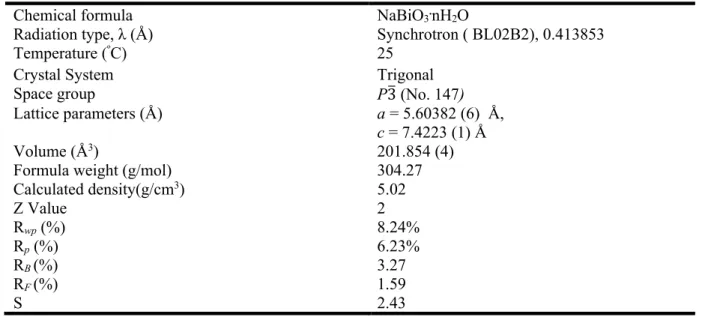
The synchrotron powder diffraction pattern of NBH was indexed completely to a trigonal unit cell of a = 5.60382 (6) Å and c = 7.4223 (1) Å. The final reliability (R) factors in the Rietveld analysis of this structural model led to reasonable values of Rwp = 8.24% and Rp =
6.23%. The details of the structure refinement and the structural parameters are summarized in Tables S1 and S2, respectively. The lattice parameters, the unit cell volume, and the observed density are similar to those previously reported using XRD data.16 Rietveld refinement of NBH
was carried out for eight possible trigonal space groups including P3, 3, P3m1, P321,
20 | P a g e
(Rwp = 8.24%) and P312 (Rwp = 8.25%). Other space groups were excluded due to a negative
isotropic displacement parameter (Biso), unsatisfactory crystal structure, and/or higher Rvalues
(Rwp = 8.66–14.2%). The P-3 space group is centrosymmetric, whereas the P312 space group
is noncentrosymmetric. Centrosymmetry was verified by means of second harmonic generation (SHG). Figure 2.2 shows the observed and calculated patterns obtained from synchrotron powder diffraction. Table 2-1, Table 2-2 and Table 2-3 show crystal data, structural parameters and selected interatomic distances (Å) for NaBiO3.nH2O respectively.
Chemical formula NaBiO3.nH2O
Radiation type, λ (Å) Synchrotron ( BL02B2), 0.413853
Temperature (ºC) 25
Crystal System Trigonal
Space group P3 (No. 147)
Lattice parameters (Å) a = 5.60382 (6) Å, c = 7.4223 (1) Å
Volume (Å3) 201.854 (4)
Formula weight (g/mol) 304.27
Calculated density(g/cm3) 5.02 Z Value 2 Rwp (%) 8.24% Rp (%) 6.23% RB (%) 3.27 RF (%) 1.59 S 2.43
Table 2-1 Crystal data for NaBiO3.nH2O.
Figure 2.2Rietveld refinement patterns from the synchrotron powder diffraction data for NaBiO3.nH2O.
The markers and solid lines denote the experimental and calculated profiles, respectively. In the middle portion, the short vertical lines denote the positions of possible Bragg reflections.
21 | P a g e
Table 2-3 Selected interatomic distances (Å) for NaBiO3.nH2O.
Crystal Structure
There is a topotactic relationship between the crystal structures of the hydrated and dehydrated phases. The crystal structures of both NBH and NBO show layered structures formed by edgesharing BiO6 octahedra. The interlayers of NBH consist of water molecules
sandwiched between two layers of sodium atoms that are perpendicular to the caxis, as shown in Figure 2.3. Na atoms in the interlayer are surrounded octahedrally by six O atoms: three O atoms from the BiO6 layer and three O atoms from water molecules. The NaO distance
(2.43(3) Å) to the BiO6 layer is shorter than that (2.56(3) Å) to the water molecules. The former
value is similar to that (2.397(8) and 2.47(1) Å) for NBO, where the Na atoms have the same octahedral coordination. The longer NaO distance in NBH may be due to the H atoms in the water molecules. The array of Na atoms along the caxis runs straight through the hexagonal tunnel of the BiO6 layers, as shown in Figure 2.4. The water molecules form a coplanar triangle
on the abplane, which is located above the corners of the hexagonal tunnel. The coordination environment of the Na atoms and water molecules is shown in Figure 2.3. The average BiO distance in a BiO6 octahedron is 2.08 Å (Figure 2.3), and this value is nearly in agreement with
Atom Site x y z Occupancy Biso (Å2) BVS
Na 2c 0 0 0.1985 (9) 1 0.88 (1) 0.93
Bi 2d 1/3 2/3 0.4974 (6) 1 0.34 (1) 5.68
O1 6g 0.388 (6) 0.380 (6) 0.3489 (1) 1 1.2 (3) 2.07
O2 6g 0.371 (3) 0.343 (4) 0.014 (5) 0.520 (8) 0.4 (4) 2.21
NaO6 octahedron BiO6 octahedron
Na—O1 2.43 (3) X 3 Bi—O1 2.10 (3) X 3
Na—O2 2.56 (3) X 3 Bi—O1 2.05 (4) X 3
mean 2.5 mean 2.08
22 | P a g e
other pentavalent bismuths (2.09–2.116 Å) observed in Ba2NdBiO6,34 Ba2YbBiO6,34 LiBiO3,3
MgBi2O6,4 NBO,5 BaBi2O68 and SrBi2O6.9
Figure 2.3 NaBiO3.nH2O crystal structure and average bond lengths between elements.
23 | P a g e
Thermal Behavior
Figure 2.5 shows the TGDTA curve of NBH. The TG curve indicates three mass loss
steps, similar to previously published reports that describe the mass loss of NBH.26,35 Here, we
discuss the structural changes of NBH using in situ hightemperature SPXRD (Figure 2.6). The first mass loss step (−7.65%, n = 1.29) correlates to the removal of crystalline water at approximately 155 °C, as shown in Figure 2.5. This water loss corresponds to the absence of a characteristic (001) diffraction peak, which is observed in the hydrated phase at approximately 2θ=3.2°, as shown in Figure 2.7. However, a small amount of water is still present until the sample reaches 172 °C, as indicated by the peak at 2θ=3.2° (Figure 2.7). This finding is probably due to the different experimental conditions used in TGDTA and SPXRD techniques. The TGDTA measurement was performed under air flow, whereas high temperature in situ powder SPXRD experiments were carried out in a sealed tube. This sealed environment should hold a small amount of water until 172 °C.
During heating, water molecules are lost, and sodium atoms move, causing the BiO6 layers to
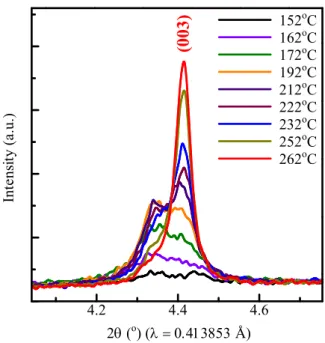
slide together to form the ilmenite structure, as shown in Figure 2.8. An intermediate phase (indicated by peak splitting) exists in the range of 175 °C to 232 °C, as shown in Figure 2.9. Above 232 °C, the ilmenite structure forms and persists until 390 °C. Due to the movement of sodium atoms and sliding of the BiO6 layers, the tunnel structure along the caxis does not form
an ilmenite phase, as shown in Figure 2.4.
The second and third mass loss steps occur above 390 °C and result from the loss of oxygen, accompanied by the reduction of Bi5+ to Bi3+. The calculated mass loss (5.25%) was somewhat
larger than the observed value (4.18%). Above 390 °C, dehydrated NaBiO3 decomposed to ε
Bi2O3 andNa2O (SPXRD data from 427 °C to 452 °C was consistent with εBi2O3; Na2O cannot
be identified by SPXRD), and finally, above 452 °C, εBi2O3 and Na2O reacted to form
24 | P a g e
Figure 2.6 Structural transformations of NaBiO3.nH2O from room temperature to 502 ºC. Figure 2.5 TGDTA curve of NaBiO3.nH2O up to 500 °C.
TG DTA Temperature (°C) M a ss l o ss ( % ) E n d o . E x o . 100 200 300 400 500 10 5 0
25 | P a g e
Figure 2.8 Crystal structure transformation from the hydrated to the dehydrated phase of NaBiO3. Figure 2.7 SPXRD patterns of NaBiO3.nH2O show removal of crystal water by the absence of peak around
2θ = 3.2o at above175oC. In te n si ty ( a. u .) 2 (o) (Å) 27oC 127oC 152oC 162oC 172oC 192oC 212oC 222oC 232oC 252oC 262oC 377oC (0 0 1 ) 3.1 3.2 3.3
26 | P a g e
Optical Properties
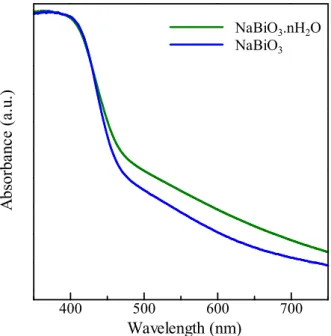
The optical absorption spectra for NBO and NBH are shown in Figure 2.10. This absorption spectra show that the absorption edges lie within the visible region for both samples. Band gaps of both compoundsweredetermined by optical absorption near the band edge by the following equation:
ℎ = (ℎ − ) /
where α, hν, A, and Eg are the optical absorption coefficient, photonic energy, proportionality
constant, and band gap, respectively. The value n depend on nature of transition, n = 1/2 for a direct bandgap, and n = 2 for an indirect gap material.36 Band gap energies were estimated by
assuming of direct transitions.36 These absorption spectra show that the NBO and NBH
absorption edges lie within the visible region. Band gap energies were estimated using the dependence of (hαν)2 on hν, assuming direct transitions.23 Tauc plot estimations of bandgap
Figure 2.9 SPXRD patterns of NaBiO3.nH2O at various temperatures.
2 (o) (Å) In te n si ty ( a .u .) (0 0 3 ) 152o C 162oC 172oC 192oC 212oC 222oC 232oC 252oC 262oC 4.2 4.4 4.6
27 | P a g e
energy for polycrystalline samples has been reported to give accurate values for monazitetype oxides.37Figure 2.11 shows bandgap energies of 2.4 eV and 2.5 eV for NBH and NBO,
respectively, which is similar to previously reported data.19,23,27
Photocatalytic Activity and DOS calculation
The photocatalytic activities of the hydrated NBH and the dehydrated NBO compounds were characterized by the decomposition of phenol at an initial concentration of 20 ppm using
Figure 2.11 Tauc plot for the estimation of the band gap for NaBiO3.nH2O and NaBiO3.
Photon energy (eV)
(h ( a. u .)
NaBiO
3.nH
2O = 2.4eV
NaBiO
3= 2.5eV
1 2 3 4Figure 2.10 UVVis absorption spectra for NaBiO3.nH2O and NaBiO3.
A b so rb a n c e ( a .u .) Wavelength (nm) NaBiO3.nH2O NaBiO3 400 500 600 700
28 | P a g e
a 0.15 g sample in 50 mL of ultrapure water. Time profiles of C/Co under visiblelight
irradiation (λ ≥ 420 nm) are shown in Figure 2.12. Suspensions were magnetically stirred in the dark (30 min) to ensure the phenol adsorbed on the sample surface. During this period, the phenol concentration decreased minimally. Under visible irradiation, phenol degradation was almost complete after 70 minutes in the presence of both NBO and NBH. The similar photocatalytic activity for NBO and NBH results from the almost identical environment of their conduction bands,8,38 as shown in Figure 2.13. Both bands display hybridization of the Bi
6s and O 2p orbitals, which is suitable for the high mobility of photoexcited electrons in the sp bands.20 While an earlier study proposed that the water in NBH may affect its photocatalytic
properties,26 we did not observe any influence on phenol degradation by the crystalline water
in NBH.
Figure 2.12 Time dependence of the photocatalytic degradation of phenol using NaBiO3 and
29 | P a g e
2.4 CONCLUSION
The crystal structure of NaBiO3.nH2O was refined for the first time using synchrotron
powder Xray diffraction data. The interlayers of NaBiO3.nH2O consist of water molecules
sandwiched between two layers of sodium atoms that are perpendicular to the caxis. The structure consists of a layered configuration with hexagonal tunnels. The water molecules form a coplanar triangle on the abplane, which is located above the corners of the hexagonal tunnel. Thermal studies confirmed an intermediate phase between the hydrated and the dehydrated phases during the dehydration process. The hydrated and dehydrated compounds displayed similar photocatalytic activities for phenol degradation due to similarly hybridized of Bi 6s and O 2p orbitals at the bottom of their conduction bands. Both compounds have almost similar band gap. Water molecules in the hydrated compound did not seem to affect the photocatalytic activity.
Figure 2.13 DOS curves simulated by firstprinciple DFT calculations for NaBiO3 (a) and
30 | P a g e
REFERENCES
[1] Mirza, H. K.; Miura, A.; Takei, T.; Kumada, N.; Ali, M. M.; Nagao, M.; Watauchi, S.; Tanaka, I.; Azuma, M.; Magome, E.; Moriyoshi, C.; Kuroiwa, Y.; Azharul Islam, A. K. M. Superconducting Double Perovskite Bismuth Oxide Prepared by a Low Temperature Hydrothermal Reaction. Angew. Chem. Int. Ed. 2014, 53, 3599–3603. [2] Mirza, H. K.; Takei, T.; Kumada, N.; Ali, M. M.; Miura, A.; Tadanaga, K.; Oka, K.;
Azuma, M.; Yashima, M.; Fujii, K.; Magome, E.; Moriyoshi, C.; Kuroiwa, Y.; Hester, J. R.; Avdeev, M. Hydrothermal Synthesis, Crystal Structure, and Superconductivity of a DoublePerovskite Bi Oxide. Chem. Mater. 2016, 28, 459465.
[3] Kumada, N.; Kinomura, N.; Takahashi, N.; Sleight, A. W. Crystal Structure of a New Lithium Bismuth Oxide: LiBiO3. J. Solid State Chem. 1996, 126, 121–126.
[4] Kumada, N.; Kinomura, N.; Takahashi, N.; Sleight, A. W. Preparation of ABi2O6 (A =
Mg, Zn) with the trirutiletype structure. Mater. Res. Bull. 1997, 32, 1003–1008. [5] Kumada, N.; Kinomura, N.; Sleight, A. W. Neutron powder diffraction refinement of
ilmenitetype bismuth oxides: ABiO3 (A = Na, Ag). Mater. Res. Bull. 2000, 35, 2397
2402.
[6] Sardar, K.; Playford, H. Y.; Darton, R. J.; Barney, E. R. Hannon, A. C.; Tompsett, D.; Fisher, J.; Kashtiban, R. J.; Sloan, J.; Ramos, S.; Cibin, G.; Walton, R. I. Nanocrystalline Cerium−Bismuth Oxides: Synthesis, Structural Characterization, and Redox Properties. Chem. Mater. 2010, 22, 6191–6201.
[7] Kumada, N.; Kinomura, N.; Sleight, A. W. Ionexchange reaction of Na+ in
NaBiO3·nH2O with Sr2+ and Ba2+. Solid State Ionics. 1999, 122, 183– 189.
[8] Saiduzzaman, Md; Yanagida, S.; Takei, T.; Moriyoshi, C.; Kuroiwa Y.; Kumada, N. Hydrothermal Synthesis, Crystal Structure, and VisibleRegion Photocatalytic Activity of BaBi2O6. ChemistrySelect. 2017, 2, 4843–4846.
31 | P a g e
[9] Kumada, N.; Miura, A.; Takei, T.; Yashima, M.; Crystal structures of a pentavalent bismuthate, SrBi2O6 and a lead bismuth oxide (Pb1/3Bi2/3)O1.4. J. Asian Ceram. Soc.
2014, 2, 150–153.
[10] Kumada, N.; Miura, A.; Takei, T.; Nishimoto, S.; Kameshima, Y.; Miyake, M.; Kuroiwa, Y.; Moriyoshi, C. Hydrothermal synthesis and crystal structure analysis of two new cadmium bismuthates, CdBi2O6 and Cd0.37Bi0.63O1.79. J. Asian Ceram. Soc.
2015, 3, 251–254.
[11] Sardar, K.; Walton, R. I. Hydrothermal synthesis map of bismuth titanates. J. Solid
State Chem. 2012, 189, 3237.
[12] Daniels, L. M.; Playford, H.Y.; Grenèche, J. M.; Hannon, A. C.; Walton, R. I. Metastable (Bi, M)2(Fe, Mn, Bi)2O6+x (M = Na or K) Pyrochlores from Hydrothermal
Synthesis. Inorg. Chem. 2014, 53, 13197–13206.
[13] Yamamoto, Y.; Withanage, W. I. U.; Takei, T.; Yanagida, S.; Kumada, N.; Yamane, H. Hydrothermal reaction of NaBiO3·nH2O with transitionmetal (Co, Ni, Cu) salts, J.
Ceram. Soc. Jpn. 2108, 126,10051012.
[14] Kumada, N.; Takahashi, N.; Kinomura, N.; Sleight, A. W.; Preparation and Crystal Structure of New Rare Earth Bismuth Oxynitrates:RBi2O4NO3(R: Y, Sm, Eu, Gd, Tb,
Dy, Er, Yb), J. Solid State Chem. 1997, 139, 321325.
[15] Kumada, N.; Takei, T.; Haramoto, R.; Yonesaki, Y.; Dong, Q.; Kinomura, N.; Nishimoto, S.; Kameshima, Y.; Miyake, M. Preparation and crystal structure of a new bismuth vanadate, Bi3.33(VO4)2O2, Mater. Res. Bull. 2011, 46, 962–965.
[16] Aurivillius, B. XRays Studies on “Sodium Metabismuthate”. Acta. Chem. Scand.,
32 | P a g e
[17] Diasa, A.; Moreira, R. L. Crystal structure and phonon modes of ilmenitetype NaBiO3
investigated by Raman and infrared spectroscopies. J. Raman Spectrosc. 2010, 41, 698– 701.
[18] Kumada, N.; Kinomura, N. Preparation of ilmenite type oxides via ionexchange reaction. Mater. Res. Bull. 1993, 28, 849854.
[19] Kou, J.; Zhang, H.; Li, Z.; Ouyang, S.; Ye, J.; Zou, Z. Photooxidation of polycyclic aromatic hydrocarbons over NaBiO3 under visible light irradiation. Catal. Lett. 2008,
122, 131–137.
[20] Kako, T.; Zou, Z.; Katagiri M.; Ye, J. Decomposition of Organic Compounds over NaBiO3 under Visible Light Irradiation. Chem. Mater. 2007, 19, 198–202.
[21] Chunlin, C.; Feng, P.; Hongjuan, W.; Hao, Y. Thermal stability of commercial NaBiO3·nH2O and its photocatalytic behaviors under visible light irradiation. Industrial
Catalysis. 2009, 17, 68–72.
[22] Chang, X.; Huang, J.; Cheng, C.; Sha, W.; Li, X.; Ji, G.; Deng, S.; Yu, G. Photocatalytic decomposition of 4toctylphenol over NaBiO3 driven by visible light: Catalytic
kinetics and corrosion products characterization. J. Hazard. Mater. 2010, 173, 765–772. [23] Takei, T.; Haramoto, R.; Dong, Q.; Kumada, N.; Yonesaki, Y.; Kinomura, N.; Mano,
T.; Nishimoto, S., Kameshima, Y.; Miyake, M. Photocatalytic activities of various pentavalent bismuthates under visible light irradiation. J. Solid State Chem. 2011, 184, 2017–2022.
[24] Lu, C. S.; Chen, C. C.; Huang, L. K.; Tsai P. A.; Lai, H. F. Photocatalytic Degradation of Acridine Orange over NaBiO3 Driven by Visible Light Irradiation. Catalysts. 2013,
33 | P a g e
[25] Ding, Y.; Zhou, P.; Tang, H. Visiblelight photocatalytic degradation of bisphenol A on NaBiO3 nanosheets in a wide pH range: A synergistic effect between photocatalytic
oxidation and chemical oxidation. Chem. Eng. J. 2016, 291, 149–160.
[26] Yu, K.; Yang, S.; He, H.; Sun, C.; Gu, C.; Ju, Y. Visible LightDriven Photocatalytic Degradation of Rhodamine B over NaBiO3: Pathways and Mechanism. J. Phys. Chem.
A 2009,113, 10024–10032.
[27] Chen, S.; Cao, Z.; Fu, X. Preparation, characterization and photocatalytic activity evaluation of NaBiO3.2H2O and NaBiO3.xH2O nanosheets. Mater. Chem. Phys.
2013,142, 748–755.
[28] Peng , F.; Chen, C.; Yu, H.; Wang, H.; Yang , J. Preparation of NaxBayBiO3.nH2O and
their photooxidation characteristic under visiblelight irradiation. Mater. Chem. Phys.
2009,116, 294–299.
[29] Altomare, A.; Caliandro, R.; Camalli, M.; Cuocci, C.; Giacovazzo, C.; Moliterni, A. G. G., Rizzi, R. Automatic structure determination from powder data with EXPO2004. J.
Appl. Cryst. 2004, 37, 10251028.
[30] Izumi, F.; Momma, K. ThreeDimensional Visualization in Powder Diffraction. Solid
State Phenom. 2007,130, 15–20.
[31] Momma, K.; Izumi, F. VESTA: a threedimensional visualization system for electronic and structural analysis. J. Appl. Cryst. 2008, 41, 653–658.
[32] Kresse, G.; Furthmuller, J. Efficiency of abinitio total energy calculations for metals and semiconductors using a planewave basis set. Comput. Mater. Sci. 1996, 6, 15–50. [33] Kresse, G.; Furthmuller, J. Efficient iterative schemes for ab initio totalenergy calculations using a planewave basis set. Phys. Rev. B: Condens. Matter Mater. Phys.
34 | P a g e
[34] Harrison, W.T. A.; Reis, K. P.; Jacobson, A. J.; Schneemeyer, L. F.; Waszczak, J. V. Syntheses, Structures, and Magnetism of Barium/RareEarth/Bismuth Double Perovskites. Crystal Structures of Ba2MBiO6 (M = Ce, Pr, Nd, Tb, Yb) by Powder
Neutron Diffraction. Chem. Mater. 1995, 7, 2161–2167.
[35] Pan, J.; Sun, Y.; Wan, P., Wang, Z., Liu, X. Preparation of NaBiO3 and the
electrochemical characteristic of manganese dioxide doped with NaBiO3. Electrochim.
Acta. 2006, 51, 3118–3124.
[36] Errandonea, D.; Muñoz, A.; Hernández, P. R.; Proctor, J. E.; Sapiña, F.; Bettinelli, M. Theoretical and Experimental Study of the Crystal Structures, Lattice Vibrations, and Band Structures of MonaziteType PbCrO4, PbSeO4, SrCrO4, and SrSeO4. Inorg. Chem.
2015, 54, 7524–7535.
[37] Naa, O.; Kumada, N.; Miura, A.; Takei, T.; Azuma, M.; Kusano, Y.; Oka, K. High Pressure Polymorph of NaBiO3. Inorg. Chem. 2016, 55, 5747–5749.
35 | P a g e
Chapter 3
Hydrothermal
Synthesis
of
Pyrochlore-Type
Pentavalent
Bismuthates Ca
2Bi
2O
7and Sr
2Bi
2O
73.1 INTRODUCTION
The low temperature hydrothermal method is an attractive synthetic route for the preparation of new inorganic compounds with various crystal structures.110 Basically,
pyrochloretype oxides (A2B2O6O') get much attention due to the broad range of elements
adapted in their crystal structures. The Asite cations are 8fold distorted cubic coordinated with two different oxygen sites (O, O'), and the Bsite cations are 6fold octahedral coordinated with oxygen (O).11 Due to the wide range of element adaptations, pyrochloretype oxide
structures exhibit versatile physical and chemical properties, allowing them a wide range of applications such as nuclear waste disposal,12 thermal barrier coatings,13 dielectric materials,14
laser materials,15 Liion batteries,16 optical materials,17 photocatalysts,18 solid electrolytes,19
oxygen evolution20 and superconductors.21
Ruthenium and iridiumbased pyrochlore oxides get much attention by researchers due to their metallic behavior.2225 Bouchard and Gillson26 synthesized Bi3+based Bi
2Ir2O7 and
Bi2Ru2O7 metallicpyrochlores for the first time. After that, many researchers investigated these
metallic compounds2734 and tried to synthesize new metallic pyrochloretype compounds
M Ir O and M Ru O [M3+ = Pr, Nd, Sm, Eu, Lu]3536 by replacing Bi3+ with other M3+
elements. Bi3+ is generally adopted in the A site but unable to be located in the B site due to its
large ionic radius for the octahedral metal position. In this case, Bi5+ could be a good choice
for the B site. Until recently, however, Bi5+ has not been reported in the B site for pyrochlores.
36 | P a g e
hydrothermal reactions, where only Bi5+ occupies the B site. In the previous research 37 of
hydrothermal reactions between hydrate sodium bismuthate withalkaline earth metal nitrates (Ca, Sr), mixed bismuth valance pyrochloretype oxides with a CO3 group contained in their
crystal structures were produced. However, alkaline earth metal hydroxides (Ca, Sr) yield pyrochloretype oxides with only Bi5+, which is confirmed by the temperaturedependent gas
evolution.
In this work, we report the synthetic procedure of two new metallic pyrochloretype pentavalent bismuthates. Their crystal structure refinement was performed by the Reitveld refinement method using synchrotron powder Xray diffraction (SPXRD) data. Their thermal stabilities were checked by thermogravimetric and differential thermal analysis (TGDTA). Their temperaturedependent gas evolution was measured by a thermogravimetric mass spectrometer (TGMS). Scanning electron microscopy (SEM) reveals the surface morphologies of particles. UVvisible spectroscopy gives an idea of the absorption spectra. The density of states curves generated by density functional theory (DFT) calculations show the contribution of each orbital of all of the elements. The temperaturedependent electrical resistivity and magnetic susceptibility were measured by a standard fourprobe method (PPMS, Quantum Design) and SQUID magnetometer respectively. AC impedance was measured to determine the grain boundary resistivity.
3.2 EXPERIMENTAL
The hydrothermal reaction was performed in a Teflonlined, stainless steel autoclave with an internal volume of 70 mL. NaBiO3.nH2O and Ca(OH)2 with 1:1, NaBiO3.nH2O and
Sr(OH)2.8H2Owith 1:1 molar ratio with distilled water (50 mL) were placed in the Teflonlined
autoclaves and heated to 80 ºC for 48 h. All starting reagents were purchased from Kanto Chemical Co., Inc. (Tokyo, Japan). The solid product was separated by filtration, washed with