2軸交差駆動に基づく面状全方向クローラ機構に関
する研究
著者
?根 英里
学位授与機関
Tohoku University
学位授与番号
11301甲第19359号
URL
http://hdl.handle.net/10097/00130249
たか ね え り
氏
名
髙 根 英 里
研究科,専攻の名称 東北大学大学院情報科学研究科(博士課程)応用情報科学専攻
学 位 論 文 題 目
2軸交差駆動に基づく面状全方向クローラ機構に関する研究
(Planar Omnidirectional Crawler Mechanism
based on Two-axis Cross Drive)
論 文 審 査 委 員
(主査)東北大学准教授 多田隈 建二郎 東北大学教 授 田所 諭 東北大学教 授 橋本 浩一 東北大学教 授 小菅 一弘 東北大学教 授 平田 泰久
論文内容要約
1. IntroductionTracked vehicles have been widely adopted in robotized search and rescue missions. However, these crawler type robots still require improvement with regards to the turning mechanism as it damages the ground as well as the crawler. The damage is due to the increased friction between the large contact area of the crawler and ground surface. The crawler cannot travel in narrow spaces, as it requires ample space to turn. To overcome this limitation, I have developed a planar omnidirectional crawler mechanism that can switch travel direction without turning.
Most studies on omnidirectional wheels and crawlers focus on mechanisms wherein contact with the ground surface is achieved via either a point or line.
However, this study proposes a crawler that moves omnidirectionally while fully in contact the running surface. Furthermore, utilizing holonomic features and two-axis cross driving, it is capable of traveling on narrow, soft, and rough terrain.
The purpose of this study is to realize a mechanism that transmits driving force to a rotating part on an endless track, and its control method for the planar omnidirectional crawler operation. Consequently, the study aims to demonstrate that the prototype can travel omnidirectionally on uneven terrain using the proposed mechanism and control method. This outcome can be achieved through the following steps.
(i) Proposal and development of transmission mechanism to control the rotating parts on an endless track (ii) Construction of geometric models for mechanical design and control
(iii) Evaluation of crawler driving performance during travel direction switching on soft terrain
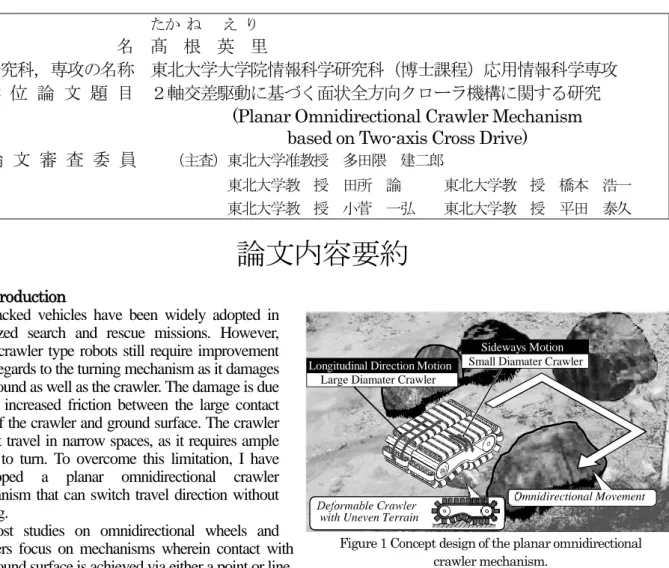
In this study, I developed a planar omnidirectional crawler mechanism with a two-axis cross drive that can transmit power in any direction at all points of contact with the object, which is capable of omnidirectional motion on uneven paths, as in Fig. 1. The crawler travels on narrow roads using omnidirectional movement. Moreover, moving in any direction is facilitated on soft ground as the contact surface allows for a larger pressure-receiving area.
2. Principle Mechanism of Two-axes Cross Drive
This study utilizes a rack chain mechanism as the driving principle of the planar omnidirectional crawler vehicle to realize a crawler that enables two-axis cross drive, depicted in Fig. 2. Furthermore, expanding the research scope for the driving force transmission mechanism onto rotating parts on an endless track, the proposed rack chain mechanism could be used as a driving principle for not only planar omnidirectional vehicles but also and those with point or line contact. Finally, I suggested the output shaft of the rack chain mechanism is to be set around three-axis, namely, the roll, pitch, and yaw.
The first prototype crawler consists of a larger crawler with multiple small-diameter belts. This large-diameter crawler prototype was able to travel in any direction using the rack chain mechanism. Additionally, it was also confirmed that the crawler deformed and negotiated to the obstacle shape when traveling diagonally to it.
Large Diamater Crawler Longitudinal Direction Motion
with Uneven Terrain
Omnidirectional Movement Sideways Motion
Small Diamater Crawler
Figure 1 Concept design of the planar omnidirectional crawler mechanism.
In the first prototype, the problem was that the small belt on the crawler disconnected from the pulley when moving diagonally. Furthermore, compared to the forward direction, in the lateral direction, the maximum climbing height was lower as it was related to the small-diameter crawler pulley radius. The solution to these issues is mentioned in Section 3.
Rack chain Motor Herical gear Spur gear Yaw Z X Y Motor Support chain Rack chain Spur gear Taper part AA battery for size comparision 170mm scale Bellows cover 3. Design Method
A summary of the design method of the planar omnidirectional crawler mechanism is described below.
The prototype planar omnidirectional crawler mechanism is depicted in Fig. 3. The omnidirectional movement was realized on various rough terrains (tactile paving, cobblestone panel, snow, grass, gravel, sand, and woodchips) in experiments illustrated in Fig. 4.
To solve the problems presented in Section 2 (belt disconnection from pulley and lower lateral climbing ability), the sprocket and chain were set to a higher height and tooth rigidity to prevent it from the crawler belt disconnecting. Experimentally, it was observed that the track with chain and sprocket was less prone to deviations than the conventional belt and prevented it from disconnecting. The sideways motion step climbing ability was improved using a taper-shaped small-crawler. Unit crawlers on both left and right sides aid in not only translating motion but also turning.
A geometric model was constructed for the anisotropy of the climbing step ability that depends on the travel direction of the crawler. From the calculation results, the crawler can overcome a step height of 98 mm without tipping over, when the traveling direction is 52⁰. A 53 mm climb was calculated in the case of forward motion and 42 mm in the case of lateral motion.
4. Control Method
In this section, the travel direction and speed control method of the planar omnidirectional crawler mechanism is described.
It was experimentally confirmed that the planar omnidirectional crawler was able to travel at any speed and direction according to commands using the input-output relationship of the rack chain mechanism based on the geometric model of an asymmetrical differential transmission.
In the experiment, the trajectory of the planar omnidirectional crawler was recorded using motion capture when the crawler translated to 16 target travel directions. The crawler speed remained constant. The ratio between the input rotation speed of the support and rack chains was calculated to derive the input value at each target angle.
It was shown that the crawler traveled to the designated direction with an average error of 2.7⁰. In the case of travel directions with a large x-axis component, the target speed was achieved with an error of less than 10%. In contrast, when the travel directions had a large y-axis component, the crawler speed was slower than the target speed (60–88% of the target speed).
The cause of this error and solutions to improve the accuracy of traveling direction and speed were discussed hereafter. The cause of the error in the traveling direction and speed is the large internal resistance of the rack chain mechanism due to chain bending. To reduce this error, the degree of deflection should be limited with a tensioner. Therefore, the maximum amount of deflection by the chain must be specified in advance. The crawler did not translate to the target angle immediately after the movement started. The cause of this transient response is that there is a delay time for the rotational speed difference between the support and rack chains because the acceleration of the two motors is the same. During that time, the crawler moves only in the x-axis direction without moving in the y-axis direction. A solution for this is to set the motor acceleration to a gradient suitable for each target angle.
Figure 3 Planar omnidirectional crawler prototype. Figure 2 Proposed rack chain mechanism as a driving
5. Evaluation of Disturbance Degree of Ground
In Section 5, as traveling performance of the prototype is evaluated by quantifying and comparing the influences of the turning and translational motion of the planar crawler mechanism to the ground surface by measuring the extent of disturbance to the ground. Furthermore, a method has been proposed to measure the mobile performance of a crawler during the switching of travel direction on soft ground.
The proposed method employs real-time measurement of sand flow in a horizontal plane under the mobile robot. A camera under the running surface recorded the sand flow moved by a mobile mechanism. The positions and velocities of sand flow were calculated using image processing techniques. The proposed method measures the places that were hidden by mobile robots and could not be observed previously, that is, the method allows soil flow by spin turning to be observed.
The disturbance degree of ground was measured with the planar omnidirectional crawler mechanism while it was turning and translating using the proposed method. As a result, it was observed that the turning motion causes more ground disturbance to the surface, 3.3 times in the case of an average point, and 4.0 times in the case of a cumulative frequency maximum point, when compared with that of the translational motion. Furthermore, it was shown that the disturbance degree of the ground was reduced by lowering the turning speed.
For a future research, I have considered how to evaluate and compare the turning performance as the traveling performance of the crawler and various mobile mechanisms using the proposed evaluation of disturbance degree of ground method. The turning performance indicates the performance that does not disturb the road surface while switching the travel direction. General evaluation indices were utilized to evaluate and compare the performance. Simple reference values for the disturbance degree of the ground were experimentally prepared. In comparison with reference values, it was confirmed that the turning motion dragged ground with a load of approximately five times than the translational motion.
These results quantitatively indicate that the translational motion can switch the travel direction with lower disturbance to the road surface compared to the turning motion.
6. Conclusion
In this study, a planar omnidirectional crawler mechanism was developed using a two-axis cross drive (it transmits power in any direction at all points in contact with the object) to enable omnidirectional motion in uneven running surfaces. Through omnidirectional motion capability, the crawler can travel on narrow paths. In addition, it can move in any direction on soft ground as it has a larger pressure-receiving area.
A rack chain transmission mechanism was utilized as the driving principle of the planar omnidirectional crawler vehicle. The proposed transmission mechanism employs two actuators. The number of actuators installed is maintained at the minimum quantity necessary to translate in the XY direction that reduces the complexity of the controls of the crawler. In addition, the proposed transmission can perform without friction drive and permits the crawler to be deformed. It can transmit a driving force in any direction reliably by adapting to the ground surface, even on rough terrain where the crawler is covered in debris.
In this research, omnidirectional motion on various rough terrain was realized using the planar omnidirectional crawler mechanism that enables two-axis cross drive.
Trampled grass
( a ) Tactile paving and cobblestone tile. ( b ) Snow. ( c ) Grass.