51
On long passives in Japanese syntactic V-V
compounds:
a cartographic approach
AKUZAWA Koyo
Abstract
This paper aims to present a novel analysis of long passives in Japanese syntactic V-V compounds by adopting the cartographic approach. Since Kageyama (1993), it has been widely accepted that V-V compounds are divided into two types, namely “lexical compounds” and “syntactic compounds”. One can predict that the syntactic compounds cannot allow the long passive operation because they are composed of two independent syntactic words; however, some syntactic compounds do allow this operation. Given the fact that the syntactic V-V compounds are restructuring verbs, this paper adopts Cinque’s analysis (2006) and maintains that the positions where V2s are generated determine whether long passives can be formed or not. This paper also claims that the syntactic difference shown in syntactic V-V compounds is similar to the structure of Italian restructuring verbs, and demonstrates that this similarity can be explained by the universal hierarchy assumed by the cartographic approach.
Key words
syntactic V-V compounds long passive restructuring cartography
1 Introduction
Since Japanese is an agglutinative language, it has numerous suffixes to show various grammatical categories. One of the most intriguing and long-argued phenomena is the V-V compound such as “kaki-nagur (write-paunch: scribble)” or “kaki-hajimer (write-begin: begin to write). Although many researchers have examined V-V compounds, Kageyama’s (1993) study regarding Japanese compounds has been influential and well recognized among linguists. According his study, Japanese compounds can be divided into two types, namely “lexical compounds” and “syntactic compounds”. The former can be treated as a canonical lexical entity even though it includes two morphological verbs, whereas the latter is treated as two syntactically distinct words. Below is one of the diagnostic tests which demonstrate that the two categories are
52
indeed distinct1. As illustrated in (1), lexical compounds cannot take Sino-Japanese verbs2 such as “kounyu-sur (purchase)” as V1; on the other hand, the syntactic compounds can.
(1) a. Gakusei-ga hon-o kai -asar -ta. Students-NOM book-ACC purchase -look for -PST a’.*Gakusei-ga hon-o kounyu -si -asar -ta. Students-NOM book-ACC purchase -DO -look for -PST ‘Students bought up books.’
b. Gakusei-ga hon-o kai -hajimer -ta. Students-NOM book-ACC purchase -begin -PST b’ Gakusei-ga hon-o kounyu -si -hajime -ta. Students-NOM book-ACC purchase-DO -begin -PST ‘Students began to buy books.’
Interestingly some syntactic compounds allow “long passive” operation, which is strictly prohibited in English as illustrated in (2) (Kageyama 1993; Kishimoto 2014; Matsumoto 1996; Nishigauchi 1993; Yumoto 2005; Zushi 2005; among others).
(2) a. Hon-ga subete kounyu -si -oe -rare -ta. book-NOM all purchase-DO -finish -PASS -PST b. *All books were finished purchasing.
This operation is anomalous if we consider locality conditions because the passive morpheme attached to “oe (finish)” triggers movement of the object from the embedded clause headed by V1 “yom(read)”.
In this paper I would like to descriptively examine syntactic structure that allows this operation by adopting the cartographic approach, especially Cinque’s (2006) proposal.
This paper is organized as follows. Section 2 gives an overview of two main studies on the long passive phenomenon, namely, Kageyama (1993) and Kishimoto (2014). Section 3 provides a brief introduction to the long passive issue and demonstrates the theoretical contribution of long passive focusing on“Restructuring”. Section 4 presents the main data concerning the long passive. Section 5 provides a new analysis on the long passive based on the Cinque’s (2006) proposal, and argues that Cinque’s (1999) hierarchy reveals the possible hierarchy of aspectual heads in Japanese. Section 6 summarizes whole discussion of this paper, and presents some remaining issues.
1 See Kageyama (1993, 1999) for other diagnostics.
53 2 An overview of previous studies
In this section I would like to present the finding of previous studies that deal with long passive.
2.1 Kageyama (1993)
This sub-section presents Kageyama’s (1993) discussion on the (im)possibility of long passive. He provides a syntactic classification of V-V compounds, as shown bellow34:
Table 1 Syntactic classification of V-V compounds
Control type -oer (finish -ing), -tukus (finish –ing), -sokoner (fail to), -sonjir (fail to), -sokona (fail to), -okurer (fail to), -wasurer (forget to), nokos (fail to), -nuk (finish -ing) -naos (do again), -narer (get accustom to), -akir (get fed up with)
Raising type -kaker (be about to), -das (begin to), -sugir (overdo), -makur (continue to)
Ambiguous between Control and Raising
-hajimer (begin to), -owar (end), -tuduker (continue to), -kir (finish –ing)
Before getting into his proposal, I look at briefly Nishigauchi (1993), which gives an analysis for long passive of aspectual verbs such as “-oe (finish -ing)”. His main idea is based on the dichotomy between control and raising. He argues that raising verbs’ inability to form a long passive construction is due to their inability to assign thematic roles to external arguments. Based on the assumption that the passive morpheme absorbs accusative feature and thematic role of the verb that it attaches to,he concludes that the raising verbs cannot be passivized because they do not have any features to be absorbed5. Kageyama’s work is based on this assumption as well, and he concludes that raising verbs are not passivizable for they lack the accusative feature, whereas the control verbs are passivizable since they possess it. In this respect his analysis is in agreement with Nishigauchi’s, but Kageyama noticed that the control verbs have to be divided into two types: passivizable control verbs and non-passivizable ones. The unpassivizable control verbs are illustrated in (3).
3 Even though Kageyama (1993) provides other V-V compounds, I listed only those that we deal with in this paper.
See Kegayama (1993: 143) for other verbs.
4 The terms “control”, “raising” and “ambiguous” are used in (4), but his exact terms are “transitive”,
“unaccusative” and “both type” respectively. I use the former ones in what follows, but it does not mean that these words indicate different notions.
5 This assumption does not predict the control verbs’ possibility of long passive because it violates locality
constrains. Therefore, Nishigauchi (1993) explains this possibility by assuming that V1 is raised tothe upper verb through head movement. See Nishigauchi for more detail.
54 (3) a. *Zassi-ga kai -sokone -rare -ta. magazine-NOM buy -fail to -PASS -PST ‘(Lit.) The magazine was failed to buy.’ b. *Ringo-ga tabe -nokos-are -ta. apple-NOM eat -fail to-PASS -PST ‘(Lit.) The apple was failed to eat.’
Since “-sokoner (fail to)” and “-nokos (fail to)” cannot take inanimate subjects, they can be considered as control verbs. Along with this fact, they seem to have the accusative feature; nevertheless, they cannot be passivized. This control verbhood is show in (4), and the accusative feature can be accounted in (5).
(4) a. *Ame-ga furi-sokoner -ta. rain-NOM rain-fail to -PST b. *Arasi-ga osoi -nokos -ta. Storm-NOM attack -fail to -PAS (5) a. Taroo-wa kigen-o sokoner -ta. T-TOP feeling-ACC offend -PST
b. Taroo-wa memo-o nokos -ta. T-TOP note-ACC leave -PST
Based on this observation Kageyama posits structure such as (6) for verbs that undergo passivization. The verbs that do not allow long passive, on the other hand, take the structure illustrated in (7)6.
(6) [vP [VP [VP Obj. V] V]
(7) [vP [VP [vP ec [VP Obj. V]v] V]
As shown in (6), the V1 of long-passivizable verbs lack the projection “v”, i.e. the V1 does not project external argument here. Accordingly, this structure allows NP movement from embedded clause to upper clause without violating the “Relativized Minimality” brought forth by Rizzi (1990).
Kageyama’s proposal can be considered as a combination of the accusative feature and the restriction of NP movement.
6 The representations in (8) and (9) are slightly modified following the current theoretical assumption. In
55 2.2 Kishimoto (2013)
Kishimoto’s (2013) approach differs from the Kageyama’s (1993) in that he does not attribute the long passivizability of V-V compounds to the restriction of NP movement. He argues that this passivizability is purely due to whether or not V2 has the accusative feature. According to Kishimoto, syntactic V-V compounds can be divided into three types: raising type, transitive type and unergative type as shown in Table 2. The transitive type and unergative type both belong to the control type, but the latter one does not have accusative feature, and consequently it cannot be passivized7.
Table 2 Kisimoto (2013)’s classification of V-V compounds
Raising -kaker (be about to), -das (begin to), -sugir (overdo), -makur (continue to)
Unergative control -sokoner (fail to), -sobirer (fail to), -owar (end), -sokona (fail to) Transitive control -oer (finish -ing), -naos (do again), -tukus (finish –ing)
As for the long passivizable status of syntactic V-V compounds, Kishimoto assumes that V1 moves up to V2 by head movement in case the V2 has the accusative feature. The sequence of the V1 and V2 then causes “restructuring”, and as a result of this movement and restructuring, the V-V compounds can be passivized.
2.3 Section summary
In this section I have presented two main proposals for long passive of V-V compounds: Kageyema (1993) and Kishimoto (2013). Kageyama attributes the long-passivizability to the “accusative feature” of V2 and the “restriction of NP movement”. Conversely, Kishimoto proposes that this passivisability can be explained solely by the existence of the accusative feature of V2. To summarize, we can conclude that both of two analyses put emphasis on the trait of V2.
3. Theoretical and empirical problems in previous works
In what follows, I would like to point out the problems found in the studies presented above; focusing on possible theoretical contribution of long passive of syntactic V-V compounds.
The fact that the long passive is prohibited in English, whereas it is not in Japanese is an interesting cross-linguistic issue. Past studies treated the long passive as a monoclausal version of a biclausal sentence. This monoclausality of this long passive is an interesting phenomenon within the extensive debate on “restructuring”. (Burzio 1986; Cinque 2006; Wurmbrand 2001; Zushi
7 Kishimoto (2013) provides some phenomena that we cannot explain based on the restriction of NP movement.
56
2005; among others). The difference related to the long passive between English and Japanese can be explained from the fact that English does not allow restructuring but Japanese does8. We cannot take the long passive as an isolated phenomenon concerning just one language; on the contrary, the long passive can be taken to be a cross linguistic problem.
In Kageyema’s (1993) account the control verbs are divided into two types depending on the complement size; with the verbs which take smaller complement the long passive is possible, whereas with the verbs which take larger one the long passive is impossible. From the perspective of restructuring, Kageyama’s idea shares certain similarities with the analysis of Wurmbrand (2001) in that they focus on the complement size. Given that also Kishimoto (2013) assumes “restructuring” to explain the long passive, it stands to reason that syntactic V-V compounds are connected straightforwardly with the discussion about restructuring.
Restructuring has been attested in various languages, but interestingly the semantic category of restructuring verbs is mainly limited to three types: modal, aspect and motion verbs. “Restructuring” in itself is a syntactic term related to the monoclausality of complex sentence, but the fact that verbs that allow restructuring are semantically restricted cross-linguistically suggests that this phenomenon is closely related to the interface between syntax and semantics. Therefore the first point to be discussed is the meaning of V-V compounds. In Kageyama (1993), however, the semantic properties of these compounds are not well considered even though he categorizes them based on their meanings for convenience sake. Even in Kishimoto (2013), the semantic properties are unmentioned.
So far I have discussed the theoretical problem concerning restructuring. In what follows, I will discuss certain empirical problems found in the previous studies. Kishimoto (2013), for example, maintains that the accusative feature of V2 decides the possibility of long passive. However, it is unclear how to decide whether or not one verb has this feature. In Kishimoto, the following verbs are listed as unergative control verbs.
(8) unergative control verbs:-sokoner (fail to), -sobirer (fail to), -owar (finish -ing), -sokona (fail to)
As regards “-sokoner (fail to)”, for example, it is fair to assume that it has accusative case because it assigns accusative marker when it is used as main verb as indicated in (9).
57 (9) Taroo-wa kigen-o sokoner -teir -u. T-TOP feeling-ACC offend -PROG -PRES ‘Taro is in a bad mood.’
Even though it is not listed in (8), “-wasurer (forget to)” can be an empirical problem as well because of its ability to assign theaccusative case when used as a main verb9. “-Wasurer” can take an object with accusative case as in (10a), but the long passive is impossible as in (10b).
(10) a. Taroo-wa yakusoku-o wasurer -ta. T-TOP promise-ACC forget -PST b. *Hon-ga kai-wasurer -rare -ta. book-NOM buy-forget -PASS -PST
(cf. Taroo-wa hon-o kai -wasurer -ta.
T-TOP book-ACC buy -forget -PST)
To summarize, on the one hand, Kageyama’s proposal is not clear in the motivation to assume the reduced VP structure for the long passivizable verbs; on the other hand, Kishimoto’s proposal is not clear inhow the accusative case of V2 is decided10.
4. Data
In this section I would like to summarize the empirical data concerning the long passive in syntactic V-V compounds.
4.1 Semantic classification of syntactic V-V compounds
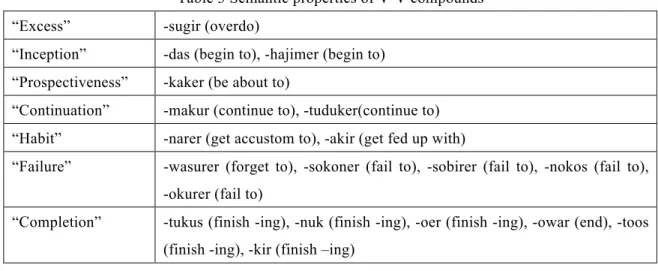
Kageyama (1993) divides the syntactic V-V compounds into semantic groups as well, but he does not argue the exact connection between these semantic properties and syntactic structures. The classification indicated in table 3 has been slightly modified.
9 See also footnote 9 in Kishimoto (2013: 180) for “-wasurer (forget to)”.
10 Kishimoto (2013) assumes that non-compound verb can be different from V-V compounds case. Based on this
assumption, he provides some pieces of evidence for the lack of ability in assigning the accusative case in the V-V focusing on “potential sentence”, “tough sentence” and so forth. However, his diagnostics are influenced also by the semantic property of “agency” assumed by the subject NP, therefore it is dubious whether we can prove the lack of the accusative feature based on his tests. See Kishimoto (2013) for more detail.
58
Table 3 Semantic properties of V-V compounds “Excess” -sugir (overdo)
“Inception” -das (begin to), -hajimer (begin to) “Prospectiveness” -kaker (be about to)
“Continuation” -makur (continue to), -tuduker(continue to) “Habit” -narer (get accustom to), -akir (get fed up with)
“Failure” -wasurer (forget to), -sokoner (fail to), -sobirer (fail to), -nokos (fail to), -okurer (fail to)
“Completion” -tukus (finish -ing), -nuk (finish -ing), -oer (finish -ing), -owar (end), -toos (finish -ing), -kir (finish –ing)
We can notice that all these compounds are aspectual ones to some extent. Here one may ask the aspectualhood of the members of “failure” type, but we can still consider “failure” type as the aspectual elements if we take them to be a kind of inceptive aspect. The “failure” type means that one cannot start an event denoted by a complement phrase; this means that it is plausible to assume that it corresponds to Cinque’s (2006) “frustrative aspect”.
4.2 Long passive and syntactic V-V compounds
In this section, I examine the possibility of long passive with the verbs illustrated in table 3. The result is as follows:
(11) a. “Excess”
*Ringo-ga tabe -sugir -rare -ta. apple-NOM eat -over do -PASS -PST ‘(Lit.)The apple was overeaten.’
b. “Inception”
Hon-ga yomi -das/hajimer -rare -ta. book-NOM read -begin -PASS -PST ‘(Lit.) The book was begun to read.’
c. “Prospectiveness”
*Taroo-ga naguri -kake -rare -ta. T-NOM hit -be about to -PASS -PST
‘(Lit.) Taro had been about to hit.’ d. “Continuation”
59
Biru-NOM build -continue -PASS -PST ‘(Lit.) The buildings were continued to built.’ e. “Habit”
*Dezain-ga mi -nare/akir -rare -ta. Design-NOM watch -get accustomed to/fed up with -PASS -PST
‘(Lit.) The design was got accustomed to watch/ The design was got fed up with watching’ f. “Failure”
*Ronbun-ga kaki -wasurer11/sokoner/sobirer/nokos/okurer -rare -ta. Article-NOM write -forget to/fail to -PASS -PST ‘(Lit.) The article was forgotten to write/ The article was failed to write.’ g. “Completion”
i) Sono an-wa ginmi -si -tukus -rare -ta. That proposal-TOP examine -DO -finish -PASS -PST ‘(Lit.) That proposal was finished examining.’
ii) Sono yoogisya-wa shiraber -nuk -rare -ta. That suspect-TOP examine -finish -PASS -PST ‘(Lit.) That suspect was finished examining.’
iii) Ronbun-ga kaki -oer/*owar -rare -ta. article-NOM write -finish/end -PASS -PST
‘(Lit.) The article was finished writing./ The article was done writing.’
11 The verb “-wasurer (forget to)” is categorized as a long passivizable verb in Kageyama (1993). Indeed, we find
examples like the following (see Kishimoto 2013): (i) Kasa-ga oki -wasurer -rare -ta. umbrella-NOM put -forget -PASS-PST (Lit.) ‘An umbrella was forgot to put.’
However, I think that we can treat this example in a different way. As Kageyama (1993) observes, some verbs are ambiguous between lexical and syntactic compounds. The verb “-nokos (fail to)”, for example, is ambiguous, i.e., there are two “-nokos”: one is formed in lexicon and the other is formed in syntax. This difference is shown in (ii).
(ii) a. Taroo-wa memo-o kaki -nokos -ta. T-TOP note-ACC write -leave -PST ‘Taro wrote a note and left it.’
b. Taroo-wa daijina koto-o ii -nokos-ta. T-TOP important thing-ACC say -fail to-PST ‘Taro failed to say an important thing.’
As we can see, in the (iia) “-nokos” means “leave something”, whereas in the (iib) it means “fail to do something”. This fact means that in the former, on the one hand, the original lexical meaning of “-nokos” remains, in the latter, on the other hand, the original meaning does not remain and it conveys an aspectual meaning of “failure”. This is true with “-wasurer” in (i) as well. The active sentence of (i) is as follows:
(iii) “Taroo-ga kasa-o oki-wasurer -ta ” T-NOM umbrella-ACC put-fail to/forget -PST
Therefore, (iii) has two meanings just as “-nokos”: one is “Taro put and forgot his umbrella somewhere” and the other is “what Taro did not do is putting his umbrella somewhere”. In the former “-wasurer” retains its lexical meaning “forget”, whereas in the latter it means “fail to” rather than “forget”. When this sentence is passivized as in (i), the only meaning that remains is “an umbrella is forgotten by someone”. This fact shows that the aspectual “-wasurer” cannot be passivized. Based on these examples, we can divide “-wasurer” in two types as “-nokos”, and we can plausibly conclude that example such as (i) is passivizable only because the verb is lexical.
60
vi) Sono kenkai-wa turanuk -toos -rare -ta. That opinion-TOP carry out -finish -PASS -PST ‘(Lit.) That opinion was finished carrying out.’
v) Gyuunyuu-ga nomi-kir -rare -ta. milk-NOM drink-finish -PASS -PST h. “Repetition”
Orinpikku-no-rogo-wa tukur -naos -rare -ta. Olympic-GEN-logo-TOP create-again -PASS -PST ‘The Olympic log was recreated.’
4.3 Section summary
In this section, I will classify V-V compounds based on their meaning, and show the (in)ability of these compounds to form long passives. The data in this section is summarized below in table 4.
Table 4 Semantic properties and passivizability of V-V compounds
Passivizable “Inception”, “Continuation (-tuduker)”, “Completion”, “Repetition”
Unpassivizable “Excess”, “Prospectiveness”, “Continuation (-makur)”, “Habit”, “Failure”, “Completion”(-owar)
5. Long passive and Cinque’s (2006) hierarchy
Based on the observations in the previous section, I argue in this section that the long passive can be explained if we adapt Cinque’s hierarchy of functional head and his explanation.
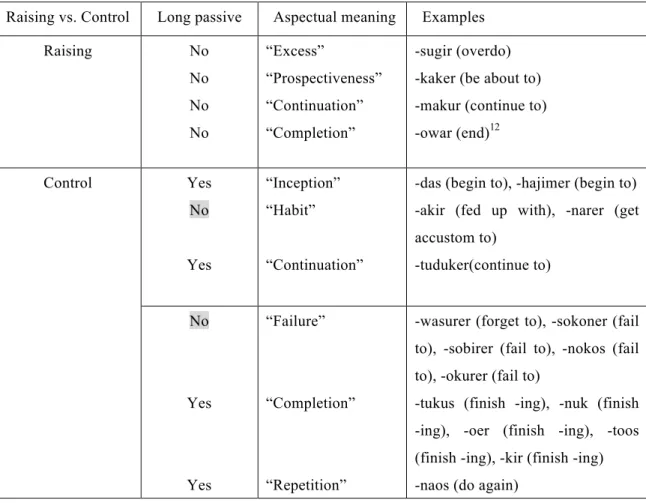
Before getting into this point, I would like to look briefly at the correlation between V-V compounds and the raising-control dichotomy. As seen in (11) in the previous section, all verbs considered as raising in the literature are unpassivizable, whereas almost all verbs, considered as control, are passivizable. This correlation is illustrated in Table 5.
61
Table 5 Correlation between V-V compounds and the raising-control dichotomy Raising vs. Control Long passive Aspectual meaning Examples
Raising No No No No “Excess” “Prospectiveness” “Continuation” “Completion” -sugir (overdo) -kaker (be about to) -makur (continue to) -owar (end)12 Yes No Yes “Inception” “Habit” “Continuation”
-das (begin to), -hajimer (begin to) -akir (fed up with), -narer (get accustom to) -tuduker(continue to) Control No Yes Yes “Failure” “Completion” “Repetition”
-wasurer (forget to), -sokoner (fail to), -sobirer (fail to), -nokos (fail to), -okurer (fail to)
-tukus (finish -ing), -nuk (finish -ing), -oer (finish -ing), -toos (finish -ing), -kir (finish -ing) -naos (do again)
Since the raising verbs take the unaccusative structure, it is plausible that they do not allow long passiviztion. The main puzzle here is concerned with the control verbs that cannot allow long passive even though they take the transitive structure13. The “-narer (get accustomed to)” and “-akir (get fed up with) can be considered as control type14; nevertheless, they do not allow long passive. This impossibility of long passive can be explained by the lack of the accusative feature of “-narer” and “-akir”. Indeed, they do not assign the accusative case to their objects as shown in (12).
12 Since “-owar (end)” shows both raising and control properties, it calls for more detailed discussion. See
Kishimoto (2013) and Oprina (2014) for the particular status of “-owar”.
13 Notice that we cannot resolve this problem by arguing that they have a complex structure because of their
restructuring status. We will revisit this point later on.
14 Their control status can be seen in sentence with inanimate subject.
(i) *Keitai-ga nari -narer/akir -ta. cellphone-NOM call -get accustomed to/fed up with -PST
This fact shows that “-narer” and “-akir” assign the θ-role to external argument, and this is considered as a one of the control verb status. However, one may doubt this diagnostic, and consequently their control status. Indeed, Zushi (2008) argues against this diagnostic. According to Zushi, given that selectional restriction is closely related to the verb’s meaning, this might be more appropriately treated in semantic terms, rather than syntactic terms such as θ-role assignment (Zushi 2008: 347). If this is correct, we can take these verbs to be unaccusative (or raising) to some extent. In such cases the long passive is impossible because they do not take a transitive structure.
62
(12) Taroo-wa hihan-ni/*o narer/aki -ta. T-TOP criticism-DAT/*ACC be accustomed to/get fed up with -PST (cf. *Hihan -ga narer/akir -rare -ta.) ctirticism-NOM be accustomed to/get fed up with -PASS -PST
If we accept this argument, the veritable problem here is the behavior of verbs grouped as “failure” such as “-wasurer (forget to). These verbs have accusative case, and they can be passivized when they are used as main verbs as exemplified in (13)~(15).
(13) a. Taroo-wa yakusoku-o wasurer -ta. T-TOP promise-ACC forget -PST ‘Taro forgot his promise.’
b. Yakusoku-ga wasurer -rare -ta. promise-NOM forget -PASS -PST ‘The promise was forgotten.’
(14) a. Sono koya-ga kesiki-o sokoner -teir -u. that hut-NOM scenery-ACC spoil -PROG -PRS ‘That hut spoils the scenery.’
b. Kesiki-ga sokoner -rare -teir -u. scenery-NOM spoil -PASS -PROG -PRS ‘The scenery is spoiled.’
(15) a. Taroo-ga memo-o nokos -ta. T-NOM note-ACC leave -PST ‘Taro left a note.’
b. Memo-ga nokos -rare -ta. note-NOM leave -PASS -PST ‘A note was left.’
Here, notice that the θ-role of the “Failure” verbs is “experiencer” rather than “agent”. Therefore, one can suggest that the impossibility of long passive shown in these verbs is due to the difference in θ-roles. However, this is not plausible because the passivization is possible with these verbs, as seen in (13b)~(15b).
What is clear so far is that the long passives of syntactic V-V compounds are directly concerned with the nature of V2, i.e., unaccusative structure and accusative case. Nevertheless, the explanation based on the status of V2s is not sufficient. In what follows, therefore, I propose that long passive can be explained based on the V2s’ syntactic positions, focusing on V-V compounds
63
that were considered as control verbs in the previous studies.
Let us now return to the restructuring discussed in section 3. The syntactic V-V compounds are closely concerned with restructuring. Their restructuring status can be examined with N(egative) P(olarity) I(tem) such as “sika (only)” or with nominative object in potential construction (Kato 1985; Miyagawa 1987; among others). The NPI “sika” requires negative suffix “nai” in the same clause, and likewise the nominative object requires the clausemate potential suffix as in (16) and (17).
(16) a. [Taroo-wa [hanako-ga yasai-sika taber-nai] koto-o sitteir-u.] T-TOP hanako-NOM vegetable-only eat -NEG COMP-ACC know-PRS b. *[Taroo-wa [hanako-ga yasai-sika taber-u] koto-o sira -nai.] T-TOP hanako-NOM vegetable-only eat -PRS COMP-ACC know-NEG (17) a. [Taroo-wa [hanako-ga yasai-ga taber -rarer -u]
T-TOP hanako-NOM vegetable-NOM eat -POTEN -PRS koto-o oboeteir -u]
COMP-ACC remember -PRS
b.*[Taroo-wa [hanako-ga yasai-ga taber -u] T-TOP hanako-NOM vegetable-NOM eat -PRS
koto-o oboer -rarer -u.] COMP-ACC -remember -POTEN -PRS
With these diagnostics, we can reveal the restructuring status of syntactic V-V compounds. The results are given below:
(18) a. ?[Taroo-wa [syoosetu-sika yomi] -wasurer/sokoner/sobirer/nokos/okurer -nai]. T-TOP novel-only read -forget to/ fail to -NEG b. [Taroo-wa [syoosetu-sika yomi]-tukus/nuk/oer/toos/kir -nai
T-TOP novel-only read -finish -ing -NEG (19) a. ?[Taroo-wa [syoosetu-ga
T-TOP novel-NOM
yomi] -wasurer/sokoner/sobirer/nokos/okurer -rare -nai].15 read -forget to/ fail to -POTEN -NEG
b. [Taroo-wa [syoosetu-ga yomi]-tukus/nuk/oer/toos/kir -rare -nai]. T-TOP novel-NOM read -finish -ing -POTEN -NEG
15 The (24a) and (25a) nay sound slightly strange, but it is due to the semantic incompatibility of “Failure” with
64
Long passive, interestingly, is attested in Italian as well (Bruzio 1986; Cinque 2006 among others). Let me here consider Cinque’s (2006) account.
In his account, restructuring verbs are indeed functional verbs that are generated in the head position of universal hierarchy of functional heads. This hierarchy is investigated in Cinque (1999). He argues that the long passive in Italian can be explained following this hierarchy. He maintains that the hierarchical relation between Voice and functional heads where the restructuring verb is generated can explain the long passive. His proposal is given below:
If, following current assumptions, we assume that for a verb to be passivized it must raise to Voice , either overtly or covertly, to pick up passive morphology (alternatively, to check the features of its passive morphology), it follows that only those verbs that are generated lower than Voice will be passivizable.
(Cinque 2006: 69)
In what follows, we put aside the discussion on the functional status of the V-V compounds, and deal with the syntactic structure of V-V compounds16. As with the Japanese long passive, the Italian long passive cannot be explained by its accusative feature as shown in (20).
(20) a. *Fu provato ad aggiustare (da Gianni). (Lit.)It was tried to mend (by Gianni). b. *Non fu riuscito a vedere da nessuno. (Lit.)It wasn’t managed to see by anybody. c. La casa fu finita di costruire il mese scorso. (Lit.)The house was finished building the last month.
d. Quelle case furono iniziate/cominciate a costruire negli anni ’20. (Lit.)Those houses were started to build in the ’20s.
(Cinque 2006:67-68)
The “provare (try)” in (20a), for example, can assign accusative case to its object17, but it remains unpassivizable: whereas “finire (finish)” in (20c) can be passivized. Cinque argues that this difference can be deduced from the hierarchy as illustrated in (21).
16 This in no way implies that the status of V2s of V-V compounds are insignificant, on the contrary, it is essential
in comparing the restructuring verbs between Japanese and Italian. I assume that all of the V2 of syntactic V-V compounds are functional to some extent. However, I leave this problem open for future research because of its complicated nature. The functional status of some Japanese aspectual verbs is explored especially in Fukuda (2012).
17 Notice that we concentrate only on descriptive aspect of these verbs. Strictly speaking, the restructuring verbs
65 (21) Aspconative>Voice>Aspcompletive
This means that verbs such as “finire”, which are below “Voice” are long passivized, whereas verbs such as “provare” cannot be long passivized because they are above “Voice”.
Adapting Cinque’s account, I propose that the long passive attested in also Japanese V-V compounds can be explained by their positions in syntactic structure. In other words, the unpassivizable verbs are generated above Voice, on the other hand, passivizable ones are place below Voice.
In section 4, I examined the aspectual status of syntactic V-V compounds. It is reasonable to think that “Failure”, “Inception”, “Continuation”, “Completion” and “Repetition” correspond with Cinque’s Aspfrustrative/success, Aspinceptive, Aspcontinuative, Aspcompletive, Asprepetitive respectively. Based on
the observations of long passive of these V2s, we can assume the hierarchy as in (22).
(22) Aspfrustrative/success>Voice>Aspinceptive, Aspcontinuative, Aspcompletive, Asprepetitive
If this is correct, the syntactic structure of the V-V compounds varies as proposed in many other previous studies (Kageyama 1993; Nishiyama and Ogawa 2010; Yumoto 2005 among others). One may ask the validity of this structure, but we have good reason to assume a wide range of syntactic structures for V-V compounds as in (22). Let us consider the syntactic array of Italian restructuring verbs investigated by Cinque; as illustrated in (23). It is worth noting that the long passivizable aspectual verbs in Italian verbs are similar to the Japanese one where the Aspfrustrative/success is
generated above Voice, whereas the Aspinceptive, Aspcontinuative, Aspcompletive, Asprepetitive are placed
below it. We can then take this similarity to be a result of universal hierarchy of functional heads18.
(23) Aspfrustrative/success>...>Voice>...>Aspinceptive>Aspcontinuative>Aspcompletive>Asprepetitive19
To summarize, if we assume this structure, we can explain not only the long passive in syntactic
18 Since this paper does not deal with “functionality” of Japanese V-V compounds, one may ask whether we can
adapt Cinque’s (2006) theory. Even though I do not look at the detailed status of V-V compounds, it stands to reason to adopt Cinque’s theory because they can be functional to some extent, as is often discussed in recent works. We, of course, have to discuss to what extent they are considered as “functional”, but I leave this problem forfuture research.
19 This hierarchy predicts that Asp
inceptive, Aspcontinuative, Aspcompletive, Asprepetitive can be long passivized. For the
Aspinceptive, Aspcontinuative, Aspcompletive, this prediction is borne out; however, for the Asprepetitive, this is not borne out.
Consider following examples: (i) a. La casa fu ricostruito. the house was rebuilt
b. *Quelle case furono tornate a costruire. these houses were again to build
The (ia) follows the prediction brought forth by Cinque’s hierarchy; however, one may attribute this long passivizability to the morphological integrity of prefix “ri-”. As shown in the (ib), the sentence with another repetitive aspect illustrated in Cinque (2006) blocks the long passive. I leave this question open.
66
V-V compounds but also the similarity in two languages concerning restructuring verbs.
6. Concluding remarks and remaining issues 6.1 Conclusion
In this paper I have discussed the phenomenon called long passive which is attested in some Japanese syntactic V-V compounds. The previous studies explained the long passive focusing on the type of structures (especially raising vs. control dichotomy) or the accusative feature of V2 in previous works. In this paper, however, I have shown some examples that the earlier analyses cannot account for, and I have assumed that the V2s of V-V compounds are generated in the various syntactic positions so as to explain the long passive. My proposal relies considerably on Cinque (2006)’s discussion about restructuring verbs, and I maintain that there exists a certain syntactic similarity in both Japanese and Italian. This research aims to shed light on the universal hierarchy of functional heads investigated by Cinque (1999); and consequently additional exploration into intrinsic status of compounds is required20.
6.2 Remaining issues
There remain at least two issues, which are as follows:
(24)
(i) Can the structure revealed in this paper explain other linguistic phenomena in Japanese? (ii) Why do the syntactic differences in syntactic V-V compounds exist?
As regards to (24i), we have to elucidate what the structure proposed in this paper predicts. The syntactic V-V compounds are discussed with many other linguistic phenomena such as honorific suffixes, short passive, scope interaction with certain focus markers and so forth.
Long passive with other complex predicates such as “-te ik (V-TE go)” can help to reveal syntactic structure of complex predicates. The motion verb “-te ik” allows the long passive as in (25a), and, interestingly, some Italian motion verbs allow the long passive as well as illustrated in (25b).
(25) a. Sono hon-wa Taroo-ni mot -te -ik -are -ta. that book-TOP Taroo-BY bring -TE -go -PASS -PST ‘(Lit.) That book was taken by Taro’
20 In this paper, the other syntactic V-V compounds that do not allow the long passive are not well investigated. It
is possible that we can appropriately treat their unpassivizability based on Cinque’s (2006) hierarchy, but I leave this question open because it is still unclear what V-V compounds correspond to where in Cinque’s hierarchy.
67 b. Sarete passati a prendere più tardi. be pass to fetch later
‘(Lit.) You will be passed to fetch later.’ (Cinque 2006: 68)
As for (24ii), we have to demonstrate the reason why the structure proposed in this paper exists. This question is directly connected to the status of V2 in V-V compounds; namely lexical vs. syntactic status of V2. As has already proven in previous studies, the V2s of V-V compounds behave differently from “canonical” verbs in a way. Even though previous works noticed the difference to some extent, they do not pay special attention to it. Fukuda (2012), however, discussed the functionality of Japanese aspectual verbs taking into consideration four aspectual verbs: “-hajimer (begin to)”, “-tuduker (continue to), “-owar (end)” and “-oer (finish-ing)”. His proposal can provide us with a fruitful insight. He rejects the traditional dichotomy between raising and control, and proposes that the four aspectual verbs are functional elements generated above or below Voice. The gist of his proposal is that the aspect placed below Voice (in L(ow)-Asp(ect) in his term) are related to the “telicity” of an event. As a result of this trait, the aspectual verbs in the L-Asp select for telic events as their complements. According to Fukuda, “-hajimer” and “-tuduker” place both above (H(igh)-Asp(ect)) and below Voice, and he provides some examples where L-Asp require telic events as their complements. The examples are given below:
(26) a. *Taroo-ga situkoi kisya-ni oikaker -tuduker -rare -ta. T-NOM persistent reporter-BY chase -continue -PASS -PST ‘(Lit.) Taro was continued to chase by the persistent reporter.’ b. *Seifu-ga kokumin-ni hihansur -hajimer -rare -ta21. government-NOM citizens-BY criticize -begin -PASS -PST ‘(Lit.) The government was begun to criticize by citizens’
(Fukuda 2012: 992)
Since the verb “oikaker (chase)” and “hihansur (criticize) ” denote an atelic event, they cannot co-occur with L-Asp, which selects telic events as its complement phrase. His idea holds true of other verbs that he does not treat. The verb “-naos (do again)”, for example, seems to show the same property as Fukuda’s L-Asp as shown in (27). The (27a) is unacceptable because the verb “-sikar (scold)” denotes an atelic event. In (27), on the other hand, the telic verb “-kak (write)” is used, so the sentence is acceptable.
21 The aspectual verbs are passivized in these examples in order to avoid the H-Asp possibility of “-hajimer (begin
68
(27) a. *Taroo-wa sensei-ni shikar -naos -rare -ta. T-TOP teacher-BY scold -do again -PASS -PST ‘Taro was scold by his teacher again.’
b. Ronbun-ga sensei-niyotte kaki -naos -rare -ta. article-NOM teacher-BY write -do again -PASS -PST ‘The article was rewritten by the teacher.’
One may question the telic property of “-naos” because it denotes repetition, which seems to be irrelevant to telicity. However, if we consider the meaning of “repetitive aspect”, it stands to reason that the “-naos” is related to telicity because “doing something again” requires “finishing doing something in advance”.
In addition to “-naosu”, other verbs such as “-hajimer (begin to)”, “-tuduker (continue to)” and “-oer (finish doing), that is, verbs placed below Voice, may be related to telicity. In other words, these verbs are below Voice because of this telicity.
The verbs that are generated above Voice, on the other hand, are grouped as “failure”. The reason why these verbs are generated above Voice can be explained from the fact that they assign “experiencer” to their external argument rather than “agent”; nevertheless the true reason is still unclear. I leave this question for future research.
References
Burzio, Luigi (1986) Italian Syntax. Dordrecht: Reidel.
Cinque, Guglielmo (1999) Adverbs and Functional Heads: A Cross-Linguistic Perspective. Oxford: Oxford University Press.
Cinque, Guglielmo (2006) Restructuring and Functional Heads, Oxford Studies in Comparative Syntax:
The Cartography of Syntactic Structures, Vol. 4. Oxford: Oxford University Press.
Fukuda, Shin (2012) Aspectual Verbs as Functional Heads: Evidence from Japanese Aspectual Verbs.
Natural Language & Linguistic Theory 30-4: 965-1026.
Grano, Thomas (2012) Control and Restructuring at the Syntax-Semantics Interface. PhD dissertation, University of Chicago, Chicago.
Kageyama, Taro (1993) Bumpo to Gokeisei [Grammar and Word formation]. Tokyo: Hituji shoboo. Kageyama, Taro (1999) Word formation. In: Natsuko Tsujimura (ed.), The Handbook of Japanese
Linguistics, 297-325. Oxford: Blackwell.
Kato, Yasuhiko (1985) Negative Sentences in Japanese. Tokyo: Sophia Linguistics 19.
Kishimoto, Hideki (2013) Togoteki hukugo dooshi no kaku to toogotokusei [Case of Syntactic Compounds and Syntactic Properties]. In: Kageyama Taro (ed.), Fukugoo dooshi kenkyuu no
69
shoboo.
Matsumoto, Yo (1996) Complex Predicates in Japanese: A Syntactic and Semantic Study of the Notion
‘word’. Tokyo and Stanford: Kurosio and CSLI.
Miyagawa, Shigeru (1987) Restructuring in Japanese. In: Takashi Imai and Mamoru Saito (eds.), Issues
in Japanese linguistics, 273-300. Dordrecht: Foris.
Nishigauchi, Taisuke (1993) Long distance passive. In: Nobuko Hasegawa (ed.), Syntax in Japanese
Comparative Grammar, 79-114. Tokyo: Kurosio.
Nishiyama Kunio, Yoshiki Ogawa (2010) Auxiliation, Atransitivity, and Transtivity Harmony in Japanese V-V Compounds. Studies in Language Sciences, Special issue: 239-291.
Oprina, Florin D. (2014) V-V predicates and Restructuring. In: Hideki Kishimoto and Yoko Yumoto (eds.), Fukuzatsu jyutsugo kenkyuu no genzai, 149-175. Tokyo: Hitsuji shoboo.
Rizzi, Luigi (1990) Relativized Minimality. Cambridge: MIT Press.
Wurmbrand, Susanne (2001) Infinitives: Restructuring and Clause Structure. Berlin: Mouton de Gruyter.
Wurmbrand, Susanne (2004) Two types of restructuring-Lexical vs. functional. Lingua 114-8: 991-1014.
Yumoto, Yoko (2005) Fukugoo dooshi, haseidooshi no imi to koozoo [Syntax and Semantics of Verbal
Compounding and Pray-alien]. Tokyo: Hitsuji shoboo.
Zushi, Mihoko (2005) Deriving the similarities between Japanese and Italian: a case study in comparative syntax, Lingua 115: 711-752.
Zushi, Mihoko (2008) Some remarks on the lexical nature of restructuring predicates. English
Linguistics 25: 340-363. AKUZAWA Koyo
70