The effect of a partial relaxation of the
school-district system on land prices and
academic performance: An empirical analysis in
Japan
著者
Kuroda Yuta
journal or
publication title
DSSR Discussion Papers
number
91
page range
1-26
year
2018-12
URL
http://hdl.handle.net/10097/00124281
Data Science and Service Research
Discussion Paper
Discussion Paper No.91
The effect of a partial relaxation of
the school-district system on land prices and
academic performance:
An empirical analysis in Japan
Yuta Kuroda
December, 2018
Center for Data Science and Service Research
Graduate School of Economic and Management
Tohoku University
27-1 Kawauchi, Aobaku
Sendai 980-8576, JAPAN
1
The effect of a partial relaxation of the school-district
system on land prices and academic performance:
An empirical analysis in Japan
*
Yuta Kuroda
†Abstract
This study investigates the extent to which gradual and partial relaxation of the school-district system for public high schools impacts land prices and student academic achievement. In Matsue City, Japan, students from outside the school district were strictly prohibited from enrolling in general public schools. For many years, students who lived beyond the district boundary were unable to attend the most academic high school that prepared students to apply to high-status universities. In 2008, however, the school-district system was eliminated in the top academic track, where students were preparing to apply to prestigious universities. In the general track, up to 5% of all prospective candidates were allowed to enroll from outside the school district. Since 2016, the percentage of students allowed to enroll from outside the school district has risen to 20%. The present study applies hedonic land-price models using the fixed-effect approach, together with panel data from 2003 to 2018 and a regression discontinuity approach focusing on the boundary of the school district. The findings show that relaxing the school-district system significantly reduced land-prices within school districts with high-quality high schools. This suggests that relaxing the school-district system may reduce the value attributed to living in a high-quality school district. The impact of this change on the number of candidates successfully applying to universities is also analyzed. Although partial relaxation of the school-district system will expand the disparity of the ratio of successful applicants attending prestigious universities, the ratio of students attending national universities or all universities does not change. This implies that a partial relaxation of the system may affect only highly academic students.
Keywords: Land prices, School quality, School district, School choice JEL classifications: R30, I20, I21, I28
* I would like to thank my advisor Kentaro Nakajima, as well as Midori Wakabayashi and Akira Hibiki. All remaining errors are my own.
† Graduate School of Economics and Management, Tohoku University, Sendai 980-8576, Japan. Email: [email protected]
2
1. Introduction
There have been many discussions about abolishing the school-district system and introducing a system of school choice; commentators have argued that adding market mechanisms to public education will allow it to operate more efficiently (Ladd, 2002). Several studies have explored the effect of changes in the school-district system on school-choice behavior, the educational market, and academic performance (e.g., Belfield and Levin, 2002; Rouse and Barrow, 2009). In addition, since public services, including public schools, are closely associated with residential-choice behavior, there have been many studies on the relationship between the school-district system and the property market (Black and Machin, 2011; Nguyen-Hoang and Yinger, 2011). However, relatively few studies have investigated the effect of changes to the school-district system on the property market.
Since abolishing the school-district system and introducing school choice reduces the importance of living in school districts with high-quality schools, the relationship between school quality and property prices may weaken. Fack and Grenet (2010) have investigated the relationship between school quality and house prices in the city of Paris. Their results suggest that an increase in one standard deviation of public-school performance raises housing prices by 1.4 to 2.4%; this effect decreases as more private schools become available in the neighborhood. Machin and Salvanes (2015) have shown that an abolition of the school-district system in Oslo County will reduce the impact of school quality on housing prices by less than half. Chung (2015) has explored the impact of school-choice reforms on housing prices in the Seoul metropolitan area. He found that school-choice systems reduce housing prices in high-quality school districts, relative to housing prices in low-quality school districts.
These empirical studies show consistent results: relaxing the school-district system weakens the relationship between school quality and property prices, and reduces the value of property in school districts with high-quality schools. However, since various types of school systems have been analyzed, producing a range of different impacts, various areas and systems are necessary for policy evaluation. Therefore, this study aims to investigate the effect of a partial relaxation of the school-district system on the relationship between property prices and student academic performance.
This study focuses on the school district of Matsue City, Japan, where the system was partially relaxed, to explore the extent to which this change affected the relationship between school quality and land price. Before 2008, Matsue City strictly prohibited students at general public schools outside the city school district from enrolling in an academic high school that specialized in preparing students for university. In 2008, however, the school-district system was eliminated for some high-level pre-university courses. Even in general courses, approximately 5% of students could be admitted from outside the school district. In 2016, the percentage of outside students was raised to
3
20%. This institutional change may weaken the relationship between high-school quality and land prices and may decrease the value of property in school districts with particularly good schools. To estimate the impact of this change, I have drawn on hedonic models of land prices using the fixed-effect approach and panel data from 2003 to 2018, as well as a regression discontinuity approach focusing on the school-district boundary. Using land-price panel data and a controlled fixed effect avoids the problem of unobserved confounding factors. Furthermore, following Black (1999), this study controls for unobserved neighborhood characteristics by comparing land near the boundary of the school district.
This study, in line with previous studies, shows that land prices decrease significantly when the school-district system is relaxed. As a regression discontinuity design, focusing on the school-district boundary, produces the same result, the main result is clearly robust. These findings also show that partially relaxing the school-district system will expand the disparity of the ratio of applicants successfully applying to prestigious universities, but not of applicants to other universities, including national universities. This implies that relaxing the school-district system may only affect particularly good students because the change is partial.
In relation to previous research, this study makes several contributions to the literature. First, it analyzes the impact on specific groups of students, focusing both on partial changes to the school-district system and on the number of successful university candidates. If school-district system is completely eliminated, many types of students are affected simultaneously. It is therefore difficult to identify which types of students have improved their academic performance, even when overall school performance has improved. In addition, previous studies have used variables based on average school quality, such as test scores or deviation values; such studies are unable to pinpoint the types of students actually affected. To provide more precise data, the present study focuses on a partial relaxation of the school-district system, affecting a limited group of students. Thus, we are able to compare affected and unaffected students, deriving a more precise estimate of the impact of relaxing the school-district system. Furthermore, by using the ratio of successful candidates admitted to each university from each high school as an index of high-school quality, the present study clearly shows that only specific students have been affected.
Second, this study deals with various potential concerns by focusing on a city in which the school district includes multiple public schools in a narrow area, with no high-quality private schools. In cases where the school district is expansive or there are few modes of transportation, eliminating the school-district system may have no effect on student behavior. When commuting is very expensive, students may attend schools close to home, even if they are offered a choice in the matter. The present study therefore focuses on a small school district with many different forms of transportation, avoiding the need to address commuting costs and similar concerns. As there are no excellent private schools, the effect of changing the school-district system is not diluted by private schools in the
4 targeted area.
The structure of this paper is as follows: Section 2 reviews the previous literature and explains the contribution made by this study. Section 3 provides institutional background and Section 4 describes empirical strategies. Section 5 discusses the school-district system and the data. After Section 6 presents the results and discussion, Section 7 concludes the paper.
2. Literature review
Many studies have considered the effect of school quality on the property market; consistent results have indicated that school quality has a significant positive effect on the price of housing or land (Black and Machin, 2011; Nguyen-Hoang and Yinger, 2011). Consistent results have also been obtained in Japan; in areas with school district systems, school quality is capitalized by property prices (Kuroda, 2018; Yoshida, Zhang and Ushijima, 2008). Izumi (2010) has investigated the Matsue City high-school district used in this study, showing that land prices in a district with high-quality schools are high, even after controlling for fixed effects.
Among studies that have investigated the impact of eliminating school districts or introducing a school-choice system on residential choice behavior or the property market, most studies have been theoretical, using a general equilibrium model (e.g., Nechyba, 2000; Ferreyra, 2007). In recent years, however, empirical research has also accumulated. Reback (2005) has explored the declining importance of the school district, following the adoption of a school-choice program in Minnesota. He has shown that residential property values increase in areas where students can transfer to outside school districts, while significantly decreasing in school districts that accept transfer students. Brunner, Cho, and Reback (2012) have also shown that introducing school choice increases population density in previously low-quality areas and reduces population density in previously high-quality areas. Chung (2015) has investigated the impact of school-choice reforms on housing prices in the Seoul metropolitan area, discovering that school choice reduces house prices in high-quality school districts, relative to house prices in low-quality school districts, by approximately 10-27%.
As these studies show, school choice reduces the importance of living in a high-quality school district. Specifically, Machin and Salvanes (2015) have found that the effect of school quality on housing prices dropped to less than half its previous level when the school-district system was abolished in Oslo County. Schwartz, Voicu, and Horn (2014) have shown that introducing a choice school reduces the value of schools capitalized to housing values to one-third of the previous amount. Fack and Grenet (2010) have focused on private schools instead of school-choice system, using Parisian data. They have shown that increasing the standard deviation of public-school quality increases house prices by 1.4–2.4%, although this effect
5
decreases as more nearby private schools become available.
Some studies have analyzed the effect of school-choice system using Japanese data. Yoshida, Zhang, and Ushijima (2008) have shown that introducing school choice weakens the effect of school quality on land prices. Nakamura (2009), Yoshida, Kogure, and Ushijima (2009) have analyzed the extent to which introducing public-school choice affects student sorting and academic performance. Their study did not obtain consistent results on the effect of school-choice systems on academic ability; they also find that disparity between schools did not expand. However, their results may have been weakened by the large number of private schools in Tokyo, a subject analyzed by previous Japanese studies.
The present study makes the following contributions to the literature. First, it analyzes the effect of school choice on specific groups of students, using both partial changes to the school-district system and the number of successful university candidates. If a school-district system is completely eliminated, all the students are affected simultaneously, making it impossible to tell which groups of students have improved in relation to the school’s overall improved performance. To address this problem, the present study uses the partial relaxation of the school-district system, which affects a limited number of students. In this study, only academically advanced students had access to school choice; many average students were not affected. Previous studies have used variables that measure overall school quality, such as test scores or deviation values; these cannot identify the types of students affected. By contrast, this study uses the ratio of candidates who successfully apply to prestigious universities from each high school as an index of high-school quality. It identifies different reactions in relation to the students’ level of academic achievement, distinguishing students who are affected and unaffected by the partial relaxation of the school-district system and enabling a precise estimate of the effect.
Second, the present study deals with various potential concerns by focusing on a city in which the school district includes multiple public schools in a narrow area, with no high-quality private schools. In areas where the school district is expansive, or transportation is scarce, eliminating the school-district system may have no effect on student behavior. When the commuting costs are high, students may not attend schools which far from their home, even if they are allowed to choose. This study therefore focuses on small school district with abundant means of transportation, eliminating the need to address commuting costs. Moreover, as this area has no private schools to compete with targeted public schools, they cannot weaken the school-district system. Additionally, by focusing on public high schools, it is likewise unnecessary to consider differences in school fees. It is therefore relatively straightforward to estimate the impact of changing the school-district system.
6
3. Institutional backgrounds
This section explains the school-district system in the targeted area. Matsue City is a regional city in southwest Japan. As of 2018, the population is approximately 200,000 and the density is approximately 390 per square meters. There are three general high schools1 in this city, which is
divided into Kita (north), Minami (south), and Higashi (east) high-school districts. High-school enrolment has been determined by residential area. Following the establishment of the third high school in 1983, this school-district system was fully maintained until 2008. With the merger of municipalities around 2000, the authorities discussed a plan to reorganize or abolish the school-district system. They agreed on a compromise plan: to partially relax the school-district system. The system was abolished altogether for "science and mathematics courses."2 In general
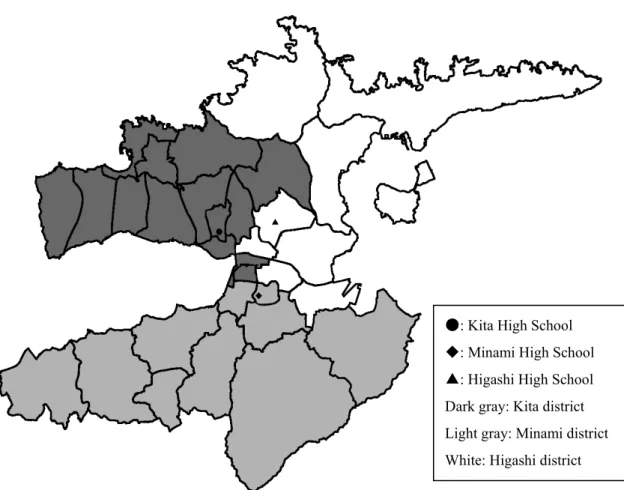
courses, it was decided that 5% of students would come from outside the school district. There were two mathematics and science courses, one each in the Kita and Minami High Schools; each class had 40 students. Approximately 900 students enroll in general courses at ordinary high schools. Of these, 5% come from outside the school district, corresponding to approximately 45 students. In fiscal 2016, the ceiling for enrollment from outside the school district rose to 20%, equivalent to 180 students. Figure 1 shows the school districts of general high schools in Matsue City. It is easy to commute within this area; if the school district is abolished, will be possible for students from any area to attend any high school.
As this paper will describe later, students at Kita High School have particularly high-level academic ability, while those at Higashi and Minami High Schools are roughly the same. For this reason, the Kita high-school district may attract more demand than the other two school districts. In Matsue City, some real-estate agencies advertise "Kita high-school district" as a strong point when selling property. In the Kita district, property may have been more expensive than in the Minami and Higashi school districts. However, due to the relaxation of the school-district system, students wishing to attend Kita High School do not necessarily have to live in the district. It follows, therefore, that relaxing the school-district system is likely to reduce land prices in the Kita high-school district.
In this case, since the school district system has been partially, rather than completely, relaxed, the effect may be relatively weak. The students affected will have exceptional academic ability and may also have high-income families with an academic background or enthusiasm for education. Yoshida, Kogure, and Ushijima (2009) have suggested that households with stronger educational backgrounds
1 In Japan, general high schools aim to prepare students to go to college after graduation; their role differs from that of vocational (e.g., industrial, commercial, or agricultural) high schools, which try to help students find employment after graduating.
2 Although this course focuses on science and mathematics, the students do not necessarily go to science-based universities after graduating. In Japanese local cities, this course is recognized as helping students attend prestigious universities.
7
and higher incomes may exhibit more selective behavior in relation to education. If so, the impact on land prices will be significant, even in the case of a partial relaxation.
Figure 1. High School Districts in Matsue City
4. Empirical strategies
The effect of school quality on land prices is estimated via a hedonic regression, using the fixed effect approach on panel data from 2003 to 2018. The interaction terms, "school district dummy" and "institution change dummy" are regressed on land prices, with various control variables included. The basic estimate equation is as follows:
●: Kita High School ◆: Minami High School ▲: Higashi High School Dark gray: Kita district Light gray: Minami district White: Higashi district
8 ln 𝑃𝑃𝑖𝑖𝑖𝑖𝑖𝑖𝑖𝑖= 𝛼𝛼 + � 𝛽𝛽1𝑖𝑖 2 𝑖𝑖=1 𝑆𝑆𝑆𝑆ℎ𝑜𝑜𝑜𝑜𝑜𝑜𝑖𝑖∙ 𝐶𝐶ℎ𝑎𝑎𝑎𝑎𝑎𝑎𝑎𝑎𝑖𝑖+ � 𝛽𝛽2𝑖𝑖 2 𝑖𝑖=1 𝑆𝑆𝑆𝑆ℎ𝑜𝑜𝑜𝑜𝑜𝑜𝑖𝑖+ � 𝛽𝛽3𝑛𝑛 2 𝑛𝑛=1 𝐶𝐶ℎ𝑎𝑎𝑎𝑎𝑎𝑎𝑎𝑎𝑛𝑛𝑖𝑖+ 𝛾𝛾𝛾𝛾𝑖𝑖+ 𝛿𝛿𝑌𝑌𝑖𝑖 + 𝜇𝜇𝜇𝜇𝑖𝑖𝑖𝑖+ 𝜀𝜀𝑖𝑖𝑖𝑖𝑖𝑖
where 𝑃𝑃𝑖𝑖𝑖𝑖𝑖𝑖 is the price of land i in high-school district a in year t. The vector 𝛾𝛾𝑖𝑖 includes
characteristics of the land, such as the distance from the nearest station or the floor-area ratio, or it indicates land fixed effects that control time-invariant unobserved characteristics. Vector 𝑌𝑌𝑖𝑖
indicates the year fixed effects; 𝜇𝜇𝑖𝑖𝑖𝑖 controls the unique trend of central urban area j; 𝑆𝑆𝑆𝑆ℎ𝑜𝑜𝑜𝑜𝑜𝑜𝑖𝑖 is a
dummy variable representing the school districts of three public schools in Matsue City, and indicates 1 if the land located within the school district. Three high schools in Matsue City focus on preparing students to apply to university. One of them (Kita High School) is excellent, while the other two (Higashi High School and Minami High School) are comparable and less academic. The present study analyzes the coefficients of "Kita" and "Minami" high school dummies, with Higashi High School as the baseline. 𝐶𝐶ℎ𝑎𝑎𝑎𝑎𝑎𝑎𝑎𝑎𝑛𝑛𝑖𝑖 is a dummy variable representing 1 after changing the
school-district system, n = 1 indicates change in 2008, n = 2 indicates change in 2016. In 2008, school choice was added for one high-level pre-university course (the "science and mathematics course." In the general course, 5% of all students could be enrolled from outside the school district after 2008. This enrolment ceiling was raised to 20% in 2016. In other words, the coefficient 𝛽𝛽1𝑖𝑖 of
the interaction term shows how the price of land in each school district changed, following changes to the school-district system.
The present study also applies a regression discontinuity design to deal with unobservable characteristics that cannot be controlled by land fixed effects. The vector of observed characteristics is replaced with boundary dummies, which indicate land that shares a boundary and uses restricted data. The sample was limited to land that was close to a boundary. Specifically, I created a subset of apartments located within less than 1000 m, 750 m, and 500 m from the boundary of a school district. Land within the same boundary is assumed to have similar characteristics, such as access to public facilities and amenities. The boundary dummy variables control for any unobserved neighborhood characteristics shared by land on either side of the boundary. They make it possible to compare land that has very similar geographical information. Differences in the value of land are thought to be caused by having a choice of public high school.
5. Data
9
5.1. Land-price data
In this study, "published land prices" and "prefectural land-price research" are used to provide data on land prices. These are appraisal evaluations carried out by real-estate appraisers; as such, they are objective land assessments, independent of sellers and buyers. The same places are evaluated annually and the data include various types of information, such as price-per-square meter, address, and distance from the nearest station. The values reported in published land prices reflect the value of the land on January 1st each year, as estimated by two real estate appraisers. The values reported in prefectural land-price research are estimated on July 1st each year by one real estate appraiser. Although these are different investigations, they use the same the indicators and show almost the same prices at the same points; for this reason, the present study combines these two data sources.
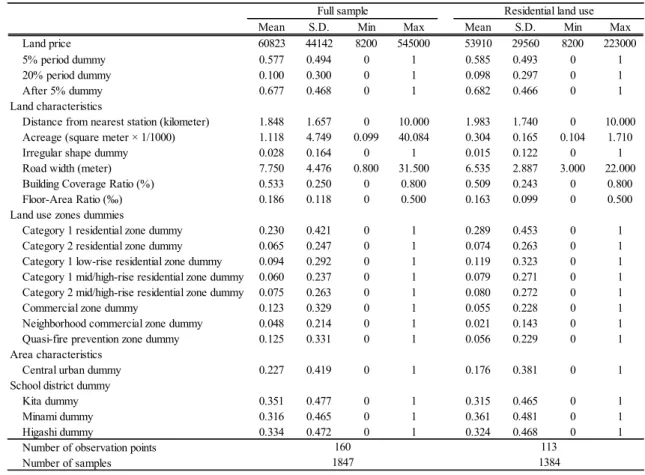
The land data derives from 2002–2018. There is a total of 160 observation points. However, the panel data are unbalanced because they contain several defects. Summary statistics of land data are shown in Table 1, divided into all land and land currently used for residential purposes.3 The "5%
period dummy" is a dummy variable that ranges from 2008 to 2016 (from the first school-district change to the second). The "20% period dummy" is a dummy variable that corresponds to the time period after the second school-district change in 2016. The dummy variable corresponding to the period after the first school-district change in 2008 is the "After 5% dummy.” For the land characteristics, this study uses the distance from the nearest station, acreage, an irregular shape dummy, road width, the building coverage ratio, and the floor-area ratio. Each piece of land has its own use restrictions, known as "Land-Use Zones.” Dummy variables have been set for each regulation. To address the concern that land prices may have different trends around the central urban area and suburbs, I have set a "central urban dummy.”4 Unobserved characteristics that
change over time are controlled by using the interaction terms of the central urban dummy and yearly dummies. Finally, additional dummy variables indicate which school district the land is located in. Matsue City is divided into three equal divisions by three school districts; there is no extreme bias in the observation point. The Higashi school district provides the baseline.5
3 The summary statistics involving samples limited to the school-district boundary are shown in Appendix A.
4 The definitions of “central urban” and “suburban” are based on the “Matsue City Central Area Revitalization Basic Plan” published by Matsue City.
10
Table 1. Summary Statistics
5.2. School data
To create an academic-achievement index by high school, the present study uses data from the "Sunday Mainichi Bessatsu: Koukou no Jitsuryoku (Sunday Mainichi Extra Issue: High School Performance)" issued by The Mainichi Newspapers Co., Ltd. This data set shows the total number of successful applicants from each high school who enroll in each university every year; 2003–2018 data have been used in this study. These data represent successful applicants, not a student who enter to school. If a student is accepted by several universities, he or she is counted more than once. Only university-level information is listed; there is no information on major.
In This study, following Kondo (2014), I use the number of successful candidates in specific university groups. This makes it possible to analyze the impact on a specific student, something that cannot be done using a school-average index, such as the deviation value. In particular, I have identified high-ranking universities and the number of students accepted by each university. The definition of this group is shown in Table 2; and the results by high school are shown in Table 3. As mentioned above, Table 3 shows that Kita high-school students have a particularly high rate of acceptance by high-ranking universities; Minami and Higashi have approximately the same lower rate of acceptance.
Mean S.D. Min Max Mean S.D. Min Max
Land price 60823 44142 8200 545000 53910 29560 8200 223000
5% period dummy 0.577 0.494 0 1 0.585 0.493 0 1
20% period dummy 0.100 0.300 0 1 0.098 0.297 0 1
After 5% dummy 0.677 0.468 0 1 0.682 0.466 0 1
Land characteristics
Distance from nearest station (kilometer) 1.848 1.657 0 10.000 1.983 1.740 0 10.000
Acreage (square meter × 1/1000) 1.118 4.749 0.099 40.084 0.304 0.165 0.104 1.710
Irregular shape dummy 0.028 0.164 0 1 0.015 0.122 0 1
Road width (meter) 7.750 4.476 0.800 31.500 6.535 2.887 3.000 22.000
Building Coverage Ratio (%) 0.533 0.250 0 0.800 0.509 0.243 0 0.800
Floor-Area Ratio (‰) 0.186 0.118 0 0.500 0.163 0.099 0 0.500
Land use zones dummies
Category 1 residential zone dummy 0.230 0.421 0 1 0.289 0.453 0 1
Category 2 residential zone dummy 0.065 0.247 0 1 0.074 0.263 0 1
Category 1 low-rise residential zone dummy 0.094 0.292 0 1 0.119 0.323 0 1
Category 1 mid/high-rise residential zone dummy 0.060 0.237 0 1 0.079 0.271 0 1
Category 2 mid/high-rise residential zone dummy 0.075 0.263 0 1 0.080 0.272 0 1
Commercial zone dummy 0.123 0.329 0 1 0.055 0.228 0 1
Neighborhood commercial zone dummy 0.048 0.214 0 1 0.021 0.143 0 1
Quasi-fire prevention zone dummy 0.125 0.331 0 1 0.056 0.229 0 1
Area characteristics
Central urban dummy 0.227 0.419 0 1 0.176 0.381 0 1
School district dummy
Kita dummy 0.351 0.477 0 1 0.315 0.465 0 1
Minami dummy 0.316 0.465 0 1 0.361 0.481 0 1
Higashi dummy 0.334 0.472 0 1 0.324 0.468 0 1
Number of observation points
Number of samples
Full sample Residential land use
113 1384 1847160
11
Table 2. Results of the University Entrance Examination
Group University
The University of Tokyo Kyoto University Osaka University Nagoya University Tohoku University Hokkaido University Kyushu University Hitotsubashi University Tokyo Institute of Technology
Waseda University Keio University Meiji University Aoyama Gakuin University
Rikkyo University Chuo University Hosei University Gakushuin University Sophia University Kansai University Kwansei Gakuin University
Doshisha University Ritsumeikan University Group C
(prestigious universities in the Kansai region) Group A
(most prestigious universities)
Group B
12
Table 3. Results of the University Entrance Examination
6. Results and Discussions
6.1. Effect on land prices
Table 4 shows the estimated results using residential land.6 Column (1) shows the estimated
results without the dummy variables related to school-district-system changes; it simply indicates the relationship between school quality and land prices. The coefficient of the Kita dummy is positive and significant, which means that a school district where the school caters to students of high academic ability has high land prices. This result is consistent with Izumi (2010). The Minami dummy also shows a positive and significant effect, but the coefficient is small. This result is consistent with the fact that Minami High School is slightly better than Higashi High School. Column (2) shows the result of using the After 5% dummy, showing the effect of the first change of
6 The results of all samples are shown in Appendix C. Since full samples contain industrial sites etc. that are not related to school quality, these results are insignificant. In this study, therefore, land used for residential is mainly used.
Mean S.D. Min Max Kita high school
Number of graduates 325.813 30.709 287 398 Number of successful candidates at group A universities 46.563 14.979 25 81 Number of successful candidates at group B universities 17.625 6.726 4 31 Number of successful candidates at group C universities 89.438 23.685 59 158 Number of successful candidates at national universities 213.750 45.128 132 298 Number of successful candidates at private universities 386.688 62.498 288 559 Total number of successful candidates 600.438 89.803 485 842 Minami high school
Number of graduates 315.125 28.275 275 368 Number of successful candidates at group A universities 12.750 4.576 6 20 Number of successful candidates at group B universities 7.813 5.581 2 21 Number of successful candidates at group C universities 50.063 18.454 26 85 Number of successful candidates at national universities 176.438 28.116 95 232 Number of successful candidates at private universities 351.313 33.295 300 439 Total number of successful candidates 527.750 51.886 443 671 Higashi high school
Number of graduates 247.750 31.717 188 303 Number of successful candidates at group A universities 8.625 5.476 1 16 Number of successful candidates at group B universities 6.563 4.107 1 17 Number of successful candidates at group C universities 28.125 9.232 16 47 Number of successful candidates at national universities 100.250 39.358 10 167 Number of successful candidates at private universities 219.813 33.777 170 290 Total number of successful candidates 320.063 45.984 180 380
13
school-district system in 2008. Column (3) shows the result of using the 5% period dummy and the 20% period dummy, showing the effect of the two system changes in 2008 and in 2016. Columns (2) and (3) suggest that land prices in the Kita high-school district are high and unaffected by the system change. However, the fixed effects of the observation points are not controlled; thus, these results may be biased by unobserved characteristics. For this reason, they have also been analyzed with the land fixed effect controlled. Column (4) shows the result of considering the first system change and controlling the land fixed effects: the intersection term of the Kita dummy and the After 5% dummy show a significant and negative effect, suggesting that relaxing the school-district system decreased the price of land in Kita high-school district. Column (5) incorporates changes to the school-district system in 2008 and 2016, controlling for land fixed effects. This result indicates that land-price decreased significantly when the school-district system was relaxed by 5% in 2008; similarly, land prices decreased again when the system was further relaxed. To summarize the above, high-quality schools have the effect of raising land prices; the effect of school quality on land prices is reduced if the-school district system is relaxed. This result is consistent with various previous studies (e.g., Chung, 2015; Machin and Salvanes, 2015; Schwartz, Voicu, and Horn, 2014).
As for the impact of the main results, the results in Table 4 suggest that the effect of a high-quality school is reduced by about 3% after a change in the school-district system. Considering that land prices in the Kita high-school district were originally 15% higher than other areas, this suggests that the impact of school quality on land prices declined by 20% when the school-district system was relaxed. This seems reasonable; Chung (2015) similarly suggested a decrease of 10–27%.
This result also suggests that even partially relaxing, rather than completely abolishing, school districts can have a significant impact. There are several possible reasons. First, as previously mentioned, people with high levels of academic ability are more likely to focus on school quality and choosing the right school. Whether the school district is completely abolished or not, if certain groups of people take selective actions, it follows that partially eliminating the school district will have a significant effect. Second, because Kita High School has an excellent academic reputation, sending more than 10% of students to prestigious universities every year, it is very expensive to live in Kita district; land prices in Kita high-school district may have increased excessively during the school-district period. There were no other noteworthy amenities, such as a main station or commercial area in the Kita high-school district; the main attraction was being able to go to Kita High School. For this reason, relaxing the school-district system may have had a very large impact.
14
Table4. Baseline Results
(1) (2) (3) (4) (5)
Kita dummy .1482*** .1408*** .1407***
(.0209) (.0325) (.0325)
Minami dummy .0540* .0942* .0941*
(.0251) (.0422) (.0423)
After 5% (5% period) dummy -.0242 -.0215 .0044 .0046
(.0741) (.0743) (.0089) (.0089)
Kita dummy × After 5% (5% period) dummy .0121 .0042 -.0302*** -.0295***
(.0385) (.0394) (.0089) (.0089)
Minami dummy × After 5% (5% period) dummy -.0586 -.0585 -.0020 -.0021
(.0500) (.0511) (.0080) (.0079)
20% period dummy -.0295 .0135
(.1067) (.0165)
Kita dummy × 20% period dummy .0585 -.0352*
(.0696) (.0155)
Minami dummy × 20% period dummy -.0586 -.0012
(.0848) (.0145)
Land characteristics
Distance from nearest station (kilometer) .0638*** .0634*** .0633***
(.0080) (.0080) (.0080)
Acreage (square meter × 1/1000) -.2516*** -.2531*** -.2529***
(.0663) (.0666) (.0668)
Irregular shape dummy -.1008 -.1055 -.1055
(.0768) (.0772) (.0771)
Road width (meter) .0364*** .0362*** .0363***
(.0040) (.0040) (.0040)
Building Coverage Ratio (% × 100) .2955** .2957** .2953**
(.1104) (.1109) (.1110)
Floor-Area Ratio (% × 1000) -.4683 -.4617 -.4574
(.4587) (.4615) (.4621)
Category 1 residential dummy .8291*** .8293*** .8291***
(.0480) (.0481) (.0481)
Category 2 residential dummy 1.196*** 1.192*** 1.195***
(.0518) (.0520) (.0521)
Category 1 low-rise dummy .8126*** .8119*** .8123***
(.0333) (.0334) (.0334)
Category 1 mid/high-rise dummy .6930*** .6931*** .6929***
(.0565) (.0566) (.0566)
Category 2 mid/high-rise dummy 1.089*** 1.084*** 1.084***
(.0522) (.0525) (.0526)
Commercial dummy 1.100*** 1.099*** 1.098***
(.1380) (.1385) (.1387)
Neighborhood commercial dummy .8283*** .8291*** .8287***
(.0511) (.0511) (.0511)
Quasi-fire prevention dummy -.0945** -.0952* -.0952*
(.0436) (.0435) (.0436)
Central urban dummy .4985*** .5147*** .5148***
(.0818) (.0821) (.0821)
Control variables
Year fixed effects YES YES YES YES YES
Central urban trends YES YES YES YES YES
Land fixed effects YES YES
N 1336 1333 1330 1238 1235
Adjusted R2 0.7685 0.7684 0.7680 0.9948 0.9948
※*, ** and *** indicate statistical significance at 5%, 1%, 0.1%, respectively. ※Standard errors are adjusted for clustering at the area level.
15
Table 5 shows the estimated results when the sample is restricted to the boundary of the school district and the individual fixed effect is controlled.7 Columns (1) and (2) show the results estimated
using samples within 1000 meters of the school-district boundary. Like the baseline results, land prices near Kita High School decreased by about 3.5%, due to the relaxation of the school-district system. Although the effect of the second change was not significant, it had a negative effect on land prices in Kita high-school district. Columns (3) and (4) show the estimated results using samples within 750 meters of the school-district boundary. These also show that land prices in Kita high-school district are decreasing, due to the relaxation of the school-district system; the coefficient is about 5.5%. In Column (4), the coefficient of the interaction terms, Kita dummy and 20% period dummy, is significantly negative; the impact is larger than after the first change of the school-district system. This suggests that the 5% relaxation of the school district decreased land prices in the Kita high-school district, and land prices decreased additionally when the system was further relaxed. Columns (5) and (6) show the estimated results using samples within 500 meters of the school-district boundary. This result is consistent with the other results, suggesting that land prices in Kita high-school district decreased by about 5% when the school-district system was first relaxed; they decreased by an additional 2% after the second change. In summary, relaxing the school-district system significantly reduced land prices in Kita high-school district, even after controlling for unobserved characteristics by focusing on the school-district boundaries. This indicates that the value of property around Kita High School has decreased, due to the relaxation of the school-district system. The results also suggest that even partial relaxation will have a significant impact on land prices.
7 The results estimated using the school-district boundary dummy, without controlling for the land fixed effect, are shown in Appendix D. The intersection terms between the Kita dummy and the system change dummy, the main variables, are not significant but show a consistent negative effect. This result is the same as the fixed effect result.
16
Table 5. Results Focusing on School-District Boundaries
6.2. Effect on enrollment rate
The results in the previous section show that relaxing the school-district system significantly reduces land prices. In this section, I analyze the extent to which high-school students’ results on their university examinations were affected by a partial relaxation of the school-district system. Since the first change took place in 2008, the students affected by that change took their examinations in 2011. As no data are yet available on the students who enrolled after the second change in 2016, this study analyzes only the impact of the first change.
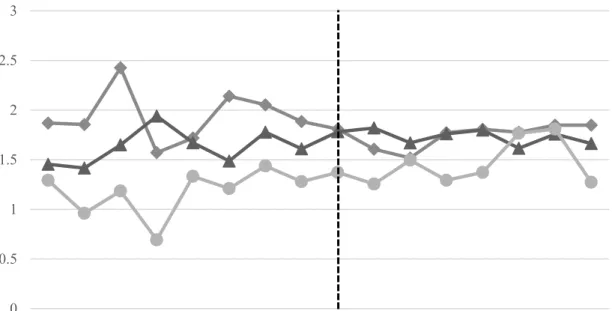
Figure 2 shows the passing rate for each of the three schools, for students applying to all universities. Figure 2 shows that Kita and Minami High Schools experienced no significant changes before and after the school-district system relaxation. Although the Higashi High School passing rate gradually improved, this trend seems unrelated to the change of school-district system.
Figure 3 shows the passing rate of national universities.8 At Kita and Minami High Schools, there
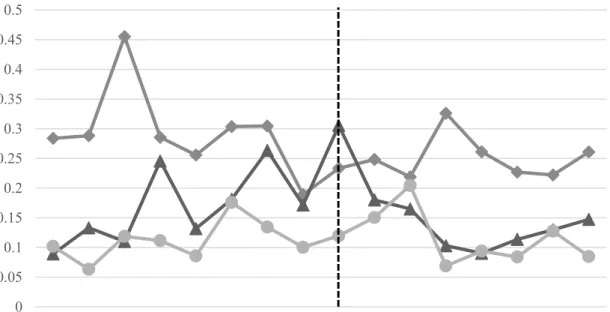
was no major difference before and after the system change; in Higashi High School, the passing rate declined after the system change. This suggests that students hoping to go to national universities may have clustered at better high schools by relaxation of the school district system. Figure 4 shows the passing rate for Group B and C universities. According to this graph, the
8 In 2006, Higashi High School had an extremely small number of successful candidates, compared to other years (whereas the average number of successful candidates was about 106, in 2006, there were only 10). This figure has been excluded from the analysis as an outlier, given the possibility of typographical error.
(1) (2) (3) (4) (5) (6) After 5% (5% period) dummy .0080 .0084 .0166 .0165 .0048 .0048
(.0099) (.0099) (.0129) (.0127) (.0114) (.0114) Kita dummy × After 5% (5% period) dummy -.0357** -.0352** -.0575*** -.0560*** -.0520** -.0493**
(.0118) (.0118) (.0144) (.0144) (.0186) (.0187) Minami dummy × After 5% (5% period) dummy .0057 .0056 .0089 .0085 -.0073 -.0065 (.0092) (.0092) (.0118) (.0118) (.0132) (.0134) 20% period dummy .0250 .0381 .0384 (.0189) (.0256) (.0262) Kita dummy × 20% period dummy -.0399 -.0698* -.0735*
(.0207) (.0271) (.0344) Minami dummy × 20% period dummy .0106 .0148 .0106 (.0164) (.0211) (.0221) Control variables
Year fixed effects YES YES YES YES YES YES Central urban trends YES YES YES YES YES YES Land fixed effects YES YES YES YES YES YES
N 522 519 389 386 270 267
Adjusted R2 0.9844 0.9843 0.9840 0.9840 0.9798 0.9797 ※*, ** and *** indicate statistical significance at 5%, 1%, 0.1%, respectively.
※Standard errors are adjusted for clustering at the area level.
17
passing rates for Minami and Higashi High School, in relation to prestigious private universities, decreased after the school-district system was relaxed. This result suggests that excellent students aspiring to attend prestigious universities may have gathered at Kita High School.
Figure 5 shows the passing rate for Group A (the most prestigious universities). Before relaxing the school-district system, Kita High School had a stable passing rate of about 15%; Minami and Higashi High Schools were stable at about 5%. However, the passing rate of Minami and Higashi High School fell dramatically after the school-district system was relaxed. At Higashi High School, the passing rate fell to 1% or less. This suggests that excellent students who lived in Higashi district may have chosen Kita High School or Minami High School. However, Figure 5 shows an overall downward trend, suggesting that the school-district change may have negatively affected the whole area. To analyze the effect of the school-district change on student performance, these results need to be compared with those of other cities, that did not undergo a system change.
In summary, partially relaxing the school district does not affect student achievement in all university entrance examinations; however it may have a strong effect on the higher academic tiers. It should be noted that some students in Japanese local cities choose to study medicine at local universities rather more difficult, high-status universities. Since the data used in this study do not include information on faculties, this is a limitation of the present study.
18
Figure 2. Ratio of Successful Applicants to All Universities
Figure 3. Ratio of Successful Applicants to National Universities
0 0.5 1 1.5 2 2.5 3 2003 2004 2005 2006 2007 2008 2009 2010 2011 2012 2013 2014 2015 2016 2017 2018
Kita Minami Higashi
0 0.1 0.2 0.3 0.4 0.5 0.6 0.7 0.8 0.9 2003 2004 2005 2006 2007 2008 2009 2010 2011 2012 2013 2014 2015 2016 2017 2018
19
Figure 4. Ratio of Successful Applicants to Group B and C Universities
Figure 5. Ratio of Successful Applicants to Group A Universities
0 0.05 0.1 0.15 0.2 0.25 0.3 0.35 0.4 0.45 0.5 2003 2004 2005 2006 2007 2008 2009 2010 2011 2012 2013 2014 2015 2016 2017 2018
Kita Minami Higashi
0 0.05 0.1 0.15 0.2 0.25 2003 2004 2005 2006 2007 2008 2009 2010 2011 2012 2013 2014 2015 2016 2017 2018
20
7. Conclusion
This study explores the impact of the school-district system on the relationship between school quality and land prices. The data were drawn from Matsue City, Japan, where the school-district system of public high schools was partly relaxed. The findings show that relaxing the school-district system significantly reduces land prices in high-level school districts. Using a regression discontinuity design to focus on school-district boundaries produces the same result. This suggests that, as the school-district system is relaxed, families no longer find it necessary to live in a specific school district, weakening the relationship between school quality and land prices.
A partial relaxation of the school-district system also increases the disparity of the ratio of successful applicants to prestigious universities; however, there is no large change in the case of applicants to national or other universities. This implies that relaxing the school-district system may have an impact only on particularly academic students if the change is partial. However, it is necessary to analyze areas without a school-district system to discover whether this effect is actually caused by the change of school-district systems.
21
References
Belfield, C. R., Levin, H. M. (2002). The effects of competition between schools on educational outcomes: a review for the United States. Review of Educational Research, 72(2), 279-341. Black, S. E. (1999). Do better schools matter? Parental valuation of elementary education. The
Quarterly Journal of Economics, 114(2), 577-599.
Black, S. E., Machin, S. (2011). Housing valuations of school performance. Hanushek, E.A., Machin, S., Woessmann, L. (Eds.), Handbook of the Economics of Education (3, 485-519). North Holland.
Brunner, E. J., Cho, S. W., Reback, R. (2012). Mobility, housing markets, and schools: Estimating the effects of inter-district choice programs. Journal of Public Economics, 96(7-8), 604-614. Chung, I. H. (2015). School choice, housing prices, and residential sorting: Empirical evidence from
inter-and intra-district choice. Regional Science and Urban Economics, 52, 39-49.
Fack, G., Grenet, J. (2010). When do better schools raise housing prices? Evidence from Paris public and private schools. Journal of Public Economics, 94(1-2), 59-77.
Ferreyra, M. (2007). Estimating the effects of private school vouchers in multidistrict economies.
American Economic Review, 97, 789-817.
Izumi, T. (2010). Tsuugakuku seido ga chika wo tuujite ataeru eikyou (The effect of the school district system on education through the land prices). Master’s thesis, National Graduate Institute for Policy Studies, Tokyo, Japan.
Kondo, A. (2014). College Entrance Examinations and Academic Ability Predetermined by Middle School Entrance: Evidence Employing 'Sunday Shocks' to Private Middle School Entrance Exams as an Instrumental Variable. The journal of Japan Economic Research, 70, 60-81. Kuroda, Y. (2018). The effect of school quality on housing rents: Evidence from Matsue City in
Japan. Journal of the Japanese and International Economies, 50, 16-25.
Ladd, H. F. (2002). School vouchers: A critical view. Journal of Economic Perspectives, 16(4), 3-24. Machin, S., Salvanes, K. (2015). Valuing school quality via a school choice reform. The
Scandinavian Journal of Economics, 118(1), 3-24
Nakamura, R. (2009). The causal effect of school choice on student achievement: an empirical analysis of achievement test in Tokyo. Economia, 60(2), 57-74
Nechyba, T. J. (2000). Mobility, targeting, and private school vouchers. American Economic Review, 90, 130-146.
Nguyen-Hoang, P., Yinger, J. (2011). The capitalization of school quality into house values: A review.
Journal of Housing Economics, 20(1), 30-48.
Reback, R. (2005). House prices and the provision of local public services: capitalization under school choice programs. Journal of Urban Economics, 57(2), 275-301
22
remaining questions. Annual Review of Economics, 1,17-42.
Schwartz, A. E., Voicu, I., Horn, K. M. (2014). Do choice schools break the link between public schools and property values? Evidence from house prices in New York City. Regional Science
and Urban Economics, 49, 1-10.
Yoshida, A., Kogure, K., Ushijima, K. (2009). School choice and student sorting: evidence from Adachi Ward in Japan. The Japanese Economic Review, 60(4), 446-472.
Yoshida, A., Zhang, L., Ushijima, K. (2008). Gakkou no shitu to chika, Adachi-ku no chika data wo mochiita kenshou (School quality and land price: Analysis using land price data of Adachi Ward). Quarterly Journal of Housing and Land Economics, 68, 10-18.
23
Appendix A. Summary Statistics of Samples at the School-District Boundary
Mean S.D. Min Max Mean S.D. Min Max Mean S.D. Min Max
Land price 75280 25217 11300 223000 77959 26486 11300 223000 79904 26548 11300 223000
5% period dummy 0.558 0.497 0 1 0.560 0.497 0 1 0.560 0.497 0 1
20% period dummy 0.082 0.274 0 1 0.081 0.274 0 1 0.083 0.276 0 1
After 5% dummy 0.640 0.480 0 1 0.642 0.480 0 1 0.642 0.480 0 1
Land characteristics
Distance from nearest station (kilometer) 1.994 1.207 0.100 6.900 1.879 1.054 0.100 6.900 1.859 0.892 0.650 6.900
Acreage (square meter × 1/1000) 0.300 0.187 0.111 1.710 0.302 0.204 0.111 1.710 0.294 0.239 0.111 1.710
Irregular shape dummy
Road width (meter) 6.926 3.479 3.400 22.000 7.300 3.764 3.500 22.000 7.409 4.226 3.500 22.000
Building Coverage Ratio (%) 0.610 0.107 0 0.800 0.613 0.109 0 0.800 0.611 0.117 0 0.800
Floor-Area Ratio (‰) 0.204 0.079 0.060 0.500 0.215 0.084 0.080 0.500 0.220 0.082 0.080 0.500
Land use zones dummies
Category 1 residential zone dummy 0.357 0.479 0 1 0.365 0.482 0 1 0.459 0.499 0 1
Category 2 residential zone dummy 0.145 0.352 0 1 0.156 0.363 0 1 0.168 0.375 0 1
Category 1 low-rise residential zone dummy 0.127 0.333 0 1 0.070 0.256 0 1 0.049 0.216 0 1
Category 1 mid/high-rise residential zone dummy 0.107 0.309 0 1 0.106 0.308 0 1 0.049 0.216 0 1
Category 2 mid/high-rise residential zone dummy 0.107 0.309 0 1 0.123 0.329 0 1 0.122 0.328 0 1
Commercial zone dummy 0.080 0.272 0 1 0.106 0.308 0 1 0.098 0.298 0 1
Neighborhood commercial zone dummy 0.048 0.215 0 1 0.035 0.184 0 1 0.049 0.216 0 1
Quasi-fire prevention zone dummy 0.128 0.335 0 1 0.141 0.348 0 1 0.147 0.354 0 1
Area characteristics
Central urban dummy 0.407 0.492 0 1 0.437 0.497 0 1 0.462 0.499 0 1
School district dummy
Kita dummy 0.367 0.482 0 1 0.332 0.471 0 1 0.315 0.465 0 1
Minami dummy 0.233 0.423 0 1 0.264 0.441 0 1 0.269 0.444 0 1
Higashi dummy 0.400 0.490 0 1 0.404 0.491 0 1 0.416 0.494 0 1
Number of observation points Number of samples 45 33 600 455 500m 24 327 NA NA NA 1000m 750m
24
Appendix B. Summary Statistics for Each School District
Mean S.D. Min Max Mean S.D. Min Max Mean S.D. Min Max
Land price 66332 32172 11200 223000 46399 21344 11300 120000 50203 30989 8200 150000
5% period dummy 0.562 0.497 0 1 0.614 0.487 0 1 0.574 0.495 0 1
20% period dummy 0.094 0.292 0 1 0.102 0.303 0 1 0.096 0.295 0 1
After 5% dummy 0.656 0.476 0 1 0.716 0.451 0 1 0.670 0.471 0 1
Land characteristics
Distance from nearest station (kilometer) 2.024 1.681 0.000 5.700 1.854 1.513 0.000 7.200 2.086 2.009 0.000 10.000
Acreage (square meter × 1/1000) 0.310 0.137 0.111 0.856 0.287 0.128 0.104 0.712 0.318 0.217 0.150 1.710
Irregular shape dummy 0.032 0.176 0 1 0.016 0.124 0 1
Road width (meter) 7.085 2.911 3.400 17.000 5.927 2.215 3.500 15.100 6.678 3.368 3.000 22.000
Building Coverage Ratio (%) 0.536 0.233 0 0.800 0.550 0.200 0 0.800 0.437 0.278 0 0.800
Floor-Area Ratio (‰) 0.180 0.115 0 0.500 0.178 0.086 0 0.400 0.131 0.089 0 0.400
Land use zones dummies
Category 1 residential zone dummy 0.128 0.335 0 1 0.418 0.494 0 1 0.301 0.459 0 1
Category 2 residential zone dummy 0.071 0.257 0 1 0.032 0.176 0 1 0.125 0.331 0 1
Category 1 low-rise residential zone dummy 0.165 0.372 0 1 0.104 0.306 0 1 0.089 0.285 0 1
Category 1 mid/high-rise residential zone dummy 0.147 0.354 0 1 0.060 0.238 0 1 0.036 0.186 0 1
Category 2 mid/high-rise residential zone dummy 0.110 0.313 0 1 0.094 0.292 0 1 0.036 0.186 0 1
Commercial zone dummy 0.110 0.313 0 1 0.056 0.230 0 1
Neighborhood commercial zone dummy 0.030 0.170 0 1 0.036 0.186 0 1
Quasi-fire prevention zone dummy 0.140 0.347 0 1 0.036 0.186 0 1
Area characteristics
Central urban dummy 0.004 0.485 0 1 0.179 0.383 0 1
Number of observation points Number of samples 33 43 37 436 501 448 NA NA NA NA NA
25
Appendix C. Full sample results
(1) (2) (3) (4) (5)
Kita dummy .0702** .0553 .0554
(.0227) (.0379) (.0380)
Minami dummy -.0369 -.0200 -.0194
(.0290) (.0501) (.0502)
After 5% (5% period) dummy -.1302 -.1287 .0017 .0029
(.0763) (.0766) (.0099) (.0099)
Kita dummy × After 5% (5% period) dummy .0251 .0178 -.0171 -.0179
(.0443) (.0453) (.0107) (.0106)
Minami dummy × After 5% (5% period) dummy -.0237 -.0233 .0152 .0142
(.0576) (.0588) (.0088) (.0088)
20% period dummy -.2496* .0086
(.1116) (.0175)
Kita dummy × 20% period dummy .0753 -.0119
(.0775) (.0172)
Minami dummy × 20% period dummy -.0347 .0234
(.0912) (.0148)
Control variables
Year fixed effects YES YES YES YES YES
Central urban trends YES YES YES YES YES
Land characteristics YES YES YES
Area fixed effects YES YES
N 1784 1781 1778 1654 1651
Adjusted R2 0.7363 0.7365 0.7365 0.9936 0.9936
※*, ** and *** indicate statistical significance at 5%, 1%, 0.1%, respectively. ※Standard errors are adjusted for clustering at the area level.
26
Appendix D. Results using School-District Boundaries
(1) (2) (3) (4) (5) (6) Kita dummy .0001 .0004 .0641** .0640** -.0524* -.0518*
(.0206) (.0207) (.0209) (.0210) (.0259) (.0260) Minami dummy -.0615 -.0610 -.4276*** -.4268*** -.3356*** -.3346***
(.0386) (.0387) (.0351) (.0355) (.0315) (.0321) After 5% (5% period) dummy .0885* .0887* .0603* .0603* .0541 .0546
(.0397) (.0400) (.0276) (.0278) (.0347) (.0350) Kita dummy × After 5% (5% period) dummy -.0397 -.0401 -.0514* -.0513* -.0363 -.0365
(.0241) (.0245) (.0200) (.0201) (.0220) (.0222) Minami dummy × After 5% (5% period) dummy -.0314 -.0237 -.0106 -.0074 -.0680* -.0662*
(.0290) (.0296) (.0241) (.0246) (.0296) (.0301) 20% period dummy .1621** .0993 .1160*
(.0596) (.0515) (.0541) Kita dummy × 20% period dummy -.0413 -.0555 -.0328 (.0429) (.0421) (.0487) Minami dummy × 20% period dummy -.0726 -.0294 -.0918 (.0603) (.0498) (.0476) Control variables
Year fixed effects YES YES YES YES YES YES Central urban trends YES YES YES YES YES YES Boundary fixed effects YES YES YES YES YES YES Land characteristics YES YES YES YES YES YES
N 548 545 403 400 275 272
Adjusted R2 0.8926 0.8926 0.9456 0.9454 0.9493 0.9492 ※*, ** and *** indicate statistical significance at 5%, 1%, 0.1%, respectively.
※Standard errors are adjusted for clustering at the area level.