• 検索結果がありません。

Department of Radiology, School of Medicine, Iwate Medical University, 19-1 Uchimaru, Morioka, Iwate 020-0023, Japan

N/A
N/A
Protected

Academic year: 2021

シェア " Department of Radiology, School of Medicine, Iwate Medical University, 19-1 Uchimaru, Morioka, Iwate 020-0023, Japan"

Copied!
6
0
0

読み込み中.... (全文を見る)

全文

(1)

7

a

Department of Physics, Iwate Medical University, 2-1-1 Nishitokuta, Yahaba, Iwate 028-3694, Japan

b

Department of Radiology, School of Medicine, Iwate Medical University, 19-1 Uchimaru, Morioka, Iwate 020-0023, Japan

c

Central Radiation Department, Iwate Medical University Hospital, 19-1 Uchimaru, Morioka, Iwate 020-0023, Japan

d
Department of Surgery, Toho University Ohashi Medical Center, 2-17-6 Ohashi, Meguro-ku, Tokyo 153-8515, Japan

Center for Liberal Arts and Sciences No. 52 (2017) , 7-12.

Keywords : X-ray spectra, YAP(Ce)-PMT detector, simple amplifier, zero dark counting, brief energy calibration

Abstract

Brief measurement of X-ray spectra using a detector consisting of a YAP(Ce) (cerium-doped yttrium aluminum perovskite) crystal and a small PMT (photomultiplier tube) is described. X-ray photons are detected using the YAP(Ce) crystal and a 0.5-mm-diam 3.0-mm-thick lead pinhole, and scintillation photons produced in the crystal are detected using the PMT. The negative output voltages from the PMT are input to a simple inverse-voltage-voltage amplifier, and the event pulses from the amplifier are sent to a multichannel analyzer to perform pulse-height analysis. Dark counts from the PMT are not counted at all. The photon energy was determined by two-point calibration using iodine-Kα fluorescence and tungsten Kα photons from an X-ray-tube target. Using the YAP(Ce)-PMT detector, both the maximum and maximum-count energies increased with increasing tube voltage at a tube current of 20 μA.

(Accepted October 20, 2017)

1. Introduction

  Recently, X-ray spectra are measured using a cadmium telluride (CdTe) detector, and the photon energy resolution has been improved to approximately 1% at 122 keV. Therefore, we performed fundamental studies on photon-counting energy-dispersive X-ray computed tomography (CT) scanners [1-3] to perform K-edge CT

Measurement of X-ray spectra using a photomultiplier tube in conjunction with a simple inverse amplifier

Eiichi SATO

a

, Yasuyuki ODA

a

, Michiaki SAGAE

a

, Sohei YOSHIDA

b

, Satoshi YAMAGUCHI

b

, Yuichi SATO

c

, Hodaka MORIYAMA

d

, Osahiko HAGIWARA

d

, Hiroshi MATSUKIYO

d

, Toshiyuki ENOMOTO

d

,

Manabu WATANABE

d

, Shinya KUSACHI

d

(2)

  A scintillation detector consisting of LSO (lutetium-oxyorthosilicate) and a photomultiplier tube (PMT)

[6] is also useful for increasing the count rate and for measuring X-ray spectra. Therefore, we measured the X-ray spectra and performed Gd-L- and Gd-K-edge CT simultaneously. However, the four-point calibration was necessary since the event-pulse height tended to saturate with increasing photon energy.

  In our research, major objectives are as follows: to construct a detector consisting of a YAP(Ce) crystal and a small PMT, to simplify an inverse-high-speed amplifier, to roughly determine the photon energy without standard radioisotopes (RIs), and to measure X-ray spectra using a lead pinhole. Therefore, we constructed the YAP(Ce)-PMT detector system and measured the X-ray spectra at high-count rates.

2. Experimental methods

2.1. Measurement of spectra using CdTe

  X-ray spectra for reference were measured using a readily available CdTe detector system (XR-100T, Amptek). In this system, a CdTe is fixed directly to the charge-sensitive amplifier, and the outputs are input to a shaping amplifier. The event pulses from the shaping amplifier are sent to a multichannel analyzer (MCA; MCA 4000, γPGT) to perform pulse-height analysis. The X-ray spectra were observed on the monitor of a personal computer (PC). The photon energy was determined by two-point calibration using Kα

1

photons of I (28.6 keV) and tungsten (W; 59.3 keV).

2.2. Measurement of spectra using YAP(Ce)-PMT

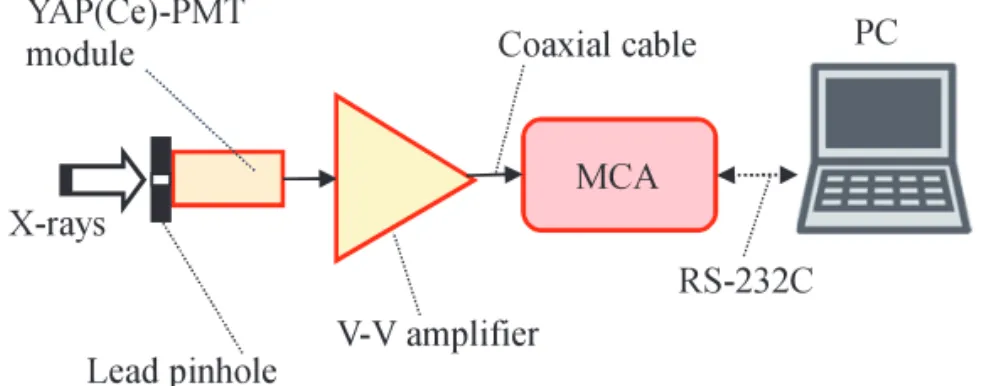
  Figure 1 shows the experimental setup for measuring X-ray spectra using a YAP(Ce)-PMT (H10721P-110, Hamamatsu) detector. In the measurement, a 0.5-mm-diam 3.0-mm-thick lead pinhole is used because first- generation CT is performed using the pinhole to improve spatial resolutions. X-ray photons passing through the pinhole are detected by the YAP(Ce) single crystal, and the scintillation photons are detected by the PMT. The crystal is attached to the incident-window glass using an optical grease. The negative PMT outputs are sent to a high-speed inverse voltage-voltage (V-V) amplifier. The event pulses from the amplifier are input to the MCA to measure X-ray spectra.

  The circuit diagram of the simple high-speed V-V amplifier is shown in Fig. 2. To perform zero-dark counting, we used an 80 MHz band-width operational amplifier (AD8032, Analog Devices). The negative PMT outputs are input to the single inverse V-V amplifier, and the outputs are sent to the MCA. Therefore, approximately 10-ns-width dark counts form the PMT are not detected at all, and only X-ray photons can be detected.

  The photon energy was determined by two-point calibration using Kα photons of I and W. A 9.0-mm-

diam lead diaphragm was used to reduce the X-ray exposure field. The quasi-monochromatic I-K photons from

a 15-mm-diam glass vial filled with 30-mg/ml I medium are detected by the YAP(Ce)-PMT detector with the

(3)

pinhole in the direction with an angle of 45º from the X-ray axis to avoid direct photons from the X-ray source.

The lead pinhole was used to improve the energy resolution and to measure spectra for X-ray imaging including the first-generation DE-CT. The tube voltage was 60 kV, and the tube current was increased to 1.0 mA to increase the count rate of I fluorescence.

  The quasi-monochromatic W-K photons were selected out using a 0.2-mm-thick W-K-edge filter placed just outside the X-ray window. The tube voltage and current were 100 kV and 20 μA, respectively.

3. Results

3.1. X-ray spectra using CdTe

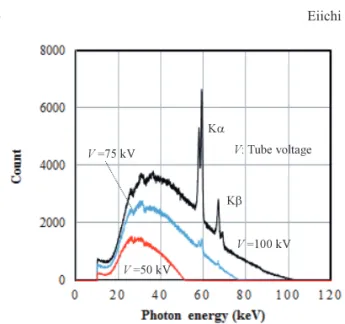
  X-ray spectra with changes in the tube voltage are shown in Fig. 3. Both the maximum photon and maximum-count energies increased with increasing tube voltage. At a tube voltage of 100 kV, sharp W-K lines were observed.

Fig. 1. Block diagram for measuring X-ray spectra using a YAP(Ce)-PMT detector using a simple V-V amplifier.

Fig. 2. Circuit diagram of the inverse V-V amplifier.

(4)

3.2. X-ray spectra using YAP(Ce)-PMT

  The X-ray spectra using the YAP(Ce)-PMT detector for determining the energy are shown in Fig. 4. It was possible to roughly determine the energy, and the average energies of I-Kα and W-Kα are 28.5 and 58.9 keV respectively.

  Figure 5 shows X-ray spectra at a tube current of 20 μA. Both the maximum and maximum-count energies increased with increasing tube voltage. Compared with spectra in Fig. 3, the maximum-count energy at a tube voltage of 50 kV was almost equal, and the maximum-count energy shifted to high energies owing to the K-photon irradiation at tube voltages of 75 and 100 kV.

4. Discussion

  We measured X-ray spectra using a YAP(Ce)-PMT detector and a lead pinhole at a count rate of 27 kcps, an energy range of 7-100 keV, and a tube current of 20 μA. The count rate was in proportion to the tube current at a tube voltage of 100 kV. Using the simple amplifier, the event pulse height was almost proportional to the

Fig. 3. X-ray spectra for reference measured using a CdTe detector with changes in the tube voltage at a tube current of 5.0 μA.

Fig. 5. X-ray spectra measured using the YAP(Ce)-PMT detector and the pinhole with changes in the tube voltage.

Fig. 4. X-ray spectra for determining the photon

energy. (a) I-K fluorescence from a glass vial

filled with 30 mg/ml I medium, and (b) W-K

photons selected using a 0.2-mm-thick W filter.

(5)

photon energy, and the photon energy could be determined by the two-point calibration. However, the pulse width increased from 200 to 500 ns because a differentiating circuit for cutting wave tails was removed.

  In the amplifier circuit, we did not use the condenser, and the time constant is determined by the 20 kΩ resistance and a stray capacity. The time constant of the amplifier was below 500 ns, and the count rate can be increased using the differentiating circuit.

  Brief energy determination for measuring X-ray spectra is important because optimal standard γ-ray sources are not necessary. Using the scintillation detectors, the energy resolution tends to improve with decreasing the pinhole diameter. However, it is quite difficult to increase the count rate of γ photons from the RI passing through the 0.5-mm-diameter pinhole. In this regard, the two-point energy calibration using K photons of I and W is useful, since the elements of the X-ray-tube target and the X-ray contrast medium are W and I, respectively.

5. Conclusions

  We measured the X-ray spectra using an LYSO-μPMT detector in conjunction with a high-speed inverse V-V amplifier. The event-pulse widths were approximately 500 ns, and the energy resolution was approximately 50% at 58.9 keV with a 0.5-mm-diam lead pinhole. The dark-count rate from the PMT was reduced to 0 cps by increasing the time constant of the amplifier. Thus, low-energy X-ray photons were detected, and both the K-edge tomograms using I and Gd media can be obtained simultaneously.

Acknowledgments

  This work was supported by Grants from Keiryo Research Foundation, Promotion and Mutual Aid Corporation for Private Schools of Japan, Japan Science and Technology Agency (JST), and JSPS KAKENHI (17K10371, 17K09068, 17K01424, 17H00607). This was also supported by a Grant-in-Aid for Strategic Medical Science Research (S1491001, 2014–2018) from the Ministry of Education, Culture, Sports, Science and Technology of Japan.

References

[1] Sato, E., Kosuge, Y., Yamanome, H., Mikata, A., Miura, T., Oda, Y., Ishii, T., Hagiwara, O., Matsukiyo, H., Watanabe, M., Kusachi, S., “Investigation of dual-energy X-ray photon counting using a cadmium telluride detector with dual-energy selection electronics,” Rad. Phys. Chem. 130, 385-390 (2017).

[2] Matsukiyo, H., Sato, E., Oda, Y., Ishii, T., Yamaguchi, S., Sato, Y., Hagiwara, O., Enomoto, T., Watanabe, M., Kusachi, S., “Investigation of quad-energy photon counting for X-ray computed tomography using a cadmium telluride detector,” Appl. Radiat. Isot. 130, 54-59 (2017).

[3] Sato, E., Yamanome, H., Mikata, A., Miura, T., Kosuge, Y., Oda, Y., Yamaguchi, S., Sato, Y., Hagiwara, O., Matsukiyo, H., Enomoto, T., Watanabe, M., Kusachi, S., “X-ray photon counting using two different energy-selection electronics and a cadmium telluride detector,” Med. Imag. Inform. Sci. 34, 126-131 (2017).

[4] Oda, Y., Sato, E., Abudurexiti, A., Hagiwara, O., Osawa, A., Matsukiyo, H., Enomoto, T., Watanabe, M., Kusachi, S., Sugimura, S., Endo, H., Sato, S., Ogawa, A., Onagawa, J., “Mcps-range photon-counting X-ray computed tomography system utilizing an oscillating linear-YAP(Ce) photon detector,” Nucl. Instr. Meth. A 643, 69-74 (2011).

[5] Sato, E., Oda, Y., Abudurexiti, A., Hagiwara, O., Matsukiyo, H., Osawa, A., Enomoto, T., Watanabe, M.,

(6)

Fig. 1.  Block diagram for measuring X-ray spectra using a YAP(Ce)-PMT detector  using a simple V-V amplifier.
Fig. 3.  X-ray spectra for reference measured using a  CdTe detector with changes in the tube voltage at  a tube current of 5.0 μA.

参照

関連したドキュメント