岩手医科大学 審 査 学 位 論 文
(博 士)
75
I
. IntroductionTo date, thoracic epidural block has been used as a major analgesic method in patients undergoing open colorectomy, because it is useful in providing optimal pain relief, early recovery of bowel function and fulfillment of discharge criteria
1, 2). However, operative and anesthetic methods have been changing. The
laparoscopic approach has become popular as a less-invasive method that contributes to a better postoperative course, lower hospital costs and shorter hospital stays, with oncological quality of treatment comparable to conventional open colorectal surgery
3 - 5 ). In recent years, it has been reported that epidural analgesia may be replaced by spinal
A comparison of epidural-based and intravenous-based postoperative analgesia in patients
undergoing laparoscopic colorectomy
Masahiro M. W
akimoto 1), Hirofumi N
agata 1), Kenji S. S
uzuki 1)and Koki O
tsuka 2) 1) Department of Anesthesiology, School of Medicine,Iwate Medical University, Morioka, Japan
2) Department of Surgery, School of Medicine, Iwate Medical University, Morioka, Japan
(Received on January 21, 2014 & Accepted on January 28, 2014)
Epidural block is a major analgesic method in patients undergoing open colorectomy, but opioid-based intravenous analgesia may be an alternative technique for laparoscopic surgery.
Forty patients were allocated to two groups: a patient-controlled epidural analgesia (PCEA) group and an intravenous patient controlled analgesia (ivPCA) group. In the PCEA group, 0 . 25 % of levobupivacaine containing fentanyl was administered at a rate of 4 ml/h with a bolus of 3 ml every hour.
In the ivPCA group, fentanyl solution containing droperidol was administered at a rate of 0 . 6 μg/
kg/h with a bolus of 0 . 6μg/kg every 30 minutes.
Plasma epinephrine concentrations and pain scores on the morning of postoperative Day 1
were significantly lower in the PCEA group (p=
0 . 022 , 0 . 036 , respectively). However, the values of serum CRP, cortisol and IL- 6 concentrations were statistically similar for both groups at all measurement points. Additional analgesic requirements, dietary restart, length of postoperative hospital stay and the occurrence of in-hospital complications also were comparable between groups.
In conclusion, epidural-based postoperative analgesia could suppress the catecholamine response and provided good pain relief, but the proinflammatory response and short-term outcomes were similar to intravenous-based analgesia after laparoscopic colorectomy.
Abstract
Key words: epidural analgesia, patient-controlled analgesia,
laparoscopic colorectomy, surgical stress, proinflammatory response Original
JIMA Vol. 66, No. 2(June 2014)pp. 75-84.
Masahiro M. Wakimoto, et al.
76
block or opioid-based intravenous analgesia in laparoscopic colorectomy because of the former ’ s delayed postoperative recovery and longer hospital stay
6 ). Remifentanil, an ultra-short-acting opioid analgesic, provides better hemodynamic stability than epidural block during major abdominal surgery
7 ). Although epidural block has been useful in reducing stress response and surgery-induced proinflammatory response for open abdominal surgery
8, 9), it has also been reported recently that the remifentanil-based anesthesia was found to be superior to epidural-based anesthesia in cardiac surgery
10). We performed a prospective controlled clinical trial in patients undergoing laparoscopic colorectomy to assess the effects of postoperative analgesia itself followed by high-dose remifentanil-based general anesthesia on surgical stress response, proinflammatory response and short-term outcomes.
II
. Materials and MethodsThis study was approved by the Ethics Committee of Iwate Medical University School of Medicine, and written informed consent was obtained from each patient prior to surgery.
1. Patient allocation and exclusion criteria Patients enrolled in this study were those diagnosed with or suspected to have colon adenocarcinoma from the cecum to the rectosigmoid colon. Subjects were allocated to two groups, a patient-controlled epidural analgesia (PCEA) group and an intravenous p a t i e n t - c o n t r o l l e d a n a l g e s i a ( i v P C A ) group, according to their patient numbers, with allocation to alternating groups for consecutively-numbered patients. Patients who had ileus, peptic ulcer, bronchial asthma,
any allergies to anesthetics and endocrine diseases, or who were using corticosteroids were excluded. Patients included underwent laparoscopic colorectomy at Iwate Medical University Hospital between September 2011 and February 2013.
2. Anesthesia and preoperative care
No premedication was given on the day of surgery, and preoperative fasting started at 9 p.m. on the day before surgery. Oral clear fluid intake was terminated 4 hours before surgery, and at the same time, infusion of acetated Ringer ’s solution containing 5 % glucose was started at a rate of 100 ml/h.
Limb-lead electrocardiograms, percutaneous pulseoxymetry, noninvasive intermittent blood pressure and the bispectral index (BIS) were monitored throughout the anesthesia. For PCEA group patients, an epidural catheter was inserted at the level of the Th 11 - 12 intervertebral space before induction of general anesthesia. Thereafter, 3 ml of 1 % lidocaine containing 30 μg of epinephrine was administered via a catheter before induction to rule out intrathecal and intravascular catheterization. After 5 -minute oxygen inhalation, general anesthesia was induced with 1 . 0 - 3 . 0 μg/ml of propofol target controlled infusion (TCI) using a Diprifusor
®(Terumo Co., Ltd, Hatagaya, Shibuya-ku, Tokyo, Japan), 200 μg of fentanyl and 0 . 25 μg/kg/min of remifentanil. Following loss of consciousness, 0 . 6 mg/kg of rocuronium was administered and the trachea was intubated. Mechanical ventilation was started with 6 - 10 ml/kg tidal volume, 8 - 15 breath/
min and 3 - 5 cmH
2O PEEP to maintain the
expiratory CO
2pressure in the range of 35 -
40mmHg. Thereafter, a nasogastric tube and
urinary catheter were inserted, followed by administration of 1 . 0 - 3 . 0 μg/ml of propofol TCI and 0 . 5 - 1 . 0 μg/kg/min of remifentanil for maintenance of anesthesia. The target concentration of propofol TCI was controlled to keep the BIS value within the range of 40 - 60 , and the infusion rate of remifentanil was increased by 0 . 1 μg/kg/min when the heart rate or systolic blood pressure rose by 20% compared to the control values recorded before skin incision. When systolic blood pressure fell by 20% compared to the control value, the infusion rate of remifentanil was decreased by 0.1 μg/kg/min, and 4-8 mg of ephedrine or 0 . 05 - 0 . 1 mg of phenylephrine was administered intravenously. Further, 10 - 20 mg of rocuronium was administered as required. Acetated Ringer ’s solution was administered at a rate of 5 - 10 ml/kg/
h throughout the entire anesthesia. Epidural analgesia was not used until wound closure.
When wound closure started, 200 μg of fentanyl, 50 mg of flurbiprofen and 1 mg of droperidol were administered intravenously, after which the following analgesic methods were commenced. In the PCEA group, 5 ml of 0 . 75 % levobupivacaine was administered by bolus, followed by the commencement of administration of 300 ml of 0 . 25 % levobupivacaine containing 700 μg of fentanyl at a rate of 4 ml/h via epidural catheter using a COOPDECH
®Balloonjector (Daiken Medical Co., Ltd, Osaka, Osaka Pref., Japan). A rescue bolus of 3 ml per hour was also prepared. In the ivPCA group, administration of 60 ml of saline solution containing 36 μg/kg of fentanyl and 5 mg of droperidol was commenced at a rate of 1 ml/h intravenously using a COOPDECH
®Syrinjector I (Daiken Medical
Co., Ltd, Osaka, Osaka Pref., Japan). The rescue bolus was set at 1 ml per 30 minutes. When the operation was finished, administration of propofol and remifentanil was terminated and 2 - 4 mg/kg of sugammadex was administered intravenously. After we were able to confirm spontaneous breathing and recovery of consciousness, the trachea was extubated. The patient was transferred to a recovery room and observed for 30 - 60 minutes, and then transferred to a ward. The efficacy of epidural analgesia was confirmed as no complaint of pain at movement.
3. Surgical technique
All procedures were performed with 5 ENDOPATH
®XCEL™ ports placed at each quadrant of the abdomen and the umbilicus.
ENDOPATH
®Bipolar Forceps, LIGAMAX™
clips, Harmonic ACE
®and EnSeal
®(all 5 devices registered by Ethicon Endo- Surgery, LLC, Guaynabo, Puerto Rico, USA) were used for vessel ligation. Anastomoses were performed extracorporeally through a Multiflap Gate (Akita Sumitomo Bakelite Co., Ltd., Akita, Akita Pref., Japan) inserted into the umbilical wound enlarged to 4 cm with ENDOPATH
®echelon™ stapler and PROXIMATE
®TX stapler (both devices registered by Ethicon Endo-Surgery, LLC, Guaynabo, Puerto Rico, USA). Some patients had 1 or 2 drains inserted in the abdomen for monitoring of postoperative bleeding and/or intestinal leakage.
4. Postoperative care
Subjects were given 2000 mL of acetated
Ringer ’s solution a day and the dose of
infusion was diminished as oral intake
increased. Hypotension defined as systolic
blood pressure of less than 90 mmHg was
77 Original: Postoperative analgesia in laparoscopic colorectomytreated with 500 ml of acetated Ringer ’ s solution administered for 2 hours. On postoperative Day 1 , the nasogastric tube was removed and clear fluid intake was permitted in the morning. The urinary catheter was also removed and the patient was encouraged to get out of bed and walk.
When urinary retention occurred, intermittent catheterization and drainage of urine was performed. Diet was restarted after bowel sound and passage of flatus or feces were confirmed. When the patient tolerated a full diet, intravenous crystalloid infusion was completed. In cases where the rescue bolus was not sufficient for pain relief, 50 mg of intravenous flurbiprofen and 15 mg of intramuscular pentazocine were administered in turn. Postoperative nausea and vomiting (PONV) was treated with 10mg of intravenous metoclopramide. Continuous epidural infusion was maintained until its empty unless repeated urinary drainage was needed or persistent PONV was observed. Continuous intravenous fentanyl infusion was also maintained unless drowsiness or persistent PONV was observed.
5. Measurements
Intraoperative blood loss, crystalloid infusion, urine output and anesthetic agent consumption were recorded at the end of surgery. Plasma epinephrine, serum C-reactive protein (CRP), cortisol and interleukin- 6 (IL- 6 ) were measured at four time points:
during anesthetic induction (T 1 ), just before tracheal extubation (T 2 ), on the morning of postoperative Day 1 (T3), and on the morning of postoperative Day 2 (T 4 ). To extract the plasma or serum samples, the venous blood was obtained, left for 120 minutes and
centrifuged at 5000 rpm for 10 minutes at each point. Extracted plasma or serum was quickly frozen prior to the assay. To assess postoperative pain and satisfaction, all patients were interviewed for pain at rest at T 3 and T4 using a visual analog scale (VAS), and for satisfaction at T 4 with our original 5 -level satisfaction scale, on which 1 corresponds to “ poor ” while 5 is “ excellent ”. Additional analgesic requirements, the day of dietary restart, the length of postoperative hospital stay, the incidence of PONV, urinary retention and drowsiness were also recorded.
6. Statistical Analysis
Continuous data are presented as mean
± SD or medians with 1 st- 3 rd quartiles according to the distribution, while categorical variables are presented as numbers. Statistical comparisons were performed using Fisher ’s exact test, Chi-square test, Student ’ s t-test or Mann-Whitney’s U test. The Kolmogorov- Smirnov test was also used to check the distribution of data. Differences with a p-value of less than 0.05 were considered significant.
For statistical analyses, G*Power 3 (Institute for Experimental Psychology, Heinrich-Heine- University, German) and GraphPad Prism
®5 for Windows (GraphPad Software Inc., San Diego, CA, USA) were used
11).
III
. ResultsP o s t o p e r a t i v e p l a s m a e p i n e p h r i n e concentration was set as the primary endpoint and a power analysis was performed based on the results for the first 10 patients studied ( 5 patients in each group). It was calculated that 20 patients were needed in each group to achieve a power of 80 percent and a p-value of 0 . 05 , therefore 30 more cases
78 Masahiro M. Wakimoto, et al.
79 Original: Postoperative analgesia in laparoscopic colorectomy
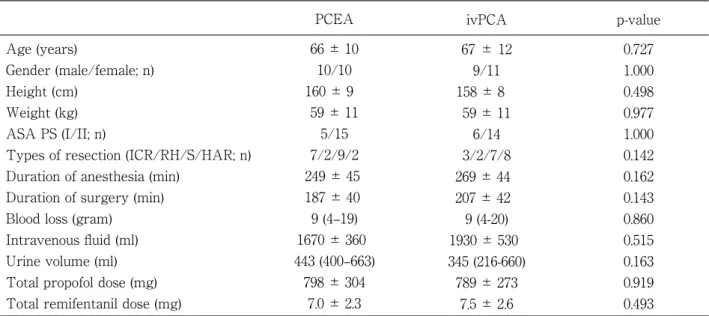
were recruited. There were no significant differences in baseline data between the
two groups (Table 1 ). In the PCEA group, epidural catheterizations were successfully
Table 1. Demographic dataAge (years)
Gender (male/female; n) Height (cm)
Weight (kg) ASA PS (I/II; n)
Types of resection (ICR/RH/S/HAR; n) Duration of anesthesia (min)
Duration of surgery (min) Blood loss (gram)
Intravenous fluid (ml) Urine volume (ml) Total propofol dose (mg) Total remifentanil dose (mg)
PCEA 66 ± 10
10/10 160 ± 9 59 ± 11
5/15 7/2/9/2 249 ± 45 187 ± 40 9 (4–19) 1670 ± 360
443 (400–663) 798 ± 304
7.0 ± 2.3
Values are expressed as mean ± SD, median (1st-3rd quartiles) or the number of patients. The p-values were obtained with 2-group comparisons. ASA PS=American Society of Anesthesiologists physical status, ICR=ileocecal resection, RH=right hemicolectomy, S=sigmoidectomy and HAR= high anterior resection.
ivPCA 67 ± 12
9/11 158 ± 8
59 ± 11 6/14 3/2/7/8 269 ± 44 207 ± 42 9 (4-20) 1930 ± 530
345 (216-660) 789 ± 273
7.5 ± 2.6
p-value 0.727 1.000 0.498 0.977 1.000 0.142 0.162 0.143 0.860 0.515 0.163 0.919 0.493
0.00
T1 T2 T3 T4
0.02 0.04 0.06 0.08 0.10
Epinephrine(ng/mL) *
A
PCEA ivPCA
Time point
0
T1 T2 T3 T4
5 10 15
CRP(mg/dL)
B
PCEA ivPCA
Time point
0
T1 T2 T3 T4
10 20 30
Cortisol(μg/dL)
C
PCEA ivPCA
Time point
0
T1 T2 T3 T4
100 200 300
IL-6(pg/mL)
D
PCEA ivPCA
Time point
Fig. 1. Profiles of changes in epinephrine (A), CRP (B), cortisol (C) and IL-6 (D).
CRP=C reactive protein. T1=during anesthetic induction, T2=just before tracheal extubation, T3=on the morning of postoperative Day 1, T4=on the morning of postoperative Day 2.
*p=0.022 vs PCEA group, † p<0.05 vs T1.
Masahiro M. Wakimoto, et al.
80
performed in all patients, without any intravascular or subarachnoidal placement.
Plasma epinephrine concentrations in the PCEA group at T 3 were significantly lower than in the ivPCA group (p= 0 . 022 , Fig.
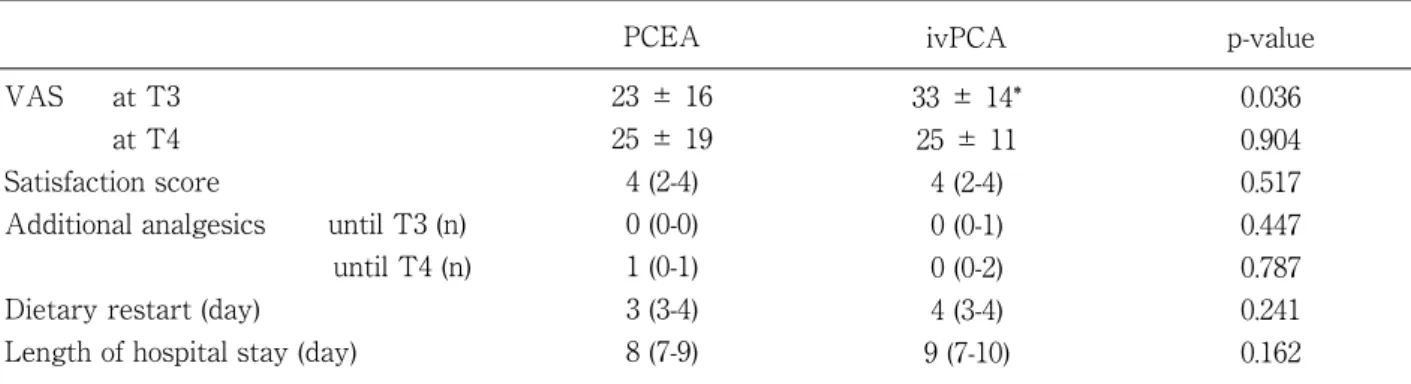
1 A). On the other hand, the values of CRP, cortisol and IL- 6 were statistically similar in both groups at all measurement time points (Fig. 1 B-D). The pain score VAS at T 3 was significantly lower in the PCEA group (p= 0 . 036 ), but satisfaction scores, additional analgesic requirements, dietary restarts and lengths of postoperative hospital stay were comparable (Table 2 ). In terms of postoperative in-hospital complications, there were no statistical differences between the groups in the occurrence rate of PONV,
urinary retention and drowsiness (Table 3 ).
There were no other surgical complications such as anastomotic leakage, wound infection, intraabdominal abscess or hematoma.
IV
. DiscussionIt has been reported that epidural analgesia is superior to intravenous analgesia with respect to pain relief, recovery of bowel function and length of hospital stay in patients undergoing colorectal surgery
1 , 2 ). Moreover, this method can also protect against pneumonia, prolonged mechanical ventilation, reintubation and myocardial infarction after thoracic and abdominal surgery
12). Therefore, epidural block is highly recommended for open colorectomy in the
Table 2. Postoperative dataVAS at T3 at T4 Satisfaction score
Additional analgesics until T3 (n) until T4 (n) Dietary restart (day)
Length of hospital stay (day)
PCEA 23 ± 16 25 ± 19 4 (2-4) 0 (0-0) 1 (0-1) 3 (3-4) 8 (7-9)
Values are expressed as mean±SD (range), median (1st-3rd quartiles). The p-values were obtained with 2-group comparisons. VAS=visual analog scale. T3=on the morning of postoperative Day 1, T4=on the morning of postoperative Day 2. Satisfaction scores were measured using a 5-level scale with the levels 1 to 5 corresponding to “poor”, “fair”, “average”, “good” and “excellent”. The values of additional analgesics are the frequency of flurbiprofen or pentazocine usage. *p=0.036 vs PCEA group.
ivPCA 33 ± 14*
25 ± 11 4 (2-4) 0 (0-1) 0 (0-2) 4 (3-4) 9 (7-10)
p-value 0.036 0.904 0.517 0.447 0.787 0.241 0.162
Table 3. Postoperative complications
PONV (n)
Urinary retention (n) Drowsiness (n)
PCEA 12
4 0
Figures are patient numbers. The p-values were obtained by 2-group comparisons. PONV = postoperative nausea and vomiting.
ivPCA 8 0 1
p-value 0.343 0.106 1.000
81 Original: Postoperative analgesia in laparoscopic colorectomy
enhanced postsurgical recovery guidelines
13). On the other hand, these guidelines also indicate that spinal anesthesia or opioid-based patient-controlled analgesia (PCA) may be an alternative method in laparoscopic surgery.
Transition of recommended analgesic methods may consist of two components: changing the surgical method, and the opioid analgesics used. With respect to the former, laparoscopy is an emerging technique that provides earlier tolerance of diet, bowel movement, flatus and stool canalization, mobilization, suction drain removal, cessation of analgesic drug administration, fewer perioperative complications, lower hospital costs and shorter hospital stays, without deterioration of the oncological quality of treatment relative to conventional open colorectal surgery
3 - 5 ). In a recent randomized trial, it was reported that epidural analgesia was found to provide better pain relief on the evening of surgery, but caused delayed recovery of bowel function, a higher incidence of PONV and longer hospital stays, and can be replaced by spinal block or opioid-based intravenous analgesia in laparoscopic colorectomy
6 ). Epidural block may also increase the incidence of intra- and postoperative hypotension and urinary retention after urinary catheter removal
2 , 12 ). Fluid overloading in treatment for hypotension during and after surgery may cause gastrointestinal edema, ileus and subsequent delayed recovery of bowel function and mobilization
14 , 15 ). With respect to the latter, remifentanil is also an emerging ultra-short-acting opioid. It may provide better hemodynamic stability and have fewer requirements for neuromuscular blockade than epidural block during major abdominal
surgery
7). It has been reported that epidural- based anesthesia attenuated stress response, surgery-induced proinflammatory response and typical postoperative transient immuno- suppression compared with remifentanil- based anesthesia in conventional open colon surgery and major abdominal surgery
8 , 9 ). In contrast, it has also been reported that high-dose remifentanil-based anesthesia was superior to epidural-based anesthesia in terms of its modulatory effects on the inflammatory response in cardiac surgery with cardiopulmonary bypass
10 ). On the basis of the above background, we hypothesized that high-dose remifentanil-based intraoperative anesthesia combined with epidural-based or opioid-based postoperative analgesia may be a potent technique for providing favorable outcomes in patients undergoing laparoscopic colorectomy.
In this study, plasma epinephrine and serum cortisol concentration were well-suppressed during anesthesia in both groups. Compared with a previous report, high-dose remifentanil was found to be able to effectively control surgical stress
8 ). Nevertheless, plasma epinephrine concentration increased during the postoperative period, particularly in the ivPCA group. Further, epidural block was found to be superior to intravenous-based analgesia in controlling surgical stress response postoperatively. Although the consumption of additional analgesics and patient satisfaction scores were similar between the two groups, lower pain scores on postoperative Day 1 in the PCEA group also provided evidence of the superiority of epidural-based analgesia.
In terms of other stress response and
proinflammatory response, there were no
82 Masahiro M. Wakimoto, et al.
statistical differences between the groups in serum CRP, cortisol and IL- 6 . This result is similar to that of previous reports in which epidural block was found to suppress increases in plasma epinephrine and norepinephrine concentrations but could not suppress increases in serum CRP, cortisol, IL- 6 and other cytokines in patients undergoing radical esophagectomy
16 ). It is believed that IL- 6 has the role of being a prime mediator in glucocorticoid release, and can directly stimulate the adrenal gland to increase serum cortisol concentrations
17 ). In this study, remifentanil-based anesthesia combined with epidural-based analgesia was not sufficient to suppress the proinflammatory response and the subsequent increase in serum cortisol concentration postoperatively.
Our study has several limitations. Firstly, it was not based on the recent fast-track, enhanced recovery protocols which contain many detailed perioperative management recommendations, but on the conventional method
13 ). In particular, these guidelines state that avoidance of nasogastric drainage and fluid overload are useful for preventing postoperative ileus, early recovery of bowel function and shorter hospital stays.
Epidural analgesia has shown superiority over opioid-based intravenous analgesia in early postoperative recovery in several trials following enhanced recovery guidelines
3 , 6 ). Secondly, the sample size may be too small to prove any differences in other outcomes
except for plasma epinephrine and pain relief, because the power analysis was performed focusing on the concentration of epinephrine, indicating the severity of surgical stress response. Specifically, although four cases of urinary retention occurred only in the PCEA group, the statistical power was insufficient to find a statistical difference.
In a future study, we intend to also investigate the influence of regional analgesia such as transversus abdominis plane block or thoracic paravertebral block. These emerging techniques are also effective for postoperative analgesia after abdominal surgery
18).
In conclusion, epidural-based analgesia was found to have several advantages over intravenous-based analgesia, in terms of postoperative catecholamine response and early postoperative pain relief for laparoscopic colorectomy. Nevertheless, in the present study it did not affect the proinflammatory response, occurrence rate of in-hospital complications or length of postoperative hospital stay. Intravenous-based postoperative analgesia may be able to replace epidural- based postoperative analgesia for patients undergoing laparoscopic colorectomy.
There is no financial support to this research, and all authors have no conflict of interest about this research.
83 Original: Postoperative analgesia in laparoscopic colorectomy
1) Liu SS, Carpenter RL, Mackey DC, et al.:
Effects of perioperative analgesic technique on rate of recovery after colon surgery.
Anesthesiology 83, 757-765, 1995.
2) Marret E, Remy C, Bonnet F, et al.: Meta- analysis of epidural analgesia versus parenteral opioid analgesia after colorectal surgery. Br J Surg 94, 665-673, 2007.
3) Feroci F, Kröning KC, Lenzi E, et al.:
Laparoscopy within a fast-track program enhances the short-term results after elective surgery for resectable colorectal cancer. Surg Endosc 25, 2919-2925, 2011.
4) Bagshaw PF, Allardyce RA, Frampton CM, et al.: Long-term outcomes of the australasian randomized clinical trial comparing laparoscopic and conventional open surgical treatments for colon cancer: the Australasian Laparoscopic Colon Cancer Study trial. Ann Surg 256, 915-919, 2012.
5) Delaney CP, Chang E, Senagore AJ, et al.:
Clinical outcomes and resource utilization associated with laparoscopic and open colectomy using a large national database. Ann Surg 247, 819-824, 2008.
6) Levy BF, Scott MJ, Fawcett W, et al.: Randomized clinical trial of epidural, spinal or patient-controlled analgesia for patients undergoing laparoscopic colorectal surgery. Br J Surg 98, 1068-1078, 2011.
7) Tohme W, Kafrouni H and Sfeir S: Combined regional-general anesthesia: evaluation of remifentanil based general anesthesia and postoperative epidural analgesia. Middle East J Anesthesiol 19, 97-110, 2007.
8) Ahlers O, Nachtigall I, Lenze J, et al.: Intraoperative thoracic epidural anaesthesia attenuates stress-induced immunosuppression in patients undergoing major abdominal surgery.
Br J Anaesth 101, 781-787, 2008.
9) Moselli NM, Baricocchi E, Ribero D, et al.:
Intraoperative epidural analgesia prevents the early proinflammatory response to surgical trauma. Results from a prospective randomized clinical trial of intraoperative epidural versus general analgesia. Ann Surg Oncol 18, 2722-2731, 2011.
10) Heijmans J, Fransen E, Buurman W, et al.:
Comparison of the modulatory effects of four different fast-track anesthetic techniques on the inflammatory response to cardiac surgery with cardiopulmonary bypass. J Cardiothorac Vasc Anesth 21, 512-518, 2007.
11) Faul F, Erdfelder E, Lang AG, et al.: G*Power 3: A flexible statistical power analysis program for the social, behavioral, and biomedical sciences.
Behavior Research Methods 39, 175-191, 2007.
12) Pöpping DM, Elia N, Marret E, et al.: Protective effects of epidural analgesia on pulmonary complications after abdominal and thoracic surgery: a meta-analysis. Arch Surg 143, 990-999, 2008.
13) Gustafsson UO, Scott MJ, Schwenk W, et al.:
Guidelines for perioperative care in elective colonic surgery: Enhanced Recovery After Surgery (ERAS(®)) Society recommendations.
World J Surg 37, 259-284, 2013.
14) H o l t e K , S h a r r o c k N E a n d K e h l e t H: Pathophysiology and clinical implications of perioperative fluid excess. Br J Anaesth 89, 622- 632, 2002.
15) Nisanevich V, Felsenstein I, Almogy G, et al.: Effect of intraoperative fluid management on outcome after intraabdominal surgery.
Anesthesiology 103, 25-32, 2005.
16) Yokoyama M, Itano Y, Katayama H, et al.:
The effects of continuous epidural anesthesia and analgesia on stress response and immune function in patients undergoing radical esophagectomy.
Anesth Analg 101, 1521-1527, 2005.
17) Silverman MN, Miller AH, Biron CA, et al.: Characterization of an interleukin-6- and adrenocorticotropin-dependent, immune-to-adrenal pathway during viral infection. Endocrinology 145, 3580-3589, 2004.
18) Melnikov AL, Bjoergo S and Kongsgaard UE:
Thoracic paravertebral block versus transversus abdominis plane block in major gynecological surgery: a prospective, randomized, controlled, observer-blinded study. Local Reg Anesth 5, 55- 61, 2012.
References
84
腹腔鏡下大腸切除術患者における術後鎮痛法としての 硬膜外鎮痛と経静脈的鎮痛薬投与との比較
脇本将寛
1),永田博文
1),鈴木健二
1),大塚幸喜
2)1) 岩手医科大学医学部,麻酔学講座
2) 岩手医科大学医学部,外科学講座
(Received on January 21, 2014 & Accepted on January 28, 2014)
硬膜外鎮痛は開腹手術後の主たる鎮痛手段であった が,腹腔鏡手術では経静脈鎮痛で代替できる可能性が ある.対象は腹腔鏡下大腸切除術を受ける患者 40 名.
硬膜外鎮痛群 (PCEA) と経静脈鎮痛群 (ivPCA) とに分 けた.PCEA 群ではレボブピバカイン・フェンタニル 混合液を,ivPCA 群ではフェンタニル・ドロペリドー ル混合液をそれぞれ投与した.第 1 病日朝における 血漿エピネフリン濃度および疼痛スコアは PCEA 群
で有意に低かった ( 順に p = 0.022, 0.036).しかしな がら,血清 CRP,コルチゾール,IL-6 濃度に関して はいずれの観察時点においても有意な群間差を認めな かった.追加鎮痛薬の使用回数,経口摂取再開日,術 後在院日数および院内合併症発生率は両群で同等で あった.硬膜外鎮痛は経静脈鎮痛に比してカテコラミ ン抑制効果と鎮痛効果に優れていたが,炎症反応抑制 効果,短期アウトカム改善効果を示さなかった.
要旨
岩手医誌 66 巻,2 号(平成 26 年 6 月)75-84 頁.