Author F. Abudinen, I. Adachi, H. Aihara, N. Akopov, A. Aloisio, F. Ameli, N. Anh Ky, D. M. Asner, T. Aushev, V. Aushev, V. Babu, S. Baehr, S.
Bahinipati, P. Bambade, Sw. Banerjee, S.
Bansal, J. Baudot, J. Becker, P. K. Behera, J.
V. Bennett, E. Bernieri, F. U. Bernlochner, M.
Bertemes, M. Bessner, S. Bettarini, V.
Bhardwaj, F. Bianchi, T. Bilka, S. Bilokin, D.
Biswas, M. Bracko, P. Branchini, N. Braun, T.
E. Browder, A. Budano, S. Bussino, M.
Campajola, G. Casarosa, C. Cecchi, D.
Cervenkov, M.‑C. Chang, P. Chang, R. Cheaib, V. Chekelian, B. G. Cheon, K. Chilikin, K.
Chirapatpimol, H.‑E. Cho, K. Cho, S.‑J. Cho, S.‑K. Choi, D. Cinabro, L. Corona, L. M.
Cremaldi, S. Cunliffe, N. Dash, F. Dattola, E.
De La Cruz‑Burelo, G. De Nardo, M. De Nuccio, G. De Pietro, R. de Sangro, M. Destefanis, A.
De Yta‑Hernandez, F. Di Capua, Z. Dolezal, T.
...
journal or
publication title
Physical Review Letters
volume 125
number 16
page range 161806
year 2020‑10‑14
Publisher American Physical Society.
Rights (C) 2020 American Physical Society.
Author's flag publisher
URL http://id.nii.ac.jp/1394/00001686/
doi: info:doi/10.1103/PhysRevLett.125.161806
Creative Commons Attribution 4.0 International(https://creativecommons.org/licenses/by/4.0/)
Search for Axionlike Particles Produced in e
+e
−Collisions at Belle II
F. Abudin´en,
42I. Adachi,
21,18H. Aihara,
115N. Akopov,
121A. Aloisio,
87,35F. Ameli,
39N. Anh Ky,
32,11D. M. Asner,
2T. Aushev,
23V. Aushev,
77V. Babu,
9S. Baehr,
46S. Bahinipati,
25P. Bambade,
96Sw. Banerjee,
105S. Bansal,
68J. Baudot,
97J. Becker,
46P. K. Behera,
27J. V. Bennett,
109E. Bernieri,
40F. U. Bernlochner,
99M. Bertemes,
29M. Bessner,
102S. Bettarini,
90,38V. Bhardwaj,
24F. Bianchi,
93,41T. Bilka,
5S. Bilokin,
52D. Biswas,
105M. Bra
čko,
107,76P. Branchini,
40N. Braun,
46T. E. Browder,
102A. Budano,
40S. Bussino,
92,40M. Campajola,
87,35G. Casarosa,
90,38C. Cecchi,
89,37D.
Červenkov,
5M.-C. Chang,
14P. Chang,
61R. Cheaib,
100V. Chekelian,
55B. G. Cheon,
20K. Chilikin,
50K. Chirapatpimol,
6H.-E. Cho,
20K. Cho,
47S.-J. Cho,
122S.-K. Choi,
19D. Cinabro,
119L. Corona,
90,38L. M. Cremaldi,
109S. Cunliffe,
9N. Dash,
27F. Dattola,
9E. De La Cruz-Burelo,
4G. De Nardo,
87,35M. De Nuccio ,
9G. De Pietro,
40R. de Sangro,
34M. Destefanis,
93,41A. De Yta-Hernandez,
4F. Di Capua,
87,35Z. Dole
žal,
5T. V. Dong,
15K. Dort,
45D. Dossett,
108G. Dujany,
97S. Eidelman,
3,50,64T. Ferber,
9D. Ferlewicz,
108S. Fiore,
39A. Fodor,
56F. Forti,
90,38B. G. Fulsom,
67E. Ganiev,
94,42R. Garg,
68A. Garmash,
3,64V. Gaur,
118A. Gaz,
58,59U. Gebauer,
16A. Gellrich,
9T. Geßler,
45R. Giordano,
87,35A. Giri,
26B. Gobbo,
42R. Godang,
112P. Goldenzweig,
46B. Golob,
104,76P. Gomis,
33W. Gradl,
44E. Graziani,
40D. Greenwald,
79C. Hadjivasiliou,
67S. Halder,
78O. Hartbrich,
102K. Hayasaka,
63H. Hayashii,
60C. Hearty,
100,31M. T. Hedges,
102I. Heredia de la Cruz,
4,8M. Hernández Villanueva,
109A. Hershenhorn,
100T. Higuchi,
116E. C. Hill,
100H. Hirata,
58M. Hoek,
44M. Hohmann,
108C.-L. Hsu,
114Y. Hu,
30K. Inami,
58G. Inguglia,
29J. Irakkathil Jabbar,
46A. Ishikawa,
21,18R. Itoh,
21,18P. Jackson,
98W. W. Jacobs,
28D. E. Jaffe,
2E.-J. Jang,
19S. Jia,
15Y. Jin,
42C. Joo,
116A. B. Kaliyar,
78J. Kandra,
5G. Karyan,
121Y. Kato,
58,59H. Kichimi,
21C. Kiesling,
55C.-H. Kim,
20D. Y. Kim,
75H. J. Kim,
49S.-H. Kim,
72Y.-K. Kim,
122T. D. Kimmel,
118K. Kinoshita,
101C. Kleinwort,
9P. Kody
š,
5T. Koga,
21S. Kohani,
102I. Komarov,
9S. Korpar,
107,76T. M. G. Kraetzschmar,
55P. Kri
žan,
104,76P. Krokovny,
3,64T. Kuhr,
52M. Kumar,
54R. Kumar,
70K. Kumara,
119S. Kurz,
9Y.-J. Kwon,
122S. Lacaprara,
36C. La Licata,
116L. Lanceri,
42J. S. Lange,
45I.-S. Lee,
20S. C. Lee,
49P. Leitl,
55D. Levit,
79P. M. Lewis,
99C. Li,
51L. K. Li,
101Y. B. Li,
69J. Libby,
27K. Lieret,
52L. Li Gioi,
55Z. Liptak,
102Q. Y. Liu,
15D. Liventsev,
119,21S. Longo,
9T. Luo,
15C. MacQueen,
108Y. Maeda,
58,59R. Manfredi,
94,42E. Manoni,
37S. Marcello,
93,41C. Marinas,
33A. Martini,
92,40M. Masuda,
12,66K. Matsuoka,
58,59D. Matvienko,
3,50,64F. Meggendorfer,
55F. Meier,
10M. Merola,
86,35F. Metzner,
46M. Milesi,
108C. Miller,
117K. Miyabayashi,
60R. Mizuk,
50,23K. Azmi,
106G. B. Mohanty,
78H.-G. Moser,
55M. Mrvar,
29F. J. Müller,
9R. Mussa,
41I. Nakamura,
21,18M. Nakao,
21,18H. Nakazawa,
61A. Natochii,
102C. Niebuhr,
9N. K. Nisar,
2S. Nishida,
21,18M. H. A. Nouxman,
106K. Ogawa,
63S. Ogawa,
81H. Ono,
63P. Oskin,
50H. Ozaki,
21,18P. Pakhlov,
50,57A. Paladino,
90,38A. Panta,
109E. Paoloni,
90,38S. Pardi,
35,35H. Park,
49S.-H. Park,
122B. Paschen,
99A. Passeri,
40A. Pathak,
105S. Patra,
24S. Paul,
79T. K. Pedlar,
53I. Peruzzi,
34R. Peschke,
102M. Piccolo,
34L. E. Piilonen,
118G. Polat,
1V. Popov,
23C. Praz,
9E. Prencipe,
13M. T. Prim,
46M. V. Purohit,
65N. Rad,
9P. Rados,
9R. Rasheed,
97M. Reif,
55S. Reiter,
45M. Remnev,
3,64I. Ripp-Baudot,
97M. Ritter,
52M. Ritzert,
103G. Rizzo,
90,38S. H. Robertson,
56,31D. Rodríguez P´erez,
85J. M. Roney,
117,31C. Rosenfeld,
113A. Rostomyan,
9N. Rout,
27D. Sahoo,
78Y. Sakai,
21,18D. A. Sanders,
109S. Sandilya,
101A. Sangal,
101L. Santelj,
104,76Y. Sato,
82V. Savinov,
110B. Scavino,
44C. Schwanda,
29A. J. Schwartz,
101R. M. Seddon,
56Y. Seino,
63A. Selce,
91,39K. Senyo,
120J. Serrano,
1M. E. Sevior,
108C. Sfienti,
44J.-G. Shiu,
61A. Sibidanov,
117F. Simon,
55R. J. Sobie,
117,31A. Soffer,
80E. Solovieva,
50S. Spataro,
93,41B. Spruck,
44M. Stari
č,
76S. Stefkova,
9Z. S. Stottler,
118R. Stroili,
88,36J. Strube,
67M. Sumihama,
17,66T. Sumiyoshi,
84D. J. Summers,
109W. Sutcliffe,
99H. Svidras,
9M. Tabata,
7M. Takizawa,
71,22,73U. Tamponi,
41S. Tanaka,
21,18K. Tanida,
43H. Tanigawa,
115P. Taras,
95F. Tenchini,
9D. Tonelli,
42E. Torassa,
36K. Trabelsi,
96M. Uchida,
83T. Uglov,
50,23K. Unger,
46Y. Unno,
20S. Uno,
21,18P. Urquijo,
108Y. Ushiroda,
21,18,115S. E. Vahsen,
102R. van Tonder,
99G. S. Varner,
102K. E. Varvell,
114A. Vinokurova,
3,64L. Vitale,
94,42E. Waheed,
21M. Wakai,
100H. M. Wakeling,
56C. H. Wang,
62M.-Z. Wang,
61X. L. Wang,
15A. Warburton,
56M. Watanabe,
63S. Watanuki,
96J. Webb,
108S. Wehle,
9M. Welsch,
99C. Wessel,
99J. Wiechczynski,
38H. Windel,
55E. Won,
48L. J. Wu,
30X. P. Xu,
74B. Yabsley,
114W. Yan,
111S. B. Yang,
48H. Ye,
9M. Yonenaga,
84C. Z. Yuan,
30Y. Yusa,
63L. Zani,
1Q. D. Zhou,
58and V. I. Zhukova
50(Belle II Collaboration)
1Aix Marseille Universit´e, CNRS/IN2P3, CPPM, 13288 Marseille
2Brookhaven National Laboratory, Upton, New York 11973
3Budker Institute of Nuclear Physics SB RAS, Novosibirsk 630090
125,
6Chiang Mai University, Chiang Mai 50202
7Chiba University, Chiba 263-8522
8Consejo Nacional de Ciencia y Tecnología, Mexico City 03940
9Deutsches Elektronen–Synchrotron, 22607 Hamburg
10Duke University, Durham, North Carolina 27708
11Institute of Theoretical and Applied Research (ITAR), Duy Tan University, Hanoi 100000
12Earthquake Research Institute, University of Tokyo, Tokyo 113-0032
13Forschungszentrum Jülich, 52425 Jülich
14Department of Physics, Fu Jen Catholic University, Taipei 24205
15Key Laboratory of Nuclear Physics and Ion-beam Application (MOE) and Institute of Modern Physics, Fudan University, Shanghai 200443
16II. Physikalisches Institut, Georg-August-Universität Göttingen, 37073 Göttingen
17Gifu University, Gifu 501-1193
18The Graduate University for Advanced Studies (SOKENDAI), Hayama 240-0193
19Gyeongsang National University, Jinju 52828
20Department of Physics and Institute of Natural Sciences, Hanyang University, Seoul 04763
21High Energy Accelerator Research Organization (KEK), Tsukuba 305-0801
22J-PARC Branch, KEK Theory Center, High Energy Accelerator Research Organization (KEK), Tsukuba 305-0801
23Higher School of Economics (HSE), Moscow 101000
24Indian Institute of Science Education and Research Mohali, SAS Nagar, 140306
25Indian Institute of Technology Bhubaneswar, Satya Nagar 751007
26Indian Institute of Technology Hyderabad, Telangana 502285
27Indian Institute of Technology Madras, Chennai 600036
28Indiana University, Bloomington, Indiana 47408
29Institute of High Energy Physics, Vienna 1050
30Institute of High Energy Physics, Chinese Academy of Sciences, Beijing 100049
31Institute of Particle Physics (Canada), Victoria, British Columbia V8W 2Y2
32Institute of Physics, Vietnam Academy of Science and Technology (VAST), Hanoi
33Instituto de Fisica Corpuscular, Paterna 46980
34INFN Laboratori Nazionali di Frascati, I-00044 Frascati
35INFN Sezione di Napoli, I-80126 Napoli
36INFN Sezione di Padova, I-35131 Padova
37INFN Sezione di Perugia, I-06123 Perugia
38INFN Sezione di Pisa, I-56127 Pisa
39INFN Sezione di Roma, I-00185 Roma
40INFN Sezione di Roma Tre, I-00146 Roma
41INFN Sezione di Torino, I-10125 Torino
42INFN Sezione di Trieste, I-34127 Trieste
43Advanced Science Research Center, Japan Atomic Energy Agency, Naka 319-1195
44Johannes Gutenberg-Universität Mainz, Institut für Kernphysik, D-55099 Mainz
45Justus-Liebig-Universität Gießen, 35392 Gießen
46Institut für Experimentelle Teilchenphysik, Karlsruher Institut für Technologie, 76131 Karlsruhe
47Korea Institute of Science and Technology Information, Daejeon 34141
48Korea University, Seoul 02841
49Kyungpook National University, Daegu 41566
50P.N. Lebedev Physical Institute of the Russian Academy of Sciences, Moscow 119991
51Liaoning Normal University, Dalian 116029
52Ludwig Maximilians University, 80539 Munich
53Luther College, Decorah, Iowa 52101
54Malaviya National Institute of Technology Jaipur, Jaipur 302017
55Max-Planck-Institut für Physik, 80805 München
56McGill University, Montr´eal, Qu´ebec, H3A 2T8
57Moscow Physical Engineering Institute, Moscow 115409
58Graduate School of Science, Nagoya University, Nagoya 464-8602
59Kobayashi-Maskawa Institute, Nagoya University, Nagoya 464-8602
60Nara Women’s University, Nara 630-8506
61Department of Physics, National Taiwan University, Taipei 10617
62National United University, Miao Li 36003
161806-2
63Niigata University, Niigata 950-2181
64Novosibirsk State University, Novosibirsk 630090
65Okinawa Institute of Science and Technology, Okinawa 904-0495
66Research Center for Nuclear Physics, Osaka University, Osaka 567-0047
67Pacific Northwest National Laboratory, Richland, Washington 99352
68Panjab University, Chandigarh 160014
69Peking University, Beijing 100871
70Punjab Agricultural University, Ludhiana 141004
71Theoretical Research Division, Nishina Center, RIKEN, Saitama 351-0198
72Seoul National University, Seoul 08826
73Showa Pharmaceutical University, Tokyo 194-8543
74Soochow University, Suzhou 215006
75Soongsil University, Seoul 06978
76J. Stefan Institute, 1000 Ljubljana
77Taras Shevchenko National University of Kiev, Kiev
78Tata Institute of Fundamental Research, Mumbai 400005
79Department of Physics, Technische Universität München, 85748 Garching
80Tel Aviv University, School of Physics and Astronomy, Tel Aviv 69978
81Toho University, Funabashi 274-8510
82Department of Physics, Tohoku University, Sendai 980-8578
83Tokyo Institute of Technology, Tokyo 152-8550
84Tokyo Metropolitan University, Tokyo 192-0397
85Universidad Autonoma de Sinaloa, Sinaloa 80000
86Dipartimento di Agraria, Universit `a di Napoli Federico II, I-80055 Portici (NA)
87Dipartimento di Scienze Fisiche, Universit `a di Napoli Federico II, I-80126 Napoli
88Dipartimento di Fisica e Astronomia, Universit `a di Padova, I-35131 Padova
89Dipartimento di Fisica, Universit `a di Perugia, I-06123 Perugia
90Dipartimento di Fisica, Universit`a di Pisa, I-56127 Pisa
91Universit `a di Roma“La Sapienza,”I-00185 Roma
92Dipartimento di Matematica e Fisica, Universit`a di Roma Tre, I-00146 Roma
93Dipartimento di Fisica, Universit `a di Torino, I-10125 Torino
94Dipartimento di Fisica, Universit `a di Trieste, I-34127 Trieste
95Universit´e de Montr´eal, Physique des Particules, Montr´eal, Qu´ebec H3C 3J7
96Universit´e Paris-Saclay, CNRS/IN2P3, IJCLab, 91405 Orsay
97Universit´e de Strasbourg, CNRS, IPHC, UMR 7178, 67037 Strasbourg
98Department of Physics, University of Adelaide, Adelaide, South Australia 5005
99University of Bonn, 53115 Bonn
100University of British Columbia, Vancouver, British Columbia V6T 1Z1
101University of Cincinnati, Cincinnati, Ohio 45221
102University of Hawaii, Honolulu, Hawaii 96822
103University of Heidelberg, 68131 Mannheim
104Faculty of Mathematics and Physics, University of Ljubljana, 1000 Ljubljana
105University of Louisville, Louisville, Kentucky 40292
106National Centre for Particle Physics, University Malaya, 50603 Kuala Lumpur
107University of Maribor, 2000 Maribor
108School of Physics, University of Melbourne, Victoria 3010
109University of Mississippi, University, Mississippi 38677
110University of Pittsburgh, Pittsburgh, Pennsylvania 15260
111University of Science and Technology of China, Hefei 230026
112University of South Alabama, Mobile, Alabama 36688
113University of South Carolina, Columbia, South Carolina 29208
114School of Physics, University of Sydney, New South Wales 2006
115Department of Physics, University of Tokyo, Tokyo 113-0033
116Kavli Institute for the Physics and Mathematics of the Universe (WPI), University of Tokyo, Kashiwa 277-8583
117University of Victoria, Victoria, British Columbia V8W 3P6
118Virginia Polytechnic Institute and State University, Blacksburg, Virginia 24061
119Wayne State University, Detroit, Michigan 48202
120Yamagata University, Yamagata 990-8560
121Alikhanyan National Science Laboratory, Yerevan 0036
122Yonsei University, Seoul 03722
We present a search for the direct production of a light pseudoscalaradecaying into two photons with the Belle II detector at the SuperKEKB collider. We search for the processeþe−→γa,a→γγin the mass range0.2< ma<9.7GeV=c2using data corresponding to an integrated luminosity ofð4453Þ pb−1. Light pseudoscalars interacting predominantly with standard model gauge bosons (so-called axionlike particles or ALPs) are frequently postulated in extensions of the standard model. We find no evidence for ALPs and set 95% confidence level upper limits on the coupling strengthgaγγ of ALPs to photons at the level of10−3GeV−1. The limits are the most restrictive to date for0.2< ma<1GeV=c2.
DOI:10.1103/PhysRevLett.125.161806
Axions and axionlike particles (ALPs) are predicted by many extensions of the standard model (SM)
[1]. Theyoccur, for example, in most solutions of the strong
CPproblem
[2]. ALPs share the quantum numbers of axions,but differ in that their masses and couplings are indepen- dent. ALPs with sub-MeV=c
2masses are interesting in the context of astrophysics and cosmology and are cold dark matter (DM) candidates, whereas ALPs with
Oð1GeV=c
2Þmasses generally relate to several topics in particle physics
[3–5]. Most notably, heavy ALPs can connect the SMparticles to yet undiscovered DM particles
[6]. ALPs thatpredominantly couple to
γγ,
γZ0, and
Z0Z0are experi- mentally much less constrained than those that couple to gluons or fermions. The latter interactions typically lead to flavor-changing processes that can be probed in rare decays
[7]. In this Letter we will consider the case that the ALPapredominantly couples to photons, with coupling strength
gaγγ, and has negligible coupling strength
gaγZto a photon and a
Z0boson, so that
Bða→γγÞ≈100%; we follow the notation for couplings introduced in Ref.
[6]. In theMeV=c
2to GeV=c
2mass range, the current best limits for ALPs with photon couplings are derived from a variety of experiments. These limits come from
eþe−→ γþinvisible and beam-dump experiments for light ALPs
[6,8,9], from eþe−→γγ [10,11]and coherent Primakoff production off a nuclear target
[12]for intermediate-mass ALPs, and from peripheral heavy-ion collisions
[13]for heavy ALPs.
We search for
eþe− →γa, a→γγin the ALP mass range
0.
2< ma<9.
7GeV=c
2in the three-photon final state. The signature in the center-of-mass (c.m.) system is a monoenergetic photon recoiling against the
a→γγdecay.
The energy of the recoil photon is
Ec:m:recoilγ ¼s−m2a 2pffiffiffis ;
where
ffiffiffi psis the c.m. collision energy. We search for an ALP signal as a narrow peak in the squared recoil-mass distribution
M2recoil¼s−2 ffiffiffips
Ec:m:recoilγ
, or as a narrow peak in the squared-invariant-mass distribution
M2γγ, computed using the two-photon system, depending on which provides the better sensitivity. We note that in the future a larger Belle II dataset will be available to calibrate the photon covariance matrix, which in turn will allow the use of kinematic fitting of the three photons to the known beam four-momentum, thus improving the sensitivity. In our search range, the width of the ALP is negligible with respect to the experimental resolution, and the ALP lifetime is negligible, thus it decays promptly. The dominant SM background process is
eþe− →γγγ. The analysis selection, fit strategy, and limit-setting procedures are optimized and verified based on Monte Carlo simulation, i.e., without looking at data events, to avoid experimenter’s bias.
We use a data set corresponding to an integrated luminosity of
ð4963Þpb
−1 [14]collected with the Belle II detector at the asymmetric-energy
eþe−collider SuperKEKB
[15], which is located at the KEK laboratoryin Tsukuba, Japan. Data were collected at the c.m. energy of the
ϒð4SÞresonance (
pffiffiffis¼10.58
GeV) from April to July 2018. The energies of the electron and positron beams are 7 and 4 GeV, respectively, resulting in a boost of
βγ¼0.
28of the c.m. frame relative to the laboratory frame.
We use a randomly chosen subset of the data, approx- imately 10%, to validate the selection, and we then discard it from the final data sample. The remaining data set is used for the search and corresponds to an integrated luminosity of
ð4453Þpb
−1.
The Belle II detector consists of several subdetectors arranged around the beam pipe in a cylindrical structure
[16,17]. Only the components that are relevant to thisanalysis are described below. Photons are measured and identified in the electromagnetic calorimeter (ECL) con- sisting of CsI(Tl) crystals. The ECL provides both an energy and a timing measurement. A superconducting solenoid situated outside of the calorimeter provides a 1.5 T magnetic field. Charged-particle tracking is done using a silicon vertex detector (VXD) and a central drift chamber (CDC). Only one azimuthal octant of the VXD was present during the 2018 operations. The
zaxis of the
Published by the American Physical Society under the terms ofthe Creative Commons Attribution 4.0 International license.
Further distribution of this work must maintain attribution to the author(s) and the published article’s title, journal citation, and DOI. Funded by SCOAP3.
161806-4
laboratory frame coincides with that of the solenoid and its positive direction is approximately that of the incoming electron beam. The polar angle
θis measured with respect to this direction. Events are selected only by the hardware trigger, and no further software trigger selection is applied.
Trigger energy thresholds are very low and no vetoes for abundant QED scattering processes are applied.
We use
BABAYAGA@NLO[18–21]to generate SM back- ground processes
eþe−→eþe−ðγÞ,
eþe−→γγðγÞ. We use
PHOKHARA9 [22]
to generate SM background processes
eþe−→PγðγÞ, where
Pis a SM pseudoscalar meson
ðπ0;η;η0Þ. This includes production via the radiative decayof the intermediate vector resonances
ρ, ω, and ϕ. Thelargest pseudoscalar background contribution for this analysis comes from
eþe−→ωγ;ω→π0γwith a boosted
π0decaying into overlapping photons. We use the same generators to calculate the cross sections of the respective processes. We use
MADGRAPH5 [23]to simulate signal events, including the effects of initial-state radiation (ISR) in event kinematics
[24], for different hypotheses formain step sizes approximately equal to the signal resolution in our search range.
We use
GEANT4 [25]to simulate the interactions of particles in the detector, taking into account the nominal detector geometry and simulated beam-backgrounds adjusted to match the measured beam conditions. We use the Belle II software framework
[26]to reconstruct and analyze events.
All selection criteria are chosen to maximize the Punzi figure of merit for
5σdiscovery
[27]. Quantities are definedin the laboratory frame unless otherwise specified. Photon candidates are reconstructed from ECL clusters with no associated charged tracks. We select events with at least three photon candidates with energy
Eγabove 0.65 GeV (for
ma>4GeV=c
2) or 1.0 GeV (for
ma≤4GeV=c
2).
This ALP-mass-dependent threshold is used to avoid shaping effects on the background distribution in the mass fit range. The following selection variables are not depen- dent on the ALP mass. All three photon candidates must be reconstructed with polar angles
37.
3<θγ <123.
7°. This polar-angle region provides the best calorimeter energy resolution, avoids regions close to detector gaps, and offers the lowest beam background levels. If more than three photons pass the selection criteria, we select the three most energetic ones and the additional photons are ignored in the calculation of any variables. This occurs in fewer than 0.2%
of all events. We reduce contamination from beam back- grounds by requiring that each photon detection time
tiis compatible with the average weighted photon time
¯ t¼
P3
i¼1ðti=Δt2iÞ
P3
j¼1ð1=Δt2jÞ;
where
Δtiis the energy-dependent timing range that includes 99% of all signal photons, and is between 3 ns
(high
Eγ) and 15 ns (low
Eγ). The requirement is
jðti−¯tÞ=Δtij<10, which is insensitive to global time offsets. The invariant mass
Mγγγof the three-photon system must satisfy
0.
88pffiffiffis≤Mγγγ ≤1
.
03pffiffiffisto eliminate kine- matically unbalanced events coming from cosmic rays, beam-gas backgrounds, or two-photon production. We reject events that have tracks originating from the inter- action region to suppress background from
eþe− →eþe−γ. We require a
θγseparation between any two photons of
Δθγ >0.
014rad, or an azimuthal angle separation of
Δϕγ >0.
400rad to reduce background from photon con- versions outside of the tracking detectors. Following a data- sideband analysis using
Mγγγ <0.88pffiffiffis, we additionally apply a loose selection, based on a multivariate shower- shape classifier that uses multiple Zernike moments
[28],on the most isolated of the three photons. This criterion reduces the number of clusters produced by neutral hadrons and by particles that do not originate from the interaction point. The selection procedure results in three ALP candidates per event from all possible combinations of the three selected photons.
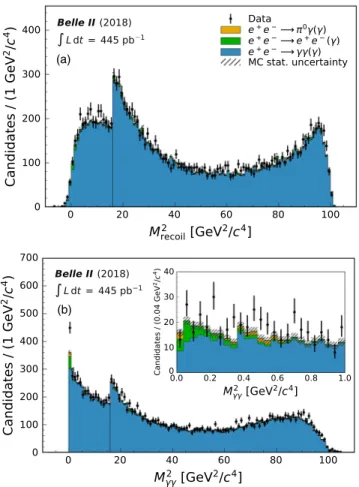
The resulting
M2recoiland
M2γγdistributions are shown in Fig.
1together with the stacked contributions from the luminosity-normalized simulated samples of SM back- grounds. The expected background distributions are domi- nated by
eþe−→γγγwith a small contribution from
eþe− →eþe−γdue to tracking inefficiencies. We find contributions from cosmic rays, assessed in data-taking periods without colliding beams, neither significant nor peaking in photon energy or invariant mass. The data shape agrees well with simulation except for a small and localized excess seen in the low-mass region
M2γγ<1GeV
2=c4. The excess is broad [see the inset in Fig.
1(b)] and not consistentwith an ALP signal, for which we expect a much smaller width in this region (see the inset in Fig.
2). As describedlater, the signal extraction does not directly depend on the background predictions because we fit the background only using data, thus any discrepancy between data and simu- lation has little impact on the result. Triggers based on 1 GeV threshold energy sums in the calorimeter barrel are found to have
εtrg¼1.0for the ALP selection, based upon studies of radiative Bhabha events.
The ALP selection efficiency is determined using large
simulated signal samples, and varies smoothly between
20% (low
ma) and 34% (high
ma). The number of
candidates in data is
3.
60.
9%(
4.
21.
1%) higher than
in the simulation for the
Eγ >0.
65GeV (E
γ >1.
0GeV)
selection. No correction is applied and we assign the sum of
the full difference and its uncertainty as a systematic
uncertainty for the selection efficiency. We assess the
difference in the photon-energy reconstruction between
data and simulation by using radiative muon-pair events in
which we compare the predicted recoil energy calculated
from the muon-pair momenta with the energy of the photon
We vary the energy selection by
1%and the angular- separation selection by the approximate position resolution of
5mrad, and take the respective full difference in the signal selection efficiency with respect to the nominal selection as a systematic uncertainty. We add these three uncertainties in quadrature assuming no correlations amongst them. The total relative uncertainty due to the selection efficiency is approximately 5.5% for ALP masses above
0.
5GeV=c
2, and increases to approximately 8% for the lightest ALP masses considered. As additional system- atic checks we vary the photon-timing selection by
1and the shower-shape classifier selection by
5%to account for possible between data and simulation samples, the invariant mass
Mγγγselection by
0.
002GeV=c
2to account for uncertainties in the beam energy, and the polar-angle-acceptance selection by propagating the effect of a
2mm shift of the interaction point relative to the calorimeter to account for maximal possible misalignment of the ECL. For all of these checks, we find that they have a negligible effect on the signal selection efficiency, so we do not associate any systematic uncertainty with them.
We extract the signal yield as a function of
maby performing a series of independent binned maximum- likelihood fits. We use 100 bins for each fit range. The fits are performed in the range
0.
2< ma<6.
85GeV=c
2for the
M2γγspectrum, and in the range
6.
85< ma<9
.
7GeV=c
2for the
M2recoilspectrum. The resolution of
M2γγworsens with increasing
ma, while that of
M2recoilimproves with increasing
ma(see Fig.
2). The transitionbetween
M2γγand
M2recoilfits is determined as the point of equal sensitivity obtained using background simulations.
The signal probability density function (PDF) has two components: a peaking contribution from correctly recon- structed signal photons and a combinatorial-background contribution from the other two combinations of photons.
We model the peaking contribution using a Crystal Ball (CB) function
[29]. The mass-dependent CB parametersused in the fits to data are fixed to those obtained by fitting simulated events. For the simulated
M2recoildistribution, the CB mean is found to be unbiased. For the simulated
M2γγdistribution, we observe a linear bias of the CB mean of about 0.5% resulting from the combination of two photons with asymmetric reconstructed-energy distributions. This bias is determined to have negligible impact on the signal yield and mass determination; therefore, no attempt to correct for it is made. Combinatorial-background contri- butions from the wrong combinations of photons in signal events are taken into account by adding a mass-dependent, one-dimensional, smoothed kernel density estimation (KDE)
[30]PDF obtained from signal simulation. The fits are performed in steps of
mathat correspond to half the CB width (
σCB) for the respective squared mass. This results in
FIG. 2. M2γγ and M2recoil resolutions with uncertainty as afunction of ALP mass ma. The inset shows an enlargement of the low-mass regionma<1GeV=c2.
(a)
(b)
FIG. 1. M2recoildistribution (a) andM2γγdistribution (b) together with the stacked contributions from the different simulated SM background samples. For M2≤16GeV2=c4, the selection is Eγ >1.0GeV; for M2>16GeV2=c4, it is Eγ>0.65GeV.
Simulation is normalized to luminosity. The inset in (b) shows an enlargement of the low-mass regionM2γγ<1GeV2=c4.
161806-6
a total of 378 fits to the
M2γγdistribution and 124 fits to the
M2recoildistribution. CB signal parameters are interpolated between the known simulated masses, and the KDE shape is taken from the simulation sample generated with the closest value of
mato that assumed in the fit.
The photon-energy resolution
σðEγÞ=Eγin simulation is about 3% for
Eγ ¼0.65GeV and improves to about 2% for
Eγ >1GeV. Using the same muon-pair sample as used for the photon-energy bias study, we find that the photon energy resolution in simulation is better than that in data by at most 30% at low energies. Therefore, we apply an energy-dependent additional resolution smearing to our simulated signal samples before determining the CB resolution parameter
σCB; we assume conservatively that the full observed difference between data and simulation is due to the photon-energy-resolution difference. We assign half of the resulting mass-resolution difference as a systematic uncertainty. The effect of a
2mm shift of the interaction point relative to the calorimeter is found to have a negligible impact on the mass resolution and is not included as a systematic uncertainty.
We describe the backgrounds by polynomials of the minimum complexity consistent with the data features.
Polynomials of second to fifth order are used: second for
0.
2<ma≤0.
5GeV=c
2, fourth for
0.
5<ma≤6.
85GeV=c
2, and fifth for
6.
85< ma≤9.
7GeV=c
2. The background polynomial parameters are not fixed by simulation but are free parameters of each data fit. Each fit is performed in a mass range that corresponds to
−20σCBto
þ30σCBfor
M2γγ, and
−25σCBto
þ25σCBfor
M2recoil. In addition, the fit ranges are constrained between
M2γγ >0GeV
2=c4and
M2recoil<100.
5GeV
2=c4. The choice of the order of background polynomial and fit range is optimized based on the following conditions: giving a reduced
χ2close to one, providing locally smooth fit results, and being con- sistent with minimal variations between adjacent fit ranges.
Peaking backgrounds from
eþe− →Pγare very small compared to the expected statistical uncertainty on the signal yield and found to be modeled adequately by the polynomial background PDF.
The systematic uncertainties due to the signal efficiency and the signal mass resolution are included as Gaussian nuisance parameters with a width equal to the systematic uncertainty. The systematic uncertainty due to the back- ground shape, which is the dominant source of systematic uncertainty, is estimated by repeating all fits with alter- native fit ranges changed by
5σCBand with the poly- nomial orders modified by
1. For each mass value
ma, we report the smallest of all signal significance values determined from each background model. The local sig- nificance including systematic uncertainties is given by
S¼ ffiffiffiffiffiffiffiffiffiffiffiffiffiffiffiffiffiffiffiffiffiffiffiffiffi2
ln
ðL=LbkgÞp
, where
Lis the maximum likelihood for the fit, and
Lbkgis the likelihood for a fit to the background-only hypothesis. The local significances,
multiplied by the sign of the signal yield, are shown in Fig.
3. The largest local significance, including systematicuncertainties, is found near
ma¼0.
477GeV=c
2with a value of
S¼2.
8σ.
By dividing the signal yield by the signal efficiency and the integrated luminosity, we obtain the ALP cross section
σa. We compute the 95% confidence level (C.L.) upper limits on
σaas a function of
mausing a one-sided frequentist profile-likelihood method
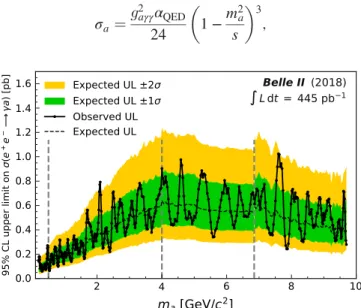
[31]. For eachmafit result, we report the least stringent of all 95% C.L. upper limits determined from the variations of background model and fit range. We convert the cross section limit to the coupling limit using
σa¼g2aγγαQED
24
1−m2a s
3
;
FIG. 3. Local signal significanceSmultiplied by the sign of the signal yield, including systematic uncertainties, as a function of ALP mass ma. The vertical dashed lines indicate (from left to right) changes in the default background PDF (0.5GeV=c2), in the photon energy selection criteria (4.0GeV=c2), and in the invariant-mass determination method (6.85GeV=c2).
FIG. 4. Expected and observed upper limits (95% C.L.) on the ALP cross sectionσa. The vertical dashed lines are the same as those in Fig.3.
where
αQEDis the electromagnetic coupling
[6]. Thiscalculation does not take into account any energy depend- ence of
αQEDand
gaγγitself
[32]. An additional 0.2%collision-energy uncertainty when converting
σato
gaγγresults in a negligible additional systematic uncertainty.
Our median limit expected in the absence of a signal and the observed upper limits on
σaare shown in Fig.
4. Theobserved upper limits on the photon couplings
gaγγof ALPs, as well as existing constraints from previous experi- ments, are shown in Fig.
5. Additional plots and numericalresults can be found in the Supplemental Material
[33]. Ourresults provide the best limits for
0.2< ma<5GeV=c
2. This region of ALP parameter space is completely uncon- strained by cosmological considerations
[34]. The remain-ing mass region below
0.
2GeV=c
2is challenging to probe at colliders due to the poor spatial resolution of photons from highly boosted ALP decays, and irreducible peaking backgrounds from
π0production.
In conclusion, we search for
eþe−→γa; a→γγin the ALP mass range
0.
2< ma<9.
7GeV=c
2using Belle II data corresponding to an integrated luminosity of
445pb
−1. We do not observe any significant excess of events consistent with the signal process and set 95% C.L.
upper limits on the photon coupling
gaγγat the level of
10−3GeV
−1. These limits, the first obtained for the fully reconstructed three-photon final state, are more restrictive than existing limits from LEP-II
[11]. In the future, withincreased luminosity, Belle II is expected to improve the sensitivity to
gaγγby more than one order of magnitude
[6].We thank the SuperKEKB group for the excellent operation of the accelerator; the KEK cryogenics group for the efficient operation of the solenoid; and the KEK computer group for on-site computing support. This work was supported by the following funding sources:
research Grants No. DP180102629, No. DP170102389, No. DP170102204, No. DP150103061, No. FT130100303, and No. FT130100018; Austrian Federal Ministry of Education, Science and Research, and Austrian Science Fund No. P 31361-N36; Natural Sciences and Engineering Research Council of Canada, Compute Canada and CANARIE; Chinese Academy of Sciences and research Grant No. QYZDJ-SSW-SLH011, National Natural Science Foundation of China and research Grants No. 11521505, No. 11575017, No. 11675166, No. 11761141009, No. 11705209, and No. 11975076, LiaoNing Revitalization Talents Program under Contract No. XLYC1807135, Shanghai Municipal Science and Technology Committee under Contract No. 19ZR1403000, Shanghai Pujiang Program under Grant No. 18PJ1401000, and the CAS Center for Excellence in Particle Physics (CCEPP); the Ministry of Education, Youth and Sports of the Czech Republic under Contract No. LTT17020 and Charles University Grants No. SVV 260448 and No. GAUK 404316; European Research Council, 7th Framework PIEF-GA-2013- 622527, Horizon 2020 Marie Sklodowska-Curie Grant Agreement No. 700525
“NIOBE,
”and Horizon 2020 Marie Sklodowska-Curie RISE project JENNIFER2 Grant Agreement No. 822070 (European grants);
L
’Institut National de Physique Nucl´eaire et de Physique des Particules (IN2P3) du CNRS (France); BMBF, DFG, HGF, MPG, AvH Foundation, and Deutsche Forschungsgemeinschaft (DFG) under Germany’s Excellence Strategy
—EXC2121
“Quantum Universe
”—Grant No. 390833306 (Germany); Department of Atomic Energy and Department of Science and Technology (India); Israel Science Foundation Grant No. 2476/17 and United States-Israel Binational Science Foundation Grant No. 2016113; Istituto Nazionale di Fisica Nucleare and the research grants BELLE2; Japan Society for the Promotion of Science, Grant-in-Aid for Scientific Research Grants No. 16H03968, No. 16H03993, No. 16H06492, No. 16K05323, No. 17H01133, No. 17H05405, No. 18K03621, No. 18H03710, No. 18H05226, No. 19H00682, No. 26220706, and No. 26400255, the National Institute of Informatics, and Science Information NETwork 5 (SINET5), and the Ministry of Education, Culture, Sports, Science, and Technology (MEXT) of Japan; National Research Foundation (NRF) of Korea Grants No. 2016R1D1A1B01010135, No. 2016R1D1A1B02012900, No. 2018R1A2B3003643, No. 2018R1A6A1A06024970, No. 2018R1D1A1B07047294,
No. 2019K1A3A7A09033840, and
No. 2019R1I1A3A01058933, Radiation Science Research Institute, Foreign Large-size Research Facility Application Supporting project, the Global Science
FIG. 5. Upper limit (95% C.L.) on the ALP-photon couplingfrom this analysis and previous constraints from electron beam- dump experiments andeþe−→γþinvisible[6,9], proton beam- dump experiments[8],eþe−→γγ [11], a photon-beam experi- ment[12], and heavy-ion collisions[13].
161806-8
Experimental Data Hub Center of the Korea Institute of Science and Technology Information and KREONET/
GLORIAD; Universiti Malaya RU grant, Akademi Sains Malaysia and Ministry of Education Malaysia; Frontiers of Science Program Contracts No. FOINS-296, No. CB- 221329, No. CB-236394, No. CB-254409, and No. CB- 180023, and SEP-CINVESTAV research Grant No. 237 (Mexico); the Polish Ministry of Science and Higher Education and the National Science Center; the Ministry of Science and Higher Education of the Russian Federation, Agreement No. 14.W03.31.0026; University of Tabuk research Grants No. S-1440-0321, No. S-0256-1438, and No. S-0280-1439 (Saudi Arabia); Slovenian Research Agency and research Grants No. J1-9124 and No. P1- 0135; Agencia Estatal de Investigacion, Spain Grant No. FPA2014-55613-P and No. FPA2017-84445-P, and Grant No. CIDEGENT/2018/020 of Generalitat Valenciana; Ministry of Science and Technology and research Grants No. MOST106-2112-M-002-005-MY3 and No. MOST107-2119-M-002-035-MY3, and the Ministry of Education (Taiwan); Thailand Center of Excellence in Physics; TUBITAK ULAKBIM (Turkey);
Ministry of Education and Science of Ukraine; the US National Science Foundation and research Grants No. PHY-1807007 and No. PHY-1913789, and the US Department of Energy and research Grants No. DE-AC06- 76RLO1830, No. DE-SC0007983, No. DE-SC0009824, No. DE-SC0009973, No. DE-SC0010073, No. DE- SC0010118, No. DE-SC0010504, No. DE-SC0011784, and No. DE-SC0012704; and the National Foundation for Science and Technology Development (NAFOSTED) of Vietnam under Contract No. 103.99-2018.45.
[1] J. Jaeckel and A. Ringwald,Annu. Rev. Nucl. Part. Sci.60, 405 (2010).
[2] R. D. Peccei and H. R. Quinn, Phys. Rev. Lett. 38, 1440 (1977).
[3] J. Preskill, M. B. Wise, and F. Wilczek, Phys. Lett.120B, 127 (1983).
[4] L. Abbott and P. Sikivie,Phys. Lett.120B, 133 (1983).
[5] M. Dine and W. Fischler,Phys. Lett.120B, 137 (1983).
[6] M. J. Dolan, T. Ferber, C. Hearty, F. Kahlhoefer, and K.
Schmidt-Hoberg,J. High Energy Phys. 12 (2017) 094.
[7] M. J. Dolan, F. Kahlhoefer, C. McCabe, and K. Schmidt- Hoberg,J. High Energy Phys. 03 (2015) 171.
[8] B. Döbrich, J. Jaeckel, F. Kahlhoefer, A. Ringwald, and K.
Schmidt-Hoberg,J. High Energy Phys. 02 (2016) 018.
[9] D. Banerjeeet al. (NA64 Collaboration),Phys. Rev. Lett.
125, 081801 (2020).
[10] J. Jaeckel and M. Spannowsky, Phys. Lett. B 753, 482 (2016).
[11] S. Knapen, T. Lin, H. Keong Lou, and T. Melia,Phys. Rev.
Lett.118, 171801 (2017).
[12] D. Aloni, C. Fanelli, Y. Soreq, and M. Williams,Phys. Rev.
Lett.123, 071801 (2019).
[13] A. M. Sirunyanet al. (CMS Collaboration),Phys. Lett. B 797, 134826 (2019).
[14] F. Abudinnet al.(Belle II Collaboration),Chin. Phys. C44, 021001 (2020).
[15] K. Akai, K. Furukawa, and H. Koiso (SuperKEKB Collaboration), Nucl. Instrum. Methods Phys. Res., Sect.
A907, 188 (2018).
[16] T. Abe et al., CERN Report No. KEK-REPORT-2010-1, 2010.
[17] E. Kouet al.,Prog. Theor. Exp. Phys.2019, 123C01 (2019);
2020, 029201(E) (2020).
[18] C. M. Carloni Calame, C. Lunardini, G. Montagna, O.
Nicrosini, and F. Piccinini,Nucl. Phys.B584, 459 (2000).
[19] C. M. Carloni Calame,Phys. Lett. B520, 16 (2001).
[20] G. Balossini, C. M. Carloni Calame, G. Montagna, O. Nicrosini, and F. Piccinini, Nucl. Phys. B758, 227 (2006).
[21] G. Balossini, C. Bignamini, C. M. Carloni Calame, G.
Montagna, O. Nicrosini, and F. Piccinini, Phys. Lett. B 663, 209 (2008).
[22] H. Czyz, P. Kisza, and S. Tracz,Phys. Rev. D97, 016006 (2018).
[23] J. Alwall, R. Frederix, S. Frixione, V. Hirschi, F. Maltoni, O.
Mattelaer, H.-S. Shao, T. Stelzer, P. Torrielli, and M. Zaro, J. High Energy Phys. 07 (2014) 079.
[24] Q. Li and Q.-S. Yan,arXiv:1804.00125.
[25] S. Agostinelliet al.,Nucl. Instrum. Methods Phys. Res., Sect. A506, 250 (2003).
[26] T. Kuhret al.,Comput. Software Big. Sci.3, 1 (2019).
[27] G. Punzi, eConfC030908, MODT002 (2003),https://arxiv .org/abs/physics/0308063.
[28] F. von Zernike,Physica (Utrecht)1, 689 (1934).
[29] T. Skwarnicki, CERN Report No. DESY-F31-86-02, 1986.
[30] K. S. Cranmer,Comput. Phys. Commun.136, 198 (2001).
[31] G. Cowan, K. Cranmer, E. Gross, and O. Vitells,Eur. Phys.
J. C71, 1554 (2011);73, 2501(E) (2013).
[32] M. Bauer, M. Neubert, and A. Thamm, J. High Energy Phys. 12 (2017) 044.
[33] See the Supplemental Material at http://link.aps.org/
supplemental/10.1103/PhysRevLett.125.161806 for addi- tional plots and numerical results.
[34] P. F. Depta, M. Hufnagel, and K. Schmidt-Hoberg, J. Cosmol. Astropart. Phys. 05 (2020) 009.