Effect of ascorbic acid and X-irradiation on HL-60 human leukemia cells: The kinetics of reactive oxygen species
ヒト由来白血病細胞株
HL-60
に対するアスコルビン 酸とX
線の効果と活性酸素種の動態に関する研究弘前大学大学院保健学研究科保健学専攻
提出者氏名: 寺 島 真 悟
所 属: 医療生命科学領域 生体機能科学分野
指導教員: 中 村 敏 也
Table of contents
Abbreviations... 2
Introduction ... 3
Materials and Methods ... 5
Results ... 8
Discussion ... 14
Acknowledgements ... 18
References ... 19
Abstract ... 24
Abbreviations
AsA : ascorbic acid
ATP : adenosine triphosphate
DiOC6(3) : 3,3'-dihexyloxacarbocyanine iodide DHA : dehydroascorbate
FBS : Fetal bovine serum
H2DCFDA : 2',7-dichlorofluorescin diacetate H2O2 : hydrogen peroxide
HBSS : hanks' balanced salt solutions NO : nitric oxide
O2• - : superoxide
PBS(-) : phosphate buffered saline(-) PI : propidium iodide
ROS : reactive oxygen species
1O2 : singlet oxygen
• OH :hydroxyl radical
Introduction
Ascorbic acid (AsA) (also known as vitamin C) therapy has been considered a therapeutic option for cancer therapy, and has few side-effects when administered intravenously in pharmacologic concentrations 1). Chen et al. reported that AsA is selectively toxic for some cancer cells but it is not toxic to normal cells 2). AsA exhibits cytotoxic effects in tumor cells, which have a low concentration of intracellular catalase that degrades hydrogen peroxide (H2O2)3). Studies have shown that tumor cells are easily damaged by H2O2, and production of the adenosine triphosphate (ATP) is decreased due to mitochondrial damage, thus leading to tumor cell death 4 — 8). H2O2 is produced during radiation therapy and some antineoplastic drugs kills the tumor cell by its cytotoxic activity 9). The generation of reactive oxygen species (ROS) derived from H2O2 is thought to be involved in the cytotoxicity. Vitamin C therapy can be used alone or in combination with chemotherapy 10 — 12). AsA in combination with radiation therapy is also expected to be effective in cancer therapy since it is considered to have few side- effects 13, 14). Koyama et al. reported that AsA does not inhibit the fatal effects of
radiation, but inhibits carcinogenesis and mutation15). Therefore, AsA may reduce the risk of a second cancer in normal cells during combined AsA and radiation therapy.
AsA is also known as a radical scavenger 16, 17), and it scavenges O2・-, ・OH,
1O2, and NO under in vitro conditions; thus, it can scavenge ROS generated by
antineoplastic drugs or X-irradiation 18). Therefore, conflicting data exist regarding AsA inhibiting the cytotoxic effects generated by the action of antineoplastic drugs or X- irradiation 19 — 23).
The majority of cell deaths induced by X-irradiation depends on the
production of intracellular ROS, which is generated during irradiation. Within several hours after irradiation, secondary ROS production occurs intracellularly, and it induces apoptosis 24, 25). Mitochondria are well known as a major source of intracellular ROS and produces ROS during intracellular ATP synthesis. Therefore, the source of
secondary ROS as a result of irradiation is thought to be the mitochondria 24 — 26). The generation of ROS from mitochondria and the loss of the mitochondrial membrane potential play an important role in inducing cell death 25, 27, 28).
In this study, we have examined the mechanism underlying cell death caused by a combination treatment of AsA and X-irradiation from the viewpoint of ROS generation by using HL-60 human promyelocytic leukemia cells and we have clarified that AsA does not inhibit the cytotoxic effects of X-irradiation.
Materials and Methods
1. Cell culture, X-irradiation, and drug treatment
The HL-60 human promyelocytic leukemia cell line (RIKEN Bio Resource Center, Tsukuba, Japan) was used in these experiments. Cells were cultured in RPMI- 1640 (Gibco, Grand Island, NY, USA) supplemented with 10% fetal bovine serum and 1% penicillin–streptomycin, and were maintained at 37°C with 95% air and 5% CO2. The passage duration was 3–5 days, and the density was not allowed to exceed 1×10⁶ cells/ml. X-irradiation was delivered using an X-ray machine MBR-1520R-3 (Hitachi, Tokyo, Japan) at 150 kV and 20 mA through a 0.5-mm Al and 0.3-mm Cu filter at a dose rate of 1.0 Gy/min. L(+)-ascorbic acid was purchased from Wako (Tokyo, Japan).
The AsA was dissolved in RPMI-1640 medium and deacidified with sodium hydrate before treatment. Catalase (Sigma Aldrich, St. Louis, MO, USA) was added to the culture to achieve a final concentration of 1,300 U/ml.
2. Cell viability assay
HL-60 cells (4.0×10⁵ cells/ml) were cultured for 6 h. A final concentration of 0.01–10.0 mM AsA was then added to the culture and the number of viable cells was counted using trypan blue dye exclusion method after 24 h. For the next experiment, 4×10⁵ cells/ml HL-60 cells were cultured with or without catalase for 6 h, and 1.0 or 2.5 mM AsA was added to the cells in combination with 2 Gy X-irradiation. The viable cells were counted by trypan blue dye exclusion method after 24 h.
3. Measurement of intracellular ROS
Subsequently HL-60 cells (1.5×10⁵ cells/ml) were cultured with or without catalase for 6 h, and 2.5 mM AsA was added to the cells in combination with 2 Gy X- irradiation. The intracellular ROS production was measured using a flow cytometer (Cytomics FC500, Beckman Coulter, Fullerton, CA) using the ROS-sensitive probe
2′,7-dichlorofluorescin diacetate (H2DCFDA; Molecular Probes, Invitrogen Corp., CA, USA) at the indicated times after exposure to X-irradiation. The cells were washed with phosphate buffered saline without Ca2+ and Mg2+ [PBS (-)], incubated at 37°C with 5 μM H2DCFDA in PBS (-) for 15 min, washed in PBS (-), and then resuspended in PBS (-) containing 5 mg/l propidium iodide (PI; Sigma Aldrich.) to exclude dead cells.
Sample data were analyzed using FlowJo software (Treestar, Inc., San Carlos, CA, USA). The median H2DCFDA fluorescence intensity of each sample was normalized to that of control sample to calculate the relative H2DCFDA intensity.
For the precise evaluation of ROS production immediately following X- irradiation, we labeled the cells with H2DCFDA prior to AsA and X-irradiation
treatments 29, 30). In brief, cells were incubated at 37°C with 5 μM H2DCFDA in PBS (-) or 10% FBS growth medium for 15 min. After labeling, the cells were treated with AsA and/or X-irradiation in the presence of H2DCFDA, washed in PBS (-), and then
resuspended in PBS (-) containing 5 mg/l PI. Samples were analyzed using a flow cytometer immediately after the treatment.
4. Measurement of mitochondrial superoxide and mitochondrial membrane potential The cells were treated with AsA and/or X-irradiation as described above without the addition of catalase. The mitochondrial superoxide levels were measured using the flow cytometer with mitochondrial superoxide indicator MitoSOX Red (Molecular Probes, Invitrogen Corp.) at the indicated times after exposure to X-
irradiation. The cells were washed with PBS (-), incubated at 37°C with 5 μM MitoSOX Red in Hanks' Balanced Salt Solutions (HBSS; with Ca2+ and Mg2+) for the 15 min, and then washed and resuspended in PBS (-). Sample data were analyzed using the FlowJo software. The median MitoSOX Red fluorescence intensity of each sample was
normalized to that of control sample to calculate the relative MitoSOX Red intensity.
The changes in the mitochondrial membrane potential was measured using the flow cytometer with 3,3′-dihexyloxacarbocyanine iodide ([DiOC6(3)]; Molecular
Probes, Invitrogen Corp.) at indicated times after exposure to X-irradiation. The cells were washed with PBS (-), incubated at 37°C with 40 nM DiOC6(3) in HBSS for 15 min, washed in HBSS, and then resuspended in serum-free RPMI1640 medium containing 5 mg/l PI to exclude dead cells. Sample data were analyzed using FlowJo software. The median DiOC6(3) fluorescence intensity of each sample was normalized to that of control sample to calculate the relative DiOC6(3) intensity.
5. Statistical analysis
Statistical comparisons were performed using the Tukey-Kramer test. All results are presented as the mean ± SD from the results of at least three independent experiments. p values less than 0.01 or 0.05 were considered to indicate statically
significant differences. Statistical analysis was performed using the Excel 2007 software program (Microsoft, USA) with Statcel 2 add-in software31).
Results
1. Cell death by AsA treatment and X-irradiation
In the initial experiment, we examined the AsA sensitivity of HL-60 cells.
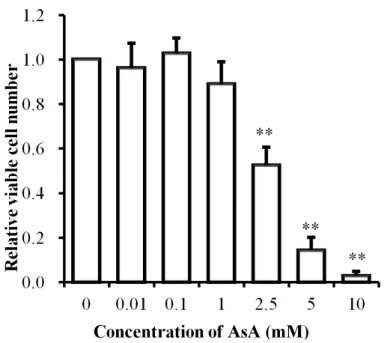
After AsA treatment for 24 h, we counted the viable HL-60 cells by trypan blue dye exclusion method. AsA showed cytotoxic effects on the growth of HL-60 cells in a dose-dependent manner from ~ 1 mM concentration (Fig. 1). Enhanced cell growth was not observed in AsA treatment at low concentration (0.01 or 0.1 mM).
Figure 1. Relative viable cell number at 24 h after AsA treatment. **p<0.01 vs. 0 mM.
AsA showed cytotoxic effects on the growth of HL-60 cells in a dose-dependent manner from ~ 1 mM.
Additive cytotoxic effects were observed when the cells were exposed to 2 Gy X-irradiation after 2.5 mM AsA treatment (Fig. 2). When 2.5 mM AsA and 2 Gy X- irradiation were used in combination, a significant decrease in the relative viable cell number was observed when compared to application of 2 Gy X-irradiation alone (p<0.05). Fig. 2 also shows the cytotoxic effect of AsA alone and in combination with
X-irradiation in the presence of catalase. When AsA was added to the culture in the presence of catalase, the cytotoxic effects of AsA disappeared. Moreover, the additive cytotoxic effects of 2.5 mM AsA and 2 Gy X-irradiation in combination decreased to the same level as obtained by 2 Gy X-irradiation alone.
Figure 2. Relative viable cell number at 24 h after X-ray irradiation (2 Gy), AsA treatment (1 or 2 mM), and combined X-ray and AsA treatment (white bars, untreated with catalase;
gray bars, treated with catalase). **p<0.01 vs. 0 mM. ††p<0.01.
2. Kinetics of intracellular ROS
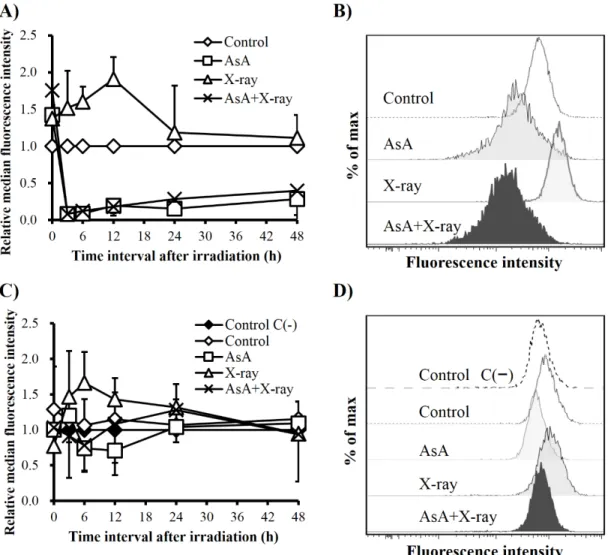
Fig. 3A shows the changes in intracellular ROS levels as analyzed using a flow cytometer. In cells treated with X-irradiation alone (2 Gy), the intracellular ROS levels increased and reached a peak at 12 h (p<0.01) compared to control, and decreased slowly thereafter. By contrast, treatment with AsA alone (2.5 mM) and in combination with X-irradiation (2 Gy) significantly decreased intracellular ROS levels at 3–24 h after X-irradiation. A representative histogram of DCF fluorescence intensity at 12 h is shown in Fig. 3B.
Fig. 3C shows the changes in the intracellular ROS levels in the presence of catalase. The intracellular ROS levels of X-irradiated cells increased slightly and reached a peak after 6 h, but there was no significant difference when compared to
control cells. The ROS levels of cells treated with AsA alone and in combination with X-irradiation were also not significantly altered compared to those of control cells. A representative histogram of DCF fluorescence intensity at 6 h is shown in Fig. 3D.
Figure 3. Kinetics of intracellular ROS production was analyzed by flow cytometry using H2DCFDA. Intracellular ROS levels without catalase (A) and with catalase (C) after X- irradiation. A representative flow cytometric histogram of H2DCFDA fluorescence intensity at 12 h without catalase (B) and at 6 h with catalase (D) after X-irradiation.
Control C(-) represents control in the absence of catalase.
In the absence of catalase, the ROS levels of cells treated with a combination of AsA and X-irradiation were significantly higher than those of the control cells at 0 h
after X-irradiation, and this difference was statistically significant (p<0.05). For the precise evaluation of ROS production immediately following X-irradiation, we labeled the cells with H2DCFDA prior to AsA and X-irradiation treatment. The ROS levels of cells treated with AsA alone and in combination with X-irradiation significantly increased immediately following X-irradiation, compared to control cells (Fig. 4A and B). Fig. 4C and D shows the amount of generated ROS when cells incubated with H2DCFDA in 10% FBS growth medium. The ROS levels of cells treated with AsA increased more in 10% FBS growth medium compared to in PBS (-).
Figure 4. Evaluation of ROS production soon after X-irradiation. We labeled the cells with H2DCFDA before AsA and X-irradiation treatment. After AsA and/or X-irradiation, samples were run on a flow cytometer immediately. ROS production in the cells incubated with H2DCFDA in PBS (-) (A) and in 10% FBS growth medium (C). A representative
flow cytometric histogram of H2DCFDA fluorescence intensity immediately following X-irradiation of the cells incubated with H2DCFDA PBS (-) (B) and in 10% FBS growth medium (D). *p<0.05 vs. 0 mM, **p<0.01 vs. 0 mM. ††p<0.01.
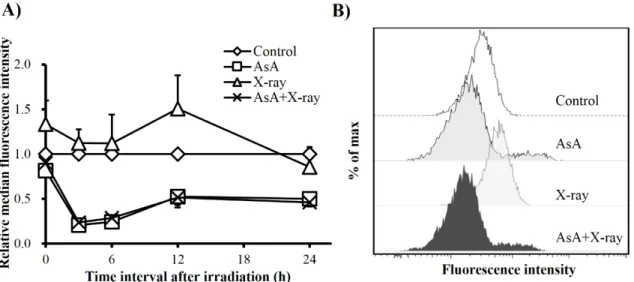
3. Kinetics of mitochondrial superoxide and mitochondrial membrane potential The changes in mitochondrial superoxide levels were analyzed by flow cytometry (Fig. 5A). When X-irradiation was used alone, mitochondrial superoxide levels increased slightly and reached a peak at 12 h (p<0.01) compared to control (Fig.
5B). By contrast, AsA alone and in combination with X-irradiation significantly decreased the mitochondrial superoxide levels at 3–24 h after X-irradiation. These changes were similar to the changes in the intracellular ROS levels.
Figure 5. Mitochondrial superoxide analysis by flow cytometry using MitoSOX Red.
(A) Kinetics of mitochondrial superoxide. (B) A representative flow cytometric histogram of MitoSOX Red fluorescence intensity at 12 h after X-irradiation.
In order to investigate whether AsA scavenged intracellular ROS or whether generation of ROS from mitochondria was decreased, we used DiOC6(3) (a
carbocyanine dye that accumulates in active mitochondria) to measure the
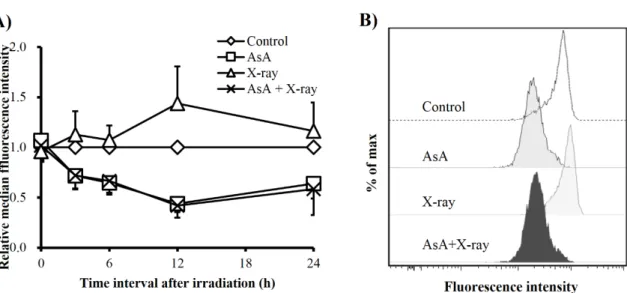
mitochondrial membrane potential by flow cytometry. When X-irradiation was used alone, the mitochondrial membrane potential increased slightly and reached a peak at 12 h (p<0.01) compared to control (Fig. 6A). Contrary to this, in the presence of only AsA or in combination with X-irradiation, the mitochondria membrane potential gradually decreased and became about ~ 40% of control value at 12 h after X-irradiation (Fig.
6B).
Figure 6. Mitochondrial membrane potential was analyzed by flow cytometry by using DiOC6(3). (A) Kinetics of mitochondrial membrane potential. (B) A representative flow cytometric histogram of DiOC6(3) fluorescence intensity at 12 h after X-irradiation.
Discussion
In the present study, we describe the potential of AsA and X-irradiation combination treatment, particularly against intracellular ROS in HL-60 cells. We demonstrate that AsA, a radical scavenger, did not inhibit the cytotoxic effect when used in combination with X-irradiation although it resulted in intracellular ROS reduction.
In this study, additive cytotoxic effects were observed when the cells were exposed to 2 Gy X-irradiation after 2.5 mM AsA treatment. When a combination of 1 mM AsA and 2 Gy X-irradiation was applied, the protective effect of AsA against 2 Gy X-irradiation was not observed and no significant cytotoxic effects were observed.
These results are consistent with the studies that AsA does not inhibit the fatal effects of radiation13, 15). When AsA was added to the culture in the presence of catalase, the cytotoxic effects of AsA disappeared. Moreover, the additive cytotoxic effects decreased to the same level obtained by X-irradiation alone. These results suggest that the action pathway of hydroxyl radicals derived from H2O2 is different in AsA and X-irradiation treatments. Catalase, being a large protein, does not penetrate cell membranes and, therefore, it is not taken up by cells. Catalase neutralizes the H2O2 derived from AsA in the extracellular fluids. Therefore, it is considered that the cytotoxic effect of
extracellular H2O2 that AsA generates is much more effective than the cytotoxic effect of intracellular AsA4, 32).
Our present study showed that AsA significantly decreased intercellular ROS production. Hence, such a result might indicate that combined AsA and X-irradiation treatment may not be effective as cell death due to signal transduction by ROS is inhibited22, 23). In AsA treatment, a significant change in the intercellular ROS level was not observed in the presence of catalase as compared with the significant reduction of intracellular ROS in the absence of catalase. For this reason, our results suggest that the slight change in intracellular ROS is due to the neutralizing effect of extracellular H2O2
by catalase in preference to scavenging intercellular ROS by AsA. It is thought that
extracellular H2O2 generated by AsA treatment might mainly decrease intercellular ROS or both cytotoxic effect and radical scavenger are necessary for significant reduction of ROS. Some studies have reported that antineoplastic drugs exhibit cytotoxic effect with reduction of ROS; hence, it showed the ability of scavenging ROS like AsA33, 34). It was also reported that intercellular ROS slightly decreased when cells were treated with H2O235).
When AsA alone and in combination with X-irradiation was used, large quantities of intracellular ROS were observed immediately following AsA and X- irradiation treatment, which was observed by labeling the cells with H2DCFDA prior to treatment. It is reported that H2O2 generation was dependent on the presence of trace amounts of serum in media2). When the cells were treated with AsA and/or X-irradiation in the presence of H2DCFDA in 10% fetal bovine serum (FBS) growth medium, but not in PBS, ~ 12-fold ROS production in the control was observed for AsA alone and in combination with X-irradiation. Since H2O2 can easily permeate cell membranes 36), large quantities of H2O2 derived from AsA might damage HL-60 cells immediately following AsA treatment, after which the intercellular ROS production is decreased.
Besides, Frömberg et al. showed that AsA or dehydroascorbate (DHA) is important for cytotoxic efficiency in the redox state of vitamin C, and they report higher therapeutic efficacy of AsA over DHA in various cell lines32). Furthermore, it is reported that tumor cells take up DHA, but not AsA, in large quantities. However, a modest change in the intracellular ROS levels was observed in the order of mM DHA20), although DHA turn into AsA in cells18), contrary to our results of AsA treatment. Therefore, the redox state of vitamin C agents may lead to contradictory results in Vitamin C treatment.
Mitochondria release cytochrome c, which activates caspase for apoptosis, leading to changes in mitochondrial respiratory chain, and the mitochondrial membrane potential is depolarized. Therefore, mitochondrial membrane potential is used as an indicator for evaluating cell life and death37). In our study, mitochondrial membrane potential gradually disappeared in cells treated with AsA. However, it is reported that an
increase in intracellular ROS is observed when the mitochondrial membrane potential is decreased by several antineoplastic agents38). Some studies reported the existence of ROS-independent mitochondrial pathway, since reduction of the mitochondrial
membrane potential is observed without an increase in intracellular ROS 33, 34, 39, 40). AsA might induce apoptosis in HL-60 cells through a ROS-independent mitochondrial
pathway as intracellular ROS was significantly decreased as compared with the control, and a reduction in the mitochondrial membrane potential was observed in AsA
treatment.
Some studies reported that the antineoplastic agent that has the ability of scavenging ROS induces apoptosis through a ROS-independent mitochondrial pathway with reduction in ROS33, 34).Furthermore, an increase in intracellular ROS and
superoxide levels derived from mitochondria was reported and mitochondrial membrane potential hyperpolarization was observed after X-ray irradiation. It is thought that X- irradiation arrests cell cycle, inhibits cell division and increase in the mitochondrial content, leading to the activation of mitochondrial respiratory chain, resulting in the increase of mitochondrial ROS26, 41). Our data are consistent with these studies, but changes in the X-ray irradiated cells were contrary to the changes in cells treated with AsA. When a combination of AsA and X-irradiation was used, ROS levels decreased to the same level obtained by AsA alone, but AsA did not inhibit the cytotoxic effects of X-irradiation. While considering ROS generation, these indicate that additive cytotoxic effects were observed since AsA and X-irradiation follow different signaling pathways.
Shinozaki et al. reported that the involvement of Bax and caspase 8 were different following X-irradiation or AsA treatment alone as compared with those following combined X- irradiation and AsA treatment against the apoptosis mechanism13).
In the present study, we examined the mechanism underlying cell death caused by a combination of AsA and X-irradiation from the viewpoint of ROS generation by HL-60 cells to reveal the clinical possibility of a combination therapy.
The combination decreased intracellular ROS generation, but additive cytotoxic effects
and reduction of mitochondrial membrane potential were observed in cells. These results suggest that AsA, which is a radical scavenger, did not exert protective effect against ROS production by X-irradiation and the signaling pathway in mitochondria was different for AsA and X-irradiation. Our results suggest that combination therapy of AsA and X-irradiation does not have an effect on cancer cell death while considering ROS generation.
Acknowledgements
First of all, my deepest appreciation goes to Prof. Toshiya Nakamura and Prof. Yoichiro Hosokawa whose comments and suggestions were of inestimable value for my study.
I thank to Prof. Ikuo Kashiwakura and Prof. Tsuyoshi Higuchi for evaluation of my thesis.
I also thank all members of Department of Radiological Life Sciences, Hirosaki University Graduate School of Health Sciences, for invaluable comments and warm encouragements.
References
1) Padayatty SJ, Sun AY, Chen Q, Espey MG, Drisko J and Levine M: Vitamin C:
Intravenous Use by Complementary and Alternative Medicine Practitioners and Adverse Effects. PLoS One, 5: e11414, 2010.
2) Chen Q, Espey MG, Krishna MC, et al: Pharmacologic ascorbic acid concentrations selectively kill cancer cells: action as a pro-drug to deliver hydrogen peroxide to tissues. Proc Natl Acad Sci U S A, 102: 13604-13609, 2005.
3) Christoph K, Ulrike K, Monika K et al: Natural resistance to ascorbic acid induced oxidative stress is mainly mediated by catalase activity in human cancer cells and catalase-silencing sensitizes to oxidative stress. BMC Complementary and Alternative Medicine 12(1): 61, 2012.
4) Chen Q, Espey MG, Sun AY, et al: Ascorbate in pharmacologic concentrations selectively generates ascorbate radical and hydrogen peroxide in extracellular fluid in vivo. Proc Natl Acad Sci U S A, 104: 8749-8787, 2007.
5) Takemura Y, Satoh M, Satoh K, Hamada H, Sekido Y and Kubota S: High dose of ascorbic acid induces cell death in mesothelioma cells. Biochem Biophys Res Commun, 394: 249-253, 2010.
6) Hsieh BS, Huang LW, Su SJ, et al: Combined arginine and ascorbic acid treatment induces apoptosis in the hepatoma cell line HA22T/VGH and changes in redox status involving the pentose phosphate pathway and reactive oxygen and nitrogen species. J Nutr Biochem, 22: 234-241, 2011.
7) Hampton MB and Orrenius S: Dual regulation of caspase activity by hydrogen peroxide: implications for apoptosis. FEBS Lett, 414: 552-556, 1997.
8) Hyslop PA, Hinshaw DB, Halsey WA Jr, et al: Mechanisms of oxidant-mediated cell injury. The glycolytic and mitochondrial pathways of ADP phosphorylation are major intracellular targets inactivated by hydrogen peroxide. J Biol Chem, 263: 1665-1675, 1998.
9) Lamson DW and Brignall MS: Antioxidants in cancer therapy; their actions and interactions with oncologic therapies. Altern Med Rev, 4: 304-329, 1999.
10) Padayatty SJ, Riordan HD, Hewitt SM, Katz A, Hoffer LJ and Levine M:
Intravenously administered vitamin C as cancer therapy: Three cases. CMAJ, 174:
937–942, 2006.
11) Riordan HD, Casciari JJ, González MJ, et al: A pilot clinical study of continuous intravenous ascorbate in terminal cancer patients. P R Health Sci J, 24: 269–276, 2005.
12) Monti DA, Mitchell E, Bazzan AJ, et al: Phase I evaluation of intravenous ascorbic Acid in combination with gemcitabine and erlotinib in patients with metastatic pancreatic cancer. PLoS One, 7: e29794, 2012.
13) Shinozaki K, Hosokawa Y, Hazawa M, et al: Ascorbic Acid Enhances Radiation- induced Apoptosis in an HL60 Human Leukemia Cell Line. J Radiat Res, 52: 229-237, 2011.
14) Herst PM, Broadley KW, Harper JL and McConnell MJ: Pharmacological concentrations of ascorbate radiosensitize glioblastoma multiforme primary cells by increasing oxidative DNA damage and inhibiting G2/M arrest. Free Radic Med, 52:
1486-1493, 2012.
15) Koyama S, Kodama S, Suzuki K, Matsumoto T, Miyazaki T and Watanabe M:
Radiation-induced long-lived radicals which cause mutation and transformation.
Mutat Res, 421: 45–54, 1998.
16) Rose RC and Bode AM: Biology of free radical scavengers: an evaluation of ascorbate.
FASEB J, 7: 1135-1142, 1993.
17) Li Y and Schellhorn HE: New developments and novel therapeutic perspectives for vitamin C. J Nutr, 137: 2171-2184, 2007.
18) Reth M: Antioxidant defenses endogenous and diet derived. In: Halliwell B, Gutteridge JMC (ed.) Free radicals in biology and medicine 4th Edition. Oxford University Press, New York, pp160-166, 2007.
19) Lawenda BD, Kelly KM, Ladas EJ, Sagar SM, Vickers A and Blumberg JB: Should
supplemental antioxidant administration be avoided during chemotherapy and radiation therapy? J Natl Cancer Inst, 100: 773-783, 2008.
20) Heaney ML, Gardner JR, Karasavvas N, et al: Vitamin C antagonizes the cytotoxic effects of antineoplastic drugs. Cancer Res 68: 8031-8038, 2008.
21) Yamamoto T, Kinoshita M, Shinomiya N, et al: Pretreatment with Ascorbic Acid Prevents Lethal Gastrointestinal Syndrome in Mice Receiving a Massive Amount of Radiation. J Radiat Res, 51: 145–156, 2010.
22) Witenberg B, Kalir HH, Raviv Z, Kletter Y, Kravtsov V and Fabian I:,Inhibition by ascorbic acid of apoptosis induced by oxidative stress in HL-60 myeloid leukemia cells.
Biochem Pharmacol, 57: 823-832, 1999.
23) Witenberg B, Kletter Y, Kalir HH, et al: Ascorbic Acid Inhibits Apoptosis Induced by X Irradiation in HL60 Myeloid Leukemia Cells. Radiation Research, 152: 468-478, 1999.
24) Lee YJ, Lee DH, Cho CK, et al: HSP25 inhibits radiation-induced apoptosis through reduction of PKCδ-mediated ROS production. Oncogene, 24: 3715-3725, 2005.
25) Ni Y, Gong XG, Lu M, Chen HM and Wang Y: Mitochondrial ROS burst as an early sign in sarsasapogenin-induced apoptosis in HepG2 cells. Cell Biol Int, 32: 337-343, 2008.
26) Ogura A, Oowada S, Kon Y, et al: Redox regulation in radiation-induced cytochrome c release from mitochondria of human lung carcinoma A549 cells. Cancer Letters, 277:
64-71, 2009.
27) Grad JM, Cepero E and Boise LH: Mitochondria as targets for established and novel anti-cancer agents. Drug Resistance Updates, 4: 85–91, 2001.
28) Green DR and Reed JC: Mitochondria and apoptosis. Science, 281: 1309-1312, 1998 29) Yoshino H, Kiminarita T, Matsushita Y and Kashiwakura I: Response of the Nrf2 protection system in human monocytic cells after ionising irradiation. Radiat Prot Dosimetry, 152: 104-108, 2012.
30) Hachiya M and Akashi M: Catalase Regulates Cell Growth in HL60 Human
Promyelocytic Cells: Evidence for Growth Regulation by H2O2. Radiat Res, 163: 271–
282, 2005.
31) Yanai H: Statcel-The useful add-in software forms on Excel (2nd ed.). OMS, Tokyo, 2006.
32) Frömberg A, Gutsch D, Schulze D, et al: Ascorbate exerts anti-proliferative effects through cell cycle inhibition and sensitizes tumor cells towards cytostatic drugs.
Cancer Chemother Pharmacol, 67: 1157–1166, 2011.
33) Wang XH, Jia DZ, Liang YJ, et al: Lgf-YL-9 induces apoptosis in human epidermoid carcinoma KB cells and multidrug resistant KBv200 cells via reactive oxygen species- independent mitochondrial pathway. Cancer Lett, 249: 256-270, 2007.
34) Zhang JY, Wu HY, Xia XK, et al: Anthracenedione derivative 1403P-3 induces apoptosis in KB and KBv200 cells via reactive oxygen species-independent mitochondrial pathway and death receptor pathway. Cancer Biol Ther, 6: 1413-1421.
2007.
35) Lin KT, Xue JY, Sun FF and Wong PY. Reactive oxygen species participate in peroxynitrite-induced apoptosis in HL-60 cells. Biochem Biophys Res Commun, 230:
115-119, 1997.
36) Antunes F and Cadenas E: Estimation of H2O2 gradients across biomembranes. FEBS Lett, 475: 121–126, 2000.
37) Griffiths EJ. Mitochondria — potential role in cell life and death. Cardiovasc Res, 46: 24-27, 2000.
38) Hara K, Kasahara E, Takahashi N, et al: Mitochondria Determine the Efficacy of Anticancer Agents that Interact with DNA but Not the Cytoskeleton. J Pharmacol Exp Ther, 337: 838-845, 2011.
39) Hou DX, Uto T, Tong X, et al: Involvement of reactive oxygen species-independent mitochondrial pathway in gossypol-induced apoptosis. Arch Biochem Biophys, 428:
179-187, 2004.
40) Ko CH, Shen SC, Hsu CS and Chen YC. Mitochondrial-dependent, reactive oxygen
species-independent apoptosis by myricetin: roles of protein kinase C, cytochrome c, and caspase cascade. Biochem Pharmacol, 69: 913-927, 2005.
41) Yamamori T, Yasui H, Yamazumi M, et al: Ionizing radiation induces mitochondrial reactive oxygen species production accompanied by upregulation of mitochondrial electron transport chain function and mitochondrial content under control of the cell cycle checkpoint. Free Radic Biol Med, 53: 260-270, 2012.
Abstract
Effect of ascorbic acid and X-irradiation on HL-60 human leukemia cells : The kinetics of reactive oxygen species
ヒト由来白血病細胞株HL-60 に対するアスコルビン酸とX線の効果と 活性酸素種の動態に関する研究
寺 島 真 悟
弘前大学大学院保健学研究科保健学専攻 医療生命科学領域 生体機能科学分野
アスコルビン酸(AsA)によるがん治療は、選択的にガン細胞を殺し、副作用の 少ない治療法として期待されており、アメリカや日本で行われている臨床試験 の多くは、化学療法と併用する形で進められている。AsAの抗がん作用機序につ いては、H2O2を除去する細胞内 catalaseが少ないガン細胞ほど AsAに対して感 受性を示すことから、H2O2由来の活性酸素種(ROS)の発生が関与すると考えられ ている。一方、X線照射による細胞死の多くは、細胞内に生成したROSに依存 することが知られている。しかしながら、ラジカルスカベンジャーでもあるAsA と放射線の併用についてはガン細胞の死に対して否定的な研究報告もある。そ こで本研究では、ヒト前骨髄性白血病由来細胞株であるHL-60を使用しAsAと 放射線の併用による細胞障害作用機序について、ROS 発生の観点から検討を行
った。2.5 mMのAsAを添加した後、2 Gyの X線を照射したとき相加的な細胞
致死効果が観察された。AsA単独処理に対し、catalaseを添加したときAsAの細 胞致死効果は消失した。X 線照射では細胞内 ROS 量とミトコンドリア由来の
superoxide量が増加したが、AsA単独及びX線との併用では減少した。しかしな
がら、H2O2を中和する catalase存在下において、AsA単独処理及び X線との併
用では細胞内ROSがわずかに減少しただけだった。さらに、AsA処理はアポト ーシスの誘導と関連があるミトコンドリアの膜電位を低下させた。これらの結 果は、細胞内ROSの低下はAsA処理によりROSが除去されているのではなく、
AsAがROS非依存的な経路を通してアポトーシスを誘導していることを示唆し ている。本研究より、ROS発生の観点からも、AsAとX線の併用療法は細胞致 死作用に問題なく、有効な治療法として期待できる。