平成27年度
京都大学大学院理学研究科
D3発表会アブストラクト
(平成28年1月19日)
物 理 学 第 二 分 野
D3 発 表 会
日 時 2016年1月19日(火)9時~
場 所 理学研究科5号館 525号室
発表時間 15分 + 5分(質問)
《 目 次 》
1.格子QCDの強結合極限におけるバリオン数揺らぎの有限体積効果
市原 輝一(9:00)・・・1
2.ハイブリッドエマルション法を用いたダブルハイパー核の研究
江川 弘行(9:20)・・・2
3.J-PARC におけるΞハイパー核の分光実験
金築 俊輔(9:40)・・・3
4. Minimal surfaces in q-deformed AdS5×S5
亀山 尚史(10:00)・・・4
5.QCD相図の非一様カイラル相転移における量子-熱揺らぎの効果について 柄澤 真太朗(10:20)・・・5
6.The binary population synthesis in the early universe and the detection rate of gravitational waves from the binary black holes
衣川 智弥(10:40)・・・6
7.Imaging Polarimetry in MeV Gamma Rays With an Electron-Tracking Compton Camera
古村 翔太郎(11:00)・・・7
8. Constraints on the Intergalactic Magnetic Field by AGN Observations with MAGIC
今野 裕介(11:20)・・・8
9.σ中間子のソフト化に注目した線形σ模型に基づく核媒質中における η→3π崩壊幅の解析
酒井 俊太郎(11:40)・・・9 ---午 後 ---
10.Tensor to scalar ratio in bimetric gravity
榊原 由貴(13:00)・・・10
11.Holographic Entanglement Entropy in the dS/CFT Correspondence and Entanglement Entropy in the Sp(N )Model
佐藤 芳紀(13:20)・・・11
12. Construction of a new model generating three-dimensional random volumes:Towards a formulation of membrane theory
杉下 宗太郎(13:40)・・・12
13.ATLAS実験Run2におけるvector like quark探索
田代 拓也(14:00)・・・13
14.M2-branes in M-theory and exact large N expansion
野坂 朋生(14:20)・・・14
15.X-ray Study of Neutral Iron Line Emission in the Galactic Ridge:
Contribution of Low-Energy Cosmic Rays
信川 久実子(14:40)・・・15
16.η光生成反応におけるビームアシンメトリーの測定
橋本 敏和(15:00)・・・16
17. Higgs potential in light of the LHC result
濱田 雄太(15:20)・・・17
18.次世代加速器のための新奇レーザーイオン源の開発
不破 康裕(15:40)・・・18
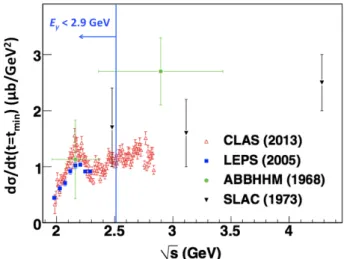
19.Eγ=1.5-2.9 GeV 領域での
φ
中間子光生成水谷 圭吾(16:00)・・・19
格子 QCD の強結合極限における バリオン数揺らぎの有限体積効果
原子核理論研究室 市原輝一
Abstract We investigate higher-order cumulants of net-baryon number in the strong coupling limit of lattice QCD. We find that fourth-order cumulant in the chiral limit shows oscillatory behavior due to the finite size effect, which can be signals for criticality in QCD.
© 2016 Department of Physics, Kyoto University
量子色力学(QCD)は強い相互作用を記述する理論であり、有限温度・密度領域において臨界点の 存在が期待されている。このようなQCD臨界現象の指標として、バリオン数の高次揺らぎが良い物理 量であると考えられている。特に、高次(三次・四次)揺らぎの符号変化により、相境界の位置が推 定可能である[1,2]。そこで QCD 臨界現象を実験的に検証する為、ビームエネルギー走査(BES)が重イ オン衝突実験で行われている。BES では、保存量及びその代替量の高次揺らぎが測られており、QCD 臨界現象の兆候を示すと期待される。例えば、バリオン数の代替量として、陽子数の高次揺らぎが測 定されている[3]。一方強力な理論手法として、第一原理計算である格子QCDが存在するが、高密度領 域では符号問題により困難が伴う。この有限密度領域において、バリオン数の高次揺らぎが格子 QCD においていくつか測定されているが、四次揺らぎの負領域の存否と大きさを体系的に確かめる事は容 易ではない[4]。
そこでバリオン数の高次揺らぎを、格子QCD の強結合極限において求めた[5]。強結合極限では符号 問題の影響が少なく、有限密度領域の議論が可能である[6]。また、臨界現象は臨界指数で特徴づけら れており、高次揺らぎの性質を調べる為には平均場近似を超えた解析が必要である。今回は補助場の モンテカルロ法を用いる事で、平均場近似を超えて物理量を評価した[5,6]。まず、三次・四次揺らぎ の温度・密度依存性をカイラル極限(裸の質量零)で議論した。低密度側では高次揺らぎは常に正で あり、上に凸な山が観測された。高密度側では振動的な振る舞いがみられ、特に四次揺らぎは負の谷 間を持つ事が確かめられた。次に、格子サイズ依存性を調べた。格子サイズを大きくするにつれ、正 の山・負の谷間の高さが鋭くなり、それらの幅は小さくなる事が判明した。熱力学極限では、スケー リング関数の解析から四次揺らぎは正にのみ発散し、負領域が存在しないと考えられている[2]。よっ て、今回確認された四次揺らぎの負領域は、相転移に起因する格子の有限体積効果であると考えられ る。
本発表では、揺らぎを取り入れた格子QCDの強結合極限下での、バリオン数の高次揺らぎの性質に ついて議論する。温度・密度依存性に加え、格子の有限体積効果について報告し、臨界現象との関連 についても言及する。
References
[1] M. Asakawa, S. Ejiri, and M. Kitazawa, Phys. Rev. Lett. 103, 262301 (2009); M. A. Stephanov, Phys. Rev. Lett.
107, 052301 (2011).
[2] B. Friman, F. Karsch, K. Redlich, and V. Skokov, Eur. Phys. J. C71, 1694 (2011).
[3] L. Adamczyk et al. [STAR Collaboration], Phys. Rev. Lett. 112, 032302 (2014); X. Luo [STAR Collaboration], PoS CPOD 2014, 019 (2015).
[4] C. R. Allton et al., Phys. Rev. D71, 054508 (2005); R. V. Gavai and S. Gupta, Phys. Lett. B696, 459 (2011); C. Gattringer and H.-P. Schadler, Phys. Rev. D91, 074511 (2015).
[5] T. Ichihara, K. Morita, and A. Ohnishi, PTEP 2015, 113D01 (2015).
[6] T. Ichihara, A. Ohnishi, and T. Z. Nakano, PTEP 2014, 123D02 (2014).
ハイブリッドエマルション法を用いた ダブルハイパー核の研究
原子核・ハドロン物理学研究室 江川弘行
Abstract We are searching for double hypernuclei with hybrid emulsion method at J-PARC K1.8 beam line to study Λ-Λ interaction. 100 double hypernuclei which include 10 identified species will be observed among 104 Ξ- stops in emulsion plates. The current status and overview will be reported in this presentation.
© 2016 Department of Physics, Kyoto University
バリオン間の相互作用はハドロン物理における重要な研究対象である。ストレンジネス-2の系につ いては実験的な難しさからデータがほとんど無く、その中でダブルハイパー核の研究は有効な実験手法 の一つである。ダブルハイパー核はΛを2つ含んだ核であり、質量を測定することでΛ-Λ間の相互作 用を測定できる。そのためにはエマルションを用いるのが有効である。エマルションは 1μm の位置分 解能で荷電粒子の軌跡を検出できるため、ダブルハイパー核の連続する弱崩壊を検出することが可能で ある。過去の実験で核種が同定されたものはKEK E373実験で発見された6ΛΛHeのみで(NAGARAイベント)、
Λ-Λ相互作用は弱い引力(∆BΛΛ = 0.67 ± 0.17 MeV)だと分かった [1]。
我々はJ-PARC K1.8ビームラインでハイブリッドエマルション法を用いたダブルハイパー核の探索実
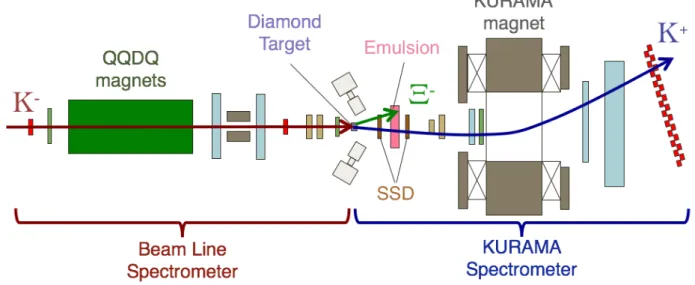
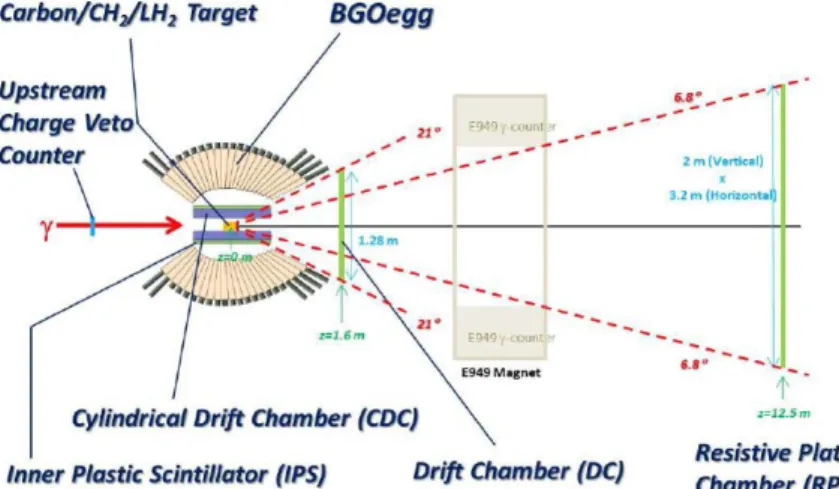
験を行う。1.8 GeV/cのK-ビームをダイアモンド標的に照射し、(K-,K+)反応で生成したΞ-を下流に設置 したエマルションに入射する。Ξ-の軌跡をエマルション直前に設置したSSD(Silicon Strip Detector) で検出することで、エマルション表面でのΞ-の入射位置と角度を予測する。エマルションは顕微鏡で解 析するが、スペクトロメータとSSDによって得られた情報からΞ-の軌跡を自動探索することで効率よく ダブルハイパー核事象を探索する。本実験では2.1tのエマルションゲルを用いて乾板を作り、104個の Ξ-をエマルション乾板に静止させる。これはKEK E373実験の10倍の統計であり、100個のダブルハイ パー核を見つけ 10 個の核について核種を同定することを目標とする。新たな核種を発見することで、
Λ-Λ相互作用の質量依存性について議論する。
エマルション乾板の製作は既に完了しており、2016年にKURAMAスペクトロメータを立ち上げデータ 取得を開始する。本発表では、実験の準備状況及び今後の展望について発表する。
References
[1] J. K. Ahn, et al. Phys. Rev. C 88 (2013) 014003.
Fig. 1. The experimental setup at J-PARC K1.8 beam line.
J-PARC におけるΞハイパー核の分光実験
原子核ハドロン物理学研究室 金築俊輔
Abstract Hypernuclei with S=-2 are good tools for investigating the baryon-baryon interaction and dense nuclear matter. We carried out a Ξ-hypernuclear spectroscopy experiment for the first time using the
12C(K-,K+) reaction at J-PARC. An excitation spectrum of Ξ-+11B system was obtained with the best energy resolution ever achieved including quasi-free Ξ- production of 1×10⁵ events.
© 2016 Department of Physics, Kyoto University
Ξハイパー核は S=-2 のバリオンであるΞと原子核との束縛系である。その核構造を調べることでΞ -核子(N)相互作用に関する情報を引き出し、拡張された核力であるバリオン間相互作用を記述する理論 モデルに制限を与えることができる。また、ハイペロン(Y)が出現すると予想される中性子星中心部で 実現される高密度核物質の理解にもYN, YY相互作用の情報が必要である。
現在得られているΞハイパー核に関する実験的情報は非常に乏しい。過去に 12C(K-,K+)反応によるミ ッシングマススペクトルの解析が行われたが、ΞN 相互作用に関する確定的な情報を示すには至ってい ない。BNL-E885実験[1]では束縛領域に有意な事象数が観測されたが、エネルギー分解能14 MeV(FWHM) では束縛状態をピークとして観測するには不十分であった。束縛領域の事象数から生成断面積が前方θ
<14°で 42±5 nb/sr と見積られ、束縛しきい値付近のスペクトル形状解析から、Ξ核ポテンシャルの
深さがVΞ= -14 MeVであると推定された。しかし、ポテンシャルの虚部を考慮すると引力がなくても実
験結果が再現できるという議論がある[2]。また、コア核の励起状態を考慮すると、数 MeV の範囲に複 数のピークが現れることも予想される[3]。励起エネルギーと状態幅を正確に決定し、Ξ核ポテンシャ ルの情報を得るために、ピーク構造を高い分解能で観測することが求められている。
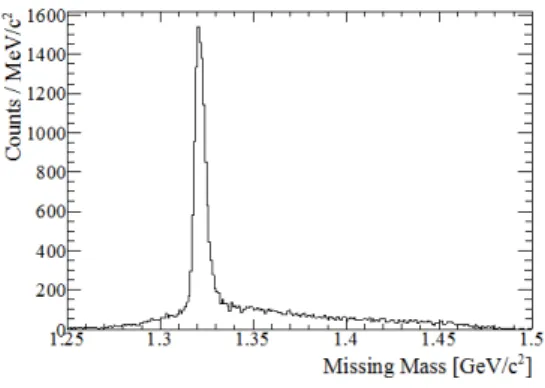
我々は J-PARC K1.8 ビームラインにおいて、12C(K-,K+)反応によるΞハイパー核 12ΞBe の分光実験を 進めてきた(J-PARC E05 実験[4])。実験計画の第一段階として、現存するSKSスペクトロメータを散 乱粒子測定に用いたパイロット実験を2015年10-11月に行った。この実験では、まず、CH2標的を用い て入射運動量1.5-1.9 GeV/cの範囲でp(K-,K+)Ξ- 反応の断面積測定を行った(Fig. 1)。エネルギー
分解能約 6 MeV(FWHM)を達成し、前方において過去のデータを2桁近く上回る統計量のデータを取得し
た。この結果は、ハイパー核生成に最適な入射運動量の検討や、ハイパー核励起スペクトル解析のため の理論計算、Ξの生成過程に関する研究に大いに貢献することが期待できる。また、炭素標的を用いた データ取得も行った。データ解析は現在進行中であるが、quasi-free 事象に関して、しきい値から300 MeV程度の十分広いエネルギー領域にわたって約10万イベントのデータを取得した。これらから期待さ れる Ξ ハイパー核の生成統計量は、42 nb/srという生成断面
積を仮定すると約35個となる。
実験の第二段階として、現在我々が建設を進めている新し い磁気スペクトロメータ S-2S を用いた測定を予定している
[5]。これを用いることでエネルギー分解能を 2 MeV(FWHM)ま
で向上させることができ、さらなる精密分光が可能になる。
S-2Sを構成する電磁石は2015年5月に完成し、磁場分布測定 などの性能評価を進めている。検出器の開発もほぼ終えてお り、数年以内のデータ取得を目指して準備が進んでいる。
References
[1] P. Khaustov, et al., Phys. Rev. C 61, 054603 (2000).
[2] M. Kohno and S. Hashimoto, Prog. Theor. Phys. 123, 1 (2010).
[3] T. Motoba and S. Sugimoto, Nucl. Phys. A 835, 223 (2010).
[4] T. Nagae, et al., J-PARC proposal (2006).
[5] S. Kanatsuki, et al., JPS Conf. Proc. 8, 021018 (2015)
Fig. 1. Missing mass spectrum of p(K-,K+) reaction at 1.8 GeV/c. The sharp peak shows the Ξ- production from hydrogen in CH2, and the broad component is the quasi-free Ξ- production from carbon.
Minimal surfaces in q-deformed AdS
5×S
5Theoretical Particle Physics Group Takashi Kameyama
Abstract We study a q-deformation of the AdS5×S5 superstring. An interesting issue is to consider holographic relations in the q-deformed background. It is proposed that a singularity surface located in q-deformed AdS5 may be treated as a holographic screen. We construct minimal surfaces and derive quark-antiquark potentials from the q-deformed geometry.
© 2016 Department of Physics, Kyoto University
The AdS/CFT correspondence is one of the most profound structures in string theory. A prototypical example is the conjectured equivalence between type IIB string theory on the AdS5×S5 background and N = 4 SU(N) super Yang-Mills theory in the large N limit. A great discovery in the recent is an integrable structure underlying this duality and it enables us to give an enormous amount of evidence for this duality.
The integrable structure behind the AdS/CFT opens up a new arena for studying integrable deformations as well.
It would be significant to reveal a deeper integrable structure behind the AdS/CFT beyond the conformal invariance. To tackle this issue, a systematic method is to employ the Yang-Baxter sigma model description [1].
In this framework, an integrable deformation is fixed by picking up a classical r-matrix satisfying the modified classical Yang-Baxter equation. In the recent, this description has been applied to study integrable deformations of the AdS5×S5 superstring [2]. This deformation can be regarded as a classical analogue of q-deformation of Lie algebras, since the Poisson symmetry algebra is a quantum group associated with the superconformal algebra.
In this study, we focus on the bosonic part of the deformed string action. The metric and NS-NS two-form of the deformed background are derived in [3]. In particular, a singular surface exists in the q-deformed AdS5. To reveal the nature of the singularity surface, we considered a Gubser-Klebanov-Polyakov (GKP)-like classical string solution on the deformed background and argued the spacetime structure by using it as a probe [3]. Then it is shown that the string solution cannot stretch beyond the singularity surface. We also considered trajectories of massless and massive particles so as to study the causal structure around the singularity surface [4]. As a result, the causal structure around the singularity surface is very similar to the boundary of the global AdS space. These results suggest that the singularity surface may be treated as a boundary in the holographic setup for the q-deformed geometry. Hence, it is nice to introduce a new coordinate system which describes the spacetime enclosed by the singularity surface. With this coordinate system, minimal surfaces whose boundary shapes are a straight line and a circle have been considered in [4,5]. In the undeformed limit, each of the solutions is reduced to a 1/2 BPS straight line Wilson loop and a 1/2 BPS circular Wilson loop, respectively. A remarkable point is that in both cases, the resulting minimal surface area does not have a linear divergence, unlike the undeformed case. This feature comes from the fact that the q-deformation may be regarded as a UV regularization.
Furthermore, we argue a quark-antiquark potential from the q-deformed AdS5×S5 so as to look for some clues of the dual gauge-theory. For this purpose, we consider minimal surfaces with a cusp on the boundary surface in the q-deformed AdS5. Then a quark-antiquark potential can be derived by taking some special limits. Since the conformal symmetry has been deformed, the resulting potential is not the usual Coulomb form, but positive and linear. We also argue that a quark-antiquark potential calculated from gravity duals of noncommutative gauge theories can be reproduced from the one for the q-deformed case by taking a scaling limit.
References
[1] C. Klimcik, JHEP 0212 (2002) 051
[2] F. Delduc, M. Magro and B. Vicedo, Phys. Rev. Lett. 112 (2014) 051601.
[3] G. Arutyunov, R. Borsato and S. Frolov, JHEP 1404 (2014) 002.
[4]T. Kameyama and K. Yoshida, J. Phys. A48 (2015) 7, 075401.
[5] T. Kameyama and K. Yoshida, J. Phys. A48 (2015) 24, 245401..
QCD 相図の非一様カイラル相転移における量子-熱揺らぎの 効果について
原子核理論研究室 柄澤真太朗
Abstract We investigate the effect of the quantum and the thermal fluctuations in the inhomogeneous chiral transition. The effective thermodynamic potential is modified by these effects. As a result, it changes the character of phase transition from the second to the first order and reduces the
inhomogeneous phase.
© 2016 Department of Physics, Kyoto University
量子色力学(QCD)によって記述される多体系の物理は、クォーク・グルーオンプラズマやコンパクト 天体内部といった様々な物理現象において支配的であり、その相構造の解明は理論的・実験的両側面に おいて重要である。近年のQCD相構造研究の大きな進展の1つとして、カイラル非一様相の存在の理論 的考察が挙げられる。カイラル非一様相とは、空間的異方性を持つ秩序変数(非一様構造)によって特徴 付けられた相であり、これまでの研究からいくつかの非一様構造の関数形において、低温-中密度領域 でその発現が示唆されている[1]。しかしながら、先行研究では議論を簡単化する為の様々な制限が課 されており、カイラル非一様相の理解が十分に得られたとは言い難い。そこで本研究では、カイラル非 一様相に対する理解を深める試みの1つとして、非一様カイラル相転移における量子-熱揺らぎの効果 について議論する。
量子または熱揺らぎは、これまで凝縮系物理学[2]やパイオン凝縮[3]の研究領域において議論されて おり、それぞれの効果によって一様-非一様相転移の次数が2次から1次へと変化することが知られて いる。一方カイラル非一様相の研究においては、典型的な非一様構造に対して非一様-回復相境界線(終 境界線)の次数が2次で与えられることが知られているものの、これまで揺らぎの効果による相転移の 次数の変化については十分な議論がなされていなかった。もし相転移の次数が変化するならば、これに 伴って得られる物理的応答も異なる。従って、終境界線の次数を正しく理解することはカイラル非一様 相を理解する上で重要である。本研究では、先行研究において開発された手法をさらに発展させること で、量子-熱揺らぎの効果を同時に考慮し、さらに終境界線の定性的および定量的変化について議論す る。具体的には、回復相における有効作用を相関関数の方法に基づいて構成し、揺らぎの効果を考慮し た有効的な熱力学関数を導出することで、相転移の次数について議論しまた終境界線の位置を外挿する。
結果、量子-熱揺らぎの効果によって終境界線は1次相転移で与えられ、またその位置はカイラル非一 様相の領域が減少する方向に移動する。
References
[1] E. Nakano and T. Tatsumi, Phys. Rev. D 71 (2005) 114006.
D. Nickel, Phys. Rev. D 80 (2009) 074025.
M. Buballa and S. Carignano, Prog. Part. Nucl. Phys. 81 (2015) 39.
[2] S. Brazovskii, Sov. Phys. JETP 41 (1975) 85.
[3] A. Dyugaev, JETP Lett. 22 (1975) 83.
The binary population synthesis in the early universe and the detection rate of gravitational waves from the
binary black holes
Theoretical Astrophysics Group Tomoya Kinugawa
Abstract We perform population synthesis simulations for Population I (Pop I), Popu- lation II (Pop II) and Population III (Pop III) coalescing compact binaries which merge within the age of the universe. We found that the typical mass of Pop III BH-BHs is
∼30 M⊙-30 M⊙. The inspiral chirp signal of gravitational waves and quasi-normal modes (QNMs) from Pop III binary black holes (BH-BHs) can be detected up to z=0.28 by KA- GRA, Adv. LIGO, Adv. Virgo and GEO network. We might be able to confirm the existence of Pop III massive stars of mass ∼ 30 M⊙-30 M⊙ by the detections of gravi- tational waves if the detection rate of the Pop III massive BH-BHs (∼ 30 M⊙-30 M⊙) dominates those of Pop I and Pop II massive BH-BHs.
⃝c2016 Department of Physics, Kyoto University
We perform population synthesis simulations for Pop I, Pop II and Pop III coalescing compact binaries which merge within the age of the universe. We habe the typical mass of BH-BHs around 10 M⊙ for Pop I and Pop II cases. On the other hand, we found that the typical mass of Pop III BH-BHs is ∼ 30 M⊙-30 M⊙. The inspiral chirp signal of gravitational waves and QNMs from Pop III BH-BHs can be detected up to z=0.28 by KAGRA, Adv. LIGO, Adv. Virgo and GEO net- work [1]. Our simulations suggest that the detection rate of the coalescing Pop III BH-BHs is ∼1.8
×102 events yr−1 (SF Rp/(10−2.5 M⊙ yr−1 Mpc−3))·([fb/(1 +fb)]/0.33)·Errsys for our standard model, where SF Rp, fb and Errsys are the peak value of the Pop III star formation rate, initial binary fraction and the possible systematic errors due to the assumptions in Pop III population synthesis, respectively. Errsys = 1 corresponds to conventional parameters for Pop I stars. To eval- uate the robustness of chirp mass distribution and the range of Errsys, we examine the dependence on the unknown parameters and the distribution functions in the population synthesis code. We found that the chirp mass has a peak at ∼ 30 M⊙ in most of parameters and distribution functions as well as Errsys ranges from 0.046 to 4. Therefore, the detection rate of the coalescing Pop III BH-BHs ranges about 8.3−720 events yr−1 (SF Rp/(10−2.5 M⊙ yr−1 Mpc−3))·([fb/(1 +fb)]/0.33) [2]. The minimum rate corresponds to the worst model which we think unlikely. Therefore unless (SF Rp/(10−2.5 M⊙ yr−1 Mpc−3))·([fb/(1 +fb)]/0.33)≪0.1, we expect the Pop III BH-BHs detec- tion rate of at least one event per year by KAGRA. Nakano, Tanaka & Nakamura (2015) [3] have shown that if S/N of the QNM is larger than 35, we can confirm or refute the General Relativity (GR) more than 5 sigma level. In our standard model, the detection rate of Pop III BH-BHs whose S/N is larger than 35 is 3.2 events yr−1(SF Rp/(10−2.5 M⊙ yr−1 Mpc−3))·([fb/(1 +fb)]/0.33)·Errsys. Thus, there is a good chance to check whether GR is correct or not in the strong gravity region. Furthermore, from the observation of the chirp signal of the coalescing Pop III BH-BHs, we can determine both the mass and the redshift of the binary for the cosmological parameters determined by Planck satellite.
Our simulations suggest that the cumulative redshift distribution of the coalescing Pop III BH-BHs depends almost only on the cosmological parameters. We might be able to confirm the existence of Pop III massive stars of mass∼30 M⊙-30 M⊙by the detections of gravitational waves if the detection rate of the Pop III BH-BHs (∼30 M⊙-30 M⊙) dominates those of Pop I and Pop II massive BH-BHs.
References
[1] Kinugawa, T., Inayoshi, K., Hotokezaka, K., Nakauchi, D., & Nakamura, T. 2014, MNRAS, 442, 2963
[2] Kinugawa, T., Miyamoto, A., Kanda, N., & Nakamura, T. 2016, MNRAS, 456, 1093 [3] Nakano, H., Tanaka, T., & Nakamura, T. 2015, Phys. Rev. D, 92, 064003
Imaging Polarimetry in MeV Gamma Rays With an Electron-Tracking Compton Camera
宇宙線研究室 古村翔太郎
Abstract We have developed an Electron-Tracking Compton Camera (ETCC) as an MeV gamma-ray telescope. ETCC has succeeded to measure the polarization with the incident photon image and energy spectrum for the polarized X-ray beam at SPring-8. Obtained modulation factor is about 0.6 at 130 keV.
© 2016 Department of Physics, Kyoto University
天体由来の100 keV以上の硬X線-MeVガンマ線は、非熱的放射や散乱過程により強く偏光していると考 えられ、その偏光状態は天体の磁場・幾何構造を探るプローブとなる。このような偏光観測の重要性に も関わらず、現在までの観測事例は数例であり、いずれの検出有意度も3σレベルにとどまる。
この帯域ではコンプトン散乱過程が優位であり、到来光子の散乱方位角分布の異方性(modulation)
の測定により偏光度及び偏光方向を決定できる。ただし解析過程において、検出器の幾何応答補正を行 うためSimulationが必須となる。問題は大きく2つ存在する。一方は宇宙線との相互作用から生じる多 量の雑音事象であり、異方性をぼかし検出感度を劣化させる。他方は、従来の検出器では光子の到来方 向とエネルギーなど不可欠な物理量の測定ができず、系統誤差評価が困難になっていたことである。
我々は次世代のMeVガンマ線望遠鏡として、電子飛跡検出型コンプトンカメラETCCを開発している。
反跳電子飛跡をガス検出器で測定することで、光学望遠鏡と同じような、優れたPoint Spread Function に基づく高精度撮像を世界で初めて実現した。これにより視野内へのガンマ線雑音事象の混入を抑制で きる[1]。さらに、ガス検出器中のエネルギー損失率測定により、荷電粒子および中性子雑音事象の高 効率除去も可能である[2]。ETCCを用いることで上記2つの課題を克服した上で、撮像による複数天体の 同時偏光観測がこの帯域では初めて可能となり、3 str以上の広視野による偏光全天探査が期待できる。
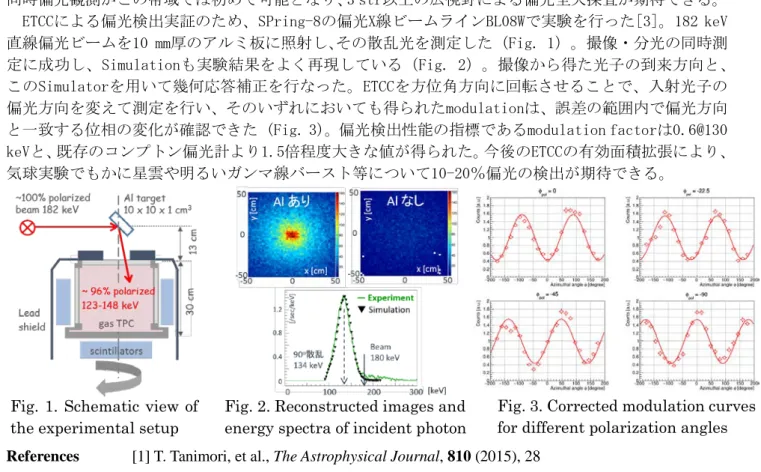
ETCCによる偏光検出実証のため、SPring-8の偏光X線ビームラインBL08Wで実験を行った[3]。182 keV 直線偏光ビームを10 mm厚のアルミ板に照射し、その散乱光を測定した(Fig. 1)。撮像・分光の同時測 定に成功し、Simulationも実験結果をよく再現している(Fig. 2)。撮像から得た光子の到来方向と、
このSimulatorを用いて幾何応答補正を行なった。ETCCを方位角方向に回転させることで、入射光子の 偏光方向を変えて測定を行い、そのいずれにおいても得られたmodulationは、誤差の範囲内で偏光方向 と一致する位相の変化が確認できた (Fig. 3)。偏光検出性能の指標であるmodulation factorは0.6@130 keVと、既存のコンプトン偏光計より1.5倍程度大きな値が得られた。今後のETCCの有効面積拡張により、
気球実験でもかに星雲や明るいガンマ線バースト等について10-20%偏光の検出が期待できる。
References [1] T. Tanimori, et al., The Astrophysical Journal, 810 (2015), 28 [2] Y. Matsuoka, et al., Journal of Instrumentation, 10 (2015), C01053 [3] S. Komura, et al., Proceedings of the ICRC (2015)
Fig. 1. Schematic view of
the experimental setup Fig. 2. Reconstructed images and energy spectra of incident photon
Fig. 3. Corrected modulation curves for different polarization angles
Constraints on the Intergalactic Magnetic Field by AGN Observations with MAGIC
Cosmic-ray group Yusuke Konno
Abstract We performed simulation to study effects of the intergalactic magnetic field (IGMF) on gamma-ray propagation from distant objects. The simulation was compared with the observation results of a blazar, 1ES 0229+200. The spectrum suggests IGMF > 10-15 G when we assume a power law spectrum with an index of -1.5.
© 2016 Department of Physics, Kyoto University
The origin of the magnetic field in our galaxy (~ 10-6 G) is unknown. One possibility is amplification from very weak seed field. Detection of the intergalactic magnetic field (IGMF) would be a suggestion of such a seed field.
Although an upper limit of IGMF < 10-6 - 10-9 G was obtained from Faraday rotation measurements, there is still large uncertainty on the IGMF strength. To constrain such a weak filed strength, a method using gamma-ray observations has been mentioned [1].
Very high energy (VHE, > 100 GeV) gamma rays emitted from distant objects like active galactic nuclei (AGN) suffers from attenuation experiencing pair production with extragalactic background optical-infrared photons.
Gamma-ray induced electrons and positrons are deflected by the IGMF while experiencing inverse Compton scattering with cosmic microwave background photons and producing secondary gamma rays in lower energy band. Due to deflection by the IGMF, an extended component could appear around a point source and its spatial profile would depend on the IGMF strength. Another effect is spectral depression of a secondary component in GeV band. If we could detect such a signature from the IGMF, we can constrain the IGMF strength.
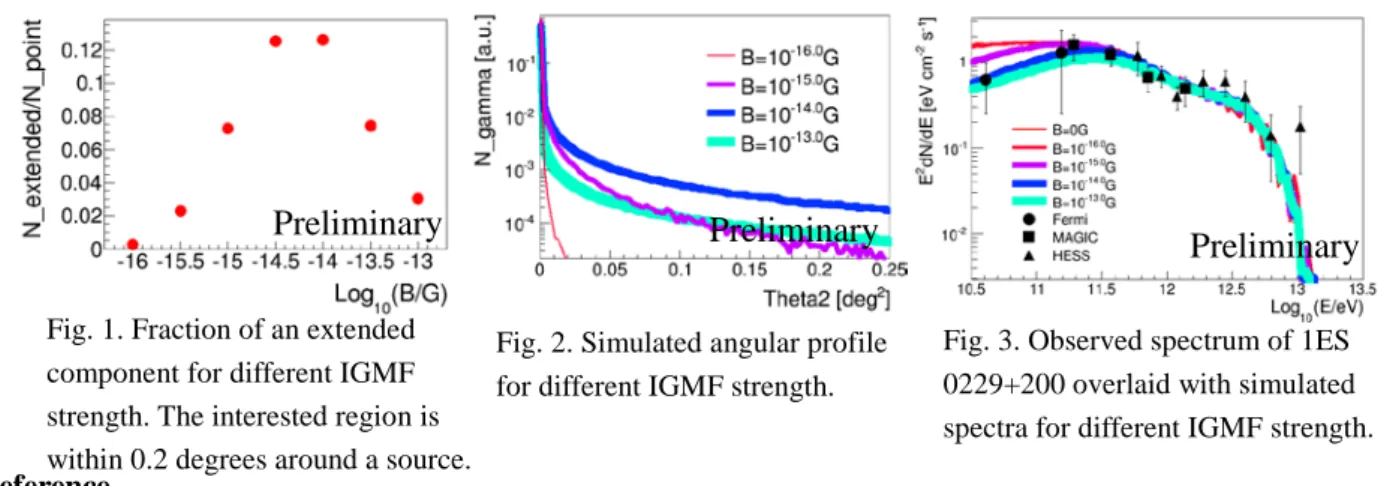
We performed Monte Carlo simulation to study IGMF effects on VHE gamma-ray propagation. As shown in Figs. 1 and 2, stronger IGMF increases extended component. At some point stronger IGMF deflects secondary component out of the interested region and decreases fraction of an extended component. If we set the interested region inside 0.2 degrees around a source, an extended component will be the most visible around IGMF strength of 10-14 G. On the other hand, spectral shape in 10 GeV - 100 GeV, which corresponds to the energy band of Fermi-LAT, is sensitive around IGMF > 10-15 G.
We searched IGMF signature using 1ES 0229+200, AGN with a hard spectrum located at z=0.14. The source was observed with MAGIC telescopes, two imaging atmospheric Cherenkov telescopes which achieve low energy threshold of 50 GeV with its large 17 m diameter mirror dish. The angular profile is compatible with that of the Crab Nebula, a well-known point source. We also studied the spectrum and it prefers stronger IGMF > 10-15 G when we assume a hard power law intrinsic spectrum with an index of -1.5 and an exponential cutoff at 10 TeV (Fig. 3).
Reference
[1] Neronov, A. & Semikoz, D. V., 2009, Phys. Rev. D, 80, 123012
Fig. 3. Observed spectrum of 1ES 0229+200 overlaid with simulated spectra for different IGMF strength.
Fig. 2. Simulated angular profile for different IGMF strength.
Preliminary Preliminary
Preliminary
Fig. 1. Fraction of an extended component for different IGMF strength. The interested region is within 0.2 degrees around a source.
σ 中間子のソフト化に注目した線形 σ 模型に 基づく核媒質中における η→3π 崩壊幅の解析
原子核理論研究室 酒井 俊太郎
Abstract The analysis of the η3π(π+π-π0 and 3π0) widths in the nuclear medium using linear sigma model shows that these widths are at most 4-10 times larger than those at ρ=0 depending on the input parameter and the enhancement occurs in association with the chiral restoration in the nuclear medium.
© 2016 Department of Physics, Kyoto University
真空中においてη中間子の3π(π+π-π0、及び3π0)への崩壊の理解には、アイソスピン対称性の破れと π中間子の間のI=J=0 channelにおける終状態相互作用が重要な役割を果たすことが知られている。こ の過程へのアイソスピン対称性の破れの必要性から、崩壊幅は特にアイソスピン対称性の破れを含む非 対称核物質によって強く影響を受けることが期待される。
核媒質中でのη中間子の崩壊幅について非線形シグマ模型を用いて解析を行った先行研究[1]において、
崩壊幅は非対称核密度 δρ=ρn-ρpに起因するアイソスピン対称性の破れによる効果の他に、核子数密度 ρ=ρn+ρpによっても増大することが示された。さらに、このη3π崩壊幅の核子数密度ρによる増大と カイラル対称性の回復の関連性、特にσ中間子のsoft化の重要性が指摘されている。ここでσ中間子の soft化とはカイラル対称性の自発的破れに伴って現れる有限質量のmodeであるσ中間子の質量がカイ ラル対称性の回復に伴い減少することである。これらのことから、核媒質中におけるη3π崩壊によっ てカイラル対称性の回復を調べることができる可能性がある。
本発表では、η中間子の3πへの崩壊幅の対称核物質中における変化を線形σ模型を用いて解析した 結果を紹介する[2]。線形σ模型はσ中間子の自由度をあらわに含んでおり、カイラル対称性の回復、及 びσ中間子のsoft化の効果を取り込むことができる。この模型においては、その重要性が指摘されてい る終状態相互作用はスカラー中間子の極を通じて取り込まれている。
この解析においてη中間子の崩壊幅は、input parameterへの依存性があるものの、真空中に比べ核媒 質中で最大4から10倍程度増大するという結果が得られた。σ中間子のスペクトル関数を調べたとこ ろσ中間子のsoft化に伴い2πへの崩壊閾値近辺の強い増大が見られたことからも、σ中間子のsoft化 がこの崩壊幅の増大に重要な役割を果たしていることが分かった。また、この核媒質中での崩壊幅の増 大は比較的低密度においても顕著であり、通常核密度の半分程度の密度(0.08fm-3)において 3から4 倍 程度増大するという結果が得られた。ここまで述べたη中間子の崩壊幅の核媒質中における増大とカイ ラル対称性の回復との関連、及び低密度においてもみられる大きな崩壊幅の増大から、この崩壊過程は カイラル対称性の回復を調べるprobeとなり得る。
また、核媒質中でのη3π0崩壊幅の増大はηπ+π-π0崩壊幅の増大に比べ小さくなるという結果が得ら れた。これはη3π0過程においてはBose対称性から現れる項の一部がσ中間子のsoft化によって相殺され てしまうことに起因することが分かった。
References
[1] Shuntaro Sakai and Teiji Kunihiro, Prog. Theor. Exp. Phys., 2015, 013D03, ibid., 089201 (2015).
[2] Shuntaro Sakai and Teiji Kunihiro, arXiv: 1512.04000.
Tensor to scalar ratio in bimetric gravity
Theoretical Astrophysics Group Yuki Sakakihara
Abstract We calculate the tensor and scalar perturbations generated during slow-roll inflation in ghost-free bimetric theory. We find that the tensor to scalar ratio is inevitably larger than the general relativity counterpart with the same power-law inflaton potential, namely, the constraint on the power-law inflation is more severe in bimetric theory.
© 2016 Department of Physics, Kyoto University
Recently, bimetric gravity was found [1, 2] as a consistent theory of gravity including massive gravitons in addition to usual massless gravitons. Giving mass to gravitons is an infra-red modification of gravity, which is thought to be a possible way to approach the origin of dark energy and dark matter. Our purpose is to make it clear whether bimetric theory is really an acceptable gravity theory describing the universe. Inflation gives us good tests of gravity since observable quantities related to inflation such as the cosmic microwave background are precisely measured. We examine the fluctuations generated during inflation which remains still now as the fluctuations of the cosmic microwave background and as gravitational waves to test bimetric theory.
We calculate tensor perturbations and scalar perturbations on slow-roll inflationary spacetime in a way which is valid in the leading order of the slow-roll parameters, which measure how the spacetime is approximated by the de Sitter accelerated expanding spacetime, thanks to the rapid decay of the massive gravitons. The background treatment that we use in our analysis is based on [3, 4] and the analysis of the tensor perturbations partially refers to [5]. Under the approximation mentioned above, the system reduces to Einstein theory with a non-minimally coupled scalar field. We obtain the tensor power spectrum and the scalar power spectrum at the end of inflation in the leading order in slow roll. Both the spectral index of the curvature perturbations and the ratio of the tensor amplitude to the scalar amplitude, i.e., the tensor to scalar ratio, which are constrained by the cosmic microwave background observations, are modified due to bimetric effects. When we adopt a simple power-law potential to the potential of the scalar field which causes inflation, the tensor to scalar ratio is larger than that in general relativity in any bimetric models, while the spectral index can be either smaller or larger depending on the models.
The trend is thought to be universal in other potentials since the difference between the bimetric effects on the tensor amplitude and the scalar amplitude originates in the difference between the effective gravitational constant governing the tensor perturbations and that governing the curvature perturbations, which determines the relation between the Hubble expansion rate and the matter energy density.
References
[1] Claudia de Rham, Gregory Gabadadze, Andrew J. Tolley, PRL 106 (2011) 231101.
[2] S.F. Hassan, Rachel A. Rosen, JHEP 1204 (2012) 123.
[3] Yuki Sakakihara, Jiro Soda, Tomohiro Takahashi, PTEP (2013) 033E02.
[4] Antonio De Felice, A. Emir Gümrükçüoğlu, Shinji Mukohyama, Norihiro Tanahashi, Takahiro Tanaka, JCAP 1406 (2014) 037.
[5] Yuki Sakakihara, Jiro Soda, JCAP 09 (2015) 015.
Holographic Entanglement Entropy in the dS/CFT Correspondence
and Entanglement Entropy in the Sp(N ) Model
Theoretical Particle Physics Group Yoshiki Sato
Abstract Recently, the holographic entanglement entropy has attracted attention as a tool to construct gravitational theories by nongravitational theories. We consider the entanglement entropy in the dS/CFT correspondence. We also study the entanglement entropy in the Sp(N) model and confirm the behaviour consistent with our holographic result.
⃝c2016 Department of Physics, Kyoto University
The AdS/CFT correspondence is a remarkable connection between gravitational theories on anti-de Sitter spacetime (AdS) and nongravitational conformal field theories (CFT). It provides us with a tool to analyze quantum gravitational theories by using nongravitational field theories. A useful quantity to analyze gravitational theories in the context of the AdS/CFT correspondence, is the holographic entanglement entropy proposed in [1]. The holographic entanglement entropy is a holographic dual of the entanglement entropy and is related to geometrical quantities which are extremal surfaces.
Therefore, the holographic entanglement entropy contains information on gravitational theories [2, 3].
It is natural to apply the holographic principle to our Universe. However, since it is known that our Universe is approximately the de Sitter spacetime (dS), not AdS, we cannot use the AdS/CFT correspondence to analyze our Universe. Then, we need the dS/CFT correspondence which is a duality between gravitational theories on dS and some conformal field theories.
Although the dS/CFT correspondence was proposed in [4, 5, 6], concrete examples of the dS/CFT correspondence hadn’t been known for a decade. Recently, Anninos, Hartman and Strominger have proposed a concrete example of the dS/CFT correspondence [7]. The authors showed that Vasiliev’s higher-spin gauge theory on dS is the holographic dual of the Euclidean Sp(N) vector model which lives inI+in dS. We are now in a position to analyze the dS/CFT correspondence using the concrete example.
We discuss the holographic entanglement entropy in the dS/CFT correspondence and the entan- glement entropy in theSp(N) model based on [8, 9] for a purpose to construct gravitational theories on dS by dual field theories. In [8], we investigate the connection between bulk geometry and the holographic entanglement entropy in Einstein gravity on dS. Also we compare the proposed holo- graphic entanglement entropy with the entanglement entropy in the free Sp(N) model, which is the holographic dual of Vasiliev’s higher spin gauge theory on dS. Furthermore, we investigate the detail of the entanglement entropy in the Sp(N) model in [9].
References
[1] S. Ryu and T. Takayanagi, Phys. Rev. Lett. 96(2006) 181602.
[2] B. Swingle, Phys. Rev. D 86(2012) 065007.
[3] M. Van Raamsdonk, arXiv:0907.2939 [hep-th].
[4] E. Witten, hep-th/0106109.
[5] A. Strominger, JHEP 0110(2001) 034.
[6] J. M. Maldacena, JHEP0305(2003) 013.
[7] D. Anninos, T. Hartman and A. Strominger, arXiv:1108.5735 [hep-th].
[8] Y. Sato, Phys. Rev. D 91(2015) 8, 086009.
[9] Y. Sato, work in progress.
Construction of a new model generating three-dimensional random volumes:
Towards a formulation of membrane theory
素粒子論研究室 杉下宗太郎
Abstract Towards a formulation of membrane theory, we construct a new model generating discrete three-dimensional random volumes. The variables are matrices, and each configuration consists of triangles glued together along their edges. The model can describe three-dimensional quantum gravity coupled to various matter fields, especially scalar fields corresponding to target-space coordinates.
© 2016 Department of Physics, Kyoto University
超弦理論には弦以外の物体も力学的自由度として存在すると考えられており、超弦理論を完全に定式 化するためには、これらの物体の基本的性質を理解する必要がある。特にM理論と呼ばれる超弦理論と 双対な理論においては、弦よりも1次元高い広がりをもつ「膜」が基本自由度として存在すると考えら れている。しかしながら、膜の量子論的性質の理解は弦よりも進んでいない。
ある種の弦理論は、弦の世界面の理論を 2 次元量子重力理論として扱うことで大きく理解が進んだ。
特に、その発展においては、行列模型による 2 次元量子重力の離散的定式化が重要な役割を果たした。
3 次元量子重力に対する離散的手法としては、行列模型の自然な拡張であるテンソル模型がある。これ は、3次元のランダムな四面体分割を生成する模型であり、連続極限で3次元重力を記述すると期待さ れている。長らくテンソル模型を解析的に扱うことはできていなかったが、近年、色付きテンソル模型 と呼ばれる可解な模型が提唱され、模型の連続極限をとることが可能となった。しかし、色付きテンソ ル模型は、狭いクラスの四面体分割しか生成しないため、3次元重力との対応は未だ不明瞭である。
本研究では、3次元空間のランダム分割を生成する新たな模型を提案した[1]。この模型の変数は2つ の実対称行列であり、行列模型で培われた手法を用いることにより、模型を解くことができると期待さ れる。また、この模型の相互作用の形は、半単純代数によって規定される。
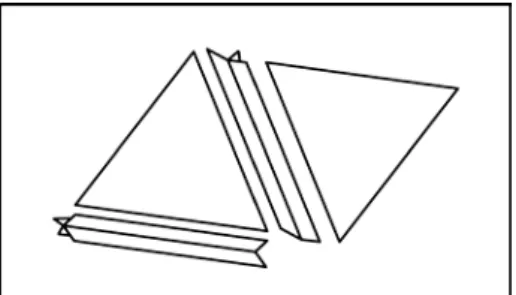
この模型で生成される配位は、下図のように三角形とその辺をつなぐ蝶番のようなものからなる。
任意の四面体分割がこの模型では生成されるが、四面体分割でない配位も生成される。しかし、模型を 規定する代数を行列環の直和にとり、相互作用を特定の形にとった場合、模型のパラメータの適当な極 限では3次元多様体の四面体分割を表す配位しか残らないことが示される。これによって、この模型の あるクラスは、物質場を含まない離散的な3次元量子重力理論と等価であることがわかる。また、模型 の相互作用項を工夫することで、四面体分割の各単体に局所的な自由度を付与することができ、ランダ ム体積上の物質場を実現することもできる[2]。この手法により、例えば、膜の標的空間上の座標に対応 する自由度を模型に載せることができる。また、ランダム体積上のイジング模型等もこの手法で構成可 能である。さらに、色付きテンソル模型と等価な模型も特殊な相互作用項をとることで実現可能である。
References
[1] M. Fukuma, S. Sugishita and N. Umeda, JHEP 1507, 088 (2015) [arXiv:1503.08812[hep-th]].
[2] M. Fukuma, S. Sugishita and N. Umeda, arXiv:1504.03532[hep-th].
Fig. 1. Triangles glued together along multiple hinges.
ATLAS 実験 Run2 における vector like quark 探索
高エネルギー物理研究室 田代 拓也
Abstract A new particle called VLQ is predicted in some models beyond Standard Model to solve the Higgs mass quadratic divergence. We use the LHC Run-2 data with 13TeV CME to search for VLQ produced via electro-weak interaction and decaying to Zt.
© 2016 Department of Physics, Kyoto University
2012年にHiggs粒子が発見されたが、標準模型では高次ダイアグラムの輻射補正によりHiggs粒子の
質量の計算値は実測値の 10桁以上も大きくなる。これは Higgsの階層性問題[1]という素粒子物理学の 未解決問題の1つである。fine-tuningを用いずにこの問題を解決するような、標準模型を超えた物理が いくつか予言されているが、その中でもTeV領域で新しい現象、粒子が現れるような理論はLHC実験 で検証可能である。
そのような理論で予言される新粒子の1つにvector like quark (VLQ)[2]がある。VLQはカイラリティ の左手系と右手系が同じ電弱SU(2)表現に属するクオークで、Little Higgs mode, composite Higgs mode等 の理論で存在が予言されている。VLQのうち、電荷が+2/3のVLQ(vector like top. 以下、Tと表現する)
はFig.1のようにHiggs粒子とtクオークと結合してHiggs粒子の質量の発散を解消する。LHCの陽子陽
子衝突ではTはFig.2のファインマンダイアグラムのように、2種類の過程で生成される。また、Tの崩 壊過程はZボソン+tクオーク、Higgsボソン+tクオーク、Wボソン+b クオークの3種類であり、それ ぞれの崩壊分岐比には理論による自由度がある。
本講演ではLHC Run2の重心系エネルギー13TeVでの陽子陽子衝突を用いて、図2(a)の電弱過程で生 成されたTがZボソンとtクオークに崩壊する事象の探索について発表する。
References
[1] S.Dimopoulos and H.Georgi, Nucl. Phys. B193(1981)150
[2] A Fermionic Top Partner: Naturalness and the LHC, arXiv:1205.1103(2013)
Fig. 1. Feyman diagram of the T coupling to t and Higgs. The (b) and (c) diagram resolve the mass divergence by (a).
Fig. 2. Feyman-diagram of the T production. The left diagram (a) shows the pair production via QCD, and the right (b) shows the single production via electro-weak interaction.
Vector Like Quark production
3Takuya Tashiro (Kyoto U)
* LHCでのT 生成過程
(1) pair production
* QCDによる対生成
* 理論の不定性が小さい
* QCDを介しているので 断面積が大きい
(2) single production
* 電弱相互作用による生成
* TとSM quarkとの間の couplingに自由度があり、
断面積の理論による不定性 が大きい
* b quarkやt quarkを伴う
* Tの質量が大きければQCD よりも大きな断面積となる
2015/9/26 日本物理学会秋季大会
Vector Like Quark production
3Takuya Tashiro (Kyoto U)
* LHCでのT 生成過程
(1) pair production
* QCDによる対生成
* 理論の不定性が小さい
* QCDを介しているので 断面積が大きい
(2) single production
* 電弱相互作用による生成
* TとSM quarkとの間の couplingに自由度があり、
断面積の理論による不定性 が大きい
* b quarkやt quarkを伴う
* Tの質量が大きければQCD よりも大きな断面積となる
2015/9/26 日本物理学会秋季大会
M2-branes in M-theory and exact large N expansion
Yukawa Insitute for Theoretical Physics Tomoki Nosaka
Abstract We analyzed the partition function of a special class of 3d U(N) superconfor- mal Chern-Simons theories for large N, and determined the all order perturbative/non- perturbative corrections in 1/N. These theories describe the M2-branes in the M-theory, and hopefully our results will shed new light on quautum corrections to the classical su- pergravity.
⃝2016 Department of Physics, Kyoto Universityc
Recently we studied the exact large N expansion of the partition function of the N = 4 U(N) circular quiver superconformal Chern-Simons theories in [1, 2, 3]. These theories are known to describe the N stack of the M2-branes in the M-theory on various orbifold. With the help of the formal relation between the partition function and a quantum statistical system ofN-particle ideal Fermi gas discovered by Marino and Putrov, we achieved to determine the all order perturbative correction in 1/N to the partition function in large N expansion [1].
We also analyzed the non-perturbative effects in 1/N. In the context of the AdS/CFT corre- spondence, these non-perturbative effects in 1/N can be interpreted quantitatively as the effects of fundamental M2-brane winding non-trivial three-cycle in the dual eleven dimensional background ge- ometry, and thus called the instantons. We determined the explicit expression of several instanton coefficients and found following interesting property [2]. If the quantum number of two different kinds of instantons satisfy particular rational relation, they exhibit the same exponential suppression in 1/N. We discovered that the individual instanton coefficient is always singular at the coincidence, though the divergences are always precisely cancelled in the net coefficients.
Restricting ourselves onto one particular theory among the N = 4 theories we also achieved to determine the coefficients of all kinds of instanton and at arbitrary quantum number [3]. We finally find that the instanton coefficients are completely reproduced by the free energy of the refined topological string theory.
References
[1] S. Moriyama and T. Nosaka, “Partition Functions of Superconformal Chern-Simons Theories from Fermi Gas Approach,” JHEP 1411 (2014) 164 doi:10.1007/JHEP11(2014)164 [arXiv:1407.4268 [hep-th]].
[2] S. Moriyama and T. Nosaka, “ABJM membrane instanton from a pole cancellation mechanism,”
Phys. Rev. D92 (2015) 2, 026003 doi:10.1103/PhysRevD.92.026003 [arXiv:1410.4918 [hep-th]].
[3] S. Moriyama and T. Nosaka, “Exact Instanton Expansion of Superconformal Chern-Simons Theories from Topological Strings,” JHEP 1505 (2015) 022 doi:10.1007/JHEP05(2015)022 [arXiv:1412.6243 [hep-th]].