to the Arithmetic-Geometric Mean Ratio
Yasutoshi Nomura
Department of Applied Science, Faculty of Science, Okayama University of Science, Ridai-cho 1-1, Okayama 700-0005, Japan
(Received October 5, 1998)
1. Introduction and the function m (n)
It is well-known that the arithmetic mean of positive reals is not less than the geometric mean of them, the equality holding if and only if they are equal. Thus it will be interesting to ask for what n positive integers xu Xz, —, Xn, n > 1, the arithmetic- geometric mean quotient Qn (xlt -~,xn) = (xln+xln + ••• +xnn)/nx1 x* — Xa is an integer greater than 1. In other words, we look for positive integer solution (xu •••,^, d) of the diophantine equation
*in+ - +V = dnxx - Xn (1)
where d > 1. For convenience we call an rc-tuple xu •••, xn trivial if xx = ••• = xn.
Note that the equation (1) can always be solvable in integers, since we have solutions te, &, Xz, •••, Xn) = (n, 1, -1, •••, 1, -1) for n = 1 mod 4
te, Xz, X*, •••, Xn) = (n, n, n, 1, -1, •••, 1, -1) for n = 3 mod 4
It seems to be difficult to solve (1) in general because there are too many ways of partitioning a given positive integer into positive integers. Hence we are mainly concerned with the case where almost all x's are equal to 1, that is, with the equation
Xin+ •" +xkn + n-k = dnxl — xk, d > 1 (2) for small value *. We denote any solution of (2) by xu —, x^y ln~k.
It is shown in [4, 5] that the equation (1) are always solvable in the following cases:
i) n is even ^ 4 with solution n — 1, I""1
ii) n is a prime congruent to 5 mod 6 with solution n—1, n2 -3n+3, ln"2 but that (1) is insoluble for n = 2.
With these facts and the numerical evidence described later I dare to make the following conjecture:
"The equation (1) has a positive integral solution for n greater than 2."
It is also interesting to find the minimum value of d for which the equation (1) is
solvable. Thus we set
m (n) = \ .
^ mi
Yasutoshi Nomura
f oo if (1) is insolvable
min {Qn (xlt —, xn): (xly •••, xn) is non-trivial} otherwise
The following facts are sometimes helpful in the machine-search of solutions of (1).
Proposition 1.1. Let xu •••, xn be an integer-solution of (1). Then 1) for n = 1 (mod p — 1) with an odd prime p dividing n one has
xx+ -" +xn = 0 (mod p) 2) for n even we have Xy+ ••• +xn = 0 (mod 2)
Proof. We see from the little Fermat theorem that xp~l = 1 (mod p) for x relatively prime to p} hence if n is written as (p — 1)
xn = (x/>-l)<? x = x
Therefore, since xn = x (mod p) in case x is divisible by p, it follows from xxnjr ••• + xnn = 0 (mod w) that xx+ ••• +xn = 0 (mod £). The second claim follows from the fact that x and xn are of the same parity,
Corollary 1.2. Let n be an odd prime. Then xx+ ••• +xn = 0 (mod n).
The following proposition is proved by Sumner and Dove (see [2]):
Proposition 1.3. Let n be an odd prime power pk. Then the equation (1) has a solution
Lemma 1.4. Let m, n and pu •••, ph be positive integers. Then any solution (pxmy ••-, pkm, ln~k) of the equation (2) yields a solution (pu —, Pu '", Pk, —, A, lmn~mA) o/ fc equation (1) w/tt w replaced by mn.
Proof. This follows from the observation that {m (pimn+ — +pkmn)+mn-mk}/
••• £*m) is reduced to {(AT+
Corollary 1.5. For n—m (pm+l) where p is an odd integer ^ 3, the equation (1) has a solution (p, p, —, p, ln~m).
m
Proof. Since pm+lis even, we see from i) that (pm, I""1) is a solution of (1) with n = pm+l, thereby the above assertion.
Proposition 1.6. For n = m2 the equation (1) has a solution (m-fl, I""1).
Proof. This follows from the fact that
yZnCk mk+m2 is divisible by m + 1 and m2 which are relatively prime.
Proposition 1.7. For n — k (mk—l)2 where m, k ^ 2, the equation (1) has a solution (m,
Proof. The number
K = kmn+n-k = kmn+k (m2k-2mk)
is clearly divisible by mk. Setting t = mk—l vte have, by the binomial theorem, K/{kmk) = rnn-k+mk-2
= mkmHt-l)+t-l
= l + mk (t-1) t+t-1 = t3 = 0 ( mod t2), which shows that K is divisible by nmk = kmkt2.
Proposition 1.8. For n = l-\-m-\-m2+ ••• 4-m5"1 where n = 0 mod s (e. g. m = 1 mod s or m = — 1 mod s for even s) the equation (1) has a solution (m, I""1).
Proof. We have
(rnn+n-l)/(nrn) = (mn"1 + l + m+ — +rns~2)/n.
Since n = 0 mod s, it follows that
+ms~2) mod « which is, by an inductive argument,
s-2) - 0 mod w>
Corollay 1.9. For n = rn3-\-m2 + m + l where m is odd, the equation (1) /&zs a solution (m, I""1).
Lemma 1.10. If am = 1 mod m /^w «9 = 1 mod q with q = mk.
Proof. Observe from the assumption that the assertion is true for k = 1.
We shall prove the assertion by the induction on k and assume that the assertion holds for k, that is, am"-l = 0 mod mk. Then, in the expression
amb+l-l = (am*-l) ((am*)m-1+ - +awfl+l\
we have
am*-l = 0 mod mk and {amb)m-l+ — +«m*+l = 0 mod m, which shows that the left hand side is divisible by mk+l.
Corollary 1.11. If m = 1 mod a and am = \ mod m then the equation (1) has a solution (a, \n~l) for n = mk.
Proof. Observe that a and m are relatively prime and we see that an-\-n — 1 is
10 Yasutoshi Nomura divisible by a and mk hence by an. Proposition 1.12. For positive integers a and m, (a-\-l)q = 1 mod q — a2m. Proof. We prove this by induction on m. Since (a + l)a2 = 1+ a3 mod a2 by the binomial theorem, the case m = 1 is valid. Assuming the case m = k, that is, )a2* = l+ qa2k for some integer q, the binomial theorem implies that a2k)*2 which concludes the induction process. Corollary 1.13. For n = a2m, m = 1, 2, •••, (fl+1, I""1) is a solution of the equation (1). 2. The function e (N) There may be two methods for solving sequentially the equation (1). One is to seek solutions xu •••, xn among partitions N = %i+ — +x» and the other is to search factorizations N = xx ••• xn for solutions of (1). The former has a defect in a rapid increase of the partition number of N as TV becomes large, while the second might be executable for large N. The second method suggests the following definition: For a positive integer N(>2)we define e (N) to be the least positive integer p for which there exists a factorization N = x1 ••• xm, 2 ^ xx ^ — ^ xmt such that Qp (xu •••, xm, 1, •••, 1) is an integer greater than 1. Following Nagell [3] we introduce the numerical function <p (n) for a positive integer n as follows: i) for n = 1, 2, 4 or pa with odd prime p let <f> (n) = <f> (n), the Euler function ii) for n - 2* where J3 ^ 3, <p (n) = lA <t> (») iii) for n — pxal p2a2 ••• where A, ^2, ••• are distinct primes <P(n) = \cm{<f>(pn, </>(p2a2), •■•} Then, if w > 1 and <2 is relatively prime to w, then a^(n) = 1 (mod n) Let (Z/nZ)* denote the multiplicative group of reduced residue classes modulo n, n > 1 and, for an integer a prime to n, let ord (a, n) denote the order of a in (Z/nZ)x. Thus ord (a, n) = 1 means a = 1 (mod w). We have 1) if gcd (m, rc) = 1 then ord (a, mn) = 1 c m {ord (a, m), ord (a, n)} 2) for a prime £ ord (a, />*) = /j*"1 ord (a, p) 3) for a prime /> > 3 23P = 8 (mod 3/>), for we have (23)p = 8P = 8 (mod />) and (2*)3 s 2p =(_!)/>=_! (mod 3), thereby obtaining 23/>-8 = 0 (mod 3p) 4) 2n = 2 (mod /)) for n = pa with odd prime />, for we have 2» = (2*-y = 2^- = 2 (mod />) by the Fermat theorem.
Lemma 2.1. For any odd n > 1 we have 2n ^ 1 mod n.
Proof. Let
n = piai ••• pkak
be the prime power factorization of n and assume that there exists pt such that 5 = ord (2, pt) is even. Then write n — ptatq and q = us + r where 0 ^ r < s. Since q is odd, it follows that r > 0 and
2» = (2T = 2q = (2s)" 2r = 2r * 1 (mod A),
which implies that 2n * 1 (mod w). When all ord (2, £,) is odd, choose t so that 5 = ord (2, pt) < pj for all j ± t. Then, for n - ptat q} q is not divisible by 5 > 1 and so we can argue in the same way as above.
Lemma 2.2. For a positive integer n (n-\-l)n+n2—1 is divisible by n2 (n + l).
Proof. We see from the binomial theorem that
(w + 1)"-1 = (n-1) n+l mod n2 whence we have
(n + l)n+n2-l = (n + l) {(n+l)"-1 + n-1}
= (n + l) {(n-1) n+l + n-1) = 0 mod n2 (n + l) We may deduce, from (i) of section 1 and Lemma 2.2,
Theorem 2.3. e (N) ^ (AT-I)2 and, for odd N, e (N)^N + 1.
With the above theorem we define an integer N to be simple if e (N) = N + l for odd N
s (N) = (N-1)2 for even N
Lemma 2.4. For any even integer a ^ 2 and for integer n ^ 1, let b = (a + l)n. Then ab+l = 0 (mod b)
Proof. We prove this lemma by induction on n. Since b is odd, this is obvious for n = 1. Assume that the congruence holds for n = k. Setting t = (a+l)k yields
in which we have, by the assumption,
a'+l = 0 mod t,
(at)a-(at)a~l+ - +l = (-l)a-(-l)fl-1+ -
= a + 1 = 0 mod a+1.
Hence one gets a«a+1)+l = 0 mod (a + l)k+l.
12 Yasutoshi Nomura
Corollary 2.5.
1) (a2ya+1)* = 1 mod (a + l)k for even a ^ 2.
n, n ^ 1.
Proposition 2.6. Let k be an integer k ^ 1. Then
1) /or n = (3*-l) (23*-f-l) ^ equation (1) /azs a solution (2, -, 2, I""3*)
2) For n = 23*+l #ze equation (1) fezs solutions (2<, I""1), where £ = 2, 4, •••, 3*—1 «r
Proof. Let m = 3*—1; then, by the preceding corollary, 2m+1-f 1 = (m + 1) q for some odd q. Then
1) Since m 2OT+1-1 = (m + 1) 2m+l-(2m+1 + l) = (m + 1) s for odd s = 2m+1-q, we see that
(m2n+n-m)/(n2m) = (m2n+m2m+1)/[m (2m+1 + l) 2m]
= 2 (2(m+1)s+l)/(2OT+1-fl) is an even integer.
2) [(20n+«-l]/(»20 = (2^+2m+1)/[(
= (2m+1/20 {(2(m is an integer, since t ^ m and gtf—1 is odd.
Lemma 2.7. L^ n = ms+l. Then m2s = 1 (mod n).
Proof. This is obvious from m2s— 1 = (ms—1) (ms+l).
Corollary 2.8. Suppose n = ms+l with odd s and m = — 1 (mod 2s). Then the equation (1) has a solution (m, P"1).
Proof. Observing that n = 0 mod 2s and that mn-l = mn-m2s = m2s (mn~2s-l) mod n we may infer by the induction that mn+n—1 is divisible by m.
Proposition 2.9. Let n = (m + 1) (m2+m + l) = m3-h2m2 + 2m + l wiYA m = ±1 mod 6. 77&0W m6 = 1 (mod w) <2Wfi? the equation (1) te « solution (m, ln~l).
Proof. We have 1 = (n-1)2 = m2 (m2 + 2m+2)2 = m«+4m2n = m6 mod n. It fol lows by induction that mn— 1 = m6 (mn~6—l) = 0 mod n.
Proposition 2.10. Let n = (m-1) (m2 -1) = mz-m2-m + l. Then m2m~2 = 1 (modn).
Proof. We have
3)-l+ ••• +m2-l + m-
= 0 mod (m2-!) (m-1).
Corollary 2.11. For odd m > 2 and n = (m — 1) (m2 — l) the equation (1) has a solution
(m, I*"1).
Proof. This follows from the fact that (m-l) (m2 — 1) is divisible by 2 (m — 1).
Proposition 2.12. For n = (m + 1) (m2+m + l) we /&^g m6 = 1 (mod n) and, if m
= ±1 mod 6 then the equation (1) has a solution (rn, I""1).
Proof. The first half follows from the identity
m6-l = (m-l) (m2 + m + l) (m + 1) (m2-m + l) (3) The second half follows from the fact that 6 | n, because m +1 = 0 mod 6 if m = — 1 mod 6 and, if m = 1 mod 6 then m + 1 = 0 mod 2 and m2 + m + l = 0 mod 3. Similarly one gets, from (3),
Proposition 2.13. For n = (m + 1) (m2-m + l) we have m6 = 1 ( mod n) and, if m
= — 1 mod 6 then the equation (1) has a solution (m, I""1).
Lemma 2.14. There hold following congruences:
m6-l = 0 ( mod (m + 1) (m2 + m + l)) m6+l = 0 (mod m2 + l)
m6r+m6(r"1)+ - +m6+l = r + 1 (mod m + 1)
mes_me(s-i)+ ... _m6+1 = x (mod
5 is even. Thus m*r+m*{r-l)+ — +m6+l = 0 mod m + 1 if and only if r
— 1 mod m + 1.
Proof. The first two follows from the factorizations:
m6-l = (m-l) (m2+m + l) (m + 1) (m2-m + l), m6+l = (m2 + l) (m4-m2
Hence m6 = 1 (mod m + 1) implies, by the binomial theorem applied to m = (m + 1) 1, the remaining congruences.
Proposition 2.15. For n = (m + 1) (m2+m + l) (m3 + m2+m + l) there hold
= 2f 12> g, 4, 6 and 12
according as m = -1, 0, 1, 2, 3 and 4 (mod 6).
Proof. Observe that m3 + m2+m + l = (m + 1) (m2+l).
For m = 6/—1 we have
= (m6-l) (m6 + l) (m6(i-1)-m6((-2)+ ••• +1)
in which the last factor is = t mod m + 1 by Lemma 2.14, a fortiori = 0 mod t. Since m2-m + l = 0 mod 3 and m — 1 = 0 mod 2 we see from Lemma 2.14 that m2(m+1)—1 is divisible by n.
Next consider the case m = 0 or 4 mod 6; then
14 Yasutoshi Nomura
in which the last factor is = m + 1 = 0 (mod m + 1) by Lemma 2.14, whence our assertion again by Lemma 2.14.
For the case m = 1 or 3 mod 6 we consider
m6(m+i)_1 = (m_i) (m + l) (m2 + m + l) (m2-m + l) (m6m+m6(w-1}+ - + m6+l) in which the last factor can be written as
whose last factor is = (m —l)/2+l ( mod m + 1), since m6 = 1 ( mod m + 1). Thus our assertion follows from the fact that m — 1 is even.
For m = 2 mod 6 we set m = 6/+2; then
in which the last factor is = 2^+1 mod m + 1 since m12 = 1 mod m + 1, and m2—m + 1 = 0 mod 3. This proves our assertion.
Lemma 2.16.
1) For q = 8*+l, 22<7 = 1 (mod q) implies 22q~4 (l + 229)+^ = 0 (mod q).
2) For odd m and n = m3s + 2, mn = 1 (mod w) implies mn"3 (l + mn)+5 = 0 (mod
1) We see from -23^ = 1 (mod q) that
22^-4
= O (mod 2) Using —m3s = 2 (mod w) we have
= 2mn"3 + 5 = -mzsmn~
= —s + s = 0 (mod w).
Corollary 2.17. For n = m3s+2 tf^A odd m and mn = 1 (mod w) ^ equation (1) /ws
<2 solution (1"~2, m, m2). For n = 2qf q = 8t + l with 22q s 1 (mod #) ^ equation (1) /^zs a so/m&w (ln"2, 2, 4).
Proof. Since (m"+m2"+w—2)/(wm3) = {m*~3 (l + mn)+s}/w, the assertion for odd m follows from Lemma 2.16, 2). For m = 2 we have
= 2 {2n"4 (1 + 2")+*} = 0 (mod 2^).
Lemma 2.18.
1) For any integer t ^ 3 tt{t~2)+t-2 = 0 (mod (^-l)2).
2) For odd t ^ lt^+t+2 = 0 (mod (t+1)2).
Proof. We see from the binomial theorem that
(t-2) (t-l)+t-2
= (t-l) (t2-2t+l) s= 0 (mod (*- which proves the first part. Similarly we have
(t+2)
= (t+1) (t2+2t+l) = 0 (mod
Corollary 2.19. For n = t (t-2) + l the equation (1) has a solution (I*"1, t). For n = t (t+2)+l with odd t the equation (1) has a solution (ln~\ t).
Lemma 2.20. For n = t (2f-3)+l = (2t-l) (t-l),
tn~l+2t-3 = 0 (mod n) if and only if tn = 1 (mod n).
Proof. Since t and n are relatively prime it follows that t*~l+2t-3 = 0 mod n iff t (tn~1 + 2t-3)
= 0 mod n iff r-1 = 0 mod n
Corollary 2.21. If tn = 1 (mod n) for n = (2t-l) (t-l) then the equation (1) has a solution (t, I""1).
Now we observe that an integer q-2p where p is odd prime is simple if, and only if both congruences
q»+n-l = 0 (mod qn) and 2n+pn+n-2 = 0 (mod 2pn)
are not true for each n with 1 ^ n < (q-1)2. Note that the former holds only if there exits a positive integer k such that n = qk + 1, where k < q — 2. Then, since n and q are relatively prime, it is equivalent to qn~l + k = 0 (mod n), which implies that qn+kq+
1 = 1 (mod n), that is,
qn = 1 (mod w).
Lemma 2.22. Let q be an even natural number and let n = qk + 1, k ^ 1. Assume that qn = 1 (mod n). Then q—1 is divisible by the minimal prime factor p of the order ord (q, n), and hence gcd (n, q — 1) > 1.
Proof. Write t = ord (q, n); then / | n implies that p | n, hence ?' = 1 (mod p). Since
« and q are relatively prime, hence gcd (q, p) = 1, we see from the Fermat theorem that qp~l = 1 (mod p). Thus
ord (q, p) | t and ord (q, p)\p-l.
Since all prime factors of t are ^ p, it follows that ord (q, p) — 1, that is, q = 1 (mod
/>), whence our assertion.
16 Yasutoshi Nomura
Corollary 2.23. Let q be an even positive integer such that q—1 is prime. Then, for each k with 1 ^ k < q—2, we have non-congruences
qn * 1 (mod n), n = qk + l.
Proof. Since n = (q-1) k + k + 1, 2 ^ k + 1 ^ q-2, it is obvious that gcd (n, q-1) = 1, whence our assertion by the contrapositive.
Corollary 2.24. Let q—l = pxp2 with odd prime pu p2 and assume ord (q, q (p1 —1) + 1) and ord (q, q (p2 —1) + 1) are even. Then, for all k with 1 ^ k ^ q—3, we /fcz#£
non-congruences qn ^ 1 (mod w) w#A w = #&-f 1.
Next, since the latter congruence holds only if n is odd, we assume n is odd. Then it is equivalent to 2n+pn+ n—2 = 0 (mod np). We consider the case n-kp, that is, the congruence 2kp+pkp+kp-2 = 0 (mod kp2). More weak congruence is 2kp+kp-2 = 0 (mod p2). This does not hold if
(p2-kp + 2)p~1 m 1 (mod p\ (3)
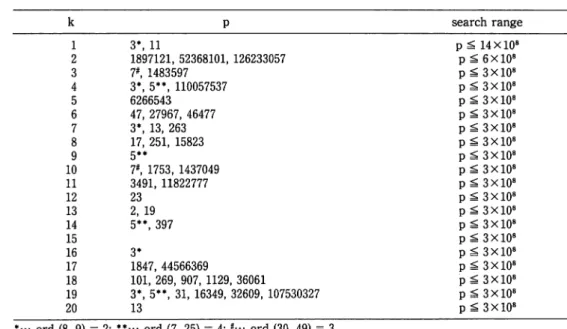
since {2kp)p~l = (2*)W) = 1 (mod p2) for odd prime p implies 2kp = 2-^/) (mod p2). But the non-congruences for k ^ 4/)—4 do not hold for few p, as machine-search shows within some large range p, in which the cases except k = 1, ^ = 3 or 11 can be excluded. Hence we make the following conjecture:
For odd prime p such that 2^ — 1 is a prime and that p > 3, 2p is simple.
Remark. The famous Wieferich congruence 2P"1 = 1 (mod p2) holds only for p = 1093, 3511 in the range p ^ 6X10⁹ (see [1, 2]). We can shows by a machine-search that the inequality
ord (2 + (*-l) p9 p2) * ord (p2-kp+2, p2)
holds if and only if either (2 + (*-l) j^K"1 = 1 (mod £2) or (p2+2-kp)p~l = 1 (mod /?2) for large range of prime p.
3. Tables
To make up the Table I we have used the computer package "GAP" together with the following program "allfac. gap" which gives a list of the factorization lists composed with factors ^ k of x. With this program on memory "facag. gap" gives solutions of (1) for n = p from px to p2.
allfac: = function (x, k) local a, b;
if IsPrime (x) or k*k > x then return [[x]];
fi;
for a in [k • • Rootlnt (x)] do if Remint (x, a) = 0 then
Append (b, List (allfac (x/a, a), y -> Concatenation ([a], y)));
fi;
od;
return b;
end;
facag: = function (nl, n2, pi, p2) local f, g, n, p. j;
n: = nl;
while n ^ n2 do f: = allfac (n, 2);
for p in [pi — p2] do
for j in [1 — Number (f)] do g: = f []*];
if p > Number (g) and Remint ((Sum (List (g, z -> 2fp))+p-Number (g)), p*n) = 0 then Print (wp=", p, "", g, '"');
fi;
od;
od;
n: = n+2;
od;
end;
18 Yasutoshi Nomura
Table I m («) for n ^ 200
m (n) solution xu •••,
3 4 5 6 7 8 9 10 11 12 13 14 15 16 17 18 19 20 21 22 23 24 25 26 27 28 29 30 31 32 33 34 35 36 37 38 39 40 41 42 43 44 45 46 47 48 49 50 51 52 53 54 55 56 57 58 59 60 61 62
2
^7
^4
^ 521
^ 98460
^ 42151
^ 1253
^ 2861165
< 44392
^ 23775972551
< 231924582674735980
^ 21633936185161
^ 11306274409
^ 896807
^ 22 digits
^ 7282
^ 351561282356642220105
< 38742049
^ 52357696561
^ 27 digits
^ 34 digits
^ 30 digits
^ 189535253532864676
^ 16962579960192958638269305
^ 28 digits
^ 39 digits
^ 53 digits
^ 41 digits
^ 57 digits
^ 40 digits
^ 41 digits
< 40 digits
^37 digits
^ 23 digits
< 152 digits
^ 57 digits
^ 47 digits
^ 101313878825474407
^ 86 digits
^ 52357696561
^ 97 digits
^ 69 digits
^ 42 digits
^ 73 digits
^ 119 digits
< 77 digits
^ 42 digits
^ 82 digits
^ 77 digits
^ 34 digits
^ 116 digits
^ 75 digits
^ 87 digits
< 94 digits
^ 46 digits
^ 92 digits
^ 86 digits
^ 103 digits
^ 203 digits
^ 108 digits
1,2,3 1, 1, 1, 3 5, 11, 12, 13, 19 1, 1, 1, 1, 1, 5 2, 3, 5, 9, 47, 56, 88 I5, 9, 9, 11
1, 1, 6, 10, 11, 14, 14, 14, 19 I4, 3, 8, 12, 15, 15, 23 I6, 2, 2, 2, 5, 5 I11, 11
I7, 2, 8, 8, 8, 8, 89 I13, 13
I13, 4, 7 I15, 3
I12, 5, 16, 34, 47, 56 I16, 2, 2
I13, 4, 4, 11, 22, 30, 30 I18, 3, 3
I20, 4 I21, 21
I18, 2, 13, 14, 34, 57 I23, 23
I24, 6 I23, 2, 8, 13 I26, 13 I27, 27
I24, 3, 42, 53, 93, 133 I29, 29
I27, 8, 100, 109, 128 I30, 13, 23
I29, 2, 3, 14, 24 I30, 2, 2, 3, 19 I32, 2, 6, 14 I35, 5
I33, 4, 4, 4, 19935 I37, 37
I32, 3, 4, 4, 4, 7, 7, 23 I39, 3
I39, 5, 161 I40, 2, 2
I38, 2, 11, 12, 167, 286 I43, 43
I43, 7, 10 I45, 45
I42, 2, 2, 8, 25, 485 I47, 47
I48, 8
I46, 6, 29, 54, 61 I45, 2, 2, 4, 6, 18, 43 I50, 5, 5
I48, 2, 2, 13, 42, 211 I52, 11, 29
I51, 4, 5, 31, 49 I55, 55 I56, 7 I55, 7, 10, 46 I54, 2, 2, 2, 23, 35 I59, 59
I58, 3, 5, 2679
I61, 61
I58, 2, 2, 29, 113, 240 I63, 3
I60, 4, 20,39, 93, 1284 I65, 2, 4
163, 3, 9, 19, 107 164, 2, 2, 2, 9, 15, 20, 25 165, 4, 4, 10, 127 169, 69
I68, 9, 52, 1575 I71, 71 170, 2, 17, 2393 171, 8, 30, 75 173, 26, 111 174, 3, 55 173, 6, 10, 108, 823 177, 77
174, 2, 2, 5, 25, 50 179, 79
180, 4
178, 2, 37, 67, 110 181, 9, 657 I81, 3, 3, 3
179, 3, 3, 4, 8, 8, 315 I85, 85
185, 172, 4951 186, 17, 29 185, 4, 6, 107, 332 I89, 89
I84, 2, 2, 2, 8, 15, 18, 37 191, 91
186, 2, 2, 2, 2, 5, 5, 16 I93, 93
192, 5, 32, 41 195, 5 196, 20, 22 1", 3 1", 100, 9901 I101, 101 I101, 301, 319 I103, 103 I100, 2, 3, 3, 5, 7 I103, 4, 101, 276
l«» 106| 11131
I106, 11, 17 I108, 9, 21 I110, 10
I*" 3> 5> 9f 9> 15> 47
1"\ 112, 12433 I113, 113
l»», 2, 18, 33, 148 I115, 115
I1", 2, 5, 6, 11, 1064 I117, 117
I115, 6, 15, 34, 220 1119, 7
1120, 12 1121, 121 1122, 3, 7 1124, 31 1125, 5 i»«f 25, 15090 1126, 3, 3 I125, 3, 4, 15, 273 1127, 2, 3, 10 63
64 65 66 67 68 69 70 71 72 73 74 75 76 77 78 79 80 81 82 83 84 85 86 87 88 89 90 91 92 93 94 95 96 98 100 101 102 103 104 105 106 107 108 110 111 112 113 114 115 116 117 118 119 120 121 122 124 125 126 127 128 129 130
^ 142 digits
< 29 digits
^ 192 digits
^ 38 digits
^ 130 digits
^ 88 digits
^ 140 digits
^ 126 digits
^ 220 digits
^ 130 digits
^ 240 digits
^ 133 digits
< 149 digits
^ 129 digits
^ 216 digits
^ 144 digits
^ 128 digits
^ 149 digits
< 47 digits
^ 160 digits
^ 229 digits
^ 38 digits
< 205 digits
^ 163 digits
^ 314 digits
^ 125 digits
^ 217 digits
< 172 digits
^ 135 digits
^ 177 digits
^ 107 digits
^ 182 digits
^ 148 digits
< 65 digits
^ 127 digits
^ 46 digits
^ 396 digits
^ 201 digits
^ 251 digits
< 201 digits
^ 84 digits
^ 252 digits
^ 425 digits
^ 129 digits
< 142 digits
^ 108 digits
^ 180 digits
^ 455 digits
^ 230 digits
^ 243 digits
^ 235 digits
^ 347 digits
^ 240 digits
^ 106 digits
^ 99 digits
^ 128 digits
^ 250 digits
< 102 digits
^ 181 digits
^ 86 digits
^ 524 digits
^ 59 digits
^ 308 digits
^ 127 digits
cm"
coi—iCM"
CM"
i—l COo■^
toco"
1—1a*00 °°
to
co" ~
cococo^fto" 3 lo"1'
CMLO"
--
2175 1801 LO00U CMlo" co"
»..>"^~^ICOC"*-COCM^CMCOLO•...LO...»tO«.»tOI LO^co cm" to" aT a00.
« s S § §
INHHH0OHNHNH l>WNHCO'"'_-O-t>-.QOCOOO~~~O0LO~.-_.HHNHHHCOinON^HHlflHHHHCOr*»^twPfcli5~**"*C^~00~»-«~tO^U>GO8>04O>COti310t^00r-t>?-aoaoaoaoaoaocoa)aoaoao0>a>a>O>oo3
t-OJC-T-HCNJOOOOOCOi-IOOLOmintj<tjo)o>r-iLotoocoLooii—i
r-HLOrHCMCOi—ICMCOCMtOCOCO"*COCM'OOCO
VII VII VII VII VII VII VII VII VII VII Ml VII VII VII VII VII Ml Ml Ml Ml Ml Ml Ml Ml Ml Ml Ml Ml Ml Ml Ml Ml Ml Ml Ml Ml Ml Ml Ml Ml Ml Ml Ml Ml Ml Ml Ml Ml Ml Ml Ml Ml Ml Ml Ml Ml Ml Ml Ml Ml
tO<OtOCO^^t>^t^C^C^I>
JCOCOCOCOCOCOCOCOCOCOCOC >oo-oasascncn4s»4^cocoi—•
<JNOiOiOINJO^OOOOOit3COCOCOCOH-*h-*t—»I—'I—*H-»I—«(—•(—»»—»(—'I—'I-'!—»»—»»—»H-*h-«t—» 4*.i—» o4^astoisjp
4^.h ascoenoi»co*c
;ss.
totitoojo »-* oo <o h-» en 5 -o h-* co to C^&asCoS ^co eo^^co cojo co^ co co 4^ wcow ^i^ g to 00^,50 t0 i° i^3 i^ i^3 to j>o to co ^o h^^jnd cojsd hnui h-» Jo Jo Jo Jo Jo to Jo ^ to ^ Q Q as oo 'co "co to co "co ^to 'P "co ^^^^^M^QPMHOoShm" m3hJOHN33^00HCOn:)N5N)«DM'' 4^COOS003cOCO- COOSO^COC^C04^C04^COV-^I-'I-'COCOCOCOC04^-<JI-^W'CO
^5CO4^4^COCOtO^^--I—1-COOOI—1(—*OS--CO^^^-tOI—1-OO4^--OO--CJ1OS^^3I—»K—»OOiJ^.COCS-^—'*~*"^^t—»COOSCOv—'4s^s-^COMO1W""ww'^--^^--^^--^...*•«.••-.>>■'.>-'.<**'N~'^' ^^ >*^' hoi^" co en ^_ ^^ %-'w' h-*" ^ ^
coto14^- co'CO-J003h-»» COCO co en
cococococococo
cococococococococococot tOHHOotooooooo^o
5H05000( 1CO jen-<3<OCO4s»COCOCO4^COCOtoencoh-'h-»oomcoco coaseneno»—'coco04^ COCOCOCO<lCO4^4^4^<J4^h^lS3C> -COCOtDCOH-'COasH-'l-'COC04^COCOCOC04^COWCOCOCOCOH-*IV-Cas--4^.1-'--h-»o---oo-tooN" coco-<jcoen4^i—»asenooi—lOs-^as--t _"""OS-COCO-^"^CO(-^-
?i23 , ^i^3 J5 ,.^ , co co<i co en 4^ h
toco-tococo--4^---w^--COCO- 2JO