ヽ「erification and Estirnation of Evaporation Heat of l,4‑dioxane Aqueous Solution at Constant Pressure(101.325 kPa)
Koryo Ko」IMAキ,Keiji KAWABATA**,Susumu TAKAHASHI***,
ⅣIasanari KuDO***キ ,Takuya KAGA*****
and Sankichi TAKAHASHI半 ***キ Abstract
This study deternュ ined the evaporation heat of l,4‑dioxane aqueous solution, which is necessary to plan the absorption― type refrigeration cycle using the wrorking medium developed by the authors and to establish a method of estilnating it based on the existing forms of both components of l,4‑dioxane aqucous solution Evaporation heat at constant pressure(101325 kPa)and mOlar fraction dependence were lneasured and calculated during both the evaporation process in which the vapor― hquid composition remained constant and the process in、vhich the composition changed, in consideration Of the liquid structure of l,4‑dioxane aqueous solution The measurements and calculation results郡 ァere compared with existing evaporation heat data and led to the follo、 、テing results,(1)The rnean difference in evaporation heat wras 2 07%bet、 Veen the value calculated using calculation software(UNIFAC method)that simulated a certain amount of evaporation in vapor― hquid equilibrium at low pressure and the value determined by experiments (2)The mean difference in evaporation heat 、、アas 335身6 betWeen the value deterHlined froni total evaporation using TG― DSC and the value calculated fronl the approxi mate expression of the relation bet、 、'een cumulative evaporation heat of partial evaporation heat and cumulative sample evaporation (3)The mean difference in evaporation heat bet都 ′een the value calculated as ln01ar fraction means of both components of the silnple Hュ ixture lnodel and (1)or(2)Ⅵras 2 55%and 3 410/。 ,respectively ln conclusion,the evaporation heat of l,4‑dioxane aqueous solution can be estirnated as mOlar fraction means of both components of the silnple nlixture mOdel as an ideal lnixture of normal liquid
Kっυ pοr,s: 1,4‑dioxane Aqucous Solution,Evaporation Heat,ふ ′Iole Fraction Dependency, Temperature Dependency, Liquid Structure ofヽ ヽアater,Estilnation
1. Introduction
The reduction of CC)2 eH五 SSions requires the recovery and effective use of lo、 、ア quality thermal energy of factory waste heat or the like at 100° C or less. To achieve this it is desirable to develop a thermal rnediunl having a lo、 v bolling point at atinospheric pressure(101 325 kPa) We investigated l,4‑dioxane aqueous solution because it is compatible 、キアith water and has sinlilar vapor‑lquid composition to the azeotropic composition of Xc=0 625 over a wide range
Received December 19, 2003
Department ofヽ′Iechanical Systems on lnformation Technology,AssOciate Professor NIechanical Engineering Systems,Graduate School of Engineering
Department of Chemical Engineering on Biological Environment,Assistant The First Hi涯 子h School Attached to Hachinohe lnstitute of TechnOlogy ふン【echanical Engineering Systems,Graduate School of Engineering, Professor
―‑ 23 ‑―
The Bulletin Of H I T V01 23
of m故 ture mole fractions Xc=06to O.8251)(wateri primary component)and a similar boiling point to the azeotropic boiling point of about 353 K. As a thermal working nuid oflow bOihng point,we considered the direrent physical,thermal and momentum properties of l,4‑dioxane aqueous solution Toninaga et a12) eXanlined the state of existence of the t、 vO cOmpOnents in a l,4‑dioxane aqueous solution using Raman spectroscopic analysis and showed that monomolecular l,4‑dioxane and、 vater are homogeneously nlixed、 、アithout fornling a hydrogen bond in the l,4‑dioxane aqueous solution. Using the 170̲NWIR che■ lical shift methOd, Mre demonstrated that the l,4‑dioxane broke the hydrogen bond acting between、vater molecules and changed the liquid structure of、 vatera)4) wIoreover,Mre demonstrated thatin a l,4‑dioxane aqueous solution,water takes different liquid structures depending on the m01e fraction,and different forms of water are homogeneously nlixed、 、アith monomolecular l,4‑dioxane indepen‐
dently fronl each other form of water、 vithout fOrnling a bond Next,we exanlined、 、/hether the monomolecular Ⅵ/ater that formed in the l,4‑dioxane aqucous solution would increase the solubility of LiBr・ 2H20 in Water and investigated the solubility increase and solution mecha‐
nism We used the pair of LiBr‑1,4‑dioxane aqueous solution and l,4‑dioxane sOlution as the
、vorking mediuna, and sho、 、アed high ehgibility for the absorption refrigerating cycle5)6),
In order to plan and design the absorption refrigerating cycle using the developed、 vorking pair,it is necessary to understand the evaporation heat(this terlll is used because the liquid is a nlixture)of l,4‑dioxane aqueous solution Therefore,this study l、 アas conducted to establish an estimation method of the evaporation heat based on the state of existence of the two components in the l,4‑dioxane aqueous solution
The evaporation latent heat of a liquid Of a pure substance can be rneasured by an adiabatic calorilneter lt can also be calctxlated froln the Clausius― Clapeyron equation,、 キアhich is based on the equivalence relation of Gibbs free energy between vapor and liquid phases. In a nlixed liquid, however, this relation is replaced by the equivalence relation of chemical potential, Mrhich is a partial quantity of Gibbs free energy corresponding to each component lto et a17) reported that the Clausius― Clapeyron relation would not hold
ln this report, considering the hquid structure of l,4‑dioxane aqueous solutiOn, 、ve e■1‐
ployed evaporation processes(電 ), C))duringヽ vhich the vapor and liquid cOmposition is held constant and an evaporation prOcess((⊃ )during which the compositiOn changes Using these methods,we calculated or lneasured the evaporation heat at constant pressure(101.325 kPa) and its dependence on rnole fraction Furthermore,■ 、アe compared the results、 vith the evapora‐
tion heat data given in previous reports
① Calculation of evaporation heat at cOnstant pressure fro■ 1 lo、キア pressure vapor―hquid equilibriunl characteristics by the UNIFAC method
② Measurement of evaporation heat at cOnstant pressure from 10w pressure vapor liquid equilibriunl characteristics experilnents
③ ふ′正easurement of evapOration heat at constant pressure using a direrential scanning calorinleter(TG―DSC)
Frona these results,Ⅵ /e exanlined the state of lnixture of the two components in the vapor
―‑ 24 ‑―
verincation and Estimation Of Evaporation Heat(Kttlw臥 ・KANttATA・ TAl(AHASHI・ KuDO・ KAGA・ TA【電ツGHI)
and liquid phases and proposed a method for estilnating the evaporation heat of a l,4‑dioxane aqueous solution at constant pressure(101 325 kPa).
2. Purpose and previous data of comparison between low pressure vapor― liquid equilibrium method and total evaporation method(TG―DSC)
Table l compares the features of the methods used for calculation and measurement of the evaporation heat of l,4‑dioxane at constant pressure(101 325 kPa)and suHllnari5es the previous data
lf the evaporation heat values obtained by lnethods(D and(2)agree with the previous data
、vithin the range of an appropriate error,the component vapores of the vaporeous phase can be considered a圧五Xture of perfect vapores Likewise,if this result agrees with the evaporation heat value obtained by rnethod ③ ,the evaporation heat of a l,4‑dioxane aqueous solution does not depend on the mixture mole fraction ヽヽ「hen the two components in the solution evaporate independently,the mean of the sum of the evaporation heat values of the components averaged by the solution weight is the evaporation heat of that aqueous solution ln other words, Tonlinaga et al.2)and these nndings3)4)confirni that the t、 、アo components independently exist in the solution、、アithout foraling a hydrogen bond These results indicate that the solution a mixture of perfect liquids
ln the previous data,documented data8)‑12)are available on the evaporation latent heat of 1,4‑dioxane as a single component,but there is
insuricient documented data on l,4‑dioxane 376 aqueous solutions
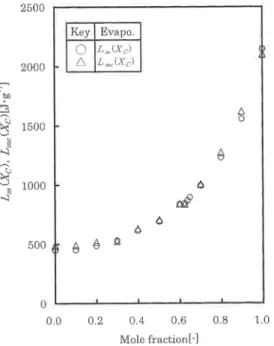
Figure l sho■ 、アs the dependence of vapor―
liquid equihbrium temperature of a l,4‑dioxane aqueous solution on H五xture mole fraction(at 101.325 kPa),eXCerpted from the previous data.
The values used in the UNIFAC method are
given in Table l.
According to thハ /o data sets of the previous data obtained fr01n vapor―liquid equilibrium experirnents,the vapor―liquid equilibriuni tenl‐
perature shows the same tendency in both data sets,and a high degree of agreement is seen in the neighborhood of the azeotropic composi―
tion,or 02<ス「c<0 85 1f the vaporeous phase is assumed to be an ideal vapor,the calculation
result by the UNIFAC method win show a
direrent tendency froni these two data sets in
00 02 04 06 08 10
Mole ll'action[‐]
Fig l Vapor―liquid equilibriuni temperature of l,4‑dioxane aqueous solution on mole fraction
374
372
370
368
866
364
862
360
358 口畠o胸声ゃHo働日0や日口召や蝋増声︒o︺H声ヴロLo自︑>
一‑ 25 ‑一
Bookl
KAGAKU)
◇
△ ロ
Table l Calculation and measurement rnethods and exiting data of evaporation heat of l,4‑dioxane aqueous solution Total evaporation (3)Thermogra宙metry―direrential scanning calorimetry (TG―DSC)method Vary properties other than an azeotroptc point 〕vleasure the amount evaporated and heat consumed by evaporation at each predeined mixing molar fraction Calculate from iOss on sample weight and from heat consumed by evaporation (1)Sumika Chemical Analysis Ser vice(2000) χG=0625
(2)Vapor liquid equilibrium experiment Keep cOnstant by eliminatinttσ errOr origins to rnake the composition of vapor generated from a boiling liquid identical to that entering a cOndenser ⅣIeasure saturation pressure versus saturation ten干 perature at each predeFined mixing molar fractiOn Apply the Clausuis―ClapeyrOn equation Calcu― late from the gradient of a curve of saturation pressure versus saturation temperature at a predeined Hlixing molar fractiOn (1)Hirata,M,S Ohe and K Nagahama: ̀̀Denshikeisanki niyoru Kiekiheikou Data", Koudansya Scientific,pp 745‑747(1975) P:760,50,100 mmHg,χc:12 points (2)Kogan,VB,Fridman,V M Kafarov,VV,; Hirata, 卜I trans : ̀̀Kiekiheikou Datebook", Koudansya Scientiac,p 290(1974) P=760 mmHg,χε:14 points (3)Kogan, VB, Fridman, V M Kafarov, VV; Hirata, ふ′I trans : Kiekiheikou Datebook", Koudansya Scientinc,p 291(1974) T=298K,χci 8 points (4)Nihonkagakukai ed : Kagakubenran Kisohen 4th Ed,p II‑136,トンIaruzen,(1993) P=760 mmHgi constant,Xc,17 points
Evaporation of a certain amount in vapor―Iquid equilibrium at low pressure (1)UNIFAC method VapOr phase: Assumed as ideal ttσas Liquid phasi COrrected、vith liquid phase activity coetticient Calculate saturation pressure versus saturation temperature at each predefined mixing molar frac‐ tion Apply the Clausuis―Clapeyron equation Calculate frona the gradient of a curve of saturation pressure versus saturation temperature at a predeaned nlixing mOlar fraction (1)Touyoujouhou system ed, Kagakukougakubenran JOuhou system PRODECE, Maruzen,p3‑132〜145,Tokyo,Japan(1990) P: arbitrary point, Xc; arbitrary point 。 ヽアapOr phase fugacity coetticient type: Ideal gas , Liquid phase activity coetticient type: UNIFAC ・ Physical―prOperties constanti Coericient of an Antoine vapor pressure type h則咽=A― 鵠 femperatu健 [C]C[にPa C]B[kPa,C]A[kPa,C]
MethOd Calculation method ヽ/1easurement method Vapor―liquid composition during process Items to be calculated and measured Calculation method for evaporation heat Existing data
↓すo田室J一す o恥口■↓ く窒 ﹈∞
︲︱ 中ω ll
verincatiOn and Estimation of Evaporation Heat(KoJI、lA・KAWABATA・ TAKAHASII・ KuDO・ KACA・TAI(AHASHI) the range O,1≦ χc<0.8
ヽヽ/e compared our experilnental data with these previous data.
3. Instrument and method of experirnent
3。l Test saコ nples
Ultrapure water(full―automatic ultrapure吼アater generator CPW‑200 by Advantec Toyo) and l,4‑dioxane(by Kanto Kagaku,special grade)、 ス/ere used for preparing samples,and the samples were prepared in the Hlixture mole fraction range χc==0.O to l.O with、 vater as the primary coコnpOnent, at increments of O,1. The quahty of the ultrapure Ⅵ/ater is: specinc resistance>18ふ江Ω ocm (298K),solubility of Na十 ,ca2+and the like lower than the detection linlit,and pH=5,8 The same sample was used for both the vapor―hquid equilibriunl and total evaporation methods ′
3.2 Ⅲlcasuring the vapor― liQuid equilibrium pressure and temperature under vapor― hquid equilibrium
3.2 1 Experirnental apparatus
Figure 2 shows a schematic diagram of experirnental apparatus The experirnental apparatus consists of an oil bath and a 300 rnl three― port flask. The oil bath is equippedヽ ハ〆ith a stirrer and thermometer and the nask is equipped with a thermometer and is installed in the bath A stirring bar is installed in the nask and is rotated frona the outside to ensure uniform temperature in the nask The nask is connected to a condenser thrOugh a connecting pipe that is thermally insulated by an insulator To the other ports, a vacuum pump and a mercury column manometer are connected to measure
the pressure in the instrument lnsulating material 3.2.2 ふ′Ieasuring method
Take about 200 1nl of the sample prepared to the prescribed inole fraction and put it in a 300 rnl three―port nask installed in an Oil bath Set the pressure in the instrument to 30 39 kPa
to atmospheric pressure using the vacuum
pump and a pressure regulating value and see‐
ing the mercury column manometer connected to the instrument Heat the sample in the oil bath to raise the liquid temperature. When the saturation temperature is reached, boilin占 begins and the liquid temperature remains con―
stant During this period,rneasure the temper‐
▲/Condenser
ature in the instrument and the pressure Fig 2 Schematic diagra■ l of experilnental difference between the inside of the instrument apparatus
Vaporっhase
Thermometer ヽCercury
― man°meter Pressure
controller Condensed phase
Flask
―‑ 27 ‑―
The Bulletin Of H I T V01.23
and atmospheric pressure
3.3 WIeasuring evaporation heat by the tOtal evaporation method(TG― DSC)
3 3 1 Direrential scanning ca10rimeter(TG―DSC)
The TG―DSC(ThermO Gra撹metry―Differential Scanning Calorimeter)used for the test is the′rype 8110 made by Rigaku Denki This instrument is the input compensation type,which detects the temperature direrence bet、 veen the sample and a reference substance and measures the compensating electric energy to o∬ set the temperature direrence.
Figure 3 shows a schematic diagram Of the inside of the DS(,furnace.
Temperature adiustment inside the furnace is accomplished by the heater installed On the side face of the furnace, and compensating heat cOntrol is autOmatically regulated by the thermOcOuple instaned in the sample holder and a compensating heater At this time, the required power for heat controlis depicted in a DSC curve as the difference in quantity of heat.
And,TG(Thermo Gravimetry)makes possible the simultaneous and quantitative detection of a change in,veight due to heating or in quantity of heat and in weight accOmpanying a che■ lical reaction For ineasurement of the sOlution,this study foHowed the convention of using an empty container as the reference substance; in this case an aluminum sample container.
3.3 2 Sample cOntainer and covering method
For the sample container,we used the aluminum pan LQ、 vith a cOver for liquid samples (8580 TlX15N 30 μl made by Rigaku Denki) ヽVe examined the erect Of the pan cOvering rllethod On the TG― DSC curve̲
First,we exanlined the TG―DSC curve using an uncovered sample cOntainer. The TG curve decreases from the beginning Of measurement at a certain gradient The DS curve is greatly disturbed and the constant― pressure evaporation heat obtained frOm it is 10、 ver than the documentary value13)by aS much as 37 46脇
̀ This is because the sample evaporation area is large and the temperature change is intense at the vapOr― hquid interface, so stable sample evaporation is thought impossible TO prevent
the erect of temperature changes,we prepared a cover、vith a hole Of o 5 1n■ l diameter and put it on the sample pan, The DSC curve 、、ァas sharp cOmpared to the uncOvered container, and the intense temperature change at the vapor―hquid interface was prevented. How̲
ever,the amount of evaporation heat、 vas lo、、アer than the documentary value by 6.83フ る This is due to the fluctuations Of the DS(,curve,which are thought to be brOught about by the leakage of the sample vapor through the gap bet、 キアeen
Standard sample
Heater
Heat capacity compensation heater
S le
Sample holder
Furnace w all Differential
thermOcOuple the peripheries of the cover and pan. Then,we Fig 3 Schematic diagram Of the inside of the crirnped the pan and cOver usinvaporample DSC furnace
―‑ 28 ‑―
利 ノ
verincatiOn and Estimation of E、・aporation Heat(KoJIMA・ KAVABATA・ TAKAHASm°KuDO・ KAGA・T郎仏L(sm)
sealer, The lluctuations of the DSC curve 0 disappeared, and the amount of evaporation
heat was 2,1815」 ・gI The direrence from ‐10
the documentary value is ‑3.34%, indiCating that high accuracy measurement is possible For this reason, we carried out experilnents using a pan■ 、アith a crirnped cover.
Figure 4 shows the TG―DSC curve forズ θ=0.O and 10
For the measurement, a sample container
of 30 mg capacity Ⅵ〆as filled、vith 10 mg of the ̲50 sample The large volume container is used to avoid boihng over during measurement and a ̲60 sample size of 10 mg was chosen to prevent the
DSC curve frOnl beco■ ling broad. Fluctuation ̲70
occurs with a sample size of 5 mg,making the 0 500 1000 1500 2000
Time[s]
analysis ditticult
Fig 4 TG― DSC curve for χc=00 and 10 3 3 3 Temperature program
The programmed temperature mode was
used for the measurement of constant pressure evaporation heat. First,、 ve held the furnace temperature at 318 K for the 5 nlinutes before the start of rlleasuremellt to thermaHy soak the reference substance and sample container This clarines the sample loss at the start of temperature rise and the changes of the quantity of heat and reduces the measurement errOrs The sample ttreight is about 10 mg, and the temperature direrence bet、 veen the reference substance and solution is slight,so a holding tilne of 5■ linutes is suFicient for thermal soaking 318 K is the highest attainable temperature of the instrument Ⅵ/hen the furnace is cooled by the air inside the furnace,
We set the endpoint above the boiling point of the sample(383K)and raised the tempera‐
ture at a predetermined rate until the endpoint ttras reached Then,we held the temperature to the endpoint We conducted a prelilninary experilnent at temperature rise rates l,3,5 and 10 K o rnin l For temperature rise rates>31(・ ■lin‑1, the endpoint、 ′、アas reached before the sample had evaporated completely, and some of the compositions of the sample solution required modincations of the temperature prograln, making measurement under the same conditions impossible For temperature rise rates <3K・ ■lin 1, a great deal of tilne is consumed until the endpoint is reached and noises are apt to interfere、vith the measured data, In addition,the amount of natural evaporation is larger than the amount of heated evaporation, and this iowers the measurement accuracy Therefore,we set the temperature rise rate at 3 K・ Hlin 1
3.3.4 Amount of evaporation heat
The amount of evaporation heat is converted by peak area The peak area must have
踊 日 ぢ
■ S のヽ 中o 8 日o 質F日︼︐ ↓﹄中soH
0
‐2
‐8
‐10
‐12
―‑ 29 ‑一
Kev DSC
TG
即 コF,
Start Point /。=10
φ64
〃 膨
The Bulletin of H I T V01 23
reproducibility and linearity with respect tO sample weight,so meticulous care is necessary in deciding ho、,、アto take the peak area There are four rllethods of taking the peak area One method uses the reaction endpoint This endpoint is the temperature at which the logarithm of temperature direrence begins to have hnearity 、vith respect to sample temperature.
However, the simplest methOd is to connect the points at which the peak curve leaves the baseline(riSing point and returning point),and we employed this lnethod because it is、 キアidely used and has reproducibility and linearity.
4. Dependence of constant pressure evaporation heat On mole fraction under low pressure vapor― liquid equilibrium
4.l Constant pressure evaporation heat, Lっ。Xc, obtained by 10w pressure vapor― liquid
equilibrium computation software(UNIFAC)
We used lo、 、ア pressure vapor‑liquid equilibrium cOmputation soft、 〃arel)to compute the evaporation heat of water‑1,4‑dioxane■lixtures from a generahzed equation of vapor― liquid
equilibrium temperature and pressure and comparatively examined the dependence of the computed values of evaporation heat on mole fraction
Finding the evaporation heat of a nlixed solution is cOmplex,and lto et al,7)repOrted that the equation would not hold TO nnd the evaporation heat of a n五 xture solution,the Clausius―
ClapeyrOn equation8)14)muSt be apphed This equation is derived by thermodynanlic analysis of the phase equilibriunl of a rnixed solution. Except for azeOtropic rnixtures,the pressure and
temperature changes during evaporation Therefore, the evaporation heat of a mixed
solution must be found as either isobaric or 12 0 isothermal evaporation heat8)15). 118
The Clausius―ClapeyrOn equation (for an ideal vapor in vaporeous phase)takes the fornl l1 6 of Eq。 (1) 114
″(ln少)̲△ち υφ
′T RT2 (1)
TherefOre,
喝
ョ112
We computed the vapor― liquid equilibrium temperature T and vapor― liquid equilibrium pressure 夕 uSing lo、v pressure vapOr― hquid computation softwarel),and Figure 5 shows the reciprocal,1/T,of temperature T in relation to the natural logarithn■ ,ln少 ,of pressureク.
Key ンYθ
○
●
◇
◆
△
▲
□
■ 十
*
× 00 01 02 03 04 05 06 07 08 09 10
h少=
110 108 106 104 102
̲△
現
.υα ク
.■+C (2)250 260 270 280 290 300 310 1000/T
Fig 5 Relation between in tt and 1000/T
―‑ 30 ‑―
verincation and Estimation of Evaporation Heat(Ko」IMュゝ・KAⅥIABATA・ T州もヽL∝sHI°KuDO・KК労ヽ。TttaHASHI) From Eq.(2),the gradientノ 10f1/T with respect to ln tt is in the relation of Eq。 (3),
̲△L.υR ,っ =̲4 … … … …(3)
Therefore,the constant pressure evaporation heat,Lっs(現3θ),takes the form of Eq。 (4)
LDs p島)=△ 劫,υα,=4R・・………・・………・・………・(4)
That is,it can be expressed as the product of 1/T,the gradientッ 4 of in夕 and the vapor constant R.
ヽヽre calculated the constant pressure evaporation heat,LDslズ θ)(marked by circles),frOm the vapor― hquid equihbriu■l pressure and temperature computed by low pressure vapor― ■quid equilibriuni computation soft、 varel),and Figure 6 shows the constant pressure evaporation heat in dependence on mole fraction
As a tendency of the dependence of とっs(塊aθ)。n m。le fraction, the constant pressure evaporation heat rapidly drops to around Йζθ=08 as the amount of added l,4‑dioxane
increases,that is,as the mole fraction Xc decreases. Past that point,it graduaHy decreases to LDs(Xθ =0.0)
4.2 Constant pressure evaporation heat, と′/″(ズc),Obtained by low pressure vapor― liquid equilibriuHl experilnent
ヽlre measured the vapor― liquid equilibrium temperature and pressure of a water‑1,4‑
dioxane nlixed liquid using a vapor‑liquid equi‐
hbriunl experilnent and calculated the constant pressure evaporation heat,L打 ″(互て0),frOm these measured values. Then,we conducted a com―
parative exanlination on the dependence of the constant pressure evaporation heat on mole fraction
Figure 6 shows the dependence of二,″(jてο)
(marked by triangles)on m01e fraction,
The dependence of L″ ″(χο)On m01e frac‐
tion shows a similar tendency to Lっ s(χc),that is,the constant pressure evaporation heat rap―
idly drops to aroundス ξG=0 8 as the amount of added l,4‑dioxane increases Past that point, it gradually decreases to L打 ″:(χO=0.0).
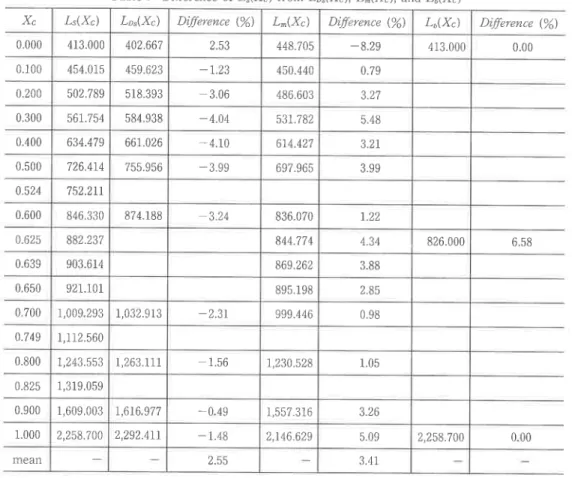
Table 2 sho、vs the ditterence between Lっ s (ス%)and L打′μ(スZ)
Forとっs(男ξ。),the dispersion is large over O.
0≦ χθ≦0 6 but it is smaH in the interva1 0 6<
χ。,and its maximum is 3 71%(at Xο =0.0),its
F〜・﹃ズOδさド﹁バSOヽゞ
00 02 04 06 08 10 Mole fraction[‐]
Fig 6 Evaporation heat of l,4‑dioxane aqueous solution on mole fraction
―‑ 31 ‑―
Key Evapo
○
△あっと,(/σ) ど,灯れ(/θ)
6 n
Q
饉
△ 心
ざ
0 鉢
0
The Bulletin Of H I T V01 23
Table 2 DifFerence between Lっ s(Xc)and L打′′l(Xc)
為 D笏珍″″θο(%)
0000 ‑371
0100 ‑328
0200 333
0.300 ‑206
0400 ‑143
0.500 2.06
0524
0600 319
0625 0639
0.650
0700 ‑120
0749 0800 0825
0900 129
1000 ‑028
mean 207
minimum is 0 28%(at X。 =10),and its mean is 2.07%.
Because LDs(XO)obtained by method ①,or the uNIFAC method,almost agrees with L打′′ι
(/cヽ)obtained by lnethod ② ,or the vapor―hquid equilibriun■ experilllent,the component vapores of the vaporeous phase of the water‑1,4‑dioxane■ lixed llquid are thought to be a nlixture of perfect vapores,
5. Dependence of constant pressure evaporation hcat on mole fraction,according to total evaporation method(TG― DSC)
5。l Constant pressure evaporation heat L″ (Xθ)by TG―DSC
ヽVe measured the weight,力 砂1,Of an empty sample container irst,We prepared water―
1,4‑dioxane■1lxed liquids to direrent values of mole fraction and took about 10 mg of each Hllxed liquid using a nlicropipette. ヽヽre drOpped the sample into the sample container unifOral‐
ly and evenly to obtain the best thermal contact between the sample and sample container Then,we measured the weight,胞 砂2,Of the sample container nlled with the sample using the 3G (described in Figure 4) The difference between the nHed and empty sample containers was
―‑ 32 ‑一
LDs(χO) 島 ″(χ)
402667 41787
459623 47495
518393 50139
584938 59711
661026 67057
755,956 740.52
74765
874188 84674
89799
95694
1,032913 1,04543
1,10764
1,263111 1,25117
1,24723
1,616977 1,59623
2,292411 2,29885
Veriication and Estimation Of Evaporation Heat(KoJI、It'KAWttATA・ T旭色ヽ島 嶋 Ⅲ ・KuDO・KA6ヽ・TAh咽鴎HI)
taken as the apparent sample weightど/1(=胞砂2 疵り1) ThiS apparent weight was entered in the TG―DSC as the nleasured sample weight.The apparent amount of evaporation heat,Ll(/
c)[J・ g―I],obtained by the DSC was computed using〕 イι,However,the temperature rise
process、 、アaS entered after holding at 318](for 5 minutes to make the sample temperature equal to the furnace temperature As a loss of、 、アeight(Msl―MS2)OCCurred due to evaporation during this period(described in Figure 4),the remainder after the subtraction of this loss was taken as the true sample weightフ ′ト
Therefore,the true constant pressure evaporation heat Lι is represented by Eq。 (5)and thiS value was taken as the product of the experi11lentally obtained apparent constant pressure evaporation heat Lι and the quotient of the apparent sample ttreight ″rι divided by the true sample、veight ttt、 This product was taken as the constant pressure evaporation heat,L′ ,1(スξc),
obtained in the programmed temperature mode.
L21ズ
。
)=Lι=ιι ・ 堵
=け維弓緋 … ………⑤
Figure 7 shoⅥ/s the constant pressure evaporation heat L″ (Xc)(Inarked by circles) obtained in the programmed temperature mode,in dependence of mole fraction
The dependence of L″ (χ。)On m01e fraction is likeとっd(ジζo).That is,as the amount of added l,4‑dioxane increases,namely,as the mole fraction Xc decreases,the evaporation heat drops to arOund ttζσ=08 Past that point,the evaporation heat gradually decreases to L′ ′l(Xc=
00)
Table 3 shows the difference between L″(ズ
c)andとっs(χc).
ヽヽre compared the direrence in the depen‐
dence on mole fraction between L2(ズ c)and LDs
(ズc)With the difference betweenと っs(χc)and L
,′″(】a。) For each value of lnole fraction, the former on the w〆 hole had a larger degree of scattering than the latter, that is, it took a
ma苅 mum of 10.82%(atズ (=0.0)and a mini mum of2.02%(at Xc=01)and its mean was 5, 88%
For the measurement of constant pressure evaporation heat by TG― DSC,reprOducibility is expected to be poor unless conditions are favor‐
able. The scattering is thought to be caused by the following factors The sample con‐
tainer must be tight to avoid the influence of evaporation. The experilnent must be con―
ducted under an ミをatmosphere to avoid the
︐ ■
﹃ズ 囀
︶ヾ的
︵ざ ヾ
500
000
500
00︒
50︒
00 02 04 06 08 10
Mole fl'action[‐ ]
Fig 7 Evaporation heat of l,4‑dioxane aqucous solution On mole fraction
―‑ 33 ‑―
Key Evapo
ι〃(/θ)
ι ttf(/ε)
○
△
6 6 盆
△0
6
△
ぜ
Δ る
The Bulletin Of H I T VO1 23
Table 3 Ditterence ofと ″(χc)frOm望%s(χc)and L″c(X6) 為
0000 0100 0200 0300 0400 0500 0524 0600 0625 0639 0650 0700
D♭陀″θι(%)
‑812
‑862
‑612 068
‑246
‑203
‑048 079
‑113 0749
0800 ‑352
0825
0900 ‑397
1000 225
mean 335
illnuence Of oxidatiOn heat The sample container and instrument must be clean to avoid the innuence Of heat loss that rnay be brought about by a poor cOntact state or stain on the outer or bottona surface of the container The tightness(cOvering)of the cOntainer,in particular,has a large influence on the results. According to a prelinlinary experilnent,the most stable data gathering is possible with a cover with a hole 0 5 rnm in diameter. By crirnping this cover on the pan,rlleasurement was performed、パrith high rehability.
5。2 Constant pressure evaporation heat,L,,Ec(/cヽ ),by TG― DSC considering the composi‐
tion change in the evaporation process
ln SectiOn 5,1, we cOmputed the constant pressure evaporation heat L′ ′ι(Xc)frOm the amount of heat required for total evaporation of a sample of abOut 10 mg in the abOve―
mentioned prograHlrned temperature rnode withOut considering the changes in sample composi‐
tion in the evaporation process ln the process to complete evaporation of the entire sample, hoMrever,the compOsition of both the vaporeous and liquid phases is thought to change.
Thus, Mre took the accumulated amount Of evaporation heat by adding up the partial
―‑ 34 ‑一
χ,捷(χ。) LDsばC) つ蛎修″%σι(%) L″ c(χc)
448705 402667 1082 48670
450440 459623 ‑202 49100
486603 518393 ‑633 51730
531782 584938 ‑952 52820
614427 661026 ‑731 62970
697965 755956 ‑798 71230
836070 874188 ‑446 840100
844774 838100
869262 895198
999446 1,032913 ‑329 1,010800
1,230528 1,263111 ‑261 1,274600
1,557316 1,616977 ‑376 1,620400 2,146629 2,292411 ‑657 2,098900
588
verincatiOn and Estimation Of Evaporation Heat(KoJIMA・ KAⅥIABATA・TA胞岨LttHI・ KuDO o KAGA・ Tハ」色(恥∝sHI)
amount of evaporation heat by TG― DSC of every evaporated l mg of the sample after the start of the temperature rise and hke、vise the accumulated amount of sample evaporation and considered the relation between the t、 、アo accumulated amounts
By comparing and exa■lining the changes in the relation bet、 veen the accumulated amount of evaporation heat and accumulated amount of sample evaporation obtained by adding up their respective partial amounts by TG― DSC of lmg of the sample,it is possible to track the changes in composition of the liquid.
Figure 8‑l sho、vs the relation betMreen the accumulated amount of evaporation heat and accumulated amount of sample evaporation and its linear(first Order)apprOxilnate equation ノ1(χc)fOr water and l,4‑dioxane as single― component compositions(男ζc=1.O and O.0)and a water‑1,4‑dioxane mixed hquid of the azeotropic composition(χ o=0625).
The two pure components and the liquid of the azeotropic composition remain in constant composition during the evaporation process in both the vaporeous and liquid phases. There‐
fore, the accumulated amount of evaporation heat and the accumulated amount of sample evaporation show a rectilinear relation,The correlation coefncient γ(‑1≦γ≦1)iS expressed as Eq (6)and it iS used as an index to indicate the degree of linear relation between two variables
(χど一万)(),ι―ダ)
(6)
昌 傷 一 万)等
登(う'を
一 夕)2
Our two variables show very high degrees of correlation of″ =0,9996(χσ=1.0),0.9989
(ジζθ=0625)and 0 9956('ζc=0.0) The evapora‐
tion latent heat of the single― component liquids and the azeotropic mixed liquid is calculated from the gradient of their respective hnes Peak area can be converted into the amount of evaporation heat, 耶〆hose reproducibility and linearity with respect to sample Ⅵreight was conarmed in this、 、アay
Figure 8‑2 shows the relation bet、 、アeen the accumulated amount of evaporation heat and accumulated amount of sample evapora‐
tion and its polynonlial(second Order)apprOxl‐
mate equationノ2(χc)atスζθ=03,05,0,7 and 09
■、アhere the composition is thought to change in both the vaporeous and liquid phases in the process of total evaporation of the sample ln the relation between the accumulated amount
200
yt(た.10)=20989x+0668
Key /θ
○
△
□ 10 0625
00
yl(ゝf̲06Z5)=08381x+01965
ylじを̲00)=04867x 00379
00 50 100 150 Loss Of Sample[mgl
Fig 8‑l Relation betttreen the accumulated amount of evaporation heat and ac‐
cumulated amount of sample evapora―
tion
γ
︻う︼ ぁ や零日ヽ口σやヽo■
―‑ 35 ‑―
Key /。
○△□◇
Key Eq
180 160 140 Ξ 120
ヽ
鳥lo o
「
σ'
田s 80 60 40 20 00
The Bulletin of H I T V01 23
of evaporation heat and accumulated amount of sample evaporation, some degree of deviation frOrll a straight hne is seen compared 、vith Figure 8‑l With the azeotropic composition being the point of division,the curve is convex
up、vards at Йξθ=03 and O.5 and convex d6、vn―
wards at ttζθ=07 and 09, indicating direrent changes in composition of the vaporeous and liquid phases in the evaporation process. That is, at スζσ<0.625, 1,4‑dioxane evaporates at a higher proportion than the initial composition of the liquid in the early stage of evaporation because of its abundance ln the later stage, Mrater becomes abundant by that amount and evaporates at a higher proportion Therefore, 00 50 1o o 15 0 the Curve takes upward convex form On the
Loss Of Sample[mgl
other hand,atブ監c>0625ゥ 、、アater is abundant and Fig 8‑2 Relation bet、、アeen the accumulated
amount of evaporation heat and ac― evaporates at a higher proportion than the
cumulated amount of sample evapora― initial composition in the early stage but l,4‑
tion dioxane evaporates at a higher prOportion in
he later stage. Therefore,the curve is convex downwards lf the rneasured results are approxilnated by the straight lineぅ,1(ズc)(alSO shoⅥ/n in
Figure 8 2))the correlation coetticient becomes/=09971(χσ=0.3),09959(ズc=0.5),09969(ズ c=07)and 0 9948(Xθ=三〇9), indicating a very high degree of correlation ln other words, evaporation takes place in silnilar composition to the liQuid composition irrespective ofス ζθ TherefOre,、ve approxilllated the results at each value ofジlζo by the straight lineノ ェ(χc)and found the constant pressure evaporation heat L′ ″c(Й缶。)frorll the gradient of these lines
Figure 7 also sho、、アs the calculated values L″ c(Xc)of evaporation heat in the progranllned temperature mode in dependence on mole fraction.
Table 3 shows the difference between L′ ″c(Xθ)and L″(χθ)
The dependence of L″c(ジζο)on mole fraction is similar as L″ (Xσ),that is,the direrence from the L″(Xθ)is 8.62%at ma苅 mum(χ。三〇1),048%at minimum(Xθ =06)and 3 35%on
average,so the t、70 are judged to have sirnilar dependence. The difFerence from LDs(XC)also shows the same behavior,so it is thought that the two collュ ponents in the liquid are mixed intO a perfect liquid.
Therefore,the constant pressure evaporation heat of a l,4‑dioxane aqueous solution can be computed froin the constant pressure evaporation latent heat of the t、 パ′o compOnents as their mean averaged、キアith a mole fraction l、 アeight.
―‑ 36 ‑一
verincation and Estimation of Evaporation Heat(KttI、lA・ KAVABAЪ生・TAI(AHASII・ KuDO・ KttA・TA yu七(sHI)
6. Estil■ation of constant pressure evaporation heat of l,4‑dioxane by silmple Hlixture model
ヽヽre proposed a silnple rnixture rnodel for evaporation heat estirnation and represented it by the most simphlled generalized equation We then estimated the evaporation heat using this model and compared and exaHined it with the computed results.
In the sirnple rnixture rnodel,the evaporation latent heat of the single components ofヽ vater and l,4‑dioxane does not change by ■lixing and there is no interaction bet■veen the two components(a HliXture of normalliquids〉 That iS,Water and l,4‑dioxane are rnixed but exist independently of each other The fact that the t覇 「o components exist independently of each other in■lixture is already evident from previous studies3)4)
ヽヽ「ith the sirllple ■lixture model, the evaporation heat Ls(男 ζc)Of any Water‑1,4‑dioxane
■lixed liquid can be represented by Eq (7),and itS Value can be found frorn the literary values of evaporation latent heat of the t、 、アo compOnents, or L17=2258.7J・ g 1 8)and Lっ=4130」・ g‑18),aS their mean averaged、vith a mole fraction、 veight.
Ls(為)=∠
窃湊鮮践を瑶器量… ……… 年
)Figure 9 shows the calculated values Ls(男 ζ。)(marked by squares)of eVaporation latent heat by the silnple 11lixtureェ nodel in dependence on mole fraction and also shows LDS(塊 岳) (marked by Cirdes)and L″(χc)(marked by
diamonds) Literary valuesS)(including refer―
ence values16))と ぅ(ズc)(marked by triangles)of evaporation latent heat of water and l,4‑diox‐
ane as a single component are also sho、 vn Table 4 shows the direrences Of とs(凱ζθ)
from Lっs(χ。),L″(Xじ),and Lぅ(/c、).
The dependence of Ls(χc)on mOle fraction shows an average value with respect to Lっ 。(ズθ)
and L″(Kc)and is plotted near the center for each value of mole fraction, At each valuc of χc except χG三〇0,L″(χθ)shOWS a lower value than LDs(χc).The direrence from LDs(Xσ )is 4
10%at ma逝mum OO=04),0,49%at minimum
(員a。=o9)and 2.55% on average, and the
direrence from L″(ズc)iS 8.29%at ma麺mum
(χο=0.0),079%at minimum(χ。=0.1)and 3 41%on aVerage
AtヴG。=0.0,the two show a direrence with a large degree of scattering. The documen‐
2500
'm 2000
邑
ど ゴ1500 どヾ
ヾlooo
ヾ
さ
さ 500
0
00 02 04 0.6 08 10
Mole fraction[‐ ]
Fig 9 Evaporation heat of l,4‑dioxane aqueous solution on mole fraction
一‑ 37 ‑―
Key Evapo.
○
◇
△
□ ιttlズσ) と′ュェ(/σ) Lblχ 。) ちす(/σ)
膠 9ロ
8
翌
9 伊
a 0
9 8