福島県立医科大学 学術機関リポジトリ
This document is downloaded at: 2021-11-08T00:02:39Z
Title
Lingering health-related anxiety about radiation among Fukushima residents as correlated with media information following the accident at Fukushima Daiichi Nuclear Power Plant( 本文 )
Author(s) 中山, 千尋
Citation
Issue Date 2019-03-22
URL http://ir.fmu.ac.jp/dspace/handle/123456789/989
Rights © The Author(s)
DOI
Text Version ETD
Lingering health-related anxiety about radiation among Fukushima residents as correlated with media information following the accident at Fukushima Daiichi Nuclear Power Plant
(福島第一原子力発電所事故後の福島住民の長期化する放射線不安 とメディア情報の関連)
福島県立医科大学大学院医学研究科医学専攻 疫学・地域保健学分野 公衆衛生学講座 博士課程
中山千尋
Lingering health-related anxiety about radiation among Fukushima residents as correlated with media information following the accident at Fukushima Daiichi Nuclear Power Plant
Author names
Chihiro Nakayama
1, Osamu Sato
2, Minoru Sugita
3, Takeo Nakayama
4, Yujiro Kuroda
1Masatsugu Orui
1, Hajime Iwasa
1, Seiji Yasumura
1, Rima E. Rudd
5Affiliations
1 Department of Public Health, Fukushima Medical University School of Medicine, Fukushima, Japan
2 Children's Department of Welfare Faculty, Fukushima College, Fukushima, Japan
3 Department of Environmental and Occupational Health, Toho University School of Medicine, Tokyo, Japan
4 Department of Health Informatics, Kyoto University School of Public Health, Kyoto, Japan 5 Harvard T.H. Chan School of Public Health, Department of Social and Behavioral Sciences, Boston, USA
* Corresponding author
Chihiro Nakayama, E-mail [email protected] ( CN )
Abstract
Following the March 2011 accident at Fukushima Daiichi Nuclear Power Plant, many residents of Fukushima have faced anxieties about the health impacts of radiation exposure.
Considering that source of information may influence resident anxiety, this study aimed to elucidate the correlation between the two. In addition, a health literacy query was included to examine a possible relationship between anxiety and health literacy skills.
A mail survey was conducted in August 2016 among 2000 residents of Fukushima Prefecture aged 20 to 79 years. Survey items included questions about current health anxieties caused by radiation, trusted sources of information about radiation, and media used to obtain information on radiation.
The survey response rate was 46.1%. Results of multiple linear regression analysis revealed that anxiety was significantly higher for the groups indicating “trust in citizen groups”
and “use of internet sites.” Anxiety was significantly lower for the groups indicating “trust in government ministries,” “trust in local government,” and “use of local broadcast television.”
Also anxiety was significantly lower for groups with higher health literacy.
It was found that the significant relationship to anxiety varies depending on the sources of
trust and media used. There is a possibility that this was caused by the difference between the
contents of each information and media reports. In preparation for future nuclear accident, it is
necessary to improve the media literacy of residents. And also it is necessary to improve the
health literacy of both the recipient and the sender of information to improve access to facts and
to safeguard the health and well-being of the public.
Introduction
Following the Great East Japan Earthquake of March 11, 2011, the accident at Fukushima Daiichi Nuclear Power Plant caused massive quantities of radioactive materials to be released and spread across a wide area. Since then, many Fukushima residents have developed anxiety about the effects of radiation exposure on their health. With the exception of the area surrounding the nuclear power plant, current air radiation doses in most areas of Fukushima have fallen to levels similar to those of major world cities, at roughly 0.1 μ Sv/h [1]. Moreover, external exposure in the first four months after the accident was below 1 mSv for 94% of those Fukushima Prefecture residents who experienced it [2]. Internal exposure for 95% of those who experienced the accident was also below the detection limit [3], which 1/10 to 1/100 lower than exposure levels caused by the Chernobyl nuclear accident [4, 5]. The inspection of all rice produced in Fukushima since 2015 found zero cases exceeding the standard allowable radiation (100 becquerels/kg) [6], and the quantity of radioactive material contained in meals consumed by general Fukushima households has also been confirmed to be extremely low, at less than 1 becquerel/kg [7]. Still, Fukushima residents are exhibiting deeply rooted anxiety about their health due to radiation exposure [8, 9].
The emotional effects on residents following the Three Mile Island and Chernobyl nuclear accidents are well documented [10, 11, 12, 13]. Excessive anxiety has been hypothesized to lower immunocompetence [14]. Impairment of resident mental and physical health is also a concern. Consequently, inquiries into the state of resident anxiety and its causes could offer insight for rebuilding resilience and for the design of preventive efforts.
A body of literature indicates that media plays an important role not only in providing
information but also in shaping perceptions. Content as well as volume of coverage are important
considerations. For example, Kasperson et al. (1988) [15] developed a theoretical framework to demonstrate that information about contemporary disasters obtained from the media has a major effect on risk perception, i.e., a human being’s subjective estimation of risk. Furthermore, research has indicated that anxiety can actually be reduced by an intervening perception that the risk is dangerous but manageable [16]. Renn et al. (1992) demonstrated that an expanded volume of media reporting tends to heighten risk perception [17]. Vestermann et al. (1999) showed that massive press coverage following a major catastrophe increases anxiety among individuals [18]. An important feature of nuclear disasters is the concern for heightened risk for negative health impacts due to radiation, e.g., carcinogenesis.
Several studies have examined the correlation between risk perception, anxiety, information, and the mass media following the Fukushima nuclear accident. Sugimoto et al.
(2013) surveyed 1560 residents of Soma City in July 2011 and found that radiation/health fears were high among those who used word-of-mouth, or rumors, as a means to obtain information.
In addition, survey findings indicated that fear for the future was low among users of national newspapers and high among users of local newspapers. Finally this research effort found that fear about social disruption was high among radio listeners [19]. In a survey of the headlines of national newspapers published between the date of the earthquake (March 11, 2011) and January 2012, Kanda et al. (2014) identified many reports about “danger and risk” in March 2011. Kanda and colleagues noted that although the circumstances of radiation exposure remained unclear;
these reports were important for disseminating information necessary for risk avoidance. But this
study also suggests the possibility that these reports may have had a subsequent impact on
increasing risk perception among the general population [20].
The Fukushima nuclear accident was the first nuclear disaster in the world to occur since the widespread proliferation of the internet. Needless to say, the internet became an important source of information for residents of Fukushima [21, 22]. A December 2015 online survey of 9249 residents of Tokyo, Osaka, and Fukushima, Murakami et al. (2016) found that trust of central government contributed negatively to perceptions of dread risk and unknown risk, trust of information from TV/radio and friends, and of online information from sources other than researchers, contributed positively to these perceptions [23]. In contrast, Rubin et al. (2012) examined 284 citizens of the UK who were in Japan at the time of the nuclear accident and found that anxiety levels were high among people who obtained information from Japanese government websites and blogs [24]. Another study conducted in Belgium, only marginally related, found that risk perception about the Fukushima accident was higher among television viewers and consumers of word of mouth, but lower among those who were satisfied with media coverage of Fukushima and who had been exposed to the issue for an extended period of time [25]. However, none of these studies has focused specifically on the residents of Fukushima Prefecture to determine how anxiety about radiation has been influenced by information and the media.
Against this backdrop, the present study aimed to examine a possible link between health- related anxiety and residents’ trusted sources of information. Also considered in this study were factors such as demographics, knowledge, and health literacy skills.
After the nuclear accident, many reports on radiation served as health information for
residents. Given the overwhelming abundance of these reports and information, residents
experienced difficulties with choosing appropriate sources, suggesting that in addition to
knowledge, health literacy is important. The World Health Organization (WHO) defines health
literacy as ‘the cognitive and social skills which determine the motivation and ability of individuals to gain access to, understand and use information in ways which promote and maintain good health’[26]. We believe these factors are related to the anxiety that Fukushima residents experience to this day.
Methods
Participants
This survey reached out to 2000 residents of Fukushima Prefecture aged 20 to 79. We divided Fukushima Prefecture into four areas based on the general regional classification of Aizu, Nakadōri, Hamadōri, and the evacuation area (the restricted area, evacuation prepared area, and deliberate evacuation area as determined on April 22, 2011), and selected 500 people from each area. The selection was based on a two-stage stratified random sampling (stage one survey of region, stage two of individuals selected randomly from the Basic Resident Registration).
Nakadōri and Hamadōri included local municipalities that were partially in the evacuation area;
these were included in the evacuation area. The instrument used in the present study, entitled
“Survey of Health and Information,” was administered as an anonymous, self-reporting postal questionnaire. We considered a returned questionnaire as participant consent to the objective of the study and their voluntary participation in it. The study was approved by the Fukushima Medical University’s Ethics Committee (Approval number: 2699).
Survey Instrument
For demographic information, respondents were asked to report their age, sex, area of residence, as well as current residence status. Options included: own home, public housing, government subsidized housing, rental home or apartment, temporary housing, home of friend/relative or other. Respondents were asked to specify whether they had children aged 18 or younger, 19 or above, were pregnant, had a pregnant family member, or had “none” (no children) at the time of the earthquake. Survey participants were also asked about their educational background, employment status, family structure,
Respondents were asked to rate their health status on a five-point scale (“extremely good,”
“very good, “good,” “fair,” and “not healthy”). They completed the health literacy scale developed by Ishikawa et al. for use with the general public [27] as well as a true false assessment of knowledge about radiation focused on five areas: properties of radiation, probability of death from cancer, genetic impact, DNA repair, and food reference values.
Participants were asked to rate their current level of health anxiety about the effects of radiation on their health due to the nuclear accident on a five-point scale ranging from “None” to
“Extreme”.
Several questions focused on sources of information to trust. Survey participants were
asked to select up to three items from the following 11 options: International organizations (UN,
WHO, etc.), experts from universities and other academic institutions, government ministries,
local newspapers, national newspapers, NHK (public broadcasting), private local broadcast
television, private national broadcast television, local government, volunteer organization such
as citizen groups, and “none of the above.” Participants were asked to indicate media used for
information about radiation by selecting up to three items from the following 13 options: Local
newspapers, national newspapers, NHK television (public broadcasting), private local broadcast
television, private national broadcast television, radio, internet news, internet sites/blogs, SNS (Facebook, Twitter, etc.), magazines/books, local government publications, word of mouth, and
“none of the above.”
Analysis Plan
Many of the survey answers were collapsed in two or three categories for analysis. For example, for age, they were divided into three groups comprising those aged 20 to 44 years (prime adults), 45-64 years (middle aged), and 65 years and older (elderly). For area, two groups were created, and comprised those in the evacuation area or ‘other’ (Aizu, Nakadōri and Hamadōri). Respondents specified whether they had children aged 18 or younger, 19 or above, were pregnant, had a pregnant family member, or had “none” (no children); collectively, they were divided into those with and without children.
Respondents were asked to rate their health status on a five-point scale (“extremely good,”
“very good, “good,” “fair,” and “not healthy”) and were then divided into the two groups of
‘healthy’ (those who responded “extremely good,” “very good, and “good,”) and ‘not so healthy’
(those who responded “fair” or “not healthy”). For health literacy, scores are determined as the sum of the values of the five items, with those above the second tertile placed in the “high”
group and those in the second tertile or below placed in the “low” group.
Knowledge about radiation was assessed according to a respondent’s knowledge of the
following five areas: properties of radiation, probability of death from cancer, genetic impact,
DNA repair, and food reference values. Participants were asked to rate short sentences as true or
false, and correct answers scored one point each for a total of five questions. Scores are
determined as the sum of the values of the five items. Those above the second tertile placed in
the “high” group and those in the second tertile or below placed in the “low” group
Participants were asked to rate “Your current level of anxiety about the effects of radiation on your health due to the nuclear accident” on a five-point scale ranging from “None” to
“Extreme,” with responses treated as a continuous variable ranging from 1 to 5.
The objective variable was “Your current level of anxiety about the effects of radiation on your health due to the nuclear accident”. The explanatory variables were “ Trusted sources of information about radiation,” and “ Media used for information about radiation,”
In order to consider the correlation between “current anxiety” and all other items, we first performed univariate analysis (Student’s t-test, and variance analysis when there were multiple categories for explanatory variables), with “current anxiety” as the objective variable and all other responses as explanatory variables. P<0.05 was considered statistically significant.
Next, multiple regression analysis was performed using explanatory variables found to be significant in the univariate analysis, with “current anxiety” as the objective variable. Of the explanatory variables found to be significant, we excluded responses of “none of the above” for trusted information source.
Ultimately, health status, health literacy score, residing at one’s own home, having no children, and working were used as moderator variables. Finally, age, sex, area, and knowledge score on radiation were forcefully input as basic moderator variables.
Results
We received 916 responses from 1985 survey subjects (excluding those returned to sender
because no one was residing at the address). After excluding 55 respondents who left age or sex
blank, we analyzed data from 861 respondents, for a valid response rate of 43.4%.
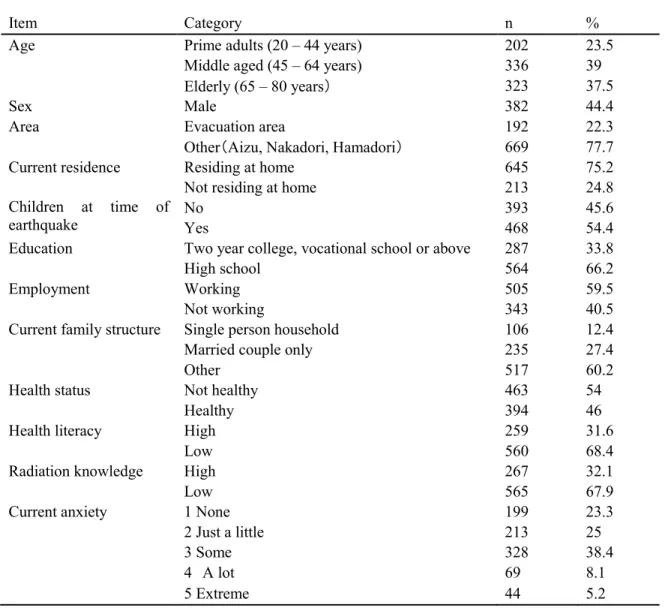
Mean age (years ± SD) of respondents was 56.6 ±14.3 years for males, 56.3 ±15.1 years for females. Mean level of current anxiety was 2.47 ± 1.09. Participant characteristics are summarized in Table 1.
Table 1. Attributes of analyzed respondents
Item Category n %
Age Prime adults (20 – 44 years) 202 23.5
Middle aged (45 – 64 years) 336 39
Elderly (65 – 80 years) 323 37.5
Sex Male 382 44.4
Area Evacuation area 192 22.3
Other(Aizu, Nakadori, Hamadori) 669 77.7
Current residence Residing at home 645 75.2
Not residing at home 213 24.8
Children at time of
earthquake No 393 45.6
Yes 468 54.4
Education Two year college, vocational school or above 287 33.8
High school 564 66.2
Employment Working 505 59.5
Not working 343 40.5
Current family structure Single person household 106 12.4
Married couple only 235 27.4
Other 517 60.2
Health status Not healthy 463 54
Healthy 394 46
Health literacy High 259 31.6
Low 560 68.4
Radiation knowledge High 267 32.1
Low 565 67.9
Current anxiety 1 None 199 23.3
2 Just a little 213 25
3 Some 328 38.4
4 A lot 69 8.1
5 Extreme 44 5.2
For age classifications, there were 202 (23.5%) prime adults (20-44 years), 336 (39.0%) middle-aged respondents (45-64 years), and 323 (37.5%) elderly respondents (65-80 years).
There were 382 males (44.4%). With regard to area, 192 respondents (22.3%) lived in the
evacuation area, and 669 (77.7%) lived in other areas (Aizu, Nakadōri and Hamadōri). Health status was “not so healthy” for 463 respondents (54.0%). The high health literacy group comprised 259 respondents (31.6%). Current anxiety status was “None” for 199 (23.3%), “Just a little” for 213 (25.0%), “Some” for 328 (38.5%), “A lot” for 69 (8.1%), and “Extreme” for 44 respondents (5.2%).
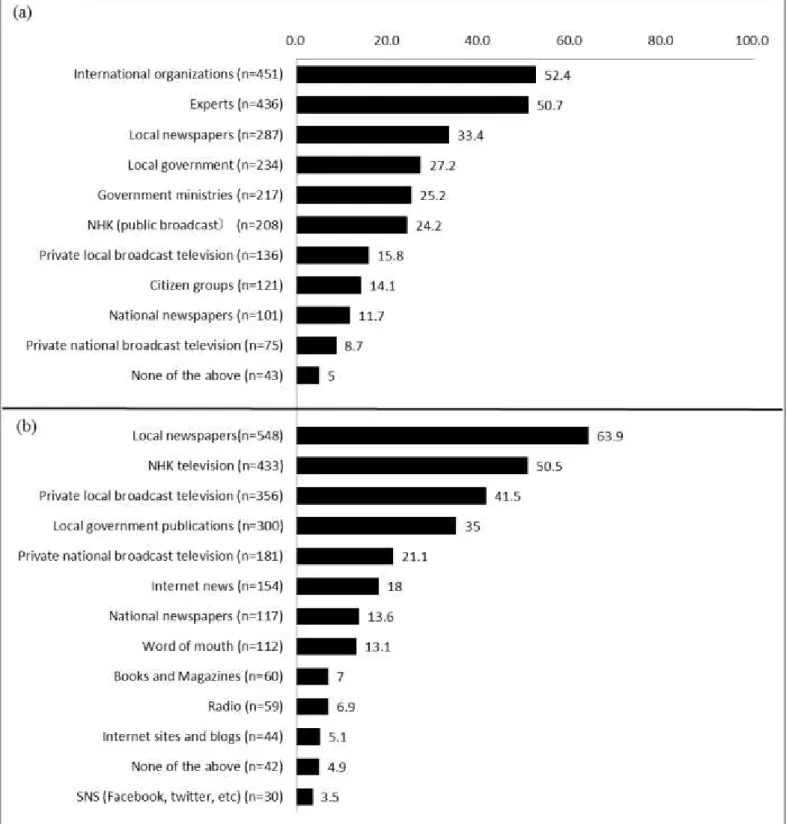
Participants’ trusted sources of information and media sources used by respondents are summarized in (Fig 1).
Fig 1. Proportion of (a) trusted information sources and (b) media used (% n=861)
With regard to trusted sources of information, 52.4% trusted international organizations, 50.7% trusted experts, 27.2% trusted local governments, 25.2% trusted government ministries, and 14.1% trusted citizen groups.
For media sources used by respondents, local newspapers were used by 63.9%, NHK television was used by 50.5%, private local broadcast television were used by 41.5%, word of mouth was used by 13.1%, and internet sites/blogs were used by 5.1%.
Results from the univariate analysis are shown in Table 2.
Table 2. Results of univariate analysis for all items with current anxiety as the response variable
Item Category(n) Mean score
for current anxiety
P value
Age Prime adult (201) vs.
Middle aged (335) vs.
Elderly (317)
2.5 (±1.1) vs.
2.4 (±1.1) vs.
2.5 (±1.1)
Sex Female (473) vs. Male (380) 2.5 (±1.1) vs.
2.4 (±1.1)
Area Evacuation area (189) vs.
Non-evacuation area (664) 2.8 (±1.1) vs.
2.4(±1.1) **
Current residence Residing at home (639) vs.
Not residing at home (211) 2.4 (±1.1) vs.
2.7 (±1.1) **
Children at time of earthquake No (390) vs. Yes (463) 2.4 (±1.1) vs.
2.5 (±1.1) **
Education Two year college, vocational school
or above (406) vs. High school(437) 2.5 (±1.1) vs.
2.4 (±1.1)
Employment Working (503) vs. Not-working (338) 2.4 (±1.1) vs.
2.6 (±1.1) **
Family structure Single (104) vs. Married couple only (234) vs. Other (513)
2.4 (±1.1) vs.
2.6 (±1.1) vs.
2.5 (±1.1) Pre-earthquake residence Own home (713) vs.
Not own home (137) 2.5 (±1.1) vs.
2.4 (±1.1) Relocation to avoid radiation Yes (223) vs. No (587) 2.8 (±1.1) vs.
2.3 (±1.1) **
Social capital (Total of 4 questions) 9 point
or above (749) vs. 8 or below (71) 2.4 (±1.1) vs.
2.7 (±1.2) Participation in local groups No (214) vs. Yes (639) 2.5 (±1.1) vs.
2.5 (±1.1)
Exercise Less than once a week (606) vs.
Once a week or more (238) 2.5 (±1.1) vs.
2.4 (±1.0) Sleep satisfaction Very or fairly dissatisfied (125) vs.
Slightly dissatisfied, satisfied (722) 2.8 (±1.2) vs.
2.4 (±1.1) **
Alcohol consumption Yes (245) vs. No (596) 2.4 (±1.1) vs.
2.5 (±1.1)
Smoking Yes (172) vs. No (672) 2.5 (±1.1) vs.
2.5 (±1.1) Health status Not healthy (456) vs. Healthy (393) 2.7 (±1.1) vs.
2.2 (±1.0) **
Mean total score for health literacy High (257) vs. Low (558) 2.3 (±1.0) vs.
2.5 (±1.1) **
Mean total score for radiation
knowledge High (266) vs. Low (560) 2.3 (±1.0) vs.
2.5 (±1.1) **
Radiation anxiety immediately
after nuclear accident Higher than average (305) vs.
Low (547) 3.3 (±1.0) vs.
2.0 (±0.8) **
Regular health checks at municipality,
workplace Yes (470) vs. No (383) 2.4 (±1.1) vs.
2.5 (±1.1)
Complete physical Yes (142) vs. No (711) 2.4 (±1.0) vs.
2.5 (±1.1)
Individual dosimeter measurement of Yes (86) vs. No (767) 2.7 (±1.0) vs. **
WBC internal radiation measurement Yes (193) vs. No (660) 2.7 (±1.1) vs.
2.4 (±1.0) **
Fukushima Health Management Survey Yes (140) vs. No (713) 2.7 (±1.1) vs.
2.4 (±1.1) ::
Thyroid test field information session Yes (7) vs. No (846) 2.7 (±1.1) vs.
2.5 (±0.8) Local physician lecture on radiation Yes (35) vs. No (818) 2.3 (±1.0) vs.
2.5 (±1.1) Other lecture or information session Yes (60) vs. No (793) 2.5 (±1.1) vs.
2.4 (±1.2) Mean total score for radiation anxiety
(7-item) (Total score) Higher than Average (412)
vs. Lower than average (384) 3.0 (±1.0) vs.
1.8 (±0.8) **
Radiation dose measurement Yes (77) vs. No (765) 3.1 (±1.2) vs.
2.4 (±1.1) **
Avoiding high radiation areas Yes (318) vs. No (514) 2.9 (±1.1) vs.
2.2 (±1.0) **
Attentive to food radiation and
production area Yes (259) vs. No (582) 3.0 (±1.1) vs.
2.2 (±1.0) **
Purchase water Yes (252) vs. No (587) 2.9 (±1.1) vs.
2.3 (±1.0) **
Affected by harmful rumor Yes (499) vs. No (342) 2.7 (±1.1) vs.
2.1 (±1.0) **
Gained something through disaster
experience Yes (443) vs. No (357) 2.6 (±1.0) vs.
2.3 (±1.1) **
Trusted information source International organizations (448) vs.
Not international organizations (404) 2.5 (±1.1) vs.
2.5 (±1.1) Experts (434) vs. No experts (418) 2.5 (±1.1) vs.
2.5 (±1.1) Government ministries (215) vs.
Not government ministries (637) 2.3 (±1.0) vs.
2.5 (±1.1) **
Local newspapers (284) vs. Not
local newspapers (568) 2.4 (±1.1) vs.
2.5 (±1.1) National newspapers (100) vs.
Not national newspapers (752) 2.5 (±1.1) vs.
2.5 (±1.1) NHK (207) vs. Not NHK 2.4 (±1.1) vs.
2.5 (±1.1) Local broadcast TV (136) vs.
Not local broadcast TV (716) 2.3 (±1.0) vs.
2.5 (±1.1) National broadcast TV (74) vs.
Not national broadcast TV (778) 2.4 (±1.2) vs.
2.5 (±1.1) Local government (232) vs.
Not local government (620) 2.3 (±1.0) vs.
2.5 (±1.1) Citizen groups (120) vs. Not
Citizen groups (732) 2.7 (±1.1) vs.
2.4 (±1.1) **
None of the above (43) vs.
Not none of the above (809) 3.0 (±1.3) vs.
2.4(±1.1) **
Media for obtaining information Local newspapers (541) vs.
Not local newspapers (309) 2.4(±1.1) vs.
2.5(±1.1)
National newspapers (116) vs.
Not national newspapers (734) 2.4(±1.1) vs.
2.5(±1.1) NHK TV (427) vs. Not NHK TV(423) 2.4(±1.1) vs.
2.5(±1.1) Private local broadcast TV (355) vs.
Not Privatelocal broadcast TV (495) 2.3(±1.1) vs.
2.6(±1.1) **
Private national broadcast TV (180) vs. Not private national broadcast TV (670)
2.6(±1.2) vs.
2.4(±1.1) Radio (58) vs. Not radio (792) 2.5(±1.1) vs.
2.5(±1.1) Internet news (153) vs.
Not internet news (697) 2.6(±1.1) vs.
2.4(±1.1) Internet sites/blogs (44) vs.
Not internet sites/blogs (806) 2.9(±1.1) vs.
2.4(±1.1) **
SNS (30) vs. Not SNS (820) 2.7(±1.5) vs.
2.5(±1.1) Books and magazines (60) vs.
Not books and magazines (790) 2.7(±1.0) vs.
2.5(±1.1) Local government publications (298) vs.
Not local government publications (552) 2.4(±1.0) vs.
2.5(±1.1) Word of mouth (112) vs.
Not word of mouth (738) 2.8(±1.0) vs.
2.4(±1.1) **
None of the above (42) vs.
Not none of the above (808) 2.5(±1.3) vs.
2.5(±1.1)
** P < .01, * p < .05
Those who were in the evacuation area, as well as those who had relocated to avoid radiation, the subjects dissatisfied with sleep, or responded that they were not so healthy had significantly more anxiety. Significantly lower levels of anxiety were also observed among those living in their own home, those without children, and those who were working, relative to their counterparts who did not live in their own home, those with children, and those who were not working, respectively. Those with high health literacy and that with high radiation knowledge both had significantly lower anxiety.
Significantly higher anxiety levels were noted for those with higher than average anxiety
immediately after the accident, those who underwent individual dosimeter measurement of
external radiation, WBC internal radiation measurement, Fukushima Health Management Survey,
the subjects with higher than average scores for radiation anxiety (7-item), the subjects currently measuring radiation dose, the subjects currently avoiding high radiation areas, the subjects concerned about food radiation and production region, the subjects currently purchasing drinking water, the subjects responding that they were affected by harmful rumor and the subjects responding that they gained something through the earthquake experience.
Based on the trusted source of information about radiation, those who answered that they trusted citizen groups or “ none ” had significantly more anxiety. On the other hand, those who trusted government ministries and local governments had significantly less anxiety. With regard to the type of media used to learn about radiation, those who used internet sites/blogs or word of mouth had significantly more anxiety, but those who used private local television broadcasts had significantly less anxiety.
Questions about the trusted source of information and media used for information about radiation elicited multiple answers from participants (who were instructed to choose three). Thus, variables found to be significant through univariate analysis, i.e., “trust in government ministries,”
“trust in local government,” “trust in citizen groups,” “use of private local broadcast television,”
“use of internet sites/blogs,” and “use of word of mouth,” were applied in different six models to examine their associations with current anxiety levels.
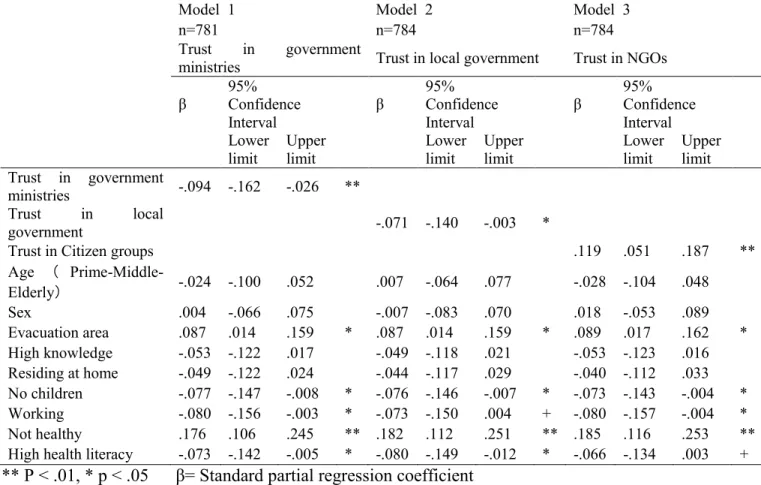
Table 3 shows the results of multiple regression analysis, with current anxiety as the objective variable, and trust in government ministries (Model 1), trust in local government (Model 2), and trust in citizen groups (Model 3) as explanatory variables.
Table 3. Results of multiple regression analysis with current anxiety as the outcome
variable and trusted information source as the explanatory variable
Model 1 Model 2 Model 3
n=781 n=784 n=784
Trust in government
ministries Trust in local government Trust in NGOs
β 95%
Confidence
Interval β 95%
Confidence
Interval β 95%
Confidence Interval Lower
limit Upper
limit Lower
limit Upper
limit Lower
limit Upper limit Trust in government
ministries -.094 -.162 -.026 **
Trust in local
government -.071 -.140 -.003 *
Trust in Citizen groups .119 .051 .187 **
Age ( Prime-Middle-
Elderly) -.024 -.100 .052 .007 -.064 .077 -.028 -.104 .048
Sex .004 -.066 .075 -.007 -.083 .070 .018 -.053 .089
Evacuation area .087 .014 .159 * .087 .014 .159 * .089 .017 .162 * High knowledge -.053 -.122 .017 -.049 -.118 .021 -.053 -.123 .016 Residing at home -.049 -.122 .024 -.044 -.117 .029 -.040 -.112 .033 No children -.077 -.147 -.008 * -.076 -.146 -.007 * -.073 -.143 -.004 * Working -.080 -.156 -.003 * -.073 -.150 .004 + -.080 -.157 -.004 * Not healthy .176 .106 .245 ** .182 .112 .251 ** .185 .116 .253 **
High health literacy -.073 -.142 -.005 * -.080 -.149 -.012 * -.066 -.134 .003 +
** P < .01, * p < .05 β= Standard partial regression coefficient
Those who trusted information released by national government ministries and local government had significantly lower anxiety than those who did not select these sources. Those who trusted information released by citizen groups had a significantly higher level of anxiety compared to those who did not select this source.
Table 4 shows the results of multiple regression analysis, with current anxiety as the objective variable, and use of private local broadcast television (Model 1), use of internet sites/blogs (Model 2), and use of word of mouth (Model 3) as explanatory variables.
Table 4: Results of multiple regression analysis with current anxiety as the outcome
variable and media used as the explanatory variable
Model 1 Model 2 Model 3
n=784 n=782 n=782
Used local broadcast Used internet sites Used word of mouth
β 95%
Confidence
Interval β 95%
Confidence
Interval β 95%
Confidence Interval Lower
limit Upper
limit Lower
limit Upper
limit Lower
limit Upper limit Private local broadcast
television -.090 -.159 -.021 *
Internet sites/blogs .102 .033 .171 **
Word of mouth .048 -.021 .117
Age ( Prime-Middle-
Elderly) -.021 -.097 .056 .000 -.076 .077 -.012 -.088 .064
Sex .000 -.071 .070 .014 -.057 .084 .004 -.066 .075
Evacuation area .078 .005 .151 * .094 .021 .166 * .085 .012 .158 * High knowledge -.053 -.123 .016 -.061 -.131 .009 -.053 -.123 .017 Residing at home -.048 -.121 .025 -.039 -.112 .034 -.047 -.120 .026 No children -.080 -.150 -.011 * -.079 -.148 -.009 * -.072 -.142 -.002 * Working -.081 -.158 -.004 * -.083 -.160 -.007 * -.080 -.157 -.003 *
Not healthy .180 .111 .250 *
* .182 .113 .252 ** .177 .108 .247 * High health literacy -.079 -.148 -.010 * -.071 -.140 -.003 * -.070 -.139 -.001 * *
** p < .01, * p < .05 β= Standard partial regression coefficient
Those who used private local broadcast television had significantly lower anxiety compared to those who did not select this source. Those who used internet sites/blogs had significantly higher anxiety compared to those who did not select this source.
Discussion
This study examined how levels of anxiety about health due to radiation exposure were related to the trusted sources of information about radiation and type of media used for information about radiation among residents in four areas of Fukushima Prefecture.
We found that those who trusted private volunteer organizations such as citizen groups as
information sources had significantly higher anxiety. Those who used internet sites/blogs for
their information on radiation also had significantly higher levels of anxiety. Furthermore, reported anxiety levels were lower in those who trusted the government and local government as a source of information about radiation. Those who used private local broadcast television as a source of information also had significantly lower anxiety.
Multiple regression analysis revealed that those who were in the evacuation area and those who responded that their health status was not so good had significantly higher levels of anxiety.
It is generally known that radiation doses in the evacuation area are relatively high, and that health-related anxiety would be understandably amplified when an individual’s health status is poor. Meanwhile, those with no children, those who are working, and those with higher health literacy scores had significantly lower levels of anxiety on almost all the model.
Limitations
This study has some limitations. First, because of its cross-sectional design, causation could
not be established. For example, it is possible that, rather than anxiety being low because
participants trusted government ministries as a source of information, there were people who
trusted the government as a source of information because their anxiety levels were low. Second,
the respondents may have included a disproportionate number of those inclined to be relatively
more cooperative with a Fukushima Medical University survey. Thus, there may have been
fewer responses from people who do not trust authorities. Third, because respondents tended to
be relatively older, our study population included fewer users of the internet, especially SNS,
which represented a limitation to understanding the actual conditions in this area. Fourth, those
with poor physical or mental health are generally less likely to respond to a survey, which may
have influenced the overall results. Finally, reliability and validity of question items on information sources, media and radiation health anxiety have not been proved yet.
Despite its limitations, the present study is quite novel in that, even though the disaster occurred over seven and a half years ago, no other similar surveys have been published on information and health-related anxiety among the residents of Fukushima (including those in the evacuation area). The response rate was 43%, less than half, but as a recent questionnaire survey on the earthquake in Fukushima it is higher one. In addition, our study explored the association between media and anxiety about radiation with a particular focus on the differences in reporting on Fukushima between the national mass media and local Fukushima mass media.
Implications for Further Study
In this study, it was found that the significant relationship to anxiety varies depending on the sources of trust and media used. There is a possibility that this was caused by the difference between the contents of each information and media reports
In a nuclear disaster, the raw data is difficult for lay people to interpret. People often rely, instead, on the interpretation of others. However, the interpretations of government, local government, mass media, citizen groups and others may differ from one another. Nuclear issues are not just a matter of science, but are sometimes shaped by political factors which influence interpretation. In addition, even the choice of data and information might be different.
There is a possibility that the difference in interpretation and data used will vary
depending on the intended audience. Local mass media responds to the local residents’ demand
and national mass media responds to the people in many parts of the country. In addition, there
are many citizen groups that respond to the demand of those who are not satisfied with the
information coming from sources of authority, including commonly available mass media.
Furthermore, information might be shaped for commercial purposes such as highlighting sensationalism for popular sales. Headlines around the globe indicate that there are many sources of information on the internet that promulgate misinformation, fake news, and harmful rumors[28, 29] along with trusted experts' scientific information [30,31].
People may well need help and guidance identifying reliable sources of information.
Media literacy education, popular in the U.S. [32, 33] may be useful in schools and help prepare the next generation to identify legitimate sources of information. Choosing reliable information from mass media and the internet is critically important for people facing nuclear disaster.
Health literacy is also very important. In this study, those in the upper group of health literacy scores tended to be less anxious. Health literacy is determined by interactions – such as those between scientists and the lay public, between health professionals and patients.
Professionals can improve the health literacy of the public by ‘translating’ health information into everyday language and avoiding jargon and complex mathematical terms.
When nuclear accidents requiring high-level expertise occurred, scientific knowledge and
medical knowledge of media managers, reporters and program makers inside the mass media
institutions proved to be insufficient. At the same time, the scientists and scholars did not focus
on providing information suitable to the public. During and after the Fukushima nuclear power
plant accident, confusion occurred among those reporting through the mass media and
contradictory information was also disseminated [34]. Therefore, the improvement of health
literacy of the mass media and the news organizations is indispensable and could prove to be
effective for dealing with the preparation for and aftermath of disasters. Clear communication
supports informed policy makers, journalists, and communities.
Conclusions
This study selected participants in a nearly random manner from throughout Fukushima Prefecture, including the evacuation area to assess the relationship between resident anxiety and sources of information. We found that levels of anxiety among residents following the Fukushima nuclear disaster were associated with the trusted information source and type of media used.
The Fukushima nuclear power plant accident was the first nuclear disaster since the internet use has become widespread and mainstream. The internet created an overflow of mass reporting and information. A pressing task for our society is to bolster measures that will ensure the release and dissemination of accurate information in such circumstances, and to help users identify accurate information. We hope that the results of this study will be of use in future discussions of how best to convey and consume information when a major nuclear catastrophe occurs somewhere in the world.
Acknowledgements
We would like to express our appreciation to Aya Goto (Professor of Health Information and Epidemiology at Center for Integrated Science and Humanities of Fukushima Medical University), Teruko Horiuchi (Department of Fundamental Nursing, Fukushima Medical University School of Nursing) and Nobuaki Moriyama (Department of Public Health, Fukushima Medical University School of Medicine) for their advice on the survey study.
References
1. Fukushima prefecture. Fukushima Revitalization Station. Available from:
https://www.pref.fukushima.lg.jp/site/portal-english/
2. Ishikawa T, Yasumura S, Ozasa K, Kobashi G, Yasuda H, Miyazaki M, et.al. The Fukushima Health Management Survey: estimation of external doses to residents in Fukushima Prefecture.
Scientific Reports 2015; 5. doi: 10.1038/srep12712
3. Hayano RS, Tsubokura M, Miyazaki M, Satou H, Sato K, Masaki S, et al. Internal radiocesium contamination of adults and children in Fukushima 7 to 20 months after the Fukushima NPP accident as measured by extensive whole-body-counter survey. Proceedings of the Japan Academy Series B. 2013; 89: 157-163. doi: 10.2183/pjab.89.157
4. Tokonami S, Hosoda M, Akiba S, Sorimachi A, Kashiwakura I, Balonov M. Thyroid doses for evacuees from the Fukushima nuclear accident. Scientific Reports. 2012;2:507.
doi: 10.1038/srep00507
5. Science Council of Japan Committee on Clinical Medicine Housyasen bougo risk management bunkakai. Houkoku Kodomo no housyasen hibaku no eikyou to kongo no kadai- gennzai no kagakuteki chiken wo Fukushima de ikasu tame ni. 2017. Available from:
http://www.scj.go.jp/ja/info/kohyo/pdf/kohyo-23-h170901.pdf. [in Japanese]
6. Fukushima Association for Securing Safety of Agricultural Products. Radioactive Material
Inspection Information 2015. Available from: https://fukumegu.org/ok/kome/year/15.
7. Sato O, Nonaka S, Tada J. Intake of radioactive materials as assessed by the duplicate diet method in Fukushima. Journal of Radiological Protection. 2013; 33: 823-828.
8. Fukushima City. 2nd Survey on Radiation Consciousness of Citizens (March 1, 2017).
Available from: http://www.city.fukushima.fukushima.jp/uploaded/attachment/36872.pdf. [in Japanese]
9. Minamisoma City. About the citizen consciousness survey in Heisei 29. Available from:
http://www.city.minamisoma.lg.jp/index.cfm/8,37866,c,html/37866/20171030-093013.pdf. [in Japanese]
10. Bromet EJ. Emotional consequences of nuclear power plant disasters. Health Physics. 2014 Feb;106(2):206. doi: 10.1097/HP.0000000000000012
11. Handford HA, Mayes SD, Mattison RE, Humphrey FJ, Bagnato S, Bixler EO, Kales JD.
Child and parent reaction to the Three Mile Island nuclear accident. Journal of the American Academy of Child & Adolescent Psychiatry. 1986 May 1;25(3):346-56. doi: 10.1016/S0002- 7138(09)60256-9
12. Havenaar JM, Rumyantzeva GM, van den Brink W, Poelijoe NW, Van den Bout J, van
Engeland H, Koeter MW. Long-term mental health effects of the Chernobyl disaster: an
epidemiologic survey in two former Soviet regions. American Journal of Psychiatry. 1997 Nov 1;154(11):1605-7. doi:10.1176/ajp.154.11.1605
13. Bromet EJ, Havenaar JM, Guey LT. A 25 year retrospective review of the psychological consequences of the Chernobyl accident. Clinical Oncology. 2011 May 1;23(4):297-305.
doi: 10.1016/j.clon.2011.01.501
14. Uno K. Teisenryou housyasen wo koete. (Beyond low dose radiation) Tokyo: Syougakkan;
2013.140. [in Japanese]
15. Kasperson RE, Renn O, Slovic P, Brown HS, Emel J, Goble R. et.al. The social amplification of risk: A conceptual framework. Risk Analysis. 1988; 8: 184.
doi: 10.1111/j.1539-6924.1988.tb01168.x
16. Wahlberg AAF, Sjoberg L. Risk perception and the media. Journal of Risk Research. 2000;
3: 39. doi: 10.1080/136698700376699
17. Renn O, Burns WJ, Kasperson JX, Kasperson RE, Slovic P. The social amplification of risk:
Theoretical foundations and empirical applications. Journal of Social Issues. 1992;48:152-54.
doi: 10.1111/j.1540-4560.1992.tb01949.x
18. Vasterman P, Yzermans CJ, Dirkzwager AJ. The role of the media and media hypes in the
aftermath of disasters. Epidemiologic reviews. 2005;27:107-14. doi: 10.1093/epirev/mxi002
19. Sugimoto A, Nomura S, Tsubokura M, Matsumura T, Muto K, Sato M, et al. The relationship between media consumption and health-related anxieties after the Fukushima Daiichi nuclear disaster. PLOS ONE. 2013;8:e65331. doi: 10.1371/journal.pone.0065331.t005
20. Kanda R, Tsuji S, Yonehara H. Text analysis of radiation information in newspaper articles headlines and internet contents after the Fukushima Nuclear Power Plant accident.Hoken Butsuri.
2014;49(2):77-78. [in Japanese with English Abstract] doi: 10.5453/jhps.49.68
21. Friedman SM. Three Mile Island, Chernobyl, and Fukushima: An analysis of traditional and new media coverage of nuclear accidents and radiation. Bulletin of the Atomic Scientists.
2011;67: 55-65. doi: 10.1177/0096340211421587
22. Endo K. What Is "Journalism" in the Age of Inter-mediality?: Based on the Survey on the 3.11 Great Earthquake and the Accident of Fukushima Nuclear Plant. Japan Science Support Foundation 2013; 1:15-25. [in Japanese].
23. Murakami M, Nakatani J, Oki T. Evaluation of Risk Perception and Risk-Comparison
Information Regarding Dietary Radionuclides after the 2011 Fukushima Nuclear Power Plant
Accident. PLOS ONE. 2016;11:e0165594. doi: 10.1371/journal.pone.0165594
24. Rubin GJ, Amlôt R, Wessely S, Greenberg N. Anxiety, distress and anger among British nationals in Japan following the Fukushima nuclear accident. The British Journal of Psychiatry.
2012:bjp-p. doi: 10.1192/bjp.bp.112.111575
25. Vyncke B, Perko T, Van Gorp B. Information sources as explanatory variables for the Belgian health-related risk perception of the Fukushima Nuclear Accident. Risk Analysis. 2017;
37: 577-578. doi: 10.1111/risa.12618
26. Nutbeam D. Health literacy as a public health goal: a challenge for contemporary health education and communication strategies into the 21st century. Health promotion international.
2000 Sep 1;15(3):259-67.
27. Ishikawa H, Nomura K, Sato M, Yano E. Developing a measure of communicative and critical health literacy: a pilot study of Japanese office workers. Health promotion international.
2008;23(3):269-74. doi: 10.1093/heapro/dan017
28. Tateno S, Yokoyama HM. Public anxiety, trust, and the role of mediators in communicating risk of exposure to low dose radiation after the Fukushima Daiichi Nuclear Plant explosion.
Journal of Scientic Communication.2013;12(2):1-22.
29. Ochi S. Processing Scientific Knowledge for the Media. In Communicating with residents about risks following the Fukushima nuclear accident. Asia Pacific Journal of Public Health.
2017; 29(2_suppl): 83S-84S. doi: 10.1177/1010539516681841
30. Perko T, Mays C, Valuch J, Nagy A. Mass and new media: review of framing, treatment and sources in reporting on Fukushima. J. Mass Commun. Journalism. 2015; 5: 252.
doi:10.4172/2165-7912.1000252
31. Nakagawa K, Tamari Y, Miyagawa R. What really occurs at Fukushima. Rayonnements Ionisants, Techniques de Mesures et de Protection. 2016:18-23. Available from:
https://inis.iaea.org/search/searchsinglerecord.aspx?recordsFor=SingleRecord&RN=48039824.
32. Hobbs R, Jensen A. The past, present, and future of media literacy education. Journal of media literacy education. 2009;1(1):1. Available from:
https://digitalcommons.uri.edu/jmle/vol1/iss1/1/
33. Thoman E, Jolls T. Media literacy—A national priority for a changing world. American Behavioral Scientist. 2004 Sep;48(1):18-29. doi: 10.1177/0002764204267246
34. Yasumura S . 47. Measures to be Taken. Yasumura S and Kamiya K (eds.). Public Health in
a Nuclear Disaster Message from Fukushima . Hiroshima; Hiroshima University Press, 2014
p401-402
Fig 1. Proportion of (a) trusted information sources and (b) media used(% n=861)
Health and Information Survey
August 15, 2016 1. Which of the following best describes your physical condition in the last month?
Please select one and mark with “○.”
1. Extremely good 2. Very good 3. Good 4. Fair 5. Not healthy
2. Regarding your lifestyle,
(1) How many times a month do you exercise or play sports on average? Please select one and mark with “○.”
1. Never 2. 1 to 3 times 3. 4 to 7 times 4. 8 to 15 times 5. More than 15 times
(2)Are you satisfied with the quality of your sleep (regardless of length) in the past month? Please select the most appropriate response and mark with “○.”
1. Satisfied 2. Slightly dissatisfied 3. Very dissatisfied 4. Very dissatisfied (I could not sleep at all)
(3)Do you drink alcohol every day? Please select one and mark with “○.”(*Two small cans for beer, one go (180 mL) for sake, 0.7 go for shochu, and two small cups or more for whiskey/wine)
1. Yes 2. No 3. I used to drink, but I quit
(4)Do you currently smoke cigarettes almost every day? Please select one and mark with “○.”
1. Yes 2. No 3. I used to smoke, but I quit
3. Have you participated in the following health check-ups, seminars, or explanatory meetings since the Great East Japan Earthquake? Please select and mark with “○” (multiple answers allowed).
1. Regular municipal/workplace health check-ups
2. Other health check-ups (e.g., complete physical examination) 3. Individual dose assessment of external radiation using a dosimeter 4. WBC internal radiation measurement
5. Fukushima Health Management Survey 6. Thyroid test field information session 7. Local physician lecture on radiation 8. Other lectures or information sessions
4. Regarding radiation anxiety,
(1)Just after the Tokyo Electric Power Fukushima Daiichi Nuclear Power Plant accident (hereinafter, nuclear accident), how anxious did you feel about the impact of radiation on your health? Please select the most appropriate response and mark with “○.”
1. Not at all 2. Only a little 3. Somewhat 4. Very 5. Extremely
(2)How uneasy do you feel about the impact of radiation on your health now? Please select the most appropriate response and mark with “○.”
1. Not at all 2. Only a little 3. Somewhat 4. Very 5. Extremely
5. Do you think you can find and use information on diseases and health on your own if you need it? Please read each statement and mark the most appropriate response with “○.”
I do not think so at all
Somewhat
disagree I can not
say either Somewhat
agree Strongly agree 1. You can collect information from various
sources such as newspapers, books, and
the Internet. 1 2 3 4 5
2. You can pick out information you want
from among a lot of information. 1 2 3 4 5
3. You can understand the information and
tell people. 1 2 3 4 5
4. You can determine how reliable the
information is. 1 2 3 4 5
5. Based on the information, you can decide plans and actions for health
improvement. 1 2 3 4 5
6. For each of the following sentences, please put a ○ in the ( ) if you think “it is correct,” × if you think “it is not correct,” or △ if you are unsure.
1. Once the body receives radiation, it remains in the body.………( )
2. According to international standards, as the exposure dose of radiation increases, the higher the probability of dying from cancer..………( )
3. In the surveys on the health effects of the second and third generation of atomic bomb survivors in
Hiroshima and Nagasaki, genetic influences were not found.………( ) 4. Once damaged by radiation, the DNA (the body of the gene) of cells cannot be repaired.………( ) 5. According to government standards for radioactive materials, the radioactivity level of general food items should not exceed 100 Becquerel per kg.………( )
7. Now, we ask you about the influence of radiation caused by the nuclear accident, what you experienced, and how you feel about it. Please read each statement below and mark the most appropriate response with “○.”
I do not think so at all
Somewh at disagree
Somewh
at agree I strongly think so 1. I am worried I might suffer from serious diseases due
to the influence of radiation in the future. 1 2 3 4
2. Every time my condition gets worse, I become anxious about
radiation exposure. 1 2 3 4
3. I am worried that the influence of radiation will be inherited to the next generation, such as my children and
grandchildren. 1 2 3 4
4. Looking at reports on nuclear power plant accidents, I
become very anxious. 1 2 3 4
5. Because I lived in an area with supposedly high radiation doses, I am worried for myself as well as my children that we might be discriminated against (e.g., receive unfair treatment).
1 2 3 4
6. I try not to talk to people as much as possible about being a
local resident of the area. 1 2 3 4
7. I have experienced conflicting opinions with my family about
the effects of radiation on health. 1 2 3 4
8. Have you adopted the following behaviors since the occurrence of nuclear accident? For each item, please mark the most appropriate response with “○.”
No I used to, but I quit Yes
1.Measure radiation doses 1 2 3
2.Avoid high radiation areas 1 2 3
3.Be attentive to food radiation and production area 1 2 3
4.Purchase water 1 2 3
9.Do you feel you can trust information on radiation based on the source of information (e.g., organization, group, or people)? Please choose 3 sources from the below list that you would trust and mark with “○.”
1. International organizations
2. Experts from universities, academic institutions, and others 3. Government ministries
4. Local newspapers (Fukushima Minpo and Fukushima Minyu) 5. National newspapers (Yomiuri, Asahi, Mainichi, and others) 6. NHK
7. Private local broadcast television (FTV, FCT, KFB, TUF) 8. Private national broadcast television
9.Local government
10 Private volunteer groups such as NGOs 11. None of the above
10. What are your sources of information on radiation? Please choose 3 out of the following responses and mark with “○.”
1. Local newspapers 2. National newspapers 3. NHK television
4. Private local broadcast television 5. Private national broadcast television 6. Radio
7. Internet news (Yahoo, etc.)
8. Internet sites and blogs other than news 9. SNS (Facebook, Twitter, LINE, etc.) 10. Books and magazines
11.Local government publications
12. Word of mouth (friends and acquaintance) 13. None of the above
11. Has the damage caused by the harmful rumor affected your life?
1. No 2. Somewhat 3. Yes If you answered 2 or 3, please provide specific details.
12. While it goes without saying that the Great East Japan Earthquake disaster is characterized by significant negative experiences, have you gained something from those experiences?
1. No
2. Yes(Please provide specific details.)
13. Finally, we ask you about yourself and basic matters concerning your home and family. There are questions related to your private life, but they are necessary in order to obtain accurate results. We thank you in advance for your contribution.
1)Please tell us your sex and age.
1. Male 2. Female ( )years
2) Which of the following best describes your current family status? Please select one and mark with “○.”
1. Single household (only yourself) 2. Couple-only household 3. Couple and unmarried children household 4. Household of unmarried children and you 5. Third generation family 6. Other
3)What is the highest educational qualification that you have completed? Please select one and mark with “○.”
1. Junior high school 2. High school 3. Junior college/vocational school 4. University/graduate school 4)Which of the following is your current residence? Please select one and mark with “○.”
1. Owned house 2. Rented house or apartment 3. Temporary housing 4. Government subsidized housing 5. Public housing 6. Home of friend/relative 7. Other
5)Which of the following was your residence before the disaster? Please select one and mark with “○.”
1. Owned house 2. Rented house or apartment 3. Home of friend/relative 4. Other ( )
6)Have you and your family moved from your original address to avoid radiation?
1. Yes 2. We moved for other reasons 3. No If you selected 3, please skip 7).
7) If you selected 1 or 2 in 6), please choose one of the following responses and mark with “○.”
1. I and my family moved together 2. Only I moved 3. Only some family members moved
4. My family members and/or I evacuated immediately after the earthquake but quickly returned
8)At the time of the Great East Japan Earthquake, did your family have a child/ren or pregnant woman?
Please circle all that apply.
1. We had a child(ren) under age 18 2. We had a child(ren) over age 19 3. (Female only) I was pregnant 4. We had a pregnant woman 5. None
9) Are you currently working? Please select one and mark with “○.” (Even if you are a househusband or housewife, if you are currently working part-time, etc., please select “Working.”)
1. Working (include self-employed and part-time workers) 2. I am on leave
3. Not working (student, househusband/wife, job seeker)
10)How do you think about people in your area you live in? Please read each statement and mark the most appropriate response with “○”.
I do not think so at all
Somewhat
disagree I can not
say either Somewhat
agree Strongly agree 1. People living in the area help
each other. 1 2 3 4 5
2. I can trust people living in the area. 1 2 3 4 5
3. People living in the area greet
each other. 1 2 3 4 5
4. If problems occur in the area, people work together to try to resolve the
problems. 1 2 3 4 5
11)Are you enrolled in the following organizations or groups?
Please mark as many responses as appropriate with “○.”
1. Neighborhood association · resident association
2. Regional groups such as youth group, women’s association, elderly association, PTA, child association (training group)
3. NPO, volunteer/citizen activity organization, co-operative association
4. Vocational organizations such as business association, peer association, industry group, labor union, etc.
5. Other( ) 6. No
◇ Please provide any additional comments below.
Thank you for your cooperation.
健康と情報についての調査
平成28年8月15日 1. 最近1か月間のあなたの身体的な健康状態は次のどれにあたりますか。最もあてはまるもの
1つに○を付けてください。
1 きわめて良い 2 とても良い 3 良い 4 まあまあ 5 不健康
2.あなたの生活習慣について
(1)汗がでるくらいの運動やスポーツを、1カ月に平均何回くらいしましたか。1つ選んで○を付け てください。
1 していない 2 1~3回 3 4~7回 4 8~15回 5 15回より多い
(2)あなたは、ここ1か月間、(睡眠の長さに関わらず)睡眠の質に満足していますか。最もあては まるもの1つ選んで○を付けてください。
1 満足している 2 少し不満 3 かなり不満 4 非常に不満か、全く眠れなかった
(3)あなたは、お酒・アルコール*を毎日飲んでいますか。1つ選んで○を付けてください。(*ビ-ルな ら小缶で2本、日本酒なら1合、焼酎なら0.7合、ウイスキ-・ワインなら小グラス2杯、以上)
1 はい 2 いいえ 3 以前飲んでいたが、やめた
(4)現在、ほぼ毎日、たばこを吸っていますか。1つ選んで○を付けてください。
1 吸っている 2 吸っていない 3 以前吸っていたが、やめた
3.あなたは東日本大震災以後に、以下のような健康診断や講習会・説明会を受けましたか。
あればいくつでも○をつけてください。
1 自治体・職場が行う定期健康診査
2 1に該当しない健康診断(人間ドックなど)
3 個人線量計による外部被ばく線量(ガラスバッジ)の測定 4 内部被ばく線量(ホールボディカウンター)の測定 5 県民健康調査における健康診査
6 甲状腺検査出張説明会(保護者や教員向けに医大医師が学校に出張して説明会を実施)
7 市町村主催の放射線関連の講演会・地元の医師による放射線や甲状腺をテーマとした講演会等
4.放射線に関する不安について
(1)東京電力福島第一原子力発電所の事故(以下、原発事故とします)が起きた直後、あなたの 健康への放射線の影響について、どのくらい不安を感じましたか。最もあてはまるもの1つ に○を付けてください。
1 全くない 2 少ししかない 3 いくらか 4 たくさん 5 非常に
(2)現在、あなたの健康への放射線の影響について、どのくらい不安を感じますか。最もあてはまる もの1つに○を付けてください。
1 全くない 2 少ししかない 3 いくらか 4 たくさん 5 非常に
5.もし必要になったら、病気や健康に関連した情報を、自分自身で探したり利用したりすること ができると思いますか。それぞれの文章を読んで、最もあてはまるもの1つに○を付けてくだ さい。
全くそう 思わない
ど ち ら か と い え ば そ う 思 わ ない
ど ち ら と も 言 え な い
ど ち ら か と い え ば そう思う
強 く そ う思う 1 新聞、本、インターネットなど、い
ろいろな情報源から情報を集められ
る。 1 2 3 4 5
2 たくさんある情報の中から、自分の
求める情報を選び出せる。 1 2 3 4 5
3 情報を理解し、人に伝えることがで
きる。 1 2 3 4 5
4 情報がどの程度信頼できるかを判
断できる。 1 2 3 4 5
5 情報をもとに健康改善のための計
画や行動を決めることができる。 1 2 3 4 5
6.以下の文章で「正しいと思う」ものに○を、「正しくないと思う」ものに×を、どちらか「分から ない」ものには△を( )の中にご記入下さい。
1 放射線を一度身体に受けるとその放射線はずっと体内に残る。………( )
2 国際的な基準では、放射線の被ばく量が多いほど、そのためにガンで死亡する確率も高くなる という考え方が採用されている。………( )
3 広島、長崎の原爆被ばく者の二世、三世の健康影響に関する調査では、遺伝的影響は
認められていない。………( ) 4 放射線でいったん傷ついた細胞のDNA(遺伝子の本体)は修復することができない。…( ) 5 政府による放射性物質の基準値では一般食品は1kgあたり100ベクレルを超えないように
設定されている。………( )