Sustainable management for small R&D‑oriented manufacturing firms
著者 Tomisawa Osamu, Hashimoto Michio page range 349‑353
year 2008
URL http://hdl.handle.net/10173/340
Abstract— Despite the fact that small to medium sized enterprises play an important role in the Japanese economy, these companies have severe problems with respect to corporate sustainability. We have investigated a small company called
“Haneron” in detail. This company was founded as a technology oriented manufacturing company and it has survived more than 30 years. The company developed strength in the area of mixed technology of analog, digital and mechatronics in the early stage of start-up. The case study shows that so-called diversification in product/market expansion grid is effective if existing technology is applied to new products. Also, the case study shows that the strategy to keep corporate size relatively small and to change business model in response to environmental and market changes is a key factor for the organization to survive. An engineering management approach for corporate sustainability was discussed and a hypothetical model to describe organization survival was proposed.
Index Terms—Business, Management, Product development, Research and development management,
I. INTRODUCTION
Small to medium sized enterprises have played an important role in the Japanese economy. The number of these enterprises is more than 99% of the total number of Japanese plants or offices. About 64% of employees belong to these companies. It was generally said that the variety of activities of small to medium companies is the source of economic vitality. It used to be said that small companies are much like big companies, except that small businesses have lower sales, smaller assets, and fewer employees. J. A. Welsh, however, mentioned that a small business is not a “little big business”, as opposed to the traditional assumption [1]. Many small manufacturing companies are subcontractors and Ulla Lehtineninvestigated subcontracting as a modern form of manufacturing and clarified the phenomena of subcontracting as a part of supply chain management concept [2]. He also classified subcontractors into four basic groups: part supplier, component supplier, specialist supplier and system supplier. He analyzed the growth of the subcontractors and suggested that the evolution was promoted by increasing their span of operation and adding new kinds of process and material purchasing.
Osamu Tomisawa is with Kochi University of Technology, Tosayamada, Kami, Kochi, Japan
Michio Hashimoto is with Haneron Inc. Osaka Japan
This work was supported in part by The Special Subsidies in Subsidies for ordinary expenses of private schools from The Promotion and Mutual Aid Corporation for Private Schools of Japan.
However, in the long recession period since the burst of the
“bubble economy” in Japan, small corporations have had a difficult time facing changes both in financing and transaction structure in globalization. In this environment, small corporations have been encouraged management innovation, but a few were successful. D.J. Story addressed to pursue the fact that close down ratio of small business is higher than big business [3]. Statistics shows that the ratio of closing down of small companies is around 5.5 %, whereas the ratio of new venture creation is less than 4% in Japan. Matsushima mentioned that obstructions to venture growth are financing, people, and change of economic environment [4]. Yoo proposed a 4-stage process model of venture growth and analyzed growth of venture companies from the view point of strategy [5].
Larry E. Greiner analyzed evolution and revolution in the growing process of organization [6]. He described size of organization as a function of age of organization. He identified a series of developmental phases through which companies tend to pass as they grow. Each phase begins with a period of evolution and ends with substantial organization change.
According to Greiner, the task for management in each revolutionary period is to define a new set of organizational practices that will become the basis for managing the next period of evolutionary growth. N. Churchill, on the other hand, proposed a framework of growth stage using size, dispersion and complexity as one dimension and company maturity as a second dimension [7].
It is important to find a solution to venture company growth problems. However, we believe it is also important to find a way to survive without increasing size of organization. In other words, find a way of management for corporate sustainability while keeping constant organization size. In this paper, we will discuss corporate sustainability from view point of technology management.
II. OBJECTIVES
We will discuss basically a technology oriented small manufacturing company. Here are a few research questions to be answered for corporate sustainability. They are:
1) Is it possible to manage a corporation long enough without increasing size of corporation and sales volume? What has to be changed for sustainability?
2) What is the key issue for sustainable management for a small technology oriented corporation?
3) What technology can be the core competence of the company?
Osamu Tomisawa, Fellow IEEE, and Michio Hashimoto
Sustainable management for small
R&D-oriented manufacturing firms
The objectives of this investigation are to find key factors for corporate survival in the light of technology management.
III. CASE STUDY
We selected Haneron Inc. for the case study. This is a small manufacturing company located in Osaka. It is a typical technology oriented venture company in Japan. The founder used to work for a big manufacturing company as an engineer, then left the company and established a private corporation. The company has survived longer than 30 years, overcoming a number of difficult economic situations in Japan. The history of the company can be divided into five stages, from the birth of the company to the present. Each stage is 4 to 7 years long. The first stage was establishment of private company during which several products were developed and manufactured as custom products. After 7 years of producing these custom products, the founder established Haneron Inc. in factory automation equipment business. The company changed its business model to OEM in the third stage. When the factory automation system business declined, the company again started to develop its own products in stage 4, and moved eventually, to an original brand business in stage 5. The products and system developed during stage 1 to 5 are all technology oriented products and had specific commonalities in the fundamental technology. Products developed in each stage are as follows:
A. Stage 1: Establishment of one-man enterprise
The founder of the company originally worked for the big corporation which fabricated a variety of electric and electronics products including home appliances and semiconductor devices. He worked specifically in the development of control circuits in the R&D department. After 5 years experience in the company, he left the company and prepared for 3 years to establish a private one-man enterprise.
The corporate mission was to develop and manufacture electronic control instruments. In this stage he developed five major products as custom products responding to requests from his customers.
1) Automatic seal engraver
His first business after retirement from a big company was to develop an automatic seal engraver. This machine is for registered personal seal which is used in Japan for official documents in place of signature. A registered seal is regulated by law to be unique in order to be distinguished from others with same name, otherwise the seal can not be registered. The machine captures a handwritten signature image by a photo sensor through a microscope and engraves the seal material by a caver. The signature image and the seal material are mounted on rotators which are synchronized with each other by a pulley.
The carver, consisting of a chisel and solenoid plunger, engraves the seal material point by point, resulting in a unique seal.
2) Electronic Relay Controller (sequence controller)
He received an order for a small size sequence controller from a chemical company when a customer planned to extend his fabrication line. A state-of-the-art controller was constructed using large relay devices with AC 100V specification, timers, counters, and temperature sensors. He developed an input circuit board with bipolar transistors to handle analog circuits, and a control circuit board with digital integrated circuit called TTL. An output circuit board was developed utilizing bipolar transistors for driving the power-relay. Noise immunity was a key issue for the relay controller which is operated in chemical production facility with a severe electric noise environment.
Another issue with the controller was that every product was a custom design dedicated to specific customers. He came up with the idea of system configuration with a standard circuit board and portion of customer specific function. However this was not implemented at that time because a bigger competitor came in with the same idea.
3) Nut runner controller
This product was an air powered nut fastening system controller for automobile engine assembly lines. The system controls torque utilizing signal sensed from strain gauges. Since automobile manufacturers had engines with a different number of nuts, the nut runner controller was divided into mother machine and children units so that it can be applied flexibly as a multi axis system.
4) Security system for explosive warehouse
This system was for explosive warehouses located in mountain areas. If any one warehouse is broken into, alarm is sounded in the administration office. This was a wired system and a pair of wires was connected among all the warehouses.
Low power consumption was a must because the system operates on batteries. It is outdoor system and it has to be moisture-proof.
This was to provide a low cost system solution to manage explosive warehouses. Actually, the same system has been produced for 30 years without any design change.
5) Calculator test tool (automated key hitter)
He started development of an automated key hitter for a calculator function test system in response to a request from a calculator company. This replaced manual input by human operators, resulting in productivity improvement.
B. Stage 2: Establishment of Haneron Inc. and fabrication of factory automation equipment
The private one-man enterprise was concerned with development and manufacturing of custom electronic controllers for 7 years in the early stage. When the founder got an order to develop a automated test system for customer’s calculator production line, he established Haneron Inc., and hired 4 people. Since the system is closely connected to the fabrication line, he dispatched two engineers to the customer for joint cooperative effort.
In this phase, the new company developed and manufactured;
1) automated assembly line controller and test system for calculator, 2) Silicon wafer tester, 3) final tester for calculator, 4) Liquid crystal display device tester, 5) Automatic adjuster for electronic thermometer, and so on.
The final tester for calculators utilized the automated key hitter which had been developed in stage 1.
C. Stage 3: Change to OEM business model
Specification of the automatic test system for electronic calculators depended strongly on a specific customer and it was difficult to extend this business to other customers as a generic product. Another issue was that customer specific production generally required extremely short delivery time. So the Haneron top management decided to change their business model to OEM. He utilized past human networks and entered PLC (program logic controller) OEM business for automobile industry. The company had some knowledge of the automobile industry through the experience with the nut runner. Also the company had the strength to handle high-variety low-volume manufacturing. So the company decided to start OEM business for PLC, specifically I/O portion of PLC.
D. Stage 4: Development of new business opportunity Factory automation was the back bone of Haneron’s business.
However, almost all industry including factory automation business had had a hard time since the burst of the bubble economy and wave of globalization in early 1990’s. Almost all stable OEM business in factory automation was gone, and the company had to find new business opportunities. This was similar situation in the early stage of the company. The company developed an artificial dialysis machine, but the business was not successful because of insufficient experience in this field. The 2nd trial was a test system for TFT liquid crystal display for color TVs. The project was joint cooperative effort between Hanelon and a big company. Other projects include a controller for home use elevators and an automobile tracking system. The fleet tracking system consists of a control center and terminals. The center system locates vehicles and gives instructions according to changes in schedule. The center and vehicles are connected through packet net works. This project was a forerunner of an original branded product.
E. Stage 5: Creating original brand
The company developed a product called DMA (Data Mail Adaptor ) under it’s own brand. The concept of DMA is to utilize a mail system to send control data in the form of e-mail text. The company had accumulated know-how and knowledge about packet communication through OEM experience.
NTT-DoCoMo, a big mobile communication company in Japan had a strategy to expand a packet communication service for machine to machine data communication. Hanelon considered that the remote control system could be simplified by combining packet communication network and internet technology.
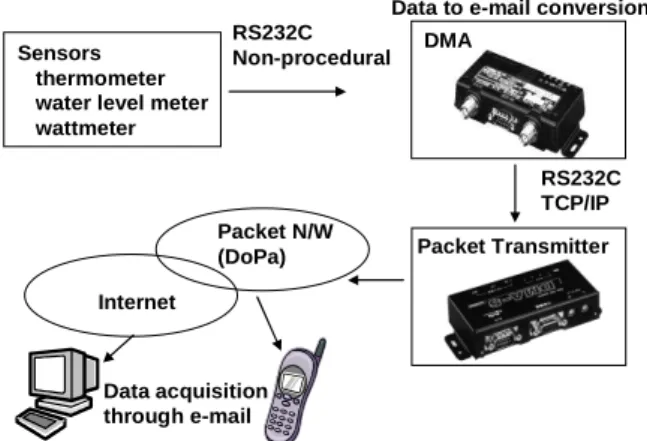
The remote control or remote monitoring system shown in Fig.1 is composed of sensors, DMA products and terminals.
The DMA receives text data from external sensors and transforms the text data into e-mail format with SMTP protocol and sends out the e-mail through the packet transmitter, packet network and internet. Reversely, it is also possible to control machines by e-mail received with POP protocol from a mail server.
Sensors thermometer water level meter wattmeter
RS232C Non-procedural
RS232C TCP/IP DMA
Packet Transmitter Packet N/W
(DoPa) Internet
Data to e-mail conversion
Data acquisition through e-mail
Fig. 1. Remote surveillance system using the Data Mail Adaptor concept
Since the packet network (DoPa) is linked to the internet, the e-mail containing the data is sent to a PC which is connected to the internet. The e-mail containing the data can be received through a cellular phone. Therefore a remote monitoring system, which sends data captured from remote sensors and remote equipment to a PC or cellular phone through packet network and internet, can be implemented. This concept provides a simple and low cost solution to remote monitoring system.
Haneron had sufficient experience of measurement, controlling, communication, both in software and hardware, in the area of factory automation system. However, the company did not have experience with respect to network protocol, so formed an alliance with big mobile communication company, which helped verification in the field.
IV. ANALYSIS OF THE CASE
A. Technology point of view
Fig.2 shows the relationship between the products from the view point of technology. The fundamental skill set was a combination of analog, digital and mechatronics technologies, which supported the company’s qualitative growth from stage 1 to stage 5. During Stage 1, i.e. early period of private one-man enterprise, the company developed many products. A key factor that supported these products development was analog, digital and mechatronics technologies. The company established the core competence of integrating these three technologies.
Know-how on noise immunity, which is crucial to analog-digital mixed circuits, was accumulated through the development of electronic relay products. Development of the nut runner product helped to foster the technology to handle a variety of custom products by introducing the concept of a combination of mother board and child units. Allthe technology developed
Non-procedure data conversion Packet commu- nication Mechatronics
Image capture Torque cont.
Seal engraver Analog ckt.
Digital ckt.
Mechatronics Electric relay
Noise immunity
Torque cont.
Sensor DC amplifier
Nut runner
Mother unit++++ children units Low power
Moisture-proof Cable wiring Security system
for explosive warehouse
System solution
Key hitter Calculator
tester
image capture
Calculator Assembly/test
line cont.
Wafer tester for calculator
Final tester for calculator
LCD tester
auto collection mechatronics Image capture
Thermometer
Program logic controller
Crane truck safety cont.
Data Mail Adapter Standard board
+ specific boards Semi-custom design
Electronic relay
FA test system
Analog, digital, mechatronics technology
Custom controller
Establishment of Haneron inc.
one-man enterprise
Custom FA equipment/
tester
FA・・・・tester
manufacturing Remote surveillance artificial dialysis
measurement equipment
(
(
(
(failure)))) TFT LCD display device
tester Home elevator
cont.
Car tracking system
OEM business autonomous biz
I/O cont.
I/O link Communication cont.
Stage 1 Stage 2 Stage 3 Stage 4
Stage 5
Fig2. Technology relevancy of products developed in Haneron Inc.
during Stage 1 contributed to development of the automated test system for the calculator production line in Stage 2. Joint effort with the customer was a good opportunity for Haneron to develop tacit knowledge regarding the test system in the customer’s manufacturing facility. In Stage 2, technology for capturing images, mechatronics and microprocessor application technology were integrated into the calculator function test system. In stage 3, Haneron manufactured I/O peripheral sub-systems in program logic controllers for an automobile production line. The I/O units feature a variety of specification depending on the customer, and the company had experience of handling high-variety low-volume manufacturing. Packet communication technology was also introduced in Stage 3. The corporation’s experience in the custom control system product business was longer than 25 years, providing it an opportunity to get in to original brand business utilizing the core competence established through stage 1 to stage 3.
A. Size of organization
The founder of Haneron had a policy with respect to corporation growth. He controlled size of organization keep the appropriate. He also controlled corporate business size to around 10 million dollars. He preferred to manage R&D activities by himself and to have complete responsibility for his products from their birth to the end of life, until stage 2. Small organization size was an advantage to this management style.
Churchill [7] suggested corporation development by 5 Stages;
existence, survival, success, take-off, and resource maturity. If a company stays at the survival stage, it can have enough customers and it can satisfy them sufficiently with its products or services to keep them. The organization can be simple and decision making can be quick. The issue is whether it generates enough cash to stay in business and to finance to earn a return.
V. IMPLICATION FROM THE CASE STUDY
A. New product strategy
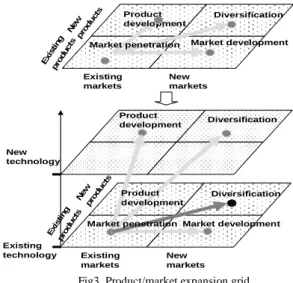
The well-known Ansoff’s matrix is constructed by market axis and product axis, and provides four types of strategy [8].
That is to say, market penetration in existing markets with existing products, new market development with existing products, new product development for existing markets, and diversification into a new market with a new product. The fourth strategy is typically implemented by M&A, otherwise it is considered to be risky unless the company has something in common with current business. However, the case study shows that the company was successful in using diversification strategy. It developed a wide variety of products and succeeded in business. A new product does not always utilize new technology. So, if we divide new product and new technology, Ansoff’s matrix can be modified to a three dimensional matrix by adding another technology plane as shown in Fig.3. Haneron Inc. has strength in this common technology, which is a combination of “Analog, Digital and Mechatronics”. A diversification strategy utilizing existing technology can be considered to be effective for small manufacturing companies.
Existing markets
New markets Existing
products New
products
Existing technology
New technology
Market development Diversification
Market penetration Product development Existing
markets
New markets Existing
products New
products
Market development Diversification
Market penetration Product development
Product
development Diversification
Fig3 Product/market expansion grid
B. Modification of Greiner’s organization growth model Greiner’s growth model is shown by the straight grey line in Fig.4., under the assumption that a company must grow and pass through all stages of development. Churchill included dispersion and complexity factors in addition to size, and also took early stage problems into account. Churchill’s model is shown by dotted grey line in the Fig.4. Both models assume corporate growth.
Our understanding is that the biggest issue for a small start-up, or small venture company, is organization sustainability rather than growth in terms of size and sales volume. To keep employment is also important issue. If we take this position, we can modify Greiner’s growth model. Instead of going through stages of revolution, we can choose strategically to keep constant business size. This is also shown in Fig. 4.
creativity autonomy
direction control
red tape coordination
collaboration
Size of Organization
small large
young Age of Organization mature
Phase 1 Phase 2 Phase 3 Phase 4 Phase 5 evolution
revolution after Greiner
One-man enterprise
Sub-contracting Custom
product OEM Existing biz +new market Constant size model
after Churchill “?”
leadership
delegation
Original brand Autonomous business
Fig.4 Corporate survival model and growth model
The example of Haneron indicates that a corporation has to change its business model in order to survive, even if size of organization is kept same. The company started as one-man enterprise, then, subcontracted for manufacture of custom
products, then moved to an autonomous business model with own original brand. This is considered to be something like metamorphosis of enterprise.
VI. CONCLUSION
Statistics shows that a problem for small business is corporate sustainability rather than corporate growth. A typical small technology oriented manufacturing company which has survived more than 30 years was investigated. The company changed its business model in response to environmental and market changes. Starting from a one-man enterprise that developed and manufactured custom roducts, the founder established a corporation to handle custom FA systems. Then he changed the business model to OEM, utilizing strength to handle high-variety low-volume manufacturing. Again he tried to escape from the subcontractor business, and finally established an autonomous business with original branding.
Through almost every stages, he took a diversification strategy with new products and new markets. The case study shows that so-called diversification in Ansoff’s matrix is effective if existing technology is used for new products. Also the case study shows that the strategy to keep corporate size relatively small and to change a business model in response to environmental and market changes is a key factor for survival.
The company changed its business model but kept mixed technology of analog, digital and mechatronics as a core competence. An engineering management approach for corporate sustainability was discussed and a hypothetical model to describe organization survival was proposed.
REFERENCES
[1] John A. Welsh and Jerry F. White, “A Small Business Is Not a Little Big Business”, Harvard Business Review, July-August, 1981
[2] Ulla Lehtinen, “Changing Subcontracting – a study on the evolution of supply chains and subcontractors”, Academic Dissertation, University of Oulu, Nov. 2001.
[3] D. J. Storey, “Understanding the Small Business Sector”, Thomson Learning Eyrope , 1994
[4] Katsumori Matsushima, “ Management on Technology”, Nikkei BP, 2004.(in Japanese)
[5] Jae Sang Yoo, “A study of Strategy for venture – The process model of ventures’ growth from strategizal approach, The bulletin of Niigata University of International and Information Studies, Oct. 2003
[6] Larry E. Greiner, “Evolution and Revolution as Organizations Grow”, Harvard Business review, May-June 1998
[7] Neil C. Churchill and Virginia L. Lews, “The Five Stages of Small Business Growth”, Harvard Business Review, May-June, 1983 [8] Ansoff “Corporate Strategy “, McGraw-Hill, Inc. 1965.