Introduction
It is well established that good mental health is a basic factor for a person to experience enjoyment in their life. Maintaining good mental health involves the following three abilities: (1) honestly expressing individual feelings (psychological well being); (2) appropriate analysis of situations and being able to cope with everyday problems (intellectual well being);
and (3) building good relationships with others (social well being).
In particular, recent studies report that it is also important for a person to find out the aim and significance of their own life and that they be able to choose their own life (human well being). Accordingly mental health has a major impact on quality of life.
Some reports1-3) indicate that there are multiple factors which influence mental health, including (1) individual disposition and ability; (2) physical condition; (3) socio-economic conditions such as dwelling, place of work, relationships with others etc.
In particular, individual social well being such as life
management consists of the following traditional elements (1) adequate exercise; (2) balanced nutritional intake; (3) rest, plus two more recently identified factors (4) dental health and (5) mental health.
It is suggested that smoking and frequent consumption of alcohol are not simply isolated dependencies but have come to be regarded as two examples of symptoms of the broad mental disorder covered by the term addiction, which also encompasses stalking, gambling and overeating.
Furthermore, having a sufficient social environment and the opportunity for social activity plays an essential role in maintaining a healthy mind.
The first objective of this survey was to inquire into the residents' current well-being, mental health and the social support resources in Toon City. The second objective of the survey was to provide the foundation for planning new health promotion activities involving social supports focusing on improving life satisfaction in Toon City.
A survey into social well-being amongst residents of Toon City aged between 20 and 64
Focused on the individual life satisfaction and social support
Yayoi TERANISHI
1), Kanako YAMAUCHI
2), Hiromi MORI
3), Isao SAITO
4)and Tadahiro KATO
5)1
) Graduate School of Education, Ehime University
2
) Center for Cooperative Research and Development, Ehime University
3) Graduate School of Medicine, Ehime University
4
) Department of Public Health, Ehime University Graduate School of Medicine
5) Center for Education and Educational Research, Ehime University
(平成22年6月5日受理)
Basic Resident Register and access to this information as digital data stored on portable media.
Our study received permission from Ehime University's Ethical Committee of Etiology to access the electronically stored personal information in the Basic Resident Register maintained by the local government of Toon City.
The second author (Kanako Yamauchi) applied to the local government of To-on City for permission to access electronically stored personal information in the Basic Resident Register maintained by the local government of Toon City for the purpose of delivering our questionnaire based on the dual requirements that the researcher, Kanako Yamauchi, was (1) the recipient of a Grant-in-Aid for Scientific Research (Category C) from the Japan Society for the Promotion of Science (Project number 21590696,
Kanako Yamauchi, research period 2009 to 2013, Factors affecting the mental health, ADL and QOL of elderly residents-a cohort study over a 13 year period. and (2) had Research Permission from Ehime University's Ethical Committee of Etiology.
(2) Study Design and Participants
We selected at random 2000 people between the ages of 20 and 64, and provided them with a questionnaire and a self-addressed envelope.
Results
(1) Respondent rate of questionnaire
Table 1 shows a respondent rate of our survey. Men comprised 37.8 percent (453/1200) and women 47.6 percent (381/800) of the Toon survey's respondents –which classified sex-and age-group.
Table 1. Respondent rate
Men Women
Distribution Respond Respondent rate(%) Distribution Respond Respondent rate(%)
20-29 300 86 28.7 200 69 34.5
30-39 300 90 30.0 200 81 40.5
40-49 240 96 40.0 160 77 48.1
50-59 240 104 43.3 160 103 64.4
60-64 120 77 64.8 80 51 63.8
Total 1200 453 37.8 800 381 47.6
(2) Demographic characteristics
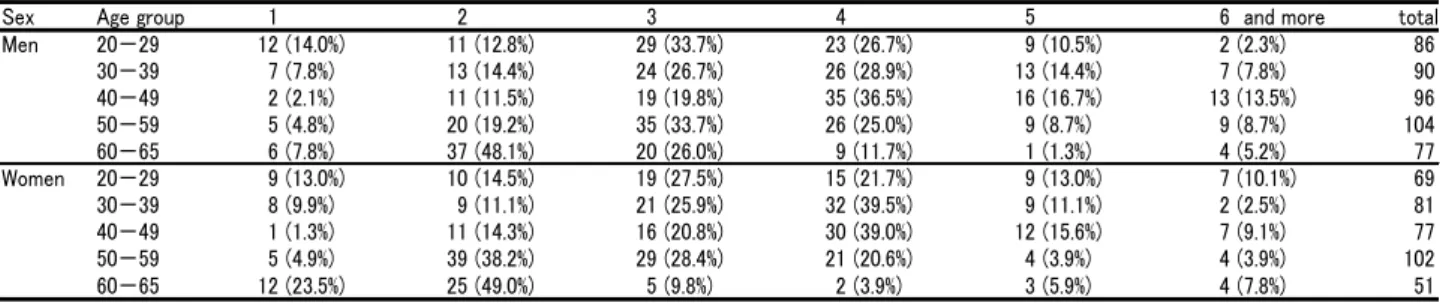
Table2 shows that respondents' family members who live together in the same household.
We carried out a questionnaire based survey into trends in family structure in Toon City.
Table 2. Family structure
The each number in horizontal six blanks - from one to six or more in Table 2 - demonstrates that of respondents' family members.
(3) Life satisfaction
We calculated individual life satisfaction based on the Life Satisfaction K items developed by Koyano et al10).
Figure 1 shows the average value of life satisfaction K according to sex and age.
Fig 1. The score of Life satisfaction K
(4) Social support
Figure 2 shows that men's social supports (psychological assistance and practical assistance) from either family members
Fig 2. The scores of men's social supports (psychological assistance and practical assistance) from either family members (See-Appendix questions of social support developed by Noguchi et al, which scores were distributed from zero to eight point)
Figure 3 shows that men's social supports (psychological assistance and practical assistance) from friends
Figure 4 shows that women's social supports (psychological assistance and practical assistance) from either family members
Fig 4. The score of women's social supports (psychological assistance and practical assistance) from either family members
Figure 5 shows that women's social supports (psychological assistance and practical assistance) from friends
Fig 5. The score of women's social supports (psychological assistance and practical assistance) from friends.
Figure 6-9 show the men's average value of psychological assistance and practical assistance according to sex and age.
Fig 6. The score of men's practical assistance (one of social supports) from either family members
Fig 7. The score of men's psychological assistance (one of social supports) from either family members
Fig 8. The score of men's practical assistance (one of social supports) from friends.
Fig 9. The score of men's psychological assistance (one of social supports) from friends.
Fig 10-13 show the women's average value of psychological assistance and practical assistance according to sex and age.
Fig 10. The score of women's practical assistance (one of social supports) from either family members
Fig 11. The score of women's psychological assistance (one of social supports) from either family members
Fig 12. The score of women's practical assistance (one of social supports) from friends.
Fig 13. The score of women's psychological assistance (one of social supports) from friends.
Approximately 60 percent of men and 70 percent of women have various kinds of social support resources in the form of family members they live with. If we look at the figures which separate psychological assistance and practical assistance it shows that men and women receive a great deal of psychological assistance from family members.
Discussion
It is well known that there is a close relationship between individual life satisfaction and social support-which also related to stress. The influence stress has on an individual is alleviated by support
structures such as spouse, family members, friends, place of work and neighborhood. Accordingly, although it is important for individuals to obtain the understanding and cooperation of those around them, local government can also play an important role in managing the social support systems which answer the needs of people suffering from stress. When the amount of stress can be kept within manageable limits, individuals can avoid the worst effects of stress.
For men, the average value of life satisfaction K increases with age, peaking in their fifties. However, the value K begins decreasing between the ages of 60 and 64, returning to the same levels as men in their twenties.
It is our view that as men in their twenties have only just started work they will encounter a number of unfamiliar circumstances. In their thirties and forties men have families and have achieved a level of stability in their jobs, and as a result their level of life satisfaction K increases. A large number of men in their fifties have achieved a level of success and social status however between 60 and 64 years old, as a result of retirement, men's level of life satisfaction K drops.
In contrast to men, women's life satisfaction K peaks during their twenties, and then the average value decreases with age. Between the ages of 20 and 50 the average value of life satisfaction K for women is higher than that of men, however it is notable that the level of life satisfaction K for men increases during their fifties whilst for women the level drops suddenly. It is believed that the reason for this difference is that men enjoy a rewarding social position in their fifties, while women face menopause
of both psychological and practical assistance.
Respondents in their twenties who have just entered the workforce depend on family members, especially parents, not only for psychological support but also practical assistance. The percentage of social support received from friends is 30 percent or less.
However, the percentage of psychological assistance is 50 percent for men, while it is 80 percent for women. Most women tend to receive a great deal of psychological assistance from friends. In other words, women get psychological assistance from friends rather than from family members.
Whereas women receive psychological assistance from friends as well as family members, men tend to depend only on family members for psychological support from.
Neither men nor women receive practical assistance from friends. Furthermore, the level of social support from friends tends to decrease with age, and the key to conducting health promotion to build up the concrete measure how public health nurses have the elderly to participate in the health and welfare services provided in To-on City
Measurement of the level of life satisfaction K includes asking the following question Do you look back on your life with a sense of satisfaction? ” According to the theory of life-cycle described by Erickson11), the concept of integrity is highly important in the elderly, and people who maintain integrity are more likely to answer positively the question about looking back. People who do not maintain this sense of integrity are apt to respond to the question negatively, and have a low level of life satisfaction. There is a concern that a low level of life satisfaction in people in their sixties has a potential
create less stressful socio-economic circumstances, occupational environments, urban environments, and residential environments in order to establish the social framework for a high quality of individual life satisfaction and social supports.
References
1) Yayoi Teranishi, Kanako Yamauchi, Hiromi Mori, Isao Satio, Tadahiro Kato (2010) Health condition of people aged between 20 and 65 in Toon City. Bulletin of The Center for Education and Educational Research The Faculty of Education Ehime University. Vol. 28 ( in press)
2) Kuriyama Shinichi, Nakaya Naoki, Ohmori- Matsuda Kaori, Shimazu Taichi, Kikuchi Nobutaka, Kakizaki Masako, Sone Toshimasa, Sato Fumi, Nagai Masato, Sugawara Yumi, Akhter Munira, Higashiguchi Mizuka, Fukuchi Naru, Takahashi Hideko, Hozawa Atsushi, Tsuji Ichiro. (2009) Factors associated with psychological distress in a community-dwelling Japanese population: the Ohsaki Cohort 2006 Study. J Epidemiol. 19(6): 294-302.
3) Nakaya Naoki, Kakizaki Masako, Ohmori-Matsuda Kaori, Shimazu Taichi, Kuriyama Shinichi, Fukao Akira, Tsuji Ichiro. (2009) Personality and gastric cancer screening attendance: a cross- sectional analysis from the Miyagi Cohort Study.
J Epidemiol,19(1). pp 34-40
4) Lin Yingsong, Nakachi Kei, Ito Yoshinori, Kikuchi Shogo, Tamakoshi Akiko, Yagyu Kiyoko, Watanabe Yoshiyuki, Inaba Yutaka, Tajima Kazuo. (2009) Lack of association between serum transforming growth factor-beta 1 and cancer mortality risk in a nested case-control study in Japan. Asian Pac J Cancer Prev, 10(2) pp 273- 278.
5) Whitlock Gary, Lewington Sarah, Sherliker Paul, Clarke Robert, Emberson Jonathan, Halsey Jim, Qizilbash Nawab, Collins Rory, Peto Richard
(2009) Body-mass index and cause-specific mortality in 900000 adults: collaborative analyses of 57 prospective studies. Lancet. 373(9669) pp1083-1096.
6) Kikuchi Nobutaka, Ohmori-Matsuda Kaori, Shimazu Taichi, Sone Toshimasa, Kakizaki Masako, Nakaya Naoki, Kuriyama Shinichi, Tsuji Ichiro (2009) Pain and risk of completed suicide in Japanese men: a population-based cohort study in Japan (Ohsaki Cohort Study). J Pain Symptom Manage 37(3) pp316-324.
7) Ikehara Satoyo, Iso Hiroyasu, Date Chigusa, Kikuchi Shogo, Watanabe Yoshiyuki, Wada Yasuhiko, Inaba Yutaka, Tamakoshi Akiko (2009) Association of sleep duration with mortality from cardiovascular disease and other causes for Japanese men and women: the JACC study.
Sleep. 32(3) pp295-301.
8) Hozawa Atsushi, Kuriyama Shinichi, Kakizaki Masako, Ohmori-Matsuda Kaori, Ohkubo Takayoshi, Tsuji Ichiro (2009) Attributable risk fraction of prehypertension on cardiovascular disease mortality in the Japanese population: the Ohsaki Study. Am J Hypertens. 22(3) pp267-272. 9) Pham Truong-Minh, Fujino Yoshihisa, Mikami
Haruo, Okamoto Naoyuki, Hoshiyama Yoshiharu, Tamakoshi Akiko, Matsuda Shinya, Yoshimura Takesumi (2009) Reproductive and menstrual factors and thyroid cancer among Japanese women: the Japan Collaborative Cohort Study. J Womens Health (Larchmt), 18(3), pp331-335. 10) Wataru Koyano Correlates of Happiness in Old
Age: Covariance Structure Model Analysis of National Survey Data Sociological Theory and Methods Vol. 8 (1993) , No. 2 pp111-125.
11) Sidney J. Blatt, Ph.D. and Rachel B. Blass (1990) Attachment and Separateness-A Dialectic Model of the Products and Processes of Development Throughout the Life Cycle. Psychoanalytic Study of the Child. 45 pp107-127.
Appendix
The questionnaire's items of Life Satisfaction K
Q33 Please answer the following questions based on your feelings, without thinking about each question too deeply.
1. Do you think that you have had more opportunities in life than other people?
1.Yes 2.No
2. Do you think that you are as healthy this year as you were last year?
1.Yes 2.No
3. Do you think that you dwell on matters too deeply?
1.Yes 2. No
4. Do you think that you have achieved most of what you wanted to achieve in life?
1.Yes 2.No
5. How often do unhappy events occur in your day to day life?
1.Rarely 2. Sometimes 3.Frequently
6. Do you think that life is very hard?
1.Yes 2.No
7. Do you think that you worry about little, unimportant matters more than you used to?
1.Yes 2.No
8. As a person, do you feel less useful than you once were?
Social supports questionnaire's items developed by Noguchi et al
Q32 Do you have family members or friends who help you when you face the situations described below?
Q32-1. Do you have family members you can talk to when you are worried about something?
1.Yes 2.No
Do you have friends you can talk to when you are worried about something?
1.Yes 2.No
Q32-2. Do you have family members who take care of you if you are sick for more than a couple of days?
1.Yes 2.No
Do you have friends who take care of you if you are sick for more than a couple of days?
1.Yes 2.No
Q32-3. Do you have family members with whom you have a very good relationship?
1.Yes 2.No
Do you have friends with whom you have a very good relationship?
1.Yes 2.No
Q32-4. Do you have family members who are supportive of you?
1.Yes 2.No
Do you have friends who are supportive of you?
1.Yes 2.No
Q32-5. Do you have family members who if necessary would lend you a considerable sum of money?
Q32-6. Do you have some family members who take it comfortable with you?
1.Yes 2.No
Do you have friends you always feel comfortable spending time with?
1.Yes 2.No
Q32-7. Do you have family members who help you at home and look after the house while you are out?
1.Yes 2.No
Do you have friends who help you at home and look after the house while you are out?
1.Yes 2.No
Q32-8. Do you have family members who nurse you and help you with housework when you are sick for an extended period of time ?
1.Yes 2.No
Do you have friends who nurse you and help you with housework when you are sick for an extended period of time ?
1.Yes 2.No