• 検索結果がありません。

Background information about POGO and its approach to capacity development

N/A
N/A
Protected

Academic year: 2021

シェア "Background information about POGO and its approach to capacity development"

Copied!
10
0
0

読み込み中.... (全文を見る)

全文

(1)

Background information about POGO and its approach to capacity development

The Partnership for Observation of the Global Ocean (POGO) has, over the last 15 years, developed a large portfolio of training programmes aimed primarily at early-career scientists from developing countries, and focussing on the topic of observational oceanography. POGO was founded in 1999 by directors of oceanographic institutions around the world as a forum to promote and support the observation of the global ocean. POGO’s membership includes most of the world’s leading ocean science and technology institutions. One of the reasons for the creation of POGO was to address the large gaps in geographical coverage of the Global Ocean Observing System (GOOS), in partnership with the Intergovernmental Oceanographic Commission (IOC). From its inception, POGO recognised that, to fill these gaps, and in particular to address the paucity of measurements in the Southern Hemisphere and in the coastal waters of most developing countries, it would need to assist these countries in developing the skills, expertise, infrastructure and institutional capacity required to conduct routine ocean observations, make the data freely available, produce models and forecasts for societal applications, and use the resulting data and products to inform policy. POGO’s Strategy emphasizes training as one of the three pillars of its Mission: (1) to lead innovation and development of the crucial components of the ocean observing system; (2) to identify and contribute to the development of the key skills, capabilities and capacities needed to achieve a global ocean observing system; and (3) to work with governments, foundations and industry, to articulate the benefits to society and required funding to build and sustain the system.

POGO training programmes

The first step in capacity building for POGO was the establishment of a Visiting Fellowship program.

This program was initially run in collaboration with the Intergovernmental Oceanographic Commission (IOC) and SCOR, but has continued since 2006 as a joint POGO-SCOR programme. Under this program, scientists from developing countries can spend up to three months receiving one-to- one training and supervision in ocean observations at a major oceanographic institution (usually, but not necessarily in a developed country). By 2021, 177 young scientists from 36 countries have been trained in this programme.

In 2005, POGO partnered with the Nippon Foundation (NF) to set up new initiatives in capacity building. The NF was established in 1962 as a non-profit philanthropic organisation, active both in Japan and abroad, with a strong interest in the marine environment. This collaboration started with the NF-POGO Visiting Professorship (VP) Program under which scientists visited a developing country to conduct training in ocean observations. Coupled with the training, funds were invested in the purchase of equipment that would facilitate the establishment of a new observing system. Visiting Professors were sent to India, Sri Lanka, Vietnam, Fiji, Tunisia and Brazil, between 2005 and 2007. In that short time, a total of 122 scientists from 26 different countries were trained.

In 2008, this program was replaced by the NF-POGO Centre of Excellence (CofE) in Observational

Oceanography, now the flagship of POGO training. Under this program, ten young scientists, mostly

from developing countries, are supported each year to study for ten months in an intensive program

related to ocean observations. The first phase of the CofE (2008- 2012) was hosted at the Bermuda

Institute of Ocean Science (BIOS) and the second phase is currently hosted at the Alfred Wegener

Institute (AWI) in Germany (from 2013). Twelve cohorts, totalling 120 students from 46 countries,

(2)

have attended the CofE to date

1

. An intensive training course is conducted in conjunction with the CofE, in a different country every year, and is often hosted by an alumnus of the CofE. The 2-3 week long “Regional CofE” has focused on specific topics related to ocean observations, with a strong focus on practical skills, and generally including a mini-research project component. The goals and outcomes of the Regional CofE are similar to those of the VP programmes. From 2009 to date

1

, 159 trainees from 28 countries have benefited from this programme. Networking has always been a priority in the NF-POGO partnership, and this led to the creation of the NF-POGO Alumni Network for Oceans (NANO), of which the alumni of all NF-POGO programmes are invited to become members.

Meanwhile, POGO continued a VP programme on a more modest scale than the NF-POGO one, which included teaching in Argentina, Namibia, Vietnam, Sri Lanka, Brazil and South Africa. The training courses generally lasted for 2-3 weeks and provided funding for travel and subsistence only.

A major expectation of this scheme was that the host institute would contribute towards the costs (e.g. provide accommodation/subsistence for the professor, provide laboratory consumables, some travel support for the trainees). In several cases, the POGO funding was used to leverage support from other local or international sources, and in one case additional funding was obtained from SCOR to allow students from further afield to participate. Training has been provided to 122 trainees from 26 countries through this programme.

One of the first priorities of POGO was to support the Austral Summer Institute (ASI) at the University of Concepción, Chile, as part of its strategy to expand ocean observations in the Southern Hemisphere. POGO provided travel support for participants, mostly from Latin America, to attend the ASI from 2001 to 2014.

In total, over 1000 young scientists from 90 countries have received advanced training under POGO training program. But what have been the results of all the training provided? What has been the

“return” on the investment made by POGO and its partners? To evaluate their success in providing training that has resulted in sustained capacity building, POGO and SCOR developed a series of on- line questionnaires aimed at (1) the past trainees, (2) the “providers” of the training (i.e., supervisors and instructors), and (3) the institutions with which the trainees were affiliated. The results from these questionnaires are presented below, as well as some conclusions drawn from these results.

Survey design

Several months were spent carefully devising the questions and optimising them in order to extract the most useful information while making the survey “attractive” to the recipients. For the questionnaire aimed at past trainees, a group of NANO alumni were consulted during a side event of the Second GEO Blue Planet Symposium in May 2015. The recommendations from that meeting on the optimal design of a questionnaire (from the point of view of the trainee/respondent) were as follows:

The questionnaire should be:

- Easy to understand (English not being the first language of most trainees) - Easy to answer

1
Data correct as of June 2021

(3)

- Brief

- Objective/quantitative (categories, multiple choice) but providing some space for additional comments at the end of the survey

- Online, with the possibility to save and return to it later (recognition of email address) and the option to answer anonymously.

To encourage the trainees to respond, it was suggested to include a short introduction explaining the importance of the feedback to the organisations that provided the training. Another suggestion was to test the questionnaire to provide an estimate of how long it would take to be completed. The survey was designed following these recommendations, then it was tested by the same alumni and additional feedback was incorporated. Most of them commented that the survey was straightforward and quick to respond to (ten minutes or less).

All three surveys were created using the on-line platform SurveyMonkey®. They were set up using an

“e-mail collector”, which allowed recipients to respond only through a link they received via e-mail.

This option was chosen to prevent duplicate or unwanted responses. This also allowed respondents to return to the survey later, without needing to set up an account and remember a password. In some cases people responded for the “wrong” programme, for example a programme that a trainee had attended less than 5 years previously, or a programme that an instructor was involved in managing rather than teaching. In one case duplicate responses were submitted. All invalid responses were deleted from the system prior to downloading and analysing the data. Errors in the training programme attended and the year of the training were detected and rectified by cross- checking the responses against our database. In summary, while on-line surveys are very powerful tools, human verification of responses is essential, although of course this cannot be done with anonymous responses.

Survey structure Survey of supervisors

This was much simpler and shorter than the trainees’ survey. The aim was to evaluate the benefits the training “providers” derived and whether the training led to continued collaboration with the students.

The survey consisted of a few background questions (name, institute, country, position, programme taught, year of training, number of students) followed by questions on whether they had kept in touch with the students, and if so why and how frequently, and which benefits they had derived from the teaching experience.

Trainees’ survey

The survey consisted of a number of background/demographic questions (name, programme attended, year of training, age at time of training) followed by several questions aimed at evaluating the impacts of the training, divided into the following categories:

1. Immediate impacts of the training on the student in terms of knowledge and skills gained, direct impacts on education and job prospects, enhanced networking/collaboration opportunities).

2. Longer-term impacts that have led to their current position.

(4)

3. Impacts on the wider scientific community at the trainee’s home institute (knowledge transfer leading to sustained capacity building).

4. Products resulting from the training (publications, presentations, etc).

We also asked whether the respondents were still living in their home country and, if so, whether they had been living there the entire time since the training. For those who were living abroad or had spent some time abroad we asked how many years, and for those who were still living abroad we asked if they intended to return. The objective was to assess whether the training was unintentionally contributing to “brain drain” of qualified young scientists away from their home countries.

Survey of institutions

The survey consisted of some personal information (name, institute, country, position) followed by some multiple-choice questions on how the capacity building had benefited the institute, as well as the country and region. They were also asked whether their institute had benefited from the capacity building programmes of other international organisations (and which ones) and if so, whether the training had been complementary with POGO’s programmes. The aim of this part of the survey was to establish which organisations POGO should be working closely with to ensure complementarity of our capacity building programmes.

Data analysis

The data were sorted by training programme using the “compare” option in SurveyMonkey® before exporting. This allowed direct comparisons to be made between the different training programmes to assess whether there were differences in the training impacts depending on the type and duration of training.

For the questions that involved providing a score between 1 and 5, a weighted mean score was calculated separately for each program, as well as for all responses irrespective of program attended.

Results

Survey of supervisors

The questionnaire was sent to 142 recipients, and responses were received from 39 of these (27%

response rate). The benefits derived by the supervisors are summarised in Table 1.

How have you benefited from providing the training? 1 = lowest, 5 = highest relevance or accuracy of statement

Weighted mean

The training improved my teaching skills 4.57

The training was a good addition to my CV 2.50

The training satisfied a requirement of my employment contract or grant 1.83 The training provided personal satisfaction or enjoyment 4.71 The training provided an opportunity for me to visit a different country or institution 3.50

The training broadened my cultural horizons 4.57

The training helped to advance one or more of my research projects 3.50

The training resulted in one or more research publications 3.57

(5)

The training led to an oral or poster presentation at one or more conferences 4.43

The training led to continued research collaborations 4.71

The training led to another visit or exchange of a student or instructor 4.71

Table 1. Weighted mean score (out of 5) given to different positive benefits derived by the training providers.

Survey of trainees

This survey was sent to 359 past trainees from 6 training programmes who received the training between 2001 and 2012. A total of 154 complete responses were recorded (a 44% response rate). Of these, 41 respondents had attended the NF-POGO VP program, which was a slightly lower than average response rate of 39%.

The average age of the respondents at the time of the training was 32 for the NF-POGO VP program (versus 28 for the CofE, 30 for the ASI, 32 for the NF-POGO Regional CofE and and 33 for the POGO- SCOR fellowships).

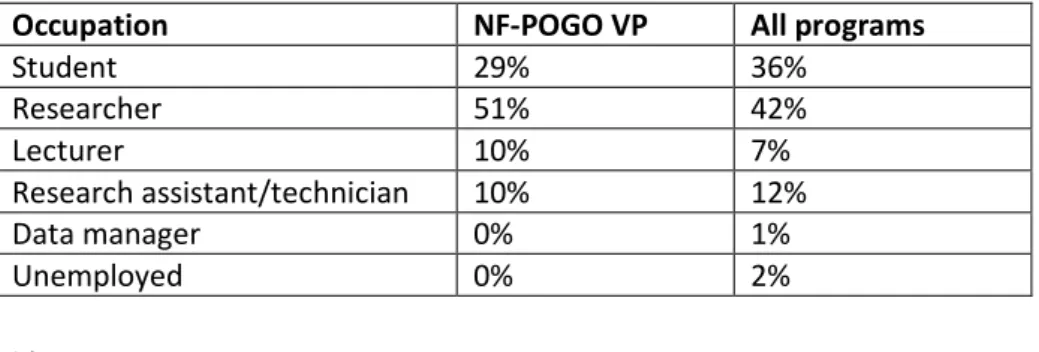
The most common occupation at the time of the training was Researcher for the NF-POGO VP (51%) as well as across all programs (42%), followed by Student (29% and 36%, respectively), as shown in Table 2a. The highest qualification of the respondents at the time of the training also followed the same pattern for the NF-POGO VP respondents compared to all respondents, with around half having a Master’s, a quarter having a Doctorate and the other quarter having only a Bachelor’s (see Table 2b).

a)

Occupation NF-POGO VP All programs

Student 29% 36%

Researcher 51% 42%

Lecturer 10% 7%

Research assistant/technician 10% 12%

Data manager 0% 1%

Unemployed 0% 2%

b)

Qualification NF-POGO VP All programs

Bachelor’s degree 19% 20%

Master’s degree 59% 53%

Doctorate 22% 27%

Table 2(a) Occupations of respondents at the time of the training, and (b) highest qualification of the respondents at the time of the training, comparing in both cases the respondents who participated in the NF-POGO VP program with the results across all program respondents.

A very high percentage of the NF-POGO VP respondents were currently living in their home country

(90%), which was exceeded only by the NF-POGO Regional Training Program (100%). Of these 90%,

81% had spent the entire time since the training in their home country. Unsurprisingly, the lowest

percentages were recorded for the programs that promote mobility (i.e., training in a foreign

(6)

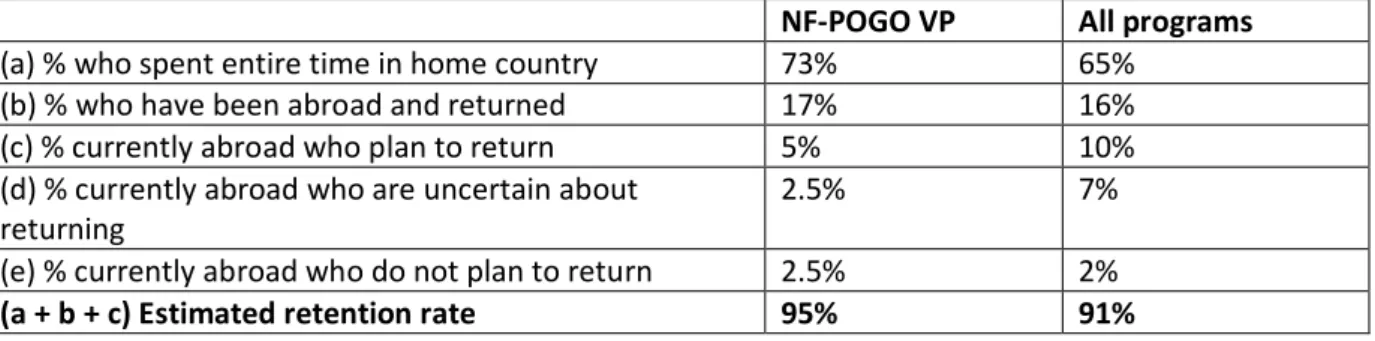
country) and networking, i.e. the NF-POGO CofE (68%) and the POGO-SCOR fellowships (73%), although looking across all programs the percentage of respondents still living in their home country was still high (81%) (see Table 3). Out of the VP respondents who were currently living abroad, half indicated that they intended to return to their home countries and a quarter were uncertain. Table 3 provides an estimated “retention rate” of trainees by the home country, calculated as the percentage of trainees who (a) never left their country + (b) left and then returned to their home country + (c) have left their country but intend to return. This was very high for the VP program (95%) but also high (91%) across all programmes (including those that promoted mobility).

NF-POGO VP All programs

(a) % who spent entire time in home country 73% 65%

(b) % who have been abroad and returned 17% 16%

(c) % currently abroad who plan to return 5% 10%

(d) % currently abroad who are uncertain about returning

2.5% 7%

(e) % currently abroad who do not plan to return 2.5% 2%

(a + b + c) Estimated retention rate 95% 91%

Table 3. Mobility of the respondents after the training and estimated “retention rate” assuming that (1) those who are abroad and plan to return do return to their home countries, and (2) those who are uncertain or do not plan to return, do not return to their home countries.

In terms of the impacts on the trainees’ careers, the categories that received the highest scores were the same for the NF-POGO VP and across all training programmes (see Table 4). These were:

• “The training enabled me to participate in new research projects”, and

• “The training enabled me to implement new techniques, use new equipment and/or use new software/models that were previously unavailable at my institute”,

• “I have continued to collaborate with scientists I met during the training (e.g., supervisor, instructor, or other trainees)”.

The lowest scores were received for:

• “The training allowed me to obtain a position (work or study) outside my home country”,

• “The training enabled me to get a job in my home country”, and

• “The training allowed me to get a promotion in my current job or to find a different job in my home country” .

Within 5 years of receiving the training, do you believe the training had a positive effect on your education/career, in any of the following ways? 1 = lowest, 5 = highest relevance or accuracy of the statement

NF-POGO VP All programs

The training allowed me to enroll in a graduate course (M.S. or Ph.D.) in my home country

2.76 2.75

The training helped me finish my masters or Ph.D. degree 3.00 3.23 The training enabled me to get a job in my home country 2.44 2.83 The training enabled me to get a promotion in my current job or

to find a different job in my home country

2.54 2.88

The training allowed me to obtain a position (work or study) 2.17 2.57

(7)

outside my home country

The training enabled me to participate in new research projects. 3.93 4.01 The training enabled me to implement new techniques, use new

equipment and/or use new software/models that were previously unavailable at my institute.

3.92 4.22

The training enabled me to participate in research cruises. 3.08 3.24 The training provided project management skills that enabled me

to organize or manage research projects or cruises.

3.39 3.51

I have continued to collaborate with scientists I met during the training (e.g., supervisor, instructor, or other trainees).

3.85 3.82

Table 4. Weighted mean score (out of 5) given to different positive impacts on respondents’

education and careers, for the NF-POGO VP respondents and across all programs.

In terms of the longer-term career impacts, scores were relatively low (see Table 5), therefore there was little direct impact of the training on the trainees’ ability to obtain a permanent position as a researcher or lecturer in marine science or a related field and even lower scores for other types of position (consultancy, management, policy) or improvements to their working conditions.

Related to your current position, did your training help you to do the following? 1 = lowest, 5 = highest relevance or accuracy of the statement

NF-POGO VP All programs

obtain a permanent position as a researcher in marine science or a related field

2.50 2.78

become a university lecturer in marine science or a related field 2.17 2.36 obtain a position in management in marine science or a related

field

1.88 2.24

obtain a position in industry or consultancy related to marine science

1.85 1.92

obtain a position in the field of marine policy 1.74 1.74

obtain a better-paid position 2.24 2.55

obtain a more-secure position 2.20 2.67

obtain a more fulfilling position 2.54 3.14

Table 5. Weighted mean score (out of 5) given to different positive long-term impacts on respondents’ careers, for the NF-POGO VP respondents and across all programs.

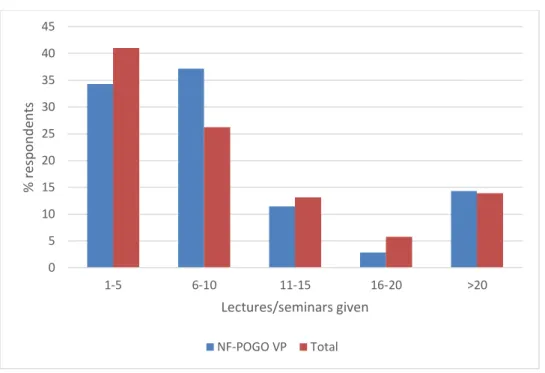
Across all programmes, an average of 80% of respondents replied that they had given seminars or lectures based on the training received, and this was slightly higher for the NF-POGO VP respondents (85%). Regarding the number of lectures/seminars, since the respondents were given various brackets to choose from, we could not infer the exact numbers, but 56% of respondents had given more than 5 lectures/seminars, and 28% had given more than 10 lectures/seminars (see Fig. 1).

Regarding the number of attendees, again we cannot infer mean values, but there were more than 20 attendees in 74% of cases, and more than 50 attendees in 37% of cases (see Fig. 2).

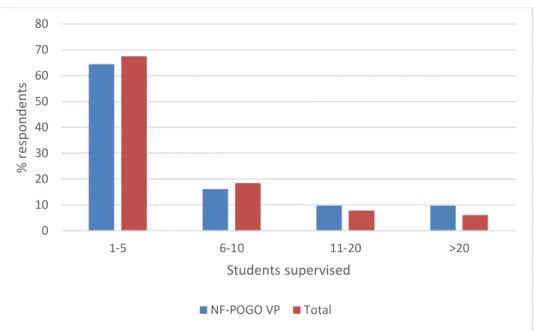
A large proportion of respondents (78% for NF-POGO VP, 75% across all programmes) said they had supervised students (undergraduate or postgraduate) since the training. In 35% of cases the NF- POGO VP respondents had supervised more than 5 students. A large proportion of the respondents (71%) said they had passed on the knowledge gained “to a large extent”, and the remaining 29%

responded that they had passed on the knowledge “to some extent”.

(8)

Around two thirds of respondents (68% for NF-POGO VP respondents, 60% across all programmes) stated that they had also mentored/supervised colleagues (e.g. research assistants, postdocs, researchers) and 67% had passed on the knowledge gained “to a large extent”. In 40% of cases the NF-POGO VP respondents had supervised more than 5 colleagues.

Fig. 1. Number of lectures/seminars given by respondents of the NF-POGO VP program compared to all respondents.

Fig. 2. Number of attendees at lectures/seminars (in total), for respondents of the NF-POGO VP program compared to all respondents.

0 5 10 15 20 25 30 35 40 45

1-5 6-10 11-15 16-20 >20

% res pondent s

Lectures/seminars given NF-POGO VP Total

0 5 10 15 20 25 30 35 40

<10 11-20 21-50 51-100 >100

% res pondent s

Lecture/seminar attendees

NF-POGO VP Total

(9)

Fig. 3. Number of students supervised by respondents of the NF-POGO VP program compared to all respondents.

Fig. 4. Number of colleagues mentored by respondents of the NF-POGO VP program compared to all respondents.

Across all programs, oral presentations at conferences were the most common output from the training, followed by poster presentations then peer-reviewed research articles (see Table 6).

Although the trend was the same for the NF-POGO VP, numbers were slightly higher, showing that these trainees had been more productive than the average across programs.

Number of products that have resulted from the training NF-POGO VP All programs

Peer-reviewed research articles 2.8 2.4

Non-peer-reviewed research articles 2.4 1.6

Oral presentations at conferences 3.3 2.9

Poster presentations at conferences 3.1 2.5

Data contributions to databases 2.1 1.7

Popular science articles, Tweets, blogs 1.1 1.2

0 10 20 30 40 50 60 70 80

1-5 6-10 11-20 >20

% res pondent s

Students supervised NF-POGO VP Total

0 10 20 30 40 50 60 70 80

1-5 6-10 11-20 >20

% res pondent s

NF-POGO VP Total

(10)

Table 6. Weighted mean number of publications for the NF-POGO VP respondents and across all programs. Note: for the purpose of calculating a mean, >5 was taken as 6, so these are lower-limit estimates.

Survey of institutions

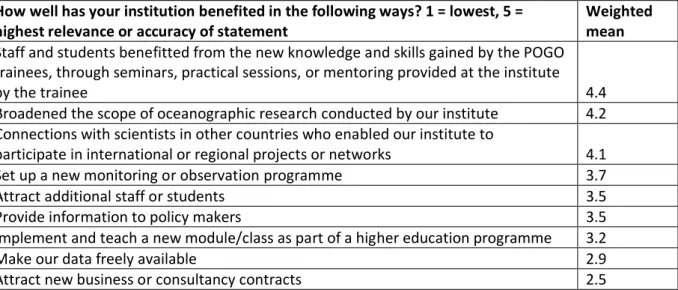
The questionnaire was sent to 90 recipients, who has either hosted a visiting professor or other regional training programme in a developing country, or because they were the parent supervisor of a POGO-SCOR fellow. The link between these recipients and the POGO training was therefore much more tenuous than for the survey of trainees, as shown by the low response rate of 12%. The responses are summarised in Table 7.

a)

How well has your institution benefited in the following ways? 1 = lowest, 5 = highest relevance or accuracy of statement

Weighted mean Staff and students benefitted from the new knowledge and skills gained by the POGO

trainees, through seminars, practical sessions, or mentoring provided at the institute

by the trainee 4.4

Broadened the scope of oceanographic research conducted by our institute 4.2 Connections with scientists in other countries who enabled our institute to

participate in international or regional projects or networks 4.1

Set up a new monitoring or observation programme 3.7

Attract additional staff or students 3.5

Provide information to policy makers 3.5

Implement and teach a new module/class as part of a higher education programme 3.2

Make our data freely available 2.9

Attract new business or consultancy contracts 2.5

b)

How well has your country/region benefited in the following ways? 1 = lowest, 5 = highest relevance or accuracy of statement

Weighted mean The country/region has improved the quality of its marine science 4.5 The country/region is better able to monitor its coastal zone 4.3 The country/region has increased its contribution to international marine science

networks. 4.1

The country/region is better able to manage its coastal resources 3.7

The country/region has increased its contribution to global ocean observations 3.6

The country/region is better able to protect its coastal zone. 3.5

The country/region is better able to predict and mitigate disasters along its coastline. 3.1

Table 7. Weighted mean score (out of 5) given to different positive impacts on respondents’ (a)

institution and (b) country/region.

Table 1. Weighted mean score (out of 5) given to different positive benefits derived by the training  providers
Table 3. Mobility of the respondents after the training and estimated “retention rate” assuming  that (1) those who are abroad and plan to return do return to their home countries, and (2) those  who are uncertain or do not plan to return, do not return to
Table  4.  Weighted  mean  score  (out  of  5)  given  to  different  positive  impacts  on  respondents’
Fig. 1. Number of lectures/seminars given by respondents of the NF-POGO VP program compared  to all respondents
+3

参照

関連したドキュメント

Standard domino tableaux have already been considered by many authors [33], [6], [34], [8], [1], but, to the best of our knowledge, the expression of the

GENERALIZED HAUSDORFF OPERATORS ON WEIGHTED HERZ SPACES..

The following question arises: it is true that for every proper set ideal J of subsets of S there exists an invariant mean M on B(S, R ) for which elements of J are zero sets (J ⊂ J

The edges terminating in a correspond to the generators, i.e., the south-west cor- ners of the respective Ferrers diagram, whereas the edges originating in a correspond to the

arXiv:1101.2075 (2011)), we claimed that both the group algebra of a finite Coxeter group W as well as the Orlik–Solomon algebra of W can be decomposed into a sum of

Abstract. In Section 1 we introduce Frobenius coordinates in the general setting that includes Hopf subalgebras. In Sections 2 and 3 we review briefly the theories of Frobenius

In Section 3 using the method of level sets, we show integral inequalities comparing some weighted Sobolev norm of a function with a corresponding norm of its symmetric

This paper presents an investigation into the mechanics of this specific problem and develops an analytical approach that accounts for the effects of geometrical and material data on