Abstract
Knowledge-based views of firms have established the importance of knowledge as a basic component of competitive advantage. This paper examines the relationship between expatriate staffing decisions in the context of the maturation stages of a subsidiary.
The paper draws from research literature and data from two studies which have evidenced a U-shaped relationship in expatriate staffing levels: higher in the lowest and highest levels of subsidiary maturation stages and lowest in the mid-stage. Propositions are proposed to examine this relationship using knowledge transfer as the basic focal process.
Key words: expatriates, knowledge-based view, global staffing, international human resource management
Ⅰ Introduction
Over the last couple of decades practitioners and academicians have increasingly examined the nature of competitive advantage of business firms.
Much of the focus has been on the charac- teristics (value, rareness, imitabilty and substituta- bility) of the firm identified by Barney (1991) as difficult to replicate, thus creating resources that could be used to create competitive advantage. Due to the applicability of the four difficult to replicate resource factors, Barney and many writers since the early 90ʼs have examined human resources as one of the primary sources of competitive advantage.
Simultaneously, knowledge-based views of the firm appeared in the literature with arguments that knowledge is the key competitive advantage
resource in current day organizations, and humans are the basic transfer mechanism used to move knowledge from one context or set of actors to another (Bartlett and Goshal, 1989; Nonaka, 1994;
Nonaka and Takeuchi, 1995︶ .
Recent research on the knowledge-based view of multinational firms emphasizes the critical role expatriates play in knowledge transfer, particularly in the areas of tacit knowledge (uncodifiable and gained through experience︶ . The great majority of research to date has focused on the types of knowledge that expatriates transfer to sub- sidiaries (Bonache and Brewster, 2001; Downes and Thomas, 2000; Hocking, Brown and Harzing, 2007;
Riusala and Smale, 2007; Riusala and Suutari, 2004︶ , factors related to the difficulty (“stickiness”)
︵Szulanski, 1996, 2003) of information transfer and to a lesser extent the role that expatriates, host operations and inpatriates play in transferring knowledge to the parent company and across various subsidiaries (Björkman, Barner-Rasmussen and Li, 2004; Bonache and Brewster, 2001; Downes and Thomas, 2000; Edström and Galbraith, 1977; Harvey and Novicevic, 2000; Hocking et al., 2007; Kurokawa, Iwata and Roberts, 2007; Mäkela, 2007; Strach and Everett, 2006; Vance and Paik, 2005︶ . Thus, the importance of the role of expatriates in the knowledge transfer process is well-established but little is known of the evolution of the knowledge transfer process over time.
Knowledge transfer and the value of various types of knowledge transferred would be expected to evolve over time and development course of a subsidiary. Little research has been devoted to the
The Knowledge-Based View of the Firm and Expatriate Staffing:
An Exploratory Explanation for a U-Curve Relationship of German Local Operations in Japan N. Sue Bruning
** I. H. Asper Shool of Business, University of Manitoba, Winnipeg, Manitoba, CANADA
examination of the knowledge transfer process over
the life of a subsidiary and on the multidirectional roles of the knowledge transfer process between home and host units and between host units.
Contrary to general expectations in the literature, two recent studies, one by Downes and Thom- as (2000) and the other by Bruning, Bebenroth and Pascha (2008) identified a U-shaped relationship in expatriate staffing, higher levels of staffing at early and most mature stages of subsidiary development and lower levels at intermediary levels of the subsidiaryʼs development. In the Bruning et al. (2008) study the focus was on management staffing levels. This paper will further explore this U-shaped relationship by proposing exploratory propositions that integrate the knowledge-based view of the firm with the relationships found in the two studies. These propositions are tentative and based on the little literature that exists, but research on this important issue of the evolution of the knowledge transfer roles of expatriates over the course of a subsidiary is virtually nonexistent.
Ⅱ Knowledge Transfer Functions of Expatriates
The effective transfer of knowledge is at the core of successful functioning of contemporary organ- izations (Bartlett and Goshal, 1989; Fang, Wade, Delios and Beamish, 2007) and expatriates are seen as the primary mechanism to transfer noncodifiable knowledge, commonly referred to as tacit knowledge.
The difficulties of transferring tacit knowledge are well-known and are compounded by the fundamental dilemma that tacit knowledge is the most advan- tageous for competitive advantage purposes but is the most difficult to transfer (Kogut and Zander, 1992, 1993︶ . Hocking et al. (2007) focused on examining the transfer of tacit knowledge and found that expatriates were more effective in applying knowledge when they had frequent knowledge access and communication with headquarters and other organizational units, while knowledge acquisition or experiential learning occurred through more frequent access to host country sources. This experiential learned knowledge was
then transferred through future assignments and other mechanisms to other units throughout the organization.The quality of the knowledge transfers has been related to the willingness and ability of the expatriates and the host country employees to transfer the knowledge; and the relationship that the expatriates and locals have formed with each other (Bonache and Zarraga-Oberty, 2008︶ . Mäkela
︵2007) argues that the value of expatriates as transfer agents is due to their rich and longer term relationships and extensive networks of relationships outside of the local area; their high trust relationships formed through their shared experiences, physical proximity and prolonged face-to-face interactions; and their shared cognitive frameworks with local employees, developed as a result of extended experience in the host country.
Thus, expatriates are most valuable in the transfer of tacit knowledge and this transfer is most effective when they demonstrate abilities and willingness to transfer the information, when the recipients also have abilities and willingness to receive the information and there is a good relationship bond between the parties.
Vance and Paik (2005) provide suggestions on how the absorptive capacity (ability and willingness to gain and share knowledge) of recipient units can be improved. Their suggestions include new employee orientation and training, instruction in the MNC predominant language, MNC home country cross-cultural awareness, supervision and technical operations management skills, expatriate coaching and liaison skills and socialization in the MNC strategy and culture.
Ⅲ Content of Knowledge Transferred and Evolution of the Subsidiary
In the absence of clear research data on the types
of knowledge transferred and the evolution of a
subsidiary, I will integrate some of the available
research studies on knowledge transfer to develop
a basic model of knowledge transfer and expatriate
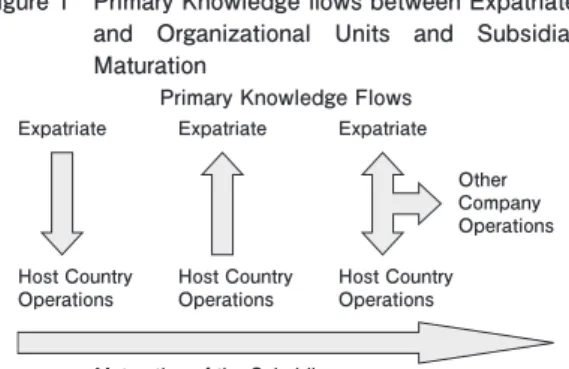
roles within the transfer process (see Figure 1︶ .
This model will provide the basis for the derived
propositions and a theoretical rationale for the U-
shaped expatriate staffing relationship.Most of the literature on expatriate roles focuses on the roles of expatriates as knowledge transfer agents from the headquarters to the subsidiary. In this capacity, the knowledge transfer roles are primarily from expatriate to the subsidiary and include such functions as establishment, coordination and control of the subsidiary. Data from the study by Bruning et al. (2008︶ , which exemplifies numerous studies on expatriate roles, may be used to partially explain the basic relationships illustrated in Figure 1. The primary expatriate roles identified by local and expatriate managers included coordination with the parent company, communication of company strategy, establishment and build-up of firm, feedback of information from Japan to the parent company and crisis management. While these roles remained important functions as the subsidiary aged, there was a reduction in the number of expatriates which would suggest less need for these roles in a general sense within the subsidiaries.
Proposition1: High levels of expatriate staffing are needed in the early stage of subsidiary development in order to provide establishment, coordination and control of the subsidiary.
During the mid stages of the subsidiaryʼs development, the staffing of senior management fell significantly and more locals were represented in senior management ranks. According to the Bruning et al. (2008) survey results, the expatriates and local managers reported that local managerʼs primary responsibilities included communication their knowledge of local structures (distribution channels, competitors, authorities, living environment,
etc. ︶; communication and facilitation Japanese culture; and to develop local talent. Through some conjecture, based on the staffing levels of subsidiaries at different stages of maturity, it appears that the local knowledge enhances the value of local talent in mid-stages of the local operationʼs development, and provides justification for increased staffing of management positions with local talent.
Proposition2: Low levels of expatriate staffing are needed in the moderate stage of subsidiary development to fulfill estab- lishment, coordination and control functions for the organization.
Finally, for the most mature subsidiaries, the data by Downes and Thomas (2000) and the Bruning et al. (2008) studies are both silent on the reasons for the increases in levels of expatriate employees.
However, using a knowledge-based view of the firm, it would be expected that as subsidiaries age they would be knowledge-creation units and, if still in existence, could become crucial performance nodes within the organizationʼs broader network.
The data from Kurokawa et al. (2007) would support this rationale given that they noted a trend in the dispersion of R&D activities from central operations to dispersed operations. Dispersed R&D facilities are able to better serve diversified international demands and markets. Further support of the enhanced value of dispersed units is the development of “learning communities” as utilized by companies such as Hewlett-Pack- ard (Human Resource Management International Digest, 2007︶ . These learning communities facilitate exchanges of researchers and managers across geographical regions to promote innovation, development and coordination. As dispersed geographical units are more highly valued for their unique contributions and knowledge that can be used for competitive advantage, the subsidiaries could then become fertile ground for multidirectional knowledge exchange. The research by Mäkela (2007) would suggest that this knowledge exchange would occur best when related actors work closely together, thus a need for assignment of expatriates to dispersed operations once the
Host Country Operations Expatriate
Maturation of the Subsidiary Host Country Operations Expatriate
Primary Knowledge Flows
Host Country Operations
Other Company Operations Expatriate
Figure 1 Primary Knowledge flows between Expatriates and Organizational Units and Subsidiary Maturation
subsidiaries have reached high levels of maturity.
The knowledge exchange is enhanced if the expatriates are embedded in the local subsidiary environment. In addition, the mature subsidiary has also reached a point where it could be fertile training ground for technical and management staff since they could be a source of tacit knowledge related to competitive advantage.
Proposition3: High levels of expatriate staffing are utilized in highly mature subsidiaries in order to facilitate knowledge transfer between the local subsidiary and other organizational units.
Ⅳ Conclusion
In this brief paper, a critical issue related to drivers of staffing of subsidiaries with local and expatriate managers is examined. This paper focuses on an issue that, to date, has not received enough attention in the research literature. Given the enormous expense and critical roles played by expatriate and local managers in firm performance, expatriate and local talent needs to be utilized in a manner that creates the highest levels of competitive advantage. Some exploratory propositions have been proposed in this paper to identify how global staffing decisions might be enhanced by coordinating staffing decisions with the maturity level and potential tacit knowledge contributions of dispersed geographic operations. Further explo- ration of these propositions is needed and research conducted to test their validity. Finally, the issues raised in this paper reinforce the need to integrate research on knowledge transfer with human resource management strategic decision choices in order to understand more about the relationships between global staffing decisions and competitive advantage.
References
Barney, J. B.(1991 ︶ ,
“Firm Resources and SustainedCompetitive Advantage,” Journal of Management, 17⑴:
99-120.
Bartlett, C. A. and S. Ghoshal(1989 ︶ , Managing across Boundaries: The Transnational Solution, Boston, MA:
Harvard Business School Press.
Björkman, I., W. Barner-Rasmussen and L. Li(2004 ︶ ,
“Managing Knowledge Transfer in MNCs: The Impact of
Headquarters Control Mechanisms,” Journal of Inter
national Business Studies, 35: 443-455.
Bonache, J. and C. Brewster(2001 ︶ , “Knowledge Transfer and the Management of Expatriation,” Thunderbird International Business Review, 43⑴: 145.
Bonache, J. and C. Zarraga-Oberty(2008 ︶ ,
“Determinantsof the Success of International Assignees as Knowledge Transferors: A Theoretical Framework,” The International Journal of Human Resource Management, 19⑴: 1-18.
Bruning, N. S., R. Bebenroth and W. Pascha(2008 ︶ , “Staff- ing of Expatriate and Local managers in German Subsidiaries in Japan: Does Age of Host Company Operations and National of Respondent Play a Role?”
Australia/New Zealand Academy of Management 2008 Annual Meetings, Auckland, New Zealand, December 4, 2008.
Downes, M. and A. S. Thomas(2000 ︶ , “Knowledge Trans- fer Through Expatriation: The U-curve Approach to Overseas Staffing,” Journal of Managerial Issues, 12⑵:
131.
Edström, A. and J. R. Galbraith(1977 ︶ ,
“Transfer ofManagers as a Coordination and Control Strategy in Multinational Organizations,” Administrative Science Quarterly, 22: 248-263.
Fang, Y., M. Wade, A. Delios and P. W. Beamish(2007 ︶ ,
“International Diversification, Subsidiary Performance,
and the Mobility of Knowledge Resources,” Strategic Management Journal, 28: 1053-1064.
Harvey, M. and M. M. Novicevic(2000 ︶ ,
“Staffing GlobalMarketing Positions: What We Donʼt Know Can Make a Difference,” Journal of World Business, 35⑴: 80-94.
Hocking, J. B., M. Brown and A. Harzing(2007 ︶ ,
“Bal-ancing Global and Local Strategic Contexts: Expatriate Knowledge Transfer, Applications, and Learning within a Transnational Organization,” Human Resource Manage
ment, 46⑷: 515-533.
︵Unknown Author)(2007