WASEDA BUSINESS & ECONOMIC STUDIES 2005 NO . 41
Metanational Challenges for Japanese MNCs in Global Knowledge Economy
by Masataka Ota*
1. Introduction
International business activities of Japanese MNCs in the 2011' century had 3 unique characteristics. First, "Global Supplier Strategy", which focused on global efficiencies through exporting, played as the central policy of Japanese MNCs . Second, unlike their Western competitors, their operational expansion into overseas markets was not done along with similarities of markets. They had no alternatives but to expand their operation drastically into Western advanced markets (particularly U.S.) which were positioned at the other end of the continuum of social system and cultural values. Third, the organizational architecture of Japanese MNCs, manufacturers in particular, has always been integral model during all the periods from 1960s through 1980s of such a miracle economic growth, the epoch-making Plazan agreement in 1985, and finally into the 21" century now.
These closely interrelated three characteristics had been effective in global competition of the 20a' century, but they face strategic and organizational problems in this current global knowledge economy. This article argues why and how Japanese MNCs had developed those characteristics and how they should respond to the rapidly changing global competition of the 21" century.
2. Internationalization Strategies of Japanese MNCs in the 20'1, Century 1) Global Supplier Strategy as the Operational Destiny
International business operations involve three strategic alternatives; Foreign Trade, FDI(foreign direct investment), and Strategic Alliances, While the ideal operation would be a mix of these three, the pattern of mixture is strategically determined by the organizational capabilities of and competitive challenges for a particular company.
Japanese companies had no alternatives, however, but to choose foreign trade as its only available national policy. As widely known, their business model was to import law valued materials from overseas, to process them into high valued products by using
* Masataka Ota is a professor of International Business at the School of Commerce.
quality human resources and unique organizational process, and then to export those products at relatively law prices. People argue this is because Japan is a natural resource poor country. It is partly true, but another greatest factor is the rate of Japanese yen to U.S. dollars.
Importing is favorable and competitive when the currency of one country is strong to US dollars, while exporting beneficial otherwise. It was natural, therefore, that Japanese companies had been long dependent on exporting as their primary international
strategy. For almost 40 years from the end of World War II in 1945 until Plaza Agreement in 1985, as shown in Table 1, Japanese yen had been relatively kept depreciated in spite of her increasing economic power during that period for some
reasons.
Table l Changes in International Market & Foreig 1945-1970 (Fixed Exchange Rate System;`49-71)
The end of WWII (1945)
Capitalizing of favorable exchange rate, Japanese manufacturers (e.g. Matsushita) starts FDI in ASEAN as their overseas factory exporting to Japan & Western markets.
1971-1984
Nixon Shock & Smithsonian Agreement (1971) Complete Shift to Floating Exchange Rare System (1973)
Japan leads NIBS based on "Flying Goose Model"
Mahathir advocates "Look East" Policy (1981) 1985-1996
Exchange Rate for Japanese MNCsn
Exchange Rate of V to US$
i '
~ US$1=¥360(1949-1971) 16 .88% revolution
eement (1971) ' US$1=¥308(1971)
} US$1=¥300-26((-1985)
Plaza Agreement(1985) • US$1=¥235(1985)
Increased local manufacturing in US and Europe ¥140(1987,
Rise of ASEAN based on "Flyinf Goose Model" US$1=VI50-90(-1996) Japanese Bubble economy & US New Economy; huge amount of
residual money floods into ASFAN J ¥79(1995)
1997-present
Asian Currency Crisis (1997)
Drastic increase in presence of Western MNCs (in service business US$1=VI20-100(-2005) in particular) in ASEAN, replacing Japanese MNCs
Rise of Chinese market and its MNCs J
source:OTA, Mssarafra (2003)Cnllaboacion ofASEAN and JapeneseMNCs.The2S Open Symp
e-ofJRM:Japan endASEAN-Tbe Forum ofRunnnr Apex Borden, \Waseda Univesi,y lesimm for Resnveh Business in Admi,risnavion
The dollar-yen exchange rate, which had been fixed at US$ 1= ¥360 since 1949, was sharply revalued by 16.88% to go up to US$ 1= ¥308 by Nixon Shock on August 15, 1971 followed by Smithsonian Agreement on December 18 of the same year. Under the preceding 22 year long fixed exchanged rate system, however, the Japanese yen to US
2
dollar rate remained unchanged in spite of her steadily accumulated economic power. It consequently provided Japanese companies with a sort of virtual depreciation of the Japanese yen.
After the floating exchange rate system was internationally adopted in 1973, the trend of dollar appreciation continued. President Nixon who suffered from Vietnam War held the strong dollar policy to bring money into U.S. from the rest of the world.
Suffering from the so-called twin deficit, or public finance account deficit coupled with trade and current deficit, President Reagan also took his high interest rate policy to invite money from overseas into U.S. In the meantime, a number of Japanese MNCs like Toyota, Honda, Matsushita, SONY to name a few, had already gained huge competitive advantages to the extent that Ezra Vogel admired them in his sensational hook "Japan as No. 1: Lessons for America (1979)" or William G. Ouchi of UCLA published his controversial book "Theory Z: How American Business Can Meet the Japanese
Challenge (1983)."
With such a favorable exchange rate continuing in chose periods, Japanese MNCs could accumulate their strategic levers into the next stage of internationalization, i.e.
overseas manufacturing or management. Some Japanese MNCs strategically tried to maximize benefits from this handicapped game until the very last minute. Who most benefited this way would be Toyota. Toyota started its local manufacturing after having secured its home market share completely, while exporting its quality automobiles under favorable conditions and, moreover, learning carefully what such competitors as Honda and Nissan struggle in their overseas manufacturing.
The strategy taken by most Japanese MNCs is known as "Global Supplier Strategy." Christopher Bartlett and Sumantra Goshal also labeled Japanese MNCs as
"Global Company" in their book "Managing across Borders (1989 & 1998)." This strategy features an extremely efficient and effective home-based production system, exporting high quality and high valued manufactured goods through the excellent international networks of the Japan specific organizations, Sogoshasha, just like sending oil through their globally networked pipeline. In a sense, Japanese manufacturers and Sogoshosha can be described to have formed a very close collaboration or specialization at national level.
Meanwhile, the critical factor of global competition migrated from comparative advantages classically provoked by David Ricardo to competitive advantages by Michael Porter. Recognizing much greater importance of competitive advantages brought by MNCs, U.S. and other member countries of G7 took the strong initiative to close Plaza
Agreement in 1985 in order to force Japanese MNCs to join them in playing a global chess game through FDI as welt
On the other hand, the U.S. had since the end of WWII enjoyed an absolutely powerful position as the only and most advanced country for many years in economics, business, and technological innovation etc. Through 1960s and 1970s it was no exaggeration that all the innovations came out from U.S. Capitalizing on the overwhelmingly strong U.S. dollars over any other currencies, US MNCs naturally chose their international expansion through FDL The research by Raymond Vernon and his team of Harvard found that most US MNCs in 1960s went overseas in order to maximize benefits from the international product life cycle theory. Before entering the growth or second stage of product cycle in U.S. market, U.S. MNCs expanded into a foreign country that showed market similarities in socio-cultural variables, but that was positioned in the less developed stage in economic and technological aspects. Through this mechanism they could lengthen the life of a particular product much longer than in case of not going overseas.
Like or curse it, US MNCs could never take the export based strategy which cannot be legitimate at all by the foreign exchange mechanism. Such an overwhelmingly strong U.S. dollars never allowed US MNCs to benefit from exporting even if they were equipped with equivalent institutions to the Japanese former MITI (currently METI;
Ministry of Economy, Trade and Industry) and Sogoshoshas like Mitsubishi or Mitsui.
Without foreign exchange rate, the result would remain the same. The assembly line or facilities which have so far manufactured one generation older products must be removed so that a room for manufacturing new products can be secured. For that purpose, the old facilities must be transferred to foreign countries with markets similarities where local manufacturing is more feasible. In a sense, US MNCs gain two birds with one stone. The first bird is benefits from an FDI based operation legitimated by the absolutely strong dollar. And the second is reuse of old system that was transferred to overseas where they can still supply just one generation older products for local markets for whom the products can be enough innovative and competitive. This is just the other side of the same coin, vis-a-vis the global supplier strategy adopted by Japanese MNCs.
2) Order of Entry into Foreign Markets
Another difference between Japanese MNCs and U.S. counterparts resides in the order of market entry overseas. While the Japanese targeted the Western markets at the
4
earliest stage of its internationalization process after AWWII, the U.S. took a very authentic approach to incrementally enter the markets with high similarities. Essentially it should he convenient and favorable for even the Japanese to enter neighboring Asian markets where the impact of tyranny of distance is much smaller. The nearest and largest market for the Japanese companies has always been China, which was closed by its Communist Party for many years until 1972 when the Japan-China relationship was normalized. Besides, no effective demands for Japanese manufactured goods existed locally in China at that time. The greatest bottleneck, however, was the negative memory of then Japanese militarism of W WII, so Japanese companies could never consider China as either a production site or potential market.
This is basically true for Korea as well, while the Korean market size is not as big as that of China. The Korean government continued to take a protective trade policy toward the Japanese products, so Japanese companies could not choose Korea as possible market either. Japanese consumer electronics companies like Matsushita entered such ASEAN countries as Thailand and Malaysia as early as 1960s, because these countries showed milder attitude toward the Japanese. But the incentive and motivation of Japanese companies was to take advantage of these countries as production sites to export to U.S. or Europe through Japan. This strategy was feasible only because the currencies ofASEAN countries were all weak to Japanese yen.
Unlike IT business that can simultaneously cover the global market from a single site, most conventional businesses need to gradually secure such physical presence as stores or factories in each local market overseas. Duplication strategy better fits the latter, while scaling strategy might go better with the former (von Krogh & Cusumano 2001).
It would be wiser for most companies of any national origin to start to enter easier markets except the case that an overwhelming core competence is available. Whether through exporting or EDI, in terms of tyranny of distance in a physical or psychological sense, it should be more efficient and effective to expand business activities along with similarities of markets. Actually not only US MNCs but also such European MNCs as IKEA (see Table 2) has taken this approach coupled with competitive duplication strategy featuring its unique "Black Box."
Table2 Duplication Strategy: IKEA Case
1954 Founded by Ingvard Kampead as Swedish manufaturers and retailers of furniture with sales of 2 million Dutch grader. IKEA means his initial and his farm Elmtaryd in Agunnayd. (The name of IKEA had been already registered by Kamptad as general merchandisers in 1943)
1958 IKEA'S lust store opened in Almhult (Sweden)(6,700rnt)
1963 The first foreign store in Oslo, 65 opened in Stockholm, 69 Denmark's first store opened 1973 The first sore outside Scandinavia opened in Zurich, 74 Germans first store in Munich, 75 the first store in Australia, 76 the first store in Canada, 77 the first store in Austria, 79 the first store in Netherland
1981 the first store in France, 83 the number of empoyees reached 6,000, 84 The first store in Belgium.
Sales reached 2,679 billon Dutch gtdder. 100% of Kamprad's personal stocks transferred to IKEA Stitching Holland (a charity fimndation), 85 The first U.S. store opened in Plymouth Meeting (Philadelphia), 87
the For UK store opened in Warrington, and then entered London, 89 The first store in Italy
1990 The first store opened in Hungary and Poland, 93 Grew up to 114 stores in 25 countries, 96 The first store in Spain, 98 The first store in China
-2000 The first pore in Russia was opened
2002 Total sales increased to 12 billion Earn. Entered ahout 30 countries as Franchiser and directs owner of stores with 75,500 employees. Sales ratio : Europe (77%), US (19%), Middle Ease/Ansrralia/Asia (4%) Sourre _ O KA, .MNemda (2003) Collaboouv, ,f AS AN -d),-... MNC,, 1k, 2Y' Ogee Sy,apndum s'/A&1. J gars id ASIAN-I3a Furvm sf8wi..eo A..~ 8srdrss Wzwda Uni,rersiry In,ims 6e Resead.u, sssaas Ao ii-I...ion
This is also the case for such Chinese emerging MNCs as TCL, Li Fan, and Aucma who are aggressively moving into ASEAN, particularly Vietnam, to start its local manufacturing of color TVs and motorcycles in Ho Chi Minh and Hanoi. Perhaps Haier is an exceptional case in that they attempted to enter the U.S. market with their niche product, or tiny refrigerators frequently found in hotel and motels. In general, however, it is an absolutely legitimate strategic decision for most Chinese emerging
MNCs to enter their neighboring countries by leveraging their strategic strength.
It is well known that Nissan chose Finland as the first exporting target among Western markets. Then top management of Nissan, reportedly, thought that their products would be favored by Finnish people because Japan was the first and only country to defeat Russia from whom Finnish people have historically long suffered hard pressures. The Nissan management expected this logic to work favorable for promoting Nissan cars in Finland. This would be a case of capitalizing on the proximity of psyche distance, not the proximity of geographic distance.
As a sort of unintentional result, however, the entry strategy of Japanese MNCs functioned as a great leverage, as Anglo-American economy became dominant globally.
Because their success in North America enabled Japanese MNCs to enter European markets with just relatively fine-tuning and vice versa. In other words, very strong pressures to shift up to top gear at the starting point consequently helped Japanese MNCs to operate with relative easiness in the 3'1 or 2rd gear position. While Japanese
6
MNCs also used the black box strategy like IKEA, the difference is the way of formulating or configuring the black box. The latter's was done in an incremental way, but the former's in a destructive way which provided Japanese with a very unique global competitiveness.
3) Integral Model as Organizational Genes
The third and most critical characteristic is that the mindset and core competence shared by most Japanese manufacturers are based on integral model architecture. It is organizational processes evolved from Japanese high context communication system. It was reinforced by the successful global supplier strategy under which high quality products were made most efficiently only by Japanese employees through such Japanese management system as lifetime employment, seniority-based wages, enterprise-based union, and just in time system etc.
In the meantime there were two big opportunities for Japanese MNCs to change the global supplier strategy. The first was Nixon Shock in 1971 when the Japanese yen was sharply revalued. But, as put earlier, since the U.S. government continued its high interest rate policy and, as a result of that, Japanese yen was kept to be relatively depreciated, the business model of Japanese MNCs remained unchanged. Through a sort of social specialization of Sogoshoshas and manufacturers, Japanese MNCs continued to export high quality and high value added products which were made by highly efficient production system operated by only Japanese.
The second was Plaza Agreement. Relentless appreciation pressure of Japanese yen forced Japanese MNCs to rush into local manufacturing or local management in Western markets, particularly in U.S. This destructive paradigm shift finally forced Japanese MNCs to take off from their long held global supplier strategy. Such a drastic migration of operational alternatives gave a great impact on strategic aspects of the Japanese manufacturers, but it did not change their organizational core competence accordingly.
After Plaza Agreement, the business operation of Japanese MNCs apparently migrated from export to FDI, but the working organizational processes at profound levels continued to be critically influenced by their organizational genes or DNA. Almost all the FDIs done by Japanese MNCs were Greenfield typed, not M&A typed. This is because the production systems of Japanese MNCs have always been based on integral model. Against Chandler's argument, the organizational processes of Japanese MNCs did not follow their new operational strategy. Rather it might be natural that organizational
processes -the most critical determinant of business model- are harder to change than strategy which is more subject to changing competitive environments. Neither strategy always follows organization, nor does organization follow strategy automatically.
3. Organizational Processes Do Not Always Follow Operational Strategy 1) Advantages of Integral Model
Integral Model is an evolutionary mass production system. Nowadays, in terms of organizational architecture, two basic mass production models exist; Integral Model and Differential (or Open Module) Model. Integral Model has been largely adopted by Japanese manufacturers, while Differential Model became rapidly dominant after IT revolution.
The strategic intent of Integral Model is maximizing value differentiation in products or services. Elements needed are ; 1) Closed architecture, 2) Keiretsu-networks, and 3)"Suriawase"(integration through extremely sophisticated adjustment) production system. Advantages of integral model are as follows:
1. Offering highly differentiated products and services based on a unique architecture
2. Very strong and close collaborations among members of Keiretsu group whose center of excellence is a large assembler like Toyota or Matsushita
3. Extraordinarily fine-tuned architecture that enables the ultimate elimination of redundancies
4. Artistically tiny and light, thin and sleek, and compact and well-packaged products whose parts or components are individually developed and designed
(Yasumuro 2001)
Figural Advantages and Limitations of Wholly Owned Subsidiaries
M & A Greenfield
Advantages I Rapid entry Rapid entry Defense of state of the Access to distribution channels
Exsiting management experience Established brand names and reputation
Reduces competition
I I
art (emerging) ology Integrated production Operational efficiency
of the cechn
Limitations
coordination problems Fit with existing business
Sources Douglas, S,P, & Cavg, C. 5. (19957 Global Madwing Seategy, McGaw HJI, p.166
R Integration with existing operation
Communication and
Investment cost Needs to build b Time delays
usmess
Greenfield typed FDI takes the form of wholly owned subsidiaries. As shown in Figure 1, while wholly owned subsidiary through M&A are effective to rapidly enter the targeted overseas market, Greenfield typed one is more effective for integral production which in turn can greatly contribute to defense of emerging innovation or technology as well as maintenance of their unique organizational process. M&A takes much effort and time to transform human resources in which the organizational process or culture of the acquired organization is deeply embedded.
On the contrary, Greenfield typed wholly owned subsidiary can build the most desirable facilities and also recruit the new local employees to be trained in Toyota way, Honda way, and whatever. One of the greatest reasons why the Japanese automobile manufacturers chose Kentucky or Tennessee as the locus of their production facilities is that they could recruit local people who were not imprinted with the U.S. automobile conventional practices (Goshal & Westney 1993). As represented by Just-In-Time (JIT) system, Japanese MNCs are excellent in making high quality products. Comparing mobile PCs launched at the same period of time, such Japanese products as SONY or Matsushita always have smaller, lighter, and thinner package than Dell, for example.
This is because the new models of SONY and Matsushita are manufactured with integral model, while Dell's with differential model, or open module model.
In the meantime, Japanese consumers also play a very important role in this successful evolution of the Japanese integral model, because Japanese manufacturers continue to develop those highly sophisticated products that satisfy such meticulous requirements of Japanese consumers. The Japanese consumers are more positive about purchasing those innovative products with less attention to pricing than their Western counterparts, as observed in such a successful market share taken by European high quality branded companies like LVMH in the Japanese market. The Japanese consumers are not price conscious but rather quality or innovation conscious.
And investment in development of extremely innovative products can be fully amortized by the repeated purchase of Japanese users, who enthusiastically but unintentionally become powerful contributors to a sort of social amortization mechanism every time the new model is introduced. They encourage an evolution of integral model that enables excellent making of quality products.
2) Organizational Processes and Japanese FIRM
Japanese companies still have a tendency to prefer fresh college graduates to the holders of Master degree in social science (including MBA) or humanities. With the
global marketplaces transforming into knowledge economy based, this tendency is becoming less dominant. In factt the number of college students who continue study at graduate schools is slightly increasing even in the social science area, and a number of universities opened their MBA programs in the last decade. In reality, however, a majority of Japanese companies still prefer college graduates.
In Japan most MBA programs are offered in the evening of weekdays and the weekend. This suggests that a few businesspeople plan to change their current affiliation after earning an MBA. Another reason behind this phenomenon is the lower liquidity of Japanese labor market than that of U.S. or Europe. A questionnaire survey conducted in August and September 2004 by a semi-government agency says that 78% supports the revival of lifetime employment system and 66.7% for seniority-based wages. It is particularly interesting that 64.2% of male and 66.4% of female among employees in their 20's support lifetime employment system.
This is also because the organizational processes of Japanese companies, particularly manufacturers, have been heavily dependent on tacit knowledge and informal human communication networks. As a result of that, Japanese companies prefer recruiting college graduates whom they can easily imprint their organizational processes and values based on tacit knowledge from the scratch. A research conducted by Hansen, Nohria, &
Tierney (1999) shows that such U.S. strategy consulting firms as BCG, Bain, and McKinsey, who favor "Personalization Strategy" based on tacit knowledge, hire top-tier MBA graduates after several time hard interviews, compared to system consulting firms like present Aecenture (then Andersen Consulting) who adopt "Codification Strategy" to recruit a large number of new college graduates (Hansen, Nohria, & Tierney 1999).
The president from the Japanese subsidiary of a certain Boston based strategy consulting firm once told me that his office recruited over 10 new college graduates out of about 20 recruits in 2002, while his U.S. parent firm, as Hansen, Nohria, and Tierney argued, recruited only competitive MBA holders from top business schools in the same year. For even the Japanese subsidiary of US based strategy consulting firm who seems more likely to follow the US styled FIRM, things are not so different from the typical Japanese companies.
10
Figure 2 Or ganizational Capabilities & R-P-V Framework .a M*`ht:`~.1"5Yo-
waQt
44r Xi kk §as
Snow OTA,Meeaesks(2002) Knowledge Maeogm,mvv,d Ovgaviadonal Proarss, The Wn.seda C.--f Review Vol. 393, School o2 Cov,meatz, Wasedn U.,ineniq, p.33- (MediNed by Masaaba Ore based an Chriscroszds a gumenu in his Md. `Dilemma of
InnoestodV Chris, ensen 2000)
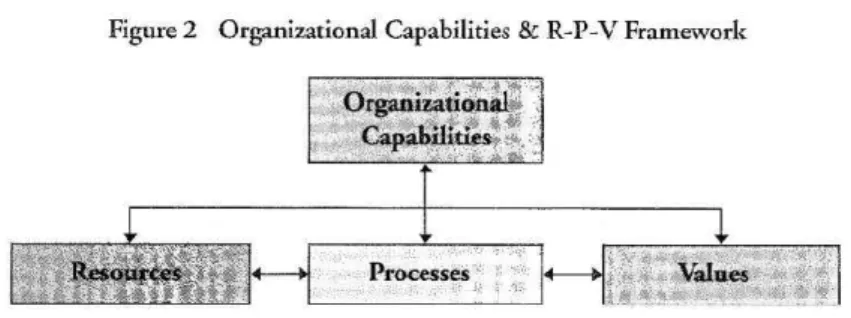
Japanese companies undoubtedly like to recruit inexperienced new college graduates, because all the employees - whether white collars or blue collars, or whether candidates to top management or factory workers - need to be trained so that they can share the organizational processes and values through tacit knowledge. This approach enables all the members from top to lower management to implement well-packaged, complicated or sophisticated tasks. As Christensen argued in his RPV framework, Resources, Processes, and Values must work in the same direction to be competitive (Christen 2000; see Figure 2). In a sense, what Japanese manufacturers are doing supports his argument.
On the other hand, as the inevitable result of their strong organizational processes, Japanese companies are not good at diversity management, particularly managing
multicultural team. In fact they used to be criticized in that they do not promote local people to upper management in their subsidiaries overseas. Besides, when the US dollar yen rate began to move unfavorable for global supplier strategy in late 1970s through mid 1980s, they did not choose to import cheap labor in order to increase factory productivities. Unlike Western countries, they tried to solve the worker shortage problem as well as the increased human resource cost by introducing assembling robots. Japan has since then been famous for the most advanced country in robotics.
Unlike Germany who received seasonal labors from Eastern European countries or Turkey, Japan could not take advantages of cheap labor from overseas, particularly neighboring countries, due to trauma of WWII. This is basically the same reason, as argued earlier, why Japanese MNCs could not expand into overseas along with market similarities. In this point as well, we can see a sort of strategic consistency which functions to build the global supplier strategy.
Amazing advances in robotics supported the global supplier strategy, but it was not
just the result of technological advancement, but rather the result of characteristics of Japanese FIRM as well. One of the reasons of this tendency is that their organizational
processes have been heavily dependent on tacit knowledge and high context communication system. And this can be soon disadvantageous in the global knowledge economy where diversity management based on multiculturalism is vital.
4. Organizational Process Supported by High Context Communication
Japanese human communication processes are based on high context communication behaviors. Here, context is defined as socio-cultural, historical, and psychological environments existing between the sender and receiver of a given communication drama. It also refers to commonly accessible frame of reference to both parties, which facilitates semantic sharing of information.
High context communication means that the amount of context which both the sender and receiver have already shared is greater. This communication pattern is very effective for the Japanese organizational processes, although it takes much time for all the organizational members to internalize the context. But once it was learned, the performance of organization or team will sharply increase, because they operate just like a semi-self-organization.
The Japanese high context communication processes have 3 interesting characteristics (Hayashi 1985 & 1994). First, the Japanese people do not express what is self-evident in or should be learned from the context. Why they rather try to be silent in discussion or talking when he/she is a stranger or novice to any social group can be attributed to this characteristic. They are expected to be familiar with the context before they speak actively. Many Westerners say that the Japanese students do not raise questions very much in the classroom. This is also why, from elementary school days, the Japanese students are instructed to listen to the teacher until he or she has finished a
story and then to ask only relevant questions.
Second, dialog cannot be active or effective until configuration of the context in question has been identified or until the identity of the communication counterpart has been known. Exchanging name cards at the earliest stage of communication process is a good example, because they can learn each other's context soon from affiliation or position printed on the cards and also can measure a sort of social distance between them. Once the counterpart's background is identified favorably, they suddenly start to communicate like old friends, particularly when they found themselves to be the graduates of the same university. Usual cross-cultural communication text books
12
featuring something like "Dos and Don'ts in Japan" only suggest that exchanging name cards be learned as an important protocol in Japan. Profoundly, however, exchanging name cards means much more than just a protocol.
Third, those who control or create, or who are just most familiar with the context involved will determine the meaning and, in most cases, become the boss. Why leadership cannot be educated effectively in Japan and also why the Western people cannot understand the process in which the Japanese leaders are selected can be ascribed to this characteristic.
High context communication enables 1) the effective sharing of tacit knowledge, 2) the flexible problem-solving among insiders, 3) the powerful organization climate, and 4) the human networks based on a long term trust. The extent to which a society depends on context differs from country to country, but the Japanese are ranked as the highest, while the lowest is Swiss German. Given that, we can easily understand how effectively
these advantages contributed to building the Japanese organizational processes which features Integral Model.
Another good example is Keiretsu which is highly based on the high context communication system. After WWII, all the Zaibatsu groups like Mitsubishi, Mitsui, Sumitomo were dismantled by the US Occupation Army. Since these Zaibatsu groups had been controlled by respective holding companies, the holding company system was also prohibited. But the result was just the formation of Keiretsu system whose central governance resided in Sogoshoshas, because they were believed to be the most excellent coordinator with great expertise of overseas markets as well as best human resources to operate international business.
Holding company system was deregulated only in 1997, and very soon many holding companies emerged particularly in financial industry. In a sense, the Japanese Keiretsu system can be taken as quasi-holding company or an alternative institution that plays the similar role of Zaibatsu in a more informal way. Keiretsu differs from Zaibatsu in that the former is more invisible. Keirersu has been indirectly managed and controlled by such invisible assets as human networks. And this might have mistakenly given such a mysterious image of Japanese management system to foreign people, in particular Americans and Europeans.
5. Organizational Challenges in the Global Knowledge Economy 1) Nature of the 21st Century Global Competition
We have so far argued why and how the global supplier strategy was built and
favored by Japanese MNCs, and why their organizational processes could not follow the change in their operational strategy. In terms of tie nature of today's global competition, however, their organizational genes can be disadvantageous. The 21" century global competition can be largely described as knowledge economy based as well as metanational/transnational oriented. More specifically the following 5 mindsets are essential to be a competitive global player now:
1) Information Based 2) Knowledge Intensive 3) Process Oriented 4) Value Creative
5) Cultural Context Responsive
Apparently the first four mindsets sound favorable for Japanese organizational processes, because they would be skillful of managing very closely interwoven communication networks. But the problem is that these four mindsets must go well with the 5'" mindset, Cultural Context Responsive. This soon means the hardest challenge ever for Japanese MNCs, because it demands the change in their organizational processes, not just their operative strategies. Above all, diversity management in cross- cultural environments would be the most difficult challenge for them.
2) Production Oriented to Market Creation Oriented
The global competition of yesterday strongly reflects the logic of production.
Actually almost all the conventional models or theories about internationalization process of MNCs are based on strategies or operations of manufacturers. Manufacturers
basically prefers controlling and managing fewer production sites, if possible only one primary production site to realize global efficiency, just like global supplier strategy once taken by Japanese MNCs.
But today's global competition emphasizes the logic of markets, not just marketing but market creation. Marketing activities are challenged to work across borders, but a market itself cannot be detached from the given space or location, because each market has a very strong stickiness of information, knowledge, and cultural values. Globalization means that a number of new markets are emerging from every corner of the world, which will be interconnected thorough MNCs with advanced Triad markets to create more dynamic and innovative global marketplaces. Globalization is not the result of any
14
intentional strategy, but an involuntary and endless process that continues to revolve and swing like a pendulum between convergence and divergence pressure .
Todays global community is more based on the logic of market whose core nature and dynamism are diverse. Basically production encourages dynamism of integration, but market features dispersion by nature. What Theodore Levitt (1983) provoked in his article "The Globalization of Markets", therefore, represents only one side of the coin of actual globalization. The meaning of the current globalization is not the same as "Global Reach" of the 20th century. As "Distance Still Matters (Ghemawat 2001)," however , specific needs or taste of each national market also matters even in the global marketplace. Rather the more deeply the globalization process advances , the more the market can be segmented or granulated in a more sophisticated way .
5. Condusion
In order to survive today's global competition whose nature is knowledge economy based and meranational/transnarional, Japanese MNCs must have the organizational capabilities that enable exploiting all the advantages of Foreign Trade , FDI (both Greenfield and M&A), and Strategic Alliances resourcefully. Increased amount of FBI is necessary to establish such physical presence as factories, stores, or offices globally. The greater the number of countries is involved the more Joint Venture or M&A across borders must be operated strategically. Then International Strategic Alliances should be readily available as well.
In the 20°h century Japan was heavily dependent on its Global Supplier Strategy by successfully transforming her Country Specific Disadvantages into Country Specific Advantages, It was a correct solution in those days. In today's global competitive environment, however, the Global Supplier Strategy minded organizational processes can no longer work successfully.
The new organizational capabilities or processes must be built through excellent management of innovative tacit knowledge, which in turn must be made as explicit as possible. More critically, Japanese managers must develop themselves to be explorer- typed communicators who do not easily depend on their own context, in other words, those who can manage zero-based communication behaviors across borders. At the same time, they need transform their organizational culture and climates to be metanational in order to facilitate diversity management, multicultural global teams in particular. For the Japanese MNCs these organizational challenges all differ from the challenges of yesterday.