The Japanese Psychonomic Society
NII-Electronic Library Service
The JapanesePsychonomic Society
ThekuaneseJeu・rnatofFkychetmmicScience
2004,VoL23,No.1,99-100
Summary
ofAwardedPresentationIP080
Low-level
Shigekazu
The
visual
interaction
in
the
effect
of
peripheral
cuing
'
TAKEi*・**,
Tatsuto
TAKEucHi**,
andKazuhiko
YoKosAwA*
Univet:sibs
of
Tokyo* and NTT Communication ScienceLabvratories**Presenting a precue near the
location
where a targetwill appear causes an enhancement ofvisual performances. This procedure iscalled peripheralcuing, and the effect of pcripheraLcuing
has been interpretedas a resutt of an allocation of covert attention. However, a low-levelvisual
interaction
between
thecue and thetargetcan enhance representation of thetargettoinduce thecuing effect.
We
examined whether the effect of peripheralcuingis
due
toan attentional process,or
to
alow-]evol
visual interaction,To
do
this,
we compared conditions with similar visualinteraetions,
but
with attent[on al]ocateddifferent]y.
In one condition, we presented the firstcuenear the targetand the second cue distantfrom the target,todeprive attention
from
the targetlocation,Inanother condition, asing]e cue was presentcd ncar thc targettoalloeate attention at the
target.
We
found
thatthe accuracy ofdiscriminating
the tiltof a targetwaslow・
erin
the
cenditionwhich attention was deprived,This result suggests thattheeffect of peripheralcuing
is
due
toanattentional process.
Key
words: covert attention,feature
search, peripheralcuing, visualinteraction
When a precue,such as a small circle, ispresented
at a targct position
before
thc onsct of the target.detectabilityand discrirninablityof the target are
rnore irnproved than when the precuc docs not
indi-cate thetargetposition
(e.g.
Posner,
1980}.
This
typeof precueiscalled a peripheralcue, and the
improve-mcnt
induced
by
the
pcriphera]cuinghas
bcen
as-sumed to
be
afunction
of covert visual attention.It
isassumed thatan abrupt onset of the
precue
guides
attention involuntarilyto the cued location.
There-fore
theperformance of the visual taskis
rnoreim-proved when attention
is
guided validly thaninval-idly.However, presenting a preeue sheuld cause an
enhancement or inhibitioneffect between the cue
and thetargetas a consequence of the
lateral
interac-tionsbetween spatial filters.This low-levelvisual
interaction
can explain theimprovement
induced
by
the peripheral euing, In thisstudy we examined
whether an attentional process or a low-levelvisual
interactioncauses theeffect of peripheralcuing.
*
Department
ofPsychology,
Graduate
School
ofHumanities and Sociology,The Universityof
kyo, 7''3-1Hongo, Bunkyo-ku, Tokyo 1I3'O033
** NTT Communication Science Laboratories, 3 1
Morinosato,
Wakamiya,
At$ugi
243-O198
Method
Three naive subjects participated in the
experi-ment. The stimuli were disp]ayed on a CRT monitor
and centrolled
by
MATLAB
andPsych
Toolbox
on anApple PowerMacG4,
We
used thefeature
searchtask,
The subjects reported the orientation of thetarget
(right
or leftfrom the vertical) embedded inthe vertically oriented seven
distractors.
We used a Gabc)rpatch
for
thestimuli.The
con-trastand theorientation of the stimuli were adjusted
for
each subjectin
a pilot experimentin
order tokeep the highest accuracy at 80-85%. The contrast
ranged from 10 to 40% and the orientation was
about
100,
The
Gabor
patches subtcnded 1.7U. Ablack circle precue subtended O,70.
The
fixation
point was always presented at thecenter of the
display,
The
stimuti were presented at eight equidistant locationsfrom
thefixation
pointat2.50eccentricity. The distances between the
neigh-boring
stirnuli were the same. The target positionwas randomized
in
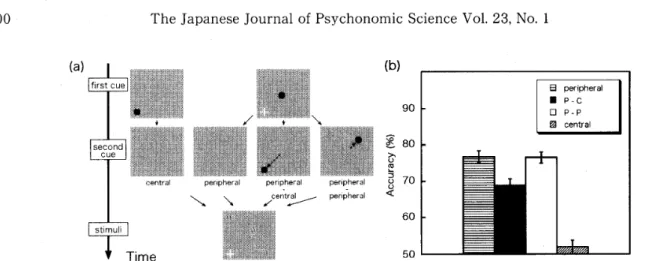
each triaLThere were four cuing conditions
(Figure
1(a)).Inthe peripheral-central
(P-C)
condition, the firstcue appeared beside the targetpositionand the secondcuc wa$ presented at the central fixation
point,
ln
The Japanese Psychonomic Society
NII-Electronic Library Service
The JapanesePsychonomic Society
1OO The
Japanese
Journal
ofPsychonomic
Science
VoL
23,
No.
1
{a)
.ptgeem.
rwes.
ttt.t
ff
ttttt
l tSee,
peflpherel pef/pheral periphernl
X
X g.Cerit7tlperipher:1
.-l,,;l:tll・
l
Figure 1.
(a)
A schematic descripLionof a sequence inof
the
cue shift.<b)
The mean accuracy of 3subjects,(b)
go
g
sotr:870<60
50one
trial.Dashed arrows reprcscnt thedirection
The error bars represent ±1
SE.
condition, was presented. Sincetheduration of pres-entation and the position of the firstcue were the sarne forthe two cuing conditions a sirnilar visual
interaction
was expected,However,
if
the cuingeffect was due toan attentional process,target
dis-crimination inthe P-C condition would belessaccu-rate as a result of attention being pulledaway from
the target positionby the onset of the second cue,
There remained a possibilitythat the motion
in-duced
by
sequential presentation of two cues mightmask theperception ef thetarget,and
it
might resultin
alower
accuracyin
theP-C
condition.In
ordcr toevaluate such a masking effect,
the
first
cue waspresented at the same positionas the firstcue inthe
P-C condition and thesecond cue was presented on
thc opposite side of the target
in
theperipheral-peripheral
(P-P)
condition. IntheP-P
6onditien
at-tention should be allocated around the target
posi-tion.Therefore,iftheaceuracy of target
discrimina-tion was
lower
in
the
P-P
conditionthan
inthe
peripheralcondition, thiswould bedue toa masking
effect and not toinattention.Inthecentral condition
only the
first
cue was presented at thefixation
point.After
800
msfrom
the start of a trial,thefirst
cuewas presented for59ms. Afteran ISIef 11.8ms, the
second cue was presented for 59ms. The cuing
periodwas fellowed by 11.8ms of ISIand the stimuli
were presented for59 ms. Randorn-dot postmasks replaced the stimul{, and
disappeared
when are-sponsc was made.
Because
theinterval
between
thecue onset and thestimulus offset was within
25e
ms, we assumed that eye movements didnot occur whi]ethestimuli were presented.
Results
andDiscussion
The
averaged accuracy of threesubjects isshownin
Figure
1(b).
The
lower
accuracy inthe
centralcuing condition suggests that presenting a precuc
near the targetimproved the discrimination of the
orientation
A
one-wayANOVA
of thethreecue types(P-C,
P-P, and periphera]} revealed a main effect ofcue types (x2
<2)==
14,73,p<,05),
A
post-hoc testbyRyan's
procedure revealedthat
the
accuracy ofthe
P-C condition was significantly lower than the accu-racy intheother conditions,
The results suggcst thatthe deteriorationof target
discrimination
in
theP-C
condition can notbe
ex-plained
by
alow-level
visualinteraction
or amask-ing effect, Based on a low-levelvisual interaction,
differenceswould not beobserved between the cuing
conditions. Based on a masking effect, theaccuracy would be lowerintheP-P and P-C conditions than in
theperipheralcondition.
However,
only accuracyin
the
P-C
condition waslower
than
the
other cuing conditions.Therefore, we conclude that the deter{orationin
the P-C
Fondition
reflected an attentional process,The abrupt onset of thesecond cue distantfrom the
targetrnight deprive attention
from
the target,The
present experiment
indicates
that a peripheralcuecan guide covert attention which
improves
arepre-sentation of visual stimuli,
References
PQsner, M. I.1980 Orienttng of attention, The