
阿寒火山の全岩化学組成とマグマティズムの特徴
13
0
0
全文
(2) (®2g|SB) mz^ VfiSTC^S^. Journal of Hokkaido University of Education (Section II B) Vol. 39, No. 2 March, 1989. Whole-rock chemical composition of the Akan volcanic field, eastern Hokkaido, Japan: Characterization of magmatism beneath the region. Keiji WADA Earth Science Laboratory, Asahikawa College, Hokkaido University of Education Asahikawa 070. PCT^®^JEi<t^NM;<1: "7 /f~^ T ^ X A ®^f. ^ ea M ^. »M^ir^NBJ \\^K?WK1. Abstract Volcanic activity in the Akan volcanic field, in the southwestern end of the Kuril arc, started in early Pleistocene and produced some stratovolcanoes and a caldera as a result of large-volume pyroclastic flows. Volcanic rocks of the Akan field range from 50.0 to 73.5wt% SiOg, and on the SiOg vs. FeO*/ MgO diagram they show two separate chemical groups of SiOz-enrichment and FeO*/MgO-enrichment. Textural evidence from petrographic observations indicate iruxing origin of the basaltic andesite, andesite, and dacite. The disequilibrium inclusions in mked lavas suggest a two-stage magma nuxing beneath the volcanic field. The overall chemical variations of the mixed rocks are best fitted by sk linear rmxing lines on the Barker diagrams. Rocks showing SiOz-enrichment are characterized by the presence of quartz and/or partially melted plagioclase, suggesting that the rhyolite magmas are possiblly the silicic endmembers. Petrographic and chemical data of the rocks showing FeO*/MgO-enrichment are essentially consistent with a process of fractional crystallization, but disequilibrium features exhibited by the phenocrysts can be explained by internal mbdng between parent and daughter magmas differentiated by the process. Geological and petrological data indicate that magma mbdng and fractional crystallization have operated in several magma chambers and conduits beneath the Akan volcanic. field, similar to Hildreth(1981)'s model for lithospheric magmatism.. (37).
(3) Keiji WADA Introduction Recent petrological studies suggest that magma inking plays an important role m the chemical variation of calc-alkalic magmas (e. g. Eichelberger, 1975 ; Anderson, 1976 ; Sakuyama, 1979, 1981 ;. Gerlach and Grove, 1982 ; Sakuyama and Koyaguchi, 1984 ; Wada, 1985 ; Koyaguchi, 1986a ; Brophy, 1987 ; Nbcon, 1988). The importance of magma mbcing has been documented by these studies, but characteristics of endmember magmas, especially of felsic endmembers, were not fully confirmed.. These include the internal mbdng of magma series developed by fractional crystallization (Sakuyama, 1981) and the mking of different magmas derived from the mantle and lower crust (Eichelberger, 1978). This paper presents the analysis of major elements in 82 built rock samples from the Alan volcanic field (analyses of 18 of the Oakan volcano samples have ah-eady been published in Wada, 1988). The volcanic rocks of the Akan field range from basalt, andesite, dacite, and rhyolite. The data indicate that both magma nuxing and crystallization fractionation took place beneath the Alan volcanic field. Variations m the calc-alkalic magma compositions in the Akan field are consistent with an endmember mbdng model in Eichelberger (1978), whereas the variations in tholeiitic magma compositions are essentially controlled by fractional crystallization with significant degrees of internal magma mbdng. Characterization of magmatism beneath the Akan field is also discussed.. Geological Setting The Akan volcanic field is located at the southwestern end of the Akan-Shketoko volcanic. belt in eastern Hokkaido(Fig. 1). The geology of the field has been described by Katsui (1951), Sato (1965), Katsui and Koide (1976), and Wada(1988), and is briefly summarized here. A simplified geological map of the Akan volcanic field is shown in Fig. 1. The volcanic. activity of the field is composed of three main eruptive events. The first event was the formation of the precaldera stratovolcanoes mcluding Mt. Kikindake in the early Pleistocene. Next, in. the middle Pleistocene (Okazaki, 1966 ; Matsui et. l4'4"E. Fig. 1 Simplified geological map of the Akan volcanic field. 1: postcaldera stratovolcanoes; 2: Kussharo pyroc-. al., 1987), eruption of large-volume pyroclastic. lastic flow deposits ; 3 : Akan pyrodastic flow de-. flows and associated pumice falls resulted in the. posits; 4: precaldera stratovolcanoes and their remrants; 5: basement rocks. K: ML Kfldn-dake ; 0. Akan caldera, which gravity anomalies show to. : Mt0al<an<iake; P : Mfc Fuppushi-dake; R: Mfc FurebetsiKiake M : Mt Meakan-dake ; L : Lake. have a subsurface structure of an oblong (20km. Akan-ko.. in E-W diameter) inverted cone (Ohkawa and. Yokoyama, 1979). After the formation of this caldera, four stratovolcanoes, Furebetsu, Fuppushi,. (38).
(4) Whole-rock chemical composition of the Akan volcanic field, Oakan, and Meaken, have grown in the caldera or at the caldera-rim. These volcanoes have several eruption centers, especially Furebetsu and Meakan. Two craters of Ponmachineshiri and Nakamachineshiri in the Meakan volcano are active now.. Whole-rock chemistry. The major element compositions in whole-rock were carried out with an X-ray fluorescence spec-. trophotometer (Philips PW1404) at Hokkaido University, after the analytical methed of Tsuchiya et al. (1989, in press). Whole-rock chemical analyses are listed in Table 1. All analyses were normalized to 100% for purposes of plotting and modelling. The volcanic rocks are defined on the basis of SiOz content into. basalt ( < 53%), basaltic andesite (53% to 56%), andesite (56% to 63%), dacite (63% to 70%), and rhyolite ( > 70%) after Gill (1981) and Ewart (1982). The rocks of the Akan volcanic field range from 50.0to73.5%Si02. No.. Sample. SiOg. TiOg. AlgOs FegOs*. MnO. MgO. CaO. NagO. K^O. P205. Total. 1. KK-1. 50.45. 0.83. 18.40 11.23. 0.18. 4.91 11.06. 2.36. 0.52. 0.12. 100.06. 2. KK-2. 52.05. 0.78. 18.71. 9.75. 0.15. 4.83 10.95. 2.31. 0.66. 0.10. 100,29. 3. KK-3. 56.76. 0.86. 16.17. 9.89. 0.17. 2.72. 7.24. 3.87. 1.68. 0.18. 98.54. 4. KK-4. 61.87. 0.85. 15.47. 8.06. 0.17. 1.59. 4.93. 4.05. 1.91. 0.27. 99.17. 5. AP-l. 71.02. 0.49. 14.11. 3.90. 0.12. 0.41. 2.35. 4.10. 2.53. 0.09. 99.12. 6. AP-2. 71.60. 0.50. 13.52. 3.58. 0.08. 0.86. 2.91. 3.79. 2.30. 0.08. 99.22. 7. AP-3. 72.24. 0.42. 13.54. 2.89. 0.09. 0.70. 2.80. 4.24. 2.00. 0.08. 99.00. 8. AP-4. 73.25. 0.52. 13.49. 2.80. 0.10. 0.64. 2.57. 4.18. 2.03. 0.09. 99.67. 9. PR-1. 54.05. 0.72. 18.52. 9.33. 0.17. 5.07. 5.07. 1.77. 0.36. 0.09. 99.15. 10. PR-2. 54.92. 0.69. 18.44. 9.94. 0.16. 4.73. 7.08. 2.23. 0.68. 0.08. 98.93. II. FR-3. 56.53. 0.64. 16,44. 8.30. 0.15. 5.23. 8.18. 2.63. 1.08. 0.09. 99.27. 12. FR-4. 59.38. 0.66. 16.45. 7.62. 0.14. 3.72. 6.94. 3.13. 1.18. 0.10. 99.32. 13. FR-5. 59.76. 0.69. 16.59. 7.80. 0.14. 3.36. 6.48. 3.09. 1.34. 0.12. 99.37. 14. FB-6. 65.95. 0.45. 14.82. 4.97. 0.09. 2.77. 4.66. 3.31. 1.98. 0.06. 99.06. 15. FR-7. 68.56. 0.42. 14, 78. 4.03. 0.08. 1.46. 3.83. 3.66. 2.26. 0.08. 99.16. 16. FP-1. 51.22. 0.66. 17.87 10.01. 17. 0.16. 6.49 10.39. 1.88. 0.70. 0.08. 99.46. FP-2. 52.28. 0.86. 17.87 10.15. 0.18. 5.05. 9.18. 2.78. 0.78. 99.28. 18. 0.15. FP-3. 53.00. 0.68. 17.77. 9.97. 0.17. 5.34. 9.94. 2.33. 0.64. 99.93. 19. 0.09. FP-4. 52.81. 0.86. 17.81 10.02. 0.17. 4.89. 9.13. 2.77. 0.86. 0.15. 99.47. 20. FP-5. 53.88. 0.88. 17.73. 9.94. 0.18. 4.26. 8.45. 3.05. 1.01. 0.18. 99.56. 21. FP-6. 54.90. 0.63. 17.67. 8.77. 0.16. 4.96. 8.59. 2.56. 0.94. 0.10. 99.28. 22. FP-7. 55.85. 0,61. 17.92. 8.33. 0.15. 4.78. 7.79. 2.59. 1.02. 0.09. 99.13. 23. FP-8. 58.22. 0.91. 16.90. 8.90. 0.19. 2.59. 6.73. 3.86. 0.91. 0.18. 99.39. 24. FP-9. 60.60. 0.71. 16.21. 7.62. 0.14. 2.84. 6.32. 3.11. 1.57. 99.23. 25. 0.11. FP-10. 68.82. 0.43. 14.99. 3.90. 0.08. 1.23. 3.68. 3.83. 2.22. 0.07. 99.25. Table la Whole-rock chemical compositions of Kikin (KK), Furebetsu (FR) and Fuppushi (FP) volcanoes and pumice from the Akan pyroclastic flow (AP). Data of petrography and locality of whole samples are available from the author.. (39).
(5) Keiji WADA No. Sample SiOg TiOg AlzOs ^0203* MnO MgO CaO NagO KgO P205 Total. 26. ME-1. 53. 89. 0.73. 17. 62. 9,71. t). 16. 5.13. 8.79. 3.07. 0.. 51. 0.11. 27. ME-2. 53. 95. 0.73. 17. 27. 9.67. 0.16. 5,18. 9.03. 2.77. 0.76. 0.12. 99.64. 28. ME-3. 54. 30. 0.73. 17. 75. 9,58. 0.16. 5.07. 8.98. 3.11. 0.52. 0.12. 100.32. 29. ME-4. 58. 50. 0.77. 17. 85. 8.33. 0.14. 3.28. 6.56. 2.66. 1.38. 0.12. 99.59. 30. ME-5. 61. 81. 0.62. 15. 85. 7.18. 0.13. 3.32. 6.30. 2.88. 1.73. 0.09. 99.91. 31. ME-6. 63. 00. 0.62. 17. 67. 6.30. 0.11. 2.49. 3.78. 3.49. 1,67. 0.11. 99.24. 32. ME-7. 63. 46. 0.59. 15, 99. 6.44. 0.11. 2.71. 5.09. 3.18. 1.85. 0.05. 99.47. 33. ME-8. 65. 46. 0.54. 15. 27. 5.54. 0.10. 2.38. 4.73. 3.40. 2.13. 0.09. 99.64. 34. ME-9. 53. 68.. 0.71. 17. 83. 9.65. 0.17. 4.82. 9.43. 2.55. 0.80. 0.09. 99.73. 35. ME-10. 54. 07. 0.72. 17. 73. 9.65. 0.17. 4.73. 9.39. 2.60. 0.76. 0.10. 99. 92. 89. 0.74. 17. 54. 9.46. 0.18. 4.69. 9.04. 2,62. 0.96. 0.09. 100.21. 36* ME-11. 54.. 99.72. 37. ME-12. 56. 92. 0.69. 17. 22. 8.80. 0.15. 4.29. 8.17. 2.75. 1.14. 0.10. 100.23. 58. ME-13. 57. 61. 0.66. 16. 90. 8.18. 0.14. 3.82. 7.98. 2.88. 1.26. 0.09. 99.52. 39. ME-14. 58.. 42. 0.77. 16. 17. 9.67. 0.16. 4.12. 6.99. 2.40. 1,07. 0.12. 99.89. 40* ME-15. 61. 44. 0.69. 15. 69. 7.21. 0.14. 3.08. 6.04. 3.09. 1.81. 0.08. 99. 2.7. 41. ME-16. 62. 55. 0.61. 16. 01. 6.63. 0.12. 2.93. 5.94. 3.14. 1.83. 0.10. 99.86. 42. ME-17. 62. 79. 0.58. 15. 83. 6.57. 0.12. 2.99. 6.13. 3.15. 1.81. 0.09. 100.06. 43. ME-18. 63. 21. 0.59. 15. 80. 6.37. 0.11. 2.77. 5.88. 3.15. 1.88. 0.07. 99.83. 44. ME-1.9. 63. 23. 0.57. 15. 64. 6.30. 0,11. 2.84. 5.92. 3.17. 1.93. 0.09. 99.80. 45. ME-20. 63. 54. 0.59. 15. 33. 6.45. 0.11. 2.77. 5.32. 3.15. 2.28. 0. 09. 99.63. 46. ME-21. 63. 81. 0.60. 16. 30. 5.91. 0.11. 2.80. 5.19. 3.01. 1.64. 0.09. 99.46. 47. ME-22. 63. 95. 0.56. 15. 67. 6.15. 0.11. 2.69. 5,70. 2.78. 1.99. 0.05. 99,65. Table Ib Whole-rock chemichl compositions of the older (ME-1 to ME-8) and somma-building stages from the Meakan volcano.. Si02. T102. ME-23. 50.24. 0.68. 18.58 10.09. 0.16. 6.52 11,54. 2.04. ME-24. 50.63. 0.75. 18.81 10.00. 0,17. 5.90 11.20. 2.28. 50. ME-25. 50.52. 0.72. 18.78. 9.95. 0.17. 5.98. 11.19. 2.13. 51. ME-26. 50.40. 0.68. 18.67. 9.85. 0.16. 6.05 10.99. 2.12. 52. ME-27. 50.81. 0.67. 18.56. 9.91. 0.16. 6.45 10.87. 2.12. .53. ME-28. 50.80. 0.69. 18.67. 9.96. 0.16. 6,09 10.87. 2.15. 54. ME-29. 51.16. 0.69. 18.60. 9.97. 0.16. 6.02 10.64. 2.19. 55. ME-30. 51.10. 0.71. 18.37. 9.81. 0.16. 5.93 11,03. 2.19. 56. ME-31. 51.70. 0.71. 18.61. 9.89. 0.16. 5,86 10.33. 2.25. 57. ME-32. 55.22. 0.70. 17.45. 8.85. 0.15. 5.09. 8.80. 2.54. 58. ME-33. 57.55. 0.66. 17.01. 8.11. 0.14. 4.05. 7.81. 2.68. 59. ME-34. 59,00. 0.62. 16.23. 7,86. 0.13. 3,98. 7.30. 2.92. 60. ME-3 5. 60.01. 0.63. 16.23. 7.58. 0.13. 3.50. 6,89. 3.09. 61. ME-36. 60.31. 0.63. 15.48. 7.86. 0.14. 3.99. 6.91. 2.96 2.99. No.. Sample. 48 49. A1203 Pe203*. MnO. MgO. CaO. 62. ME-37 .. 60.43. 0.63. 15.66. 7.71. 0.13. 3.88. 6,71. 63. ME-38. 63.01. 0.60. 15.04. 6.60. 0.12. 3.06. 5.72. 64. ME-39. 65.22,. 0.53. 15.44. 5.50. 0.10. 2.39. 5,02. Na20.
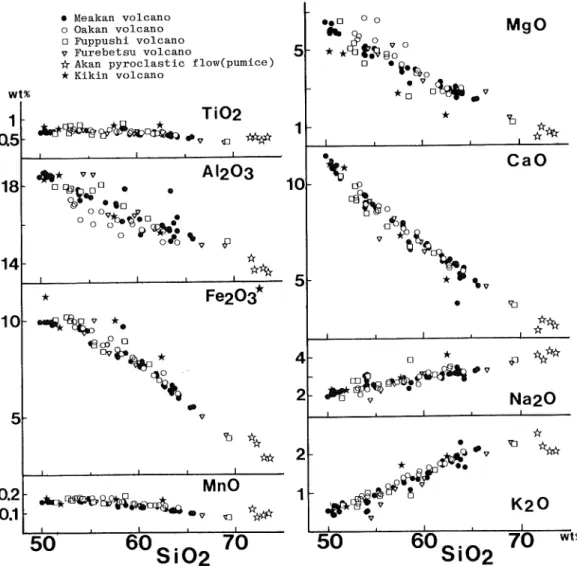
(6) Whole-rock chemical composition of the Akan volcanic field, • Meakan volcano o Oakan volcano a Fuppushi volcano 7 Furebetsu volcano •fr Akan pyroclastic flow(pumice) * Kikin volcano. WtX. 1. A. QE. 18. •k. * *. *. L_ t. 101 .\. •. "*^J *•. JL. '€o?^. J^s. *. ^\. 5. ^^. a. tp. ®. - ^. 21v. v. ^ ^ 1. 0.1. •7 0 ''W. 50 t. .. L. L. ^ 1. 50. 60Si02 70. J_I. *•. ^^<"7. J_L. ^^.. ^^v. •kt(. MnO. 0.2. CaO. *'Sv. Fe20s*. *. 1C. ^^ ^. ^ u, ^. 7 "6. A. , ^. 1-. J_L. ±. /*®a. %. y. ^0. ;"^.-. '°°°°'M^ 14. W go. D -«g, •. <»V 0 ^. [:IESri.aD ». MgO. ^_70. *0. A1203. 0'. 0 0. Ti02. ^*_ vv. E'*». ••D. g.6^'8 • 7. J_L. t]. , ^. ft ^ Na20. ^ ^ •A-. K20 _L. 60Si0270. wt%. Fig. 2 SiOj, variation diagram.. The whole-rock analyses are plotted in the SiOg variation diagram in Fig. 2. The lavas from the Kikin volcano consist of basalt and aphyric andesite, and form a distinct group of higher FegOs* and lower MgO, compared to the postcaldera volcanic rocks. Pumice fragments from the Akan pyroclastic. flows show the most differentiated compositions (71.5 to 73.5% SiOz) m the Akan volcanic field. The lavas and theu- inclusions, and essential pyroclasts from postcaldera volcanoes show a simple compositional variation from basalt to dacite, but compositions are distmguished by several different groups as described below. Two different compositions for basalts from the Meakan volcano define the lower KgO (Nishiyama. basalts) and higher KgO (Akanfuji basalts). This may indicate differences in the primitive magma compositions. The KgO abundances in the Mt. Minamidake basaltic andesites from the Meakan volcano are shifted to lower values from expected crystallization lines of the Akanfuji and Nishiyama basalts. The rocks from the Fuppushi volcano form two distinct groups : one with non-linear, and the other with. (41).
(7) Keiji WADA linear oxide variations with SiOg. The laves and inclusions from the Oakan volcano show two linear trends on SiOg variation diagram, that is caused by the mbdng of different mafic endmember magmas (Wada, 1988). The basaltic andesite to dacite suites from the Furebetsu and Meakan volcanoes are also characterized by two linear composition-trends.. Petrographical evidence for magma mixing Evidence for magma rmxing is found in disequUbrium texture in the volcanic rocks of the Akan field. The texture can be divided into two types : one, Rl-type, with disequilibrium phenocryst assemblage such as forsteritic olivme and quartz ; and the other, R2-type, with disequilibrium texture exhibited in phenocryts such as an overgrowth or a reaction corona.. w. Fig. 3 Photomicrographs of lavas from postcaldera stratovolcanoes with unpolarized light (except D). A : Quartz phenocryst surrounded by augite reacion rims. B : Coexistence of olivine phenocryst in mafic mclusion and quartz phenocryst in the host. C : Coexistence of type-A plagioclase and type-B plagioclase. D : Augiteovergrowth wholly covering orthopyroxene with irregular boundai-y. Scale bars are 0.1mm.. (42).
(8) Whole-rock chemical composition of the Akan volcanic field,. The Rl-type includes two types of plagiodase with contrasting glass inclusions (Wada, 1988) : type-A plagioclase derived from mafic endmember magma contains black-colored glass inclusions with numerous quench crystals, sometimes showing a honey-combed or dusty-zoned structure, whereas type-B plagioclase from felsic endmember magma contains colorless to light brown glass inclusions, which display resorbed and melted structure (Fig. 3C). Therefore, the Rl-type rocks show a coexistence of disequlibrium phenocrysts of contrasting compositions, resulting from a mbdng between basalt containing type-A plagioclase or olivine and dacite or rhyolite contaming type-B plagioclase or quartz (Fig. 3A-C). The overgrowth texture in the R2-type is characterized by completely covered augite around the uregular-shaped orthopyroxene phenocryst (Fig. 3D). There are textures showing the reaction between phenocrysts and the surrounding uuxed melt: an augite reaction corona around quartz phenocryst (Fig. 3A), and an orthopyroxene reaction corona around olivine. Some of these olivines are strongly resorbed and wholly coated by coarse-graind orthopyroxenes. The overgrowth and reaction products may have been formed by an abrupt change of liquid composition caused by magma mixing. (Eichelberger, 1978 ; Sakuyama, 1984 ; Tsuchiyama, 1986). Additional evidence for magma mbdng is the presence of mafic inclusions in the host lavas. Their inclusions vary from macroscopic to microscopic, and show a vesicular and quenched nature. They show a possible mafic endmember that underwent cooling upon mbdng (Bacon, 1986 ; Koyaguchi, 1986ab ; Wada, 1988). Most of these inclusions show textural evidence for magma nuxing such as Rland/or R2-types. This indicates that two-stage nuxing occurred within magma chamber and conduit,. first a formation of the mixed inclusions, followed by mbdng with host lavas (Koyaguchi, 1986b).. Interpretation of petrochemical data Petrographic observation of the volcanic rocks in the Akan field allows a classification into three groups : (1) group-I rocks with both Rl-and R2-type textures, (2) group-II rocks with R2-type texture,. and (3) group-III rocks with nearly equilibrium texture without the Rl-and R2-types. Fig. 4 shows the SiOg vs. FeO*/MgO diagram (Miyashiro, 1974). Most of the group-I rocks appear in the calc-alkalic rock field. The group-II rocks are plotted near the boundary line of the tholeiitic and calc-alkalic rock fields, but among these, the rocks from Fuppushi volcano show similar compositions to the group-III. rocks below. Most group-III rocks belong to the tholeiitic rock series and show increasing FeO*/MgO with slight increase of SiOg, however pumices from the Akan pyroclastic flows and a few dacites from the Meakan volcano belong to the calc-alkalic rocks. With the petrographic and petrochemical data the characteristics of endmember magmas that are related by mbdng can be determined. The mafic endmembers of group-I rocks are tholeiitic basalt or basaltic andesite defined by group-III rocks, although some of their endmembers may not be effusive at the surface. The magma that produced large-volume pyroclastic flows of the Akan caldera is a possible candidate as the felsic endmembers of the group-I rocks because of the trend-line of the mbdng and presence of felsic phenocrysts equilibrium with dacite or rhyolite. The group-II rocks do not contain felsic phenocrysts such as quartz or type-B plagioclase. This suggests that these rocks were fanned by "internal mbdng" of less evolved mafic magmas with evolved magmas of the tholeiitic series.. (43).
(9) Keiji WADA. • Group—I * Group-II. 0 Group-ffl. wt%. Si02l 70|. 110 FeO*/HgO =8.6. 60. 50.. 2 • _ ^3. FeO"/MgO. Fig. 4 SiOz vs. FeO*/MgO diagram. Solid line defines tholeiitic (TH) and calc-alkalic (CA) characteristics, following Miyashiro (1974).. Furebetsu Fuppushl. Furebetsu Fuppushl. Meakan. Me a k an. Oakan. Oakan. case I. casell. case I. case 11. case I. TiOg. -0.94. -0.83. -0.93. -0.86. -0.96. -0.84. Al2"3. -0.94. -0.76. -0.96. -0.93. -0.99. -0.96. casell. FegOs*. -0.97. -0,97. -0.97. -0,98. -1.00. -0.98:. MnO. -0.94. -0.96. -0.85. -0.92. -0.97. -0.94. MgO. -0.98. -0.98. -1,00. -0.99. -1.00. -0.99. CaO. -1.00. -0.95. -1.00. -0.91. -1.00. -0, 97. NagO. 0.97. 0.80. 0,99. 0.93. 0.98. 0.93. KgO. 0.98. 0.95. 0.99. 0.99. 1.00. 0.97. 55.57,68 59,60,61 62,63,64. 29 to 47. 11,14,16. 9,10,12 13,15,21 22,24,25. data No,. (Table I) mixing line of Fig. 5. 4. 6. mixing llne-I. mixing llne-II. Wada(1988). Wada(1988). 1. 3. 2. Table 2 Correlation coefficient by straight-line regression analyses in the SiOz variation diagram.. (44). 5.
(10) Whole-rock chemical composition of the Akan volcanic field,. EXPLANATION Fractional crystalllzation trend 0 Oakan volcano F Fuppushi volcano M Meakan volcano K Kikin volcano. 10. Magma mixing line. MgO. 1 ,Oakan volcano(case-I) Fuppushi and Furebetsu volcanoes(case-I) Oakan volcano(case-II) Meakan volcano(case-I) Fuppushi and Furebetsu volcanoes(case-II ) Meakan volcano(case-II ) Felsic endmeraber. A. field of pumice from Akan pyroclastic flow. (n=4). wt%. 50. 60. Si02. 70. Fig. 5 MgO vs. SiOg diagram showing a summary of the fractionation and mbdng relationships. Dotted line represents an estimated fractional crystaUization trend.. The variety in chemical composition of group-I rocks reflects several mudng lines caused by different compositions of endmembers, especially differences in the degree of fractional crystallization of mafic endmember magmas. A total of sk mbdng lines of group-I can be determined from the SiOg variation diagram (Fig. 2), and the linearity by least square regression was checked by a correlation coefficient value (Table 2). Fig. 5 shows the MgO-SiOg relations summarizimg the results. The nuxing line of case-I from the Meakan volcano corresponds to the rock series from the younger stage, and the mafic endmember is the Nishiyama basalt. The mbdng line of case-II is fonned by the rock series. from the somma-building (about 13000y. ago, Katsui and Koide, 1976) and older stages, and the mafic endmember is convergent to the basaltic andesite by the fractional crystaUization of Akanfuji or Nishiyama basalts. The mafic endmembers of the mbdng lines of case-I and case-II from the. Furebetsu and Fuppushi volcanoes correspond to the primitive and more differentiated basalt of the. Fuppushi tholeiitic series, respectively. Estimated mafic endmembers of the two mixing lines from the Oakan volcano are the primitive olivine-rich basalt and fractionated plagioclase-rich basalt (Wada, 1988).. (45).
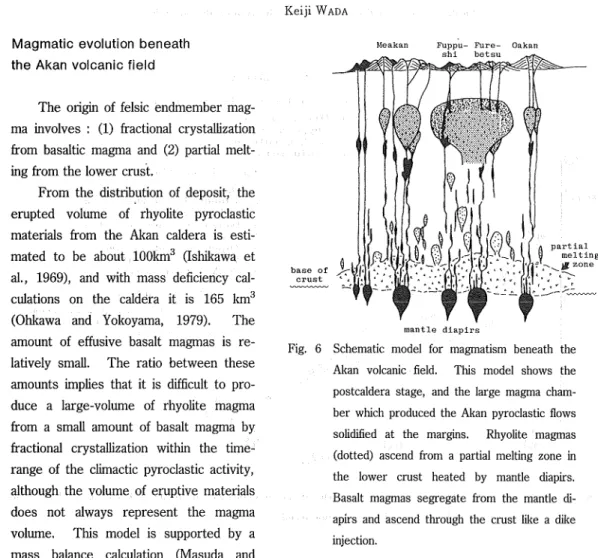
(11) Keiji WADA Magmatic evolution beneath. Fuppu- Pure- Oakan. shi betsu. the Akan volcanic field The origin of felsic endmember magma involves : (1) fractional crystallization. from basaltic magma and (2) partial melting from the lower crust.. From the distribution of deposit, the erupted volume of rhyolite pyroclastic materials from the Akan caldera is esti-. mated to be about 100km (Ishikawa et al., 1969), and with mass deficiency cal-. culations on the caldera it is 165 lan (Ohkawa and Yokoyama, 1979). The amount of effusive basalt magmas is relatively small. The ratio between these. mantle diapirs. Fig. 6 Schematic model for magmatism beneath the Akan volcanic field. This model shows the. amounts implies that it is difficult to pro-. postcaldera stage, and the large magma cham-. duce a large-volume of rhyolite magma. ber which produced the Akan pyroclastic flows. from a small amount of basalt magma by. solidified at the margins. Rhyolite magmas. fractional crystallization within the time-. (dotted) ascend from a partial melting zone m. range of the climactic pyroclastic activity,. the lower crust heated by mantle diapirs.. although the volume of eruptive materials. Basalt magmas segregate from the mantle di-. does not always represent the magma. apirs and ascend through the crust like a dike. volume. This model is supported by a. mjection.. mass balance calculation (Masuda and. Aoki, 1979) that the calc-alkalic andesite does not show the crystallization product from the tholeiitic basalt. Therefore, the rhyolite source is most likely to be in the lower crust, receiving the latent heat. from the mantle-derived basaltic magma (Eicheiberger, 1978; Hildreth, 1981 ; Ikeda, 1984 : Takahashi, 1986 ; Kobayashi, 1987). It appears that the produced rhyolitic partial melts show some variety in composition, due to the degree of partial melting and/or local heterogeneity of source materials (Taka-. hashi, 1986; Kobayashi, 1987). Fig. 6 shows a schematic model of the magma plumbing system beneath the Akan volcanic field,. that is consistent with the model of mature island-arc'lithospheric magmatism advocated by Hildreth (1981, Fig. 15D). The most important constramt on the model is the plural mbdng lines of the calcalkalic series and liquid lines of descent of the tholeiitic series in the post Akan-caldera stage (Fig. 5). Since these postcaldera stratovolcanoes have many volcanic centers, magmatic evolution after the caldera-forming could have been operative in multiple magma chambers beneath the Akan field. The first. stage of magma mbdng may have taken place within the magma chamber by an influx of basaltic magma (Eichelberger, 1978; Yanagi and Ishizaka, 1978). Replenishing of the basaltic magma into the shallowlevel reservoir is likely to take place periodically (0' Hara, 1977); this mechanism facilitates convection and mbdng in the magma chamber, and triggers asceding of magmas into a conduit. With a tholeiitic. (46).
(12) Whole-rock chemical composition of the Akan volcanic field,. magma composition in resident magma chamber the magma mbdhg produce the group-II nuxed rocks, and when calc-alkalic rhyolite magma it produces group-I mked rocks. When time allows, complete mixing in the rhyolitic magma chamber forms a homogeneous blended liquid of andesite or dacite composition. The calc-alkalic group-III rocks may correspond to this blended magmq. The second stage of mbdng could effectively occur in a conduit on the ascent to the surface (Koyaguchi, 1986b). Evidence of quenching of the mafic inclusions reflects an incomplete mbdng of magmas with the conduit. (Koyaguchi, 1986a ; Wada, 1988). It appears that heterogeneous pyroclastic materials containing banded pumices in the somma-building stage from the Meakan volcano were produced by this secondstage mixing with very short pre-emptive residence times (Wada, m preparation).. Acknowledgments : I wish to thank Prof. Yu Hariya for permission to use the XRF and Mr. Tomoyuki Shibata for advice on XRF analysis at Hokkaido University. I am also grateful to many undergraduates of the Asahikawa College, Hokkaido University of Education, for their help in the field and sampling work.. References. Anderson, A. T. (1976), Magma mixing : petrological process and volcanological tool. J. Volcanol. Geotherm. Res., 1, 3-33. Bacon, C. R. (1986), Magmatic inclusions in silicic and intermediate volcanic rocks. J. Geophys. Res., 91,. 6091-6112. Brophy, J. G. (1987), The Cold Bay Volcanic Center, Aleution volcanic arc : II. Implications for fractionation and mbdng mechanism in calc-alkaline andesite genesis. Contr. Mineral. Petrol., 97, 378-388.. Eichelberger, J. C. (1975), Origin of andesite and dacite ; evidence of rmxing at Grass Mountain in California and at other cu-cum-pactfic volcanoes. Geol. Soc. Amer. Bull., 86, 1381-1391. Eichelberger, J. C. (1978), Andesitic volcanism and crustal evolution. Nature, 275, 21-27.. Ewart, A. (1982), The mineralogy and petrology of Tertiary-Recent orogenic volcanic rocks : with special reference to the andesitic-basaltic compositional range. In : Thorpe, R. S. (ed), Andesites : orogenic andesites and related rocks., John Wiley and Sons., 25-95.. Gerlach, D. C. and Grove, T. L. (1982), Petrology of Medicine Lake Highland volcanics : characterization of endmembers of magma mbdng. Contr. Mineral. Petrol., 80, 147-159.. Gill, J. B. (1981), Orogenic Andesites and Plate Tectonics. Springer-Verlag. Hildreth, W. (1981), Gradients in silicic magma chambers : implications for lithospheric magmatism. J. Geophys. Res. 86, 10153-10192.. Ikeda, Y. (1984), Petrological significance of granitic inclusions from Pliocene-early Pleistocene pyroclastic flow deposits in central Hokkaido, Japan. J. Japan. Assoc. Min. Petr. Econ. Geol., 79, 60-80. Ishikawa, T., Katsui, Y., Oba, Y. and Sato, H. (1969), Some problems of the calderas in Hokkaido. Bull. Volcano]. Soc, Japan., 14, 97-108. (in Japanese with English abstract) Katsui, Y. (1951), Geology of the Meakan volcano. Bull. Geol. Corn. Hokkaido., 16, 7-16. (in Japanese with En-. glish abstract) Katsui, Y. and Koide, K. (1976), Geology and topography of the Mt. Meakan-dake. In : Yokoyama, I. et al. (ed.), Meakandake., Committee for Prevention of Disasters of Hokkaido., 3-20. (in Japanese) Kobayashi, T. (1987), Magma genesis by crustal anatexis. Bull. Volcanol. Soc. Japan., 32, 237-257. (in Japanese. with English abstract).. (47).
(13) Keiji WADA Koyaguchi, T. (1986a), Textural and compositional evidence for magma muung and its mechanism, Abu volcano group, Southwestern Japan. Contr. Mineral. Petrol., 93, 33-45.. Koyaguchi, T. (1986b), Evidence for two-stage mfadng in magmatic inclusions and rhyolitic lava domes on Niijkna Island Japan. J. Volcanol. Geotherm. Res., 29, 71-98. Masuda, Y. and Aoki, K. (1979), Trace element variation of the volcanic reeks from the Nasu zone, northeast Japan. Earth Planet Sci. Lett., 44, 139-149. Matsui, M., Kimura, G., Kobayashi, Y., Miyasaka, S, and Narukawa, J. (1987), Quatemary Sequence in Kushiro region, eastern Hokkaido. In: Professor Masaru Matsui memorial volume. 105-112. (in Japanese) Miyashiro, A. (1974), Volcanic rock series in island arc and active continental margins. Am. J. Sci., 274, 321-355.. Nixon, G. T. (1988), Petrology of the Younger Andesites and Dacites of Iztaccihuatl volcano, Mexico : 1. Disequilibrium phenocryst assemblages as indicators of magma chamber processes. J. Petrol., 29, 213-264.. O'Hara, M. J. (1977), Geochemical evolution during fractional crystallization of a periodically refilled magma chamber. Nature, 266, 503-507. Ohkawa, S. and Yokoyama, 1. (1979), Subsurface structure of Akan caldera based on gravity anomalies. Geophys.. Bull. Hokkaido Univ,, 38, 17-29. (in Japanese with EngUsh abstract) Okazaki, Y. (1966), Geology of Kushiro and its environs. Kushiro library 7. (in Japanese) Sakuyama, M. (1979), Evidence of magma mbdng : petrological study of Shirouma Oike calc-alkaline andesite volcano, Japan. J. Volcanol. Geotherm. Res., 5, 179-208.. Sakuyama, M. (1981), Petrological study of the Myoko and Kurohime volcanoes, Japan: crystallization suquence and evidence for magma rruxing. J. Petrol., 22, 553-583. Sakuyama, M. (1984), Magma mbung and magma plumbing systems in island arcs. Bull. Volcanol., 47, 685-703.. Sakuyama, M, and Koyaguchi, T. (1984), Magma mbdng in mantle xenolith-bearing calc-allsalic ejecta, Ichinomegata volcano, northeastern Japan. J. Volcanol. Geotherm. Res., 22, 199-224.. Sato, H. (1965), Explanatory text of the geological map of Japan, scale 1 ; 50,000, Akanko. Geological Survey of Japan, 82p. (in Japanese with English abstract) Takahashi, E. (1986), Genesis of calc-alkali andesite magma in a hydrous mantle-crust boundary : Petrology of Iherzolite xenoliths from the lchinomegata crater, Oga peninsula, northeast Japan, part II. J. Volcanol. Geotherm. Res., 29, 355-395, Tsuchiya, N., Shibata, T., Koide, Y., Owada, M., Takazawa, E., Goto, Y., Jai Ho Choi, Terada, S., and Hariya, Y.. (1989), Major element analysis of rock samples by X-ray fluorescence spectrometry, using scandium anode tube. J. Fac. Sci, Hokkaido Univ., ser. IV (in press).. Tsuchiyama, A. (1986), Experimental study of olivine-melt reaction and its petrological implications. J. Volcanol. Geotherm. Res., 29, 245-264. Wada, K. (1985), Magma mixing process of calc-alkalic andesite from Funagata volcano. J. Japan Assoc. Min. Petr. Econ. Geo!., 80, 467-483. Wada, K. (1988), Magma mbdng for calc-allialic rocks in Oakan volcano, Hokkaido. J. Min. Petr. Econ. Geol., 83,. 273-288. (in Japanese with English abstract) Yanagi, T. and Ishizaka, K. (1978), Batch fractionation model for the evolution of volcamc rocks in an island arc : an example from central Japan. Earth Planet. Sci. Lett., 40, 252-262.. (48).
(14)
図



+4


関連したドキュメント
岩内町には、岩宇地区内の町村(共和町・泊村・神恵内村)からの通学がある。なお、岩宇 地区の高等学校は、 2015
白山にちなんで名づけられた植物は、約20種 あります。ハクサンとつく以外に、オヤマリン
づくる溶岩を丸石谷を越えて尾添尾根の方へ 延長した場合,尾添尾根の噴出物より約250
Amount of Remuneration, etc. The Company does not pay to Directors who concurrently serve as Executive Officer the remuneration paid to Directors. Therefore, “Number of Persons”
敷地と火山の 距離から,溶 岩流が発電所 に影響を及ぼ す可能性はな
敷地と火山の 距離から,溶 岩流が発電所 に影響を及ぼ す可能性はな
敷地と火山の 距離から,溶 岩流が発電所 に影響を及ぼ す可能性はな
敷地からの距離 約48km 火山の形式・タイプ 成層火山..
