子 どもの社会化 藤原正光
SOCIALIZATION IN CHILDHOOD : Norm Acceptance
and
Rejection
in the Classroom (A Proposed Study)
Masamitsu Fujihar a
(Associate Professor of Educational psychology, Bunkyo University, Japan. Honorary Fellow, University of Minnesota, 1986-87)
I. Background of the Problem A. Social Understanding and Interpersonal Relations
(1) What is socialization ?
(2) Interpersonal relations in childhood (3) Three response patterns to group norms B. Group Norm or Standard Formation
(1) Shared frame of reference (2) Norm or standard in a classroom (3) Jackson's return potential model C. Responses to Group Norms
(1) Conformity (acceptance) (2) Non-conformity (independence) (3) Deviation (rebellion)
II. Proposed Investigations
A. Categorization of School Rules (elementary, junior high. and senior high school) B. Application of Jackson's Return Potential Model to School Rules
C. Experimental Studies of Conformity, Non-conformity, and Deviation (1) Background of the proposed experiments
(2) Proposed Experiment 1 (conformity and non-conformity) (3) Proposed Experiment 2 (deviant behavior)
D. Referencies
This paper was written during 1986-87 at the Univ. of Minnesota. I would like to gratefully thank Dr. Henry Borrow (just retired Professor from the Univ. of Minnesota in June 1986) for his assistance in va-rious phases of the study.
I. Background of the Problem A. Social Understanding and Interpersonal Relations
(1) What is socialization ?
Since Piaget's studies were introduced in Japan following World War II, many types of investigation about socialization have been published on moral judgment, develop-ment of thinking, interpersonal relationship in childhood, and related reseach issues.
In these studies, Piaget's concept of socialization is usually defined as the processes whereby an individual acquires important behavioral patterns established by a socie-ty, or as the processes whereby an individual learns important behavioral patterns through interactions and transactions with others. The former definition implies cultu-ral transmission, while the latter emphasizes individual learning. In this paper, it is the latter meaning of socialization that is used Reber (1985) defines socilization as the process whereby an individual acquires the knowledge, values, faclities with languege, social skills, and social sensitivities that enable him or her to become integrated into and to behave adaptively within a society.
Let us examine briefly the rules to which children are exposed in our society. There are many kind of rules ranging from formal (e.g., laws) to informal ones (e.g., promises to a friend). If children violate these rules without valid explanation, they are general-ly disliked, rejected, or punished by others. Consequentgeneral-ly, it is very important for chil-dren to learn, understand, and accept social rules.
(2) Interpersonal relations in childhood
From early childhood, we have many impotrant relations with other persons (e.g., parents, peers, teachers, and so on). When we encounter problems too difficult to re-solve by ourselves, we rely on them for assistance and advice. These individuals con-stitute our refernce groups. The term "reference group" is usually defined as a group with which a person identifies and whose norms he follows, whether or not he is him-self accepted by the group, or whether or not he is physically a part of it. (Statt,
1981)
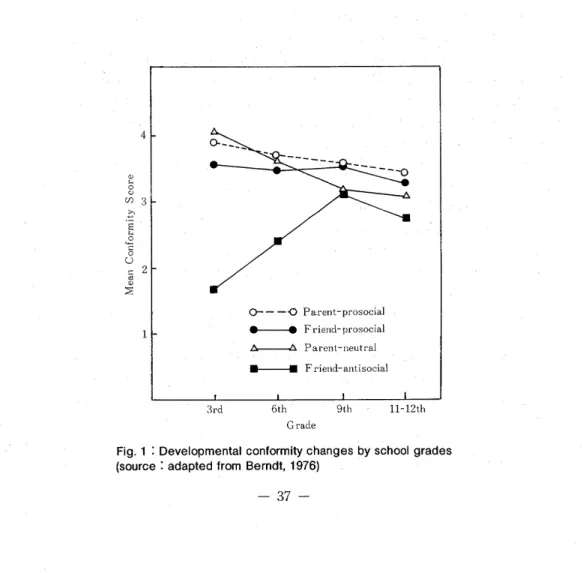
Since Sherif's (1936) classical study of norms, many studies of group influence on child socialization have appeared. Berndt (1976) presented children with 30 different hypothetical situations and asked them how they would respond to peer pressure in each situation. He found several interesting results. (see Fig. 1) The mean conformity scores in the prosocial and neutral situations gradually declined with grades. But the effect of antisocial peer pressure on children followed a characteristic course, rising sharply from third to six grade, then declining during high-school years as adolescents begin to accept conventional standards. Findings suggest that children in early adolescence have responsive patterns that differ from those of children in other age ranges.
This writer proposes an age-related reference group model. (Fig. 2) Children are ex-posed to a critical situation which they encounter problems too difficult to be resolved by themselves alone. In this situation, they will tend to regard their peers, teachers, or parents as a principal reference group in order to find a correct or a modal answer. Fig. 2 illustrates that the number of reference groups and the degrees of their import-ance change with age. The basic elements of this model are as follows.
(1) The influence of mother on the child's norm development gradually delines from infancy to adolescence.
(2) The influence of father rises from childhood to adolecence.
(3) After middle childhood, peer influence gradually becomes stronger. Later, the group pressure of heterosexual friends becomes strong in the problem-solving
situations in S's daily life.
Erikson(1968) proposed eight developmental stages of ego-identity from a psychoanalytical point of view. In his theory, Erikson emphasized the importance of family members on the norm development of elementary school children (stages 1 to 3), of like-sexed peer relationship in later elementary school children (stage 4), and of intimate friends (including like-sexed friend) beyond that (stages 5-8).
Fig. 1 : Developmental conformity changes by school grades (source : adapted from Berndt, 1976)
Fig. 2 : Principal reference groups by age grouping S.: Subject Ma. : Mother Fa. : Father Teach. : Teacher 0 : small influence 0 : strong influence 0 : Weak influence
(3) Three response patterns to group norms
As noted above, children are exposed to many kinds of social pressure which origin-ate in group norms and in social standards. We must distinguish between their mean-ings. The group norm may be defined as the behavior expected of all members of a group within the specific context of that group. The social standard may be defined as any socially agreed-upon and expected behavior within the broader society. Group norms are subject to change. The term "group norm" carries a more flexible and less compulsory connotation than "social standard".
Children do not always follow or obey group norms or social standards . Three broad types of response follow from exposure to a norm or a standard .( Fig. 3) These three response patterns are defined as follows.
Conformity (acceptance) : behavioral (overt) attempt to act in ways consistent with the majority's judment (a grop norm or a standard)
Non-conformity (independence) : no overt behavior change in group pressure tions
Deviation (rebellion) : behavioral (overt) attempt to act in ways counter to the norm or standard
Since the appearance of Sherif's(1936) and Asch's(1951) influential conformity stu-dies, numerous reports have been published, most of them investigating situational fac-tors in conformity. Some, however, have examined the conformity formation process .
Deutsch and Gerard(1955) proposed that social pressure might be divided into an informational social influence and a normative social influence. The former influence relates to a physical reality, and the latter to a social reality. The physical reality
- 38 —
fers to the physical universe that is directly or indirectly measurablle. In this sense, it is objective and limited to what can be publicly and reliably measured. The social reality is dependent upon or, indeed, defined by the consensus of a group.
The idea of normative social infuence is of particular interest to Japanese develop-mental psychologists because it is directly connected to the theme of norms and standrds in the classroom.
B. Group Norm or Standard Formation (1) Shared frame of reference
Using an autokinetic apparatus, Sherif (1936) found several very interesting and sig-nificant results. Subjects were asked to judge the extent of movement in a supposedly moving but actually stationary light. On any given trial, as soon as the movement was perceived, the subject pressed a key which turned the light off. After the light was turned off, the subject orally reported the extent of movement in inches.
Sherif found that the subject who viewed the light in a group setting showed a gra-dual convergence toward an agreed-upon extent of movement. Furthermore, when the individuals in the group were later tested alone, they continued giving the group-established judgments.According to Sherif, each group formulated a norm regarding the extent of movement.
This finding had a strong impact on later studies of group influence. Jacobs and Campbell (1961) examined the transmission of an arbitrary norm through ten genera-tions of trials employing the same type of autokinetic apparatus as Sherif's (1936). (Fig. 4) They used the concept of "transmission of arbitrary norm" in the same sense that Sherif used the concept of "shared frame of reference." In this judgment situation in which independent judgment of movement averaged 2.8 inches, confederates were used to establish an arbitrary norm of 15.5 inches. The transmission of this norm was studied as confedrates and old members were removed from the group one by one while new members were added. Jacobs and Campbell reported the arbitrary norm gra-dually decayed in each of the 12 experimental groups and that the group judgment
drifted back to the natural norm found in the control groups. However, significant rem-nants of the arbirary norm persisisted for four or five generations beyond the removal of the last confederate from the group.
Weick and Gilfillan (1971), in a laboratory experiment, reported different results from those of Jacobs and Campbell. They concluded that two different types of arbit-rary tradition were operating (warranted and unwarranted arbirary tradition) and that the former tradition (i.e warranted) persisted through several generations com-pared to the latter.
The tasks posed in Weick and Gilfillan's study are different from those used in Jacobs and Campbell's study. Their tasks took the form of a kind of game which was usually used in experiments of normative social influence. It seems reasonable to con-clude that differences in research design contributed to the disparity of results in the two studies.
(2) Norms or standards in a classrom
Children are exposed to many kind of norms and standards in the classroom which are different from those of their families. They are sometimes in conflict in their class because of the disparities between family norms and school norms. Some examples are disobeying the rules in games or at home, complaining about another's unfairness and or discrimination against oneself, and making distrustful or negative remarks about the actions of others towards oneself. It is sometimes difficult for children to adjust themselves to their classroom after producing these strong negative feelings about their classmates. Although teacher are typically disturbed by such violation of the norms and may take action to curb it, parents tend to be far more permissive and are
more tolerant of their children's disobedince of the rules.
Kerr and Nelson (1983) listed disruptive behaviors which are obstacles to the ongoing learning process in the classroom.(Table 1.) These researchers are concerned about these behaviors not only because they disrupt ongoing educational activities but also because they drain off a lot of teacher time and attention.
How do children learn to accept or to adapt to these norms or standards in their school ? Children may be taught them by their teachers or by children by means of a certain compulsive force such as punishment, or through advice, instruction, and so on.
Tamura(1985) insists that the norms which children must obey should be divided into proscriptive norms and prescriptive norms. With respect to proscriptive norms. he presents the examples of cheating in an examination, truancy, and class tradiness. As examples of prescriptive norms, he offers the making of friends, working hard, keeping promises, and so on.
The problem of norm (or standard) categorization will be discussed in greater detail later in this paper.
Table 1 : Examples of Disruptive Behavior Items • teases or bullies other children
• blames others for his action
• annoys or provoke peers into hitting or in other ways attacking him • disobeys the rules in games or in the house
• disrupts others' activities
• resists following instructions or requests • is inconsiderate of others
• complains about others' unfairness and/or discrimination against him • makes distrustful or suspicious remarks about actions of others toward him • argues and must have the last word in verbal exchanges
• does not obey until threatened with punishment • boisterousness , rowdiness
• uncooperativeness in group situations
(soure : slightly adapted from Kerr, M. et. al., 1983)
(3) Jackson's return potential model
A survey of the findings of conformity studies reveals the presence of conflicting re-sults among investigations using nearly identical experimental procedures. These dif-ferences can sometimes be attributed to the ambiguous measurment of norms.
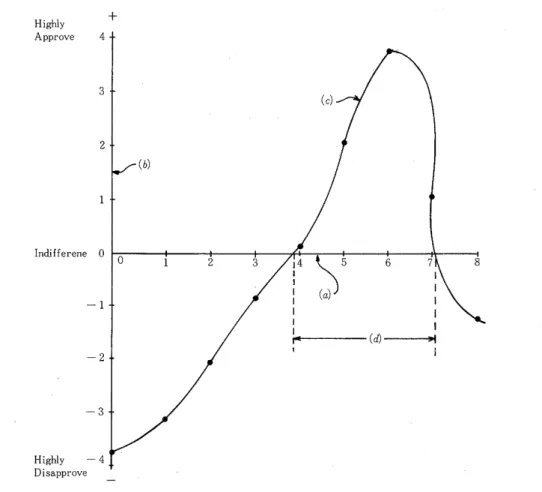
One approach to this problem is to be found in the work of Jackson (1960) who proposed the return potential model as a way to examine the elements of norm struc-ture. Jackson's model (Fig. 5) examines norm structure from five checkpoints as
enumerated below. In the graph, the behavior dimension is on the horizontal axis and the approval dimension on the vertical axis.
(2) the range of tolerable behavior : the permissible range of behavior in the stu-dent's class
(3) the intensity of a norm : the intensity of approval or disapproval value evoked by appropriate or disappropriate behavior. An index can be developed by summing the ordinates or height of the curve at each scale position on the behavior dimen-sion, and represents the total area encompassed by the curve.
(4) the potential return difference : the difference between average approval values and average disapproval values on each given potential curve
(5) the crystallization of a norm : the total variance or dispersion of the return potential for all scale positions on the behavior dimension. When the amount of dispersion is large, indicating that members' ideas of appropriate or inappropriate behavior do not coincide, the degree of crystallization is low.
Fig. 5 : Schematic diagram showing the Potential Model for representing norms. (a) A behavior dimension; (b) an evaluation dimension; (c) a return potential curve, showing the distribution of approval-disapproval among the members of a group over the whole range of behavior; (d) the range of tolerable or approved behavior.
(source : adapted from Jackson, 1960)
The effectiveness and validity of Jackson's model have gradually gained recognition in studies of refence groups. A more detailed discussion of this matter will be pre-sented later in the paper.
C. Responses to Group Norms (1) Conformity(acceptance)
Using Asch-type tasks in a children's conformity study, Costanzo & Shaw (1966) found that both males and females showed an increase with age in their susceptibility to peer influence until early adolesence, after which a decline set in. This finding was almost identical to the results obtained by Iscoe et al. (1963).
According to Hartup's (1970) developmental studies of conformity , we can conclude that the relationship between age and conformity to peer group influence is curvilinear and that the susceptibility to peer influence is highest in early adolescence. Hartup's findings are consistent with Piaget's developmental stage theory (1932) .
Using modified Asch-type tasks to control task difficulty, Fujihara (1976) obtained results similar to those of Costanzo & Shaw (1966) and Allen et al. (1972) . However, he did not find a statistically significant main effect for task difficulty .(Fig. 6)
Hall et al. (1966) recently reviewed the studies by Costanzo et al. (1966) and Berndt (1979) as follows.
"The behavior of child
ren in such a contrived situation may not accurately flect thir conformity to peer pressure, points out Hartup (1983). Conformity-or
lack of it-apparently depends on the child's understanding of social rules , his or her motives, and the nature of the peer group. After reviewing the research , he
concluded that on easy teaks, children become progressively less likely to conform
to peer judgment with age, but that on difficult or insoluble tasks, they may
tinue to rely on the suggestions or judgments of their peers."
Fig. 6 : Mean conformity scores by ages and curvilinear regressions for peer-, teacher-, and mother-groups (source : Fujihara, 1976)
As Hall et. point out, Children's understanding of social rules is one of the most im-portant factors influencing conformity.
(2) Non-conformity (independence)
Many children in the school settings persist in their inappropriate behavior even af-ter their teachers or classmates have told them to desist. This appears puzzling, since they are usually aware of the social unacceptability of their behavior and of the kind of penalty that will be imposed on them if they continue.
As noted before, non-conformity (independence) can be defined as a covert attitude or behavior change that implies a disagreement with the opinions of others (teachers or classmates) in a group pressure situation. Non-conformity is different from devia-tion which takes the form of overt behavior.
Who shows the highest degree of non-conformity to the group norm ? It has been pointed out that the higher status person in a group generally shows the highest de-gree of conformity to the group norm and simultaneously, shows the greater deviation from it. (Wilson, 1960: Honma, 1966)
Mitsui (1977) investigated rule-breaking among students with reference to the re-turn of library books. The sophomore year was the earliest grade in which students were eligible to charge out books from the seminar library. Every student was re-quired to return borrowed books within three months. However, the percentages of students who broke the rule were, respectively, 36.9% (sophomores), 54.3% (juniors), 66.5%(seniors), and 69.8% (graduates). The frequency of breaking the rule increased with college grade. It is likely that the sophomores who were the most responsive to the book-return rule felt the greatest anxiety about imposition of penalties for rule violations.
(3) Deviation (rebellion)
Violence has become one of the biggest social problems facing Japan. Over the past ten years, the incidence of child-initiated violence in Japanese school and family set-tings has been steadily increasing as has the severity of the violent acts. Many psycho-logists, educators, and other concerned persons have been making efforts to account for this alarming trend and to seek approaches to a solution.
The frustration-aggression hypothesis has been one of the most popular theories to be applied to the problem. This theory assumes that frustration always (or usually) leads to aggression (covert or overt) and that aggressive behavior is typically an in-dicator or some prior frustration.
Rowen (1986), a columnist with the Washinton Post, offers the following sociologic-al commentary on the Japanese educationsociologic-al system.
"The comparisons with Japan have to be made with care : The Japanese pay a steep emotional price for a superior system. One must remember that the
- 44 —
consuming drive of Japanese parents to get a boy into the prestigious Tokyo versity begins in kindergarten ; girls are still largely ignored. Auther Robert
Christopher says in his excellent book, "The Japanese Mind," that few American
families would put themselves through the stress and strain that culminate in the inhumanity of "examination-hell."
From the stand point of the frustration-aggression hypothsis, the stress and strain described above may play a important part in precipitating violence in schools and families. However, against this hypothesis, We can say that the causal link between frustration and aggression is circular and complex and that the hypothesis probably offers too simplistic an interpretation of behavior.
It is evident that many forms of deviant and rebellious behavior exist in Japanese school settings despite the pressure of group norms and standards to prevent them. studies of such non-conformity behavior now appear both timely and urgent.
II. Proposed Investigations
A. Categorization of School Rules (elementary, junior high, and senior high shool)
As noted above, group norms and standards in school settings have been classified into several categories by reseachers.
Tamura (1985) divides rules into proscriptive norm and prescriptive norm using a sociological frame of reference.
Kerr and Nelson (1983) divide specific problem behaviors into categories labeled disruptive, socially immature and inadequate, social withdrawal, self-stimulatory and self-injurious, aggressive behavior, and drug abuse. They approach the management of these problem behaviors in school settings from the viewpoint of clinical psychology.
Examination of the validity of these categorizations reveals several deficiencies . (1) The categorizations are so ambiguous and arbitrary as to be of questionable
utility in research.
(2) Some norms are known to be more improtant than others to children in school settings. Classification schemes have failed to take into consideration the
grees of importance among norms.
(3) The categorizations have been derived from adult (researchers or teachers) perspectives of behavior, not from children's perspective.
Multivariate analysis might provide an effective technique to deal with these de-ficiencies. The analysis takes two general forms. One (e.g., analysis of variance, analy-sis of covariance) reveals the patterns of interaction between several independent vari-ables. The other (e.g., multi-dimensional analysis, factor analysis, multiple correlation) examines the patterns of correlation between a large number of variables, and identi-fies the main underlying dimensions or factors.
In this proposed study, factor analysis will be used to analyze and classify the rules (norms) in school settings.
Procedures
(1) The variables (norms or rules) yielded by factor analysis will be arranged according to their factor loading (weighting). These variables will be used as
tasks in the following studies : application to Jackson's return potential model :
conformity experiments : cross-cultural study.
(2) It is enriched that the matrix of rule variables in the school settings to be rived from the factor analysis will yield such factors as an interpersonal factor, a
school-and-work-oriented factor, one or more personality factors, and still others. (3) The norm structures will be .examined developmentally, that is, for successive
age groups.
Subjects
About 400 subjects will be drawn from among 10-, 13-, 16-, and 19-year-old stu-dents (about 100 Ss from each age group).
Tasks
Each rule listed in the questionnaire will be subjectively ranked in importance (7-point scale) by each subject/respondent. About fifty items will be included in the ques-tionnaire. ( Table 2)
Sample questionnaire items :
How important do you feel each of the following rules is in your school setting ? For each item, please circle the number that best represent your feeling (opinon).
not-
important neutral important
• tardiness —3, —2, —1, 0, 1, 2, 3
• chattering —3, —2, —1, 0, 1, 2, 3
B. Application of Jackson's Return Potential Model to School Rules
As noted above, Jackson's return potential model (1960) is characterized by the point of maximum return, range of tolerable behavior, intensity of norm, potential re-turn difference, and crystalization of norm. Jackson described his model as follows.
"Each property of a norm will be defined both conceptually and operationally . Thus, the construction of the model represents an attempt to provide a way of
thinking about norms and their properties in a differential and logical way and to
suggest methods of measuring these properties with relative precision. To the gree that the attempt is successful, it may provide a useful means for the study of
such problems as the socialization of the child, the integration of students into the
classroom group, and the relation of individual personality to social environment
of instructional groups."
If Jackson's model can be shown to apply to rules in school settings, it may then provide a useful general strategy for managing many problem behaviors.
The behavior norm used by Jackson to illustrate his model was "the number of times a member speaks in an hour's session of a discussion group." As noted before, this
Table 2. The list of norms in the school settings
1 failing to raising hand for recognition when asking a question . 2 chatting
3 taking a nap 4 inattentiveness
5 leaving one's seat after the starting bell rings 6 cheating in an examination
7 failing to do homework assignment. 8 leaving schoolbooks or pencils at home
9 changing one's location in the classroom without permission 10 calling out to the teacher before being recognized 11 looking out the window or looking around the room 12 sitting with eyes closed but not napping
13 hitting another student
14 making audible noises such as animal calls 15 drumming with a pencil on the desk or wall 16 throwing pencils, paper, or book
17 creating any audible noise other than vocalization
18 tardiness (e.g., not doing assigned work for entire 20-mins . interval)
19 engaging in motor behavior that diverts the attention and/or activities of other stu dents
20 being unnecessarily dependent on others for help
21 expressing anger in poorly controlled and tantrum-like fashion
22 being perfectionistic (compulsively meticulous about having everything exactly right) 23 apologizing repeatedly for one's mistake
24 referring to oneself as dumb, stupid, or incapable 25 weeping or crying without provocation '26 social withdrawal : preference for solitar
y activities 27 shyness or blushing
28 becoming easily flustered and confused
29 failing to initiate relationships with other children 30 failing to engage in group activities • 31 trying to avoid calling attention to oneself 32 not protesting when others hit, tease, or criticize 33 prefering to play with younger children
34 being underactive, slow moving, or lacking in energy
35 unusual body motion : swaying back and forth while sitting and standing
36 reacting with great pain to any minor burn , prick, abrasions or cut, (suggesting that the person has less tolerance for pain than most children)
37 avoiding looking directly at another person's (e.g. teacher or stranger) face 38 being upset by little things that are not "right"
39 destroying things beloging to school or other students 40 feeling no guilt after misbehaving
41 reacting with defiance to another person's instructions or command 42 speaking ill of others
43 breaking promises 44 behaving selfishly
45 playing with only special friends 46 telling a dirty story
47 tattling
48 not playing games seriously 49 absenting oneself from practice 50 being quarrelsome
type of behavior may be classified as a prescriptive norm such as a person's perform-ance on some cooperative task, or the appropriate amount of money to spend on a birthday gift for one's friend.
It may be assumed that these kinds of norms gradually take form during the social development of the group. Therefore, they have properties that differs from norms set arbitrarily beforhand by teachers or other adult authorities, as, for example, many proscriptive norms—cheating in an examination, chatting in a classroom, and so on.
When one applies these proscriptive norms to Jackson's model, one obtains a graph that differs markedly from his graph (see Fig. 5). For example, let us evaluate "tattling behavior" (using a 7-point approval-disapproval scale) on a behavioral dimension
ex-pressed in terms of the degrees of rule-deviation. We will obtain a potential curve as illustrated in Fig.7, that is, the curve will remain in the positive (approval) area until the critical point, but after that, it will enter the negative (disapproval) area.
The feeling factor (bad-good feeling) should also be considered, because it plays an important part in evaluating the rule. However, Jackson's model does not address this point.
Fig. 7 : Expected potential curve of "tattling" (prospective norm)
Hypotheses
(1) The point of maximum (Jackson's term) return will be higher (see Fig. 5) for highly restrictive norms.
This kind of norm may put a premium upon active participation by members of the group ; i.e., strong feelings exist about conformity and deviation.
(2) The range of tolerable behavior (Jackson's term) will be narrower for highly res-trictive norms.
The greater the consequence that behavior has for a group and for its central con-cerns, the narrower will be the range of tolerable behavior.
(3) The intensity of a norm (Jackson's term) representing the total area encompassed by a curve will be greater for highly restrictive norms.
This measure describes the over-all intensity of evaluation in a group, whether of approval or disapproval, regarding the particular behavior.
(4) The potential return difference (Jackson's term) representing the difference between approval and disapproval values will show negative values for high restrictive norms . Because, subjets are likely to have negative feeling about even a slight deviatism in the case of highly restrictive norms.
(5) The crystallizaion of a norm (Jackson's term) represented by summing the total variance or dispersion of a return potential curve for all positions on a behavior dimension, will be higher for highly restrictive norms .
When crystallization is high, indicating that members ideas of the norm are alike, that norm may be considered to be important by the most group members.
(6) Difference will also be found between different age groups among children. The de-gree of similarity between a return potential curve for children and that for adults will rise with the age of the child group.
(7) Somewhat different results of feeling factors from thought factors will be obtained with reference to hypotheses (1) through (6) above.
Subjects' ratings of the behavior norms (rules) as based on their feelings , will differ from the ratings as based on their thoughts. The rationale for this hypothesis is that subjects' feelings and thoughts play different roles in the evaluation of norms .
Subjects
About 400 students will be drawn from 10-, 13-, 16-, and 19-year-old age groups (about 100 Ss in each age group, respectively).
Task
The aim of this investigation is to evaluate school children's feelings and thoughts about behavior norms (7-point scale) which are selected from the categorization proce-dure noted above. It will be carried out a first step in this study . Twenty norms will be used as the tasks to be rated in this study, consisting of four factors derived from the matrix of rule variables in school settings.
A sample questionnaire item and two ways of arranging results are illustrated in Table 3 and Fig. 8.
C. Experimental Studies of Conformity, Non-conformity, and Deviation (1) Background of the proposed experiments
It is appropriate here to discuss several critical points about the study of conformi-ty before proposing new experimental designs.
(1) In a conformity experiment, group pressure situations should be clearly divided into normative and informational group pressure situations .
(2) Tasks used in a conformity experiment should be divided into social reality tasks and physical reality tasks. The former have modal answers created by the
mem-Table 3 : A sample questionnaire item and two ways of arranging subjects' recording of responses Situation : Time of Arrival at School
Question : What kind of feelings and thoughts do you have ? Please check the most appropriate point on each of the following scales.
Fig. 8 : Expected figures of feeling and thought about "time of arrival at school"
bers of a group or a society. The latter have a factually correct answer on which there is group consensus.
(3) In devlopmental conformity studies, the reference groups (peer, teacher, or rents) which might play important role in influencing Ss' judgment, should be
sidered carefully at each developmental stage.
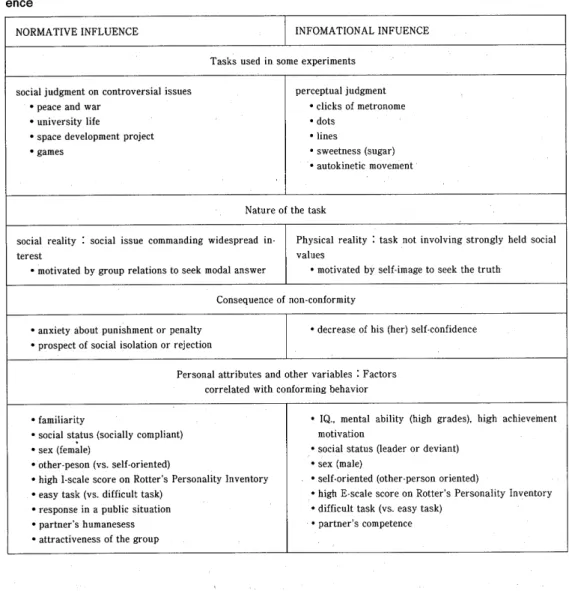
Summary of findings derived from previous experimental conformity studies are presented in Table 4. Several brief interpretations of the table are presented as fol-lows.
Tasks used in some experiments : Typical tasks which have been used in conformity
studies are shown in the first section of Table 4. (social judgment vs. perceptual
judgment tasks.)
Nature of the task : Social reality vs. physical reality according to the differnces tween the motives evoked at the time of judgment.
Consequence of non-conformity : the consequencies of non-conformity are shown according to whether the group person has a normative or an informational basis.
The listed consequences may be expected when Ss do not conform to their group
norm.
Personal attributes and other variables correlated with conforming behavior : the factors which appear to correlate positively with conformity are listed for both
normative and informational group pressure situations.
(2) Proposed Experiment 1 (conformity and non-conformity) Purposes
One of the main objectives of this experiment is to examine developmentally the de-grees of influence of reference groups upon children in a normative group pressure situation, using conformity and non-conformity as the measures of socialization. The reference groups as described above are known to play a very important part in the formation of an S's judgment in critical problem solving situations.
Three kinds of reference group will be selected—a peer group, a teacher group, and a parent group. Two of the three reference groups will be paired and presented simul-taneously during the stimulus judging session. Ss will be asked to judge a norm (rule in the school settings) under two different kinds of group pressure. The alleged in-formation from the reference group will actually be fictitious and will be arbitrarily set by the experimenter.
Another main purpose is to examine the relationships between conformity (or no-conformity) and the factors enumerated below.
(1) sociometric status of the sujects
(2) personality factors (as derived from Rotter's personality inventory) Measure of conformity and non-conformity
This exeriment will require two sessions with the subjects. The intent of the first session will be to obtain base-line responses in a "no group pressure situation." The
Table ence
4. Summary of Findings of Conformity Experiments : Normative vs. informational group
infl-NORMATIVE INFLUENCE INFOMATIONAL INFUENCE
Tasks used in some experiments
social judgment on controversial issues perceptual judgment
• peace and war • clicks of metronome
• university life • dots
• space development project • lines
• games • sweetness (sugar)
• autokinetic movement
Nature of the task
social reality : social issue commanding widespread in- Physical reality : task not involving strongly held social
terest values
• motivated by group relations to seek modal answer • motivated by self-image to seek the truth
Consequence of non-conformity
• anxiety about punishment or penalty • decrease of his (her) self-confidence
• prospect of social isolation or rejection
Personal attributes and other variables : Factors
correlated with conforming behavior
• familiarity • IQ ., mental ability (high grades), high achieve.ment
• social status (socially compliant) • sex (female)
motivation
• social status (leader or deviant)
• other-peson (vs. self-oriented) • sex (male)
• high I-scale score on Rotter's Personality Inventory • self-oriented (other-person oriented)
• easy task (vs. difficult task) • high E-scale score on Rotter's Personality Inventory
• response in a public situation • difficult task (vs. easy task)
• partner's humanesess • partner's competence
• attractiveness of the group
aim of the second will be to obtain subject responses under two different kinds of "group pressure situations ." The measure of conformity will be defined as the discre-pancy between the patterns of first-session vs. second-session responses. (Fig. 9)
Conformity score= Ci
t=i
The measure of non-conormity is frequency of non-movement on the same norm under two different kinds of group pressure.
A. Hypotheses about conformity
(1) Conformity to peer group norms will increase significantly during middle adolesc-ence (13-16 year olds as compared to other age groups).
(2) Conformity to teacher group norms will be higher during childhood(10-year olds) than during adolescence (13-, 16-, and 19-year-olds).
(3) Conformity to teacher-and parents-reference group norms will decrease with age (between ages 10 and 19).
(4) Conformity to each refence group will show significant high positive correlations with certain interpersonal and personality norms and with school-work-oriented
norms.
(5) Middle sociometric status members (average group acceptance) will show the high-est conformity to group norms.
(6) Subjects with high I-scale scores will be high in conformity (combined norms). B. Hypotheses about non-conformity
(1) Non-conformity will be high during middle adolescence (13-16year olds) in teacher- , and parents-group pressure situation.
(2) Non-conformity to peer group norms will be low during middle adolescence.
(3) Subjects in low sociometric status (low group acceptance) will show higher non-conformity than Ss in high.
(4) Subjects with high I-scale, scores will be high in non-conformity. Subjects
About 480 Ss will be drawn from 10-, 13-, 16, and 19- year old age groups (about 120 Ss in each age group, respectively)
Procedure
First session : Subjects will be asked to evaluate forty items about norms on a 7-point scale, these items to be selected from a "categorization study" to be performed in advance of this study. The Ss will also be asked to complete Rotter's Personality In-ventory.
Second session : Subjects will to asked to evaluate the same items of thought as used in the first session, referring to alleged information (arbitrarily set by experimenter) from reference groups. They will also be given the sociometric test.
Experimental design
Fig. 9 : The illustration of measure of conformity A : S's first session's responses
B,C : information from a reference group (fictitious) D : S's second session's responses
C1—C7 : discrepancy between first-and second-session's resp-onces at a given point on a behavioral dimension
The experiment will employ a 4 X 2 X 3 design as follows : Age (10-, 13-, 16-, and 19-year old age groups) X Sex (male-female) X Reference group (peer, teacher, and parents).
(3) Proposed Experiment 2 (deviant behavior) Purposes
One of the main objectives of this experiment is to examine developmentally the de-grees of deviation from reference groups (peer, teacher, and parents) in a normative group pressure situation where Ss implicitly seek to have their own thought about
norms.
A second purpose is to examine the relationships between (the degrees of) deviation from reference groups and the factors enumerated below.
(1) sociometric status of the subjects
(2) personality factors (as derived from Rotter's Personality Inventory)
The experimental design of this study will be almost the same as that for Proposed Experiment 1 (conformity and non-conformity study) except for the way in which in-formation from the reference groups is delivered. In the second session (group press-ure situation), the alleged information from the reference groups will be fictitious and will be arbitrarily set by the experimenter. The information to be presented will be the same as in the first session.
Measure of deviation
The experimental design of this study will consist of two sessions similar to Proposed Experiment 1. That is, the purpose of the second session will be to obtain base-line responses. The purposes of the second session will be to obtain responses in a group pressure situation.
The measure of deviation will be defined as the discrepancy between the patterns of first-session vs. second-session responses. (Fig. 10)
Deviation score= Di
i=i
Hypotheses
(1) Deviation scores (aggregate of scores) in a peer-, teacher-, and parents-group press-ure situation will be high during middle adolescence and especially higher in the
rents' group pressure situation.
(2) Deviation scores will show significantly high positive correlations with
al norms, school-work-oriented norms, and personality norms, respectively.
(3) The higher the sociometric status of a subject in the group, the greater the likeli-hood that the subject's behavior will be deviant.
(4) High E-scale scores on Rotter's Personality Inventory will correlate positively with high deviation scores.
Subjects
The sampling characteristics of the sujects will be matched to those of the subjects in Proposed Experiment 1.
Fig. 10 : The illustration of measure of deviation A : S's first session's responses
B : S's second session's responses
D1 — discrepancy between first-and second-session's
sponses
Procedure
The tasks and the procedure will be the same as for Experiment 1 (conformity and non-conformity) except for the way (see p. 52, 53).
Experimental design
The experimental design will be the the same as for Experiment 1 (4 X 2 X 3). D. References
Allen, v. 1., & Newtoson, D. (1972) Development of conformity and independence. Journal of Personality and Social Psychology, 22, 18-30.
Asch, S. E. (1951) Effect of group pressure upon the modification and distortion of judgment. In H. Guitzkow (Ed.), Group, leadership, and man. Pittsburgh : Carnegie
Press. 177-190.
Berenda, R. W. (1950) The influence of groups on the judgment of children. New York : King Crown Press.
Berndt, T. J. (1979) Development change in conformity to peer and parents. Develop-mental Psychology, 15, 605-616.
Costanzo, P. R. & Shaw, M. E. (1966) Conformity as a function of age level. Child De-velopment, 37, 967-975.
Cruchfield, R. S. (1955) Conformity and character. American Psychologist, 10,
191-198.
Deutsch, M. & Gerard, H. B. (1955) A study of normative and informational social in-fluence upon individual judgment. Journal of Abnormal and Social Psychology, 51, 629-636.
Erikson, E. H. (1968) Identity : Youth & Crisis. New York : Norton.
Fujihara, M. (1976) An experimental study of developmental trend in conformity : the effect of group pressure from peer-, teacher-, and mother groups on conformity. Journal of Japanese psychology, 47. 193-201.
Manual of child psychology. New York : Wiley.
Hartup. W. W. (1983) Peer relations. In P. H. Mussen (Ed.) Handbook of child Psychol-ogy. 4th ed. Vol. 4 : E. M. Hetherington (Ed.) Socialization, Personality, and Social structure. New York : Wiley 102-196.
Honma, M. (1966) The effect of group status on conformity. reported at Japanese Psychology Association. (In Japanese)
Iscoe. I., William, M., & Harvey, J. (1963) Modification of children's judgment by a simulated group technique : A normative developmental study. Child Development, 34, 963-978.
Jackson, J. M. (1960) Structual chardcteristics of norms. In G. E. Jensen (Ed.) Dynamics of instructional groups. Univ. of Chicago Press.
Jacobs, R. C., & Campbell, D. T. (1961) The perpetuation of an arbitrary tradition through several generations of a laboratory microculture. Journal of Abnormal and Social psychology, 62, 649-658.
Kerr, M. M., & Nelson, C. M. (1983) Strategies for managing behavior problems into the classroom. Columbus. Ohio : Bell and Howell.
Mitsui, H. (1977) About social interaction in experimental social psychology. Annual report of psychology of Tokyo Metropolitan Univ. Vol. 119, 59-84. (In Japanese) Piaget, J. (1932) The moral judgment of the child. New York : Free Press (1965). Rowen, H. (1986) "Japan's edge starts in school", In Washinton Post, adapted from
Minneapolis Star and Tribune, Nov. 28.
Reber, A. S. (1985) Dictionary of Psychology. New York : Penguin Books Sherif, M. (1936) The Psychology of social norms. New York :Harper. Statt, D. (1981) Dictionaly of Psychology. New York : Barnes & Noble. Tamura, M. (1985) Norms. In H. Mitsui (Ed.) Social psychology. (In Japanese)
Weick, K., E. & Gilfillan, D. P. (1971) Fate of arbitrary traditions in laboratory micro-culture. Journal of Personality and Social Psychology, 17, 179-191.
Willson, S. R. (1960) Personality patterns, source attractiveness, and conformity. Jour-nal of PersoJour-nality, 28, 186-199.