A POSTERIORI ERROR ESTIMATES FOR TWO POINT
BOUNDARY VALUE PROBLEMS
著者
KAJITA Suzuko
journal or
publication title
鹿児島大学理学部紀要. 数学・物理学・化学
volume
16
page range
31-48
別言語のタイトル
2点境界値問題に対する事後誤差評価
URL
http://hdl.handle.net/10232/6407
A POSTERIORI ERROR ESTIMATES FOR TWO POINT
BOUNDARY VALUE PROBLEMS
著者
KAJITA Suzuko
journal or
publication title
鹿児島大学理学部紀要. 数学・物理学・化学
volume
16
page range
31-48
別言語のタイトル
2点境界値問題に対する事後誤差評価
URL
http://hdl.handle.net/10232/00000495
Rep. Fac. Sci., Kagoshima Univ., (Math., Phys., & Chem.), No.16, p.3ト48, 1983
A POSTERIORI ERROR ESTIMATES
TWO POINT BOUNDARY
VALUE PROBLEMS
By Suzuko Kajita*
(Received September 10, 1983)
Abstract
We consider error estimates for the Galerkin approximations of two point boundary value problems. The error formulas are asymptotically expressed in terms of a posteriori
errors.
1. Introduction
In this paper we consider error estimates for the Galerkin approximations of the following two point boundary value problems :
●
-(a(x)u'Y+b(x)u-f(x), *e/,
〟(0)-〟 l)-0
-u"+a(x)u'+b(x)u-fix), xJI,
〟0-〟l)-0.
Already, by Babuska and Rheinboldt, error formulas and optimal partitions have been published in the case of the piecewise linear approximation for (1.1) ([1]). In this paper we employ the piecewise polynomials of degree more than 2. The error formulas in [1] were considered under the conditions :
uV+l¥x)アO, xel
and
(1.3) u(or+1)(vk)-0, */。r+2)U ≠0, k-l,..., Q, 0≦^1<^2<...</Z<7≦1, where uo is the solution of (1.1).
The main object of this paper is to introduce error formulas under more general condition than (1.3) :
ォri>(/i*)-O, k-¥, …, Q, ≦^l</^2<...</i<7≦1. First, in Section 3, we consider the following simple problem :
-u/f-f(x)y x^L
〝(0)-〟1 -0.
For this problem we consider the properties of the error and error estimates. And, based on these properties and error formulas, we consider error formulas for (1.1) and (1.2) in Sections 4 and 5, respectively. The error formulas are asymptotically expressed in terms of a posteriori errors.
The results in this paper may be generalized for error estimates under other norms than we use here. Also, by using the results of Sections 4 and 5, we shall mention optimal
partitions
2. Notations
Let ∫- 0, 1. 0n ∫ we consider partitions
A : ¥)-xo<x¥<x2<.^<xm-1<xm-l
and introduce the notations
Ij-[xj-i, Xj] hj-Xj-xj-i ● /=1, m, 石-maxhj,h-minhj. 1≦j≦ml≦j≦m AllpartitionsAwhichforfixed/[>0,x>¥satisfy h>Ah* aresaidtobeU,#)-regular. Onaninterval/(/⊆/)wedefine u,v)j-fuvdx. IfPr(J)denotethecollectionofallpolynomialsofdegreenotgreaterthanr,then continuouspiecewisepolynomialspaceノ♂左isdefinedasusualby M左-(u∈C-(/)v¥n∈Pr(lj),j-l,mv(O)-v(l)-O}. AndPr{J)consistsofthepolynomialswhichbelongtoPr{J)andvanishattheendpoints ofJ. Alsoletvi,符r 2,.‥rjr-ibethedifferentzeropointsoftheJacobipolynomial
7rU -
1 drー1 x(l-x) dxr[(x(l-x)Y]
with weight function x(l-x) and we define
xij-Xi-i+hiVj, i-l, m, -1, r-1.
From now on, let γ≧2 and C be a generic constant independent of any partition.
3. A posteriori error estimates-Part I
In this section we consider the following two point boundary value problem :
(3.1)
Lu--u"-f(x), x^I,
〝(0)- 〟(l)-0,
where we assume that fe Cr(I).
The solution u。 of (3.1) belongs to Cr+2(/). Let z。,,∈,#左be the Galerkin approx-imation to ㍑ determined by the relation
A Posteriori Error Estimates for Two Point Boundary Set
Z-Zlo ZA,r-Then the following result is well known :
●
Lemma 3.1. For all partitions A the error z satisfies at the knots z(xj)-O, y-0,..., m.
Proof. The Green's function G(x, <f) for (3.1) is given by
G(x,
S)-(
*(!-」), 0≦x≦E, f(1-x), ≦x≦1.
In particular, at the knots it follows that (3.2) Byusing G(x )wehave G(xj, )∈M左 y-O, …, m. u(x)-(Lu, G(x, ))y -("′, ∂G af <*, ),
This representation holds for u e Hi(I) so that it can be applied to z. Since
(Z′, u′)∫-0, ∀u∈ M左, we have (3.3) ・(*,)-(*', #(*,-, )¥
-(Z′,普(xj,ト'),蝣 ∀u∈・現,
33from which follows
¥z{xj] ≦ zWlhd悪日普(xj,トvwmi).
From (3.2) it follows that
z(xj)-o, y-o, m. This completes the proof of Lemma 3.1.
Note that this lemma holds for all continuous piecewise polynomials which are the
●
Galerkin approximations to uo. Next lemma shows the relation between zA,r and zァ,r+¥ at the knots and the Jacobi points.
Lemma3.2. For all partitions △ at the knots and the Jacobi points we have zA,r+l(Xi)-ZA,r(xi)-O, l-0,.... M,
Z。,r+l¥XijトZ△r(xij)-O, i-l,..., w, ;-1, … r-1. Proof. It follows from Lemma 3.1 that
uoKXi)-Zァ.r(xi)-0 uo(xi)-ZA.r+l(xi)-O i-0, m. Zァ,r+l¥Xi)-ZA,r(xi)-O, f-0, m. KZk,r, W′)/,-(/, W)u (Z左,r+u w′)/ォ蝣-(/, w)n Hence Since
VwePtUi), i-l, m,
wehave (3.4)(z左-lZa,->w′)/,-0,∀u)∈P-r(Ii),1-1,m. WetakewjeP-r{Ii)whichsatisfiesw"{xik)-8jkasw.SinceォA,m-ォ4(rePr+iUt)and wiePr-iUi),itfollowsfromthepropertyofJacobipointsthattherearepositiveconstants o)kwithl≦k≦r-1suchthat l(Zムーi-Z左,r,wj)lt¥-¥(Zァ.r+l-Z△,r,Wj)lt hi ∑ a)k夏生i¥XikトZ△Axik))wj{xik) ㍗-1 k=1 符=(1-符k) Wj -hi五行三百zA,r+l(xij)-Z△Axh)¥. Henceitfollowsfrom(3.4)that z△,r+l(xij)-Z。r(x!j)-O. ThiscompletestheproofofLemma3.2. AlsoitfollowsfromLemma3.1thatforeachsubinterval/,thefollowingestimate holdsindependentofeveryothersubinterval. Lemma3.3.ForallpartitionsAthereareconstantsCsuchthat ・<*>!wl-Uj)≦c¥¥U(。r+1)¥Whrk-0,...,r,;=1m, wheretheconstantsCdependonrandkbutnotonh5. Notethat (Z′,u′)/,-0,∀u∈Pr-(U/-!,w. LetuobetheLagrangeinterpolationofdegreertouQon/,.ThenitfollowsfromLemma 3.1thatza′-U。∈P?(Ij),and,therefore, (Z′,Z′)0-(z′,Z′+(Z△,r-uo)′h, -W,ua-wo)/. <,Cz′k-</,)l│Mi>r+1)L-ilj <M/2, i.e., Hz′¥L2Uj)≦C││ォir+1)¥¥L-U M′2. Hencewehave zWl-u^CWz'WvuMl/2 <cnruh-(ん蝣h? Alsowehave Hz。--U。¥¥l-Uj)≦Z¥¥L-(〟+││Uq-UqI-(/,) <C¥¥iAr+l)¥¥L-uAhr whichtogetherwithMarkoffsinequalityimpliesthat ● -U)--y(*)││ zA,rU。IILoO' '(/>)≦C││U(or+1品んhr jr+l-kk-0,...,r. Ontheotherhand, Uo uo nU + r (0 〟 ハL VI / qt川U 8 5 ItL-(ムMト k-0, …, r.
Hence it follows that
・(*>!L-(ム)≦ W u^-u^h-(ん+ll uik)-z告‖L-Uj) ≦C││ K&r+1> L-</,>W+卜 k-0,.... r. This completes the proof of Lemma 3.3.
A Posteriori Error Estimates for Two Point Boundary 35
l
Now set
pj(x)-U。(x)-Z芸Ax) ・f>j(x)-Z芸,r+l(x)-Zl,r(x) Then we obtain the following lemma :
Lemma 3.4. Suppose that
xelj, j-l, m. uir+1)(x)*O,V*e/. Then,forallpartitionsAthereareconstantsC(r)andC(r)suchthat [mni/2 sJI^IIWtfl(1+O(h))as亮一O, and (3.6)Hwlhd-C(r>≠恒(r-1) 3日2LHlj)hr]′(1+OU))asかO, wheretheconstantsintheboundsofthe0-termsdependonfandrbutnotonAand theconstantsC(r)andC(r)areuniquelydeterminedbyr. Proof.Set
oj(x)-pAxトUx)
<PiAx)-z。,r+¥¥xトZ△r(x)
¢2j(x)- U。(xトZ。.r+l(x)
Then obviously 3.7) 3.8) (3.9) Also set z(x)-<Pu(x)+¢2,i(x) oj¥x)- U。(x)-zl,r+i(x) ∀x∈Ij, j-l, m. Vx牀Ij, /-i m, (¢2,,-,V′)h--(oj,v)u, ∀u∈H。KIj), /-1, m.po-mm {¥ u¥>r+I)(x)¥, xel}, pj-max {] u¥>r+1Kx)¥, xelj)
¢7-max {刷r-1)ix)¥, x∈Ij)
By the assumption we have
iprn(x)i
po
/-1, m.
≧1, ∀x∈Ij, j-l, m.
and, hence, it follows from Lemma 3.3 and (3.8) that
<tf-1)(x)¥ - uV+1)(xトzi:xi(x)¥ ≦Chj≦cii>r"(x>L
po
This implies that
(3.10)
w ¥x)-p( /-1)(xトoY-1¥x)
-p告Kx)(l+O(hj))ashi-0. Therefore, for all / with l≦j≦m,
(3.ll) oAx)¥<Chr j≦C-^-hl Po ・C忽hr Al+O{hj))ashj-*O,∈I,・
^蝣< C │U<-r-1) wlhi.j)hj]/2
≦ c l刷r-2)¥¥L2(lJ)hj:/2
≦C ll¢j¥¥mij)hjr* /2. Combining this inequality with (3.ll ), we obtain
7j(x)¥ ≦ CII6,日mmh)12(l+0{hj)) and oj(x)¥ ≦c uy-vhwhrl′'ii+oihj)), which imply (3.12) GjWmij≦C││fa‖L2(u)hj(l+O(hj)) as hj-0 and (3.13) ‖oAmu^CUy-'li^hKl+Oihj)) as hj→0・
Also, from (3.9) and ¢2,j∈ H。(Ij) we have
II ¢2j¥¥mij)≦ ll ¢2j¥¥mij) II oj ‖LHlj) ≦C"¢芸 Wmij)IIoj¥¥mij)hj i.e., (3.14) ll ¢2j Wmij)≦ C ││ (yj¥¥L2(ij)hj, whichtogetherwith(3.12)and(3.13)gives (3.15)¢芸jWlhij)≦CUj¥mu)hj(l+O(hj)) and (3.16)¢2j¥¥mij)≦cuy-'ii^hr'a+oikj)). Moreover,itfollowsfromLemma3.2that ¢ui(xj-i)-</>ij(xji)-…-¢lAxjr-1)-</>l,j(xj)-O. Let5r+ibethepolynominalofdegreer+1on/sothat sr+l(O)-sr+l(tfir)-…-Sr+i(vr-i)-5r+i(D-0 ands(rr+V)(jc)-l.Thenwehave ¢1*7,(x)-</>[?iKx)hrlc sr+lX-Xj-i ,hjx∈Ij,;-1,...,m, where¢&+1)(#)isaconstant.Wedenote C(㍗)- sr+l sr+l
;22…: C(r)-蹴
′ Fromtherepresentationof¢1,Jweobtain =¢i,j¥¥mij)-C(r]¢1,JILHlj)hj-C(r)¢&+1)IU,>W, i.e., (3.17)‖¢uwmij)-C(r)Uj‖mii)hj-C(r)Uri)¥¥mwhl Itfollowsfrom(3.7),(3.15)and(3.17)thatwithsomeα z'¥¥h(ij)-(¢1J+¢L-,</>' u+¢2J)lj -l#Ji.(/サ+2αII¢uwLHIj)I協jWLHIj)+偶J¥¥2L2(U) -C(rf¢llHu)h2 Al+O(hj)) andAPosterioriErrorEstimatesforTwoPointBoundary ・¥L2(I)[m"ll/2 2││^│i.(/y,^J(l+0(石))ash-0・ Similarly,by(3.16)and(3.17)weobtain IIzf¥L2U)-C{r>卦刷r-1)112 wIHIj)hY¥′(l+0(石))ash-0 Thiscompletestheproofofthislemma. Fromnowon,lettheconstantsC(r)and(ラ(r)bethevaluesinLemma3.4. ByLemma3.4weobtainthefollowingresult: Theorem3.5.0ntheassumptionofLemma3.4wehave [m 11/2 21│pilli.(/y)fe5J(i+0(育))as万一o・ and (3.19)Whm)-C(r)[ア││uir+l)¥¥lHli)hr¥′2(i+o(石))ash-0, wheretheconstantsintheboundsofthe0-termsdependonfandrbutnotonA. Proof.By(3.12)wehave (3.20) p. S-L2(/,)一座j+oj‖LHU) -Uj¥m,Al+O(hj)) 37
which together with (3.5) gives (3.18). Also, by (3.10) we have
l刷r-1)│mu^ Wpy-" miAl+O(hj))
Since py l)- U。r+1¥ we have
UY l)¥¥l*uj>- u(。r+1) ¥miAl+O(hj)).
Hence, by (3.6) we obtain (3.19).
In Lemma3.4 and Theorem3.5 we assume that u(or+1)(x)≠O for all x ∈ /. Clearly, the assumption is very severe. But, actually, the results are largely valid also when 〝『+1) has zeros m ∫. In order to show these we prove the following lemma and theorem :
Lemma 3.6. Suppose that
u¥r+1)(fik)-O, k-i, …> 4, ≦vl<U2<…<fJtq≦1.
For any (A, xYregular partition A with l≦x<ヱ±- we have
㍗
(3.21) ′¥LHI)-C(r)[2 ││MUmhlTil+Oi研) as h-0
and
(3.22) ¥z uhd-C(r)[アuy-1)ViHii)hjr¥′2(i+o(研) as首-0,
where 」-r+l-rx and the constants in the bounds of the 0-terms depend onf and r but not on A.
Proof. For any 8 >O we introduce the sets
/サ-{*∈I=x-Mk¥<∂ forsomejuk}, I」-I\在
Ja-{j-l,..., m; IjnIe≠¢}, /#-{!,..., m)\ん
(3.23) ∑ hj≦2(♂,+h)q≦ASoQ<i for石≦80・
ノ∈ノ∂。Since min {│ uor+I)(x)¥, x e /」>}-po>0, for the subintervals /, with jeJァO we have LL z′ ¥¥Ihw- C(r)2 II u(。r+1)¥¥lmJ)kV(l+ O(hj)l
Hence, for石≦d。 it follows from (3.23) that
(3.24) z'Whm≧∑"Z′¥Un j∈JL -dr)212iiォri)iiU)/irl(i+o(h)) Ljej.%J ・CirfpU頂2γ(2hj)(l+O(h)) ≧ch2rxa+o(石)). Ontheotherhand,byLemma3.3wehave aAx]≦Chiy-i,…,m fromwhichfollowsby(3.14) "¢'12 2JllLHlj)≦Chi2r+3 ≦Ch2(r+l-rx)石2rxhj ≦C¥¥z′I2 ¥LHI)石2*hAl+O(石))as石→O,y-i,...,m. Thentherearesomeconstantsα,βiandβsuchthat m Hz′Ili2(/)-∑(¢u+¢rlf│ 2J,<PIJ+¢2,J)lj .7-1 わ れ HJ 1-2 2上 .〟 ′ l . 仙 r
・
∑
何
層 相 川 u ニ ・+2a(sIIo'xjIli-(^>)1/2(sII4>' 2jWUu)2 〃 nLu 2 2上 . . ? ′ 2 dr m ∑ . . i ( + -(sII#Ji.(/,>Jβ/m (2 ¥J=1鶴12 ¥LHIj)'′¥z'¥¥mi)h'(l+O(石)) +βk'HW)石Hl+O(石)). Hencewehave (m 2鶴¥l-,)Kl+0(h牀))asかO, wherethevaluesI怖,j瞳HIj)withl≦j≦mmaybecomputedinthesamewayasinLemma 3.4 Theorem3.7.0ntheassumptionofLemma3.6wehave(3.25) .IU'llw)-C(r)[
and(3.26) ll*'IU/>-C(r)[
m ∑ J-lIlpji.<*>fc5jl/2(l+0(鍋) as h-0
uo ││12iwh2r¥′2(i+o(鍋) as h-0,
where the constants in the bounds of the 0-terms depend onf and r but not on A. Proof. It follows from Lemma 3.3 and (3.24) that
・3.27) ;恩¥LHij)hj
≦Ch2j2r+3≦C¥¥z′lIまHi)石2eMi+o(石)).
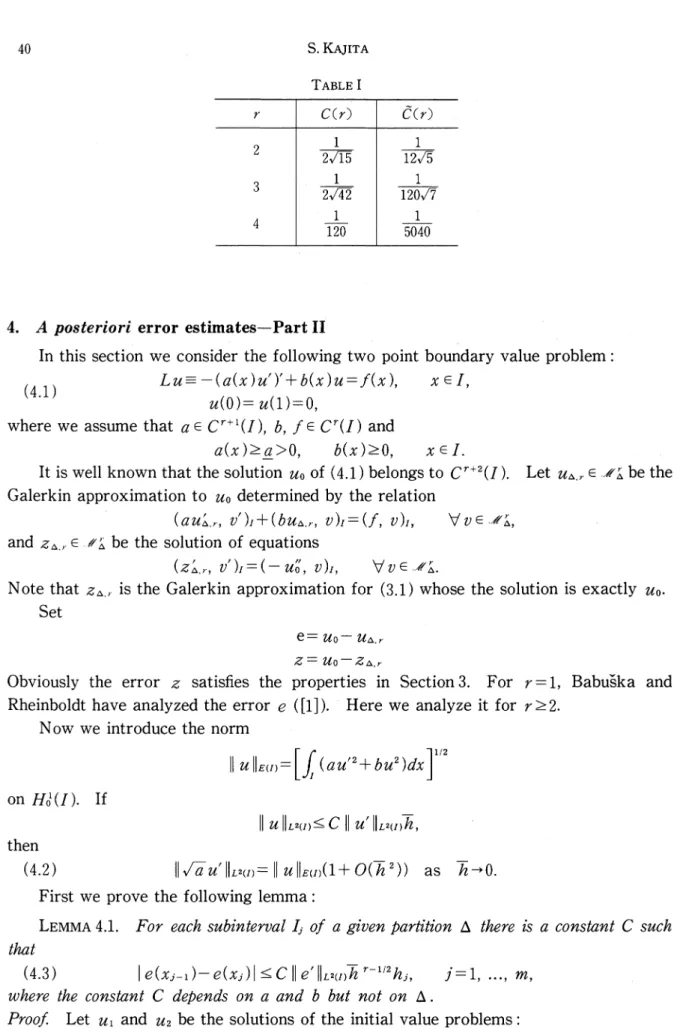
A Posteriori Error Estimates for Two Point Boundary 39 ▲1、 C(r)2(鼻IIpjWl-hy)-C(r)2(2││fa+a,fmii)h]¥ m -C(r)2∑(Uji.(M+2αjWfaWmij)¥¥oj‖L2(/;)+lloj‖L2(u))hj J-1 m -C{r)2∑I¥4>j¥UM J-l ・β1(卦¥l/2__ whmhj)wLnnk'U+Oih)) +β2││2′12 ¥LHI)石2」(l+0(石)) -"Z′¥hm(l+O(石e))ash→0, whichimpliesthat(3.25)holds. By(3.22)and(3.27)weobtain(3.26)inthesamewayasintheproofof(3.25). Hereweremarkthat(3.18)and(3.25)inTheorems3.5and3.7areaposteriori computableerrorestimates. Moreoverlet di>aj>d2>0,j-l,m. Then,similarlyasintheproofofLemmas3.4and3.6,Theorems3.5and3.7,weeasily obtainthefollowingresult: Theorem3.8.If u(or+1)(x)ア0,Vxel. Then,forallpartitionsAwehave (3.28)鼻αIz'WIhij)1′-C(r)¥taj¥¥pj¥ U=i!i><′]l/2(l+0(石))asかo and (3.29)rmαj¥¥z′12 ¥LHlj)1′-C(r)[m s .7=1α]l/2(1+CX扇))asかO, wheretheconstantsintheboundsofthe0-termsdependonfandrbutnotonA. Alsoif u{。r+1)(fxk)-0,k-l,...,<?,≦/il<^2<...<//<7≦1, then,forany(A,xYregularpartitionsAwithl≦x<ヱ±-,wehave ㍗ (3.30)rm 2 LJ=lαj¥z′112′蝣′-C(r)¥α]l/2(l+0(方))as万一o and (3.31)Vmll [2atjll^'Hi-l′Vm -C(r)¥jlαM(or+U│mn)hi y]′(1+O(h」))as亮一O, wheree-r+¥-rxandtheconstantsintheboundsofthe0-termsdependonfandrbut notonA. TheseresultsshallplayimportantpartsinSection4. ThefollowingTableIshowssomevaluesoftheconstantsC(r)andC(r). Inthefollowingsections,weconsiderthemoregeneraltwopointboundaryvalue problems.
Table I ㍗ C (㍗) C (r) 2 2/ 151 1 12/ 5 3 1 1 2 120ノラ 4 1 1 120 5040
4. A posteriori error estimates-Part II
In this section we consider the following two point boundary value problem :
4.1)
Lu--¥a(x)u')'+b¥x)u-f¥x), xe/,
〟(0)-〟(l)-0, whereweassumethata^Cr+1(/),byfeCr(I)and a(x)≧旦>0,b{x)≧0,x∈I. Itiswellknownthatthesolutionu。of(4.1)belongstoCr+2(I).Letu^r∈・M左bethe Galerkinapproximationto〟。determinedbytherelation (auま.',V′)l+(bUA,r,V)l-(f,V)l,∀u∈J4W左, andz△.,.∈i(/左bethesolutionofequations (Zムr,V′)/-(-U。,V)i,∀u∈・M左. NotethatzAristheGalerkinapproximationfor(3.1)whosethesolutionisexactlyuo. Set e=〟o 〟A,㍗ Z-uQ-ZA,r ObviouslytheerrorzsatisfiesthepropertiesinSection3.Forr-l,Babuskaand RheinboldthaveanalyzedtheerroreHereweanalyzeitforr>2. Nowweintroducethenorm u¥¥e(i)-u<au2jrbunl/2 )dx¥ onHi(I).If uwmn≦Cu′¥LHI)石, then (4.2)√言u′I│12(/)-IIu¥¥e(i)(1+0(石))as石→O. Firstweprovethefollowinglemma: ● Lemma4.1.ForeachsubintervalIjofagivenpartitionAthereisaconstantCsuch that (4.3)¥e(xj-i)-e(xj)¥≦Ce¥LHJ)h′'hj,y-i,...,w, wheretheconstantCdependsonaandbbutnotonA. Proof.Letu¥andmbethesolutionsoftheinitialvalueproblems:respectively. Set
A Posteriori Error Estimates for Two Point Boundary
Lu-O, w(0)-0, w'(O)--l,
エ〟-0, 〟(l)-0, 〟′(1)--1,
F#)-a(S)(ui(S)u'2(S)-u¥(」)u2(S)) Then the Green's function for (4.1) is represented by
G(x,
S)-(
ui(x)u2(S)F{S),
u^)u2(x)F(S),
0≦x≦E, f≦x<1.In the same way as in (3.3) we have
e(xj-i)-e(xj)-(ae',意(G(xj-uトG(xj, - )),
+(be, G{xi-i, )-G(xj, ))/
-{aef,妾(G(xj-i, )-G(xJt - ))-v')i
+(be, G(xj-i, )-G(xj, )-v)i, ∀u∈・Jt左,
from which follows
(4.4) Ie(xj-1ト>Xx>)¥≦C││e'IU/)inf 1-jUGixs-x,トG(xj,
)トV ¥¥L2(I)
Hereon inf u(x々)-G(xj-i, x* -G(xj, x* '蝣-j-l, j
dS{G(xj-i,トG(xj, - ))-v'¥¥Uへ〟)
inf u∈*z v(xk)-G¥xj-i,Xk) -Gixj,xm) ・蝣--I,j ≦ Ch2rti and 日m[ u(x々V^Prilj) )-G(xj-i,Xk -G(xj,xh >=/-!,/ Thereforeweobtain m 〃∈[卦¥ ( U2(Xj-1トUiixMFuiY-v'fmu)
dS(G(xj-i, )-G(xj, )トuHIj)≦Ch2 j2r+lf喧(Gixj-u - )-G(xj, - ))-v'¥LHD≦房r-1′'h.
41which together with (4.4) gives (4.3).
Also we obtain the following relation between e and z :
Lemma4.2. Let e and z be the errors associated with (4.1) and (3.1) which have the same solution uo> respectively. Then
(4.5) ¥e'¥¥mi)-¥¥z′IU/)U+o(石)) as 石→O,
Proof. By the definition of z△,′. we have
(z¥z)i-¥z¥ e)i
and
-z 1112(7)-{e -z¥ e'-z')i
- e', e'),-2(e', z'),+(z', z'h -¥e¥ e')i-(z¥ z')i
- e hm- z′!ォ</>, i.e., (4.6) ¥e‖un-¥¥z││2wlhi)-Ie-z′lli2u). Also (4.7)(z′,u′)/,-0,∀u∈p-r(ij),y-i,…,m. Letvbethepiecewiselinearfunctionsothat v(xj)-e(xj),;-1,m. Itfollowsfromthepropertyofαthat "e′-zl12 wlhd≦‡(a(e′-z'¥e′-Z′)I ‡{(a(e′-Z′),e′-z-レr)i+(a(e'-z′),V)t} a{¥(be,e-z-v)i¥+¥(az′,e′-z'-v'),¥+¥(a(e'-z′),V')i¥] Nowletaj-aXj-^Xj),then (4.8)a(xトajl≦Chj,∈/,,y-i,...,m. Also,sinceIIe-z-レuHlj≦C¥¥e'-z′¥¥L2(ij)hjand (4.9)IeWmn≦Ce‖LHI)石, wehave m e-z-レ′uHD≦C∑hj2¥e-z-v¥LHIj) i-l (4.10) 2 一 ・ J '乃 m ∑ . . iC ≦ e′-Z′瞳2(u)hj ≦C U'-z′IlまHi) and ¥{be, e-z-v)A≦CIIe││12(7)¥¥e-z-vWmn
≦ell ′¥lhi) e′-Z′ LHI)石2. It follows from (4.6), (4.7), (4.8) and (4.10) that
¥(az′,e-z-v)i¥≦
蝣C¥¥z ││L2(/)lk -z │L2(/)h
≦C¥¥e'¥¥mn¥Ie′-Z′WlkdH.
Moreover it follows from (4.3) that
Therefore
and 4.ll)
A Posteriori Error Estimates for Two Point Boundary
"e′- :'i>m≦C e′Hlhi) e′-Z′ ¥LHI)石
lle′-Z'ILHI)<C¥e′ mi)h. Hence,from(4.6)wehave O≦u‖L2(I)-¥¥Z′│2 ¥LHI)≦C││e'112LHI)石2, whichgives(4.5).
Now set
rj(x)-(LuA,r-f)(x)
-a(x)e"(x)+a'(x)e'(x)-b(x)e(x), x&Ij
ォ-ォn-1+Xj Obviously ;-1, m. 43 暮a(xトajl≦Chj≦C号hj,∈Ij,/-!,...,7VI whichimplies (4.12)a(x)-aAl+O(hj))ashj-O,xelj,j-l,...,m. UsingTjand#,withl≦j≦m,thefollowingerrorformulashold: Theorem4.3.Supposethat U(or+1)(x)≠O,x∈I. Then (4.13)‖e¥¥E{i)--rm =C(r)2 b=l丑禦]l/2--(1+OU))ash-0 and (4.14)IeIU(/サ-C(rfm )2協7y(r+l)││22mij)h2 /′¥l+O(h))ash-0, wheretheconstantsintheboundsofthe0-termsdependona,b,fandrbutnotonA. Proof.Setij{x)-zlAx)- uaAx)
fj(x)-Uo(x)-zlAx)
∂1-(蓋 afj││z.2(′アh] m j-l aj( m ¥1/2
It follows that xeIJt j-l, m, m llノ盲Z′lli2(/)-∑ (al′, z'¥ .7-1 ( m -(∑aj z′¥LHlj j-¥which together with (3.28) and (4.12) implies that
[協wlhd[m"ll/2_ QaAfstmifitfA(l+O(h)) -C(㍗) [ 蓋ar312 ¥¥L2(Ij) Till .7-1 h)] 1/2 (1+OU)) as fc-サO.
Also, by using (4.6) and (4.ll), we have
IIIノ盲e'‖2LHiy J盲Z′ liz(/)l
-¥(a(e′+Z′), (e′-Z′))/
≦C e′+Z′ ¥L2(i)¥¥e -z′Il12(/)
≦C¥ e ‖2LHI)石 ≦ c ll V信e'‖2LHI)五 Thus
(4.15) W^e′IL2(/)-ltJ言Z′ k.(/)(l+OU)) as 石→o
and
C{r)d^ ノ盲e'‖tォm(l+O(石)) as 亮一O. It follows from (4.ll) that
d2≦C II Ul,f--Zと,rlllW)
<C ¥e'-z'¥¥im
≦C e′Wwnh
≦cIIeurn五
Hence, there are some constants aj with l≦j≦9 such that
C(r)2 ∑ 」L地 m 3-1 CLi h2 j-C(r)2X i=i君/(a(x)rj(x)+a(x)zj(x) +a'(x)e'(x)-b(x)e(x)Ydx -C(r)2dl+a,dl+α2We′‖LHI)石2+α3IIe」2(/)石2 +α4did2+αirfie′¥LHI)石+α¥d¥e¥LHI)石 +a7d2IIe'lmn石+α¥d2¥¥eU2(/)石 +a9e′IIIIJ' mi)eWmnn' -lI√言e'‖!.(/)(!+0(石))as石→O. Since(4.9)holds,from(4.2)thisimplies
e│U(/,-C(r)[
j-¥ aj」 irAUm
Moreover, it follows from (3.29) that
││/^^/ ││i2(/)- C(r)
m∑aj
.7-1 (1+OU)) as fc-サO.]l/2(1+O(h))
c(r)[│! iiy^ォri)iiiサ(/^r]1'2(i+o(A)) asかO,
where together with (4.2) and (4.15) gives (4.14). Also we obtain the following theorem :
●
Theorem 4.4. Suppose that
;r+n(jォ*)-0, 6-1, tf, 0<^i<^2<...<//,<!.
For any (A. x)-regular partition A with l≦x<^±1, we have
A Posteriori Error Estimates for Two Point Boundary 45 (4.16)‖eHew-C(:2 i=l丑禦]l/2(l+0(鍋)asかo and (4.17)││e│U(/)-C(r)[fll^u¥r+1)lmmh2/¥′¥l+O(he))as五一O, wheretheconstantsintheboundsofthe0-termsdependona,b,fandrbutnotonA. Proof.Itfollowsfrom(3.30)that llv^s'lLHI)[m 2 j=10.7II#Ili2(/y)蝣′¥l+O{h)) -C(r)¥J2iaj¥¥fAl*uJ)hl¥'¥l+0(ht)) -C(㍗) [ Also, it follows from (3.31) that
││/^'IU>-C(r)[
-C{r)
[蓋 arjlli'w h]
m J-l Clj m ∑ 3-1 m ∑ j-¥ 1/2(1+O(he)) as fc->0.
]l/2(l+0(鍋)
I協wfcr+1)II-*r (l+O(he)) as 石→o・
After this, on the same proof as Theorem 4.3, we obtain (4.16) and (4.17).
We remark that (4.13) and (4.16) in Theorems 4.3 and 4.4 are a posteriori computable error estimates. Also, (4.14) and (4.17) will play the important parts in the discussion of optimal partitions ([3] ).
5. A posteriori error estimates-Part III
In this section we consider the following two point boundary value problem :
(5.1) Lu…-u′′+a(x)u′+b(x)u-f(x), x∈I, 〟0 -〟(l)-0, whereweassumethata,b,ftCr(I). ItiswellknownthatthesolutionuQof(5.1)belongstoCr+2(I).Letu^r∈・M左bethe Galerkinapproximationto〟。determinedbytherelation (u左,,・v')i+(auと,;+bU&,I,vh-(f,v)i,∀u∈.4W左 andz△,′∈{rAbethesolutionofequations (Zま.′V')i-(-u' Lv)i,∀u∈.J?左. NotethattheGalerkinapproximationuA>・existsfor石su氏cientlysmallandthatz。.′一is theGalerkinapproximationfor(3.1)whosethesolutionisexactly〟O. Set e-Uq-Ua,,-, Z-Uo Za;. ObviouslytheerrorzsatisfiesthepropertiesinSection3.Thefollowingrelationholds betweeneandz: Lemma5.1.Leteandzbetheerrorsassociatedwith(5.1)and(3.1)whichhavethe samesolutionuo,respectively.Then (5.2)′III2(/)-暮2'│U/)(1+O(石))as亮一O,
where the constant in the bound of the O-term depends on a, b and r but not on A. Proof. By the definition of the Galerkin approximation we have
(e¥ e )i+{ae +be, e)i-(e', zr)i+{ae +be, z)i,
U', z')i-(z', e h.
By Theorem8 of [2], we have
ewlhd≦C We′IU2u)五 ・llw)≦C Hz′ ¥LHI)五 Moreover let v be the piecewise linear function so that
●
v(xj)-e(xj), ;-0,..., m.
Also let G(x, <?) be the Green's function for (5.1). Then in the same way as in (3.3), we
have
e(xj)-¥e¥普(*.j,トV)+{ae′+be,G(xj,トv)i, ∀u∈ "I
from which follows
¥e(xj) ≦C¥¥e ¥LH′) inf僅(xj,上欄(/)
Therefore
‖vwlhd≦C¥¥e ‖LHD方r and
(5.3)
e-z¥¥mi)≦ e-z-v¥¥mi)+ 1/1¥lhd
≦C(¥¥e'-z'¥w)h+We ¥¥mn石r).
On the other hand, we have
e -z'hm-(e'-z', e'-z'),
(5.4) -(e¥e'),-2{e',zr),+{z',z'¥ -(e¥e)i-(z¥z'h -euHi)-12 wlhj). Henceitfollowsfrom(5.3)and(5.4)that O≦He′‖Inn-Wz'Whu)-{ae'+be,z二e)I ≦C(He′│U/)+IMIi2(/))│U-」¥LHI) ≦Ce′iwnwWe′‖lhd-′│2 ¥LHI)石+¥¥e′LHI)石r) i.e., We'‖ui)-¥¥z′│2 ¥LHI)≦C¥¥e‖mnh.From above we obtain (5.5) which implies o≦e!.(/>-z′│2 ¥LHI)≦C¥¥e′‖Z.2u)h'
He'‖mo-¥¥z'Wmnil+Oi亮)) as h→0.
Now set
rj(x)-(LuA,r-f)¥x)
-e"(x)-a(x)e'(x)-b(x)e(x), x&h, j-l, m.
Then from Theorem 3.5 we obtain the following theorem :●
A Posteriori Error Estimates for Two Point Boundary 47
uVl¥x)≠O, x∈I. Then
(5.6) 蝣│U)-C(r)[卦 ]l/2(l+0(石)) as亮一o
and
(5.7) l│elU.(/)-C(r)[l! ││ォri)lliォu/)/ir]1'2(l+0(/i)) asかO,
where the constants in the bounds of the 0-terms depend on a, b, fand r but not on A. Proof. Set
Tj(x)-zlAx)- ulAx)
fj(x)- U。(x)-ZZAx)
),
xelj, j-l, m, 蝣蝣-卦rAhwhij′2, ・-(鼻wrAU-hn′2・ From(5.4)and(5.5)wehave zA,r-WA.r││iサ(/)-II」′-zII2 wlhd -eun-z′Un ≦C¥¥e′¥LHI)石2 anditfollowsfrom(zA,UA,r)¥lj∈PAL)that (5.8) /m左,r-UA,r¥¥huj)) y/i -Cz△,,-uAwmn ≦C"e′¥LHI)五 Alsotherearesomeconstantsα,withl≦i≦9suchthat C(r)2卦rAUmh^Cirf鼻ha jj(fj(x)+Tj(xトa(x)e'(xトb(x)e(x))zdx (5.9)-C(r)2dl+αidi+α2lie'瞳Hi)石2+α3IIe││i2(∫)石+a4did2 +α^lll,′‖mi)h+α¥d¥IIe¥LHI)育+#7^2We′‖LHI)石 +α8^22Wmn石+#9II」IU2(/)II」IU2(/)石2 Itfollowsfrom(3.18)and(5.2)that C(r)di-U′kォ/)(l+O(石)) -le'│U.</)(l+O(石))as石→O, whichtogetherwith(5.8)and(5.9)gives m C(rf∑rAU′)hj-We′Ili*</)(1+O(石))ash→0. .7-1 Moreover,from(3.19)and(5.2)weobtaintheerrorformula(5.7). AlsofromTheorem3.7weobtainthefollowingtheorem: Theorem5.3.Supposethat wir+lW-O,k-l,....q,≦J^1<M2<…<lアq≦1. Forany(A,xYregularpartitionAwithl≦x<ヱ±-wehave γ[m"ll/2 2Ik,-WUwhjI(l+O(he))as亮一o and rmll (5.ll)│e'││i.(/,-C(r)[j2IIォir+1)lliサ(w^rJ′¥l+O(h'))ash-0, wheretheconstantsintheboundsofthe0-termsdependona,b,fandrbutnotonA. Proof.Itfollowsfrom(3.25)and(5.2)that C{r)dM¥z′t.m(l+O(石e)) │e'│U/>(l+O(石e))as石→O, whichtogetherwith(5.8)and(5.9)impliesthat m C(rf∑trj¥¥h(∫hj-¥¥e'¥¥hm(l+O(石蝣))as石→O. .7-1 Hence(5.10)isgiven. Also,from(3.26)and(5.2)weobtaintheerrorformula(5.ll). Weremarkthat(5.6)and(5.10)inTheorems5.2and5.3areaposterioricomputable errorestimates.Also,(5.7)and(5.ll)willplaytheimportantpartsinthediscussionof optimalpartitions Inthispaperweconsidertheerrorestimatesforγ≧2.But,theproofsofthelemmas andthetheoremsinSections3,4and5applytothecaseof㍗-1.Hencesimilarresults aregivenfor㍗-1.Thenweobtain 1 c(1)-C(1)-官有・ References [1]I.BabuskaandW.C.Rheinboldt,`AnalysisofOptimalFiniteElementMeshesinRl',Math. Comp.33,435-463(1979). [2]J.Douglas,Jr.andT.Dupont,`GalerkinApproximationsfortheTwoPointBoubdaryProblem UsingContinuous,PiecewisePolynomialSpaces',Numer.Math.22,99-109(1974). [3]S.Kajita,lAPosterioriErrorEstimatesandOptimalMeshesforTwoPointBoundaryValue Problems',toappear.