A
Mathematical
Aspect
for
Liesegang
Phenomena
-
リーセガング現象の数理的様相
-広島大学大学院理学研究科
(
数理分子)
大酉 勇 (Isamu Ohnishi)*Department
of
Mathematical
and Life Sciences,
Graduate School
of Science,
Hiroshima
University
1
Liesegang
Phenomena
Liesegang phenomenon is pattern
formation
appeared ina
gel-containingsystem [1]. Wecan
observe striped patterns like in Fig.1, 2, especially in the presence of concentrationgradients in initial data. These striped patterns
are
called “the Liesegang band” and “theLiesegang ring” respectively, because they
were
discovered by R. E. Liesegang in1896
forthe first time. In this paper,
we
discuss about the mechanismof thiskind ofstripedpatternformation.
The Liesegang band is
obtained
,$\mathrm{b}\mathrm{y}$, forexample, thefollowingprocedure. A
$\mathrm{s}$ lution of
one
soluble electrolyte, for instance, lead
nitorate
$(\mathrm{P}\mathrm{b}(\mathrm{N}\mathrm{O}_{3})_{2})$, at relatively low concentrationis placed in
a test
tube to whicha
gel-forming material is added. Aftera
gel is formed,another electrolyte solution, such
as
the potasium iodide (KI), normally at substantiallyhigher concentration, ispoured
on
thetop ofthegel containing Pb(NOs)2. The iodideons
$(\mathrm{I}^{-})$ diffuse into the gel and react with
lead ions $(\mathrm{P}\mathrm{b}^{+})$ to form lead iodide
$(\mathrm{P}\mathrm{b}\mathrm{I}_{2})$ which is
almost insoluble.
$\mathrm{P}\mathrm{b}^{2+}+2\mathrm{I}^{-}arrow \mathrm{P}\mathrm{b}\mathrm{I}_{2}$
After
an
interval ofminutes
there appear bands, s0-called the Liesegang band likea
Fig. 1.The times after the start of the experiment at which pictures (a) to (c)
were
taken,are as
follows: (a)
2
hours, (b) 8 hours, and (c)48
hours.
.
この論文は、広島大学大学院理学研究科の三村昌泰教授、およひ、同研究科の大学院生てあった濱岡玉緒氏との共同研究てす。
We
can
make the Liesegang ring similarly. A solution ofKI is set up in theinner part ofa
petri dish whose outer part is occupied by Pb(NOs)2 contained in gel. Here, KI solutionis much higher concentration than $\mathrm{P}\mathrm{b}(\mathrm{N}\mathrm{O}_{3})_{2}$
.
As $\mathrm{I}^{-}$ diffuse intoan
outer solution, the insoluble salt $\mathrm{P}\mathrm{b}\mathrm{I}_{2}$ precipitates and rings, s0-called the Liesegang ring appear likea
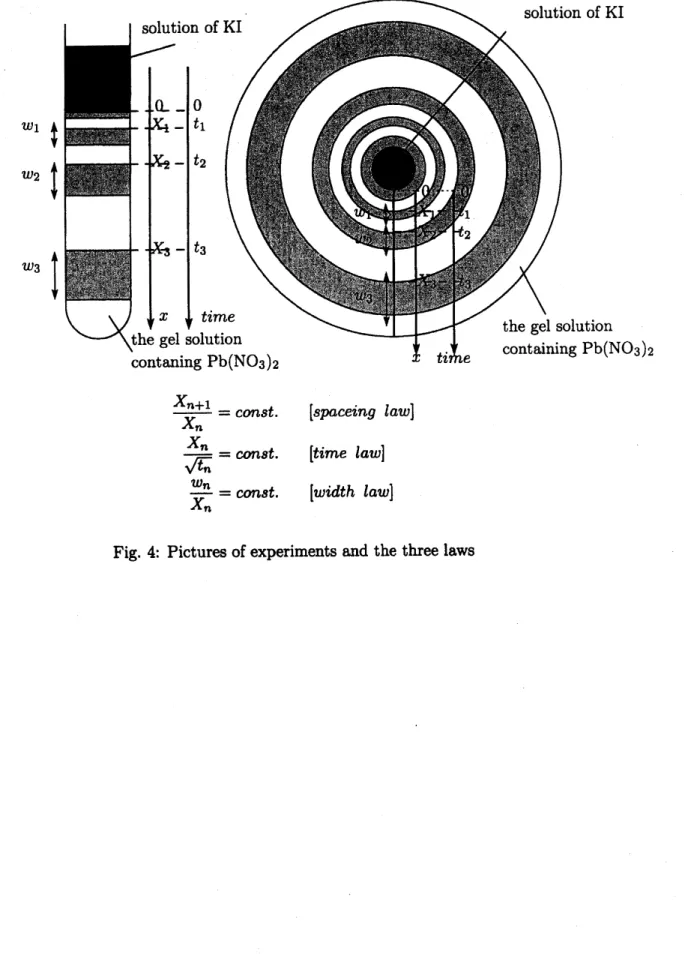
Fig.2.It is also well-known that these striped patterns satisfy three periodic laws, spacing law,
time law, and width law inchemicalexperiments practically [5]. spacing law
can
bedescribedas
$X_{N+1}=pXn,$ where $X_{N}$ is thedistance
of$N$-th band (ring) location froman
originaljunction and $p$ is
a
positive constant (Fig.3). time law and width laware
expressedas
$\sqrt{t_{N}}=qX_{N}$ and $w_{N}=rX_{N}$ respectively, where $t_{N}$, $w_{N}$, $\mathrm{q}$and $\mathrm{r}$
are
the interval from timewhen the experiment started to formation time ofthe $N$-th band (ring), width of the $\mathrm{i}\mathrm{V}$-th
band (ring) and positive constants.
There
are a
lot ofmathematical modelsknown,whichdescribes theinterestingphenomena.We adopt the reduced KR model which is reduced from the well-known Keller-Rubinow
model. We
can
referto the forthcomingpaper [2] about thedetailof theKR model and theFig. 1: the Liesegang band [3] Fig. 2: the Liesegang ring [4]
$\frac{X_{n+1}}{X_{n}}=cnst$
.
$\frac{X_{n}}{\sqrt{t_{n}}}=$const. $\frac{w_{\hslash}}{X_{n}}=$const. [spaceing law] [time law] [width law]2
Mathematically
rigorous Analysis for the reduced
KR
model
2.1
Existence
ofa
time
local weak solution
Without loss of generality,
we
make $D_{c}=1$as we
change the reduced KR model to thedimension less form.
$\{$
$c_{t}=\Delta c+b_{0}S’(t)\delta(r- 5(t))$ $-qP(\mathrm{c}, d)$,
$0<t<T$
, $\mathrm{x}$ $\in \mathrm{R}^{n}$,$d_{t}=qP(c,d)$,
$0<t<T$
, $\mathrm{x}$ $\in \mathrm{R}^{n}$,$(B.C.)$ $\lim_{farrow\infty}c(t,\mathrm{x})=0,$ $0<t<T,$
$(I.C.)c(0, \mathrm{x})=0,$ $d$(0,x) $=0,$ $\mathrm{x}\in \mathrm{R}^{n}$,
(2.1)
where
$\delta$means
theDirac
$\delta$ inone
space dimension,
$P(c, d)=\{$ $(c-C_{a})+$,
on
{
$\mathrm{x}\in \mathrm{R}^{n};c>C_{s}$or
$d>0$}
$,$0, otherwise,
$q>0$, $b_{0}>0$, $C_{s}\geq C_{a}\geq 0$ : given constants,
$S(t)=\alpha\sqrt{t}(\alpha>0)$ : given function.
$r$ is definedby
$r=||=$ $x_{n-1}^{2}+x_{2}^{2}+\cdots+xB,$ $\mathrm{x}=$ $(x_{1}, x_{2}, \cdot\cdot| , x_{n})\in \mathrm{R}^{n}$
.
In this chapter
we
consider (2.1) incase
of$C_{a}=0.$We first define
a
weak solution of (2.1). Let $c(\cdot, \cdot)\in L^{1}(0, T;W^{1,\infty}(\mathrm{R}^{n}))$, $d(\cdot, \cdot)\in$$L^{\infty}$$((0, 7 )$ $\mathrm{x}\mathrm{R}^{n})$
.
Ifthese satisfy$c(t, \mathrm{x})$ $=$ $\int_{0}^{t}\int_{\mathrm{R}^{n}}\frac{1}{(4\pi(t-s))^{\frac{n}{2}}}e^{-\frac{\{\mathrm{x}-\xi)^{2}}{4(t-\epsilon)}}b_{0}S’(s)\delta(\lambda-S(s))$th$ds$
$-q \int_{0}^{t}\int_{\mathrm{R}^{n}}\frac{1}{(4\pi(t-s))^{\frac{n}{2}}}e^{-\frac{(\mathrm{x}-\xi)^{2}}{4(t-s)}}P(c,d)d\xi ds$, (2.2) $d(t, \mathrm{x})$ $=$ $q \int_{0}^{t}P(c, d)$ds,
then
we
calla
couple ofthema
weak solution of (2.1), wherewe
define
A by$\lambda=|4|=\sqrt{\xi_{1}^{2}+\xi_{2}^{2}+\cdots+\xi_{n}^{2}}$,
for$4=$ $(\xi_{1}, \cdots,\xi_{n})\in \mathrm{R}^{n}$
.
Weadopt the folowing form of the polar coordinate in $\mathrm{R}^{n}$ to rewrite (2.2):
$\{$
$\xi_{1}$ $=$ A$\sin\beta_{n-1}\sin\sqrt n-2\ldots\sin\sqrt 2\cos\beta 1$
,
$\xi_{2}$ $=$ A $\sin\sqrt n-1\sin\beta_{n-2}\ldots\sin\sqrt 2\sin\beta_{1}$,
.
$\cdot$
.
$\xi_{n}$ $=$ A$\cos\sqrt n-1$,
6
$0\leq\lambda<\infty$
,
$0\leq$ $\mathrm{f}1_{1}$ $<2\pi,$
$0\leq\beta_{j}<\pi(j=2,3, \cdot\cdot \mathrm{L}, n-1)$
.
Therewritten formof (2.2) is
$c(t,\mathrm{x})$ $=$ $\int_{0}^{t}\int_{\mathrm{R}^{n}}\frac{1}{(4\pi(t-s))^{n}\tau}e^{-\frac{(\mathrm{x}-\xi(\lambda))^{2}}{4(l-\epsilon)}}b_{0}S’(s)\delta(\lambda-S(s))J(\lambda,\beta)d\lambda d\beta ds$ ,
$-q$$\int_{0}^{t}7_{n}\frac{1}{(4\pi(t-s))^{\frac{n}{2}}}e^{-\frac{(\mathrm{x}-\epsilon(\lambda)\}^{2}}{4(t-s)}}P$(c,$d$)$J(\lambda, \mathrm{B})$ $d\lambda d\beta ds$, (2.4)
where $\beta=$ $(\beta_{1}, \cdots, \mathrm{j}3_{n-1})$, $d\beta=d\beta_{1}\ldots$$d\beta_{n-1}$
,
and$J(\lambda, \beta)=2^{n-1}\sin^{n-2}\beta_{n-1}\sin^{n-3}\beta_{n-2}\cdots\sin \mathrm{f}1_{2}$
is the Jacobian of the polar coordinates, and $\xi(\lambda)(= (\xi_{1}(\lambda), \xi_{2}(\lambda)$,$\cdots$ ,$\xi_{n}(\lambda)))$
means
thevariableschanged by
use
of(2.3). Weemphasize the dependency onlyuponA because thereis the term ofthe Dirac $\delta$
on
A in the first term ofthe right-hand side of (2.4).We remark that, if$n=1$ and the boundary condition of$c$ at $x=0$ is the homogeneous
Neumann, the corresponding integral equation of$c$is
$c(t, x)$ $=$ $\int_{0}^{t}\frac{b_{0}S’(s)}{\sqrt{4\pi(t-s)}}(e^{-\frac{(\alpha-S(s))^{2}}{4(t-\epsilon)}}+e^{-\frac{(oe+S(s))^{2}}{4(l-s)}})ds$
$-q$$\int_{0}^{t}\int_{0}$
”
$\frac{1}{\sqrt{4\pi(t-s)}}(e^{-\mu_{\mathrm{t}-s)}^{2}}\emptyset-+e^{-\frac{(x+\xi)^{2}}{4(t-s)}})P(c,d)d\xi ds$
.
Therefore
we
shouldalso definetheweak solution separately inone
space deimension byuse
of the above expression. But the mathematical argument in this chapter is appricable to
the
case
ofone
space dimension.We define the operator $G$ by
$G(c)=$ (theright-hand side of (2.4))
and the space of functions $K$ by
$K=L^{1}(0,T;L^{\infty}(\mathrm{R}^{n}))$
.
Let
us
define thenorm
of$K$ by$||c||_{K}=/_{0}^{T}||c(t, \cdot)$$||L\infty dt$,
and $K$ is a Banach space. We note that $G$ is
a
compact operatoron
$K$ for any $d(\cdot, \cdot)\in$$L^{\infty}$((0,i) $\mathrm{x}\mathrm{R}^{n}$), and note that let
us
$K_{1}=\{c\in K;||c||_{K}\leq 1\}$,
Theorem 2.1 (existence ofa time local weak solution)
If
T $>0$ is smallsufficiently,there exists a weak solution
of
(2.1) such that c $\in K$ and d$\in L^{\infty}((0,$T) $\cross$ Rn). $\mathrm{p}\mathrm{r}.)$ We first note that, for any$c\in K$,$d(t, \mathrm{x})(0<t<T)$ satisfies
$d(t,\mathrm{x})$ $=$ $q \int_{0}^{t}P(c, d)ds$
$=$ $\{$
$q \int_{0}^{t}c(s, \mathrm{x})ds$, if$c>C_{s}$ or $d>0,$
0, otherwise, (2.5)
and $d(\cdot, \cdot)\in L^{\infty}((0, T)\mathrm{x}\mathrm{R}^{n})$
. Therefore
we
regard $d$as
a function
of $c$.
Ifwe
put thefunction $d(c)$ into $P(c, d)$ of (2.2), then we consider of (2.2)
as
only $c$’s equation. We willprove the existence of
a
solution $c\in K$ of (2.2). Letus
decide $d$ byuse
of (2.5) for $c$constructed already, and
we can
makea
weak solution of (2.1) eventually.Now
we
will estimete (2.4) forany
$c\in K.$[Estimate for the first term of the right-hand side of (2.4)]
Let
us
makethefollowingchange ofvariables tothe first term of the right-hand side of(2.4),$\{$
$p^{2}$ $=$ $\frac{\mathit{8}}{t}$
,
(2.6) $x_{i}$ $=$ $S(t)y_{\dot{l}}$ $(i=1,2, \cdots, n)$,
and
we
get$=$ (2.7)
where $\mathrm{y}=$ $(y1,12, \cdots, y_{n})$ and $\mathrm{S}^{n-1}$
means
the unit sphere in $(\mathrm{v}\mathrm{z} ・1)$ space dimensions.Theright-hand sideof (2.7) isindependent from$t$, and
moreover
it takesa
boudedvalue at$\mathrm{y}=(0, 0, \cdots, 0)$ and
converges
to0 as
$|\mathrm{y}|arrow\infty$.
Therefore it takesa
positive maximumi$\mathrm{n}$
Rn. There
exists
a
positive constant $M_{1}$ independentof both $t$ and$\mathrm{x}$ such that$|$the first term oftheright-hand side of
(2.4)$]$ $\leq M_{1}$
.
(2.8)Thus
we
get$\int_{0}^{T}||$the first term
8
[Estimate for the $\mathrm{x}$-derivative of the first term of the right-hand side of (2.4)]
Let
us
notethat$\frac{\partial}{\partial x_{\dot{l}}}=\frac{1}{S(t)}\frac{\partial}{\partial y_{i}}$ $(i=1,2, \cdots, n)$,
and
$\ovalbox{\tt\small REJECT}$
Therefore there exists
a
positive constant M2 such that$|\mathrm{x}$ -derivative of the first term of
the
right-hand side of (2.4)|$\leq M_{2}\sqrt{\frac{1}{t}}$
.
For any $7=2,3$,$\cdot\cdot$
.
,$n$, letus
estimate $x_{j}$-derivative in thesame
manner, and there existsa
positive constant $M_{3}$ independent ofboth $t$ and $\mathrm{x}$ such that$|$the$\mathrm{x}$-derivative ofthe first termofthe right-hand side of$(2.4)|\leq nM_{2}\sqrt{\frac{1}{t}}$
.
Thus
we
get$\int_{0}^{T}||\mathrm{x}$-derivative of the first termof the right-hand side of $(2.4)||_{L}\infty dt\leq 2nM_{2}\sqrt{T}r$
[Estimatefor the second term ofthe right-hand side of(2.4)]
$| \int_{0}^{t}\int_{\mathrm{R}^{n}}\frac{1}{(4\pi(t-s))^{\frac{n}{2}}}e^{-\frac{(\mathrm{x}-\xi(\lambda))^{2}}{4(t-*)}}P(c,d)J(\lambda,\beta)d\lambda d\beta ds|$
$\leq\int_{0}^{t}\int_{\mathrm{R}^{n}}\frac{1}{(4\pi(t-s))^{\frac{n}{2}}}e^{-\xi_{t-}^{\mathrm{x}}}\neq-*\neq^{2}d\xi||c(s, \cdot)||_{L}\infty ds$
.
(2.9)Let
us
remark that$\int_{\mathrm{R}^{n}}\frac{1}{(4\pi(t-s))^{\frac{n}{2}}}e^{-\frac{(\mathrm{x}-\xi)^{2}}{4(t-\epsilon)}}d\xi=1,$
and
we
get(the right-hand sideof (2.9)) $=lt$$||c(s$
,
$\cdot$$)||\mathrm{z}\infty ds\leq||c||K$.
Therefore
$\int_{0}^{T}$ (theleft-hand side of (2.9))$dt\leq||c||K$ $7_{0}^{dt=}T||c||_{K}T$
.
9
$| \frac{\partial}{\partial x_{1}}\int_{0}^{t}\int_{\mathrm{R}^{\hslash}}\frac{1}{(4\pi(t-s))^{\frac{n}{2}}}e^{-\frac{(\mathrm{x}-\xi(\lambda))^{2}}{4(t-s)}}P(c, d)J(\lambda, \beta)d\lambda d\beta ds|$
$\leq$ $\int_{0}^{t}(|\int_{x_{1}}^{\infty}\frac{1}{2\sqrt{\pi(t-s)}}(-\frac{x_{1}-\xi_{1}}{4(t-s)})e^{-\neg}4(t-s(x-\xi)^{2}$
,
$|$$+| \int_{-\infty}^{x_{1}}\frac{1}{2\sqrt{\pi(t-s)}}(-\frac{x_{1}-\xi_{1}}{4(t-s)})e^{-\dashv_{4}^{-}+)^{2}}‘-*d\xi_{1}|(oe)$
$\int_{\mathrm{R}^{n-1}}\frac{1}{(4\pi(t-s))^{\frac{n-1}{2}}}e^{-\frac{\Sigma_{\dot{\mathrm{z}}=2}^{n}(x_{j}-\xi_{j})^{2}}{4(t-e)}}d\xi_{2}\cdots d\xi_{n}||c(s, \cdot)||_{L\infty}ds$
.
(2.10)
Let
us
make the following chenge of variable$\theta_{1}=-\frac{x_{1}-\xi_{1}}{2\sqrt{t-s}}$, and $\int_{x_{1}}^{\infty}\frac{-(x_{1}-\xi_{1})}{8\sqrt{\pi}(t-s)^{\frac{3}{2}}}e^{-\frac{(oe-\xi)^{2}}{4(\ell-s)}}d\xi_{1}$ $=$ $\frac{1}{2\sqrt{\pi(t-s)}}7^{\theta_{1}e^{-\theta_{1d\theta_{1}}^{2}}}\infty)$ 1 $=$ $\overline{4\sqrt{\pi(t-s)}}$
.
Let
us
estimate the integral termon
$(-\mathrm{o}\mathrm{o}, x_{1})$ in thesame
wayas
above, and note that $\int_{\mathrm{R}^{n-1}}\frac{1}{(4\pi(t-s))^{\frac{\mathfrak{n}-1}{2}}}e^{-\frac{\Sigma_{\mathrm{j}=2}^{n}(x_{\mathrm{j}}-\xi_{j})^{2}}{4(\mathrm{t}-s)}}d\xi_{2}\cdots d\xi_{n}=1,$and
(the right-hand side of (2.10)) $= \int_{0}^{t}\frac{1}{2\sqrt{\pi(t-s)}}||c(s$,$\cdot$$)||L\infty$ds.
Therefore
$\int_{0}^{T}$(theleft-hand side of (2.10))dt $\leq$
$\leq$
For any$j=2,3$,$\cdot\cdot$
.
io
Therefore, if$T>0$ issmall sufficiently, then for any $c\in K_{1}(\subset K)$
$||G(c]|K$ $\leq M_{1}T+nM_{2^{\sqrt{T}+}}(T+n\mathrm{a})$ $||c||K$
$\leq$ 1.
Thus $G$ is a compact operator from $K_{1}$ into $K_{1}$
.
Bywe
of the Schauder’s fixed pointtheorem,
we
conclude that there exists$c\in K_{1}$ such that $c=G(c)$.
$\square$Remark 2.2 We
see
thesolutionc
be bounded in $W^{1,\infty}(\mathrm{R}^{n})$ uniformly in time except thetime point t$=0$from the above proof.
2.2
Time global
solution
and its
regularityTheweak solution satisfies the following:
$\mathrm{o}$ ‘Gap’ in time
occurs
at the moment when $t$ becomes positive in the meaningof $\sup-$norm
because of the non-homogeneous term of the Dirac $\delta$.
But the solution isLips-chitz continuous intime if$t>0.$
’ We cannot expect that the solution
on
$r=S(t)$ is smoother than in $W^{1}$,”(R$n$), although it issmooth in $r\neq$S(t)
In fact, let
us
calculate it directly byuse
of (2.4), and if the solution existson
a timeinterval $(0, 7 )$ for
some
positive constant $T$, it is Lipschitz continuous in$0<t<T$
and isin $C^{2}(\mathrm{R}^{\hslash \mathrm{S}}\partial D_{S(t)})$
,
andmoreover
$c\in L^{1}(0,T;W^{1,\infty}(\mathrm{R}^{n})\cap L^{p}(\mathrm{R}^{n}))$ $(1 \leq p\leq\infty)$
.
Here $D_{a}=\{\mathrm{x}\in \mathrm{R}^{n};|\mathrm{x}|<a\}$ for
any
$a>0.$Next,
we
will prove thata
time global solution exists. If $c\equiv 0,$ then the followingdifferencial inequality holds:
$\{$
$c_{t}\leq$ bc$+$
boS’{t)6(t
$-S(t)$) $-qP(c, d)$$\lim_{farrow\infty}c(t,\mathrm{x})=0$ $c(0,\mathrm{x})=0.$
Therefore,
as
longas
it exists, thesolutionof (2.4) satisfies$c(t,\mathrm{x})\geq 0.$
We
see
precipitationoccur
continuouslyinspace
and time, if$C_{s}=C_{a}=0.$We estimate
on
thesecondtermofthe right-hand side of (2.4).1
$[$As (2.7) and (2.8)
are
taken into account,$0\leq$ $c(t, \mathrm{x})$ $\leq$ $\int_{0}^{1}\int_{\mathrm{S}^{n-1}}\frac{b_{0}\alpha^{n}}{(4\pi(1-p^{2}))^{\frac{n}{2}}}e^{-\frac{\alpha^{2}(\mathrm{y}-\xi(\mathrm{p}))^{2}}{4(1-\mathrm{p}^{2})}}J(p, \beta)d\beta dp$ $\leq$ $M_{1}$,
(2.11) uniformly for $\mathrm{x}$
.
Therefore for any $T>0,$$\int_{0}^{T}||c(t, \cdot)||L\infty dt\leq M_{1}T$
(2.12)
We estimate
on
$c_{\mathrm{x}}(t,\mathrm{x})$ in thesame manner
as
in the proofof Theorem 2.1. In fact,
we
make the
same
calculationas
in [Estimatefor the$\mathrm{x}$-derivative of the first term oftheright-hand side of (2.4)$]$ and [Estimate for the
$\mathrm{x}$-derivative of the second term of the right-hand
side of (2.4)$]$, and
we use
(2.11)on
the way. Therefore there existsa
positive consta $\mathrm{t}$ $M_{3}$ such that, for $i=1,$2,$\cdot\cdot 1$ ,$n$,$\int_{0}^{T}||c_{x_{i}}(t,\mathrm{x})||L\infty\leq M_{3}\sqrt{T}$
.
(2.13)
Thusthere exists
a
positive constant $M_{4}$ such that for any fixed $T>0$$||c||_{K}\leq M_{4}(\sqrt{T}+T)$, (2.14)
by
use
of (2.12) and (2.13).Prom
(2.14)we see
thesolution
be ina
bounded set for anyT $>0.$ This
means
that atime global solution exists.Remark 2.3 In the end ofthe section 2.2,
we
consider about radially symmetric solutionsof (2.1). If it is assumed that thesolutionof (2.1) is radially symmetric, then it satisfies the
equationsof the radially symmetric problem:
$\{$
$d_{t}=qP(cc_{t}=c_{\mathrm{r}r}+, \frac{n-1}{d)\mathrm{r}},c_{f}+b_{0}S’(t)\delta(r-S(t))-qP(c, d)$,
$(B.C.)rarrow.\infty \mathrm{h}\mathrm{m}c(t, r)$$=0,$
$(I.C.)c(0, r)=0,d(0, r)=0.$
(2.15)
By putting
x
$=$ (r,0,0,\cdots ,0)
into (2.4),we
naturally derive the integral equation of theweak formulationin the following:
$c(t,r)$ $n$ $\mathfrak{n}2$ $\ovalbox{\tt\small REJECT}_{\mathrm{k}}^{\mathrm{z}}ff$ $s$ $r$ $rt$ $n2$ $d(t,r)$ $s$
We make the
same
argumentas
in the sections2.1
and2.2
to get thesame
kind of results12
have
no
uniquness result of the solution of (2.1) because of the discontinuity of $P(c, d)$,we
do not conclude that the solution of (2.1) is only radially symmetric. Furthermore wenote that,
even
ifweassume
that the solutionis radially symmetric, wecannot immediatelyprove that the solution is unique, although in the following sections
we
focus ona
radiallysymmetric solution to analyse the pattern formation of Liesegang phenomena.
2.3
Analysis
to
discontinuous
precipitation
For (2.15), let
us
makea
rescaling in the following:(2.17) $\{\begin{array}{l}r=S(t)yt=e_{}^{\tau}\end{array}$
let $\mathrm{u}(\mathrm{t}, y)=$u(t,$r$), and
we
get$\{$
$\overline{d}_{\tau}=q\tilde{P}(u,\tilde{d})u_{\mathcal{T}}=\frac{1}{e^{7}\alpha^{2}}u_{yy}+(,\frac{y}{2}+\frac{n-1}{\alpha^{2}y})u_{y}+\frac{b_{0}\delta(y-1)}{2}-e^{r}q\tilde{P}(u,\tilde{d})$
,
$(-\mathrm{o}\mathrm{o}, \log T)$
$\mathrm{x}(0, \infty)$
,
($-\mathrm{o}\mathrm{o}$,$\log$T) $\mathrm{x}(0, \infty)$,
$\lim_{yarrow\infty}u(\tau, y)=0\frac{\partial u}{\partial y}|(\tau, 0)=0-$, $-\infty<$ $\mathrm{r}$ $<\log T$,
$u(-\infty, y)=0$
,
$d(-\infty, y)=0,$ $0<y<\infty$,
(2.18)
Here
we
use
$\delta(ax)=\frac{1}{a}\delta(x)$
,
and
we
define$\tilde{P}(u,\tilde{d})=P(c, d)$, $\tilde{d}(\tau, y)=$ u(t,$r$).
Wehave the correspondingexistenceand smoothness resultstothe
ones
intheoriginal scale.Namely, (2.18) has
a
time global solution$u$,
and forany $T>0$ it is Lipschitz continuous intime $\mathrm{r}$ and $C^{2}([0,1)\cup$ $(1, \infty))$ in $y$
.
Moreover for any $1\leq p\leq\infty$,
$u\in L^{1}$ $(0,\log T;$
1
$1,”[0,\infty)\cap L^{p}(0,\infty))($We nowconsider about the equation (2.15) without the termof $P(c,$d) to focus only on
c.
Ifwe
define $l!$ by$\Psi(t,r)=\int_{0}^{t}\int_{\mathrm{R}^{n}}\frac{b_{0}S’(s)}{(4\pi(t-s))^{\frac{n}{2}}}e^{-\frac{r^{2}-2r1(\mathrm{S}(*))+s(s)^{2}}{4(\mathrm{t}-s)}}‘ J(S(s),\beta)d\beta ds$, (2.19)
(2.20)
from (2.16)
we
see
this bea
solution of (2.15) without the term of $P$.
In (2.19),we
makethe folowing rescaling:
$\{p^{2}=\frac{s}{t}r=S(t,)y$
and
we
get(the right-h d
side of
(2.19)) $= \int_{0}^{1}\int_{\mathrm{S}^{\mathfrak{n}-1}}$$\frac{\alpha}{(4\pi(1-))\overline{2}}e^{-^{\alpha}}$
$4(-\mathrm{p})2\epsilon(p)+\mathrm{p}^{2}J$
13
This integral does not depend upon$t$ (or $\tau$). If I(y) is defined
as
the right-hand side of theabove equality, then this is
a
stationary solution of (2.18) without the term of$\tilde{P}$.
Namely, I(y) solves
$\{$
$0= \frac{1}{\alpha^{2}}u_{yy}+(\frac{y}{2}+\frac{n-1}{\alpha^{2}y})u_{y}+\frac{b_{0}}{2}\delta(y-1)$,
$yarrow.\infty \mathrm{h}\mathrm{m}u(y)=0$, $u_{y}(0)=0.$
(2.21)
We define C’ by
$C^{*}= \Psi(1)=\int_{0}^{1}\int_{\mathrm{S}^{n-1}}\frac{b_{0}\alpha^{n}}{(4\pi(1-p^{2}))^{\frac{n}{2}}}e^{-\frac{\alpha^{2}(1- 2\xi_{1}(p)+p^{2})}{4(1-\mathrm{p}^{2})}}J(p,\beta)d\beta$dp.
Lemma
2.4
(Estimate for V)$\Psi(y)=C^{*}$ $(0\leq y\leq 1)$
1
(y) $<\Psi(1)$ and $\Psi_{y}(y)<0$ (y$>1)$pr.) If$0\leq y\leq 1,$ then (2.21) has
a
singularityapparently at y $=|$0.
Thereforewe
return tothe original equation in n space
dimensions.
Thesolution cof (2.1) without $P(c,$d) satisfies$c_{t}= \sum_{j=1}^{n}c_{x_{j}x_{j}}+b_{0}S’(t)\delta$ (2.22)
Let
us
make thefollowing change of variables:$\{$ $x_{j}t==e^{\tau}S(,t)X_{j}(j=1,2,\cdots,n)$
,
(2.23)and, if$u(X_{1},X_{2}, \cdots, X_{n}, \tau)=\mathrm{c}(x_{1},x_{2}, \cdots, x_{n}, t)$, then $u$satisfies
$u_{\tau}= \sum_{j=1}^{n}(\frac{1}{\alpha^{2}}(x_{\mathrm{j}}\dot{f})+\frac{1}{2}(X_{j}u_{\mathrm{x}_{\mathrm{j}}}))+\frac{b_{0}}{2}\delta($ $\sum_{j=1}^{n}X_{j}^{2}-1)i$ (2.24)
and the extended function of I$(!/)$ constantly to the direction of$\beta$ is
a
stationary solutionof (2.24). Therefore this satisfies
$0= \sum_{j=1}^{n}(\frac{1}{\alpha^{2}}(u_{\mathrm{x}_{j}x_{j}})+\frac{1}{2}(X_{j}u_{X_{j}}))$ in $D_{1}^{n}= \{(X_{1}, \cdots, X_{n});\sum_{j=1}^{n}X_{j}^{2}<1\}$ , (2.25)
and this is equal to the constant C’
on
$\partial D_{1}^{n}$.
Byuse
of the uniformly elliptic type of thestrong maximumprinciple, this is equal to the constant C’ in$\overline{D_{1}^{n}}$
.
Thuswe
get$\Psi(y)\equiv C^{*}(0\leq y\leq 1)$
.
If$y>1,$ then I(y) satisfies
$\{$
$\frac{1}{\alpha^{2}}\Psi_{yy}+(\frac{y}{2}+\frac{n-1}{\alpha^{2}y})\Psi_{y}=0,$ $\Psi(1)=C^{*}$,
$\lim_{yarrow\infty}$ I(y) $=0.$
14
If there is $y_{0}\in(1, \infty)$ such that $\Psi_{y}(y_{0})=0,$ then the constant function I(y) $\equiv$ I(yo)
satisfies the first equation of (2.26). By
use
ofthe uniqueness of the solution of the initialvalue problem of the second order linear ordinary differencial equations, the solution of
(2.26) must be the constant, which equals to $C’>0$ by the boundary condition at the
origin. This is contradict to $\lim_{yarrow\infty}$&(y) $=0.$ Therefore $\Psi_{y}(y)\neq 0$ forany $y\in$
$(1, \infty)$
.
As $\Psi$is smooth enough in $(1, \infty)$ and $C’>0,$ it is
seen
that $y(y)<0 $(1 <y<\infty)$.
$\square$1
Fig. 5: Shape of I(y)
Theorem 2.5 (The first precipitation)
1
If
$C_{B}<C^{*}$,
then thereare
$t^{*}>0$ and$r^{*}>0$ such that thefirst
precipitationoccurs
in$\{(t, r)\in [0, \infty)\mathrm{x}[0, \infty);0<t<t^{*}, 0\leq r<r^{*}\}$
.
$\mathrm{o}$
If
$C_{s}\geq C^{*}$, then the precipitationnever
occurs.$\mathrm{p}\mathrm{r}.)$ For any $t>0,$ the solution of (2.15)without $P(c, d)$ is the following integral: $\mathit{1}^{t}$$\int_{\mathrm{S}^{n-1}}\frac{1}{(4\pi(t-s))^{\frac{n}{2}}}e^{-\frac{(\mathrm{r}^{2}-2r\mathrm{S}1\{S(s))+S(s)^{2})}{4(t-s)}}b_{0}S’(s)J(S(s), \beta)d\beta ds$
.
Moreover, we remark that this integral is mapped to the stationary solution $lj$ of (2.21) by
the rescaling (2.17). This
means
that, if $C_{s}<C^{*}$, then thereare
$t^{*}>0$ and $r^{*}>0$ suchthat the first precipitation must
occur
in $\{(t, r)\in [0, \infty)\mathrm{x}[0, \infty);0<t<t^{*}, 0\leq r<r^{*}\}$,
and else if$C_{s}\geq C^{*}$, then the precipitation
never occurs.
$\square$In what follows,
we
assume
that $(0=)C_{a}$ $<C_{s}<C^{*}$.
We nextprove
that, if $c$ becomesgreater than $C_{\partial}$ in
some
interval, then $c$must go down less than $C_{s}$ aftersome
finite timepassesby.
Theorem 2.6 (discontinuous precipitation) We
define
$\hat{c}(t, y)$ $=c(t, r)$ byuse
of
therescaling $r=S(t)$y. It is assumed that there
are
$T_{0}>0$ anda
subinterval $(y_{1}, y_{2})\in[0, \infty)$15
$\hat{c}(7(),y)>C_{s}$, ly $\in(y_{1},y_{2})$,
$\hat{c}(T\circ, y)$ $\leq C_{s}$, otherwise.
Then, there is a
finite
time $T^{*}>T_{0}$ such that$\hat{c}(T’, y)$ $\leq C_{s}$,
for
all$y\in[0, \infty)$.
$\mathrm{p}\mathrm{r}.)$ We first note that
(2.27)
$c(t,r)= \int_{0}^{t}\int_{\mathrm{S}^{n-1}}\frac{1}{(4\pi(t-s))^{\frac{\mathrm{n}}{2}}}e^{-\frac{r^{2}-2\mathrm{r}\xi_{1}(s(s))+S(s)^{2}}{4(e-s)}}b_{0}S’(s)J(S(s),\beta)d\beta ds$,
$-q7^{t}7_{n} \frac{1}{(4\pi(t-s))^{\frac{n}{2}}}e^{-\frac{r^{2}-2\mathrm{r}\xi_{1}(\lambda)+\lambda^{2}}{4(t-s)}}P(c,d)J(\lambda,\beta)d\lambda$d
$\sqrt$ds.
By
use
of (2.20), thefirst term ofthe right-hand side is changedto I(y), which is independentfrom $t$
.
By useof the following change of variables:$\{\begin{array}{l}r=S(t)y\lambda=S(t)\eta sp=-t\end{array}$
to the second term,
we
get$- \frac{q\alpha^{n}t}{(4\pi)^{\frac{n}{2}}}\int_{0}^{1}\int_{\mathrm{S}^{n-1}}\int_{0}^{\infty}\frac{1}{(1-\mathrm{p})^{\frac{n}{2}}}e^{-\frac{\alpha^{2}(y^{2}-2y\xi_{1}(\eta)+\eta^{2})}{4(1-p\}}}\hat{P}(\hat{c},\hat{d})J(\eta,\beta)d\eta d\beta$ dp, where $\hat{P}(\hat{c},\hat{d})=P(c,d)$, $\hat{d}(t,y)=d(t,r)$
.
Therefore $\hat{c}(t,y)=\hat{c}(T_{0},y)$ (2.28)$- \frac{q\alpha^{n}(t-T_{0})}{(4\pi)^{\frac{n}{2}}}\int_{0}^{1}\int_{\mathrm{s}7^{\infty}\frac{e^{-\frac{\alpha^{2}(y^{2}-2\mathrm{y}\xi_{1}(\eta)+\eta^{2})}{4(1-p)}}\hat{P}(\hat{c},\hat{d})J(\eta,\beta)}{(1-p)^{\frac{n}{2}}}d\eta d\beta dp}n-1^{\cdot}$
As
$\hat{P}(\hat{c},\hat{d})=\hat{c}$at least inthe moving interval$(\sqrt{\underline{t}\mathfrak{g}t}y_{1},\sqrt{\mathrm{g}t}y_{2})$ (t $>t_{0})$,
$\geq$
ie
as
longas
$\hat{c}>l$ for any fixed $l\in(0, C_{s})$.
By
use
ofLemma 2.4, thereis $y_{0}>0$suchthat $\Psi(y)<C_{s}$ in $[y0, \infty)$.
Therefore, if$t>T_{0}$,then
$\hat{c}(t,y)$ $\leq\Psi(y)<C_{s}$,
in [yo,$\infty)$
.
Letus
take sucha
y0 and fix it, and thereexists $M_{5}>0$suchthat, if y $\in[0,$yo],then
$\int_{0}^{1}\int_{\mathrm{s}}\mathfrak{n}-1\int \mathrm{x}_{1}^{y_{2}}\frac{1}{(1-p)^{\frac{n}{2}}}e^{-\frac{\alpha^{2}(y^{2}-2y\xi 1(\eta)+\eta^{2}\}}{4(1-\mathrm{p})}}J(\eta,\beta)d\eta d\beta dp>M_{5}|y_{2}-y_{1}|\sqrt{\frac{T_{0}}{t}}$
.
Thus
$\hat{c}(t,y)\leq\hat{c}(T_{0},y)-\frac{q\alpha^{n}lM_{5}|y_{2}-y_{1}|(t-T_{0})\sqrt{\mathrm{g}Tt}}{(4\pi)^{\frac{n}{2}}}$ ,
(2.29)
as
longas
$\hat{c}>l$.
On the other hand, there is
a
constant $M_{6}>0$suchthat$\hat{c}\geq M_{6}e^{-q(t-T_{0})}$ in the moving interval $(\sqrt{\frac{T_{0}}{t}}y_{1},$$\sqrt{\frac{T_{0}}{t}}y_{2})$
In fact, this is because the rescaling $r=S(t)y$ makes the moving interval pulled back to
$(y_{1}, y_{2})$ and the solution satisfies the differential inequality:
$c_{\mathrm{t}} \geq c_{ff}+\frac{n-1}{r}c_{r}-qc$, in $(y_{1},y_{2})$
.
Therefore,
as we
take l in (2.29)as
$M_{6}e^{-q(t-T_{0})}$, there existsa
constant $M_{7}>0$such that$\hat{c}(t,y)\leq\hat{c}(T_{0},y)-\frac{q\alpha^{n}M_{7}|y_{2}-y_{1}|e^{-q(\mathrm{t}-T_{0})}(t-T_{0})\sqrt{\frac{T}{t}\mathrm{q}}}{(4\pi)^{\frac{n}{2}}}$
.
Now
we
note that the function $e^{-q(t-T_{0})}$(t $-T_{0})$$\sqrt{\underline{T}_{\mathrm{A}}t}$attains the maximum$M_{q}$ at
a
timepoint $7_{1}>T_{0}$
.
Therefore,we
conclude that$\hat{c}($?1,$y) \leq\hat{c}(T_{0},y)-\frac{q\alpha^{n}M_{7}|y_{2}-y_{1}|M_{q}}{(4\pi)^{\frac{n}{2}}}$,
where
we
define$M_{q}=\mathrm{m}\mathrm{a}\mathrm{x}t\geq T_{0}$
(
$e^{-q(t-T_{0})}(t- \tau 0)4)>0.$If$\hat{c}($ 0,$y)- \frac{q\alpha^{n}M_{7}|y_{2}-y_{1}|M_{q}}{(4\pi)^{\frac{n}{2}}}\leq C_{s}$, then the conclusion ofthetheoremholds. Otherwise,
17
of Lipschitz continuity ofthe solution $\hat{c}$
.
Therefore, letus
replace$T_{1}$ to $T_{0}$ and $(y_{3}, y_{4})$ to $(y_{1}, y_{2})$, andlet
us
continue to make thesame
argumentas
abovefinite times. Hence, thereis a finite time $T^{*}>T_{0}$ suchthat
$\hat{c}($7”,$y)\leq C_{s}$,
for ffi $y\in[0, \infty)$, because $\hat{c}$ is boundedin
$W^{1,\infty}([0, \infty))$ uniformly
on
time byRemark 2.2.Here
we
remark that there is a positive constant $M_{1}^{*}$ such that $M_{7}\geq M_{1}^{*}>0$ in theabove finite ime operation, and remark that there is
a
positive constant $M_{2}^{*}$ such that$M_{q}\geq M_{2}^{*}>$ $0$
as
$T_{0}$ is bigger and bigger. $\square$Remark 2.7 Prom Theorem 2.6,
once
$c$ becomes bigger than $C_{s}$, $c$ goes down and willbecome less than $C_{s}$ after
some
finite time passes by. Therefore precipitationoccurs
dis-continuously spatially and temporarily. Moreover, Theorem
2.6
tellsus
that the intervalwhere precipitation
occurs
must bevery small because $c$must go down ato
$\mathrm{n}\mathrm{c}\mathrm{e}$ if$c$exceeds$C_{s}$ a little. But it is
difficult
thatwe
estimate how small the intervalis, because of the
discontinuity of$P(c, d)$
.
2.4 time
law&
spacinglarn
We first consideroftheproblemin the original scale. $(\underline{R_{N}},\overline{R_{N}})$ isdefined
as
themaximumopen interval where the $N$’th precipitation happens, and $\overline{t_{N}}(>0)$ is defined
as
the$\mathrm{s}$ lution of the equation: $S(\overline{t_{N}})=\overline{R_{N}}$.
Especially, by Theorem 2.5,$\underline{R_{1}}=0.$ By Th
orem
2.6 andthe definition of$P(c, d)$,
(
$\underline{R_{N}},\neg R_{N}$ must be a finite open interval.We
now
think about the dynamics of the system after the $\mathrm{i}\mathrm{V}’ \mathrm{t}\mathrm{h}$ precipitation’s beingsettled down and until $N+1$’st precipitation’s occuring. For this purpose, we separate the
halfline $[0, \infty)$ to $[0,\overline{R_{N}}]$ and $(\overline{R_{N}}, \infty)$
.
We prove that(1) The $N+1$’st precipitation will
never
occur
in [$0,\urcorner R_{N}$, and(2) The$Nf$$1$’stprecipitation really
occurs
in$(\overline{R_{N}}, \infty)$
,
which satisfies time laut rigorouslyand spacing lawapproximately.
We first prove (1).
Theorem 2.8 The $N+l’st$precipitation willnot
occur
in $[0, \overline{R_{N}}]$.
$\mathrm{p}\mathrm{r}.)$ We define $\overline{t_{N}^{*}}$
as
$T^{*}$ of Theorem 2.6 with$(y_{1}, y_{2})=(\underline{R_{N}},\overline{R_{N}})$
.
If$\overline{t_{N}’}>\overline{t_{N}}$, then it isseen
that the next precipitation does notoccur
in $(\overline{t_{N}}, \overline{t_{N}^{*}})$ by Theorem 2.6. Thereforewe
consider about the next precipitation only in $t>\overline{t_{N}^{*}}$
.
Now, in $t>\overline{t_{N}^{*}}$ and $0\leq r\leq\overline{R_{N}}$, $c$satisfies18
$c_{t} \leq_{rr}+\frac{n-1}{r_{C}}c_{r}c(^{\frac{c}{t_{N}^{*}}},r)<_{s}$
,
’
$0\leq r\leq 0<r<_{\overline{N\frac{R}{R_{N}}}}.’t>\overline{t_{N}^{*}}$
Therefore, by
use
of the maximum principle of parabolic type equation, the maximum valueistaken either
on
$c(\overline{t_{N}^{*}}, r)$, on $c(t, 0)$or on
$c(t,\overline{R_{N}})$.
Therefore, if $c$exceeds $C_{s}$ in $[0, \overline{R_{N}}]$, itmust be either $c(t,0)$
or
$c(t,\overline{R_{N}})$.
In what follows
we
prove that both $c(t, 0)$ and $c(t, \overline{R_{N}})$ do not exceed $C_{s}$ actually. Weshow that if$c(t, r)|_{r=0}$,$\overline{R_{N}}$ takesthemaximum, then it
goes
down. For the purpose,we use
the integral expression in therescaled system. $\beta$denotes either 0
or
$\overline{R_{N}}$.
For $\mathrm{J}$$=0$or
$\overline{R_{N}}$,we
define $t_{\beta}^{*}(>\overline{t_{N}^{*}})$as
the time when $c(t, \beta)$ takes the maximum in $[0, \overline{R_{N}}]$.
In the integralexpression (2.28), let us substitute$t_{\beta}^{*}$ for$T_{0}$, and
we
get$\hat{c}(t,y)=\hat{c}(t\beta*,y)$ (2.30)
$- \frac{q\alpha^{n}(t-t_{\beta}^{*})}{(4\pi)^{\frac{n}{2}}}\int_{0}^{1}\int_{\mathrm{S}^{n-1}}\int_{0}^{\infty}\frac{e^{-\frac{\alpha^{2}(y^{2}-2y\xi_{1}(\eta)+\eta^{2})}{4(1-p)}}\hat{P}(\hat{c},\hat{d})J(\eta,\beta)}{(1-p)^{\frac{n}{2}}}d\eta d\beta dp$
.
By the rescaling (2.17),theprecipitationinterval
moves
tothe left-handside. Therefore, weestimate
the valueof $\hat{c}$(t,
$\sqrt{\mathit{4}^{t^{*}}t}y$).
On
the movingpoint $\sqrt{l^{t^{*}}t}y$, it isseen
that$\hat{c}(t,\sqrt{\frac{t_{\beta}^{*}}{t}}y)=\hat{c}(t_{\beta}^{*\sqrt{\frac{t_{\beta}^{*}}{t}}},y)$ (2.31)
$- \frac{q\alpha^{n}(t-t_{\beta}^{*})}{(4\pi)^{\frac{n}{2}}}(\frac{t_{\beta}^{*}}{t})^{\frac{n}{2}}\int_{0}^{1}\int_{\mathrm{s}}n-1\int_{0}^{\infty}\frac{e^{-\frac{\not\simeq^{\iota^{*}}\alpha^{2}(y^{2}-2y\xi_{1}(\zeta)+\sigma^{2})}{4(1-p)}}\hat{c}(t,\sqrt{\frac{t_{\beta}^{*}}{t}}\zeta)J(\zeta,\beta)}{(1-p)^{\frac{n}{2}}}d\zeta d\beta dp$ , where \langle is definedby
$\eta=\sqrt{\frac{t_{\beta}^{*}}{t}}\zeta$
.
Wetake
a
constant $l\in(0, Cs)$ anda
subinterval $[\mathrm{y}\mathrm{j}, y_{2}’]\subset[0,\neg R_{N}$ such that$c\wedge(t,$ $\sqrt{\frac{t_{\beta}^{*}}{t}}y)>l$for any $y\mathrm{E}$ $(d_{1}, y_{2}’)$, and fix them. Therefore, there exists
a
constant $B^{*}>0,$ which is dependenton
$y_{1}’,$$/\mathrm{t}2$ and is independent from $y,t,t_{\beta}^{*}$,(the second termof the right-hand side of (2.31)) $<- \frac{q\alpha^{n}(t-t_{\beta}^{*})}{(4\pi)^{\frac{\mathfrak{n}}{2}}}(\frac{t_{\beta}^{*}}{t})^{\frac{n}{2}}lB$’
On the other hand, it is easily
seen
that there isa
constant $\delta_{1}>0$ such that for anyie
$\hat{c}(t_{\beta}^{*},\beta)\geq\hat{c}(t_{\beta}^{*\sqrt{\frac{t_{\beta}^{*}}{t}}},\beta)$
because $\beta$$=0$ or because $\beta=\overline{R_{N}}$and $\hat{c}$takes the maximum value at $\overline{R_{N}}$
.
Moreover, letus
define $M_{t_{\beta}}*$ by
$M_{t}$
7
$\beta*=\sup_{t>t_{\beta}^{*}}((t-t_{\beta}^{*})(\frac{t_{\beta}^{*}}{t})^{\frac{n}{2}})>0$.
(By simple calculation, it is
seen
that, if $n=2,$ then $M_{t_{\beta}}$, $=t_{\beta}^{*}$ and, if $n\geq 3,$ then$M_{t_{\beta}^{*}}= \frac{2t_{\beta}^{*}}{n-2}(\frac{n-2}{n})^{\frac{n}{2}}.)$ We note that there is aconstant
$\delta_{2}>0$ such that $(t-t_{\beta}^{*})(_{\overline{\overline{t}}}^{t_{\beta}^{*}})^{\frac{n}{2}}$ is
monotoneincreasingin$t\in[t_{\beta}^{*},t_{\beta}^{*}+\delta_{2}]$,and alsonotethat
$M_{t_{\beta}}*$ becomesbigger
as
$t_{\beta}^{*}$becomes bigger. It is, therefore,seen
that there isa
constant $\delta_{3}>0$ and $\delta_{4}>0$ such that for any$t\in(t_{\beta}^{*},t_{\beta}^{*}+\delta_{3})$
$\hat{c}$
(t,
$\sqrt{\frac{t_{\beta}^{*}}{t}}\mathit{3})<\hat{c}(t_{\beta}^{*},\beta)$, and $c\wedge(t_{\beta}^{*}+\delta_{3},\sqrt{\frac{t_{\beta}^{*}}{t_{\beta}^{*}+\delta_{3}}}\beta)<\hat{c}(t_{\beta}^{*},\beta)-\delta_{4}$
.
(2.32)Therefore, both $c(t,$0) and $c(t,\overline{R_{N}})$ cannot exceed $C_{\theta}$
.
$\square$Next,
we
will prove (2). Weremark that chasnever
reached $C_{s}$so
far inr $>\overline{R_{N}}$, t $\leq\overline{t_{N}}$.
We define functions $\varphi_{N}(t)$, $\eta_{N}(t)$, and$\psi_{N}(r)$ by
$\mathrm{p}_{N}(t)$ $=c(t,\overline{R_{N}})$ $(t>\overline{t_{N}})$,
$\eta_{N}(t)=c_{f}(t,\overline{R_{N}})$ $(t>\overline{t_{N}})$,
$\psi_{N}(r)=c(\overline{t_{N}},r)$ $(0<r<\infty)$,
for the solution $c$ of the original equation (2.15). By Theorem 2.6 and the maximality of
$(\underline{R_{N}},\overline{R_{N}})$,
$0\leq\psi_{N}(r)<C_{s}(\overline{R_{N}}<r<\infty)$
.
(2.33)$c$solves the following evolutionary equation:
$\{$
$c_{t}=c_{ff}+ \frac{n-1}{\frac{\mathrm{r}}{\infty^{C(}R_{N}}}c_{r}+b_{0}S’,(t)\delta(r-S(t))(B.C.)\lim_{farrow}t,r)=0(B.C.)c(t,)=\varphi_{N}(t)$,
’
$t>t>t>\overline{\frac{}{t_{N}}\frac{t_{N}}{t_{N}}},’,\overline{R_{N}}<r<\infty$
,
$(I.C.)c\Gamma t_{N}$,$r)=\psi_{N}(r)$, $\overline{R_{N}}<r<\infty$,
(2.34)
in $t>\overline{t_{N}}$and $\overline{R_{N}}<r<\infty$
.
One of
our
main tools is the comparison principle of the parabolic type equation withthe problem with Homogeneous
Dirichlet
boundary condition at $\mathrm{r}=0.$ Therefore,we
mustextendtheequation (2.34) naturally intothe interval [0,$\neg R_{N}$
.
For this purpose,we
consider20
$\{$
$\tilde{\mathrm{c}}_{t}=\tilde{c}_{\tau r}+\underline{n-1}\tilde{c}_{r}$, $t>\overline{t_{N}}$, $0<r<\overline{R_{N}}$, $(B.C.) \tilde{c}(t, \frac{f}{R_{N}})$
$=\varphi_{N}(t)$, $t>\overline{t_{N}}$,
$(B.C.)\tilde{c}_{r}(t,\overline{R_{N}})=\eta_{N}(t)$, $t>\overline{t_{N}}$,
$(I.C.)$ $\tilde{c}(\overline{t_{N}},r)=\psi_{N}(r)$, $0<r<\overline{R_{N}}$
.
(2.35)
(2.35) has
a
unique solution $\tilde{c}$, and byuse
ofthe comparison principle,$\tilde{c}(t,r)$ $>c(t,r)\geq 0$
is satisfied in$t>\overline{t_{N}}$
,
$0<r<\overline{R_{N}}$.
Finally, letus
consider the following evolution equation:$\{$
$)t=v_{\tau r}+ \frac{n-1}{f}v_{\mathrm{r}}+b_{0}S’(t)\delta(r-S(t))$, $t>\overline{t_{N}}$, $0<r<\infty$
,
$(B.C.)$ Cr(t,$0$) $=\eta_{N}(t)$, $t>\overline{t_{N}}$,
$(B.C.) \lim \mathrm{g}\{\mathrm{t},$$r)=0,$ $t>\overline{t_{N}}$, $farrow\infty$
$(I.C.)v(\overline{t_{N}}, r)=\psi_{N}(r)_{1}$ $0<r<\infty$,
(2.36)
and (2.36) has
a
uniquesolution $v$.
Moreover, $v$ satisfies$v(t,r)=\tilde{c}(t,r)$ $>c(t,r)$
int $>\overline{t_{N}}$, $0<r<\overline{R_{N}}$, and
satisfies
$v(t,r)=c(t,r)$ in $t>\overline{t_{N}}$, $\overline{R_{N}}<r<\infty$
.
Without lossofgenerality,
we
normalize$\overline{t_{N}}=1,$as we
fix $N\in$ N. Inorderto investigatebehavior ofthesolutionof (2.36),
we
studythe following homogeneous problem:$\{$ $\mathrm{r}\infty f(1,r)=0f(t,0)=0\lim_{arrow}f(t, r)’,=0,$ $f_{t}=f_{m}+ \frac{n-1}{f}f_{r}+b_{0}S’(t)\delta(r- S(t))$ , $t>1t>1,’ r>0t>1|$ ’ $r>0,$ (2.37)
Furthermore,
we
need to consider the next problemtosee
properties ofa
solution of(2.37).$\{$ $g_{t}=g_{rr}+, \frac{n-1}{r}g_{f}+b_{0}g(t,0)=0g(0,r)=0$
,S’(t)6(r
$-S(t)$), $t>0,,,$ $r>0t>0t>0r>0$ ’ $\lim_{farrow\infty}g(t, r)=0,$ (2.38)A important difference between (2.37) and (2.38) is the time whenthe initial data is given.
It is 1 in (2.37), although it is 0 in (2.38).
(2.38) has
a
uniquetime global solution. As $\mathrm{g}(\mathrm{t}$, is transformed by the following changeofvariables:
(2.39)
21
$g(t’, r’)$ solves the quite
same
equation (2.38). Therefore it is satisfied that$g(t,r)=g(\lambda^{2}t,\lambda r)$ $(\lambda>0)$
.
(2.40)Welet $\lambda=\frac{1}{\sqrt{t}}$
,
andwe see
$g(t,r)=g(1, \frac{r}{\sqrt{t}})$
.
(2.41)Moreover
we use
therescaling: $r=S(t)y$ to get$g(t,r)=g(1, \alpha y)$
.
(2.42)Weremark that the right-hand side of (2.42) is independent ffom $t$
.
Letus
define $lf^{D}$ by$\mathrm{I}^{D}(!/)$
$=g$(1, cry),
and this is
a
stationary solutionofthe equationrescaled by $r=S(t)y$.
Namely, $lj^{D}$ solves$\{$
$0= \frac{1}{\alpha^{2}}\Psi_{yy}+(_{2}^{u}+\frac{n-1}{\alpha^{2}y})\mathrm{t}_{y}+’ \mathrm{j}6(y-1)$
,
$y>0,$$\Psi(0)=0,$
$\lim_{farrow\infty}$ I(y) $=0.$
(2.43)
This
means
that the solution of (2.38) has the “similar” shape to $lj^{D}$ and its maximumpoint
moves
to the right-hand side.On the other hand, we make the change of variables, $r=S(t)y$ and $t=er$ , for the
equation (2.37). Ifwe define $h$ by $h(\tau, y)=$ g(t,$r$), then the rescaled equation is
$\{$
$h_{\tau}= \frac{1}{\alpha^{2}}h_{yy}+(_{2}^{\mathrm{H}}+\frac{n-1}{\alpha^{2}y})h_{y}+\underline{b}2$n$\delta(y-1)$, $\tau>0$, $y>0,$
$h(\tau, 0)=0,$
$y \infty h(0, y)=0\lim h(\tau, y)$
.
$=0,$ (2.44)
Now, let
us
consider the function $lf^{D}-h,$ which satisfies the heat equation with homogeneous
Dirichelet boundary condition and with the initial condition $lf^{D}$.
Therefore, $\Psi^{D}-h$converges
to0
uniformly in $y$, whichmeans
that $f$is monotone increasing and$f(t, S(t)y)arrow$ I$D(y)$($=$g(l,$\mathrm{a}\mathrm{y}$)$.$, uniformly in $y$,
as
$tarrow$oo
(namely $\mathrm{r}$$arrow\infty$).Wenext define $C^{**}$ by $C^{**}:=\Psi^{D}(1)>0,$ and study the shape of I$D(y)$ minutely.
Lemma 2.9 (Estimate for I$D(!/)$)
$\Psi^{D}(y)>0$, in $(0,\infty)$
,
$\Psi_{y}^{D}(y)>0,$ $in$ $(0,1)$, $It_{y}^{D}(y)<0$, in $(1,\infty)$,22
$\mathrm{p}\mathrm{r}.)$ I$D(y)>0$ in $(0, \infty)$ is clear.
We will show that $\Psi_{y}^{D}(y)>0$in $(0, 1)$ bycontradiction. In $(0, 1)$, $\Psi^{D}$ solves
$\{$
$0= \overline{\alpha}^{\mathrm{I}}1\Psi_{yy}D+(_{2}u+\frac{n}{\alpha}-l^{\frac{1}{y})}$ I$i$, in $(0, 1)$,
$\Psi^{D}(0)=0,$
$\Psi^{D}(1)=C^{**}>0.$
(2.45)
Ifthere exists$y_{0}\in(0,1)$ such that $\Psi_{y}^{D}(y_{0})=0.$ Let
us
define $G(y)$ by $\mathrm{G}(\mathrm{y})\equiv$ $\mathrm{I}"(y_{0})$ (the constant function),and $G$ solves
$\{$
0 $=$ $\frac{1}{\overline{\overline{\alpha}}^{\pi}}G_{\mathrm{y}y}+$ $(_{2}^{u}+ \frac{n-1}{\overline,\alpha^{3}\overline{y}})Gy$,
$G_{y}(y\mathrm{o})$ $=$ 0,
$G(y_{0})$ $=$ $\Psi^{D}(y\mathrm{o})$
.
By
use
of the uniqueness theorem ofthesolution of the initialvalue problem ofthe secondorder linear partial
differential
equations, thisdoes
not haveany
solutionmore
than $G$.
Therefore the solution of (2.45) must correspond to $G$
.
Thuswe
see
I(y) $\equiv 0$ (for any$y\in(0,1))$ from $\Psi^{D}(0)=0.$ But it contradicys that $C^{**}>0,$
so
that$\mathrm{I}\mathrm{f}^{D}y(y)\neq 0$ ( for any$y\in(0,1)$).
Taking $C^{**}>0$ into account,
we
get I$\mathrm{G}(\mathrm{y})$ $>0$ ( for any $y\in(0,1)$). Wecan
prove that$\Psi_{y}^{D}(y)<0,$ ( for any $y\in(1,$$\infty$)) in the
same
manner,so we
omit it. $\square$Fig. 6: $\mathrm{D}^{D}(y)$
For the non-homogeneous problem (2.36),
we
makea
change of variables (2.17) andwe
define $w(\tau,y)=$ v(t, toget
$\{$
$\prime w(\tau, \mathrm{o}^{\overline{\overline{\alpha}^{\mathrm{T}}}2\overline{\overline{\alpha}^{2}\overline{y}}2})=\eta_{N}(e^{\tau})\lim_{yarrow\infty}^{w_{\tau}}w(\tau,y)=0=^{1}w_{yy}+(u,’+n-1)w_{y}+k\delta(y-1)$ $\tau>0,,y>0\tau>0\tau>0$
,
’
$w(0,y)=\psi_{N}(\alpha y)$
,
$y>0.$23
Lemma 2.10 (Estimate for (2.46))
If
$C_{s}<C^{**}$, then the solutionof
(2.46) continuesto attain its maximum at $y=1$
after
some
finite
time passed by.$\mathrm{p}\mathrm{r}.)$ The
difference
$w-$ $h$ between solutions of (2.46) and (2.44)
solves classically th$\mathrm{e}$
following equation:
$\{$
$z_{\tau}=pz_{yy}+(_{2}^{\mathrm{g}}+ \frac{n-1}{\alpha^{2}y})z_{y}$
,
$\tau>0$, $y>0,$$z(\tau, 0)=\eta_{N}(e^{\tau})>0,$ $\tau>0,$
$1\dot{\mathrm{m}}_{yarrow\infty}z(\tau, 0)=0,$ $\tau>0,$
$z(0, \mathrm{g}/)$ $=\psi_{N}(\alpha y)>0,$ $y>0.$
(2.47)
By
use
ofpreserving the positivity,we
see
w
$>h,$ (2.48)for any $\tau>0$, $y>0.$
We
now
separate the intervalwhere $w$ defines to $(0, 1)$ and $(1, \infty)$.
In $(0, 1)$, $w$ solves$w_{\tau}= \frac{1}{\alpha^{2}}w_{yy}+(\frac{y}{2}+\frac{n-1}{\alpha^{2}y})w_{y}$ $\tau>0$, $0<y<1,$
classically. Weapplytheparabolic typeof strong maximumprincipletosee$\mathrm{w}(\mathrm{t}, y)$attaining
its maximum either at $\tau=0$, $y=0$
or
$y=$ l. On the other hand,we
have already knownthat the next precipitation does not
occur
in $[0,\overline{R_{N}}]$ by Theorem 2.8. Moreover,as
taking(2.48), Lemma 2.9, and the fact that $harrow\Psi^{D}$
as
$tarrow$oo
into account, weconclude that,if$C_{s}<C^{**}$, then$w$ continuesto attain its maximum at $y=1$ after
some
finitetime passesby.
In $(1, \infty)$
,
we
take $R>0$ large enough and fix it. Weprove
thesame
property in [1J].Finally
we
use
the fact that$\lim_{yarrow\infty}w(\tau, y)=\square 0.$ Weeventually
see
$w$ attaining its maximum
at $y=1$ after
some
finite time.In what$\mathrm{f}\mathrm{o}\mathbb{I}\mathrm{o}\mathrm{w}\mathrm{s}$,
we
define$\tau_{N+1}’$
as
thetimewhenthesolutionw
of (2.44) hits $C_{s}$, $N+1$’sttime, and also define
$t_{\acute{N}+1}=e"$
.
In original temporary and spatially scale, $R_{N+1}’$ is defined
as
the spatial point where thesolution
c
hits CS) $N+1$’st time.Theorem
2.11 (time law)If
$C_{s}<C^{**}$, then $R_{N+1}’=\alpha\sqrt{t_{N+1}}$.
pr.) By Lemma 2.10, $w(\tau,$1) continues to attain the maximum value and hits $C_{s}$ in
some
finite time, if$C_{\mathit{8}}<C^{**}$
.
Therefore, inoriginal scale, itmeans
that24
which
means
time law. 口We define$\tau_{N+1}’$
as
the time when thesolution $h$ of (2.46) hits C8, $N+1$’st time, and alsodefine
$t_{N+1}’=e^{\tau_{\acute{N}+1}’}$.
Moreover,we
define$R_{N+1}’=S(t_{N+1}’)$ and$\overline{\tau_{N}}=\log\overline{t_{N}},$.
Theorem 2.12 (spacing law) It is
assume
that there existsa
small constant$\epsilon_{1}>0$ suchthat,
for
any $i,j\in$N,$\sup_{f>0}|\psi_{i}(r+\overline{R.})-\psi_{j}(r+\overline{R_{j}})|<\epsilon_{1}$
.
(2.49)Then there
are
constants C’ $>0$ and$\delta_{0}\geq 0$ such that$\frac{R_{\acute{N}+1}}{\overline{R_{N}}}=C^{*}+o(\epsilon_{1}^{\delta_{0}})$
if
$C^{**}>C_{s}$ andif
$|C"-C_{s}|$ is small enough.pr.) Inthe interval $\ulcorner R_{N}$,$\infty$),
we can
separatethesolutionv
of(2.36) to thefollowing threeparts:
$\mathrm{f}(\mathrm{t},\mathrm{r})=f(t,r)+U(t,r)+$f(t,$\mathrm{r}$),
Here $f(t,r)$ solves (2.37), $U(t,r)$ solves the following:
$\{$
$U_{t}=U_{\Gamma T}+ \frac{n-1}{f}U,$
,
$t>\overline{t_{N}}$, $r>\overline{R_{N}}$,$U(t, 0)=0$, $t>\overline{t_{N}}$,
$\lim_{\mathrm{r}arrow\infty}U(t,r)=0$, $t>\overline{t_{N}}$,
$U(\overline{t_{N}}, r)=\psi_{N}(r)$
,
$r>\overline{R_{N}}$,(2.50)
and $v(t, r)$ solves the following:
$\{$ $V_{t}=+ \frac{n-1}{\varphi_{N}f}V_{r}V(t,)=(t)\frac{V_{ff}}{R_{N}},$ , $t> \overline{t}t>\frac{N}{t_{N}},$, $r>\overline{R_{N}}$, $\mathrm{r}\infty V\Gamma t_{N},$ $r)=0,r> \lim V(t,r)=0,t\overline{t_{N}}\frac{>}{R_{N}}.$ ’ (2.51)
For the solution U of(2.50), there existsa positive constant $M_{8}$ such that
$\mathrm{r}\in \mathrm{s}\mathrm{u}\{\begin{array}{l}\mathrm{p}0,\infty\end{array})$
$|U(t,r)| \leq\frac{1}{4\pi t}\int_{0}^{2\pi}\int_{0}^{\infty}\psi_{N}(r)rdrd\theta$
$\leq\frac{M_{8}}{t}arrow 0$, $(tarrow\infty)$
.
Takingthe assumption of (2.49) into account, thereexists
a
positive constant $M_{9}$ such that25
for
any
$ij\in$ N. Here $U^{(i)}$ isthe corresponding solution to(2.50) with $N=i$for
a
$\mathrm{y}i\in$N.The solution of(2.51) satisfies that
$\lim_{tarrow\infty}|$I $(t, r)|=0$ (exponentially), (2.53)
because of$\lim_{tarrow\infty}\mathrm{p}_{N}(t)=0$ (exponentially). Therefore $f$ is only related to the $N+1$’st
precipitation. We first consider about the solution $f$ of (2.37). We have already made a
rescale of (2.37) by (2.17) to get (2.44).
Let
us
remark that the right-hand side of (2.44) is independent ffom $\tau$, and there existsa
positive constant $M_{10}$ independent of$N$ such that, for any $N\in$N, it holds that$r_{\acute{\acute{N}}+1}-\overline{\tau_{N}}=M_{10}$
.
In theoriginal scale ofspaceanf time, it
means
that$\log t_{N+1}’-\log\overline{t_{N}}$ $=$ $M_{10}$
$\frac{t_{N+1}^{\prime/}}{\overline{t_{N}}}$ $=$ $eM_{10}$
Furthermore, because $R_{N+1}’=S(t_{N+1}’)$
, we
get$\frac{R_{\acute{\acute{N}}+1}}{\overline{R_{N}}}==e^{\underline{M}}\sqrt{\frac{t_{\acute{\acute{N}}+1}}{21\overline{1t_{N}}}}$
,
We
next think of the solution $w$ of (2.46). Byuse
ofboth (2.52) and (2.53),we
see
thedifference betweenthesolutionsof (2.44) and (2.46)be at most in$O(\epsilon_{1})$ ($\epsilon_{1}$ issmall enough).
Thus thereexists $\delta_{0}\geq 0$such that
$\frac{R_{N+1}’}{\overline{R_{N}}}=e^{M}?+o(\epsilon_{1}^{\delta_{0}})$,
because of Theorem 2.11 0
Remark 2.13 The assumption (2.49)
means
that smallis the difference betweenthe shapeof the solution in$r>r_{1}$. at the moment when$t=t_{\dot{l}}$ and the shape of thesolutionin
$r>rj$ at
themoment when $t=t_{j}$ for any $i,j\in$ N. It apparently
seems
to be difficult thatwe
provethis in mathematically rigorous
manner, because
ofthe
hystericis happening. According tonumericalsimulations that
we have
alreadydone, itseems
thatthisissatisfied very well. Wetherefore think that
we
have made the essential mechanismbywhichLiesegang phenomenaoccurs
clear.As
we
state in Remark 2.7,we can
consider of the interval $(R\mathrm{p},\overline{R_{N}})$as
very small.Therefore,
as
$R_{N}’\in(\underline{R_{N}},\overline{R_{N}})$,we can
regard the difference between$R_{N}’$ and$\overline{R_{N}}$ as much
smaller than the difference between$\overline{R_{N}}$ and$\overline{R_{N+1}}$
.
Hencewe
can
regard Theorem 2.12as
spacing law. But it is difficult that we estimate how small the interval is because of the
28
参考文献
[1] R. E. Liesegang, Chemisette Fernwirkung, Photo. Archiv. 800 (1896), 305-309.
[2] T. Hamaoka, D. Hilhorst, R.
van
der Hout, M. Mirauraand I. Ohnishi, in preparation.[3] S. Kai, and S. C. Muller, Spatial and temporal Macroscopic Structures in Chemical
Reaction System : Precipitation Patterns and
Interfacial
Motion, Scienceon
Form. 1(1985), 8-38.
[4] S. Kai, S. C. Muller, and J. Ross, Curiosities in Periodic Precipitation Patterns,
Sci-ence.
216 (1982),635-647.
[5] S. Kai, Macroscopic pattern
formation
in precipitationprocess (in Japanese), AppliedPhysics, 54, (1985),
19-27.
[6]
S.
Kai,K. Higaki, H. Yamazaki, T. Yamada, Patternformation
in precipitationprocess(importance
of
Ostwaldripenning) (in Japanese), Dengakuron $\mathrm{C}$, 10711 (1987),1011-1018.
[7] S. Kai, PatternFormationin Precipitation, FORMATION DYNAMICS AND
STATIS-TICS OF PATTERNS(Vol 2), World Scientific, 54, (1993),
206-265.
[8] Ostwald, Z. Phys. Chem. 27 (1897),
256.
[9] $\mathrm{J}.\mathrm{B}$
.
Keller, and $\mathrm{S}.\mathrm{I}$.
Rubinow, Recurrent precipitation and Liesegang rings,J.Chem.Phys. 74 (1981),
5000-5007.
[10] D.Hilhrst, R.van der Hout, and $\mathrm{L}.\mathrm{A}$
.
Peletier, Thefast
reaction limitfor
a
reaction-diffusion
systerm, J.Math.Anal.Appl. 199 (1996),349-373.
[11] M. Yamaguchi, and T. Nogi, “Stephan Problem” (in Jananese), Sangyotosho, (1977)
[12] M. Protter, and H. Weinberger, “Moirnum Principles in
Differential
Equations”,Springer-Verlag. (1984)
[13] R.Temam,
![Fig. 3: spacing larv (the courtesy of Kai) [6]](https://thumb-ap.123doks.com/thumbv2/123deta/6020471.1065289/3.892.472.734.166.414/fig-spacing-larv-courtesy-kai.webp)