
150
YearsofVortexDynamics HASSANAREF1
CenterforFluid Dynamics and DepartmentofPhysics TechnicalUniversityofDenmarkKgs. LyngbyDK-2800, Denmark
and
DepartmentofEngineeringScience andMechanics, CollegeofEngineering,
VirginiaPolytechnic Institute&StateUniversity, Blacksburg,VA 24061, USA 1. Introduction
The subject of vortex dynamics
can
fairly be said tohave been initiated by the seminalpaper[23] of HermannLudwigFerdinand Helmholtz
150 years ago.
Inthispaper
Helmholtz established his three laws ofvortexmotion
in
roughly the form theyare
found today in textbookson
fluid mechanics. Onemotivationseems
to havebeenhis interestin frictional phenomena, camiedover
fromhisinterest in energetics; anotherwas
his growingawareness
ofthepower
ofGreen’s theorem in hydrodynamics. Ina
speech [25] ata
banqueton
the occasion ofhis 70th birthday–an
eventthat brought together 260 friends and admirers at Kaiserhofon November 2, 1891 -Helmholtz gavethe followingaccount:
I have also beenin aposition to solve several problems in mathematical physics, someofwhich the greatmathematicianssincethetimeofEulerhadworkedoninvain –forexample, problemsconcerning
vortex motion and the discontinuity ofmotion influids, the problem of themotionof soundwavesatthe openendsoforganpipes, andsoon. Butthe pridewhlchImight havefeltabout the final resultofthese $invesuga0ons$was considerablylessened bymyknowledge that I had only succeededin solving such problems, aftermanyerroneousattempts, by the gradual generalization of favorable examples and bya seriesoffortunateguesses. I wouldcomparemyself toamountainclimberwho,not knowingtheway, ascendsslowly and painfully and isoftencompelled to retracehis steps because he cangonofarther; who, sometimesbyrcasoning and sometimes by$acciden\zeta hiLs$uponsigns ofaffcsh path,which leads himalittlefarther:and who finally,when he has reached thesummit,discoverstohisannoyance aroyal roadonwhichhe might have riddenupifhehad been clever enough to findtherightstarting poimatthe
beginning.Inmypapers and memoirsI havenot,of course,giventhe readeranaccount ofmywanderings,
buthave onlydescribedthe beaten path along whichonemayreachthesummitwithout trouble.
Until the
appearance
ofHelmholtz’spaperthe integralsofthe hydrodynamicalequationshadbeen deternined almost exclusively on the assumption that the cartesian components of the velocityof each fluid particle
are
partial first derivatives ofthe velocity potential. Helmholtz eliminated thislimitation,andtookintoaccounttheeffectsofffictionbetween different elements of the fluidor
between the fluid and a solid boundary. At the time the effect offriction had not been fully understood mathematically. Helmholtz endeavored toidentifyaspectsofthemotionthatfrictional forces will produce ina
fluid. Keyamong
theseisthe spin-up of individual fluidparticles, which is measuredbythevectorfield knownas
the vorticity.It is somewhat
rare
thata
subject ina
rather”mature” science such as fluid mechanics hasso
clear
a
starting date. Usually when this happens it isdue toa
seminalpaperby a luminary of thefield,
a paper
that is far ahead of anything elseproduced by his contemporaries, anda
paperthat is quickly embraced by thecommunity and sets thestagefordevelopments fordecades tocome. The earlypapers
inthenew
field ofvortexdynamicswere
scatteredamongmany
joumalsinmany countriesandwere
writtenina
multitudeoflanguages, primarily English,French, German,Italian andRussian. This diversity of publicationvenue
and language, unfortunately, often makes the150 YearsofVortex$Dynm\dot{u}cs$
literature ratherdifficulttoidentify and
access
forthe modemresearcher. An attemptto assemb]$e$a
comprehensivc bibliography forthe firstcentury ofvortex dynamicsmay
befound in [47]. For additional backgroundonHelmholtzand his workin hydrodynamicssee
[14].2. Case studies
Some of the older papers collectedin the bibliography [47] have maintained themselvesinto modem researchwhileothers havebeen long forgotten. For example, thethesis ofGr\"obli [19,20] andthe later
paper
by Synge [69]on
the solution of the three-vortex problemwere
revived about30
years ago throughthe independent rediscoveries by Novikov [53] and Aref[2]. Fora
review of the history of solution, neglect and re-discoveiysee
[6]. While the three-vortex problem isvery
interesting of itsown
accord, the discovery of chaos in the four-voitex problem (cf. [3]) immediately propelledthis kindofproblem to the frontlines of”modern science”. Seealso\S 2.2
below.Anotherexample ofthis kind
may
be found in the extensiveseries of works byDaRios([13]andseverallaterpapers)
on
vortexfilament motionundertheso-calledlocalized
induction approx-imation. In spite ofhaving been doneas a
thesis under T. Levi-Civita,one
the most illustrious mathematicians of his day, this work, somehow,never
“took”. Itwas
not until the $19ffl$’s whenArms&Hama[8] and Betchov[11] re-introduced thisidea-andBatchelorincludeditinhis well
knowntext [9]-thatit finally became
a
standardpartofthe subject. The beautifultransformation of Hasimoto [21], and the idea that vortexfilamentscan
support solitonwaves, also playeda
role inthis ”assimilation” into modem research. The histoiy ofDaRios’ work has been reviewed by Ricca[58,59].2.1 Helmholtz’spaper
Helmholtzdiscovered
a
seriesoffundamentalpropositionsinhydrodynamics thathad entirely es-caped his predecessors. He pointed out that already Euler hadmentionedcases
of fluidmotion in whichno
velocity-potentialexists, forexample, the rotation ofa
fluid aboutan
axis whereevery
elementhasthesame
angular velocity. Aminute sphereoffluidmaymove as a
whole ina
definite direction, and change its shape, all while spinning aboutan
axis. This lastmotionisthe distinguish-ingcharacteristic ofvorticity. Helmholtzwas
the firsttoelucidate key propertiesof thoseportions ofa
fluid in which vorticityoccurs.
His investigationwas
restricted toa
frictionless, incompress-iblefluid. He proved that in suchan
idealsubstance vortexmotioncouldneitherbe producedfrom irrotational flownor
be destroyed entirely byany
natural forces thathavea
potential. If vorticity exists withina
group
of fluid particles, theyare
incapable oftransmitting ittoparticles thathave none. Theycannotbe entirely deprived of theirvorticitythemselves(althoughthe vorticity ofany individual particlemaychangeinthree-dimensionalflow; in two-dimensional flow the vorticity ofeach particle is a constantofthe motion). For an ideal fluid the laws ofvortexmotion establish
a
curious andindissoluble fellowship between fluid particles and theirstateofrotation. In the Introductiontohis
paper
Helmholtz states:Hence it appearedto metobe of importancetoinvestigate thespecies of$mo\dot{u}on$ for which thereisno
velocity-potential.
The following investigation shows that when there isa velocity-potentialthe elements of the fluid
have norotation, but thatthere is at least aportion of the fluid elements inrotationwhen there is no
$vel\propto ity-\mu ten\dot{0}d$.
Byvortex-lines(Vvirbellinien)1 denotel\’inesdrawnthroughthe fluidsoas ateveiy pointtocoincide
withtheinstantaneous axisofrotationofthecorrespondingfluid element.
150YcarsofVortex Dynamics
everypoint of theboundaryofaninfinitely smallclosedcurve.
Theinvestigationshowsthat,ifallthe forces whichactonthe fluidhaveapotential,–
1.Noelement ofthe fluid whichwasnotoriginally inrotation is made to rotate.
2. The elements whichatanytimebelongtoonevortex-line,however theymaybetranslated,remain ononevonex-line.
3. The productof thesection andtheangularvelocityofaninfinitelythinvortex-filamentisconstant
throughout itswhole length, andretains thesamevalueduringalldisplacements of the filament. Hence
vortex-filamentsmusteitherbeclosed curves,ormusthavetheirendsin the boundingsurface ofthefluid. According to Tmesdell [75, p.58] the
name
vorticity was introduced by Lamb [35] for the vector, $\omega$, whoseCartesian components, $(\xi, \eta, \zeta)$,are
given in terms ofthe components $(u, v, w)$ofthe(Eulerian)velocityvector $u$by
$\xi=\frac{\partial w}{\partial y}-\frac{\partial v}{\partial z}$, $\eta=\frac{\partial u}{\partial z}-\frac{\partial w}{\partial x}$, $\zeta=\frac{\partial v}{\partial x}-\frac{\partial u}{\partial y}$. (1)
In modemvectornotation
$\omega=\nabla\cross u$
.
(2)Helnholtz’sresultin
\S 1
ofhispaperthatan
arbitraryinstantaneous state ofcontinuous motion ofa
defomtable medium is at each point the superposition ofa
uniform velocity oftranslation,a
motion of extension, a shearingmotion,andarigidrotation, precipitatedan
extendeddebate with the French academician Bertrand.The mird lawcontains twostatements,$viz$that “vortex-filaments must either be closed curves”,
or
thatthey‘musthave theirendsinthebounding surface ofthe fluid”. Thefirststatementexcludes thepossibility of vortex lines that wander aperiodically andnever
close,as one
finds, forexample, ina
chaotic,three-dimensional
flow2.
The second is, in principle, correct only for vortex lines, althoughan
example ofa
thin vortexfilament that ends ata
point in the interiorofthe fluid has,so
faras we
are
aware,never
been given. Thevorticity distribution insuch asffucture would be near-singular. See[18] fora
modem perspectiveon
thisproblem.In
\S 3
ofhispaper [23] Helmholtz addresses the inverse problemoffinding the components ofthe velocity $u,$ $v,$ $w$ ffom the components ofvonicity $\xi,$ $\eta,$ $\zeta$ (up to
a
potential flow thatcovers
theboundaiyconditions). He independently obtains the representationsofStokesfortheclassical problem of vector analysis of determining
a
vector field of known divergence $($‘hydrodynamicintegrals of the first class” in his terminology) and curl (“hydrodynamic integrals of the second
class“). Determination ofthe velocity field for incompressible fluid leads to the Biot-Savartlaw ofelectromagnetism, which in the present
case
reads that each rotating element of fluid induces inevery
other elementa
velocity with direction perpendicular to the plane through the second element that contains the axis of the first element. The magnitude of this induced velocityis
directly proportionaltothe volume of the firstelement,its angular velocity, and the sine of the angle betweenthe line that joins thetwoelements andthe axis ofrotation,and is inversely proportionaltothe
square
ofthe distance between thetwo elements.Helmholtzalsoestablishesanalogiesbetweenthe induced velocity and the forces
on
magnetizedparticles. Mostof these relationswould todaycomeundertheheading of potentialtheory.
In
\S 4
ofhispaper
[23]Helmholtz derivesan
elegantexpression fortheconserved kineticenergy,
“vis viva”inhisterminology,ofinfinite fluid with
a
compactdistribution ofvorticity within it. 2Thebestlcnown examplesmaybethc$ABC/lows$studicdby severulauthorseversincc their inuoductionin1965-66byArnokiand$H\ell non$;see[4]foralxiefdesnipoonin the context of.chaotic advection“. Thereare manyotherinstanccswhere vortexlines donotclose.Iodeed,closed
150 Yeaisof VortexDynarnics
Figure 1: MotionoftwoparaUcl rcctilnearvortices (orpoint$vom\infty s$). Top: (a) circulations of thesamesign;$Cb$)
circulations ofopposite sign.Bottom: Motion ofavortexpair.From[27].
In \S 5, entitled “Straight parallel vortex-filaments”, Helmholtz studies certain simple
cases
in which therotationofthe elementsoccurs
only ina
set of parallel rectilinearvortex-filaments. In particular, he considers several infinitely thin, parallel vortex-filaments each of which carriesa
finite, limiting value, $m$, ofthe product of the cross-sectional
area
and the angular velocity. Thisisthe
now
celebratedconcept ofa
pointvonex.
Helmholtz considers simplecases
ofthe dynamics of such vortices. He establishes the law ofconservation of the centerof
vomcity ofan
assemblyof point vortices. The discussion is phrased in terms of the ”center of gravity” of the vortices
(consideringtheir values of $m$
as
the analog of”masses”): “Thecentre ofgravity ofthevortex-filaments remains stationaryduring theirmotionsabout
one
another, unless thesum
of the masses bezero,in whichcase
there isno centreofgravity:’ Withoutfurther explanation Helmholtznotesthe following two
consequences:
1. Ifthere be asingle rectilinear vortex-filamentofindefinitely small section in afluidindefinitein all
directionsperpendicularto it,the motionofanelement of the fluid at finite dlstancefromit depends only
onthe product$(\zeta dadb=m)$ofthe velocityofrotationandthesection, notonthe formofthat$\sec\dot{u}on$.
Theelements ofthe fluidrevolveabout itwithtangential velocity$= \frac{m}{\pi r}$,where$r$is$A\epsilon$distance fmm the centreofgravityofthe filament.
ne
positionofthecentre ofgravity, the angular velocity, theareaofthe$s\propto uon$,andtherefore,of course, the magnimde $m$remainunaltered,evenif the form oftheindefinitely
small$\sec 0on$mayalter.
2. lfthere be two rectilinear vortex-fllaments of indeflnitely small section inan unlimitedfluid, each
willcause the otherto move ina direction perpendiculartothe line joining hem. Thus the length of
150YeaisofVortex Dynamics
Figure 2:Self-inducedforward motion ofavortex ring. From[27].
distancesfromit. If therotationbeinthesamedirectionforboth(thatis, ofthesamesign)theircentre ofgravity lies betweenthem. Ifin opposite directions(thatis,ofdifferentsigns), thecentreofgravity
lies in the linejoiningthemproduced. Andif,inaddition,the productofthevelocityand thesectionbe
thesame forboth, sothatthe centre ofgravityisataninfinitedistance, they travel forwards withequal
$ve1\infty ity$,andin parallel directions perpendiculartothe linejoiningthem.
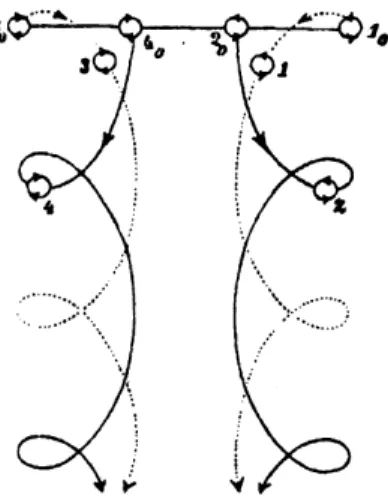
See Fig. 1 for later illustrations ofthese motions. Inadditiontointroducing thisnotionof
a
vortexpair”Helmholtzdescribes the motion of
a
$sing$]$e$ vortex-filamentnear an
infiniteplane to whichitisparallel. Hestatesthat the boundarycondition will be fulfilledifinstead oftheplane thereis
an
infinitemass
of fluid with another vortex-filamentas
the image (with respect to the plane) ofthe first, and concludes: “From this it follows that the vortex-filamentmoves
parallel to theplane in thedirection in which the elementsofthefluid betweenit and the planemove, and withone-fourth ofthe velocity which the elements at the foot ofa
perpendicular from the filamenton
the plane have:’In \S 6, entitled“Circularvortex-filaments”,Helmholtz smdies the axisymmetric motion of
sev-eralcircular vortex-filaments whose planesare
parallel to the xy-plane, andwhosecentersare on
the z-axis. Here he considers the problem in full detail and amives at the conclusion that “ina
circularvortex-filament of
very
smallsectioninan
indefinitely extendedfluid,thecentreofgravity of the section has, from the commencement,an
approximately constant andvery
great velocity paralleltotheaxisof the vortex-ring, and this is directed towards the sideto which the fluidflows through the ring.” (SeeFig.2 fora
laterillustration.)Whentwosuchringsofinfinitesimal cross-sectionhave
a
common
axisand thesame
direction ofrotation, theytravel in thesame
direction. As they approach, the firstring widens and travelsmore
slowly, thesecond contracts and travels faster. Finally, if theirvelocitiesare
not toodifferent,150 YearsofVortex Dynsnics
Figure3: mustrationof leapfrogging” bytwovortexpairs.Theinduced velocitiesarcindicatedbyarrows.From[27]
baseduponGr(Sbli’scalcuhuons[19, 20].
then repeated indefinitely (in principle- in reality the finite
cores
of the rings and the effects of viscosity$wiU$only allowone ortwocyclesof thismotion). If twovortexringshaveequal radiiandopposite angularvelocities, theywillapproacheach otherandwiden
one
another;andwhen theyare very
near
toone
another,their velocity of approach becomes smaller andsmaller,andtheirrate of widening fasterand faster. Justas
in thecase
ofthe straightvortexfilamentnear
the plane wall,this motion is similarto the motion ofa singlevortex ring mnning
up
against aplane wall. The imageof theringinthe wallis another similarringwith the oppositesense
ofcirculation.Lanchester
saw
thistype ofmotion involvingseveralvomces
tobe relevant to vortex formationbehind
a
wing of finite span. Hewrote [36,p. 122]:Groups offllamentsorringsbehave inasimilarmannertopairs: thus agroupofringsmayplay “leap-frog“ collectivelysolongas$Ae$totalnumber ofrings doesnotexceedacertainmaximum;congregations of vortex filaments likewise by their mutual interactionmove as a partofaconcentrated system, like
waltzers in aball-room; whenthe number exceeds a certain maximum the wholesystemconsists ofa
number oflessergroups.
Onlyin
rare
cases
doesa
singlepaperput foiwardso
many profoundideas andopen
so many
avenuesfor further investigation. Almost fifty years later, in 1906, Lord Kelvin, who had himself
conducted
many
greatsmdies developingvortexdynamics further, wrote in the preface toa
book aboutHelmholtz [33] that“his admuirabletheory ofvortexringsisone
ofthemostbeautifulofall thebeautiful piecesof mathematical workhitherto done in the dynamics of incompressible fluids.’‘ Surprisingly Helmholtznever
continuedhis investigations of the topic established in his ground-breakingpaper
[23]. Instead hewrote another remarkablepaper
[24]on
discontinuous motion ofan
inviscid fluid in which he used thenotion ofa
vortex sheetfrom[23].2.2Point
vomces
Avast
area
of research started by Helmholtz’spaperis the smdy of themotionof straight, parallel,infinitely thin vortex filaments (rectilinear vortices) in incompressible inviscid fluid or,
equiva-lently, the two-dimensional problem of point vortices
on a
plane. Through pioneering work ofhydrody-150 YearsofVortexDynanuCs
namics provided bysuch vortex elementsbecame the foundationfor
an
entire familyof numericalmethodsfor flow simulation todaycollective]y known
as
vortexmethods.The problem of $N$ interacting point vortices
on
the unbounded xy-plane, with vortex $\alpha=$ $1,$$\ldots,$$N$having strength
$\Gamma_{\alpha}$ (which is constant accordingto Helmholtz’s theorems) and position
$(x_{\alpha},y_{\alpha})$,consists in solving the folowingsystem of$2N$first-order,nonlinear, ordinarydifferential
equations
$\frac{dx_{\alpha}}{dt}=-\frac{1}{2\tau 1}\sum_{\beta=1}^{N}/\Gamma_{\beta}\frac{y_{\alpha}-y_{\beta}}{l_{\alpha\beta}^{2}}$, $\frac{dy_{\alpha}}{dt}=\frac{1}{2\pi}\sum_{\beta=1}^{N}’\Gamma_{\beta}\frac{x_{\alpha}-x_{\beta}}{l_{\alpha\beta}^{2}}$ , (3)
where $\alpha=1,2,$$\ldots,$$N,$ $l_{\alpha\beta}=\sqrt{(x_{\alpha}-x_{\beta})^{2}+(y_{\alpha}-y_{\beta})^{2}}$is the distancebetween voitices $\alpha$ and $\beta$, and the prime
on
the summation indicatesomission of the singularterm$\beta=\alpha.$ TypicaUy,an
initial value problemis addressed with the initial positionsofthevortices and their strengths given
so as
tocaptureor
modelsome
flow situationofinterest.The system (3)
can
alsobewrittenas
$N$ODEsfor$N$complex coordinates$z_{\alpha}=x_{\alpha}+iy_{\alpha}$$\frac{dz_{\alpha}^{*}}{dt}=\frac{1}{2\pi i}\sum_{\beta=1}^{N}’\frac{\Gamma_{\beta}}{z_{\alpha}-z_{\beta}}$, $\alpha=1,2,$
$\ldots,$$N$, (4)
wherethe asterisk denotescomplexconjugation.
Inhislecmres[32,Lecmre20] Kirchhoff demonstrated that thesystem(3)
can
becastinHamil-ton’scanonical$fomi^{3}$
:
$\Gamma_{\alpha}\frac{dx_{\alpha}}{dt}=\frac{\partial H}{\partial y_{\alpha}}$, $\Gamma_{\alpha}\frac{dy_{\alpha}}{dt}=-\frac{\partial H}{\partial x_{\alpha}}$, $\alpha=1,2,$
$\ldots,$$N$, (5)
wheietheHamiltonian,
$H=- \frac{1}{4\pi}\sum_{\alpha,\beta=1}^{N}/\Gamma_{\alpha}\Gamma_{\beta}\log l_{\alpha\beta}$, (6)
is conserved during the motion ofthe point vonices. (Here and in what follows $\log$ denotes the namrallogarithm.)
In additionto$H$theHamiltonian system(5) hasthree independem first integrals:
$Q= \sum_{\alpha=1}^{N}\Gamma_{\alpha}x_{\alpha}$ , $P= \sum_{\alpha=1}^{N}\Gamma_{\alpha}y_{\alpha}$, $I= \sum_{\alpha=1}^{N}\Gamma_{\alpha}(x_{\alpha}^{2}+y_{\alpha}^{2})$
.
(7)Regardless of the values of thevortex strengths,theintegrals$H,$$I$, and$P^{2}+Q^{2}$
are
ininvolution,that is, the Poisson bracket between any two of them is zero;
see
the review paper [3]or
the monograph$[50]^{4}$.
AccordingtoLiouville’s theoreminanalytical dynamics the Hamiltoniansystem(5) for$N=3$ is then integrable regardless of the values of the vortex strengths. Aterse general statementtothis effectwasincluded byPoincar\’e in hislecmres [56,
\S 77].
Anextensive analytical smdy of integrability andof several special
cases
ofthree-vortexmotion had already been performed by Gr\"obli in his noteworthy 1877 G\"ottingen disseitation [19] (later 3Acomplete$cor\ddagger espnden\infty$followsby$set\dot{0}ng$the $gener|hzd$coordinates“$q_{\alpha}=x_{\alpha}$andthe $genei\cdot hrr4moment\iota’ p_{a}=\Gamma_{a}y_{\Phi}$. Thisresults inthe$oem\alpha\cdot ble$insight that the.phasespace –in thesenseofHamiltoniandynamics–forapoint vortexsystem is,in essence,its
configurationspace, afactlaterexploited byOnsager inaseminalpaper[54]onthc statisticalmechanics ofasystem of pointvortices.
150 Yearsof VortexDynamics
also published
as an
extensivepaper
[20]$)$ thatmust rightly beconsidereda
classic of the vortexdynamics literature. An account ofthe life, scientific achievements and tragic deathof the Swiss scientistandmathematician WalterGr\"obli (1852-1903)maybe foundin [6].
Thesolution of the three-vortex problem andthedissertation itself
were
mentionedinfootnotes by Kirchhoffin thethird(1883)editionof his]$ecmres$ [$32,$Lecmre20,\S 3]
andinthefundamentaltreatise by Lamb[35,
\S 155]
(althoughinaway
that doesnotfullyrevealthe comprehensivenamre
of Grobli’s investigations). Basedon
thesecursory
citations it is not difficult to understand that almosta
cenmry
later Batchelor would write in his important text [9] that the details ofmotion ofthree point vortices “arenotevident”. A lengthy excerpt (in Englishtranslation)from Gr\"obli’s dissertation is given in [6].The Hamiltonian (6) depends only
on
the mumal distances $l_{\alpha\beta}$ between the vortices whichsuggeststhat
one can
write equations of motion that involve only these distances. Suchequationswere
obtainedbyGr\"obli and later byLaura [37] whoalso expoundedon
the canonical formalism. Theyare
$\frac{dl_{\alpha\beta}^{2}}{dt}=\frac{2}{\pi}\sum_{\lambda=1}^{N}//\Gamma_{\lambda}\epsilon_{\alpha\beta\lambda}A_{\alpha\beta\lambda}(\frac{1}{l_{\beta\lambda}^{2}}-\frac{1}{l_{\lambda\alpha}^{2}}I,$ $\alpha,$ $\beta=1,2,$
$\ldots,$$N$, (8)
where the twoprimeson thesummation sign
now
mean
that $\lambda\neq\alpha,$$\beta$.
The quantity$\epsilon_{\alpha\beta\lambda}=+1$ ifvortices$\alpha,$$\beta$and$\lambda$ appearcounterclockwise inthe plane, and
$\epsilon_{\alpha\beta\lambda}=-1$if they
appear
clockwise.Finally, $A_{\alpha\beta\lambda}$ is the
area
of the vortextriangle$\alpha\beta\lambda$whichcan,inmm,
be expressedinterms ofthethreevortexseparations (thesides ofthevortexmangle)byHero’s formula. Interestingly,Eqs.(8)
were
re-discovered independently at least twice: by Synge [69] in1949
and by Novikov [53] in1975.
For $N$ vorticesone
has $\frac{1}{2}N(N-1)$ quantities $l_{\alpha\beta}$ and, thus, $\}N(N-1)$ equationsoftheform(8). However,only$2N-3$ ofthese
are
independent. Itcan
be shown that$\frac{1}{2}\sum_{\alpha,\beta=1}^{N}\Gamma_{\alpha}\Gamma_{\beta}l_{\alpha\beta}^{2}=(\sum_{\alpha=1}^{N}\Gamma_{\alpha})I-P^{2}-Q^{2}$
.
(9)Theequations(8),then,have twogeneralfirstintegrals,$viz$theHamiltonian(6)and thequantity
on
the left hand side of(9). Usingthesetwointegrals thethreeODEs for$l_{12},$ $l_{23}$and$l_{31}$maybereduced
to
a
single ODE thatcan
be solved by quadramre, and thiswas, in essence, the solution method outlined byGr\"obliinhisdissertation [19, 20]. Thecase
$N=3$ thus appearsas
acriticalone
sincefor
more
vortices additional “scales of motion”appearwithoutany obvious integrals toconstrain them. One may, therefore, expect the problem to become non-integrable. Indeed, this is whathappens and theconnectiontotherecentinterest in the
emergence
ofchaos innonlineardynamics is established. Theappearance
ofchaos inpoint vortex dynamicsas one
goes
from threetofour vortices is analogous tothe appearanceof chaos in the gravitational N-body problem ofcelestial mechanicsas one goes
from two to three bodies. For thecase
of pointmasses
theappearance
of chaos
or
the absence ofintegrability became part of the legacy ofPoincar\’e. For inexplicablereasons
the analogous discussion for pointvortices hadto waitformore
thana
cenmry
afterthesolution of the three-vortex problem. Both Gr\"obli [19, 20] and later Laura [37] outlined how to
determinethe ”absolutemotion” ofthe voricesprovided thesolution for the ”relative motion”
as
givenbyequations (8)was
alreadyknown.The
namre
of the motion oftwo vortices had already been outlined by Helmholtz [23]. The motion of three vortices–both the relative and the absolute motion–with various intensities and initial conditionswas
extensively analyzed by Gr\"obli [19, 20]. The relative motion ofthree150Yeaisof Vortex Dynamics
arbitrary voitices, based upon Eqs.(8),
was
studied and classified by Synge [69] by introducing triangularcoordinates ina
”phase space” of the three distances between thevortices. Gr\"oblihad actually found such arepresentation for thecase
ofthreeidenticalvortices, and thisconsmictionwas
foundindependentlya
cenmry
laterbyNovikov[53]. Synge’s comprehensive analysiswas
re-discovered independently in[2]. Thus, todaythe three-vortex problemmaybeconsideredtohave arathercompletesolution. Gr\"obli [19,20] alsodiscoveredanunusualcasewherethethree vortices
converge on a
pointina
finite
time. Except forSynge’s smdy[69],whichwas
itselfoverlooked,this intriguingcase
ofvonex
collapse alsowent unnoticed fora
century. It is admittedlyasomewhat specialcase
requiring boththatthe harmonicmean
of thethreevortex strengths bezero
and that the integral ofmotion(9) vanish.The integrable pmblem offour vortices arranged
as
two coaxial pairs has been addressed in many papers. Gr\"obli [19,20] investigated thecase of’ieapfrogging” when all vortices have thesame
absolute strength, and obtainedan
analytical representation forthe vortex trajectories, cf.Fig.3. His analysis
was
repeated independently byLove [40] andHicks [26].The
case
ofuniform rotation ofa
regular polygon of $N$vorticeswas
addressed in the AdamsPrize essay of J. J. Thomson [71]. He proved that the regular N-gon is stable to infinitesimal permrbations for $N=2,3,4,5,6$but becomes unstablefor $N>7$
.
(For$N=7$ the polygon is marginallystableto linear order and one must go tothe next orderto decide the stabilityissue.) This smdywas
extended by Havelock[22] andothers, and the problem continuestobeaddressed inthe hteramreinvarious forms. See therecentreview[5] andalsotheextension
to”triple rings”byAref&vanBuren [7].
Helmholtzwasalso the first to address problemsof pointvorticesinteracting withrigid
bound-aries [23]. As
we
have seen, he considered thecase
ofa
point vortex in the spacebounded by a planewall. Usingan
“image” vortex ofoppositestrength situated at the reflection of the originalvortexin theplane boundaryhereducedthe problemtothatofthe motionof
a
vortexpairon
the unboundedplane. Thisuseof the”methodofimages” has since been widely employedin various problems of themotion ofa
singlepointvortexinvarious bounded$\beta omains$.
Aparticularcase
ofan
equilibriumofavortexpair behinda
cylinder inauniform potential flow isknownas
the $F6ppl$problem”after the senuinal
paper
[17].$\Pi e$ general
case
ofthe motion ofpoint vortices in an arbitraiy domainwas
$smAed$byRouth[63] using the theory ofconformal mappings.
.
The velocity ofa point vortex in the transformedplaneis not equal to the velocityobtained by simple $substim\dot{u}on$ ofthe conformal mapping into
theexpressionfor the velocityinthe original plane-
one
requires alsotheinfluence of theimages which is capmred by the so-called Routhcorrection”. Acompletemathematical theorywas
devel-oped byLin[39] whoshowed that the problem isalwaysHanuiltonian withaHamiltonian function that isa
hybrid of Kirchhoff’s Hanuiltonian (6) forthe unbounded plane and the Hamiltonian that Routhfoundformotion ofasinglevortexin abounded domain[63].W. Thomson [72]
was
the first to show thata
vortex pair in steady motionon
the unbounded plane is accompanied byan
”atmosphere“, i.e.,a
fixed,$c$]osedvolume (area)of fluid particles thatmove
forward with the vortexpair. The boundingcurve
of this ”atmosphere” is todaysometimes called the ‘Kelvin oval”. Figure 4 reproduces the original drawing from [72] wherewe
findthis description:$\Pi e$diagramrepresents precisely theconvexoutline referredto,andthe lines ofmotionof theinterior
fluid camiedalong by thevortex,forthecaseofadouble vortex consisting oftwoinfinitelylong, parallel, sffaightvorices ofequal$rota0ms$in opposite directions.Thecurveshavebeendrawnby Mr. D.
150 Yearsof VomDynamics
Figure 4:The “atnosphere” traveling withavortexpair.Fmm[72].
is
$\frac{y^{2}}{a^{2}}=\frac{2x}{a}\frac{N+1}{N-1}-(1+\frac{x^{2}}{a^{2}})$, where $\log N=\frac{x+b}{a}$.
The motionofthe surrounding fluid must be precisely thesame as it would be if the spacewithin this
surfacewereoccupiedbyasmooth solid.
Each passive fluidparticle maybe considered ‘a pointvortex of
zero
strength”, and theequa-tionsofmotionfor all particles advected by the translatingvortexsystem
are
integrable.The defor-mation ofa
line offluid connectingtwo vortices within themovingbodywas
studied analytically byRiecke [60];see
[48]foradditional illustrations.2.3 Vonexatoms
In the $1860’ sW^{\cdot}m$
am
Thomson, later Lord Kelvin, becamevery
interested in vortex dynamicssince he
was
convinced that atomswere
to be modeledas
vortex configurations in the aether. Taitmadea
complete English translation ofHelmholtz’spaper [23] forhisown use.
He also de-visedsome
extremely cleverexperimentstoillustratethe vortextheory using smoke vortex rings in air. Following completion of their famous Treatise on Natural Philosophy, referred to sim-plyas
”Thomson and Tait”, and the successful laying of the Atlantic cable in 1866 (for whch Thomsonwas
knighted andbecame Sir WilhiamThomson),ThomsonvisitedTaitin Edinburgh in nid-January 1867 and saw the smoke rings with hisown
eyes. Tait’s translation of Helmholtz’spaper
was
published thatsame
year in Philosophical Magazine. One must imagine that Kelvin encouraged his ffiend andcolleague topreparethis translationfor publication.Thomson’s prodigious talent produced several firstrate studiesofvortex dynamics which,
al-though ultimatelywrong-headed intermsofatomic physics, havehad
a
lastinginfluenceon
fluid dynamics. Theidea ofcirculation, forexample, is fromthis period. The circulation is definedas
thecontourintegral oftheprojectionof the flow velocityon
the tangenttothecontour,$\Gamma=\oint_{C}V\cdot ds$
.
(10)Heshowedthat for
any
material contourmovingaccording toEuler’sequationforincompressibleflow,the circulation is
an
integral ofthemotion,a
result known todayas
Kelvin $s$circulation150 YearsofVonexDynamics
Figure5:Thit’sdrawings,reproducedin[74],that capture Thomson’sideasonhow atomsariseasvortex strucmresin
the aether.
W. Thomson(LordKelvin). This profound insight has continuedtoexert
an
influenceon
the entire field of fluid mechanics, includingin
suchareas
as
the assessment of theaccuracy
of numerical methods and in mrbulence modeling. Circulation isa
distinctly topological entity, independentof the shapeof the vortex andmeasurable by integration along any circuitthat loops around the
vortex. In thissense, thenotion of circulationmaybetaken as oneoftheearliestintroductions of
topological considerations into fluid mechanics. Tait’s seminal work
on
theclassification of knotson
closedcurves
is a spin-offofhis interest in vortex atoms. It has stood the testoftime andis todayrecognizedas an
important contributiontotopology,knot theoryandgraphtheory. Maxwellwas an
importantcatalystfor Tait’s workon
knots, sincehe had also become interested intopo-logical ideas. Today the intersection of fluid mechanics and topology, in its multiple forms, has matured into
a
subfield often referred toas
topological fluid dynamics. Thepermanence
of circu-lation inan
ideal fluidwas one
of thecomerstones ofvortex atom theory. Likeatoms, vortices in theaethercouldneitherbecreatednor
destroyed.Thomson’s fascination with the floating magnetexperiments by Mayer, e.g., [45, 46], and his role inthe re-publication of these works in joumals such
as
Nature andPhilosophicalMagazine, werealso outgrowthsofhisconvictionthatvortices andatomsare
intimately related. SeeSnelders’article [66] for
a
comprehensive historical reviewof this topic. The famous quotefrom Thomson that ”Helmholtz’s [vortex] ringsare
the only tme atoms” summarizes the theme ofthis research thrust. Figure5
depicts thekindof things heenvisioned.Althoughitultimatelyfaded,the vortexatomideamaintaineditself for
many years
and through Kelvin’s boundlessenergy
and great influence spread widely in the scientific community. The extensiveworkbyJ. J.Thomson,discovereroftheelectron,onvortexdynamicsinwas
stimulated by vortex atom theory. Even in his greatpaper
of 1897 entitled ”Cathode Rays”, in which the discovery of the electron isannounced,we
findtheseremarks: “Ifwe
regardthesystemof magnetsas
a
model ofan
atom, the number ofmagnets being proportional to the atonicweight,... we
should havesomethuing quite analogousto the periodiclaw...”, where by “periodic law” hemeans
the periodic table of theelemerts. The referencetothe floatingmagnetsistoMayer’s experiments mentioned above. We see whata
profound role these demonstration experiments played in the tluinking of these greatscientists. We shouldnotforgetthat atthe time analogexpenimentswere
one of the only
ways
ofexploring solutions to nonlinear equations that did not easily yield toanalytical methods. Computers and numerical solutions
were
stilmany years
inthemmre.
150 YearsofVortexDynamics
atomwritten for the 1878edition of Encyclopedia Britannica. He provided
a
detailed description ofpropertiesofvorticesin idealfluid andstrongly supported theidea of vortexatoms. Apparently,he
was
reminded ofhisown
earlier articles in whichhis celebrated electromagnetic theorywas
initially formulated basedupon a
mechanical modelthatalsomade referencetoHelmholtz’spaper
[23].2.5 Vonex ringsInspiteof the greatpopularityof Tait’s[70,pp. 291-294]smoke boxfor generating
vortexrings in air,the firstobservationof vortexrings probably corresponds with the introduction of smokingtobacco! Northmp [51,p.211] writes:
Itisnotimprobable thal the first observer ofvortexmotionswasSirWalterRaleigh; if popularbadition maybe credited regarding his useoftobacco, andprobably few smokeissince his dayhave failedto observe the curiouslypersistentfoms ofwhiteringsoftobacco smoke whichtheydelighttomake. But
sometwohundredeightyyearswentby,after the romanticdays of RaleighandSir FrancisDrake,who
madetobacco popular in England, beforeascientificexplanationofsmokeringswasattempted.
Edwin Fitch Northmp(1866-1940)
was
a
professor of physicsatPrinceton and author ofa
science fiction book entitled “Zero to Eighty: Being my Lifetime Doings, Reflections, and Inventions;also my Joumey around the Moon.” The book
was
published in Princeton in1937
under thepseudonym Akkad Pseudoman. It gives
a
fictional account, supported by valid scientific data, ofa
MorrisCounty resident’s trip around themoon.
Itappears
to havea sustained followingin the world ofscience fiction.Bycurious coincidence the firstexperimental observations of the generation ofvortexringsin air
were
performedby Rogers [61] inthesame
year
(1858)that Helmholtz publishedhisseninalpaper
[23]. William BartonRogers$(1804arrow 1882)$will bebetter known todayas
the founder ofMIT.Indeed,he
was
heavily engagedin this enterprise ataboutthe timehis paperon
vortexringswas
written.The extensive smdy by Northrup [51,52] should also be mentioned here. It contains
a
very
detailed description ofa
”vortexgun”, including all the parameters,togetherwithbeautifulphotosofinteracting vortex rings andvortexringsinteractngwith rigidobstacles,
e.g.,
witha
small watch chain. The modem readermay
be intriguedtosee
in these$neararrow cenmy$oldpapers
an
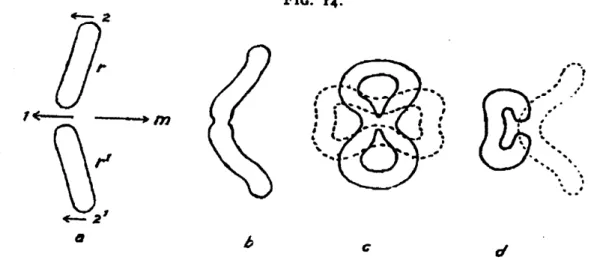
essentiallycontemporary elucidationoftheinteraction of twocircular vortexringstilted towards
one
anothcrso
as
tointeract$aRer$havingpropagatedforsome
dismce, cf. Fig.6.Theoretical smdiesofthe motion ofa ciicularvortex ring ofclosed toroidal shapewith
core
radius$a$andradius$R$of thecenterline of thetoms,where$a\ll R$, in
an
ideal fluid ledtoa
formulafortheself-induced translational velocity$V_{ring}$,directed normallytothe plane ofthering: $V_{ring}= \frac{\Gamma}{4\pi R}(\log\frac{8R}{a}-C)+O(a/R)$
Here $\Gamma$ is the (constant) intensity of the voitex ring, equal to the circulation along
any
closedpath around the vortex core, and $C$ is
a
constant. Therewas some
disagreement inthe literamreconceming thevalue of$C$
.
The value $C= \frac{1}{4}$was
given (without$pr\infty f$)byW.Thomson [73] andlater by Hicks, Basset, Dyson and Gray. This corresponds to the
case
where the vonicityinside thecore
varies$d\dot{u}$ectlyas
the distance from the centerline of the ring. The value$C=1$was
givenby Lewis [38], J. J. Thomson [71], Chree, Joukovsk\"u, and Lichtensteinforauniformdistribution of vorticitywithin the
core.
Fora
hollow vortex core,or
ifone
assumes
the fluid inside thecore
is stagnant, the value $C= \frac{1}{2}$ results $[$?$]$. The reviewby Shariffand Leonard [65]on
vortex ring150 YeaisofVortexDynamics
FIG. $\iota 4$
.
$\epsilon$
$t$
$c$ $d$
Figure6: Sketch of interaction of twoidenticalvortexrings launchedon acollisioncourse. From Northmp[52].
2.5 Vonexstreets
Most students of fluid mechanicsknow thatthe
common
staggeredarray
ofvortices
that forms in the wakeofacylinder(or anybluffbody) is called theK\’amdnvonex
street. Theconceptof the vortexstreet isamong the bestknown in all offluid mechanics,in the same ’ieague”asReynoldsnumber, Bemoulli’sequation and theconcept ofthe boundary layer. Thefornation and
smcmre
of vortex wakes downstream of bluff bodies had been smdied extensivelyin experiments going backtoLeonardodaVinci,butvon$K4rm4n$’stheorywasthefirst real analysis of the phenomenon. In his charnuing book [30] he explains that his interestwas
aroused byan
early picmre ofsuch vortices ina
fresco inone
of the churches in Bologna, Italy, where St. Christopher is shown carrying the child Jesusacross
a
flowing stream. Altemating vorticesare
seen
behind the saint’sfoot;
see
[49] for a beautiful color picmre of this fresco at the Church of St Dominic, entitled Madonna$con$bambino$tra$ ISantiDomenico, PietroMamre $e$ Critoforo,painted byan
unknownartistofthe fourteenth$cenmi\gamma$
.
Altemating vortices in air
were
observedand imaged by the English scientistMallock [41,42] whileimpressivephotos of suchvortices inwaterwere
obtained by the German scientistAhlbom [1]. The French scientistB\’enard[10] also observed the altemating formation ofdetached vorticeson
the two sides ofa
bluff obstacle in water and later in many viscous fluids and in colloidal solutions.Analysis shows that only two such configurations will propagate inthe streamwise direction: Thevortices musteitherbe arrangedin
a
symmetricor
ina
staggered configuration. Numerically the intensities ofthe vortices, $\Gamma$, are $aU$equal, but the vortices
on
the two horizontalrows
have opposite signs. Inremarkable theoretical investigations [28, 29]von
K4rm\’an examined theques-tionof stability of such processions inunbounded, incompressible,inviscid,two-dimensional flow
withembedded pointvortices. Hebecame interestedin this problem when he
was
appointedas a
graduateassistantin G\"ottingen in Prandtl’s laboratory in 1911. Prandtl hada
doctoral candidate,K.Hiemenz, towhom hehadgiven the taskofconstructing
a
waterchannelinordertoobserve the separationoftheflowbehinda
cylinder. Much to his surprise, Hiemenzfound thattheflow inhis channel oscillated violently,andhefailedto achievesymmetrical flow abouta
circularcylinder.150Yess ofVortexDynanics
$.-rightarrow—arrow 0———–\oplus---arrow---arrow-\oplus---\sigma$
$\ovalbox{\tt\small REJECT}_{\backslash }^{\wedge’}$
-.
$——\oplus---\otimes----arrow---\Theta^{--arrow---\oplus--}$
.
$.——-\Theta---rightarrowrightarrow---\oplus--arrow----arrow-rightarrow-\Theta-rightarrow---arrow--rightarrow--\oplus---$
$\ovalbox{\tt\small REJECT}_{\backslash }’.\mathfrak{G}\cdot-\cdot----rightarrow--rightarrow--\Theta^{---\mathfrak{G}^{---\oplus---}}$
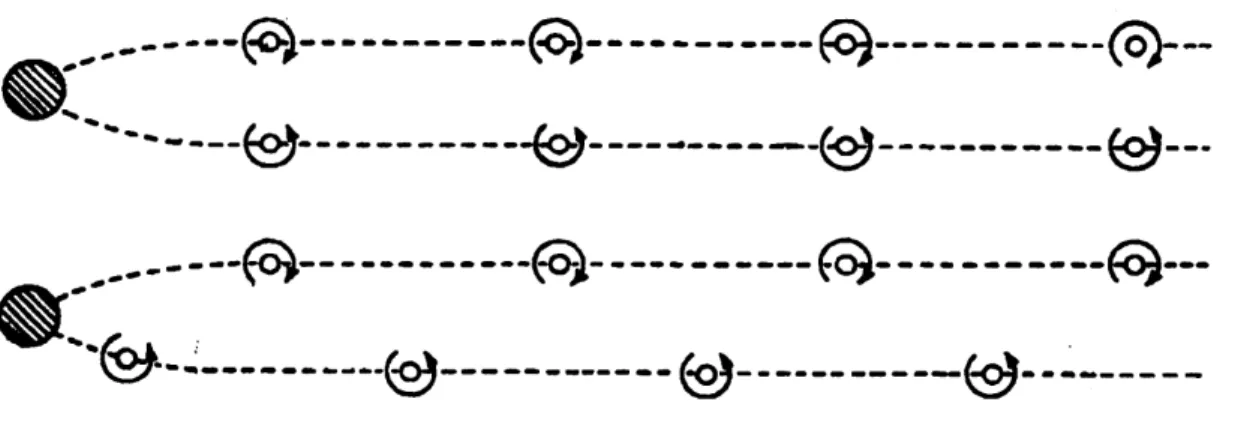
Figure7: Schematic ofasymmetric andastaggeoed vortex street downstream ofabluff body. From[30].
Von$K4rm4n$ addressed themodel problem oftwoinfinite
rows
ofpoint vortices and deriveda
criterionforwhen such
a
configuration isnotunstabletolinearized
perturbations. He showed that the symmetnic configuration, cf. Fig.7, is always unstable and thatthe staggered configuration is also unstableunlessthespacingbetweensuccessive vortices in eitherrow
andthedistance between th$e$rows
hasa
definiteratio.If thespacing between successive vorticesin the
same row
is called $l$, andif the distancebe-tween thetwoparallel
rows
iscalled$h$,von
Kkmdn’s criterion [29]is$\cosh\frac{\pi h}{l}=\sqrt{2}$,
or
$\frac{h}{l}=0.283$.
(11)The velocity, $U$,ofhorizontal translation of theinfinite
rows
is foundtobe$U= \frac{\Gamma}{2l}\tanh\frac{\pi h}{l}$
.
(12)$7bis$ is todayverywell known. What is probablyless well known is that in the originalpaper
[28]
von
$K4rm4n$foundthe criterion (11) with $\sqrt{3}$$(or h/l=0.365)$ on the righthand side ratherthan $($the $correct)\sqrt{2}$, which
was
confirmed subsequently in [31,64] (with reference to the thennewly created theory of
an
infinite system of linear differential equations due to O. Toeplitz in 1907) and by LordRayleigh [57]. The original drawings [31] of thestreamlines ina
coordinate systemmoving steadily with the vorticesare
reproduced in Fig.8. (Whentheratio $h/l$is given byEq.(ll),the propagationspeed of the street,$U$,inEq.(12)is $\Gamma/l\sqrt{8}.)$
The
erroneous
value was, for example, later used by Synge [68] in his re-denivation of the$Karm4n$dragfomiula,althoughthe analysisiseasily corrected.
Von $K4 4n$’s analysis precipitated huge amounts of work, both experimental, analytical-and much later–numerical. On July 18, 1922,
a young
W. Heisenberg, then a smdent of A. SommerfeldattheInstimteforTheoretical PhysicsatUniversity ofM\"unchen,submittedan
article$[$?$]$ in which he tried to define
an
absolute size of the K\’arm\’an vortex street behinda
flat plateofwidth $d$ placed perpendicularly to the oncoming flow of velocity $U_{\infty}$ farupstream. Based on
physical arguments heamived atAe numericalvalues $l/d=5.45$ and $h/d=1.54$
.
Thesevaluesfit
von
$K4rmdn$’s second value for the ratio ofwidth to intra-row spacing, $h/l=0.283$ and the ratioof the speed ofpropagationoftherow
relativeto the flow speed at infinity, $U/U_{\infty}=0.229$.
150 Years of Vortex Dynamics
Figure8: Sbeamlinesofavoilex$sn\cdot eet$in the co-moving$\hslash ame$basedon$m\epsilon$pointvortexmodel[31].
of
a
new
matrix” version ofquanmm
mechamics for whichhewas
toreceive the Nobel prize in1933
togetherwith E. Schrodinger and P. A. M.Dirac.
Nevertheless, his doctoral dissertation,completedin July 1923,
was on
hydrodynamics, in particularstabilitytheoryandmibulence, andhe would retum briefly to the topic of fully developed turbulence in the period following World WarII.
The
necessary
condition for absenceoflinear instabilitywas
generalizedtovortex streets mov-ing obliquely to thedirection ofthe “free stream” by Dolaptschiew andMaue. Wluile thepaper
by Maue [43] will probably be famuiliar, in part because this workwas
highlighted in the well-known]$ecmres$ of Sommerfeld [67], theextensive work of Dolaptschiew is less well known than it oughttobe. Insofaras
assimilationinto theliteramreinthe Westis concemed,thesimationwas
nothelped by severalof Dolaptschiew’spapers beingpublished in Bulgarian andRussian, albeit usuallywith
an
abstractor
summary
in Gennan.3. Conclusion
History,toparaphraseLeibnitz,is
a
useful thing, forits smdynotonly givestothe researchers of thepast theirjustdue butalso provides those of thepresentwitha
guide fortheorientation
of theirown
endeavors. While Helmholtz’s 1858paper on
vortex dynamics andvorticityis of great importance andspawned thenew
subfieldof vortex dynamics,one
must admit that in the greater scheme of things Helmholtz is today primarily remembered for other contributions to science. Thereare
several individuals who would not today be immediately associated with the field ofvortex dynamics, since they did work in other fields– often well outside fluid mechanics–that becameof
even
greaterimportance. Wemay
listDirichlet, Fiiedmann, Hankel,Heisenberg,Klein, Lin, Love,J. J.Thomson,Zermeloand probablyeven
Lord Kelvin.In the “case studies” in SectionII
we
havefocusedon
whatone may
callthe classicalapplica-tions
of Helmholtz’s vortex theory. It is the test ofany
significant advance thatit elicits interest far beyond the boundaries anticipated by itscreator. Thus, the importanceof vortexdynamicswas
realized in meteorology and oceanography by such towering figuresas
VilhelmBjerknes whose seminal work[12]bearsthe title “On the dynanics of thecircularvortex: with applications tothe atnosphere and atmospheric vortex andwave
motions.” At the offier end ofthe size-scale spec-tmmwe
may
cite the application of classical vortex dynamics to superfluid Helium [16], where150YeaisofVortex Dynamics thefamous footnote in [54] announcedthequantization ofcirculation inthis
case.
Asone surveys
thenow
vastliteramre in vortex dynamicssome
150 years
after Helmholtz’spaper
one
is stmck bythe richnessofthesubjectmatter,andby how thevaniousaspectsenterdifferent applicationsin almost infinitely variedways. Kuchemann’s figurative characterization of vorticesas
“the sinews and muscles of fluid motions” [34] is no less apt today than itwas
when itwas
written 40yearsago.
Acknowledgments Theauthor acknowledgessupportof
a
Niels BohrVisiting Professorship atthe Danuish Technical University provided by the Danish National Research Foundation. Thispaper
is largelybased on the jointpaper
with V. V. Meleshko [47]. I thank Slavafor sharing his many insightsinto the history and practice ofvortexdynamics.References
[1] F. Ahlbom 1902$0kr$den Mechanismus des hydrodynamischenWiderstandes,$Abh$
.
$Geb$.
Naturw.Hamburg 17, 1-57.[2] H.Aref1979Modon of three vorticcs.Phys.Fluids 22,393-40.
[3] H. Aref1983Integrable, chaotic andtuibulent vortexmotionintwo-dimensionalflows.Annu Rev. Fluid Mech 15,345-389.
[4] H.Aref2002The development ofchaotc advection.Phys. Fluids14, 1315-1325.
[5] H.Aoef,P. K.Newton,M. A.$S\sigma emler$,T.Tokieda&D.L.Vainchtein2002 Vortexcrystals,$Ad\nu$
.
Appl.Mech.39,1-79.
[6] H.Aref,N.Rott&H.Thomann 1992$Gr6bli$’ssolution of the three-vortex problem.Annv.Rev.FluidMech.$u$
.
1-20.
[7] H.Aref&M.&Buren2005Vortex$\sigma iple$rings.PhysicsofFluids17, 057104,21pp.
[8] R. J.Arins&F.R.Hama 1965 Locahzed-inductionconcepton acurved vortex andmotionofan$eUipAc$vortex
ring.Phys. Fluids 8,553-559.
[9] G. K. Batchelor1967AnIntroductiontoFluid Dynamics.(CambridgeUniversityPress)
[10] H.BPnard 1908 Formationdecentresdegiration
a
$1’ a\dot{m}bre$d’un obstacleenmouvement,C. R. Acad Sci. Paris147, $83k842,97k972$.
[11] R.Betchov 1965Onthe curvature and torsionofanisolated vortex filament. J. Fluid Mech. 22,471-479.
[12] V.Bjerknes 1921 On thedynamicsof the circularvortCx: with applications to the atmosphere and atnospheric vortexandwavemotions.Geoffs.Publ.2,No4.
[13] L. S. Da Rios 1906 Sul moto$d$
.un
liquido indeflnitocon unfllettovorticoso di forma qualunque, Rend. Circ.Mat. Palemo22, 117-135.
[14] O.Damigol 1998Fromorganpipestoatmosphericmotion: Helmholtzonfluidmechanics,Hist.StudPhys. Sci. 29,1-51.
[15] A. Einstein 1924 Zum hundertjghrigen Gedenktag von Lord Kelvin’s oehm. (26. Juni 1824),
Naturwis-senschoften12,$\theta$)$1-\infty 2$.
[16] R. P. Feynman 1955Application ofquanmmmechanicstoliquidHelium,In: CJ.Gorter, ed.,Progress in low
TemperaturePhysics(NorthHolland,Amsterdam)117-53.
150Yeais of Vortex Dynamics
[18] O.VelascoFuentes2007 Onthe topology ofvoitexlines and mbes. J. Fluid Mech. 584,147-156.
[19] W.$Gr6bli,$ $1877a$Spezielle Probleme uber die Bewegung geradliniger parallelerV/rbelfdden (Ztircherund
Fur-rer,Zitrich).
[20] W. Grobli, $1877b$ Spezielle Probleme liber die Bewegung geradliniger paralleler Wirbelfaden, Vierteljschr
Natu$fGes$. Ziirich 2237-82,129-168.
[21] H.Hasimoto,A solitonon avortexfilament,J. FluidMech.51(1972)477-485.
[22] T. H. Havelock1931Stability of motionofrectilinear voitces in ringfonnation,Phil.$Mag$
.
(ser. 7)11,617433.[23] H. Helmholtz 1858 $\iota Jber$ Integrale der hydrodynamischen Gleichungen, welche den Wrbelbcwegungen
entsprechen.J. ReineAngew.Math55(1858)25-55. English translation byP G. Tait: Phil $Mag$
.
(ser. 4) 33,485-510.
$[y]$ H.Helmholtz,1868 Ucber discontinuirlicheFlussigkeitsbewegungen. Monatsber.AkadWSss.Berlin(1868) 215-228.English translation: Ondiscontinuousmovementsoffluids,Phil.$Mag$
.
(ser.4)36(1868)337-346.[25] H. von. Helmholtz 1892 Autobiographisches Tischrede bei der Feier des 70. Gcbunstages. In: Ansprachen
undR$\epsilon$&n,gehaltenbeideram2. November 1891 zuEhrenvonHemannvonHebnholtzveranstalteten Feier
(Hirschwald, Berlin)46-59.Englishtranslation: An autobiographicalsketch, InSelected Writings
of
Hemann vonHetmholtz, R. Kahl, ed.(WesleyanUniversityPoess,Middletown)466478.[26] W.M. Hicks 1922On themumalthreading of vortex rings, Proc.R. Soc. LondonA102,111-131.
[271 N.E. Joukovskii1892[Helmholtz’s]worksonmechanics. In Hemannvon Helmholtz 1821-1891.Public lectures delivered at the ImperialMoscow UniversityfortheHelmholtzfiind. A.G. Stoletov, ed., (MoscowUniversity
Press,Moscow)37-52(inRussian).
[28] ‘Ri. vonKtnndn 1911 $Ukr$denMechanismusdesWiderstandes,den ein bewegter$K6\Pi rr$in einerFltlssigkeit
eifait1.Teil,Nachr. $Ges$
.
$m_{ss}$.
Gtittingen. Math.-Phys.$Kl$.
$509-517$.
[29] Th. vonKarm\’an 1912$0kr$denMechanismusdesWiderstandes,denembcwegter$K\text{\"{o}}_{\Psi}r$ineinerFltissigkeit
erfhrt.2.Teil,Nachr $G\epsilon s$. $mss$.
$G\delta t\dot{\alpha}ngen$.Math.-Phys.$Kl$.$547-556$.
[30] Th. von $K4rm4n$ 1954Aerodynamics. Selected Tapics in the Light oftheir Historical Development (Comell
UniversityPress, Ithaca).
[31] Th.vonKAm4n&H. Rubach1912Uber den Mechanismus des Fltlssigkeits-undLuftwiderstandes,Phys.$Z13$,
49-59.
[32] G. Kirchhoff1876Vorlesungenubermatematische PhysikMechanik(Teubner,Leipzig)Also:2nd edn(1877); 3rdedn(1883);4thedn(1897).
[33] L. Koenigsberger 1906 Hemannvon Helmholtz (ClarendonPress, Oxford; Reprinted byDoverPublications, NewYork,1965)
[34] D. Ktlchemann 1965Reporton the I.U.T.A.M. Symposiumonconcentrated vortexmotions influids,J. Fluid Mech 21,1-20.
[35] H. Lmb 1932Hydrodynamics 6th edn(CambridgeUniversityPress)
[36] F.W.Lanchestcr,Aerodynamics. Constituting thefirstvolumeofacomplete WorkonAerial Flight(Constable& Co., London, 1907).
[37] E.Laura 1905 Sulle equazioni differenzialicanoniche delmotodiunsistemadivorticielementari, rcttilinei$e$
paralleli,inunfluido incompressibileindefinito,AttiAccad.Sci. Tonno. $Cl$Sci. $Fis$.Mat.Nat. 40,$2\Re-312$
.
150 YearsofVortexDynamics
[39] C. C.Lm 1943On the MotionofVortices in$\eta_{\nu 0}$Dimensions(UniversityofTorontoPress,Toronto).
[401 A.E. H. Love1894On the motionofpairedvordceswithacommonaxis,Proc.Lond Math. Soc.25$185arrow 194$
.
[41] A.Mallock 1907 Ontheresistanceofair,Proc.R. Soc. LondonA79$262arrow 273$
.
[42] A.Mallock 1911lnfluence of viscosityonthe stability ofthe flow offluids.Proc. R. Soc.londonA84482-491.
[43] A.W.Maue 1940Zur StabiltitdcrKtirmdnschen$Wubels\alpha ak,$$Z$Angew.Math. Mech20,129-137.
[44] J.C. Maxwell1878Atom,In:$Encyclo\rho au$Britannica9thedn(London)33648.
[45] A. M. Mayer $1878a$A noteon experiments with floating magnets; showing themotions and arrangements in
aplaneof freely moving bodies,actedonbyforces of
amacuon
and oepuLsion; andserving in thesmdy of the$direc0ons$and
mouons
oflinesof$magne\dot{u}c$force,Am.J.Sci. (ser. 3)15,276-277.[46] A. M.Mayer $1878b$Floatingmagnets,Nature17,487-488.
[47] V. V.Meleshko&H.Aref2007Abibliography ofvortexdynanics 1858-1956.$Ad\nu$.ApplMech41, 197-292.
[48] V.V. Meleshko&G. J. F.vanHeijst1994Interacung two-dimensionalvortexsmicmies:Point$v\propto\dot{u}ce\epsilon$,contour
kinematicsand$s\ddot{m}ng$properues,InChaosAppliedtoFlutd Mixing, H. Aref and M. S. BlNaschic, eds,(Oxford,
Pergamon)233-267.
[49] T.Mizota, M.Zdravkovich,K.-U.Graw&A. Leder2000St.Christopherand the
vonex.
Nature 404,226.[50] P. K. Newton 2001 $Th\ell$ N-vortex Problem: $Analy\alpha cd$ Techniques. Applied$Math\ell m\dot{n}cal$Sciences, $vol145$.
(Springer,NewYork)
[51] E.F. Nrnip1911Anexperimental smdy ofvortex$mo0ons$in liquids. J.$fi$}$unku_{n}$Inst. 172, 211-226,$u5-368$
.
Also: Scient. Am.SuppL 74(1912)204-205, 215, 238-239,248-249.
[52] E. F.Northrup1912Aphotographic smdy ofvortexringsinliquids.Nature88,$463A68$.
[53] E.A. Novikov 1975 Dynamics and statisticsofasystemofvordces.$uETF$a1868-1882.English$\sigma$anshrion
in: Soviet Phys.$- JK\Gamma P41$(1975)937443.
[54] L. Onsager1949$Sta\dot{0}s\dot{u}cal$hydromechanics. NuovoCimento 6(Suppl.)$27\triangleright 287$
.
[55] H. C. Pocklington 1895 The configuration ofa pair of equal and opposite hollow straight vortices, offinite
cross-scction,moving steadily throughfluid. Proc. Camb. Phil. Soc.8, 178-187.
[56] H.$Poincar6$ 1893 Thiorie$d\ell s$tourbillons($Can\ell$, Paris).
[57] Lord Rayleigh1915Roliantones,Phil.$Mag$.(ser. 6)29,$433-4\mu$.
[58] R. L.Ricca,Rediscovery ofDaRios equations, Nature352(1991)561-562.
[59] R.L. Ricca, The contributions ofDaRios and Levi-Civitatoasymptotic potential theory and vortex filament dynamics,Fluid$Oyn$
.
Res. 18(1996)245-268.[60] E. Rieckc 1888BeitrtigcmrHydrodynamik,Nachr.$c_{es}$
.
$m_{ss.fflmngen}$Math.-Phys.$KL$(1888)347-357.[61] W. B.Rogers 1858On the$foma\dot{u}on$of rotating rings by airandliquids under
cemn
$condi0ons$ofdischarge,$Am$.J.Sci.(ser. 2)26,246-258.
[62] L. Rosenhead1931Thefmnation of vortices fromasUtaceofdiscontinuity, Proc. R. Soc.LondonA134, 170-192.
[63] E.J. Routh 1881 Some applicationsofconjugatefunctions,Proc.Lond Math Soc.12,$73 9$
.
[64] H. L. Rubach 1914 Ueber die Entstehung und Fortbewegung des mrbelpaares hinterzylindrischen$K\delta rpem$ $(Asseiia\dot{0}on, GOt\dot{u}\mathfrak{n}gen)$.
150 YeaisofVortex Dynamics
[65] K.Shariff&A.Leonard1992Vortex rings, Annu.Rev.Fluid Mech. 24,235-279.
[66] H.A.M.Snelders 1976A.M.Mayer’sexperimentswith floatingmagnetsand theirusein the atomic theoriesof matter,A$nn$
.
Sci.33,67-80.[67] A. Sommeffeld1943Vorlesungen uber theoretischePhysik2. Mechanikder
defomierbaren
Medien(Becker& Erler,Leipzig, 1943). English translation: Lectures ontheoretical Physics, 2. MechanicsofDefomableBodies (AcademicPress,NewYork).[68] J. L. Synge 1927Mathematical investigation of thethrustexperiencedbya cylinderinacurrent, the motion beingperiodic,Proc. R.Irish Acad. 37,95-109.
[69] J. L.Synge 1949On themotion of threevonices,Can. J. Math. 1257-270.
[70] P.G. Tait 1876Recent Advances in Physical Sciences 2nd edn(Macmilan, London).
[71] J. J.Thomson 1883A$n_{e\dot{WS}C}$ontheMotionofVortexRings:anessaytowhich theAdamspnzewas$\omega udged$
in1882,in theUniversityofCambridge(Macmillan,London).Reprinted: (DawsonsofPallMall, London,1968). [72] W. Thomson $1867a$On vortexatoms,$Pwc$
.
R. Soc. Edinb. 6(1867)94-105. Also: $PklMag$.
(ser. 4)34(1867)15-24.Also: Proc. Glasgow Phil. Soc.6(1868) 197-208.
[73] W. Thomson$1867b$Thetranslatory velocityofacircular vortexring,Phil.$Mag$
.
(ser. 4)33(1867)511-512. [74] W.Thomson 1869Onvortexmotion,Trans. R. Soc. Edinb.25,$217-2\infty$.
[75] C.Truesdell 1954 The KinemoticsofVonicity.(IndianaUniversityPress,Bloomington)
[76] F.L.Westwater1935The mllingupofthe surface of discontinuity behindanaerofoil of finite span.Rep.Memo.

![Figure 2: Self-induced forward motion of a vortex ring. From [27].](https://thumb-ap.123doks.com/thumbv2/123deta/5987438.1060413/5.892.281.601.186.546/figure-self-induced-forward-motion-vortex-ring.webp)
![Figure 4: The “atnosphere” traveling with a vortex pair. Fmm [72].](https://thumb-ap.123doks.com/thumbv2/123deta/5987438.1060413/10.892.304.599.198.422/figure-atnosphere-traveling-vortex-pair-fmm.webp)
![Figure 5: Thit’s drawings, reproduced in [74], that capture Thomson’s ideas on how atoms arise as vortex strucmres in the aether.](https://thumb-ap.123doks.com/thumbv2/123deta/5987438.1060413/11.892.159.677.186.363/figure-drawings-reproduced-capture-thomson-vortex-strucmres-aether.webp)
![Figure 8: Sbeamlines of a voilex $sn\cdot eet$ in the co-moving $\hslash ame$ based on $m\epsilon$ point vortex model [31].](https://thumb-ap.123doks.com/thumbv2/123deta/5987438.1060413/15.892.251.658.190.437/figure-sbeamlines-voilex-moving-hslash-based-epsilon-vortex.webp)
