Title Towards smart lighting modeling of cyber physical systems
Author(s) FANG, Yuan; OOI, Sian En; LIM, Yuto; TAN, Yasuo Citation The 11th Asia Lighting Conference (ALC): 1-4
Issue Date 2018-09-14
Type Conference Paper
Text version publisher
URL http://hdl.handle.net/10119/16006
Rights
Yuan FANG, Sian En OOI, Yuto LIM, and Yasuo TAN, Towards smart lighting modeling of cyber physical systems, The 11th Asia Lighting Conference (ALC), 2018. 本著作物は照明学会の許可のもとに掲載するも のです。This material is posted here with
permission of the Illuminating Engineering Institute of Japan.
TOWARDS SMART LIGHTING MODELING OF CYBER PHYSICAL
SYSTEMS
FANG Yuan1,2, WANG Weizhen1,2, Sian En OOI2, ZOU Nianyu2, LIM Yuto2, TAN Yasuo2
1: Dalian Polytechnic University (DPU)
2: Japan Advanced Institute of Science and Technology (JAIST)
ABSTRACT
Cyber-physical systems (CPS) are complex systems with depth collaboration of computation, communications, and control (3C) technology. CPS is widely used in the fields of industrial production, smart city, smart transportation, smart health and so on. Smart lighting is a typical CPS application in the IoT society which connects people, things, and the environment, especially in LED age. Modeling of smart lighting is a crucial point for developing the smart home. In the existing research on smart lighting, it is studied as an independent system. However, the development of intelligent lighting is part of a complex system. In this paper, we address the smart lighting modeling with a part of the CPS system. Energy savings and human comfort are the basic principles of smart lighting design and development. For this purpose, we proposed the novel simple and proximate time model (SPTimo). Using the preliminary design of the SPTimo, a smart lighting model with energy savings and human comfort features based on the overall needs of smart home is given.
Keywords: cyber-physical system, time modeling, intelligent dynamic lighting, iHouse
1. INTRODUCTION
We live in an increasingly connected and automated society. Smart environments embody this trend by linking communication and computing infrastructures to everyday settings and commonplace tasks. CPS is tight integration of computation, communication, and control for active interaction between the physical world and cyber world. A wide range of data is collected from the physical world via sensor networks, analyzed and transformed into knowledge in cyberspace using big data processing technologies and other tools to create information and value that will energize industry and solve social problems. Smart Home is a complex system of systems (SoS) that combines energy, lighting, and the Internet. Smart lighting is a typical CPS application in the IoT society which connects people, things, and the environment, especially in LED age.
In the existing research on smart lighting modeling, it is studied as an independent system. However, the development of intelligent lighting is a part of a complex system. This creates a problem when the combination of smart lighting and other systems is exerted. Existing CPS modeling method is the procedure and initial process of the modeling are still highly complicated. Furthermore, time is very consuming because it requires a full and in-depth understanding of the details of the physical environments. Another weakness is that when new hardware is added to the original system, the system needs to be remodeled.
The objective of this paper is to propose a smart lighting model base on the simple and proximate time model (SPTimo) framework of CPS to meet the requirements of smart lighting modeling and analysis with system energy saving and human comfort. This paper first analyzes the combination of CPS and smart lighting. Second, the research background of this research is given. Finally, this paper analyzes the characteristics of dynamic lighting and comfortable lighting and presents a smart lighting model with a machine learning module.
2. BACKGROUND
2.1 CYBER-PHYSICAL SYSTEMS
CPS is usually defined as a tight integration of computation, communication, and control with a deep interaction between physical and cyber elements in which embedded devices, such as sensors and actuators, are wireless or wired networked to sense, monitor and control the physical world. [1] With CPS becoming more popular, many types of research have devoted to their development. The CPS has significant real-time control features that are consistent with dynamic
lighting and energy-efficient lighting. Smart lighting is part of a smart home complex system. The modeling and analysis play an essential part in the safety and mission critical system of systems (SoS) development in CPS.
2.2 SMART LIGHTING MODELING
Smart lighting is an interdisciplinary research field, which is mainly related to energy policy, art design, intelligent lighting control circuit and LED materials. In [2], summarizes our experience in designing and modeling unique habitat and multiple inhabitant smart environments based on learning and prediction-based paradigm. Visual comfort and energy savings of smart lighting were discussed in [3]. In [4], [5], [6], a wireless sensor network and LED control modeling was analyzed. However, they use many technologies and modeling methods, which are more complicated, and not intuitive, not easy for developers to implement. At present, research on CPS for smart lighting modeling has not been mentioned in the literature.
2.3 IHOUSE
iHouse stands for Ishikawa, internetted, inspiring, intelligent house. iHouse that is based on Standard House Design by Architectural Institute of Japan is an advanced experimental environment for future smart homes. iHouse is located at Nomi city, Ishikawa prefecture that consists of sensors, home appliances, and electronic devices are connected using ECHONET Lite version 1.1 and ECHONET version 3.6. iHouse is shown in Fig. 1. And the iHouse floor plan is shown in Fig. 2. There are more than 100 sensors in iHouse for temperature, humidity, pyrheliometer, illumination, wind direction, pyroelectric and other sensing work. There are different kinds of controllers here. LEDs fully illuminate iHouse.
Fig.1 iHouse Fig.2 iHouse floor plan
3. INTELLIGENT DYNAMIC LIGHTING
In this section, we proposed a simple and proximate time model framework for CPS application. Then, we researched “Report of Time Habits of Japanese in Daily Life, 2015”, proposed the machine learning algorithm by minimizing the electricity consumption of power and maximum human comfortable based on SPTimo. Since we can obtain the simulation result to support SPTimo can realize the intelligent dynamic lighting (IDL).
3.1 SIMPLE AND PROXIMATE TIME MODEL
The Simple and Proximate Time model (SPTimo) framework is illustrated in Fig. 3. There are three sub-models included in the frame. The first sub-model is Computation Model. This model approximates all the components with computational requirements from the different platform. A service request requires connecting different platforms in a specific order. Each platform has different devices that complete the tasks. The operation generated by each device is called Time
Task. In a CPS service, time tasks are required to be completed before their deadlines. To satisfy
this requirement, their required computation resources should be allocated to tasks at the right time. The allocated result is called schedule, while the allocating process is called scheduling which is conducted by a scheduler equipped in the system. The second sub-model is Control Model. All the components of the approximate control operation are integrated into this model. The control model is mainly proposed in the control model, especially the feedback control algorithm, which includes online and offline forms. Communication Model follows the existing communication protocols. It mainly includes the network synchronization unit and the time offset of the SPTimo framework. [7]
In this framework, time tasks are used to communicate. In this framework, the time task and its basic scheduling method are first defined. A time task is a multidimensional set 𝑇𝑇 = (𝑇, 𝑆, 𝑉). It includes a subset of time 𝑇, a subset of states 𝑆, and a subset of values 𝑉. The 𝑗time task of 𝑖 platform is 𝑇*,+= {𝐴*,+, 𝐸*,+, 𝐷*,+} is the arrival time in a task scheduling, 𝐸*,+ is the execute time, and
𝐷*,+ is the deadline. Each task 𝑆*,+= {𝑠*,+},𝑠*,+is the state of the elements. 𝑉*,+ is a value of the time
task 𝑇*,+ with state 𝑆*,+. 𝑖 is means the 𝑖 time task, and 𝑗 is means the 𝑗 platform, (𝑖, 𝑗) ⊂ 𝑁. A service
is defined by the operation of the platforms with the order of execution in the CPS application. 𝑆𝑒𝑟𝑣𝑖𝑐𝑒 = (𝑃*≺ 𝑃+) . We assume that the execution time task 𝑇*,+ inside the platform 𝑃* are
disordered. In order to meet the highest proportion of successful service execution, the time task sequence within the platform can be adjusted.
Fig. 3 Simple and Proximate Time Model Framework
3.2 MODELING OF SMART LIGHTING 1. Modeling
The smart lighting system is divided into the following results according to the components of SPTimo. All devices were according to iHouse.
Fig. 4 Describe the model of smart lighting Fig. 5 Time Habits of Japanese in Daily Life
2. Machine learning of smart lighting
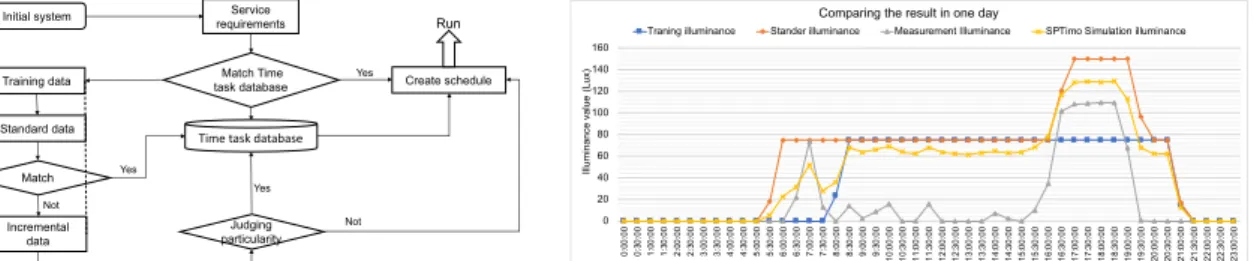
SPTimo has a time task database, which is the main basis for discriminating the task tree. In addition to the training data and standard data added during the initial installation of the system, there is also an incremental data portion. Training data is from survey data of time habits in daily life [8], as Fig. 5 is shown. The time period stay at home is mainly concentrated on an employed from 0:00-8:00, 18:30-24:00, and the weekend stay at home time is slightly longer than this data for three and a half hours. Stay at home time, in addition to sleeping, there are many activities that need to be illuminated, for example, cooking, doing housework, watching TV, etc. Human biological and social properties determine the time of occurrence of the necessary events, for example, cooking time, sleeping time, etc.
A simple machine learning process for smart lighting is shown in the Fig. 6. Through the operation of the system, the incremental data is continuously matched, and the time task database is perfected, so that the system is more in line with the balance of comprehensive energy saving and human comfort. Physical Devices Service Requirements Network Fabric Cy b er Wo rl d SPT im o Fr am ew or k Control Model Computation Model Physical Wor ld Communication Model Time Task Database Sort Search Machine Learning Other Computation
Online Control
Machine Learning Offline
Control Other Control Database SPTimo Time Offset
Network Synchronization Service Requirements Ne tw o rk s
: Internal synchronization : External interaction
Item SPTimo Symbol Description
LED Lighting
Physical Devices
!" LED illumination source number i Electric Window #" Electric window number i Illuminance Sensor $%&'()_+" Illumination sensor number i Pyrheliometer $%&'()_," Outdoor illuminance sensor number i Temperature Sensor $%&'()_-" Temperature sensor number i Switch $./01ℎ" Switch number i IT Power Monitor ,(.%)" Power monitoring equipment Time Habits in Daily Life databaseML 0)3&/&4_5303 Data
Time(24h) 0.0 0.5 1.0 1.5 2.0 2.5 3.0 3.5 4.0 4.5 5.0 5.5 6.0 6.5 7.0 7.5 8.0 8.5 9.0 9.5 10.0 10.5 11.0 11.5 12.0 Weekday Holiday Weekday Holiday Weekday Holiday Weekday Holiday Weekday Holiday Time(24h) 12.0 12.5 13.0 13.5 14.0 14.5 15.0 15.5 16.0 16.5 17.0 17.5 18.0 18.5 19.0 19.5 20.0 20.5 21.0 21.5 22.0 22.5 23.0 23.5 24.0 Weekday Holiday Weekday Holiday Weekday Holiday Weekday Holiday Weekday Holiday Sleep Cooking Housework Watch TV Stay at home Sleep Cooking Housework Watch TV Stay at home
3.3 RESULT OF SIMULATION
Taking the change process in one day's illumination (Sunday, July 23, 2017) as an example, the simulation of SPTimo was carried out, and the comparison results with other values were obtained. The illuminance values required for the smart lighting system are listed in the fig. 7 below, which are training illuminance, standard illuminance, measurement illuminance and SPTimo illuminance. The results show that SPTimo strikes a balance between standard illuminance and training illuminance as well as measured illuminance.
Fig. 6 Simple machine learning algorithm flow Fig. 7 Comparing the result in one day
4. CONCLUSION AND FUTURE WORK
In this paper, the problem that the isolated design of smart lighting system cannot interact with other systems is proposed, and the intelligent fusion and CPS are deeply integrated. We propose a simple proximate model based on time task, which can quickly complete modeling and verification to improve system development efficiency. Finally, the modeling process of SPTimo model is applied to smart home lighting, and the corresponding simulation results are obtained. The results show that the similar weight distribution and balance can be achieved in each parameter.
Future work will further refine the machine learning algorithms of intelligent lighting to make it applicable to complex systems.
REFERENCES
(1) Lee E A. CPS foundations[C], Design Automation Conference (DAC), 2010 47th ACM/IEEE. IEEE, 2010: 737-742.
(2) Das S K, Cook D J. Designing and modeling smart environments[C], Proceedings of the 2006 International Symposium on on World of Wireless, Mobile and Multimedia Networks. IEEE Computer Society, 2006: 490-494.
(3) Cimini G, Freddi A, Ippoliti G, et al. A smart lighting system for visual comfort and energy savings in industrial and domestic use[J]. Electric Power Components and Systems, 2015, 43(15): 1696-1706.
(4) Sevincer A, Bhattarai A, Bilgi M, et al. LIGHTNETs: Smart LIGHTing and mobile optical wireless NETworks—A survey[J]. IEEE Communications Surveys & Tutorials, 2013, 15(4): 1620-1641. (5) Afshari S, Mishra S, Julius A, et al. Modeling and control of color tunable lighting systems[J].
Energy and Buildings, 2014, 68: 242-253.
(6) Hu Y, Luo M R, Yang Y. A study on lighting uniformity for LED smart lighting system[C]//Proc. 12th China Int. Forum Solid State Lighting (SSLCHINA). 2015: 127-130.
(7) Yuan FANG, Sian En OOI, Yuto LIM, Yasuo TAN, Time Task Scheduling for Simple and Proximate Time Model in Cyber-Physical Systems, The Fifth International Conference on Computational Science and Technology 2018, Springer, 2018
(8) NHK Broadcasting Culture Research Institute: Report of Time Habits of Japanese in Daily Life, 2015
ACKNOWLEDGEMENTS
Corresponding Author Name: FANG Yuan
Affiliation: School of Information Science and Technology, Dalian Polytechnic University (DPU)
e-mail: [email protected]; Initial system Training data Incremental data Service requirements Standard data Match Not Yes Match Time
task database Create schedule Yes
Time task database
Judging particularity Yes Not Run 0 20 40 60 80 100 120 140 160 0: 00: 00 0: 30: 00 1: 00: 00 1: 30: 00 2: 00: 00 2: 30: 00 3: 00: 00 3: 30: 00 4: 00: 00 4: 30: 00 5: 00: 00 5: 30: 00 6: 00: 00 6: 30: 00 7: 00: 00 7: 30: 00 8: 00: 00 8: 30: 00 9: 00: 00 9: 30: 00 10: 00: 00 10: 30: 00 11: 00: 00 11: 30: 00 12: 00: 00 12: 30: 00 13: 00: 00 13: 30: 00 14: 00: 00 14: 30: 00 15: 00: 00 15: 30: 00 16: 00: 00 16: 30: 00 17: 00: 00 17: 30: 00 18: 00: 00 18: 30: 00 19: 00: 00 19: 30: 00 20: 00: 00 20: 30: 00 21: 00: 00 21: 30: 00 22: 00: 00 22: 30: 00 23: 00: 00 Ill um in an ce va lu e (L ux)
Comparing the result in one day