access construction in dialysis acceptance in patients with diabetic nephropathy
著者 藤田 祐子
著者別表示 FUJITA Yuko journal or
publication title
博士論文本文Full 学位授与番号 13301甲第5085号
学位名 博士(保健学)
学位授与年月日 2020‑03‑22
URL http://hdl.handle.net/2297/00060029
Original Article
Journal of Wellness and Health Care Vol.43 ⑵ 33〜44 2019Introduction 1. Background
Issues in haemodialysis initiation in patients with diabetic nephropathy can be largely attributed to the patient’s difficulty in accepting dialysis. Dialysis is a treatment method involving renal replacement therapy
that is necessary for life support in patients with end- stage kidney disease. Vascular access construction, necessary for treatment delivery and to access blood, is typically scheduled at the patient’s convenience.
As patients with renal failure caused by diabetes characteristically present with systemic vascular
School of Health Sciences, Graduate School of Medical Science, Kanazawa University, Japan
1 ) Faculty of Health Sciences, Institute of Medical, Pharmaceutical and Health Sciences, Kanazawa University, Japan
The structural model on the effect of vascular access construction in dialysis acceptance in patients
with diabetic nephropathy
Yuko Fujita,Michiko Inagaki
1), Keiko Tasaki
1), Tomomi Horiguchi
1), Yuya Asada
1)Abstract
Background: Issues with hemodialysis initiation in patients with diabetic nephropathy can be largely attributed to difficulty in accepting this procedure. Vascular access construction is essential for initiation of dialysis, but there has been no focus on the patient’s condition at the time of treatment.
Purpose: This study was performed to create a structural model of the effect of vascular access construction for maintenance of dialysis and how it influences the acceptance of dialysis in patients with diabetic nephropathy.
Methods: Type 2 diabetes patients with diabetic nephropathy who began receiving hemodialysis less than 5 years prior to the start of the study were included. Patients were surveyed by completing an anonymous self-recorded questionnaire and data were analyzed using exploratory factor analysis and structural equation modeling.
Results: Data of 90 patients were analyzed. A number of factors related to self-care behaviors adopted in response to vascular access construction, including “body-conscious dialysis treatment life,” “hoping that one’s body is still fine,” and “recollection of the feeling of having distanced vascular access construction,” were identified and subsequently inserted into our structural model. The structural model by which vascular access construction directly affected dialysis acceptance was then elucidated. The chi-squared value was 117.358, Goodness of Fit Index (GFI) was 0.863, Adjusted Goodness of Fit Index (AGFI) was 0.814, Comparative Fit Index (CFI) was 0.945, and Root Mean Square Error Approximation (RMSEA) was 0.044, indicating slightly lower values for GFI and AGFI.
GFI was higher than AGFI and RMSEA was < 0.050. Therefore, the model was suggested to show goodness of fit.
Conclusion: The structural model by which vascular access construction affects dialysis acceptance in patients with diabetic nephropathy was clarified.
KEY WORDS
Vascular access construction, dialysis acceptance, diabetes, diabetic nephropathy, structural model
degeneration, poor aspects of their general condition are likely to become exacerbated leading to conditions such as cardiac insufficiency. Thus, many medical care providers recommend that the patients undergo vascular access construction earlier than what is typically suggested to patients with renal failure caused by other illnesses1). However, since patients with diabetic nephropathy still have some subjective symptoms, they may hesitate to take the decision to undergo vascular access construction2). Furthermore, these patients typically undergo maintenance dialysis. Therefore many patients understand that there are associated negative aspects to this treatment like the frequent dialysis sessions and that these in turn will limit their lifestyle, including the restriction of water intake. Thus, some patients may consider the construction of vascular access to equal the start of maintenance dialysis and because of this, refuse vascular access construction. No studies so far have focused on the patient’s condition at the time of vascular access construction. Many reports suggest there is lifestyle distress after commencing dialysis, i.e., at the time of maintenance dialysis3). It was previously believed that the initiation of dialysis would not be accepted by the patient because of the distress in life associated with maintenance dialysis.
Vascular access construction serves as a stepping-stone for the overall process of accepting dialysis and it has not yet been clarified how this affects maintenance dialysis. In an earlier study4), the psychological state and dialysis lifestyle of patients were described in detail from the time of vascular access construction until maintenance dialysis. As a result, the psychological process of vascular access construction was clarified and a conceptual diagram of the impact of the patient’s psychological state at the time of vascular access construction on dialysis life and dialysis acceptance following maintenance dialysis was created.
In the present study, the question of whether a structural model could be created based on such results was investigated. We sought to determine how vascular access construction affects dialysis acceptance in patients with diabetic nephropathy and to create a structural model of the influential factors involved in this process. If such a model could be drawn, then it would likely help identify better care methods for dialysis acceptance after vascular access construction.
2. Study purpose
The purpose of the present study was to create a structural model to evaluate the experience of vascular access construction for maintenance dialysis and how this influences the acceptance of dialysis in patients with diabetic nephropathy.
3. Definition of terms
For the purposes of this study, dialysis acceptance refers to the state of psychological acceptance of the barriers impeding dialysis from being received, with the operational definition by Fukunishi consisting on a scale of 15 items for evaluating the level of mental acceptance of dialysis treatment5). In addition, dialysis life refers to the patients’ lives during the ongoing dialysis treatment, focusing on the issues of vascular access construction, self-care behaviours such as dietary and water restrictions, as well as subjective factors such as feeling physical relief.
Materials and methods 1. Procedure
To create a structural model, the framework in the present study was set based on a previously described conceptual diagram4). With that framework in consideration, a questionnaire was created in order to identify question items about self-care behaviours from the start of vascular access construction to current time. Next, the factor structure of self-care behaviours from vascular access construction was determined, after which the development of the hypothesis for the structural model starting at the point of vascular access construction was completed. The progression from framework setting to questionnaire creation and structural model creation are outlined below.
1) Framework setting
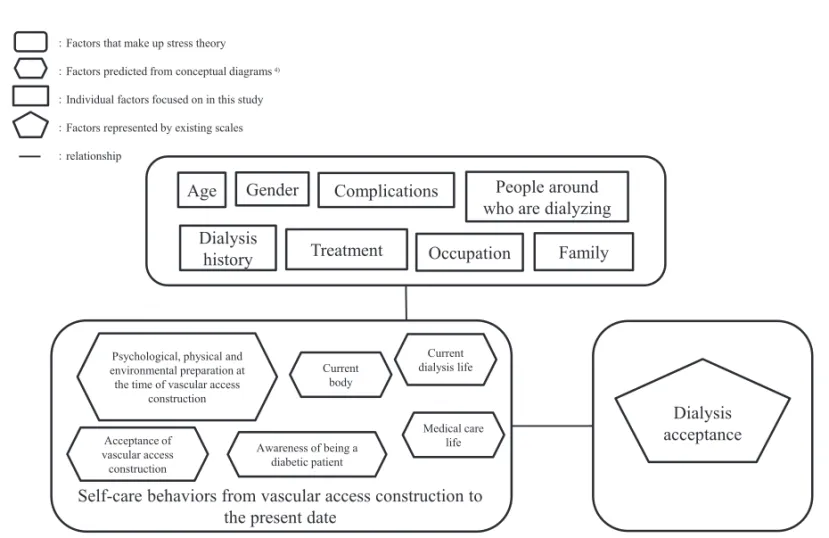
The framework was set with reference to the conceptual diagram based on previous research4). We refined the framework according to Lazarus’s theory of stress6, 7), (Figure 1). The previous study4) was a hypothesis-generating idiographic study. Here, ‘dialysis acceptance’ was set as the generated evaluation framework. Individual factors such as age, gender, dialysis history and employment, among others were included.
2) Creation of the questionnaire inquiring about self- care behaviours from vascular access construction to
the present day.
(1) Creation of the draft questionnaire
The experience of vascular access construction is not only limited to the past but it also affects present-day dialysis conditions4). Thus, by strongly linking vascular access construction with dialysis, it was sometimes accepted with resignation, and a process involving proceeding with dialysis constructively continued. The results also showed that individuals with diabetes were constantly made aware of their disease.
A draft was initially created based on the categories of these results, including ‘recalling how one’s body felt prior to dialysis notification’, ‘unable to dissociate one’s self and vascular access construction’ and ‘constructive dialysis upon resignation to receive dialysis’ along with
‘mental and environmental preparation for vascular access construction’ and concepts including ‘performing self-care upon accepting that one has renal failure’,
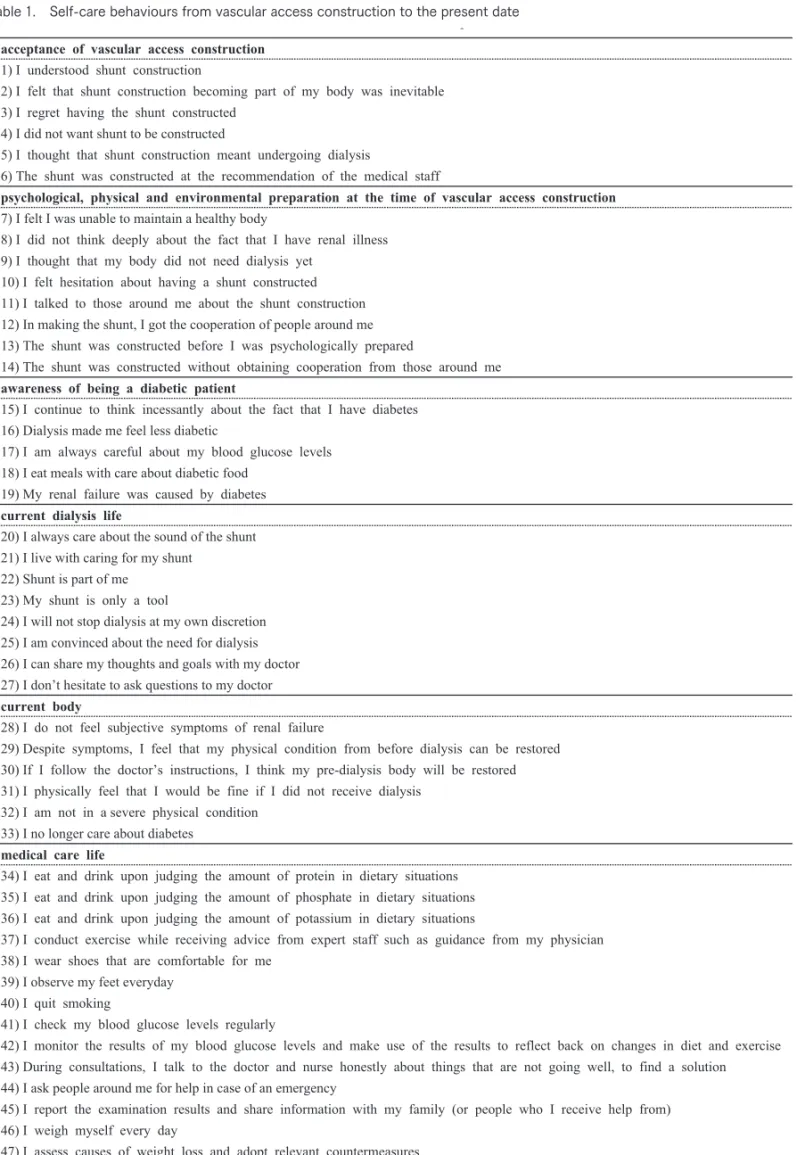
‘awareness that one is a diabetes patient’ and ‘body not giving the impression of serious illness’. Self-care behaviours included items as previously described by Inagaki et al.8) (Table 1).
( 2) Creation of the questionnaire inquiring about self-care behaviours from vascular access construction to the present day.
The draft was examined by exploratory factor analysis to identify question items inquiring about self-care behaviours from the time of vascular access construction to the present day.
3) Structural model creation
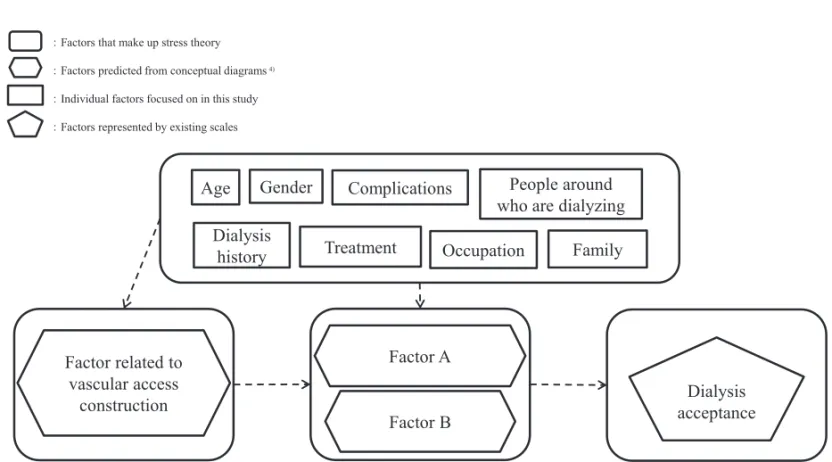
(1) Creating the hypothesis of the structural model Among factors identified by exploratory factor analysis, we set out to depict a structure starting from the time of vascular access construction. Thus, we drew a hypothesis, as shown in Figure 2. On the basis of this hypothesis, influential factors associated with dialysis acceptance were found, and structural equation modeling (SEM) was performed to create a structural model.
2. Study subjects and study institutions 1) Study subjects
The inclusion criteria involved type 2 diabetes patients with diabetic nephropathy who began receiving haemodialysis less than 5 years prior to the start of this study, while the exclusion criteria composed of patients in whom diabetes and diabetic nephropathy were diagnosed at the same time that notification of vascular access construction was provided, patients with cognitive dysfunction and patients with communication difficulties.
Fig. 1 Research framework based on results found in the qualitative research
:Factors that make up stress theory
:Factors predicted from conceptual diagrams
:Individual factors focused on in this study
:Factors represented by existing scales
:relationship
Fig. 1 Research framework based on results found in the qualitative research
Dialysis history
People around who are dialyzing Occupation
Treatment Complications
Family Gender
Age
Dialysis acceptance
Psychological, physical and environmental preparation at the time of vascular access
construction
Medical care life Current
body
Current dialysis life
Awareness of being a diabetic patient Acceptance of
vascular access construction
Self-care behaviors from vascular access construction to the present date
4)
Table 1. Self-care behaviours from vascular access construction to the present dateTable 1 Self-care behaviours from vascular access construction to the present date acceptance of vascular access construction
1) I understood shunt construction
2) I felt that shunt construction becoming part of my body was inevitable 3) I regret having the shunt constructed
4) I did not want shunt to be constructed
5) I thought that shunt construction meant undergoing dialysis
6) The shunt was constructed at the recommendation of the medical staff
psychological, physical and environmental preparation at the time of vascular access construction 7) I felt I was unable to maintain a healthy body
8) I did not think deeply about the fact that I have renal illness 9) I thought that my body did not need dialysis yet
10) I felt hesitation about having a shunt constructed 11) I talked to those around me about the shunt construction 12) In making the shunt, I got the cooperation of people around me 13) The shunt was constructed before I was psychologically prepared
14) The shunt was constructed without obtaining cooperation from those around me awareness of being a diabetic patient
15) I continue to think incessantly about the fact that I have diabetes 16) Dialysis made me feel less diabetic
17) I am always careful about my blood glucose levels 18) I eat meals with care about diabetic food
19) My renal failure was caused by diabetes current dialysis life
20) I always care about the sound of the shunt 21) I live with caring for my shunt
22) Shunt is part of me 23) My shunt is only a tool
24) I will not stop dialysis at my own discretion 25) I am convinced about the need for dialysis 26) I can share my thoughts and goals with my doctor 27) I don’t hesitate to ask questions to my doctor current body
28) I do not feel subjective symptoms of renal failure
29) Despite symptoms, I feel that my physical condition from before dialysis can be restored 30) If I follow the doctor’s instructions, I think my pre-dialysis body will be restored 31) I physically feel that I would be fine if I did not receive dialysis
32) I am not in a severe physical condition 33) I no longer care about diabetes
medical care life
34) I eat and drink upon judging the amount of protein in dietary situations 35) I eat and drink upon judging the amount of phosphate in dietary situations 36) I eat and drink upon judging the amount of potassium in dietary situations
37) I conduct exercise while receiving advice from expert staff such as guidance from my physician 38) I wear shoes that are comfortable for me
39) I observe my feet everyday 40) I quit smoking
41) I check my blood glucose levels regularly
42) I monitor the results of my blood glucose levels and make use of the results to reflect back on changes in diet and exercise 43) During consultations, I talk to the doctor and nurse honestly about things that are not going well, to find a solution 44) I ask people around me for help in case of an emergency
45) I report the examination results and share information with my family (or people who I receive help from) 46) I weigh myself every day
47) I assess causes of weight loss and adopt relevant countermeasures
2) Survey institutions
The subjects were selected from 12 hospitals and clinics that had a blood purification centre in the Hokuriku region of Japan and for which research cooperation was obtained. The selection of subjects was requested by the nursing manager of the blood purification centre of the facility where the survey cooperation was obtained. All patients who agreed to the questionnaire survey were selected from patients who met the selection criteria. The planned target number is said to be 100–150 patients as a minimum standard9), and in this study, there were 100 patients. We asked doctors and nurses to distribute the questionnaires. The contents of the request were to explain the patients who could be the subject of the study and that they were free to participate/
not participate and to hand out an envelope with a questionnaire. The collection method for questionnaires was the retention survey method, and a collection box was installed at the blood purification centre of each hospital.
3. Survey items
The survey was conducted by means of a self- recorded questionnaire. Responses were provided for each question item according to a 5-level Likert scale ranging from one point for ‘does not apply’ and five points for ‘applies’. The dialysis acceptance scale was a
4-level Likert scale ranging from one point for ‘does not apply at all’ to four points for ‘applies well’.
The questionnaire was further optimised to its final version by review from several other investigators.
Further to this, the content and expression were checked by several nurses who worked at the dialysis institutions. A pre-test was performed and the question items were determined. ‘Dialysis acceptance’ was evaluated using a scale developed by Fukunishi et al.
to determine the level of psychological acceptance to dialysis treatment that was referred to as the dialysis acceptance scale hereafter5). This scale consisted of a total of 15 items that were evaluated according to a four-point range for each item, yielding a score starting from 15 to 60 points, with the higher score indicating a higher level of dialysis acceptance. These items are listed in Table 2. Approval for use of this scale was obtained upon explaining the objective of this study to the drug manufacturers, including describing the developers and scale used.
For the patients’ characteristics, study participants were asked to select the relevant item for age, gender, presence or absence of cohabiting family members, presence or absence of dialysis in one’s surroundings, number of dialysis institutions attended, dialysis history, presence or absence of diabetes complications other than nephropathy and type of treatment for diabetes.
Fig. 2 Hypothesis of a structural model regarding how vascular access construction affects dialysis acceptance in patients with nephropathy
:Factors that make up stress theory
:Factors predicted from conceptual diagrams
:Individual factors focused on in this study
:Factors represented by existing scales
Fig. 2 Hypothesis of a structural model regarding how vascular access construction affects dialysis acceptance in patients with nephropathy
Factor related to vascular access
construction
Factor A
Factor B Dialysis
history
People around who are dialyzing Occupation
Treatment Complications
Family Gender
Age
Dialysis acceptance
4)
4. Data analysis
Data analysis was performed in two stages, exploratory factor analysis and SEM, using the SPSS Statistics version 25.0 Armonk (IBM Corp., NY, USA) and the Amos version 25.0 Armonk (IBM Corp., NY, USA). The first stage involved evaluation of the structural content of items to depict process-related factors.
To demonstrate whether the created items could be depicted as factors, an exploratory factor analysis was applied as the first stage of analysis and the presence or absence of a ceiling effect and floor effect in the question items was verified to confirm the suitability, consistency and conformity of the question content in the 47 draft questions. In the factor analysis, factors were adopted based on a factor loading value of 0.35.
For the selected factors and the overall question items created, the reliability of internal consistency was verified by calculating the Cronbach’s alpha coefficient.
The second stage involved an SEM analysis to examine the structural plan of influential factors related to dialysis in patients with diabetic nephropathy. SEM is a method capable of depicting the structure between factors, including observed and latent variables, as a model. Our ultimate goal was to examine the structure that affects dialysis acceptance as previously4) and, thus, this method was used as the second stage of analysis.
The optimal fit of the model was determined using the chi-squared test, Goodness of Fit Index (GFI), adjusted
Goodness of Fit Index (AGFI), comparative fit index (CFI) and root mean square error of approximation (RMSEA). An analysis was performed based on GFI, AGFI and CFI of nearly 1, with a small difference noted between GFI and AGFI and an RMSEA value lower than 0.05.
5. Ethical considerations
Consent was obtained after explaining to patients the objective and methods of the study, including that participation or nonparticipation would have no impact on future treatment and that data-handling procedures and data destruction would occur after study completion.
The present study was approved by the ethical review board of the Kanazawa University Graduate School of Medical Sciences (approval no. 721-3).
Results
1. Patient characteristics
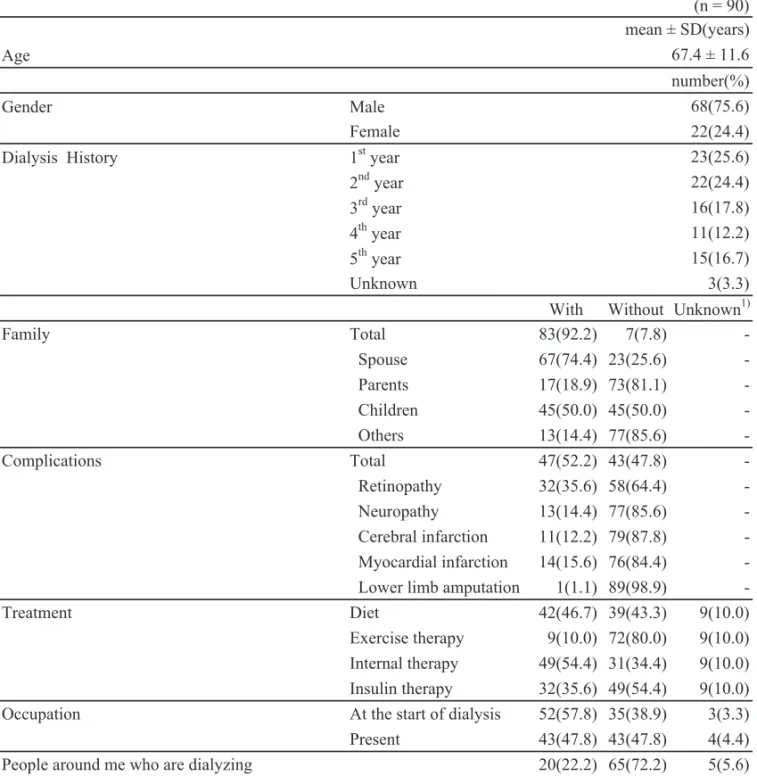
Questionnaires were distributed to 117 participants and responses were collected from 95 of them. Valid responses were received from 90 participants (response rate: 81.2%, valid response rate: 94.7%). Patients’
characteristics are presented in Table 3. The study population sample had a mean age of 67.4 years and approximately 76% males. More than 90% of patients responded that they cohabited with a family member, and approximately 20% reported that someone around them was receiving dialysis.
Table 2 The scale for evaluating the level of psychological acceptance of dialysis treatment
Table 2 The scale for evaluating the level of psychological acceptance of dialysis treatment
5) 5) 1.Dialysis has become a part of my life2.I remember having fun before I got kidney failure 3.I live a calm life
4.I think I would have a happy life if I didn’t have kidney failure 5.I can tell my friends and acquaintances that I am undergoing dialysis 6.If I don’t want to get dialysis, won't have to get dialysis
7.I forget about dialysis outside the hospital
8.I think continuously about dialysis for the rest of my life
9.I think I learned some dietary restrictions and weight management as a habit 10.I wonder why I have to undergo dialysis
11.I feel that dialysis is long 12.I strive to live day by day
13.I blame dialysis if something goes wrong
14.I think I could have demonstrated my ability without dialysis 15.I think it is thanks to dialysis that I can live my life now
2. Exploratory factor analysis of the questionnaire about self-care behaviours from vascular access construction to the present date
To search for factors on the items in Figure 1, the mean and standard difference values were calculated for the 47 items in the questionnaire and the score distribution was verified. The item analysis results revealed a bias in the score distribution that was attributed to the ceiling and floor effects in 26 items.
With regards to ‘acceptance of vascular access construction’, items exhibiting a ceiling effect included ‘I understood shunt construction’, ‘I felt that shunt construction becoming part of my body was inevitable’, ‘I thought that shunt construction meant
undergoing dialysis’ and ‘the shunt was constructed at the recommendation of the medical staff’. Further, a floor effect was found for ‘I regret having the shunt constructed’.
In the ‘psychological, physical and environmental preparation at the time of vascular access construction’, a ceiling effect was found for ‘I talk to those around me about the shunt construction’ and a floor effect was found in ‘the shunt was constructed without obtaining cooperation from those around me’. In ‘awareness of being a diabetic patient’, a ceiling effect was found for ‘I continue to think incessantly about the fact that I have diabetes’, ‘I am always careful about my blood glucose levels’ and ‘my renal failure was caused by diabetes’,
Table 3 Patient characteristics (n = 90)
Age
number(%)
Gender Male 68(75.6)
Female 22(24.4)
Dialysis History 1st year 23(25.6)
2nd year 22(24.4)
3rd year 16(17.8)
4th year 11(12.2)
5th year 15(16.7)
Unknown 3(3.3)
With Without Unknown1)
Family Total 83(92.2) 7(7.8) -
Spouse 67(74.4) 23(25.6) -
Parents 17(18.9) 73(81.1) -
Children 45(50.0) 45(50.0) -
Others 13(14.4) 77(85.6) -
Complications Total 47(52.2) 43(47.8) -
Retinopathy 32(35.6) 58(64.4) -
Neuropathy 13(14.4) 77(85.6) -
Cerebral infarction 11(12.2) 79(87.8) - Myocardial infarction 14(15.6) 76(84.4) - Lower limb amputation 1(1.1) 89(98.9) -
Treatment Diet 42(46.7) 39(43.3) 9(10.0)
Exercise therapy 9(10.0) 72(80.0) 9(10.0) Internal therapy 49(54.4) 31(34.4) 9(10.0) Insulin therapy 32(35.6) 49(54.4) 9(10.0)
Occupation At the start of dialysis 52(57.8) 35(38.9) 3(3.3)
Present 43(47.8) 43(47.8) 4(4.4)
People around me who are dialyzing 20(22.2) 65(72.2) 5(5.6)
1) Unknown: Patients who do not understand
mean ± SD(years) 67.4 ± 11.6 Table 3 Patient characteristics
whereas there were no items that exhibited a floor effect.
Moreover, in the ‘current body’ section, a floor effect was found in ‘I physically feel that I would be fine if I did not receive dialysis’. For ‘medical care life’, a ceiling effect was found for ‘I eat and drink upon judging the amount of potassium in dietary situations’,
‘I wear shoes that are comfortable for me’, ‘I quit smoking’, ‘I check my blood glucose levels regularly’,
‘I report the examination results and share information with my family (or people who I receive help from)’, ‘I weigh myself every day’ and ‘I assess causes of weight loss and adopt relevant countermeasures’. No items exhibited a floor effect.
Finally, in ‘current dialysis life’, there was a floor effect for ‘a shunt is only a tool’, whereas, for all other items, there was a ceiling effect.
In the question item ‘I physically feel that I would be fine if I did not receive dialysis’, a floor effect was observed. However, in an earlier study4), an important focus was placed on the manner of perceiving the body, and the mean and standard deviation were judged to be approximately 1. Therefore, without deleting this item, all other 25 items were removed from subsequent analyses.
Next, factor analysis was performed using the generalized least-squares method for the 22 items.
Considering the changes in eigenvalues and factor
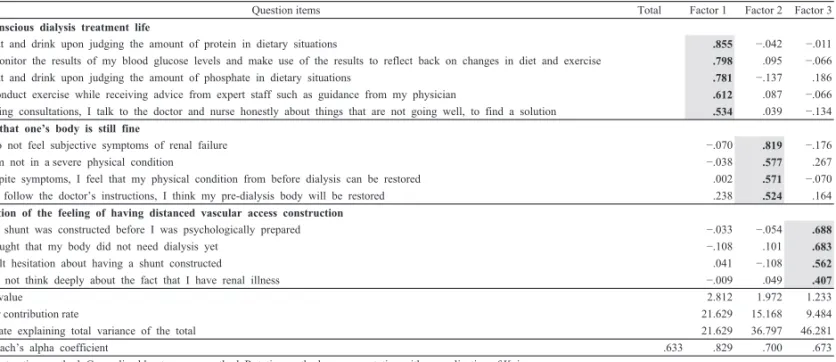
interpretability, a three-factor construct was considered valid. Assuming the three factors, a factor analysis was performed again by use of the generalized least- squares method and promax rotation. Consequently, the three items that did not show sufficient factor loading were excluded from the analysis. For the remaining 19 items, factor analysis was performed a second time with the generalized least-squares method and promax rotation. Items with low factor loading and those with high loading in two factors were excluded. The final factor pattern following promax rotation is shown in Table 4. The number of factors was determined based on an eigenvalue of 1 or higher. There were no items with a factor loading value lower than 0.35 or any with a factor loading value that became 0.35 or more for multiple factors. Furthermore, the rate explaining the total variance of the 13 items by the three factors prior to rotation was 46.28%. The Kaiser–Meyer–Olkin (KMO) measure of sampling adequacy, which is an index to demonstrate the validity of using factor analysis, was 0.707, and Bartlett’s test of sphericity resulted in p <
0.01.
The first factor comprised five items and these included: ‘I eat and drink upon judging the amount of protein in dietary situations’; ‘I monitor the results of my blood glucose levels and make use of the results to reflect back on changes in diet and exercise’; ‘I eat and drink upon judging the amount of phosphate in dietary
Question items Total Factor 1 Factor 2 Factor 3
body-conscious dialysis treatment life
34) I eat and drink upon judging the amount of protein in dietary situations .855 −.042 −.011
42) I monitor the results of my blood glucose levels and make use of the results to reflect back on changes in diet and exercise .798 .095 −.066
35) I eat and drink upon judging the amount of phosphate in dietary situations .781 −.137 .186
37) I conduct exercise while receiving advice from expert staff such as guidance from my physician .612 .087 −.066 43) During consultations, I talk to the doctor and nurse honestly about things that are not going well, to find a solution .534 .039 −.134 hoping that one’s body is still fine
28) I do not feel subjective symptoms of renal failure −.070 .819 −.176
32) I am not in a severe physical condition −.038 .577 .267
29) Despite symptoms, I feel that my physical condition from before dialysis can be restored .002 .571 −.070
30) If I follow the doctor’s instructions, I think my pre-dialysis body will be restored .238 .524 .164
recollection of the feeling of having distanced vascular access construction
13) The shunt was constructed before I was psychologically prepared −.033 −.054 .688
9) I thought that my body did not need dialysis yet −.108 .101 .683
10) I felt hesitation about having a shunt constructed .041 −.108 .562
8) I did not think deeply about the fact that I have renal illness −.009 .049 .407
Eigenvalue 2.812 1.972 1.233
Factor contribution rate 21.629 15.168 9.484
The rate explaining total variance of the total 21.629 36.797 46.281
Cronbach’s alpha coefficient .633 .829 .700 .673
Factor extraction method: Generalized least-squares method, Rotation method: promax rotation with normalization of Kaiser The Kaiser–Meyer–Olkin (KMO) measure of sampling adequacy: 0.707, Bartlett’s test of sphericity: p < 0.010
Table 4 Exploratory factor analysis of the questionnaire about self-care behaviours from start of vascular access construction to the present date
Table 4 Exploratory factor analysis of the questionnaire about self-care behaviours from start of vascular access construction to the present date
situations’; ‘I conduct exercise while receiving advice from expert staff such as guidance from my physician’;
and ‘during consultations, I talk to the doctor and nurse honestly about things that are not going well, to find a solution’, of which high loading was found for items related to self-care behaviours. Therefore, this factor was designated as ‘body-conscious dialysis treatment life’.
The second factor comprised four items, including ‘I do not feel subjective symptoms of renal failure’; ‘I am not in a severe physical condition’; ‘despite symptoms, I feel that my physical condition from before dialysis can be restored’; and ‘if I follow the doctor’s instructions, I think my pre-dialysis body will be restored’, of which items regarding to the body not feeling seriously ill showed high loading values. Therefore, this factor was labelled as ‘hoping that one’s body is still fine’.
The third factor comprised four items including ‘the shunt was constructed before I was psychologically prepared’, ‘I thought that my body did not need dialysis yet’, ‘I felt hesitation about having a shunt constructed’ and ‘I did not think deeply about the fact that I have renal illness’, of which items on the
experience of distancing vascular access construction had higher loading values. This factor was designated as
‘recollection of the feeling of having distanced vascular access construction’.
Lastly, to verify the reliability of the internal consistency for each factor, the Cronbach’s alpha coefficient was analysed. The Cronbach’s alpha coefficient was 0.829 for the first factor, 0.700 for the second and 0.673 for the third factor. Overall, Cronbach’s alpha coefficient was 0.633 and did not fall below the reference value of 0.600.
3. Structural model of the impact of vascular access construction on dialysis acceptance
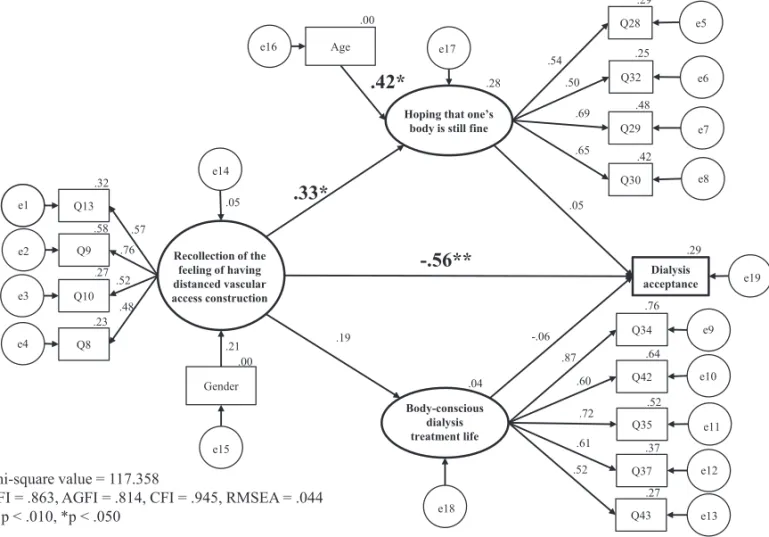
On the basis of the assumed hypothesis, a structural model with a high level trend of explanatory adequacy was investigated and, as a result, a structural model with three latent variables and three observed variables was created. In this model, as an indicator of conformity, the chi-squared value was 117.358, GFI was 0.863, AGFI was 0.814, CFI was 0.945 and RMSEA was 0.044. Because the criteria indicating conformity could be satisfied, the model was deemed valid.
In the model used, for ‘hoping that one’s body is
Fig. 3 Structural model from vascular access construction to dialysis acceptance
Fig. 3 Structural model from vascular access construction to dialysis acceptance
Recollection of the feeling of having distanced vascular access construction
Hoping that one’s body is still fine
Body-conscious dialysis treatment life e1 Q13
e2 Q9
e3 Q10
Q8 e4
Q28 e5
Q32 e6
Q29 e7
Q30 e8
Q34 e9
Q42 e10
Q35 e11
Q37 e12
Q43 e13
e14
Gender
e15
Age
e16 e17
e18
Dialysis
acceptance e19
.48 .52
.76 .57
.23 .27 .58 .32
.21 .00 .05
.19
.33*
-.56**
.00
.42*
.28.65 .69 .50 .54
.42 .48 .25 .29
.05
-.06
.04
.87 .60
.72 .61 .52
.76
.64
.52
.37
.27 .29
Chi-square value = 117.358
GFI = .863, AGFI = .814, CFI = .945, RMSEA = .044
**p < .010, *p < .050
still fine’ in the ‘recollection of the feeling of having distanced vascular access construction’, the path coefficient was 0.33, whereas, for ‘dialysis acceptance’
in the ‘recollection of the feeling of having distanced vascular access construction’, the path coefficient was
− 0.56, with significant differences observed in both.
A higher tendency toward ‘recollection of the feeling of having distanced vascular access construction’
intensified the ‘hoping that one’s body is still fine’ and tended to reduce ‘dialysis acceptance’. In regards to
‘hoping that one’s body is still fine’, a significant path coefficient of 0.42 from age was drawn. Therefore we showed that age had the effect of intensifying support for ‘hoping that one’s body is still fine’.
There was no significance in the path for ‘body- conscious dialysis treatment life’ in the ‘recollection of the feeling of having distanced vascular access construction’. For gender, while a path to ‘recollection of the feeling of having distanced vascular access construction’ was drawn, there was not a significant difference noted (Figure 3).
Discussion
1. Factor structure in self-care behaviours from vascular access construction to the present date
In this study, question items were created based on an previous study4) for the ‘acceptance of vascular access construction’; the ‘physical, psychological and environmental preparation at the time of vascular access construction’; the ‘awareness of being a diabetic patient’; the ‘present dialysis life’; the ‘present physical condition’; and the ‘life during medical care’.
Exploratory factor analysis enabled the following three factors to be extracted: ‘recollection of the feeling of having distanced vascular access construction’, ‘hoping that one’s body is still fine’ and ‘body-conscious dialysis treatment life’. Identifying these factors made it possible to establish the structural model hypothesis in this study. As the present study provides a perspective that has not been extensively focused on in previous studies, it can be said to offer novel findings.
The validity of the question items for the structure of the factors extracted was demonstrated by satisfying the criteria based on the cumulative contribution ratio (46.281%), KMO measure of sampling adequacy (0.707) and Bartlett’s test of sphericity (p < 0.01).
Furthermore, the Cronbach’s alpha coefficient was 0.633 overall, ranging from 0.673 to 0.829 for each factor, and while the numerical values were low, there were no values that fell below this reference number10), This demonstrates that the factor structure maintained internal consistency.
2. The significance of being able to draw a structural model from vascular access construction up to acceptance of dialysis
Based on the results of the present study, a path was drawn from ‘recollection of the feeling of having distanced vascular access construction’ directly to
‘dialysis acceptance’, which were negatively correlated.
Furthermore, the chi-squared value was 117.358, GFI was 0.863, AGFI was 0.814, CFI was 0.945 and RMSEA was 0.044, indicating a slightly lower value for GFI and AGFI. However, GFI was higher than AGFI and RMSEA was lower than 0.05 therefore the model was believed to show goodness of fit. The present study also focused on vascular access construction and on a structural model from the time of vascular access construction until dialysis acceptance was drawn.
We found that ‘recollection of the feeling of having distanced vascular access construction’ did not lead to significantly reduced acceptance through ‘hoping that one’s body is still fine’. Therefore, it was suggested that it is important to support patients and understanding that they may feel physically well.
In patients with renal failure caused by diabetes vascular access is established earlier when compared to patients with renal failure caused by other diseases, based on the results of markers like serum creatinine1), 11). It has been suggested that commencing dialysis while the patient is still feeling physically well can reduce their level of distress. To help patients make the step to beginning dialysis without hesitation, it is important to prepare the patient for the procedures they will need to endure.
3. Internal structure of ‘recollection of the feeling of having distanced vascular access construction’
We also extracted the factor of ‘recollection of the feeling of having distanced vascular access construction’. This factor consisted of ‘the shunt was constructed before I was psychologically prepared’, ‘I thought that my body did not need dialysis yet’, ‘I felt hesitation about having a shunt constructed’ and ‘I did
not think deeply about the fact that I have renal illness’.
For the ‘acceptance of vascular access construction’, a ceiling effect was observed in most items including ‘I felt that shunt construction becoming part of my body was inevitable’ and ‘the shunt was constructed at the recommendation of the medical staff’, and therefore, these were excluded. This may indicate that vascular access was accepted for many patients in a manner correlating with their lack of hope. As a factor to promote dialysis acceptance, it is important to provide psychological, physical and environmental support to patients. The guidelines suggest offering information for the purpose of the patient’s education1).Our results may aid in the preparation of methods for educating these patients prior to the time of vascular access construction.
4. Limitations of the present study
In the present study, patients who commenced dialysis less than 5 years prior to initiation of the study were included. Thus, there is a possibility that the results may not accurately apply to patients with a history of dialysis of 6 years or more. Additionally, because it is thought that it can be applied only to
patients in the Hokuriku region of Japan, it is necessary to conduct a survey with a wider range in the future. In the future, it will be necessary to increase the number of subjects.
Conclusions
In this study, a structural model of how vascular access construction affects dialysis acceptance in patients with diabetic nephropathy was elucidated.
Such a structure showed that there was a tendency in patients to distance themselves from vascular access construction and that this was directly associated with dialysis acceptance. This study could be a useful finding for providing better recuperative support for vascular access construction in patients with diabetic nephropathy.
Acknowledgements
I would like to express my heartfelt gratitude to all of the study participants for providing valuable data and to the staff at the involved hospitals for their cooperation in the present study.
References
1 ) The Japanese society for dialysis therapy (2013):
Guidelines for maintenance hemodialysis:
Hemodialysis prescriptions,Journal of Japanese society for dialysis therapy, 46 (12), 1134-1155 2 ) H. Onbe (Sanaki), K. Takigawa, M. Oka (2011):
Factors affecting acceptance of disability in hemodialysis patients with diabetic nephropathy and their structure. Journal of Japan society of nursing research, 34(2), 31-38
3 ) I. Tagami, N. Watarai (2011): An analysis of research on psychological characteristics of patients with hemodialysis treatment. Medical and health research: Bulletin of Tsukuba international university (2), 175-183
4 ) Y. Fujita, M. Inagaki, K. Tasaki, et al. (2018): The impact of vascular access on dialysis life in diabetic nephropathy patients,Journal of Japan academy of diabetes education and nursing, 22(1), 7-17 5 ) I. Fukunishi (2001): Development of a scale to
evaluate the level of psychological ‘Acceptance’
of dialysis treatment. OFF TIME, Chugai Pharmaceutical Company, 67, 13
6 ) Richard S. Lazarus (1999)/ H. Motoaki, H. Ogawa,
K. Noguchi, et al. (2015): The psychology of stress and emotion―From the perspective of narrative research― (1ST Edition), 59-102, Jitsumukyouiku- Shuppan, Tokyo
7 ) Richard S. Lazarus, S. Folkman (1984)/ H. Motoaki, Y. Haruki, M. Oda (2014): The psychology of stress—Research on stress appraisal and coping, 143-166, Jitsumukyouiku-Shuppan, Tokyo
8 ) M. Inagaki, K. Tasaki, N. Murakado, et al. (2004):
The process of developing outcome measures of diabetes education, Japanese journal of nursing education, 37(7), 581-590
9 ) T. Murakami, R. Yukihiro, H. Ito, et al. (2018):
Structural equation modeling for psychology and social science, 21-22, Nakanishiya-Shuppan, Kyoto 10) A. Oshio (2014): Psychological survey data
analysis using SPSS and Amos―Factor analysis to covariance structure analysis (2nd edition), 154, Tokyo-tosho Co., Ltd
11) The Japanese society for dialysis therapy (2011):
Guidelines for the construction and repair of vascular access for chronic hemodialysis, Journal of Japanese society for dialysis therapy, 44 (9), 865
糖尿病性腎症患者における内シャント造設が透析受容に影響する構造モデル
藤田 祐子,稲垣 美智子1),多崎 恵子1),堀口 智美1),浅田 優也1)
要 旨
背景:糖尿病性腎症患者の血液透析導入時における課題は,透析受容の困難さにある。内 シャント造設は透析導入に必須であるが,内シャント造設時の患者の状態に焦点を当てた ものはない。
目的:本研究の目的は,糖尿病性腎症患者における,内シャント造設が維持透析している 現在に至るまでに経験することとどのように影響し合って,透析受容に至るのか,その構 造モデルを作成することであった。
方法:対象は血液透析を導入して 5 年以内の 2 型糖尿病性腎症患者であり,無記名自記 式質問紙法により調査を行い,探索的因子分析,構造方程式モデリング(SEM)の手法を 用い分析を行った。
結果:分析対象者は 90 名であった。内シャント造設から現在の療養行動において,“ 身体 を意識した透析療養生活 ”“ まだ身体は大丈夫という希望 ”“ 内シャント造設を遠ざけてい た気持ちの回顧 ” という因子構造を見出し,構造モデルに投入することができた。この結 果は内シャント造設が透析受容に直接的に影響を与える構造を示すものであった。また,
χ2値 = 117.358,GFI = .863,AGFI = .814,CFI = .945,RMSEA = .044 であり,GFI,
AGFI の値がやや低いものの,GFI > AGFI となっており,RMSEA も .050 未満であるため,
モデルの適合度はあると示唆された。したがって,本研究は内シャント造設に着目し,内シャ ント造設から透析受容に至る構造モデルを描くことができたと考える。
結論:糖尿病性腎症患者における内シャント造設が透析受容に影響する構造モデルを明ら かにすることができた。