• 検索結果がありません。

Effects of iron, manganese and zinc enriched coffee and tea wastes on lettuce – a field trial

N/A
N/A
Protected

Academic year: 2021

シェア "Effects of iron, manganese and zinc enriched coffee and tea wastes on lettuce – a field trial"

Copied!
10
0
0

読み込み中.... (全文を見る)

全文

(1)

Effects of iron, manganese and zinc enriched coffee and tea wastes on lettuce – a field trial

Attila OMBÓDI

1

– Claudio Kendi MORIKAWA

2

1: Szent István University, Faculty of Agricultural and Environmental Sciences, Institute of Horticulture, Hungary, 2100 Gödöllő, Páter Károly utca 1., E-mail: [email protected]

2: National Agriculture and Food Research Organization, National Institute of Vegetable and Floriculture Science, Japan, 514-2392 Mie, Tsu Ano Kusawa 360

Abstract: Ensuring proper microelement supply under alkaline soil conditions could be a challenge even with the application of synthetic chelates. In this study, the application of coffee and tea wastes enriched with water soluble inorganic iron, manganese and zinc compounds was compared to water solution application of the same compounds at the same amount on a field with an alkaline Calcaric Arenosol. One butterhead and two iceberg lettuce cultivars were used as test plants. The effects of microelement enriched wastes on microelement availability in the soil, measured by DTPA-TEA method, was not clear-cut. However, the soil application of those microelement enriched wastes increased the nutritional value of lettuce by resulting in significantly higher concentration in cores for all the three investigated microelements. The highest rate of increase was observed for iron. As a consequence, lettuce heads accumulated significantly higher amount of iron, while this was not the case for manganese and zinc.

There were comprehensive differences in the microelement concentration of the cores of the three investigated cultivars, with the butterhead type having especially high iron concentration. Head weights were not affected by the treatments. Hence, under the field conditions of this study, higher microelement concentration and uptake in the lettuce heads was not a prerequisite for good lettuce yield, as it was proved by the results of a zero control.

However, the soil application of microelement enriched coffee and tea wastes for supplying microelements for lettuce in alkaline soil proved to be promising, especially for iron.

Keywords: iron, zinc, manganese, butterhead lettuce, iceberg lettuce

Introduction

Soil or irrigation water alkalinity limits production of vegetable crops in many parts of the World (Roosta, 2011). Alkaline soil and alkaline irrigation water are also quite common in Hungary (Jones et al., 2005; Rácz, 2007).

Uptake of some microelements, for example iron, manganese and zinc, are especially restricted under alkaline conditions (Marschner, 1998;

Füleky and Rajkainé Végh, 1999). In order to avoid yield loss and reduced nutritional value under alkaline conditions synthetic chelates are applied to provide available microelements for the plants. Several different carriers (EDTA, HEEDTA, DTPA, EDDHA, EDDHHA and NTA) are used to produce microfertilizer chelates (Hoffmann and Górecki, 2000 cited in Tyksinski and Komosa, 2008). Compared to a conventional, water soluble inorganic microelement compound (ferrous sulphate), application of chelates gave good results in soilless lettuce production (Roosta et al., 2015). However, these compounds can be

very expensive; hence their use is often not cost effective (Roosta et al., 2015). Moreover, the application of these synthetic chelates is often less effective in soil culture. Even significantly decreased head weights and chelate excess symptoms as a result of Fe-EDTA+DTPA, Fe- DTPA and Fe-AM-4 applications were reported (Tyksinski and Komosa, 2007 cited in Tyksinski and Komosa, 2008; Kozik et al., 2011). Thus, there is a need for cheaper chelating agents which can be used effectively and economically even in open field production.

The use of agricultural waste products is a logical answer to the problem outlined above. Their volume is constantly increasing with growing population (Sönmez et al., 2017) and their organic matter content offers the possibility of containing potentially metal-chelating substances (Morikawa and Saigusa, 2008). Sönmez et al.

(2017) applied greenhouse wastes, used coco peat

and spent mushroom compost at different ratios

for greenhouse-grown lettuce. Marketable yield

(2)

increased compared to the control while iron and manganese concentration did not decrease.

However, zinc concentration in the lettuce heads fertilized by compost became lower.

Coffee and tea are among the most popular beverages worldwide. Large amounts of coffee and tea wastes are produced by companies manufacturing coffee and tea beverages. These wastes should be reused on a sustainable way (Morikawa and Saigusa, 2008). It was found that coffee waste application to an Arenosol in the Democratic Republic of Congo promoted nutrient retention of this sandy soil besides of several other favourable physico-chemical changes (Kasongo et al., 2011). Coffee and tea are very rich in phenolic compounds which can act as metal chelating agents (Brown et al., 1998).

Morikawa and Saigusa (2008) composted coffee grounds and tea leaf wastes together with ferrous- sulphate. Application of the resulting compost increased plant-available iron concentration in neutral and alkaline soils, and significantly enhanced iron content of Japanese leaf radish.

Top-dressing application of microelement enriched coffee and tea waste materials was suitable to increase iron, manganese and zinc content of rice grains and to enhance grain yield (Morikawa and Saigusa, 2011).

Lettuce is rich in mineral nutrients (Rubatzky and Yamaguchi, 1997). Calcium, iron and phosphorus content of lettuce is especially high, and its manganese and zinc concentration is also considerable (Hartz et al., 2007). Bosiacki and Tyksinski (2009) found the highest manganese and zinc content in lettuce, out of nine investigated vegetable crops. Hence, effectiveness of microelement fertilisation has special importance in lettuce production, both in soil and soilless cultures. Accordingly, microelement fertilisation of lettuce has being extensively studied recently (Tiksinski and Comosa, 2008; Kozik et al., 2011; Roosta, 2011; Roosta et al. 2015; Sönmez et al., 2017).

The objective of this study was to investigate the effects of tea and coffee waste products enriched with water soluble inorganic microelement compounds, on iron, manganese and zinc

concentration and uptake of lettuce heads under field conditions on an alkaline sandy soil in the central region of Hungary.

Material and methods

Climatic and edaphic conditions

The field trial was carried out in the horticultural experimental field of Szent István University (NL 47°35’, EL 19°21’) in 2013. The average air temperature of the cultivation period (22

nd

April – 14

th

June) was 16.8 ⁰C, while total precipitation was measured 134 mm. The used field was under constant intensive vegetable cultivation for almost six decades. The loamy sand soil of the field was classified as Calcaric Arenosol. According to measurements made in a soil suspension using a soil/deionised water ratio of 1:5, the soil of the exact site showed the following characteristics: pH 8.0, EC 0.61 mS cm

-1

, organic matter content 1.1%. Iron, manganese and zinc concentrations of the soil were measured from both 0.1 mol L

-1

HCl (Fe 25.2, Mn 116, Zn 29.0 mg kg

-1

) and DTPA- TEA (diethylene-triamine-pentaacetic acid – triethanol amine) (Fe 16.3, Mn 16.6, Zn 9.0 mg kg

-1

) extracts by an inductively coupled plasma (ICP-OES) instrument (Thermo Scientific iCAP 6000, Tokyo, Japan) following the methods of Jones & Case (1990) and Provin & Zhang (2014), respectively. Some chemical parameters of the irrigation water were the following: pH 7.25, EC 0.55 mS cm

-1

, HCO

3-

372 mg L

-1

, Fe 0.3 mg L

-1

, Mn and Zn under 0.01 mg L

-1

.

Cultivation methods

Three lettuce cultivars were selected for the trial. A buterrhead type lettuce, ‘Jolito RZ’

(Rijk Zwaan Zaadteelt en Zaadhandel B.V.), a European iceberg type lettuce, ‘Diamanthinas RZ’ (Rijk Zwaan Zaadteelt en Zaadhandel B.V.) and a Japanese iceberg type lettuce, ‘V lettuce’

(Kaneko Seeds Co. Ltd). Unlike iceberg (or

crisphead) lettuce, butterhead type does not form

a firm, cabbage like core; hence the central part

of the head is not separated from the outer leaves

during harvest and selling. Seeds were sown into

peat mixture filled plug seedling trays, having

(3)

61 cm

3

plug volume, on 22

nd

March and raised in an unheated greenhouse. Basal fertilization was carried out by broadcasting on 21

st

April, providing nitrogen (N), phosphorus (P

2

O

5

) and potassium (K

2

O) at 10, 11.8 and 13.9 g m

-2

rate, respectively. Raised beds having 0.6 m width and 0.1 m height were formed on the same day.

Distance between the centres of two neighbouring beds was 1.4 m. Beds were covered with black polyethylene mulch. Seedlings having 5 true leaves were transplanted on 22

nd

April into double rows. Distance between the rows and also distance between the plants in a row were 0.3 m. The field was equipped both with micro sprinkler and drip irrigation (20 mm i.d., 30 cm emitter spacing, 1.7 L·h

–1

emitter discharge) systems. Irrigation was performed based on tensiometer readings. The amount of supplied irrigation water was 70 mm altogether. Nitrogen fertigation was applied on 17

th

and 25

th

of May through the drip irrigation system at 2.5 g m

-2

rate at each occasion, using ammonium-nitrate as fertilizer. In accordance with their growing periods, the three cultivars were harvested at different dates, ‘Jolito RZ’ on 27

th

May, ‘V Lettuce’ on 6

th

June and Diamantinas on 10

th

June.

Treatments

Methods of microelement (Fe, Mn, Zn) supply meant the treatments. Three treatments and a zero control (CNT) were applied on 21

th

April.

Plants of the CNT were not supplied by any microelement fertilizers. Microelement enriched coffee waste (MCW) and tea waste (MTW) were prepared from coffee grounds or from tea drags, respectively, following the method described by Morikawa & Shinohara (2013). Water soluble inorganic microelement compounds, 116 g iron-chloride (FeCl

3

), 44 g manganese- sulphate (MnSO

4

*5H

2

O) and 44 g zinc-sulphate (ZnSO

4

*7H

2

O), were mixed to 796 g coffee or tea waste and used as microelement sources.

MCW and MTW were mixed at 10 cm depth into the soil at 100 g m

-2

rate simultaneously with bed formation. For an other treatment the same amount of inorganic microelement compounds (IMC) (FeCl

3

11.6 g m

-2

, MnSO

4

*5H

2

O 4.4 g m

-2

, ZnSO

4

*7H

2

O 4.4 g m

-2

, representing 4.00

g m

-2

iron, 1.00 g m

-2

manganese and 1.00 g m

-2

zinc concentrations, respectively) were supplied alike for the microelement enriched waste treatments. Microelements were dissolved in water, distributed onto the surface of the plots and mixed into the soil thereafter at 10 cm depth.

A randomised split plot design with three replications was used. Each plot contained 42 plants arranged in double rows. Accordingly, width and length of a plot was 0.6 m and 6.3 m, respectively, and consisted of three 2.1 m long subplots each containing 14 plants, representing the three cultivars. Hence, area of a plot was 3.8 m

2

. Measurements

The six central plants were sampled from every subplot. Stems were cut at the soil level, and fresh weight of the whole heads, including all the outer leaves, was measured immediately. In the case of the two iceberg type cultivars the core and the outer leaves were divided, also weighed separately and handled as two samples.

The samples were dried in an oven at 65°C until reaching constant weight, then dry weight was determined. Iron, manganese and zinc concentration of lettuce cores and outer leaves were measured from dry grounded samples by an ICP-OES instrument (Thermo Scientific iCAP 6000, Tokyo, Japan) using the method of Provin

& Zhang (2014). Microelement uptake of above ground parts of lettuce plants were calculated based on these concentrations and dry weight data. An average soil sample was formed from six subsamples for every subplot. Samples were taken from the 0 to 0.1 m depth on 14

th

June. Soil samples were air dried for four days on room temperature and passed through a 2 mm sieve.

Plant-available microelement concentration of these samples was determined by the method of Provin & Zhang (2014).

Statistical analysis

Differences in means were tested by a two-

way ANOVA (with microelement fertilizer

treatment and cultivar regarded as factors) and

subsequent post-hoc comparisons of means

(Fisher’s protected least significant difference

(LSD) test at P=0.05).

(4)

Results and Discussion

Concentration of iron, manganese and zinc in the soil

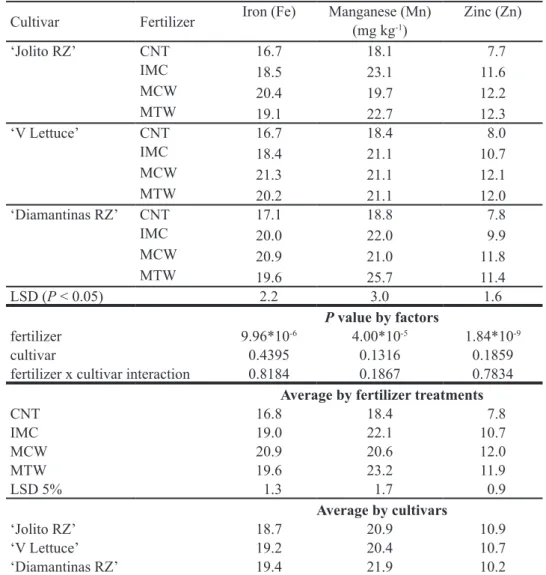
The method of microelement supply significantly affected the plant-available microelement concentration in the soil, while lettuce cultivar and fertilizer x cultivar interaction did not reveal a pronounced effect (Table 1).

In the average of the three cultivars, all the three treatments increased plant-available iron, manganese and zinc concentration in the soil compared to the CNT. However, in regard of concentration, order of the treatments was different for the three investigated microelements.

For iron, MCW application was the most

effective, significantly increasing its plant- available concentration in the soil compared to MTW and IMC treatments. This result is in good agreement with the findings of Kasongo et al. (2011). MTW resulted in higher manganese concentration compared to MCW application, while significant differences in manganese level could not be detected neither between the IMC and MCW, and the IMC and MTW treatments.

Zinc concentration in the IMC treatment was significantly lower compared to the two waste product treatments, while MCW and MTW produced practically equivalent results. The measured values represent a high level of iron, manganese and zinc supply, even in the CNT plots (Stevens; Mahashabde and Patel, 2012).

Cultivar Fertilizer Iron (Fe) Manganese (Mn) Zinc (Zn) (mg kg

-1

)

‘Jolito RZ’ CNT 16.7 18.1 7.7

IMC 18.5 23.1 11.6

MCW 20.4 19.7 12.2

MTW 19.1 22.7 12.3

‘V Lettuce’ CNT 16.7 18.4 8.0

IMC 18.4 21.1 10.7

MCW 21.3 21.1 12.1

MTW 20.2 21.1 12.0

‘Diamantinas RZ’ CNT 17.1 18.8 7.8

IMC 20.0 22.0 9.9

MCW 20.9 21.0 11.8

MTW 19.6 25.7 11.4

LSD (P < 0.05) 2.2 3.0 1.6

P value by factors

fertilizer 9.96*10

-6

4.00*10

-5

1.84*10

-9

cultivar 0.4395 0.1316 0.1859

fertilizer x cultivar interaction 0.8184 0.1867 0.7834 Average by fertilizer treatments

CNT 16.8 18.4 7.8

IMC 19.0 22.1 10.7

MCW 20.9 20.6 12.0

MTW 19.6 23.2 11.9

LSD 5% 1.3 1.7 0.9

Average by cultivars

‘Jolito RZ’ 18.7 20.9 10.9

‘V Lettuce’ 19.2 20.4 10.7

‘Diamantinas RZ’ 19.4 21.9 10.2

Table 1. Effect of fertilizer type on plant available concentration of iron, manganese, zinc in the soil after lettuce cultivation, measured by DTPA-TEA method

(CNT = Zero control; IMC = Inorganic microelement compounds; MCW = Microelement enriched coffee waste;

MTW = Microelement enriched tea waste)

(5)

This could be the result of the long-time intensive farming and thus intensive fertilization in the experimental field.

Concentration of iron, manganese and zinc in the core

Both investigated factors and also their interaction significantly affected microelement concentration in the core (Table 2).

Core of the lettuce is the consumed part; hence its microelement concentration has nutritional importance. Therefore it is of great importance that in the average of the three cultivars, application of both waste materials resulted in significantly higher concentration of all the three investigated microelements, compared to the

IMC treatment. Differences between the results of MCW and MTW treatments could not be proved statistically. IMC treatment significantly enhanced manganese and zinc concentration compared to the CNT, but this was not the case for iron. Rate of difference between the results of the CNT and the three treatments was bigger for manganese and zinc than for iron. Iron concentration in the butterhead lettuce was about eight times higher

compared to the two iceberg cultivars (Table 2).

This result is in agreement with the Japanese Food Composition Database. The USDA nutritional database (U.S. Department of Agriculture, 2015) also indicates higher iron content for butterhead (12.4 mg kg

-1

) than for iceberg lettuce (4.1 mg kg

-1

). Mou (2009) explained the lower nutrient

Cultivar Fertilizer Iron (Fe) Manganese (Mn) Zinc (Zn) (mg kg

-1

fresh weight)

‘Jolito RZ’ CNT 22.88 3.04 1.82

IMC 23.95 2.94 1.88

MCW 27.47 3.53 2.14

MTW 28.43 3.67 2.16

‘V Lettuce’ CNT 2.47 0.94 1.57

IMC 3.01 1.06 1.96

MCW 3.77 1.18 2.08

MTW 2.85 1.02 1.86

‘Diamantinas RZ’ CNT 2.79 0.90 1.61

IMC 2.82 8.61 6.53

MCW 3.42 8.93 7.06

MTW 3.61 8.92 7.19

LSD (P < 0.05) 2.23 0.58 0.37

P value by factors

fertilizer 0.0019 1.19*10

-15

7.83*10

-17

cultivar 1.24*10

-24

5.03*10

-23

1.94*10

-24

fertilizer x cultivar interaction 0.0182 7.65*10

-17

3.56*10

-17

Average by fertilizer treatments

CNT 9.38 1.63 1.67

IMC 9.93 4.20 3.46

MCW 11.56 4.54 3.76

MTW 11.29 4.54 3.74

LSD 5% 1.29 0.34 0.21

Average by cultivars

‘Jolito RZ’ 25.68 3.29 2.00

‘V Lettuce’ 3.02 1.04 1.87

‘Diamantinas RZ’ 3.16 6.84 5.60

LSD 5% 1.11 0.29 0.18

Table 2. Effect of fertilizer type on iron, manganese and zinc concentration (mg kg

-1

fresh weight) in cores of three lettuce cultivars

(CNT = Zero control; IMC = Inorganic microelement compounds; MCW = Microelement enriched coffee waste;

MTW = Microelement enriched tea waste)

(6)

content of the core of iceberg type lettuce compared to more open-headed lettuces with its closed structure, as the synthesis or absorption of many nutrients is light dependent. On the contrary Rubatzky and Yamaguchi (1997) listed very similar iron content for iceberg and butterhead lettuces. In their study Roosta et al.

(2015) did not find significant differences in iron and zinc concentration of butterhead and iceberg lettuces either.

There were also comprehensive differences among the manganese and zinc concentration of the three cultivars, with ‘Diamantinas RZ’

having 4-6 times higher values compared to ‘V lettuce’, and three times higher values compared to the butterhead type ‘Jolito RZ’ (Table 2). It is supposed that these high concentrations were the main reason for that the extent of difference between the results of the treatments and the CNT was by far the biggest for ‘Diamantinas RZ’ manganese and zinc concentrations. Due

to its higher manganese and zinc accumulating capacity this cultivar could exploit the higher plant-available microelement level of the soil ensured by the treatments (Table 1). Zinc concentration results for ‘Jolito RZ’ and ‘V lettuce’ were in good agreement with data of the USDA nutritional database (U.S. Department of Agriculture, 2015), which indicates 1.5 mg kg

-1

value for iceberg and 2.0 mg kg

-1

for butterhead lettuce.

Concentration of iron, manganese and zinc in the outer leaves

Outer leaves were investigated separately for the two iceberg type cultivars, as their weight equals the core weight. MTW treatment resulted in significantly the highest iron and manganese concentration in the outer leaves, while MCW did not increase them compared to the CNT (Table 3). All the three treatments increased zinc concentration compared to the CNT, with IMC treatment producing the highest value. In the

Cultivar Fertilizer Iron (Fe) Manganese (Mn) Zinc (Zn) (mg kg

-1

fresh weight)

‘V Lettuce’ CNT 12.25 2.54 0.97

IMC 9.45 2.54 1.73

MCW 12.26 2.81 1.38

MTW 19.68 3.60 1.62

‘Diamantinas RZ’ CNT 12.27 3.59 1.41

IMC 11.24 3.31 1.83

MCW 14.06 3.84 1.60

MTW 15.67 4.55 1.65

LSD (P < 0.05) 2.79 0.81 0.42

P value by factors

fertilizer 5.96*10

-6

0.0027 0.0046

cultivar 0.8820 1.30*10

-4

0.0674

fertilizer x cultivar interaction 0.0205 0.9514 0.4953 Average by fertilizer treatments

CNT 12.26 3.06 1.19

IMC 10.35 2.93 1.80

MCW 13.16 3.30 1.49

MTW 17.68 4.07 1.63

LSD 5% 1.98 0.57 0.30

Average by cultivars

‘V Lettuce’ 13.41 2.87 1.43

‘Diamantinas RZ’ 13.31 3.82 1.62

LSD 5% 0.40 0.21

Table 3. Effect of fertilizer type on iron, manganese and zinc concentration in outer leaves of two iceberg type lettuce cultivars

(CNT = Zero control; IMC = Inorganic microelement compounds; MCW = Microelement enriched coffee waste;

MTW = Microelement enriched tea waste)

(7)

average of the two iceberg cultivars, iron content of the outer leaves was four times higher than that of the core (Table 2). This result is in good agreement with the findings of Mou and Ryder (2002). On the other hand zinc and manganese concentration in outer leaves of ‘Diamanthinas RZ’ was much smaller than that of the core, while this was not the case with ‘V lettuce’.

Head weight

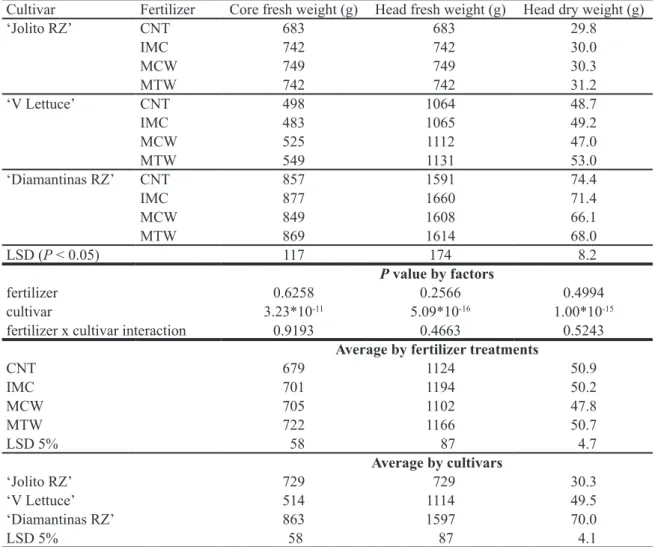
Core and head fresh weights and head dry weight were not affected by the fertilizer treatment and by treatment x cultivar interaction (Table 4).

Kozik et al. (2011) did not find any significant differences either between their microelement fertilizer treatments, except for a yield decreasing effect of Fe-DTPA at the highest rate. However, our result is not in agreement with the findings of Morikawa and Saigusa (2008, 2011), who

discovered higher leaf radish fresh weight and rice grain yield as a result of application of microelement enriched coffee and tea waste materials. As it was expected prior to the trial, the highest head weights were produced by

‘Diamantinas RZ’ and the lowest ones by the butterhead type ‘Jolito RZ’.

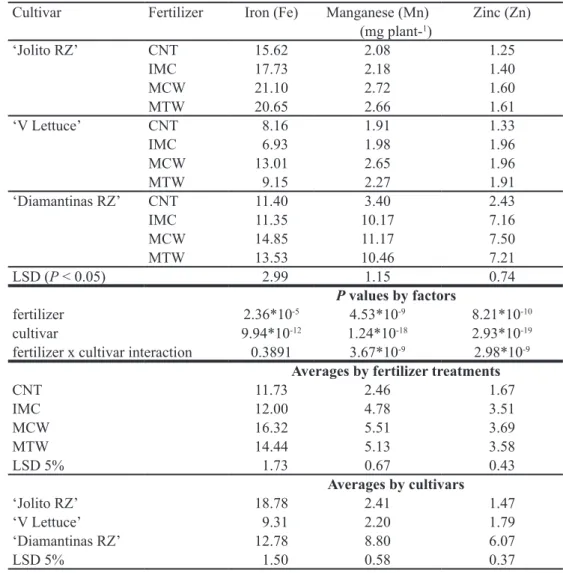
Iron, manganese and zinc uptake of lettuce heads As fertilizer treatments did not affect head weight results significantly, microelement uptake results showed similar tendency to the concentration data. Microelement uptake of lettuce heads was significantly affected not only by the two investigated factors but also by their interaction (Table 5). In the average of the three cultivars the two waste treatments resulted in significantly higher iron uptake compared to the CNT and to the IMC treatment. This latter treatment

Cultivar Fertilizer Core fresh weight (g) Head fresh weight (g) Head dry weight (g)

‘Jolito RZ’ CNT 683 683 29.8

IMC 742 742 30.0

MCW 749 749 30.3

MTW 742 742 31.2

‘V Lettuce’ CNT 498 1064 48.7

IMC 483 1065 49.2

MCW 525 1112 47.0

MTW 549 1131 53.0

‘Diamantinas RZ’ CNT 857 1591 74.4

IMC 877 1660 71.4

MCW 849 1608 66.1

MTW 869 1614 68.0

LSD (P < 0.05) 117 174 8.2

P value by factors

fertilizer 0.6258 0.2566 0.4994

cultivar 3.23*10

-11

5.09*10

-16

1.00*10

-15

fertilizer x cultivar interaction 0.9193 0.4663 0.5243

Average by fertilizer treatments

CNT 679 1124 50.9

IMC 701 1194 50.2

MCW 705 1102 47.8

MTW 722 1166 50.7

LSD 5% 58 87 4.7

Average by cultivars

‘Jolito RZ’ 729 729 30.3

‘V Lettuce’ 514 1114 49.5

‘Diamantinas RZ’ 863 1597 70.0

LSD 5% 58 87 4.1

Table 4. Effect of fertilizer type on head weight of three lettuce cultivars

(CNT = Zero control; IMC = Inorganic microelement compounds; MCW = Microelement enriched coffee waste;

MTW = Microelement enriched tea waste)

(8)

did not enhance iron uptake. In average of the three cultivars, manganese and zinc uptake was significantly increased by all the three treatments. This latter result was mainly due to the three-fold increase in manganese and zinc uptake of ‘Diamanthinas RZ’ as the effect of the treatments.

There were comprehensive differences among the cultivars in the accumulation of microelements (Table 5). Despite its inferior weight ‘Jolito RZ’

had significantly the highest iron accumulation, and hence nutritional value, due to its very high iron concentration (Table 2). Manganese and zinc uptake was significantly the highest for

‘Diamantinas RZ’ due both to its higher head weight and to its higher manganese and zinc concentration. No significant differences in the

uptake of these two microelements between

‘Jolito RZ’ and ‘V lettuce’ were found.

Conclusions

Application of microelement enriched coffee and tea wastes increased the nutritional value of lettuce by resulting in significantly higher concentration in cores for all the three investigated microelements (Fe, Mn, Zn). The highest rate of increase was observed for iron.

There were comprehensive differences in the microelement concentration in the cores of the investigated cultivars, high iron content of ‘Jolito RZ’ and high manganese and zinc content of

‘Diamantinas RZ’ are worth noting. Although head weights were not affected by the treatments, due to the higher concentration, iron uptake was

Cultivar Fertilizer Iron (Fe) Manganese (Mn) Zinc (Zn) (mg plant-

1

)

‘Jolito RZ’ CNT 15.62 2.08 1.25

IMC 17.73 2.18 1.40

MCW 21.10 2.72 1.60

MTW 20.65 2.66 1.61

‘V Lettuce’ CNT 8.16 1.91 1.33

IMC 6.93 1.98 1.96

MCW 13.01 2.65 1.96

MTW 9.15 2.27 1.91

‘Diamantinas RZ’ CNT 11.40 3.40 2.43

IMC 11.35 10.17 7.16

MCW 14.85 11.17 7.50

MTW 13.53 10.46 7.21

LSD (P < 0.05) 2.99 1.15 0.74

P values by factors

fertilizer 2.36*10

-5

4.53*10

-9

8.21*10

-10

cultivar 9.94*10

-12

1.24*10

-18

2.93*10

-19

fertilizer x cultivar interaction 0.3891 3.67*10

-9

2.98*10

-9

Averages by fertilizer treatments

CNT 11.73 2.46 1.67

IMC 12.00 4.78 3.51

MCW 16.32 5.51 3.69

MTW 14.44 5.13 3.58

LSD 5% 1.73 0.67 0.43

Averages by cultivars

‘Jolito RZ’ 18.78 2.41 1.47

‘V Lettuce’ 9.31 2.20 1.79

‘Diamantinas RZ’ 12.78 8.80 6.07

LSD 5% 1.50 0.58 0.37

Table 5. Effect of fertilizer type on iron, manganese and zinc accumulation in three lettuce cultivars

(CNT = Zero control; IMC = Inorganic microelement compounds; MCW = Microelement enriched coffee waste;

MTW = Microelement enriched tea waste)

(9)

significantly higher in the microelement enriched waste treatments, in some agreement with the soil extract measurements. In contrast with some previous experiments conducted with the same waste materials the yield could not be increased by the investigated microelement fertilization method. Hence, under the field conditions of this study, higher microelement concentration and uptake in the lettuce heads was not a prerequisite for good lettuce yield, as it was proved by the results of a zero control. However, even under the high microelement level condition of the soil of the experimental field, the application of

microelement enriched coffee and tea wastes for supplying microelements for lettuce in alkaline soil proved to be promising, especially for iron.

Newly developed techniques for recycle organic wastes like coffee and tea wastes will certainly increase the add-value of those wastes, whose disposal is currently an environmental concern, because presently they have few uses. These wastes are rich in polyphenols that can bind metals like iron, manganese and zinc, serving as a carrier for plant absorption, increasing the nutritional value of crops for human health.

References

Bosiacki, M., W. Tyksinski (2009): Copper, zinc, iron and manganese content in edible parts of some fresh veg- etables sold on markets in Poznan. Journal of Elementology. 14: 1. 13-22. DOI: http://dx.doi.org/10.5601/

jelem.2009.14.1.02

Brown, J. E., H. Khodr, R. C. Hiderm C. A. Rice-Evans (1998): Structural dependence of flavonoid interactions with Cu2+ ions: implications for their antioxidant properties. Biochemical Journal. 330: 3. 1173-1178. DOI: http://

dx.doi.org/10.1042/bj3301173

Füleky, Gy., K. Rajkainé Víg (1999): A talaj tápanyagszolgáltató képessége. [Nutrient providing capacity of soil.]

In: Gy. Füleky (Ed.): Tápanyaggazdálkodás. [Nutrient management.] Mezőgazda Kiadó, Budapest, 91-139. p.

Hartz, T.K., P.R. Johnstone, E. Williams, R.F. Smith (2007): Establishing lettuce leaf nutrient optimum ranges through DRIS analysis. HortScience. 42: 1. 143-146.

Japanese Food Composition Database. https://fooddb.mext.go.jp/ Ministry of Education, Culture, Sports, Science and Technology.

Jones, A., L. Montanarella, R. Jones (Eds.) (2005): Soil atlas of Europe. European Comission, Publication Office of the European Union, Luxembourg, Luxembourg

Jones, Jr. J. B., V. W. Case (1990): Sampling, handling and analyzing plant tissue samples. In: R. L. Westerman (ed.):

Soil Testing and Plant Analysis Edition 3, Soil Science Society of America Inc, Madison, Wisconsin, USA, 389-427. p.

Kasongo, R. K., A. Verdoodt, P. Kanyankagote, G. Baert, E. Van Ranst (2011) Coffee waste as an alternative fertilizer with soil improving properties for sandy soils in humid tropical environments. Soil Use and Management. 27:

1. 94–102 DOI: http://dx.doi.org/10.1111/j.1475-2743.2010.00315.x

Kozik, E., W. Tyksinski, M. Bosiacki (2011): A comparison of the efficiency of organic and mineral iron compounds in the greenhouse cultivation of lettuce. Journal of Elementology. 16: 1. 59-68. DOI: http://dx.doi.org/10.5601/

jelem.2011.16.1.59-68

Mahashabde, J. P., S. Patel (2012): DTPA – Extractable micronutrients and fertility status of soil in Shirpur Tahasil region. International Journal of ChemTech Research. 4: 4. 1681-1685.

Marschner. H. (1998): Mineral nutrition of higher plants. Academic Press Inc., San Diego, California, USA, 862 p.

Morikawa, C. K., M. Saigusa (2008): Recycling coffee and tea wastes to increase plant available Fe in alkaline soil.

Plant and Soil. 304: 1-2. 249-255. DOI: http://dx.doi.org/10.1007/s11104-008-9544-1

(10)

Morikawa, C. K., M. Saigusa (2011): Recycling coffee grounds and tea leaf wastes to improve the yield and mineral content of grains of paddy rice. Journal of the Science of Food and Agriculture. 91: 11. 2108-2111. DOI: http://

dx.doi.org/10.1002/jsfa.4444

Morikawa C. K., M. Shinohara (2013): Water-soluble iron supply agent with reducing power and with coffee grounds or tea dregs as raw material http://www.google.com/patents/EP2554042A1?cl=en

Mou, B., E. J. Ryder (2002): Relationship between the nutritional value and the head structure of lettuce. In XXVI International Horticultural Congress: Advances in Vegetable Breeding. Acta Horticulturae. 637: 361-367.

DOI: http://dx.doi.org/10.17660/ActaHortic.2004.637.45

Mou, B. (2009): Nutrient content of lettuce and its improvement. Current Nutrition & Food Science. 5: 4. 242-248.

DOI: http://dx.doi.org/10.2174/157340109790218030

Provin T., H. Zhang (2014): DTPA and DTPA-Sorbitol extraction of micronutrients. in: F. J. Sikora (ed.): Soil test methods from the Southeastern United States. Southern Cooperative Series Bulletin No. 419, Southern Asso- ciation of Agricultural Experiment Station Directors, Raleigh, North Carolina, USA, 118-123. p.

Rácz, I. (2007): [Quality of water used for irrigation in forced cultures of vegetables in Hungary.] PhD dissertation (In Hungarian with English thesis), Corvinus University of Budapest, Hungary

Roosta, H. R. (2011): Interaction between water alkalinity and nutrient solution pH on the vegetative growth, chlo- rophyll fluorescence and leaf Mg, Fe, Mn and Zn concentrations in lettuce. Journal of Plant Nutrition 34: 5.

717–731. DOI: http://dx.doi.org/10.1080/01904167.2011.540687

Roosta, H. R., M. Jalali, M., S. M. Ali Vakili Shahrbabaki (2015): Effect of nano Fe-Chelate, Fe-EDDHA and FeSO

4

on vegetative growth, physiological parameters and some nutrient elements concentrations of four varieties of lettuce (Lactuca sativa L.) in NFT system. Journal of Plant Nutrition, 38: 14. 2176-2184. DOI: http://dx.doi.or g/10.1080/01904167.2015.1043378

Rubatzky, V. E., M. Yamaguchi (1997): World vegetables. Principles, Production and Nutritive Values. Chapmann

& Hall, New York , USA

Sönmez, I., H. Kalkan, H. Demir, R. Külcü, O. Yaldiz, M. Kaplan (2017): Mineral composition and quality pa- rameters of greenhouse grown lettuce (Lactuca sativa L.) depending on fertilization with agricultural waste composts. Acta Scientiarum Polonorum, Hortorum Cultus. 16: 3. 85–95. DOI: http://dx.doi.org/10.24326/

asphc.2017.3.9

Stevens, J.: Special analysis interpretation sheet. DTPA extractable copper, iron, manganese and zinc. http://www.

lsuagcenter.com/~/media/system/a/e/9/5/ae951c0e4d25ecd7658617b3ad58da96/rec-dtpa.pdf

Tyksinski, W., A. Komosa (2008): After effect of iron chelates on the yielding and iron content in greenhouse let- tuce. Acta Scietinarum Polonorum, Hortorum Cultus. 7: 2. 3-10. DOI: http://dx.doi.org/

U.S. Department of Agriculture (2015): National nutrient database for standard reference. Release 28. September

2015. https://ndb.nal.usda.gov/ndb/

Table 1. Effect of fertilizer type on plant available concentration of iron, manganese, zinc in the soil after lettuce  cultivation, measured by DTPA-TEA method
Table 2. Effect of fertilizer type on iron, manganese and zinc concentration (mg kg -1  fresh weight) in cores of  three lettuce cultivars
Table 3. Effect of fertilizer type on iron, manganese and zinc concentration in outer leaves of two iceberg type  lettuce cultivars
Table 4. Effect of fertilizer type on head weight of three lettuce cultivars
+2

参照

関連したドキュメント

A knowledge of the basic definitions and results concerning locally compact Hausdorff spaces and continuous function spaces on them is required as well as some basic properties

Notice that for the adjoint pairs in corollary 1.6.11 conditions (a) and (b) hold for all colimit cylinders as in (1.93), since (F ? , F ∗ ) is an equipment homomorphism in each

H ernández , Positive and free boundary solutions to singular nonlinear elliptic problems with absorption; An overview and open problems, in: Proceedings of the Variational

We consider a parametric Neumann problem driven by a nonlinear nonhomogeneous differential operator plus an indefinite potential term.. The reaction term is superlinear but does

Keywords: Convex order ; Fréchet distribution ; Median ; Mittag-Leffler distribution ; Mittag- Leffler function ; Stable distribution ; Stochastic order.. AMS MSC 2010: Primary 60E05

This issue was resolved by the introduction of the zip product of graphs in [2, 3], which led to exact crossing number of several two-parameter graph families, most general being

Key words: exterior differential systems; variation of Hodge structure, Noether–Lefschetz locus; period domain; integral manifold; Hodge conjecture; Pfaffian system; Chern

In particular, we consider a reverse Lee decomposition for the deformation gra- dient and we choose an appropriate state space in which one of the variables, characterizing the