Modality‑(in)dependent Second Language Learning
著者(英) Deborah Chen Pichler, Elena Koulidobrova, Jeffrey Levi Palmer
journal or
publication title
Senri Ethnological Studies
volume 101
page range 165‑186
year 2019‑06‑21
URL http://doi.org/10.15021/00009425
165
Edited by Kikusawa Ritsuko and SaNO Fumiya
11. Modality-(in)dependent Second Language Learning
Deborah Chen Pichler
Gallaudet University, USA
Elena Koulidobrova
Central Connecticut State University, USA
Jeffrey Levi Palmer
Gallaudet University, USA
Abstract
Advances in bilingual research have brought widespread recognition that many aspects of what we previously assumed to be “typical” language development are in fact specific to monolinguals, and that divergent developmental patterns observed for bilingual children are a normal consequence of acquiring more than one first language. In this chapter, we discuss how studies of sign language bilingualism are poised to effectuate a similar broadening of public consciousness regarding second language (L2) bilingualism, until now built almost exclusively on the study of unimodal speech bilinguals. We summarize acquisition patterns that have emerged from the nascent literature on various sub-categories of sign bilinguals and discuss how these findings affect prevailing assumptions about bilingualism. We argue that more rigorous research on unimodal sign bilinguals in particular is needed to refine our current understanding of bilingual language acquisition and processing, and clarify the extent of critical period effects on L2 acquisition by late-exposed deaf signers.
11.1. Introduction
The field of language acquisition has traditionally been dominated by studies of monolingual speakers, leading to the perception of monolingual patterns of development as “typical,”
despite the fact that the majority of the world’s population is not monolingual (Grosjean 2010). By comparison, bilingual patterns of language development have been viewed as aberrant or disordered, until relatively recent advances in bilingual research demonstrated that many aspects of “typical” monolingual development are neither typical nor expected in contexts where individuals acquire more than one language at a time. Thanks to these bilingual studies, we now have a clearer understanding of where monolingual and bilingual acquisition patterns converge, and recognize many divergent patterns as normal effects of bilingualism. Yet bilinguals are far from a monolithic entity, encompassing multiple sub-categories defined by a lengthy list of factors, one of which is language modality. In
Deborah CheN Pichler, Elena KOulidObrOva and Jeffrey Levi Palmer
166
recent years, research interest in bilingualism involving sign languages has risen sharply, focused primarily on bimodal bilinguals who use at least one sign language and one spoken language. Studies of this population reveal that their basic developmental milestones are similar to those observed for unimodal speech bilinguals, but also reveal unique patterns of language mixing and cross-modal influence that had not been observed before (Petitto and Holowka 2002; Emmorey et al. 2005). These potential modality effects offer more nuanced insights into what qualifies as “typical” bilingual development, depending on the modality of the languages involved. In the same way that research on unimodal speech bilinguals broadened public consciousness about overlapping but distinct paths for monolingual versus bilingual L1 acquisition, research on bimodal bilinguals has brought recognition of two overlapping but distinct paths for speech versus sign L2 acquisition. There is, however, a second group of L2 sign language learners that remain largely absent in the L2 sign literature: deaf signers who learn an additional sign language as an L2.1) We argue that this category of L2 learners is crucial for comprehensive understanding of L2 development and the effects of modality. Not only are deaf L2 signers a logical comparison group for both unimodal spoken L2 learners and bimodal sign L2 learners (in the former case because deaf L2 signers are also unimodal bilinguals, and in the latter case because they are also learning a signed L2), but they are also a crucial test case for re-examining the effects of late L1 exposure on subsequent L2 acquisition by deaf learners.
Most reports of L2 learning by deaf individuals measure their ability to learn the written version of the ambient spoken language. A consistent finding of these studies is that deaf signers with late exposure to an accessible L1 (either a natural signed or spoken language) perform poorly in L2 development of the local written language (Mayberry et al. 2002;
Mayberry 2007; Cormier et al. 2012). For example, in a test of grammaticality judgment of written English sentences, Mayberry and Lock (2003) reported that deaf adults exposed to their first accessible language (ASL) between the ages of 4 and 13 scored significantly below both hearing and native signing deaf learners with comparable length of experience with English as an L2 (over 12 years). The crucial difference, the authors argued, is the fact that both groups of successful L2 English learners had early access to a first language.
While it is assumed that only deaf children from deaf families receive early and reliable access to a first language, more recent reports demonstrate that this is not always the case.
Hrastinski and Wilbur (2016) analyzed 6th to 11th grade deaf students’ ASL proficiency and their scores on standardized tests of English reading comprehension and grammatical usage. They identified ASL proficiency as the strongest predictor of successful performance on English tests, even stronger than home language (ASL versus a spoken language). This is an encouraging indication that a strong sign language environment at school may allow some deaf students from hearing families to develop ASL proficiency well enough to support successful subsequent acquisition of English as an L2. But the main observation remains intact: deaf individuals who fail to develop strong proficiency in at least one L1 are at a distinct disadvantage for subsequent L2 acquisition of written English.
There are numerous studies that document the academic challenges faced by deaf students (e.g. Qi and Mitchell 2011, Marschark et al. 2015, Hrastinski and Wilbur 2016, among others). While each study defines academic achievement differently, most rely on
measures of English reading or writing. It is unclear how much these studies can inform our knowledge of deaf L2 English acquisition since we cannot tease apart L2 English learning from the confounds of various cognitive processes related to working in a language that one does not hear (e.g. decoding for reading, grapheme recognition for writing). It is quite possible, then, that difficulties of deaf students on L2 English tests reflect at least in part difficulties with English phonological coding and awareness that are distinct from the basic ability to learn an L2. Furthermore, unlike hearing L2 English learners, who benefit from a wide range of phonological experiences that could potentially transfer to their English, deaf learners have far fewer potential transfer points. We propose that testing deaf learners’
performance in L2 acquisition of another sign language would provide a more direct and accurate measure of the effects of late L1 exposure on L2 learning, a point to which we will return at the end of this chapter.
First, a foray into related domains of bilingual development is necessary as background.
In Section 11.2, we summarize some important insights that have emerged from spoken language bilingual research so far. In Section 11.3, we ask how language modality might affect bilingual acquisition, and introduce terminology to distinguish between acquisition contexts across and within modalities. Section 11.4 provides a brief summary of notable acquisition patterns observed so far for bimodal bilingual learners, setting the stage for our discussion in Section 11.5 of deaf L2 signers as a crucial comparison group for both types of bilingual L2 learners. Finally, in Section 11.6 we report on deaf signers’ learning of a second sign language, arguing that a more successful picture emerges for these students than is typical for the L2 studies of written English summarized earlier. We close in Section 11.7 by sketching out some promising directions for future research on deaf L2 learners, focusing on the domain of phonology, traditionally the most widely investigated domain for L2 sign language development so far.
11.2. Bilinguals Diverge from Monolinguals: Insights from Unimodal Speech Bilingualism
Normally, when most people think of bilingual studies, they think of bilinguals who know more than one spoken language. These bilinguals are unimodal bilinguals because both of their languages are transmitted in the same modality (i.e. both are spoken languages).
Research on this population, which encompasses the majority of people around the world, has significantly altered our assumptions about “normal” patterns of how humans acquire, store, process and lose language. We now understand that monolingual standards are not appropriate to apply to bilingual acquisition, because “[a] bilingual is not two monolinguals in one person,” as famously declared by François Grosjean (1989). Decades of research on unimodal bilingual speakers has uncovered patterns of language development and processing that diverge noticeably from those observed for monolingual speakers. These differences are known collectively as bilingual effects and manifest from the earliest stages of language development. For instance, compared to their monolingual peers, bilingual infants remain sensitive to certain phonetic contrasts longer (Albareda-Castellot et al. 2011) and focus earlier and longer on mouth patterns of their interlocutors, a source of additional information
Deborah CheN Pichler, Elena KOulidObrOva and Jeffrey Levi Palmer
168
that facilitates the acquisition of two languages (Pons et al. 2015). With respect to word learning, bilinguals are frequently reported to have smaller vocabularies than their monolingual peers, but these differences disappear when both of the bilinguals’ languages are considered jointly (Pearson and Fernández 1994). In the domains of syntax and morphology, the interaction of two or more grammars results in a particularly rich spectrum of bilingual effects, often labeled as cross-linguistic influence (Hulk and Müller 2000) or language synthesis (Koulidobrova 2012, Lillo-Martin et al. 2016). For example, researchers have observed that bilingual Spanish-English and Italian-English children overuse overt arguments when speaking Spanish and Italian, both languages that make frequent use of null arguments (Sorace and Serratrice 2009). This pattern of “over-redundancy” has been attributed to transfer from their dominant language, English, which is not a null argument language.
Bilinguals may develop certain aspects of syntax at a different rate than monolinguals, depending on many variables such as the particular languages they are learning (Hulk and Müller 2000), the quantity of input they receive in each one (Hoff and Core 2013) and the aspect of morpho-syntactic development in question (Unsworth 2014).
Much of the recent literature on bilingual effects has focused on the proposal that both unimodal bilinguals’ languages are activated at all times, requiring suppression of one language when focusing or using the other (Green 1998). This alternating activation and suppression of languages underlies a host of bilingual effects such as cross-linguistic activation (e.g. interference from words in one language on a vocabulary task involving the other language) and code-switching, a type of language mixing characterized by switches between one language to another within a single sentence or discourse (Muysken 1997).
Perhaps the most widely publicized consequence of simultaneous bilingual activation is the so-called “bilingual cognitive advantage,” an umbrella term for various cognitive advantages reported for bilinguals compared to monolinguals (Bialystok et al. 2008). In particular, bilinguals are better at cognitive control, allowing them to suppress or filter out conflicting/
irrelevant information and focus on the task at hand. Initially, it was not clear whether this advantage was somehow a consequence of bilingualism itself, or the result of some other aspect associated with bilingualism, a question to which we will return in the next section.
Ultimately, the extensive research on unimodal bilinguals has led to the important recognition that monolingual brains and bilingual brains differ in many ways, and that these differences necessarily result in different patterns for language learning.
11.3. Recognizing Modality as a Factor in Acquisition: Proposed Terminology While the overwhelming majority of bilingual research focuses exclusively on unimodal speech bilinguals, recent studies have begun to explore a “new” type of bilingual, those who know a sign language and a spoken language. This category is commonly referred to as bimodal bilinguals, although there is less consensus on the populations to which this label is applied. At its most inclusive, the category of bimodal bilinguals encompasses anyone who uses at least one spoken language and one sign language. Exposure to these languages may begin simultaneously from birth or soon afterwards, otherwise known as
Bilingual First Language Acquisition (BFLA), or sequentially as Second Language Acquisition (SLA), with the sign language typically occurring as the L2. Bimodal bilingual first language acquisition applies to Children of Deaf Adults (Codas), hearing individuals raised by at least one deaf, signing parent, and Deaf Children from Deaf Families with a Cochlear Implant (DDCI), signing deaf individuals who can access speech through a cochlear implant (though not from birth, since implantation and subsequent access to sound is typically not available until close to one year of age). Bimodal second language acquisition applies to hearing sequential L2 learners of a sign language, a large and rapidly growing segment of the signing population in the U.S., Australia and many other countries where national sign languages have emerged as popular L2 choices among adult learners (Johnston 2004; Wells 2004).
Extending BFLA and SLA research to sign languages raises the important question of how language modality may affect the way language is acquired and organized. To highlight the potential for modality effects, we follow the practice (Chen Pichler 2010; Chen Pichler and Koulidobrova 2015) of including modality in our category labels within BFLA and SLA (Figure 11-1). We thus distinguish between unimodal BFLA, in which individuals are simultaneously exposed to two languages in the same modality (i.e. sign language + sign language, or spoken language + spoken language), and bimodal BFLA, described earlier as simultaneous exposure to one sign language + one spoken language. Within the category of SLA, we similarly distinguish between M1L2 (unimodal or “first modality L2”) learners who learn an L2 in the same modality as their L1 (i.e. L1 and L2 are both sign languages, or L1 and L2 are both spoken languages) and M2L2 (bimodal or “second modality L2”) learners who have a spoken L1 and a signed L2.2) In this chapter the term L2 learners, without any designation for modality, will be reserved as an umbrella term for both M1L2 and M2L2 learners.
Figure 11-1 Sub-categories of bilingualism
11.4. Modality Matters: Insights from Bimodal Bilingualism
Research on bimodal bilinguals has become increasingly common during the last decade,
Deborah CheN Pichler, Elena KOulidObrOva and Jeffrey Levi Palmer
170
focusing mainly on Coda adults (Bishop and Hicks 2005; Emmorey et al. 2008) and children (Baker and van den Bogaerde 2008; Lillo-Martin et al. 2014), and adult hearing M2L2 signers (Ortega 2013; Chen Pichler and Koulidobrova 2015). Coda developmental studies have shown that in many ways, bimodal BFLA proceeds similarly to spoken language unimodal BFLA, displaying familiar patterns for vocabulary development (Petitto et al.
2001) and language synthesis in a number of syntactic and discourse domains (Koulidobrova 2012; Palmer 2015; Lillo-Martin et al. 2016; Reynolds 2016). Yet other aspects of Coda development appear to be unique to bimodal bilinguals, including a disproportionate preference for code-blending (Petitto et al. 2001; Baker and van den Bogaerde 2008; Kanto et al. 2017), a type of code mixing in which signing and speech are co-articulated, rather than the code-switching that is a hallmark of unimodal speech bilingualism. Discovering the constraints that dictate how and when native bimodal bilinguals combine their two languages in this way has evolved into a major research objective for studies of both child and adult Codas. With respect to cognitive processing, preliminary investigations by Emmorey et al. (2008) reported the surprising result that the “bilingual cognitive advantage” was not observed for adult Codas, who scored on par with spoken monolingual controls on tasks testing cognitive control. The authors attribute this finding to the fact that Codas are not physically obligated to suppress one of their languages in order to use the other, and so frequently opt for the cognitively less taxing option of code-blending, which in turn results in less overall “life-long experience of constantly controlling the production of two languages”
(Emmorey et al. 2008: 1204). Following this line of reasoning, enhanced cognitive control for bilinguals is therefore not a result of bilingualism per se, but rather the accumulated experience of suppressing one language in order to use another.
The studies mentioned above represent only a tiny corner of the now substantial body of research documenting bimodal BFLA among Coda and DDCI signers. Because this chapter is primarily interested in L2 learners, we will not delve any further into the literature on BFLA, but only point out that those studies have had the cumulative effect of establishing two distinct varieties of bilingualism in public perception: “traditional” bilingualism, involving two or more spoken languages, and bimodal bilingualism, featuring at least one sign language.
This dichotomy has been reinforced by studies of bimodal SLA, to which we turn now.
Research on M2L2 learners examines the developmental patterns of hearing L2 signers that could be potentially unique to this particular acquisition context. In particular, researchers have focused on areas that have already emerged from L1 sign research as the source of potential modality effects, or developmental patterns that are unique to language in one modality or the other. Chief among these areas are iconicity and phonology, two domains in which researchers have previously identified modality effects for children’s L1 acquisition of sign languages (e.g. Meier et al. 2008; Thompson et al. 2012); it stands to reason, then, that these domains could display similar modality effects for adult M2L2 acquisition of sign languages. Researchers’ interest in iconicity lies in the observation that sign languages in general make very striking and frequent use of motivated forms, i.e. forms that resemble or suggest the concept they represent. Although iconicity is pervasive in sign languages, existing even at the morphological and syntactic levels, it is most readily apparent at the lexical level. Researchers have long noted that signs which “look like what they mean” are
noticed by new L2 signers, who may use lexical iconicity as a mnemonic device for learning new signs (Lieberth and Gamble 1991; Campbell et al. 1992). This learning strategy has not been noted for spoken L2 learners, to our knowledge, and thus appears to be unique to signed L2 development. More recent investigation of the role of iconicity on L2 development has confirmed hearing M2L2 signers’ sensitivity to lexical iconicity in both perception and production. For instance, Ortega (2013) and Ortega and Morgan (2015) report that beginner M2L2 signers of British Sign Language (BSL) are more accurate in their reproduction of isolated non-iconic signs than strongly iconic signs; they tend to treat the latter as gestures, producing their own gestural forms rather than a phonologically faithful copy of the signs they were instructed to reproduce. Findings from lexical processing studies report that iconicity aids proficient M2L2 signers (as well as deaf native signers) in matching signs with their corresponding pictures: pictures that highlight the iconic quality of a sign, e.g.
the ASL sign for CANDLE, which suggest a burning flame atop a narrow cylinder, are matched more quickly to that sign than pictures that do not highlight the iconic quality, e.g.
a picture of an unlit candle (Thompson et al. 2009; Vinson et al. 2015). Although those researchers argue that iconicity is prevalent in both spoken languages and sign languages, their study results point to the significant effect of iconicity on lexical processing that is especially prominent for sign languages.
Potential modality effects related to L2 phonological development of sign languages arise due to the fact that signed languages are produced with large, paired articulators (arms and hands) moving across a relatively large articulatory space, in contrast to the single, small articulator (the tongue) moving in a very constricted articulatory space (the oral cavity) in spoken languages. Additionally, M2L2 signers must learn to recognize and produce the many non-manual cues (e.g. eye blinks, eye gaze, brow movements, head nods, torso leans, etc.) that contribute important syntactic and prosodic information to signed utterances.
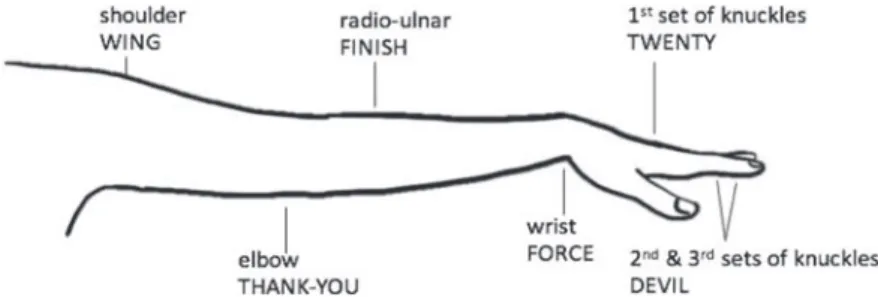
Well-formed signing thus demands a level of physical coordination that often exceeds new M2L2 signers’ skills in visual perception and manual/facial dexterity (Rosen 2004), resulting in a host of noticeable phonological errors. One such error is proximalization of sign movement, which originates from activation of one or more joints along the arm and hand, as illustrated in Figure 11-2.
Figure 11-2 Examples of ASL signs whose movement originates from activation of joints along the arm and hand (Chen Pichler et al. 2018)
Many researchers have noted a tendency of new M2L2 signers to shift the locus of movement
Deborah CheN Pichler, Elena KOulidObrOva and Jeff rey Levi Palmer
172
to a joint that is closer to the torso than in the target form, or add movement at an extra joint that is closer to the torso than the target joint, or (for signs requiring movement at multiple joints) omit movement at one or more distal joint. For example, Mirus et al. (2001) report that in the ASL sign GALLAUDET, normally signed with simultaneous bending at the first set of knuckles and extension at the wrist, the wrist movement is often proximalized to the elbow by new signers. Proximalization has a noticeable effect on the overall appearance of signs, making them look larger than normal and inappropriately “loud” (Mirus et al.
2001: 117). This effect contributes a perception of accented, non-nativelike signing.
Duration of movement is another aspect of sign language phonology that is notably different in M2L2 signing compared to native deaf signing. Cull (2014) paired clips of native deaf and M2L2 signers then asked raters to identify the signer in each pair that looked “less native” in their production. Deaf native signers consistently rated M2L2 signers as “less native”. Careful analysis of the ASL sentences produced by deaf native signers and hearing M2L2 signers revealed significant differences in duration across the two groups.
Production by hearing signers was consistently and significantly longer in duration for individual signs, transition movements between signs, and entire utterances. Cull (2014) concluded that longer duration is a hallmark feature of beginner M2L2 signing and is noticeable enough to contribute to deaf signers’ perception of a non-native signer “accent”.
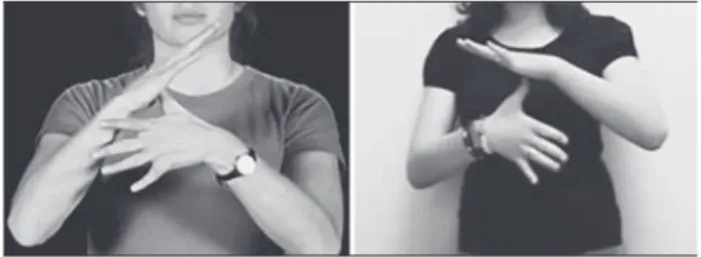
In addition to the non-native production patterns just discussed, researchers have also documented multiple M2L2 errors related to sign perception. In Figure 11-3, both the deaf ASL model on the left and the M2L2 signer on the right are right-handed, yet the M2L2 signer produces the sign (SENIOR) with the left hand in dominant position, failing to rotate the signing space. Rosen (2004) refers to such errors as mirror errors and attributes them to faulty perception.
Figure 11-3 Mirror error in reproduction of the ASL sign SENIOR by an L2 signer of ASL (right panel)
Bochner et al. (2011) argue that beginner M2L2 signers are less sensitive in their perception of contrastive differences in sign phonology than native signers or more advanced M2L2 signers. Participants were asked to view pairs of sentences signed in ASL, and determine for each pair whether the two sentences were the same or different. Contrasts included in the experimental design included differences in orientation, handshape, location, movement and “complex morphology”, a loosely defined category that consisted of differences in a variety of formational parameters. Results showed that beginner signers were the least accurate in their visual discrimination abilities, followed by intermediate signers, and lastly,
by native deaf controls.3) Movement contrasts were perceived with the lowest accuracy for all three subject groups, a pattern also reported by Cull (2014). Subjects were also surprisingly unsuccessful in identifying sentence pairs that featured the same utterance. Bochner et al.
argue that the perceptual difficulties they find among M2L2 signers stem in part from the unavailability of phonological transfer from their L1 to their L2. Whereas extensive phonological similarities between, say, English and Spanish allow English L2 learners of Spanish to transfer significant phonological knowledge to their L2, the modality difference between spoken versus signed phonology prevents M2L2 signers of enjoying the same benefit. Bochner et al. conclude that “L2 learners of signed languages, especially adult learners, will face a formidable challenge in acquiring the phonology of the signed language in situations in which their L1 is a spoken language” (2011: 1321). They recommend that sign language instructors explicitly train M2L2 students on phonological contrasts to help them overcome the challenges of learning phonology in a new modality (see Geer and Keane 2017 for an example of one such approach).
The emerging picture from M2L2 signer research reinforces the traditional versus sign language bilingual dichotomy mentioned earlier: on one hand, we have “traditional” unimodal L2 learners of a second spoken language, exhibiting typical L2 learner effects, and on the other hand, we have M2L2 sign language learners who plausibly exhibit modality effects in addition to or instead of certain typical L2 learner effects. But is bilingualism truly dichotomous in this way, with the fundamental difference between sub-categories resting on whether or not a sign language is involved? We argue that this question can only be answered through careful consideration of a third group of bilinguals, hitherto largely overlooked: unimodal sign language bilinguals.
11.5. The Other Unimodal Bilinguals: M1L2 Sign Bilinguals
Deaf signers who learn more than one sign language are relatively rare compared to hearing M2L2 signers. Yet pockets of such unimodal sign bilinguals can be found in linguistically diverse communities like Montreal, Canada, or along the US-Mexican border, where two distinct sign languages (as well as distinct spoken languages) have co-existed for extended periods of time (Quinto-Pozos 2002; 2008). Increasing mobility of deaf signers internationally has also brought deaf users of various sign languages to Gallaudet University and other Deaf hubs in large cities worldwide. When these deaf immigrants learn the sign language of their new home country, they become M1L2 learners. Where do such signers fit in with respect to the bilingual developmental patterns we have discussed so far? As unimodal bilinguals, M1L2 signers may pattern like unimodal speech bilinguals described in Section 2, exhibiting significant levels of transfer between their L1 and L2, making frequent use of code-switching rather than code-blending, and displaying the same advantages in cognitive control associated with unimodal speech bilinguals. Alternatively, as sign language bilinguals, M1L2 signers may pattern more closely with other bilinguals who use a sign language;
such an outcome would suggest that the modality effects observed so far for bimodal bilingual signers (Section 11.4) are better characterized as features of sign language acquisition in any context, rather than acquisition in a new modality. Finally, we may find that M1L2
Deborah CheN Pichler, Elena KOulidObrOva and Jeffrey Levi Palmer
174
signers exhibit patterns of a third subtype of bilingualism that we have not observed before, challenging current assumptions of a bilingual dichotomy.
To date, very little research has been published documenting cases of second sign language acquisition. Existing research focuses mainly on phonology, although studies are beginning to emerge on other topics related to syntax and code mixing. With respect to phonology, a series of studies documenting deaf signers’ accuracy in reproducing signs from a foreign, unfamiliar sign language suggests that M1L2 signers are not immune to the errors described for M2L2 learners in Section 11.4. In a comparison of phonological accuracy of isolated ASL signs reproduced by hearing M2L2 learners and Croatian deaf M1L2 learners, Chen Pichler (2008) reported that although deaf learners produced natural-looking, well- coordinated signs, they also made frequent mirror errors, as well as numerous small errors in handshape, especially involving the thumb position. Similarly, Mirus et al. (2001) reported proximalization errors produced by deaf German signers asked to reproduce isolated ASL signs, despite their extensive experience with German Sign Language (DGS). Palmer (2013) elicited isolated ASL signs from profoundly deaf Chinese Sign Language (CSL) users from Beijing, China with no previous experience with ASL, measuring the duration of static and transitional movements (P=postural and T=transforming segments) in the signs. He found that the CSL signers held the static segments significantly longer than the native ASL deaf model, as shown in Table 11-1. The ratio of P to T duration was also significantly different from that of the deaf ASL model.
Table 11-1 Duration measurements from Palmer 2013
Static P duratiONs DyNamic T duratiONs RatiO P:T
ASL Model L1 .033 secs .145 secs 1:4
Chinese Subjects M1L2 .11 secs .12 secs 1:1
Taken together, the findings of the studies summarized above suggest that several phonological errors associated with hearing M2L2 signers also occur for deaf M1L2 signers. These differences possibly contribute to a non-target signing “accent” that both Chen Pichler (2008) and Palmer (2013) report is noticeable in their M1L2 subjects’ ASL production.
Furthermore, noting that duration of static segments is an important component of phonological and morphological structure in sign languages (Sandler 1996; Johnson and Liddell 2011), Palmer suggests that purely phonetic changes like lengthening of sign duration can impact morphological accuracy in addition to phonological accuracy. One obvious question that remains, however, is whether the phonological errors observed for M1L2 signers reflect transfer from the signers’ L1, or whether they occur across L2 sign language learners, regardless of previous sign language experience. In the absence of detailed phonological studies of movement in Croatian Sign Language, German Sign Language and Chinese Sign Language, we cannot yet determine the correct interpretation of the M1L2 results gathered so far.
Syntactic development of M1L2 signers has been under-studied, although some preliminary results have recently begun to surface. Koulidobrova (2019) collected L2 ASL narratives from deaf L1 signers of Emirati Sign Language. Both ASL and Emirati Sign
Language allow (and even prefer) subjects of finite clauses to remain null; however, Koulidobrova reports overuse of overt subjects in Emirati signers’ ASL. In this respect, the participants of her study behave like unimodal spoken language bilinguals with a similar language combination, but unlike bimodal bilingual (native and non-native) ASL signers.
By the same token, Emirati signers oversupply overt arguments in 1st person (1IX), a pattern that has not been recorded in the literature on unimodal spoken language bilingualism.
While the aforementioned study does not make any direct claims about M1L2 syntax, it sheds light on the interaction of processing-related effects and syntax by demonstrating an increased cognitive load required in managing two languages in the same modality, as has been previously proposed by Sorace and colleagues (see Sorace 2011 and references therein).
Overuse of overt subject forms as a language control mechanism may thus be part and parcel of the bilingual experience, independent of syntactic requirements of any specific L1 and L2. If this aspect of L2 acquisition is modality-independent, then it is not surprising that signing M1L2 learners should behave in parallel ways to spoken M1L2 learners.
Furthermore, Koulidobrova (2019) argues that the overuse of overt subjects by her participants did not depend on their age of sign L1 acquisition (per Mayberry and Lock 2003, et seq.), as their over-supply of 1IX diminished with increasing proficiency in L2 ASL. These findings lead to the conclusion, albeit tentative at this stage, that over-supply of overt subjects is proficiency-dependent, but neither language- nor modality-dependent.
Finally, with respect to M1L2 patterns of code mixing, anecdotal evidence suggests that deaf sign bilinguals frequently code-switch between their two sign languages, a pattern supported by the very small number of studies that exist on deaf sign bilinguals. Zeshan and Panda (2015) document frequent code-switching by a small group of deaf signers of Burundi Sign Language (BuSL) who are fluent L2 learners of Indian Sign Language (ISL).
Despite individual variation, several patterns of code-switching emerge, such as frequent use of reiterative code-switching (Quinto-Pozos and Adam 2013) in which signers repeat the sign for a single concept twice, once in each sign language. ISL-BuSL bilinguals also demonstrated a reliance on signs that are formed similarly across both sign languages, and word order patterns that are grammatical in both languages. Zeshan and Panda report that the percentage of signs that are formed similarly across both sign languages is quite high in their data, with the result that it is often impossible to pinpoint the locus of a code-switch.
This state of events is also reported by Quinto-Pozos (2002) for Mexican Sign Language and ASL bilinguals, making direct comparison with patterns reported for unimodal speech code-switching difficult for now. Nevertheless, the Zeshan and Panda (2015) study contributes importantly to our understanding of code-mixing behaviors among deaf sign bilinguals, documenting frequent and sustained code-switching in this population. The authors conclude that the code-switching patterns they observed are part of a “relatively stable bilingual linguistic variety” (126) in which “lexical choices and grammatical patterns of code-switching are not random but follow certain regularities” (128). In these respects, the code-mixing behavior for unimodal BuSL-ISL bilinguals echoes familiar patterns reported for unimodal speech bilinguals.
If deaf sign bilinguals’ code-switching parallels that of unimodal speech bilinguals, they should be subject to the same requirement to suppress one language in order to produce
Deborah CheN Pichler, Elena KOulidObrOva and Jeffrey Levi Palmer
176
the other. Whether or not regular suppression of this sort leads to the same gains in cognitive control documented for unimodal speech bilinguals depends in large part on whether the cognitive cost of language switching is the same across sign languages as it is across some spoken languages. Adam (2012) studied deaf signers fluent in Australian Sign Language (Auslan) and Australian Irish Sign Language (AISL) and reported that signers frequently code-switched between their two sign languages. In a task of picture identification, these deaf signers were equally fast in Auslan and AISL, even for signers for whom Auslan was their dominant sign language. This finding is surprising, given that unimodal speech bilinguals typically display switching costs (measured by response times, for instance) that are asymmetric, depending on whether they switch into or out of their dominant language (Meuter and Allport 1999). Adam’s findings raise the question of whether an absence of the typical asymmetrical switch costs reflects a modality effect (i.e. something about sign languages makes code-switching less cognitively costly than it is in spoken language) or if there is some other explanation, perhaps related to the societal context of the signers under study. The fact that Adam’s unimodal sign bilinguals were part of a bilingual community where Auslan-AISL bilingualism is common supports the latter possibility. Like the BuSL-ISL bilingual context studied by Zeshan and Panda (2015), Auslan and AISL have been in sustained contact for many years, likely leading to entrenched patterns of language mixing.
Signers acculturated to these patterns can be reasonably confident that they are shared among others in the community, so users can code-switch freely, without having to monitor whether or not their mixing of Auslan and AISL is appropriate for a particular interlocutor.
There is evidence that whether or not bilinguals develop advantages in cognitive control is influenced by how intensely they must monitor their use of language mixing (J. Kroll, personal communication). Isolated bilinguals might thus be expected to develop more cognitive control (and exhibit higher switch costs) than bilinguals living in large communities where everyone is bilingual in the same two languages. Alternatively, cognitive control in bimodal bilinguals has also been investigated in terms of perceptual integration (i.e. having to integrate both audio and visual information simultaneously in order to complete a task).
Ormel et al. (2016) reported that Codas were more adept at cross-modal integration than other signing groups, although they did not test deaf unimodal bilinguals. These initial findings highlight the importance of including a variety of deaf bilingual populations in future research to identify the source of bilingual effects like increased cognitive control.
11.6. Revisiting Critical Period Effects and Language Transfer in Light of Unimodal Sign Bilinguals
Beyond being an important comparison group for investigating the developmental and cognitive patterns associated with bimodal bilinguals, deaf unimodal bilinguals are also a crucial test case for examining critical period effects on L2 learning by deaf signers who had delayed or degraded exposure to their first language. Researchers have demonstrated that late L1 exposure negatively affects deaf adults’ ability to interpret a variety of syntactic structures and detect grammatical errors in written English, even after decades of experience with the language (Mayberry and Lock 2003; Mayberry 2007). Mayberry concludes that
“the timing of L1 exposure in early life affects the outcome of all subsequent language learning, both the L1 and the L2, independent of sensory–motor modality” (2007: 543).
However, deaf unimodal bilinguals are conspicuously absent from the existing literature on critical period effects. We argue that unimodal L2 sign acquisition must be examined for a comprehensive understanding of the effects of late L1 exposure on subsequent L2 acquisition.
Anecdotally, deaf adults are very successful in acquiring a second sign language, but systematic research that explicitly controls for age of L1 exposure has only recently begun to appear.
One such study, Koulidobrova and Palmer (under review), examines the performance of early- versus late-exposed unimodal deaf M1L2 learners of ASL. The authors administered the phonological discrimination task designed by Bochner et al. (2011) to a group of 25 deaf male signers from the United Arab Emirates, Saudi Arabia and Kuwait, and five hearing controls with no exposure to ASL or other sign language. The deaf Middle Eastern signers had between 1-4 years of ASL experience so far, and were mixed in terms of their age of exposure to their L1, with roughly a third of them receiving first exposure to a sign language only after the age of 10. As a group, in terms of the overall score on the task, they performed on par with the hearing M2L2 beginner learners in Bochner et al.; yet, in all conditions analyzed individually, they outperformed the hearing non-signers, and performed favorably compared to the deaf controls and hearing M2L2 signers from Bochner et al. (2011),4) particularly with respect to orientation and movement (Figure 11-4).
Figure 11-4 Accuracy in ASL phonological discrimination cited from Koulidobrova and Palmer under review
While these findings do not speak to the type of phonological errors M1L2 learners are expected to make (and, therefore, do not contradict the findings of the studies on hearing M2L2 learners presented earlier), the results do suggest that having a previous sign L1 is an advantage for learning the phonology of a second sign language, at least when it comes to perception. Importantly, the late-exposed signers among the Middle Eastern M1L2 group scored on par with signers with early or native exposure. For this task, the amount of L2 practice was a significant predictor of test score, rather than age of acquisition of L1 or L2.
Deborah CheN Pichler, Elena KOulidObrOva and Jeffrey Levi Palmer
178
These early results suggest that a phonological advantage in some areas may accrue even to those with late exposure to their L1, at least in the domain of phonological discrimination.
If it turns out to be the case that critical period effects are less evident in deaf signers’
L2 sign development than in their L2 written development, one major factor may be an increased potential for positive transfer between an L1 and L2 that share the same modality.
Decades of research on spoken language L2 learners has demonstrated the powerful facilitative effects of some types of transfer for acquisition. For instance, cognates between the L1 and L2 speed lexical development, especially for beginning learners (Pérez et al. 2010; Hall 2002). These facilitative effects in vocabulary may “free up” cognitive resources for other aspects of L2 learning, resulting in advantages in other domains such as syntax, compared to students whose L1 share fewer cognates with their L2 (Ard and Homburg 1983). Similarly, students whose L1 and L2 employ similar morphological processes benefit from morphological transfer (Jarvis and Odlin 2000).
While transfer is possible between a deaf learner’s signed L1 and their written L2, particularly at the syntactic level, the potential for transfer between two natural sign languages is arguably much higher at all linguistic levels, due to striking typological similarities across sign languages examined so far (Allard and Chen Pichler 2018; Lucas and Valli 1992;
Sandler 2006). Lexical similarity across sign languages can be relatively high even in historically unrelated sign languages, as noted earlier by Zeshan and Panda (2015) and Quinto-Pozos (2002). Non-concatenative morphology, grammatical non-manuals, classifier forms and the exploitation of space to mark linguistic functions are also common features across many sign languages. Unimodal L2 sign acquisition thus presents a range of potential transfer effects from the L1 sign language which may facilitate L2 sign development in a way parallel to what has been observed for unimodal spoken L2 development.
Additionally, studies of unimodal L2 sign acquisition may also uncover transfer effects that have been hitherto overlooked. Palmer and Koulidobrova (2017) note that when the L2 ASL learners they studied (L1 Emirati Sign Language) had difficulty accessing an ASL sign, their circumlocution strategies centered on classifier constructions and depiction, prominent features of sign languages in general. This reliance on depiction contrasts starkly with reports of circumlocution strategies by hearing L2 learners of spoken languages, who focus on the function that a lexical item denotes rather than its description; e.g. for the target word “chair”, L2 learners primarily represent it as an “item to sit on” rather than a
“piece of furniture with four legs, a seat, and a back” (see Campillo 2006 and references therein). However, existing circumlocution studies have not yet investigated L2 acquisition contexts where learners’ L1 and L2 both make significant use of classifiers or other depictive devices. Thus, the circumlocution strategy reported by Palmer and Koulidobrova for unimodal L2 sign could be specific to L2 in the signed modality, or it could predict that variation in circumlocution strategies depending on the availability of depictive devices in learners’ L1 and L2, irrespective of modality.
In conclusion, deaf unimodal L2 sign acquisition offers invaluable opportunities to expand our understanding of L2 acquisition beyond the two contexts that have traditionally been studied so far: unimodal L2 acquisition of spoken languages, and deaf L2 acquisition of written languages. Additionally, we have argued that careful examination of ultimate
outcomes by deaf L2 sign language learners with late L1 exposure is a crucial counterpart to existing research on critical period effects for deaf L2 learners of written language.5) We propose that deaf people’s M1L2 sign language learning is a more direct testing ground for their L2 potential than their learning of an L2 written language, as the latter entails additional complications related to phonological decoding of a spoken language that deaf learners may not access.
11.7. Conclusions and Future Directions
The literature on unimodal deaf L2 signers is still in its infancy, but we hope to have demonstrated the very pressing need for more research on this traditionally neglected population. First, unimodal deaf L2 learners are a valuable comparison group for both bimodal and unimodal L2 learners, helping us tease apart developmental and cognitive patterns related to language development across modalities versus error patterns that are simply typical of L2 learning, or sign language learning. Research on unimodal deaf L2 learners will also allow us to determine the extent to which grammatical knowledge from a signed L1 is transferred to a signed L2. The brief survey of findings presented in this chapter suggests that a signed L1 does not guarantee target-like behaviors in signed L2 phonology; M1L2 signers display several of the error patterns of proximalization, mirror errors and extended duration that have previously been associated with M2L2 learners.
However, it is important to note that in most of those phonological studies, the M1L2 signers tested were sign-naïve, rather than actual sign language learners. Only a longitudinal study of actual sign language learners can tell us how long the errors that we observed persist and how they change with continued exposure. As it is, phonological errors appear to occur at a lower frequency for the deaf M1L2 signers than for M2L2 signers, a pattern that could indicate a facilitative effect of phonological transfer for M1L2 sign language learning. This interpretation is in line with the conclusion of Koulidobrova and Palmer (under review), one of the few studies to test actual M1L2 sign learners, that previous sign language experience confers an advantage for phonological discrimination.
Koulidobrova and Palmer (under review) also highlight a second domain in which unimodal deaf L2 signers are a crucial test case, the determination of critical period effects on L2 acquisition by late-exposed deaf signers. Their study showed that age of acquisition was not a significant predictor of phonological awareness, although other domains may of course yield different results and should be investigated. Whereas disadvantages for L2 acquisition in learning the local written language have been amply documented for late- exposed deaf signers, it remains plausible that some of those deficits could reflect independent confounds related to phonological coding of written language. Comprehensive, careful comparison with sign M1L2 acquisition by early- and late-exposed deaf signers on a variety of tasks is crucial for refining our understanding of how age of L1 acquisition and modality affect L2 learning. While the research described in this chapter is preliminary and focuses primarily on phonology only, parallel questions must be asked for morpho-syntax, semantics, and pragmatics of L2 sign language acquisition. Such avenues for research offer valuable predictions to guide investigations in this important emerging field, which carries enormous
Deborah CheN Pichler, Elena KOulidObrOva and Jeffrey Levi Palmer
180
potential to broaden and reshape our perceptions of bilingual learners.
Notes
1) We have made an effort throughout this chapter to reserve the capitalized term Deaf for contexts that index a Deaf cultural identity. For all other cases, where it is not our intention to specify or focus on cultural identity, we use the lower-case form of the word, deaf.
2) We recognize that gray areas still exist even under our more detailed categorization of bilinguals.
For instance, Codas, DDCI and L2 signers who learn a second sign language might be grouped together as M1L2 learners, since they all have previous experience with a sign language, or that label might be reserved only for BFLA signers. Determining which of these two possibilities is the most appropriate will depend on future empirical evidence on the extent to which BFLA vs.
SLA of a previous sign language affects acquisition of a subsequent sign language. Although Figure 11-1 makes no distinction between bilinguals and multilinguals, strictly speaking the two terms are not interchangeable, despite the fact that the literature has often treated them as such (we thank an anonymous reviewer for bringing this point to our attention). Additionally, we acknowledge that the M2L2 term, as we define it, would technically also apply to individuals with a signed L1 who subsequently learn a spoken L2, but since this type of case has not yet been attested in the acquisition literature, we leave to future research the question of whether categorization of such learners with hearing learners of their first signed L2 is appropriate.
3) It is worth pointing out that the proficiency terms (“beginner” and “intermediate”) used by Bochner et al. (2011) are based on the course in which subjects were enrolled at the time of study, with the number of hours of exposure and experience with ASL acting as a proxy for ASL proficiency.
Bochner et al. categorized subjects as “beginners” if they were enrolled in ASL I-III at a college campus (i.e. in their first, second or third semester of ASL as L2) and “intermediate” if they were enrolled in ASL V (5th semester of ASL as L2). In reality, student proficiency at any given ASL course level varies considerably across settings and individuals.
4) Unfortunately, Bochner et al. (2011) pooled results from both M2L2 and deaf L1 signers, such that it is not possible to determine the accuracy of only the M2L2 group or the deaf L1 group separately.
5) Although the early findings of studies on deaf unimodal sign L2 learners suggest that they may be more successful in their L2 sign learning than the previous crucial period literature (based on deaf difficulties with L2 written language) would suggest, this in no way weakens the findings of existing critical period research conducted by Mayberry and others, who have convincingly demonstrated the perils of late L1 exposure for deaf learners. The empirical evidence remains clear that optimal L1 and L2 acquisition require early exposure to a language that is natural, grammatical and accessible to the learner.
References
Adam, R.
2012 Unimodal Bilingualism in the Deaf Community: Contact between Dialects of BSL and ISL in Australia and the United Kingdom. Ph. D. dissertation, University College London.
Allard, K. and D. Chen Pichler
2018 Multi-modal Visually-oriented Translanguaging among Deaf Signers. Translation and Translanguaging in Multilingual Contexts 4(3): 384-404.
Albareda‐Castellot, B., F. Pons, and N. Sebastián-Gallés
2011 The Acquisition of Phonetic Categories in Bilingual Infants: New Data from an Anticipatory Eye Movement Paradigm. Developmental Science 14(2): 395-401.
Ard, J. and T. Homburg
1983 Verification of Language Transfer. In S. M. Gass and L. Selinker (eds.) Language Transfer in Language Learning: Series on Issues in Second Language Research, pp. 157-176.
New York: Newbury House Publishers.
Baker, A. and B. van den Bogaerde
2008 Code-mixing in Sign and Words in Input to Output from Children. In C. Plaza Pust and E. Morales Lopez (eds.) Sign Bilingualism: Language Development, Interaction, and Maintenance in Sign Language Contact Situations, pp. 1-28. Amsterdam: John Benjamins Publishing Company.
Bialystok, E., F. I. M. Craik, and G. Luk
2008 Cognitive Control and Lexical Access in Younger and Older Bilinguals. Journal of Experimental Psychology: Learning, Memory, and Cognition 34(4): 859-873.
Bishop, M. and S. Hicks
2005 Orange Eyes: Bimodal Bilingualism in Hearing Adults from Deaf Families. Sign Language Studies 5(2): 188-230.
Bochner, J. H., K. Christie, P. Hauser, and J. M. Searls
2011 When is a Difference Really Different? Learners’ Discrimination of Linguistic Contrasts in American Sign Language. Language Learning 61(4): 1302-1327.
Campbell, R., P. Martin, and T. White
1992 Forced Choice Recognition of Sign in Novice Learners of British Sign Language. Applied Linguistics 13(2): 185-201.
Campillo, P. S.
2006 The Use of Circumlocution in the Foreign Language Context. Porta Linguarum: Revista Internacional de Didáctica de las Lenguas Extranjeras (5): 7-16.
Chen Pichler, D.
2008 Signing with an Accent: Second Language (L2) ASL Phonology. Paper presented at Round the Deaf World in Two Days (It’s a Small World): Sign Languages, Social Issues/Civil Rights, Creativity, Swarthmore College, Philadelphia, PA, February 29- March 1.
2010 Sources of Handshape Error in First-time Signers of ASL. In D. J. Napoli and G. Mathur (eds.) Deaf Around the World: The Impact of Language, pp. 96-121. Oxford: Oxford University Press.
Chen Pichler, D. and E. Koulidobrova
2015 Acquisition of Sign Language as a Second Language (L2). In M. Marchark and P. E.
Spencer (eds.) The Oxford Handbook of Deaf Studies in Language, pp. 218-229. Oxford:
Oxford University Press.
Chen Pichler, D., M. Kuntze, D. Lillo-Martin, R. M. Quadros, and M. R. Stumpf
2018 Sign Language Acquisition by Deaf and Hearing Children: A Bilingual Introductory
Deborah CheN Pichler, Elena KOulidObrOva and Jeffrey Levi Palmer
182
Digital Course. Washington DC: Gallaudet University Press.
Cormier, K., A. Schembri, D. Vinson, and E. Orfanidou
2012 First Language Acquisition Differs from Second Language Acquisition in Prelingually Deaf Signers: Evidence from Sensitivity to Grammaticality Judgement in British Sign Language. Cognition 124(1): 50-65.
Cull, A.
2014 Production of Movement in Users of American Sign Language and Its Influence on Being Identified as “Non-Native”. Ph. D. dissertation, Gallaudet University. Washington DC.
Emmorey, K., H. B. Borinstein, and R. Thompson
2005 Bimodal Bilingualism: Code-blending between Spoken English and American Sign Language. In J. Cohen, K. McAlister, K. Rolstad, and J. MacSwan (eds.) Proceedings of the 4th International Symposium on Bilingualism, pp. 663-673. Somerville, MA: Cascadilla Press.
Emmorey, K., G. Luk, J. Pyers, and E. Bialystok
2008 The Source of Enhanced Cognitive Control in Bilinguals: Evidence from Bimodal Bilinguals. Psychological Science 19(12): 1201-1206.
Emmorey, K., H. B. Borinstein, R. Thompson, and T. H. Gollan
2008 Bimodal Bilingualism. Bilingualism: Language and Cognition 11(1): 43-61.
Geer, L. C. and J. Keane
2017 Improving ASL Fingerspelling Comprehension in L2 Learners with Explicit Phonetic Instruction. Language Teaching Research 22(4): 439-457.
Green, D. W.
1998 Mental Control of the Bilingual Lexico-semantic System. Bilingualism: Language and Cognition 1: 67-81.
Grosjean, F.
1989 Neurolinguists, Beware! The Bilingual is not Two Monolinguals in One Person. Brain and Language 36(1): 3-15.
2010 Bilingual: Life and Reality. Cambridge, MA: Harvard University Press.
Hall, C. J.
2002 The Automatic Cognate form Assumption: Evidence for the Parasitic Model of Vocabulary Development. International Review of Applied Linguistics in Language Teaching 40(2):
69-87.
Hrastinski, I. and R. B. Wilbur
2016 Academic Achievement of Deaf and Hard of Hearing Students in an ASL/English Bilingual Program. Journal of Deaf Studies and Deaf Education 21(2): 156-170.
Hoff, E. and C. Core
2013 Input and Language Development in Bilingually Developing Children. Seminars in Speech and Language 34(4): 215-226.
Hulk, A. and N. Müller
2000 Bilingual First Language Acquisition at the Interface between Syntax and Pragmatics.
Bilingualism: Language and Cognition 3(3): 227-244.
Jarvis, S. and T. Odlin
2000 Morphological Type, Spatial Reference, and Language Transfer. Studies in Second Language
Acquisition 22(4): 535-556.
Johnson, R. E. and S. K. Liddell
2011 A Segmental Framework for Representing Signs Phonetically. Sign Language Studies 11(3): 408-463.
Johnston, T.
2004 W(h)ither the Deaf Community? Population, Genetics, and the Future of Australian Sign Language. American Annals of the Deaf 148(5): 358-375.
Kanto, L., M. L. Laakso, and K. Huttunen
2017 Use of Code-mixing by Young Hearing Children of Deaf Parents. Bilingualism: Language and Cognition 2(5): 947-964.
Koulidobrova, E.
2012 When the Quiet Surfaces: ‘Transfer’ of Argument Omission in Speech of ASL-English Bilinguals. Ph. D. dissertation, University of Connecticut, Storrs, CT.
2019 Argument Omission in Sign L2 Acquisition by Deaf Learners: Back to the Inhibition. In T. Ionin and M. Rispoli (eds.) Three Streams of Generative Language Acquisition Research.
Language Acquisition and Language Disorders 63: Selected papers from the 7th Meeting of Generative Approaches to Language Acquisition – North America, University of Illinois at Urbana-Champaign. John Benjamins.
Koulidobrova, E. and J. L. Palmer
under review Phonological Discrimination in Sign L2 Acquisition by the Deaf: A Contribution to the Field of L2 Acquisition. Studies in Second Language Acquisition.
Lieberth, A. K. and M. E. B. Gamble
1991 The Role of Iconicity in Sign Language Learning by Hearing Adults. Journal of Communication Disorders 24(2): 89-99.
Lillo-Martin, D., R. M. de Quadros, D. Chen Pichler, and Z. Fieldsteel
2014 Language Choice in Bimodal Bilingual Development. Frontiers in Psychology 5: 1163.
Lillo-Martin, D., R. M. de Quadros, and D. Chen Pichler
2016 The Development of Bimodal Bilingualism: Implications for Linguistic Theory. Invited keynote paper, Linguistic Approaches to Bilingualism 6(6): 719-755.
Lucas, C. and C. Valli
1992 Language Contact in the American Deaf Community. San Diego, CA: Academic Press.
Marschark, M., D. M. Shaver, K. M. Nagle, and L. A. Newman
2015 Predicting the Academic Achievement of Deaf and Hard-of-hearing Students from Individual, Household, Communication, and Educational Factors. Exceptional Children 81(3): 350-369.
Mayberry, R. I.
2007 When Timing is Everything: Age of First-language Acquisition Effects on Second-language Learning. Applied Psycholinguistics 28(3): 537-549.
Mayberry, R. I. and E. Lock
2003 Age Constraints on First versus Second Language Acquisition: Evidence for Linguistic Plasticity and Epigenesis. Brain and Language 87(3): 369-384.
Mayberry, R. I., E. Lock, and H. Kazmi
2002 Development: Linguistic Ability and Early Language Exposure. Nature 417(6884): 38.
Deborah CheN Pichler, Elena KOulidObrOva and Jeffrey Levi Palmer
184
Meier, R. P., C. E. Mauk, A. Cheek, and C. J. Moreland
2008 The Form of Children’s Early Signs: Iconic or Motoric Determinants? Language Learning and Development 4(1): 63-98.
Meuter, R. and A. Allport
1999 Bilingual Language-switching in Naming: Asymmetrical Costs of Language Selection.
Journal of Memory and Language 40: 25-40.
Mirus, G., C. Rathmann, and R. P. Meier
2001 Proximalization and Distalization of Sign Movement in Adult Learners. In V. Dively, M.
Metzger, A. M. Baer, and S. Taub (eds.) Signed Languages: Discoveries from International Research, pp. 103-119. Washington DC: Gallaudet University Press.
Muysken, P.
1997 Code-switching Processes: Alternation, Insertion, Congruent Lexicalization. In M. Pütz (ed.) Language Choices: Conditions, Constraints, and Consequences, pp. 361-380.
Amsterdam: John Benjamins Publishing Company.
Ormel, E., M. Giezen, E. van Diggelen, U. Klomp, K. Buts, Z. Ng, F. Manhardt, and M. van Zuilen 2016 Language use and cognitive control in bimodal bilinguals. Paper presented to Theoretical
Issues in Sign Language Research 12, Melbourne, Australia, January 2016.
Ortega, G.
2013 Acquisition of a Signed Phonological System by Hearing Adults: The Role of Sign Structure and Iconicity. Ph. D. dissertation, University College London.
Ortega, G. and G. Morgan
2015 Input Processing at First Exposure to a Sign Language. Second Language Research 31(4):
443-463.
Palmer, J. L.
2013 Duration of Segments in First-time Production of ASL by Deaf Chinese Signers. Unpublished manuscript. Gallaudet University, Washington DC.
2015 ASL Word Order Development in Bimodal Bilingual Children: Early Syntax of Hearing and Cochlear-implanted Deaf Children from Signing Families. Ph.D. dissertation, Gallaudet University, Washington DC.
Palmer, J. and E. Koulidobrova
2017 Circumlocution by Deaf Sign Language Bilinguals. Paper presented to International Symposium on Bilingualism, University of Limerick, Ireland, June 2017.
Pearson, B. Z. and S. Fernández
1994 Patterns of Interaction in the Lexical Growth in Two Languages of Bilingual Infants and Toddlers. Language Learning 44: 617-653.
Pérez, A. M., E. D. Peña, and L. M. Bedore
2010 Cognates Facilitate Word Recognition in Young Spanish-English Bilinguals’ Test Performance.
Early Childhood Services (San Diego, CA) 4(1): 55-67.
Petitto, L. A., M. Katerelos, B. G. Levy, K. Gauna, K. Tétreault, and V. Ferraro
2001 Bilingual Signed and Spoken Language Acquisition from Birth: Implications for the Mechanisms Underlying Early Bilingual Language Acquisition. Journal of Child Language 28(2): 453-496.
Petitto, L. A. and S. Holowka
2002 Evaluating Attributions of Delay and Confusion in Young Bilinguals: Special Insights from Infants Acquiring a Signed and a Spoken Language. Sign Language Studies 3(1):
4-33.
Pons, F., L. Bosch, and D. J. Lewkowicz
2015 Bilingualism Modulates Infants’ Selective Attention to the Mouth of a Talking Face.
Psychological Science 26(4): 490-498.
Qi, S. and R. E. Mitchell
2011 Large-scale Academic Achievement Testing of Deaf and Hard-of-hearing Students: Past, Present, and Future. Journal of Deaf Studies and Deaf Education 17(1): 1-18.
Quinto-Pozos, D.
2002 Contact between Mexican Sign Language and American Sign Language in Two Texas Border Areas. Ph. D. dissertation, University of Texas, Austin TX.
2008 Sign Language Contact and Interference: ASL and LSM. Language in Society 37: 161
-189.
Quinto-Pozos, D. and R. Adam
2013 Sign Language Contact. In R. Bailey, R. Cameron, and C. Lucas (eds.) The Oxford Handbook of Sociolinguistics, pp. 379-403. Oxford, UK: Oxford University Press.
Reynolds, W.
2016 Early Bimodal Bilingual Development of ASL Narrative Referent Cohesion: In a Heritage Language Framework. Ph. D. dissertation, Gallaudet University, Washington DC.
Rosen, R. S.
2004 Beginning L2 Production Errors in ASL Lexical Phonology: A Cognitive Phonology Model. Sign Language & Linguistics 7(1): 31-61.
Sandler, W.
1996 Phonological Features and Feature Classes: The Case of Movements in Sign Language.
Lingua 98(1): 197-220.
Sandler, S.
2006 Phonology, Phonetics, and the Nondominant Hand. In L. Goldstein, D. H. Whalen, C.
Best (eds.) Papers in Laboratory Phonology: Varieties of Phonological Competence, pp.
185-212. Berlin: Mouton-de-Gruyter.
Sorace, A.
2011 Pinning Down the Concept of “Interface” in Bilingualism. Linguistic Approaches to Bilingualism 1(1): 1-33.
Sorace, A. and L. Serratrice
2009 Internal and External Interfaces in Bilingual Language Development: Beyond Structural Overlap. International Journal of Bilingualism 13(2): 195-210.
Thompson, R. L., D. P. Vinson, B. Woll, and G. Vigliocco
2012 The Road to Language Learning is Iconic: Evidence from British Sign Language.
Psychological Science 23(12): 1443-1448.
Thompson, R. L., D. P. Vinson, and G. Vigliocco
2009 The Link between Form and Meaning in American Sign Language: Lexical Processing Effects. Journal of Experimental Psychology: Learning, Memory, and Cognition 35(2):
Deborah CheN Pichler, Elena KOulidObrOva and Jeffrey Levi Palmer
186
550-557.
Unsworth, S.
2014 Comparing the Role of Input in Bilingual Acquisition across Domains. In T. Grüter and J. Paradis (eds.) Input and Experience in Bilingual Development, pp. 181-201. Amsterdam, Netherlands: John Benjamins Publishing Company.
Vinson, D., R. L. Thompson, R. Skinner, and G. Vigliocco
2015 A Faster Path between Meaning and Form? Iconicity Facilitates Sign Recognition and Production in British Sign Language. Journal of Memory and Language 82: 56-85.
Welles, E. B.
2004 Foreign Language Enrollments in United States Institutions of Higher Education, Fall 2002. Profession 2004(1): 128-153.
Zeshan, U. and S. Panda
2015 Two Languages at Hand: Code-switching in Bilingual Deaf Signers. Sign Language &
Linguistics 18(1): 90-131.