• 検索結果がありません。

英語学習用レベル別多読教材講読時の多様な

N/A
N/A
Protected

Academic year: 2021

シェア "英語学習用レベル別多読教材講読時の多様な"

Copied!
25
0
0

読み込み中.... (全文を見る)

全文

(1)

英語学習用レベル別多読教材講読時の多様な L1 使用について The Multiple Uses of the L1 When Students Read EFL Graded Readers

ギリス・フルタカ・アマンダ・ジョアン

(Amanda Gillis-Furutaka)

要   旨

レベル別講読教材は外国語としての英語(EFL)教育の場でも多読(ER)プログラムにおいて も広く使われている。この教材は

EFL

学習者の目標言語(TL)の語彙力、文法力に合わせて平 易化されている。こうした平易化された教材を使用する目的は、既習の語彙や既習の文法項目 に読者がふれる機会を増やすことである。この復習作業により目標言語への親密度が増し、そ の言語の自動処理が加速することがねらいである。こうした多読により期待される効果は話し、

書く流暢さとともに、読解力、流暢さ、速度の向上である。本稿は多読プログラムを必修科目 として履修する日本人大学生が多読の際に

L1 を使用する程度について報告し、その理由を検討

する。ミックス方式のアプローチを使用する。京都産業大学の学生を対象とする 2012 年1月実 施のアンケート調査(N=2464)、および、その後の同一学生集団(N=30)を対象とした詳細 な面談をデータとしている。L1 使用の驚くべき頻度とその広範な使用域について論じる。英語 の文章を理解する際の

L1 への依存は英語が和文を使った英文解釈によって教えられているため

であると単純に考えるべきではない。L1 使用は作業メモリーの役割、流暢さのレベル、学生の 使う読解用テクニック、および多読教材の言語レベル、スタイル、内容に関係することである。

キーワード: 多読、レベル別講読教材、読解、頭の中で和訳すること、

インナー・スピーチ(自己内対話

)、ワーキングメモリー(短期記憶)

Extensive Reading (ER) was first introduced at Kyoto Sangyo University (KSU) by Professor Thomas Robb in 1987. At that time, English majors did not use graded readers. They used SRA Reading Kits once a week in class and read teenage novels from the USA for homework. They wrote summaries in notebooks, which were checked by their teacher, and points were awarded according to the length and level of difficulty of the books. The effectiveness of this method for improving overall English skills was tested and confirmed by Robb and Susser (1989).

When a new curriculum was introduced in 2000, “Outside Reading” was introduced as required out-of-class work for English majors in their first and second year. Graded readers were added to the youth literature collection and the library agreed to keep the books in the reserved

[研究論文]

(2)

book section. More books have been added each year and the Language Learning Center also began to lend books with CDs from 2006. The level of difficulty of the reading materials now ranges from 75 headwords to 2,600 headwords (CEFR level C1

1

). If students wish to read beyond this, there is a collection of English language youth literature in the section labeled “Books for Fun”.

To check that students were reading the books, they were required to take quizzes on computers. Initially, a software package called Accelerated Reader, developed for use in American schools, was used. This software did not suit our purposes very well and so Thomas Robb developed a more suitable plug-in software system called Moodle Reader. This has now been replaced by MReader, which is an independent website. The purpose of the Moodle Reader and MReader software is to verify that the students have read the books rather than to test their level of comprehension. This is because the aim of ER programs is for students to read large amounts of English at, or a little below their level, in order to build up their reading fluency and speed. The quizzes enable students and teachers to keep a record of all that has been read.

Once MoodleReader was available to all students on campus, the Extensive Reading program could be extended beyond the English majors to include the approximately 2,500 students in the General English program. The Faculty of Culture also decided to use the program with their first year students and so in 2009, there were roughly 3,000 KSU students using the program. The effectiveness of the program for improving the reading ability of the students was demonstrated by Robb and Kano (2013). They compared the final reading test scores of students in 2008, who had not done ER, with those in 2009. The improvement was clear for all levels of students.

Many other researchers have shown how the increased exposure to the second language (L2) that ER provides can improve the reading ability of learners (Beglar, Hunt, & Kite, 2012; Al- Homoud & Schmitt, 2009; Grabe & Stoller, 1997). It is believed that this reading practice allows L2 readers to build up automaticity (rapid, unconscious processing of the target language), which reduces the burden on their working memory and affords greater capacity for processing meaning (Grabe, 2011). However, little is known about the process of building automaticity, the capacity of the L2 working memory, and the role that the first language (L1) plays in all of this.

1) The Common European Framework of Reference (CEFR) was published by the Council of Europe in

2001. It describes a language learner’s ability in terms of reading, writing, listening and speaking at 6

levels: A1, A2 (basic user); B1, B2 (independent user); C1, C2 (proficient user) (University of Cambridge

ESOL Examinations, 2011.)

(3)

Before undertaking this research, I had assumed that when L2 learners are reading a graded text that is at their lexical comprehension level (i.e. they can understand 98% –100% of the vocabulary), they are processing it directly in English. In theory, there should be no need to translate into the L1. This assumption, however, was overturned when I undertook research with KSU students participating in the ER program (Gillis-Furutaka, 2012). My research aim at that time was to uncover reasons why some students read voraciously while others struggled to reach the minimum target set. The students that I interviewed reported the need to switch into Japanese frequently to analyze or make sense of the graded readers. This finding gave rise to the following research questions that form the basis of this paper.

1. How widespread is the practice of Japanese university students switching into the L1 when reading a graded reader in the L2?

2. What are the reasons why Japanese university students switch into the L1 when reading a graded reader in the L2?

Use of the L1 in L2 learning

There has been a great deal of debate about the role of the L1 in the language classroom.

Ellis and Shintani (2014, 223) summarize the two sides of the argument: “On the one hand, using the L1 deprives learners of the opportunity to experience communicating in the L2 but, on the other hand, it helps to alleviate the anxiety that arises when communicating with limited linguistic resources.” One reason why uncertainty about the role of the L1 in language learning has arisen is that it plays a different role in different teaching methods. For example, there is no use of the L1 in the Direct Method, the Audiolingual Method, Total Physical Response, The Silent Way, or the Natural Approach. In contrast, the L1 is required when the Grammar Translation Method, the Bilingual Method, Community Language Learning, and some Two-way Immersion programs are used. Use of the L1 in the classroom has thus been both proscribed and prescribed in the past.

Cook (2010) explains how there has been a substantial change of attitude towards the role of the L1 in language learning thanks to changes in the study of language itself as well as to changes in the academic, social and political climate of the 21st century. “There is a greater recognition of complexity, diversity, difference, and indeterminacy” (Cook, 2010:38).

Nevertheless, the most popular English-language handbooks for teachers rarely discuss the

use of the L1 in instructional activities (Ellis & Shintani, 2014, 226), regardless of the reality that

the L2 classroom is a bilingual community. The L1 is, in fact, in constant use by students, who

(4)

translate in their heads and make comparisons between their L1 and the L2, even if the teacher does not require them to voice these thoughts aloud (Ferrer, 2005). Harmer (2007) argues that mental translation is indeed natural in the early stages of L2 learning and outlines the benefits of using the L1 to compare the L1 and L2 and to maintain a positive learning environment. Although teachers and students are well aware of this common phenomenon, “there is a conspicuous lack of research that has investigated what effect (facilitative or debilitative) use of the L1 has on learning” Ellis and Shintani (2014: 245).

The role of mental translation and inner speech in L2 reading

There has been a lot of research into the use of the L1 when students are dealing with high- level and academic texts, or with problem-solving activities, (Bernhardt & Kamil, 1995; Chamot, Kupper, & Impink-Hernandez, 1988; Davis & Bistodeau, 1993; Erten & Razi, 2009; Hosenfeld, 1984; Kern, 1994; Upton & Lee-Thompson, 2001). Various terms are used to describe the mental processes of the learners while engaged in such activities. Two terms that I shall use are mental translation and inner speech. Kern (1994) defines mental translation as a mental reprocessing of L2 words, phrases, or sentences in L1 forms while reading L2 texts. It is “related to what Vygotsky (1986) called “inner speech”, an internalized language that is for oneself, as opposed to external, social speech that is produced for others” (Upton & Lee-Thompson, 2001.) In contrast to this substantial body of research with high proficiency level students, less research has been carried out with low proficiency level students, and, to my knowledge, there has not been a detailed investigation into the role of mental translation or inner speech in extensive reading.

There is, on the other hand, a growing body of research into the variations in literacy learning and processing in diverse languages, and into the influences of linguistic distances between languages when learning to read in a L2 (Grabe, 2009; Koda, 2007). Grabe points out that there is an increased likelihood of greater linguistic processing interference when 2 languages are more distinct linguistically, such as Japanese and English (Grabe, 2009: 109).

Koda draws attention to the fact that, unlike L1 reading, L2 reading involves two languages. “The dual-language involvement implies continual interactions between the two languages as well as incessant adjustments in accommodating the disparate demands each language imposes. For this reason, L2 reading is crosslinguistic and, thus, inherently more complex that L1 reading” (Koda, 2007: 1).

On the other hand, it is generally acknowledged by Japanese researchers of extensive

(5)

reading that translating into the L1 is undesirable when students are engaged in ER because it slows readers down, reduces the amount they read, and decreases motivation and pleasure in reading (Takase, 2008; Sakurai, 2013). A view commonly held among educators in Japan is that Japanese students are trained to read English through translating word-by-word. As a result, when they read English, “Japanese translation for each word automatically pops up in their mind”

(Takase, 2008:126). Takase compared the reading performance of five groups of university students and examined the different factors that motivated some groups to read more than other groups. She recommends that students “unlearn this automatic translation habit and read English and understand the content in English” by reading a lot of very easy books, and “if necessary, with the help of pictures instead of a bilingual dictionary” (p.126). In cases where the students tried to read books that were above their level, and which required dictionary use, Takase explains that: “For them, reading is interpreted as translating. They feel that without translation, even a simple sentence cannot be fully comprehended” (p. 132). Her survey questions, however, did not ask the students about when and why they translated into their L1.

Sakurai (2011: 73) explains how translating and reading are different in nature and that the brain functions differently depending on the language. Moreover, translation involves more work and is time consuming. It therefore slows the reading speed, and this, in turn, can negatively affect comprehension. Her research demonstrated that students who did not translate as they read graded readers in an ER program read more books than those who did translate. Based on her findings, she concludes that: “learners start enjoying English in English more when they stop translating stories into Japanese. This may result in the increase in the amount of reading” (p.73).

These findings need to be explored more fully by asking students to explain where and when in a graded reader text they feel the need to translate into their L1 and the reasons why they switch from thinking in the L2 to thinking in their L1. In other words, is it reasonable to expect low-level Japanese readers of English to be able to read directly in English without recourse to their L1?

Method

To investigate the extent to which and the main reasons why KSU students were using

mental translation and inner speech while reading, a mixed methods approach was used. To

collect quantitative data, a survey of 2,464 first year students was carried out in January 2012

at the end of their first year of studies and a year of required ER. The survey was administered

(6)

after their final exam for the General English program. The survey was piloted first with English majors in their second year of the English Department ER program. There were eight questions on the survey. Data from only the three questions that are directly relevant to this study will be discussed in this paper.

To examine more thoroughly the ways in which KSU students use the L1 when reading in the L2, a qualitative approach was used. Thirty volunteers (17 males and 13 females) took part. They belonged to the following departments: Science (1), Life Sciences (1), International Culture (1), Business Management (2), Economics (2), Law (5), Foreign Languages (18). The participants were asked to read aloud to the researcher to determine their reading level and then to read silently the opening pages (about 700 words) of one of 4 graded readers deemed by the researcher to be an appropriate level. There was a fairly balanced and representative spread of student reading levels, as can be seen in Figure 1 below. The lowest level student was still reading books in the KSU ER program for beginner level students, while 2 students were reading the highest level books in the ER program for proficient students. Most of the participants, however, were in the low intermediate to upper intermediate reading ability range. The silent reading was followed by a semi-structured interview on their reading habits in general and on the ER program. The interview included close scrutiny and discussion of the text they had read. They were asked to mark the places where they had thought in Japanese or translated into Japanese and to explain why they had done so. This is a form of think-aloud protocol. The students could choose which language(s) to use during the interview. The interviews were carried out according to the rules and with the approval of the KSU Research Ethics Committee. The data was recorded and transcribed by the researcher.

Materials used:

• 4 texts at 4 levels (CEFR level A1, A2, B1, B2)

• A1 text by publisher A

• A2, B1, B2 texts by publisher B

• None of the texts were in the Kyoto Sangyo University ER program at that time.

(7)

To my knowledge, this retrospective type of think-aloud protocol has not been used to research ER. Think-aloud protocols have been used by researchers of L2 reading skills in the past (Kern, 1994; Davis & Bistodeau, 1993), but think-aloud protocols are usually carried out in real time with participants verbalizing their thoughts while they read through a text, and so are more suitable for investigating strategies used and difficulties encountered when reading a difficult text for detailed understanding. Moreover, the participants need to be trained in how to carry out the think-aloud process before they can begin. This method did not seem suitable for researching the ER experience where students are reading fast and for general comprehension. By using the retrospective approach, students could read as they would normally read a graded reader and then recall and explain what they had done with no need for prior training.

Survey results

I will discuss first the results from the three survey questions. Tables 1 and 2 below show the percentages of students who responded. They have been divided into 3 groups according to the number of words (in thousands) that they read that year. For example, 0–49 = students who read between 0 and 49,000 words from April–January. The column on the right shows the most diligent readers, who read more than 150, 000 words.

Q4

多読学習を始めた今年4月のことを思い出してください.当時頭の中で日本語に訳しなが ら多読の本を読んでいましたか?その頻度は?

(When you started the ER program in April, how often did you translate what you read into Japanese?)

0 2 4 6 8 10

1 2 3 4 5 6 7 8 9

Number of students

KSU reading level

Figure 1. Reading levels of the students who were interviewed

(8)

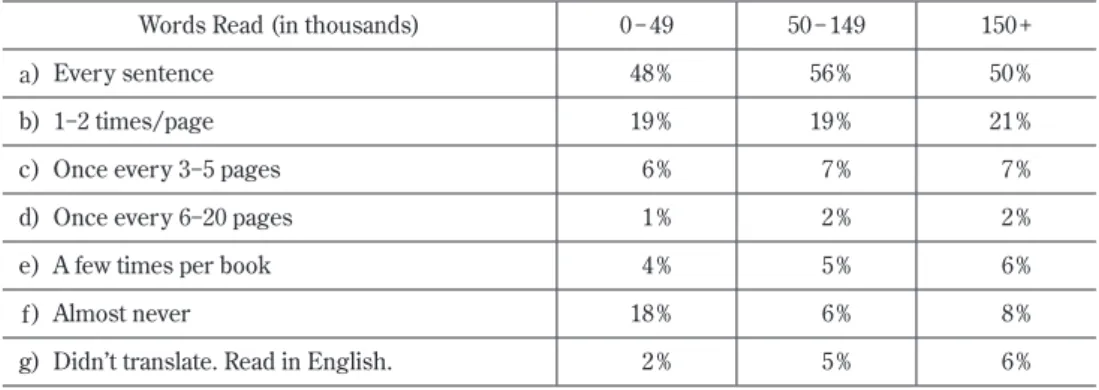
Table 1. Percentage of students who translated what they read into Japanese at the start of the year

Words Read (in thousands) 0−49 50−149 150+

a) Every sentence 48% 56% 50%

b) 1−2 times/page 19% 19% 21%

c) Once every 3−5 pages 6% 7% 7%

d) Once every 6−20 pages 1% 2% 2%

e) A few times per book 4% 5% 6%

f) Almost never 18% 6% 8%

g) Didn’t translate. Read in English. 2% 5% 6%

We can see at a glance that at the beginning of the ER program, there was a lot of translating going on among all 3 groups of readers (from the least to the most diligent). Translating every sentence was extremely common and translating less than once or twice a page was very uncommon. Moreover, the percentages for the frequency with which students translated are fairly uniform across the three groups. There is one exception: 18% of the least diligent group reported that they almost never translated. We can only speculate as to why this was the case.

Overall, we can say that translating what they read as they go seems to be a very common way of approaching ER at the start of the program for all KSU readers.

Q5

現在,多読の本を頭の中で日本語に訳しながら読みますか? その頻度は?

(Now, when you are reading an ER book, how often do you translate into Japanese?)

Table 2. Percentage of students who translated what they read into Japanese at the end of the year

Words Read (in thousands) 0 − 49 50 − 149 150 +

a) Every sentence 39 % 37 % 26 %

b) 1 − 2 times/page 23 % 27 % 27 %

c) Once every 3 − 5 pages 6 % 11 % 11 %

d) Once every 6 − 20 pages 1 % 3 % 4 %

e) A few times per book 7 % 6 % 10 %

f) Almost never 18 % 9 % 13 %

g) Didn’t translate. Read in English. 5 % 6 % 8 %

There was a clear reduction in the amount and frequency of translating across the board.

The most significant reduction was among the group that read the most. The middle-range

group also showed a reduction in the frequency with which they translated, but this is not as

(9)

great as for the more diligent readers. However, it is greater than for the least diligent readers.

We can therefore speculate that the more students read, the less they tend to translate. This is encouraging, but the results also indicate that even after a year, translating is part of the L2 reading process for most students in the ER program.

A third question asked students to check the reasons why they translate. The options were based on a pilot survey carried out with 2

nd

year English majors who were completing 2 years of ER and who were asked to explain the reasons why they translate. The nine most common responses were used. Students could check all the options that applied to them.

Q8

読んだ英語を頭の中で日本語に訳す理由はなんですか。自分に当てはまるものをチェッ クして下さい(複数回答可)。(Why do you translate into Japanese when you are reading in

English? Check the reasons that apply to you.)

1.

日本語に訳さない (I don’t translate)

2.

単語が分からない時 (When I don’t know a word)

3.

何度も同じ分からない単語が出てきた時 (When I come across the same word I don’t know

several times)

4.

文が分からない時,理解するため (When I don’t understand a sentence, to get the meaning)

5.

文 法 が 難 し く て 理 解 で き な い 事 が あ る か ら (When the grammar is difficult to help me

understand)

6.

読んでいる内容が正しく理解できているか確認する (To check I understood correctly what I

have read)

7.

話の流れをつかむため (To understand the narrative flow of the story)

8.

日本語で考えていないと内容理解できないから (If I don’t think in Japanese, I cannot understand

the contents)

9.

英語が母語ではないのでどうしても単語見たら日本語もでてくる (English is not my mother

tongue so when I see a word the Japanese just comes into my head)

(10)

0 100 200 300 400 500 600 700 800 900 1000

1 2 3 4 5 6 7 8 9

N um be r of s tu de nt s

Reasons

Figure 2. Reasons why student translate into Japanese when reading in English

The most common reason for translating was (4) when students didn’t understand a

sentence, to get the meaning (921 students). It seems that translating into Japanese helped them

to infer the meaning. The next most common reason was (7) to understand the narrative flow

of the story (844 students). This suggests that the L1 rather than the L2 is used for noting and

recording events in the story, for summarizing, for puzzling out, and possibly for thinking about

the direction the story might take. The third most common reason was (2) when students didn’t

know a word (482 students). Translating into Japanese to gain understanding of the context in

their L1 may help them to deduce the meaning of the unknown word. Almost the same number

of students indicated (8) that if they didn’t think in Japanese, they could not understand the

contents (447 students). This suggests that for many students higher-level thinking in the L2

is not yet possible, and that thinking in the L1 is seen as necessary for storing and reflecting

on what they have read. The next most common reason for mental translation was (6) to check

they understood correctly what they have read (330 students). Being able to translate into the

L1 may provide reassurance that they have understood what they read in the L2. Almost the

same number of students (238) reported (3) translating into the L1 when they came across the

same word they didn’t know several times as those who reported (5) translating to help them

understand when the grammar was difficult (237). These data suggest that the L1 is, by default,

the language of higher-level thinking and analyzing.

(11)

The least common reason for using mental translation was (9) that English is not their mother tongue, so when they saw a word the Japanese just came into their head (210 students).

In other words, although it happens, it is not common for L1 equivalents to spring to mind when reading in the L2. This suggests that, contrary to common belief, translation is not simply an automatic response, the result of studying bilingual word lists, or of being taught English through the grammar-translation method. Significantly, only 5.7% of students (N=141) said they didn’t translate into Japanese (1).

Interview and think-aloud protocol findings

It may be surprising to some that only two students (one CEFR A2 level Interview #25 and one CEFR B1 level Interview #21) said that the reason why they translate is that they were taught to read like this in high school. The interviews and think aloud protocols confirmed and clarified the complex picture that emerged from the findings of the survey data. There are, in fact, many different reasons why students use Japanese when reading graded readers and they can be classified into the following broad categories and their respective sub-categories. 1) Reasons related to the conscious use of the L1 as a tool for a) aiding the working memory, b) deducing the meaning of complex structures and unknown vocabulary, c) confirming comprehension and providing confidence, d) creating an image in their mind. 2) The subconscious role of the L1 in a) automatic translation, b) alerting learners to difficult syntax. A third category of reasons for use of the L1 is related to the readability of the graded reader texts (in terms of content, style of writing, and language.) For a detailed discussion of the readability of the graded reader texts, see Gillis-Furutaka 2015 (forthcoming).

Furthermore, the interview data showed clearly that students use mental translation less when they become more fluent and practiced readers. This transition seems to start when they reach KSU reading level 5 (CEFR level B1). Moreover, a small number of students said that they try to avoid using Japanese. The reasons for this and all the above points will be discussed below.

1. The conscious use of the L1 as a tool

a) Use of the L1 as a tool for aiding the working memory

Low-level students find long sentences difficult to process directly in the L2. This is illustrated by the following interview extract. The Japanese language sections of the interviews have been transcribed into romaji and followed by an English translation by the researcher.

Speaker A is the researcher in each exchange. The interview number, CEFR level of the text

(12)

used in the interview, and the Kyoto Sangyo University (KSU) ER reading level at the time of the interview are noted.

Interview #22 (CEFR A1 level text, KSU level 3)

AK: Kore wo kaita tokoro ga atama no naka de yaku shita. Hai. (The places I marked are where I translated in my head. Yes.)

A: Hai wakarimashita. Hai…eto ja…tatoeba … (I see. Yes, so for example … ) “They always have interesting adventures on holiday.” Eto…. Kore ha tango, muzukashii tango ka dona riyu ha muzukashikatta? (I see… Was this because of difficult words? Why was this difficult?)

AK: Tango wa wakarun desu kedo sono junban ga nagai to wakaranai to natte kitte desu node. (I know the words but it’s long and so I couldn’t follow it.)

It seems that the capacity of the L2 working memory is limited at the early stages of L2 acquisition. Another student explains how lower-level students deal with longer sentences by breaking them into small chunks, mentally translating each part, and reassembling the parts.

This process is carried out in the L1.

Interview #9 (CEFR A2 level text KSU level 4)

A: (Reading aloud from the text.) “I could think of lots of places I would rather be, like at home waiting for Mum to get back from work. Though I’d never tell Alex that.” So “I could think of lots of places I would rather be” kore no muzukashii ten ha? (What is the difficult point in this?) Y: So desu ne … ma bun ga nagakatta nan de … chotto hitotsu zutsu yonde ikou ishiki wo motte…

(This sentence is long so I thought I would read it a little at a time.)

A: Hai. Dakara rikai suru tame ni nihongo de sukoshi zutsu… (I see. To understand it you translated it a little at a time…)

Y: Hai. So desu ne. (Yes, that’s right.)

A: …tsuyaku shite…soshite zenbu toriawashite… (You translate little by little then put it together?) Y: So desu ne. (That’s right.)

A: …rikai dekita. Hai wakarimashita. So desu ne nagai bunsho ga komarimasu desu ne? (And you could understand. I see. Long sentences are a problem, aren’t they?)

Y: So desu ne. (Yes, they are.)

This student’s strategy for dealing with long sentences shows how the L1 working memory

can be used like a notepad on which learners can record small parts of the sentence, one at a

(13)

time, and then refer back to their mental notes when they are ready to assemble the pieces. It seems that such mental translation plays a vital role in the L2 reading comprehension process.

b) Use of the L1 as a tool for deducing the meaning of complex structures and unknown vocabulary Many A1, A2, and even B1 level students explained how translating the parts of the English text that they could understand into Japanese helped them to deduce the meaning of an unknown word or phrase. This extract from interview #22 illustrates this general principle.

Interview #22 (CEFR A1 level text KSU level 3)

AK: So desu ne. Wakaranai bubun ga aru to sore igai ni honyaku shite sono suisoku … suru no de…

(So if there are parts I don’t understand, I guess them by translating the other parts.)

A high level student showed how thinking in Japanese helps to understand when a key vocabulary item is unknown.

Interview #21 (CEFR level B1 KSU level 6) A: “Seeing the confused look on her face”…

K: “Confused” ah … confused … ah … when I read story I don’t understand, but thinking in Japanese I understand this meaning.

A: OK, so how do you translate confused here? “A confused look on her face.”

K: Konran?

Translating into Japanese also helps students work out difficult syntax.

Interview #15 (CEFR level A1 KSU level 4) Y: This part is …er… feel me…er grammar part.

A: Right “as hard as he could” mm. Difficult grammar here?

Y: Yes.

A: Mm.

Y: I translate Japanese.

A: OK and how did you translate it?

Y: Ah.. dekiru dake (as much as he can)

The higher-level student in the next extract explains how she has developed a habit to

(14)

translate certain constructions into Japanese, such as ‘If clauses’.

Interview #21 (CEFR B1 KSU level 6) A: (Reading) “If it had been a month ago….”

K: I’m very difficult…if setsu (If construction) If setsu is translated in Japanese my kuse. (It’s my habit to translate ‘if ‘constructions into Japanese.)

Three other higher-level students explained that they read directly in English the parts they can understand and translate only the parts they cannot (consciously at times and also subconsciously).

c) Use of the L1 as a tool for confirming comprehension and providing confidence

A further use of the L1 is to check their comprehension of what they have read. This gives confidence that they have understood the English. The following extract from an interview with a low-level student illustrates how translating every line is his preferred way to read in English, even though it is more time-consuming.

Interview #19 (CEFR A1 KSU level 3)

R: Eigo wo yonde mite, so desu ne. Ma ichigyou yondara ichigyou wo nihongo ni henkan shiteiru kanji desu ne. Atama no naka de. (I try to read in English and then I read a line in English and then translate it into Japanese in my head.)

A: Ah ha,hai. Dakara zenbu awasete nikai yondeimasu…ikkai eigo de, mo ikkai nihongo de… (So altogether you read everything twice, once in English and once in Japanese?)

R: So desu ne (That’s right).

He goes on to explain that he can read directly in English if he needs to, such as when time is limited in exams, but he prefers to translate every line if he has time because he can be sure he has understood. Translating gives him confidence that he has understood.

R: Nihongo ni yaku sanai to yappari naiyou haaku dekinai to iu ka. (If I don’t translate, I can’t grasp the contents.)

A: Ah, hai. Amari jishin ga nai? (You don’t have much confidence?) R: Hai. Eigo dake de chotto … (If it’s only in English, it’s a bit …)

A: Hai. OK. Erm… dochi no hou ga ii? Yaku suru ka sono mama eigo de yomu? (Which is better,

(15)

to translate or to read directly in English?)

R: Mm…yappari yaku suru hou ga suki desu. (I prefer to translate.)

This use of translation was especially common among the lower-level students.

Interview #20 (CEFR level A1 KSU level 4)

A: … “So this year the two families are going on holiday together” eto … doshite muzukashikatta?

(Why was this difficult?)

H: Hmm… kekko wakaranai desu kedo … sa de yonde mo ikkai nihongo de … kakunin shimashita…

(I’m not sure why, but I read it again in Japanese to check.) A: Kakunin suru tame ni? (To check?)

H: Hai. (Yes.)

Interview #18 (CEFR A2 KSU level 5) A: So in April, you translated much more.

K: Ah, every time.

A: Oh. OK. So every sentence? Taihen deshita! (It was really tough!) That’s why it took so long.

K: Yes. Very long

A: Very long. Did you translate because you didn’t have confidence that you could understand in English?

….

K: Mm…atama ni haitte konai to iu… (It won’t go into my head.) A: Atama ni haitte konai? (It won’t go into your head?) Ah, ah…

K: And er…imi ga amari jishin nai (And I wasn’t confident about the meaning.)

One of the most common reasons for switching into Japanese is when something unexpected happens in the story and thinking in Japanese helps to create a picture of the scene and to analyze what may have happened. This is true of all levels of students interviewed. Here is just one example.

Interview #29 (CEFR level B1 KSU level 3)

A: “Then Hiro picked up his book. It was an American thriller. He’d brought it with him to

practice his English and with two violent murders already, it was quite exciting.” (Laughter) Eto

doshite kono bubun ga muzukashikatta kana? (Why was this bit difficult?)

(16)

Y: Nanka kankei nai naiyou ga dete kiteiru no ni dou iu … (When the topic changes to something unrelated, what is…)

A: Ah… kyu ni hanashi no nagare ga kawatteiru kara wakaranai dakara ah ha ja nihongo de kangaenaoishite… (Ah … when the direction of the story suddenly changes and you don’t understand, you switch into Japanese…)

Y: Hai (Yes)

A: … kakunin suru tame? (… to check your understanding?) Y: So desu ne. (That’s right.)

A: Ja kekko rikai shimashita ne. (You understood very well.) Demo nihongo de kangaenaosu to jishin ga aru? (But if you think in Japanese, do you feel confident?)

Y: Kakujitsu ni aru. (I feel certain.)

Another student explains how he needs to think in Japanese in order to organize the action in the story in his head.

Interview #1 (CEFR A2 KSU level 3)

K: Mazu yappari koudou to ka doko ni nani ga aru to ka. Kou iu no wa wari to kakunin suru. (First of all, the action and what is where that kind of thing. This is what I check.)

A: Hai. Ato de nihongo de kangaetara wakaru? (Yes and afterwards if you think in Japanese, can you understand?)

K: Nihongo dattara ma nihongo ni junban ga aru kara tabun… (If I think in Japanese then I can order things, maybe.)

d) Use of the L1 as a tool for creating an image in the mind

Some students, especially the more experienced and confident readers, explained that they can picture the scene or action in their head while they read as long as the English is easy to understand.

Interview #13 (CEFR A2 KSU level 4)

Ay: Eto sonani muzukashikunai bun da to jibun de atama no naka ondoku shinagara eizoka shiteiru kanji. (If the sentences are not difficult, I can see a picture in my head.)

Four lower-level students said that they translate into Japanese to get an image in their head

in order to understand the scene and action concretely. In the extract below, an intermediate level

(17)

student explains how she also needs to translate into Japanese before she can do this.

Interview #11 (CEFR A2 KSU level 6)

M: So, erm … I can understand “began to walk down the side”, but after that … so I have to need the image of this scene, so I read again and image … make image … so I translate to Japanese and I made the image so I do like that.

Interestingly, a higher-level student reported that she creates an image in her mind, but is not sure if she does this in English or Japanese. This is what she said.

Interview #30 (CEFR Level B2 KSU Level 6)

H: Mm. Atama nanka e ga … e … ga atama no naka ni dete kite … nanka … nihongo ni yaku shiteriu wakaranai kedo yondete itara katte ni eizo ga dete kuru. (In my head there’s a picture … I don’t know if I’m translating into Japanese, but I can see an image.)

2. The subconscious role of the L1 a) Subconscious/automatic translation

It seems that the L1 is always active when the L2 is being processed and that the two languages work in tandem a lot of the time, especially when students are still at lower proficiency levels. The following extract illustrates how this kind of translation is not taught in school, but has occurred “naturally” for this student.

Interview #15 (CEFR level A1 KSU level 4) A: “Though I’d never tell Alex that”.

Y: Ah, ‘never’ is er … naturally I translate Japanese.

A: Ah, always?

Y: Yes.

A: You always translate ‘never’ into Japanese?

Y: Yes, I see … A: … ‘never’ …

Y: … I always translate in Japanese.

A: Isn’t that interesting? Yeah, you just do it automatically without thinking? Hm.

A: Are there any other words that you always translate?

(18)

Y: Ah, naturally?

A: Yes, naturally, like ‘never’.

Y: Ah, many many.

A: Oh, right.

Y: For example, ‘another’, and ‘always’.

A: Is this something that you do, or did a teacher recommend you to do this? Is this, your automatic translating of these words, is this something just you do or did you teacher in junior high, senior high recommend?

Y: I studied…

A: Oh, just your …

Y: …for er… entrance exams.

A: Ah, so it was a hint? A recommendation?

Y: No, I …

A: …oh you just did it?

Y: I did.

Another student (Interview #24 CEFR A2 KSU level 4) reported that when he comes across the word “thought” in a story, it alerts him automatically to pay attention (in Japanese) to what comes next. A higher-level student (Interview #21 CEFR B1 KSU 6) finds herself automatically translating the past perfect, apostrophes, and the word “nowhere”.

In fact, it seems difficult to switch off the L1. The extract below illustrates this point and also shows how the L1 and L2 lexicons appear to be linked to a common lexical concept.

Interview #26 (CEFR level B1 KSU level 5)

S: Patto konai yatsu wa … yaku shite shimaimasu. (If something doesn’t come to mind immediately, I end up translating.)

A: Hai. Yaku shita … “Fields” mo sono tango wo wakaranakatta? (I see. You translated. How about

“fields”, didn’t you know this word, either?)

S: Wakattan desu kedo nihongo no hou ga saki dechatta (I knew it but the Japanese came to mind first.)

Another example, also from a higher-level student, illustrates how the L1 and L2 lexicons

work together:

(19)

Interview #12 (CEFR B2 KSU Level 4)

K: Ano kantan na tokoro to yondete douji ni atama no naka de nihongo yaku shiterun desu kedo.

(When I’m reading something easy in English, the Japanese translation comes into my head simultaneously.)

A: Ah, hai hai (Yes, I see.)

K: Fukuzatsu ni naru to modochotte …hai. (If it’s complicated, I go back.)

A: Hai, dakara sono mama eigo de yondemasen? (Yes, so you don’t read directly in English?) K: Hai. (Yes.)

A: Zuuto nihongo ni kurikaeshiteiru. (You are translating into Japanese all the time.) K: Kurikaeshite no hou ga oi. (I’m translating most of the time.)

When do students stop translating a lot and start reading directly in English?

Several students reported doing this in the fall semester (Interview #2, #18, #20, #23,

#30). The earliest student to make this change did so in June, only 2 months into the program (Interview #16 CEFR B2 KSU level 6). Most students do this gradually and naturally (i.e. not following the advice of a teacher) when they reach KSU level 5. This finding needs to be verified with more quantitative and qualitative research because the current sample size is very small.

Reasons for not translating

Most students do not translate unless they feel they really need to. The student in the extract below summarizes the attitude of many that translating is too much trouble.

Interview #8 (CEFR level B1 KSU level 5)

S: Nan ka mo eigo no tango ga imeji dekirun node mo ichichi yonde nihongo yaku shinai kangaete iku to chokuzen eigo de kangaete mendokusai yaku shichau. (If I can get an image from the English words then I carry on reading and thinking directly in English. I don’t translate. It’s a lot of trouble to translate.)

One student (Interview #20 CEFR level A1 KSU level 4) stopped translating as she read at

the end of the first semester because her ER teacher advised the class to try to avoid this. She

found it hard to do so at first, but followed her teacher’s advice and tried to re-read in English

if she did not understand, rather than switch into Japanese. Nevertheless, during the think

aloud protocol, she pointed out the occasions when she had switched into Japanese when she

encountered unknown or forgotten vocabulary and complex syntax, as well as to puzzle out

(20)

what was happening in the story when something unexpected happened. This shows again how automatic the response is to code-switch when higher-level thinking is required.

Another student expressed a very strong opinion about translating into Japanese. He thinks that it does not help him to improve his English and tries to avoid translating.

Interview #17 (CEFR level B1 KSU level 5)

A: Yeah. Erm… do you think you should try to avoid translating? Yaku suru no wa amari yokunai to kanagaeteiruka, zen zen mondai nai to kangaeteiruka? (Do you think that translating is not good or do you think it is not a problem?)

K: Yokunaito…

A: Yokunai? Ah…doshite yokunai?

K: Er because English is not Japanese. Also Japanese is not English.

A: Ah, right. So it’s better of you’re reading in English to think in English?

K: Yes.

A: If you’re reading in Japanese, stick to Japanese. Ah, OK.

K: If I translate English in Japanese, I can understand the … it doesn’t mean understanding English, I think.

A: Ah, OK. Mm. You’d rather be able to understand directly?

K: Yes.

A: In English?

K: Yes.

A: OK, so translating into Japanese is a kind of method to understand the story … K: Yes.

A: … but it doesn’t help your English.

K: Yes.

As a teacher, it was very encouraging to find such insight into the complex matter of translating from one language to another and such determination to understand English directly.

Discussion

Cook (2010) explains very eloquently the psycholinguistic and social role of the L1 in L2 acquisition:

Humans teach and learn by moving from the familiar to the unfamiliar, by building new

(21)

knowledge on to existing knowledge. Language learning and teaching is no exception to this general rule. Translation is just a bridge between the familiar and the unfamiliar, the known and the unknown. To burn that bridge or to pretend that it does not exist, hinders rather than helps the difficult transition which is the aim of language teaching and learning. Learners moreover need that bridge to maintain the links between their languages and identities. They should never be forced to leave everything behind them, simply because they are speaking another language.

(p. 155)

L2 learners are undergoing “bilingualization” (Widdowson, 2003) and have their L1 to draw on as a resource when trying to decode the L2. It could therefore be seen as counter productive to tell students not to translate or think in English when they read. In fact, Sociocultural Theory views the L1 as a highly effective meditational tool for enhancing L2 learning. It does so in two ways: through private/inner speech and through assisting in scaffolding production in the L2.

Several studies are cited by Ellis and Shintani (2014: 243) that show how even advanced-level learners continue to use the L1 for inner speech and that this can facilitate both communication and learning. This is an avenue for further exploration by ER researchers and practitioners, as well as the authors and publishers of graded reading materials.

This study was limited to a relatively small sample of Japanese university student learners of English, from low to upper intermediate level. For a broader and deeper understanding of the role of the L1 in ER, similar surveys and interviews with think aloud protocols need to be carried out with beginners to advanced level learners, both in Japan and in other countries where ER is part of the English curriculum. This will provide a better understanding of the process of learning to read English, and a better basis on which to decide when to advise students that they should start to try to read directly in the L2.

Conclusion

The survey results showed that use of the L1 when reading graded readers in the KSU

ER program was widespread initially, but that there was a clear reduction in the frequency

with which students were translating into the L1 by the end of the one-year ER program. The

fact that students nevertheless continued to rely heavily on their L1 to support their reading

comprehension suggests that such use of the L1 is common among Japanese university

students. Whereas the survey data does not show if there is any connection between the level of

(22)

proficiency of the students and the amount they translate, the qualitative interviews showed more clearly that the higher-level students (those reading at CEFR level B1 KSU level 5) needed to rely on the L1 far less for general comprehension and when dealing with unknown words or difficult grammatical structures. They also seemed more confident that they could understand directly what they read in the L2. They did not feel the need to translate into Japanese because they could mentally visualize the scene and action most of the time.

These results suggest that the L1 should be seen as a tool to aid L2 reading comprehension.

Although students should be encouraged to try to read directly in the L2 as much as possible, the role of the L1 for low-level learners needs to be acknowledged and better understood. It is clear that low-level KSU students need the support of their L1 working memory to decode even the apparently simple reading material of graded readers in the ER program. The advantages of reading directly in the L2 should, of course, be pointed out to students as both a goal and an expectation. In fact an ER program is an ideal opportunity for encouraging low-level learners to try reading directly in the L2 because, unlike all the high-level university entrance exam practice reading materials they have encountered in high school, the focus of an ER program is on general understanding, not detailed comprehension. Learners can be encouraged to trust their instincts, try to picture the scene in their heads, skip unknown words and read quickly. With practice, they will increase their reading speed, fluency confidence and enjoyment.

This research has changed my understanding of and attitude towards the role of the L1 in ER. My first reactions on discovering the frequency with which readers were using mental translation were surprise and concern that this would interfere with the development of automaticity in their reading skills. The interviews and think aloud protocols have revealed to me that the L1 is not a hindrance, but is a vital tool for building reading skills and one that should not be overlooked. This research has also heightened my awareness that our learners are operating as emerging bilinguals, something that needs to be both acknowledged and celebrated.

Acknowledgments

I would like to thank my co-researchers on this project. Matthew Claflin helped with the

pilot survey and Thomas Robb helped with the data collection and analysis. This 3-year project

has been funded by the Japanese Ministry of Education, Culture and Science.

(23)

References

Akamatsu, N. (2008). The effects of training on automatization of word recognition in English as a foreign language. Applied Psycholinguistics, 29, 175–193.

Al-Homoud, F. & Schmitt, N. (2009). Extensive reading and a challenging environment: A comparison of extensive and intensive reading approaches in Saudi Arabia. Language Teaching Research, 13, 383–401.

Allen, D. (2009). A study of the role of relative clauses in the simplification of news texts for learners of English. System, 37(4), 585–599.

Amer, A.A. & Khouzam, N. (1993). The Effect of EFL Students’ Reading Styles on their Reading Comprehension Performance. Reading in a Foreign Language, 10(1), 967–978.

Bamford, J. (1984). Extensive Reading by Means of Graded Readers. Reading in a Foreign Language, 2(2), 218–260.

Beglar, D., Hunt, A., & Kite, Y. (2012). The effect of pleasure reading on Japanese university EFL learners’

reading rates. Language Learning, 62(3), 665–703.

Bell, T. (2001). Extensive reading: Speed and comprehension. The Reading Matrix 1(1). http://www.

readingmatrix.com/articles/bell/article.pdf

Bernhardt, E. B., & Kamil, M. L. (1995). Interpreting relationships between L1 and L2 reading: Consolidating the linguistic threshold and the linguistic interdependence hypotheses. Applied Linguistics, 16, 15–34.

Blau, E. K. (1982). The effect of syntax on readability for ESL students in Puerto Rico. TESOL Quarterly, 16, 517–528.

Carrell, P. L. (1987). Readability in ESL. Reading in a Foreign Language, 4(1), 21– 40.

Chamot, A.U., Kupper, L., & Impink-Hernandez, M.V. (1988). A study of learning strategies in foreign language instruction: Findings of the longitudinal study. McLean, Va: Interstate Research Associates.

Claridge, G. (2012). Graded readers: How the publishers make the grade. Reading in a Foreign Language, 24(1), 106–119.

Coady, J. & Huckin, T. (1997). Second Language Vocabulary Acquisition: A Rationale for Pedagogy. Cambridge:

CUP.

Cook, G. (2010). Translation in Language Teaching. Oxford: Oxford University Press.

Crossley, S. A., Allen, D. B., & McNamara, D. S. (2011). Text readability and intuitive simplification: A comparison of readability formulas. Reading in a Foreign Language, 23(1), 84–101.

Davis, J.N. & Bistodeau, L. (1993). How do L1 and L2 reading differ? Evidence from think aloud protocols.

The Modern Language Journal, 77(4), 459–472.

Ellis, R. & Shintani, N. (2014). Exploring Language Pedagogy through Second Language Acquisition Research.

London & New York: Routledge.

Erten, I.H. & Razi, S. (2009). The effects of cultural familiarity on reading comprehension. Reading in a Foreign Language, 21(1), 60–77.

Farrell, T. S. C. (2009). Teaching Reading to English Language Learners. Thousand Oaks, CA: Corwin Press.

Ferrer, V. (2005). The Mother Tongue in the Classroom: Cross-linguistic comparisons, noticing and explicit knowledge. Online: http://www.teachenglishworldwide.com/Articles/Ferrer_mother%20tongue%20 in%20the%20classroom.pdf

Gillis-Furutaka. A. (2012). MoodleReader at Kyoto Sangyo University: Why is the program working for some,

but not for others? Extensive Reading World Congress Proceedings, 1, 40–43.

(24)

Gillis-Furutaka. A. (2015). Graded reader readability: some overlooked aspects. Journal of Extensive Reading, Vol. 3. 1-19. http://jalt-publications.org/access/index.php/JER/article/view/1397/65

Grabe, W. (2009). Reading in a second language: Moving from theory to practice. New York: CUP.

Grabe, W. & Stoller, F. L. (1997). Reading and vocabulary development in a second language: A case study.

In J. Coady, & T. Huckin (Eds.), Second language vocabulary acquisition (pp. 98-122). Cambridge:

Cambridge University Press.

Grabe, W. & Stoller, F. L. (2011). Teaching and Researching Reading (Second Edition). Harlow: Pearson Education Ltd.

Harmer, J. (2007) The Practice of English Language Teaching. 4th edition. London & New York: Longman.

Hosenfeld, C. (1984). Case studies of 9th grade readers. In Alderson, J. and Urquart (Eds.) Reading in a Foreign Language (pp. 231-249). New York: Longman.

Kern, R. G. (1994). The role of mental translation in second language reading. Studies in Second Language Acquisition, 16, 441–461.

Koda, K. (2007). Reading and Language Learning: Crosslinguistic Constraints on Second Language Reading Development. Language Learning, 57, 1-44.

Lotherington-Woloszyn, H. (1993). Do Simplified Texts Simplify Language Comprehension for ESL Learners?

In M. L. Tickoo (Ed.), Simplification: Theory and application (pp.140–154). Singapore: SEAMEO Regional Language Center.

McLeod, B. & McLaughlin, B. (1986). Restructuring or Automaticity? Reading in a Second Language.

Language Learning, 36(2), 109–23.

Robb, T. N. & Kano, M. (2013). Effective extensive reading outside the classroom: A large-scale experiment.

Reading in a Foreign Language, 25(2), 234–247.

Robb, T. N. & Susser, B. (1989) Extensive Reading vs Skills Building in an EFL Context. Reading in a Foreign Language, 5(2), 239–251.

Sakurai, N. (2013). Interesting Books and No Translation: Two Factors to Increase the Amount of Reading in an Extensive Reading Program. ACTA HUMANISTICA ET SCIENTIFICA UNIVERSITATIS SANGIO KYOTOIENSIS, Humanities Series, 46, 67–77.

Storch, N. & Aldosari, A. (2010). Learners use of first language (Arabic) in pair work in an EFL class.

Language Teaching Research, 14(4), 355–375.

Takase, A. (2008). The Two Most Critical Tips for a Successful Extensive Reading Program. Kinki University English Journal, 1, 119–136.

Tarone, E., & Swain, M. (1995). A sociolinguistic perspective on second-language use in immersion classrooms. Modern Language Journal, 79, 166–178.

Tweissi, A. I. (1998). The effects of the amount and the type of simplification on foreign language reading comprehension. Reading in a Foreign Language, 11, 191–206.

University of Cambridge ESOL Examinations. (2011). Using the CEFR: Principles of Good Practice. Retrieved January 29, 2015 from

http://www.cambridgeenglish.org/images/126011-using-cefr-principles-of-good-practice.pdf

Upton, T. A., & Lee-Thompson, L. (2001). The role of the first language in second language reading. Studies in Second Language Acquisition, 23, 469–495.

Vann, R.J. and Abraham, R.R. (1990). Strategies of Unsuccessful Language Learners. TESOL Quarterly, 24(2),

(25)

177–198.

Wan-a-rom, U. (2008). Comparing the vocabulary of different graded-reading schemes. Reading in a Foreign Language, 20(1). Retrieved February 18, 2014, from

http://nflrc.hawaii.edu/rfl/April2008/wanarom/wanarom.html

Widdowson, H. G. (2003) Defining Issues in English Language Teaching. Oxford: Oxford University Press.

Young, D. J. (1999). Linguistic Simplification of Second Language Reading Material: Effective Instructional

Practice? The Modern Language Journal, 83(3), 350–366.

Table 1. Percentage of students who translated what they read into Japanese at the start of the year
Figure 2. Reasons why student translate into Japanese when reading in English

参照

関連したドキュメント

[11] Karsai J., On the asymptotic behaviour of solution of second order linear differential equations with small damping, Acta Math. 61

We have formulated and discussed our main results for scalar equations where the solutions remain of a single sign. This restriction has enabled us to achieve sharp results on

In [BH] it was shown that the singular orbits of the cohomogeneity one actions on the Kervaire spheres have codimension 2 and 2n, and that they do not admit a metric with

Abstract. The backward heat problem is known to be ill possed, which has lead to the design of several regularization methods. In this article we apply the method of filtering out

An important new aspect of the results in [ 12 ] is that they enable one to obtain uniqueness of stationary distributions for stochastic delay differential equations when the

In this paper we study certain properties of Dobrushin’s ergod- icity coefficient for stochastic operators defined on noncommutative L 1 -spaces associated with semi-finite von

L. It is shown that the right-sided, left-sided, and symmetric maximal functions of any measurable function can be integrable only simultaneously. The analogous statement is proved

On the other hand, the Homeomorphism Conjecture generalizes all the conjectures appeared in the theory of admissible (or tame) anabelian geometry of curves over alge- braically