• 検索結果がありません。

The Geometrical Effects of Substitutional Impurities on Electric and Magnetic Properties of (10,0) Carbon Nanotube by using Density Functional Theory

N/A
N/A
Protected

Academic year: 2021

シェア "The Geometrical Effects of Substitutional Impurities on Electric and Magnetic Properties of (10,0) Carbon Nanotube by using Density Functional Theory"

Copied!
6
0
0

読み込み中.... (全文を見る)

全文

(1)

Electric and Magnetic Properties of (10,0) Carbon Nanotube by using Density Functional Theory

a

E

LY

A

PRILIA

,

b

A

CEP

P

URQON AND b

S

UPRIJADI

a

Center for Instrumentation Technology and Automation (CITA) ITB

b

Faculty of Mathematics and Natural Sciences, Institut Teknologi Bandung, Jl. Ganesha 10, Bandung 40132 Indonesia

e-mail: [email protected]

Abstract. We have studied the properties of CNT (10, 0) with the impurities of gallium arsenide and nitrogen.

We constructed five geometrically different structures and investigated their electric and magnetic properties by using density functional theory (DFT) and generalized gradient approximation (GGA) exchange correlation.

We found that the structural variations of gallium arsenide and nitrogen substitution impurity on CNT (10, 0) show the effects on their electronic and magnetic properties such as the different magnetic moments on several types of CNT (10, 0) impurity.

Keywords: Carbon Nanotubes (10, 0), atom impurity, density functional theory

1 Introduction

Carbon nanotubes (CNTs) have been interesting research object since Ijima found it [1]. They show interesting properties such as the electronic and magnetic properties of CNTs depend on their structural and chirality. Moreover, the flexibility of CNT is expected as a potential material for spintronic devices. Furthermore, a defect also affects electronic and magnetic properties of CNT. For examples, S.S. Yu et al [2] investigated a substitutional impurity as a defect and found that electronic properties of CNT could be controlled by adjusting nitrogen on perfect SWCNT. Gallium and arsenide effects on CNT (10, 0) has been reported in the previous work [3] that band gap of CNT (10, 0) is reduces and magnetic moment is occurs on the structure by substituting arsenide atom.

Meanwhile, Gallium atom impurity removes band gap of CNT (10, 0). Conductivity is also can be controlled by inducting magnetic field. Combination of magnetic and electronic characteristic by substituting atoms on CNT is expected to obtain interesting material properties as a new electronic device. For this reason, we use As Ga and N as substituted atom on CNT (10, 0). Gallium arsenide itself is known as semiconductor material. Gallium and Arsenide as semiconductor based atom is expected to give better properties on CNT especially on its magnetic properties.

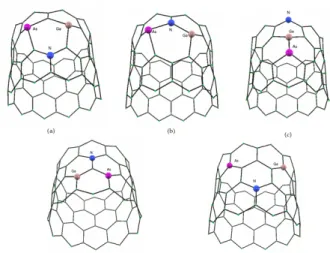
We construct five different types of structure, based on atom impurities position: Type-1, we put

gallium nitrogen and arsenide atom at one honey comb on CNT structure. Type-2 at cross neighbors

position of gallium nitrogen and arsenide atom, type-3 at parallel position of atom impurities, type-4

at Y position of atom impurities, and type-5 at far position of atom impurities as shown in Figure 1.

(2)

Figure 1 SWCNT (10, 0) with Ga, As and N atom impurities (a) Type-1 (b) Type-2 (c) Type-3 (d) Type-4 (e) Type-5

2 Calculation Method

Our object systems are impurity on surface CNT (10, 0) with substitution atoms. Using PHASE software with employed ultrasoft pseudopotential by Vanderbilt [4] and generalized gradient approximation by Burke Perdew and Ernzerhof (GGA PBE)[5]. We use plane wave and electron density cutoffs energy, 200 Ry and 25 Ry, respectively.

Figure 2 Flowchart of Self-Consistent Functional

(3)

Firstly, by using Kohn-Sham equation, we calculated the system to find optimized structure.

Optimized structure was required to obtain electronic and magnetic properties of ground states of the system. These properties constructed system’s characteristics. On PHASE software using 1 x 2 x 1 k- points with 80 atoms with impurity on SWCNT (10, 0) as shown in Figure 2, a random number generated initial guess for density of electron. Initial guess of electron density was used to construct effective potential for Kohn-Sham equation system.

Effective potential equation:

σ σ

XC hartree ext

eff
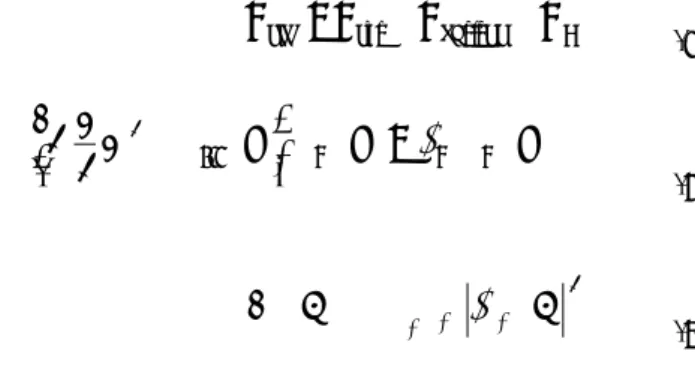
V V V

V = + +

(1) Kohn –Sham equation:

) ( )

( ) 2 (

1

2

r r

r

V

effσ

⎥⎦ ⎤ ψ

iσ

= ε

iσ

ψ

iσ

⎢⎣ ⎡ − ∇ +

(2)

Electron density equation:

)

2

( )

( r =

i

f

i i

r

n

σ σ

ψ

σ

(3)

By solving Kohn-Sham equation we obtained wave function to construct new electron density that are compared with initial guess. This loop stop if new electron density consistent with the previous electron density, called self-consistent field (SCF). The output of this process is defined of energy or force at ground states of the system by minimizing the total energy. If the ground state is obtained, structure of the system is optimized.

PHASE software package is also includes density of states calculation. Information of density of states is important to estimate characteristic of the systems. Using Ekcal mode calculation with 1 x 10 x 1 k- point we obtained density of states. For visualizing the system, we use PHASE viewer software.

3 Result

Figure 3 DOS of Perfect CNT (10, 0)

Before describing result for CNT with impurity, we summarize the properties of perfect SWCNT (10,

0). SWCNT (10, 0) is a zigzag edge semiconductor CNT with 0.82 eV band gap [6]. Density of state of

(4)

CNT (10, 0) can be seen in Figure 3. Inexistence of magnetic moment indicates that CNT (10, 0) is non

magnetic material. These results agree with previous work by Saito et.al [7].

(5)

Figure 4 DOS of CNT (10, 0) with impuritires (a) type-1 (b) type-2 (c) type-3 (d) type-4 (e) type- 5

Our calculations mainly show two contrast results. For examples in Figure 4, the density of states of type-1 and type-5 show a different number of spin up and spin down in their magnetic properties.

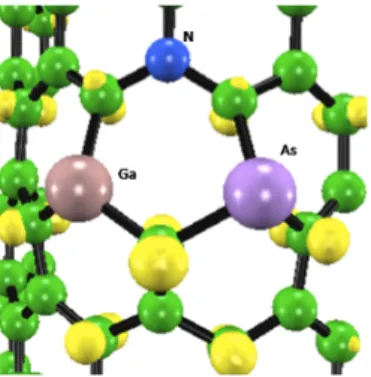
Both of magnetic moment are 1 µB. In contrast, The type-2, type-3 and type- 4 have no magnetic moment. Furthermore, The spin density distribution was calculated to identify the distribution of spin at each atom on type-1 as shown in Figure 5. The bright area indicate unoccupied spin density which are distributed in Pz type states.

Figure 5 Spin density distribution of type-1. Isosurface value 0.003(a.u)

3

.

Furthermore, the calculations show that the all types (Type-1 to Type-5) have zero band gaps on DOS curve indicating that CNT (10, 0) with Ga As and N atom impurities are metallic. In addition, based on previous work, the zero gaps of those structures are caused by gallium atom impurity. For the reason, we focus the magnetic moment, because the magnetic moment interestingly only occurs on type-1 and type-5 when the gallium arsenide and nitrogen are not connected directly. Table 1 shows the detailed comparison of electronic and magnetic properties of CNT (10, 0).

Table 1 The Comparison results of electronic and magnetic properties of gallium arsenide nitrogen impurities on CNT (10, 0)

CNT Impurities Band Gap (eV) Magnetic Moment (µ

B

)

(10, 0) - 0.82 0

(10, 0) Type 1 No gap 1

(10, 0) Type 2 No gap 0

(10, 0) Type 3 No gap 0

(10, 0) Type 4 No gap 0

(10, 0) Type 5 No gap 1

In addition, the gallium arsenide and nitrogen impurity on CNT (10, 0) also changes the structural CNT. For examples, the distortions of bond length due to atom impurities are detected. The reason are the larger size of gallium and arsenide atom than carbon atom on CNT (10, 0) cause upward position of gallium and arsenide. This drift practically changes the structure of perfect CNT (10, 0).

4 Summary Remarks

(6)

Our results showed the magnetic, electronic and structure changes of CNT (10, 0) by the impurities of gallium arsenide and nitrogen. We found Magnetic moment occurs on type-1 and type-5 when gallium, arsenide and nitrogen atom does not directly connect each other. We found that all types have zero gaps of DOS curves indicating that gallium arsenide and nitrogen impurity metalizes CNT (10, 0).

5 Acknowledgement

Authors would like to thank to Program Peningkatan Kapasitas ITB for financial supports of this research. One of authors (Ely Aprilia) also would like to thank to Center for Instrumentation Technology and Automation ITB for financial supports.

References

[1] Sumio Ijima. Nature, 354:56-58 November 1991

[2] S.S. Yu, W. T. Wen, Q. B. Zheng and Q. Jiang. Nanotechnology 18:1-7, March 2007

[3] Ely Aprilia. Master thesis ITB, 2012

[4] Vanderbilt. Phys. Rev. B, 41: 7892-7895, April 1990

[5] P. John, K. Burke and M. Ernzerhof. Phys. Rev. Lett. 77: 3865-3868, October 1996

[6] Fahdzi Muttaqien. Master thesis ITB, 2012

[7] R. Saito, G. Fujita, M. Dresselhaus. M. S. Dresselhaus. Appl. Phys. Lett. 60: 2204-2206, March 1992

Figure 1 SWCNT (10, 0) with Ga, As and N atom impurities  (a)  Type-1 (b) Type-2 (c) Type-3 (d) Type-4 (e) Type-5
Figure 3 DOS of Perfect CNT (10, 0)
Figure 4 DOS of CNT (10, 0) with impuritires (a) type-1 (b) type-2 (c) type-3 (d) type-4 (e)  type- 5

参照

関連したドキュメント

In summary, based on the performance of the APBBi methods and Lin’s method on the four types of randomly generated NMF problems using the aforementioned stopping criteria, we

The aim of this work is to prove the uniform boundedness and the existence of global solutions for Gierer-Meinhardt model of three substance described by reaction-diffusion

Related to this, we examine the modular theory for positive projections from a von Neumann algebra onto a Jordan image of another von Neumann alge- bra, and use such projections

In the current paper we provide an atomic decomposition in the product setting and, as a consequence of our main result, we show that

From the delayed cosine and sine type matrix function on the fractal set R αn (0 < α ≤ 1) corresponding to second order inhomogeneous delay differential equations with

Selberg; Local Well-posedness below the Charge Norm for the Dirac-Klein-Gordon system in two space dimensions, Journal of Hyperbolic Differntial Equations (2007), no.. Bachelot;

We study the classical invariant theory of the B´ ezoutiant R(A, B) of a pair of binary forms A, B.. We also describe a ‘generic reduc- tion formula’ which recovers B from R(A, B)

After performing a computer search we find that the density of happy numbers in the interval [10 403 , 10 404 − 1] is at least .185773; thus, there exists a 404-strict