Relationships amongdistribution, climatic
conditions and phenology of the moss Pogonatum urnigerum in Niigata Prefecture and adjacent regions
著者 Shirasaki Hitoshi, Sato Masaji journal or
publication title
植物地理・分類研究 = The journal of phytogeography and toxonomy
volume 51
number 1
page range 1‑12
year 2003‑06‑25
URL http://hdl.handle.net/2297/48518
Introduction
In the deep snow-covered district of Niigata Prefecture, the distribution of many bryophytes associated with sporophyte production is reduced by the local climatic conditions, such as the hot- ter and drier summer in the lower coastal area and deep winter snow in the interior mountain- ous area(Shirasaki 1999). Although the two spe- cies of epiphytic mosses,Neckera humilisandN.
yezoana, have been reported to grow near each other in the coastal lowlands, they are segre- gated by their different air temperature require- ments for sporophyte maturation in the interior mountain area of the prefecture(Shirasaki 2000 a). One of the terrestrial mosses, Pogonatum urnigerum(Hedw.)P. Beauv., is frequent in the interior mountain area, but is rarely found in the coastal lowlands and in the midwestern area of the prefecture. The distribution of the species is similar to that of Polytrichum formosum,
which belongs to the same family, Polytrichaceae
(Shirasaki 1990 a). Furthermore, both species sometimes grow near together at the cool loca- tion known as the “wind hole area”, where the air temperature is lower and humidity is higher for a long period(Shirasaki 1990 b). As the sporophyte-bearingPog. urnigerumis widely dis- tributed vertically, vegetative growth, fertiliza- tion and sporophyte development seem to be well adapted to the various climatic conditions in the district.
Lackner(1939)observed the phenology of many mosses including Pog. urnigerum in western Russia, but there was no information on the cli- mate. Hughes(1990)investigated the seasonal development of the apical meristem of the sporo- phyte in seven species ofPolytrichum and Pogo- natum, including Pog. urnigerum. Polytrichum is more widely distributed and adaptable than Pogonatumin higher latitudes, probably because
1Biological Laboratory, Niigata College of Pharmacy, 5―13―2 Kamishin’ei-cho, Niigata-shi 950―2081, Japan ;
2Kagura-Mitsumata Ski Slope, Prince Hotels Co., 742 Mitsumata, Yuzawa-machi 949―6211, Japan
!The Society for the Study of Phytogeography and Taxonomy 2003
Hitoshi Shirasaki
1and Masaji Sato
2: Relationships among
distribution, climatic conditions and phenology of the moss Pogonatum urnigerum in Niigata Prefecture and adjacent regions
Abstract
The relationships among climatic conditions, phenology and distribution were investigated for the mossPogo- natum urnigerumin Niigata Prefecture and adjacent regions. The moss is frequent in the interior mountainous areas, but very rare in the coastal lowlands including the midwestern area of the prefecture. Although fertiliza- tion occurs in early spring in areas where snowfall is fairly light, it is delayed until May or June in the deep snow-covered district. Its sporophyte develops in warmer seasons and matures before snowfall, and spore disper- sal occurs in May of the following year. Although it takes only 6 months for sporophyte maturation during snow- free seasons, the moss usually needs a value for Kira’s warmth index of 35.1 or more for sexual reproduction.
Therefore, the sporophyte distribution may be inhibited by the lower air temperature during its growing seasons in the alpine zone. Growth appears to be restricted to the areas, in which potential evapotranspiration of 130―
190 mm in August. The moss may be more sensitive to a drier climate than higher air temperature, because its vegetative growth is well adapted to a wide range of air temperatures. As the moss requires higher air humidity and strong sunlight at open sites, it may be excluded from the coastal lowlands and the midwestern area of the prefecture, which show higher evapotranspiration in summer than at higher elevations.
Key words: distribution, evapotranspiration, phenology,Pogonatum urnigerum, snow.
1
sporophyte formation by the former is delayed until the following summer, whereas the sporo- phyte of the latter matures completely before snowfall. There is no detailed explanation, how- ever, for the relationship between the distribu- tions of these two genera and climate in north- ern Europe. The polar, sub-Arctic and sub- Antarctic moss, Pol. alpestre, is well adapted to a wide air temperature range during snow-free periods, because vegetative growth and sporo- phyte production are not affected by the differing periods of snow cover at different latitudes
(Longton 1979). However, the relationship be- tween the factors limiting its distribution and its phenological features has received little com- ment.
The aim of this study was to clarify the rela- tionship among the distribution pattern, phenol- ogy and local climatic factors for this moss. This was done by a field investigation of their growth conditions at sites in and adjacent to Niigata Prefecture, central Japan.
Distribution ofPogonatum urnigerum in Japan Pogonatum urnigerum is widely distributed in Japan, China, Korea, Mongolia, India, Himala- yas, the Russian Far East, Europe and North America, but also occurs in scattered high moun- tain localities in Africa, south-east Asia, Philip- pines and Papua New Guinea(Osada 1965 ; Lawton 1971 ; Hyvönen 1989 ; Redfearn et al.
1996). The southernmost distribution in south- east Asia is Papua New Guinea, at about 8°S
(Hyvönen 1989). It is common in mountain and subalpine regions of central Japan, whereas it is rare in those regions of southwestern Japan in the warm temperate zone, such as Shikoku and the Kyushu Islands(Osada 1966). Vertically, it is distributed from lower elevations of 10 m to above 3,100 m a.s.l. on Mt. Fuji(Takaki and Watanabe 1987)and Mt. Kitadake(Takaki et al.
1970), central Japan, while at lower latitudes in South West Japan its lowermost elevation tends to increase(Horikawa 1955).
Methods Study sites and materials
The study area is in Niigata Prefecture and adjacent areas, located at ca 36°40′N, 137°40′
E to 38°40′N, 140°0′E in the northern part of central Japan(Fig. 1). The prefecture is severely affected by the winter monsoon, and is well known to be one of the regions with the deepest snowfall in Japan(for climatic details, see Shirasaki 1996). Field surveys were carried out between 1972 and 2001 throughout the study area. Observations on habitat conditions were made at the time of specimen collection.
With respect to microclimate measurements, one of the locations forPog.urnigerum, the ski ground on Mt. Naeba, Niigata Prefecture(36°
51′52.5″N, 138°43′7.5″E, 1,350 m a.s.l.), was selected for this study. This is one of the deepest snowfall areas in the prefecture, where the mean maximum snow depth is 3.26 m in February.
The moss grows at this site with a dense cover- age of about 80% or more in a quadrat of 1 m×1 m and produces many sporophytes every year. It is therefore well adapted to the microclimatic conditions there. The moss also grows at lower elevations with deep snowfall. However, the higher elevation was selected for investigation, because the strong influence of snow cover on its growth is shown rather than that of earlier expo- sure from snow in spring. The site is convenient for microclimate measurements in winter, be- cause there is an approachable path, avoiding dangerous snow avalanches in early spring. It seemed likely that microclimate measurements would be the key to explaining largely its moun- tain distribution in the prefecture.
The ski ground is surrounded by the sparse fo- liage of beech trees remaining after deforestation for skiing.Pogonatum urnigerum grows on open ground, which is intermingled with a sparse meadow of short grasses and herbs such as Carex nubigera and Trifolium pratense, and small colonies of other mosses such asPol.com- mune, Pol. juniperinum and Racomitrium ja- ponicum, usually being exposed to direct sun- light.
Voucher specimens are deposited in the her- baria of the Biological Laboratory, Niigata Col- lege of Pharmacy, and of Y. Ikegami in Niigata City. The occurrence of the sporophyte in these specimens was also investigated.
2
Climatic factors
Using the grid method(Watanabe and Shirasaki 1991), the occurrence of the species in the grid was analysed along with various cli- matic factors. Factors such as Kira’s warmth in- dex(Kira 1976), maximum snow depth, summer
(total for July and August)and winter(total from December to March)precipitation, and po- tential evapotranspiration in August were used for the analysis(for details, see Shirasaki and Watanabe 1995 ; Shirasaki 1996). Kira’s warmth index is important for the growth on ground surfaces exposed to the air in warmer seasons, because plants usually grow in the ac- cumulative condition of mean monthly air tem- perature above 5℃. Deep snow delays its gametangial fertilization and causes a short pe- riod of its growing seasons. Although epiphytic plants on well-drained trees may be controlled by air humidity, terrestrial plants at open ground are exposed to rain alternated with strong sunlight and use soil water in warmer seasons. As evapotranspiration shows as mois- ture condition on ground surface, it may be also important for the terrestrial moss growth. The value in August which is the maximum of mean monthly potential evapotranspiration is calcu- lated by Thornthwaite’s(1948)method, for it re- quires only the two variables : mean monthly air temperature and net solar radiation. Clima- tological data were supplied by the Japan Mete- orological Agency(1996).
Microclimate measurement
Air temperature and relative humidity at the site of the ski ground on Mt. Naeba were meas- ured with two thermo-hygrographs(SS―206 C, Log Electronics, Inc., Tokyo, Japan). Two sen- sors were placed on a beech tree at 0.5 m and 3.6 m above the ground. The former was covered by deep snow in winter, but the latter was ex- posed to the air all year round. Each sensor was connected to the logger, and the data were re- corded at 30―min intervals from 29 December 2000 to 14 January 2002.
Vegetative growth
The moss stem shows annual growth segments similar to tree rings in wood(Lackner 1939).
Male or female gametangia of the moss are an- nually produced on the upper part of each seg- ment of the shoot. The segment length of each shoot is considered to suggest historical events within a region(Watson 1975). As the moss shows a wide distribution, its annual growth rates at different Kira’s warmth indices may in- dicate the influence of air temperature during its growing seasons on vegetative growth. Ten dry shoots were selected from each package of all specimens. Leafy shoot length with number of segments except for the naked foot portion of first year shoot was measured on graph paper ruled into one-millimeter squares by microscopy, and its annual growth rate per shoot was calcu- lated(Fig. 3).
Sporophyte maturation
Although 2―5 archegonia occur in the gy- noecium of this moss, only one is fertilized and matures. As the moss also has a two-year gy- noecium with archegonia or sporophytes on a ga- metophyte, the second-year sporophyte matura- tion stage and the juvenile stage in first year were distinguished by microscopy. Observations on sporophyte maturation were also made at the time of monthly sampling at the Mt. Naeba ski ground. Each stage is distinguished as follows
(for details, see Greene 1960 ; Deguchi and Yananose 1989 ; Shirasaki 2000 a);Maturation stage : SV(swollen venter), ET(embryotheca), SC(seta with calyptra), CE(capsule expanding), OI(operculum intact), OF(operculum fallen), EF(empty and fresh).
Although male shoots with antheridia were frequent on the specimens, almost all their antheridia were dehisced and shriveled, except for the materials collected in November at the ski ground on Mt. Naeba. No mature antherid- ium was found on specimens collected in autumn or winter. This can mature rapidly and disperse sperm just after snow clearance in early spring.
Results 1. Distribution
In Niigata Prefecture and adjacent regions, Pog. urnigerum is frequent in the interior moun- tainous areas, which are near the eastern and southern margins of the prefecture and the 3
Fig. 1. Horizontal distribution ofPogonatum urnigerumwith the isograms of potential evapotranspiration of 130 mm(blue line)and 190 mm(red line)in August,●=specimens without sporophytes,○=with sporophytes,
□=localities from the literature.
Fig. 3. Male and female shoots ofPogonatum urnigerum. Each arrow shows antheridium and annual growth seg- ments on the shoot.(Mt. Naeba, 1,350 m a.s.l., 17. Jun. 2001. no.18083).
4
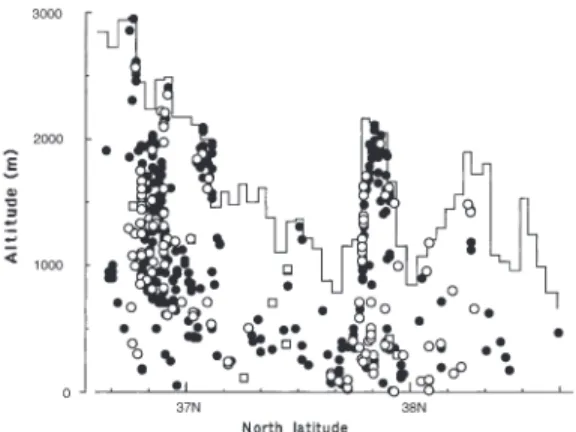
mountainous area of Sado Island(Fig. 1). Its dis- tribution falls largely within the area of deep winter snow cover(for isograph of maximum snow depth in the prefecture, see Ishizawa 1986). However, it is rarely found in the area from Joetsu-shi to the Shinanogawa River, the midwestern area of the prefecture. This is also a mountainous area above 500 m a.s.l. with deep snow above 3.0 m in winter, but summer precipi- tation is less than 440 mm(for isograph of total precipitation for July and August, see Shirasaki 1989). Vertically, the species occurs from eleva- tions of 10 m a.s.l. to the alpine zone at 2,930 m a.s.l.(Shirouma Mountains, Nagano Prefecture)
(Fig. 2). However, its lowermost distribution forty years ago has now disappeared due to ur- banization(10 m a.s.l. Niigata-shi, Niigata Pre- fecture).
2. Relationship between frequency of occurrence and climatic factors
Table 1 shows the frequencies of occurrence of Pog. urnigerum in relation to several climatic factors, such as Kira’s warmth index, maximum snow depth, summer and winter precipitation, and potential evapotranspiration in August.
In Niigata Prefecture, the moss occurs more frequently at cool sites with values for Kira’s warmth index of 80 or less, and precipitation of 440―620 mm in summer. Figure 1 also shows the isograms of potential evapotranspiration of 130 mm and 190 mm in August ; 83.6% of its distri-
bution falls within the areas where are 130―190 mm in August. With respect to winter conditions, it occurs more frequently at sites with precipita- tion of 600―1,400 mm and a snow depth greater than 1.5 m. Table 2 shows the results of correla- tion analysis among the five climatic factors.
Among these climatic factors in warmer seasons, the frequency of the value for Kira’s warmth in- dex is correlated the most closely with that of potential evapotranspiration in August. The higher correlation between the both factors re- sults from the same variables of mean monthly air temperature in August is used in the both formulas estimated. The frequency of the value for maximum snow depth shows a negative cor- relation with that of Kira’s warmth index and of potential evapotranspiration in August. Deep snow for a long period until summer decreases both the value for Kira’s warmth index and the potential evapotranspiration in August at the habitats. Although the frequency of the value for maximum snow depth shows a low correlation with that of summer precipitation, that of snow depth shows a significant correlation with that of winter precipitation. With respect to summer and winter precipitation, the frequency of the value for summer precipitation shows a signifi- cant correlation with that of winter precipitation.
Therefore, the three climatic factors such as po- tential evapotranspiration in August, and sum- mer and winter precipitation are important inde- pendent variables for the value for Kira’s warmth index.
3. Vegetative growth
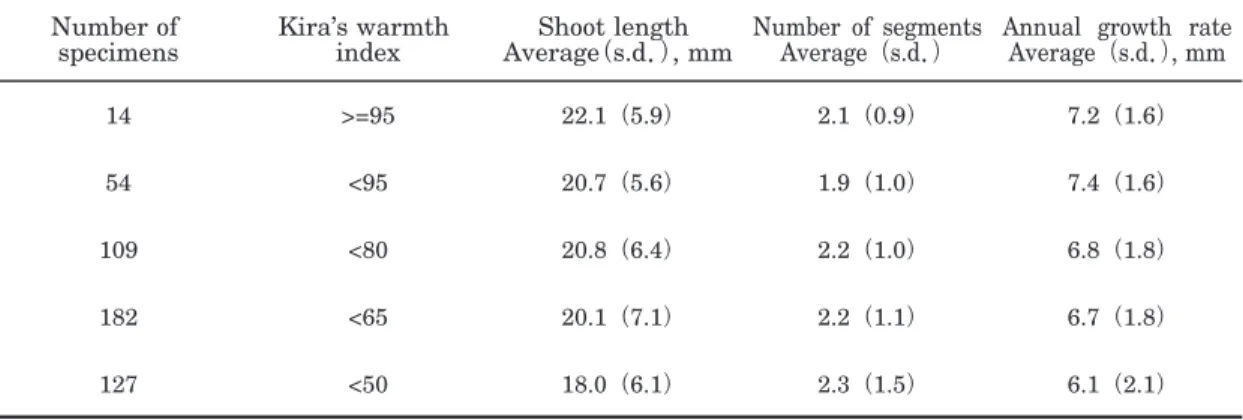
Table 3 shows the vegetative growth of Pog.
urnigerum such as shoot length with number of segments in a shoot and annual growth rate at different Kira’s warmth indices. The age of the moss is estimated by the number of segments in a shoot. The lower the value for Kira’s warmth index, the shoot length and annual growth rate tend to decrease, while the number of segments per shoot increases. The most aged shoot shows 9 segments at 2,550 m a.s.l.(Korenge-san, Shi- rouma Mountains)and the next aged one has 7 segments at 1,780 m a.s.l.(Tanemaki-yama, Iide Mountains). The value for Kira’s warmth index is correlated closely with vertical distribution of Fig. 2. Vertical distribution ofPogonatum urnigerum,
●=specimens without sporophytes,○=with sporo- phytes,□=localities from the literature.
5
Warmth Index
%
<50 23.7
<65 29.3
<80 28.6
<95 14.3
>=95 4.1 Snow depth(m)
%
<0.5 2.1
<1.0 2.1
<1.5 8.4
<2.0 19.2
<2.5 22.6
<3.0 16.0
>=3.0 29.6 Summer precipitation(mm)
%
<320 1.7
<380 5.6
<440 13.6
<500 21.3
<560 30.8
<620 16.8
>=620 10.1 Winter precipitation(mm)
%
<400 3.5
<600 5.2
<800 13.9
<1000 17.1
<1200 32.4
<1400 19.2
>=1400 8.7 Evapotranspiration(mm)
%
<110 0.7
<130 1.4
<150 17.8
<170 38.0
<190 27.9
<210 7.7
>=210 6.6
Warmth Index Snow depth Summer precipitation
Winter precipitation
Evapotranspi- ration
Warmth Index 1.000
Snow depth −0.626* 1.000
Summer precipitation −0.043ns 0.218* 1.000
Winter precipitation 0.028ns 0.499* 0.538* 1.000
Evapotranspiration 0.834* −0.512* −0.062ns 0.066ns 1.000
Number of specimens
Kira’s warmth index
Shoot length Average(s.d.), mm
Number of segments Average(s.d.)
Annual growth rate Average(s.d.), mm
14 >=95 22.1(5.9) 2.1(0.9) 7.2(1.6)
54 <95 20.7(5.6) 1.9(1.0) 7.4(1.6)
109 <80 20.8(6.4) 2.2(1.0) 6.8(1.8)
182 <65 20.1(7.1) 2.2(1.1) 6.7(1.8)
127 <50 18.0(6.1) 2.3(1.5) 6.1(2.1)
Table 1. Frequencies of occurrence ofPogonatum urnigerum in relation to climatic factors as Kira’s warmth in- dex, maximum snow depth(m), summer and winter precipitation(mm), and evapotranspiration in August
(mm)
n=288. For the result of the correlation analysis among the five factors, see Table 2.
Table 2. Correlation analysis among the five climatic factors such as Kira’s warmth index, maximum snow depth, summer and winter precipitation, and evapotranspiration in August on the distributional grids ofPogonatum urnigerum
n=288. *, P<0.0001 ; ns, non-significant.(adjusted the probabilities of error toα=0.05).
Table 3. Mean shoot length, number of segments, and annual growth rate ofPogonatum urnigerum at different Kira’s warmth indices
6
the moss along elevation(correlation coeffi- cient:−0.925). Although the vegetative growth is inhibited by the lower air temperature during the growing seasons, the moss persists for a long period in the severe climate of the interior mountainous area.
4. Relative humidity
At 3.6 m above the ground, where the sensor is usually exposed to the air, atmospheric hu- midity fluctuated widely throughout winter.
However, at 0.5 m above the ground with its snow cover, a value of 100% was maintained during November and May near the ski ground on Mt. Naeba. After the snow melted on 20 May 2001, the values at 0.5 m above the ground fluc- tuated similar to those at the higher one. Spore dispersal occurs during May and June, when hu- midity fluctuates markedly, ranging from 100 to 50% or less. Although the higher site sometimes tended to be drier, the lower site at 0.5 m above the ground maintained a high value for relative humidity(88% or more)during July and Septem- ber. After snowfall in 14 November 2001, the lower site beneath snow again had 100% relative
humidity.
5. Air temperature
Figure 4 shows the mean daily air tempera- ture and the sporophyte maturation cycles of Pog. urnigerum at the same location as men- tioned above. At the site exposed to the air throughout winter, the minimum mean monthly air temperature was−7.5℃in January and the mean daily air temperature fell to the extreme minimum of−12.2℃on 15 January 2001. How- ever, the temperature beneath snow was usually
−1.4℃during January and May, except for the beginning of snowfall. After the snow had melted on 20 May 2001, the air temperature rapidly in- creased from freezing point to 11.3℃.Gametan- gia maturation and fertilization occur at almost the same time as the rapid increase in air tem- perature in May. During June and August 2001, the mean monthly air temperature at 0.5 m above the ground ranged from 13 to 18℃and was usually 0.1 to 0.5℃lower than that at 3.6 m above the ground. The temperature at the lower one was about 0.2 to 0.3℃warmer during Sep- tember and November until snowfall on 14 No-
Fig. 4. Mean daily air temperature with sporophyte maturation cycle ofPogonatum urnigerumat the ski ground on Mt. Naeba, Niigata Prefecture.(for sporophyte maturation stages, see author’s methods).
7
vember 2001. After snowfall it was about 0℃.
6. Production and maturation of sporophyte Figures 1―2 show the distribution of specimens of Pog. urnigerum bearing the sporophyte. Al- though it shows dioecious sexuality(Osada 1965), it frequently produces sporophytes. The occur- rence of sporophytes was observed in 165 of 495
specimens(33.3%). Figure 5 shows seasonal dis- tribution of sporophyte maturation stage of the moss with its elevation in the district. The first embryo after fertilization(stage ET)was ob- served on 29 April 2000 at 30 m a.s.l.(Mikawa- mura, Niigata Prefecture). Archegonial fertiliza- tion and sporophyte development usually rest until April or May after snow clearance. The ju- venile sporophyte develops to stage ET-SC with its elevation rising up from 40 to 2,560 m be- tween May and July. Relationship between the sporophyte development and vertical distribution in stage ET-SC is unclear during summer. Rapid sporophyte maturation from stage SC to stage OI occurs at elevation ranged from 350 to 1,470 m a.s.l. during August to November. Despite at the higher elevations, the moss produces mature sporophytes before snowfall. In the mountain re- gions of the prefecture the sporophyte opercula are never released until the following spring, due to the completely developed sporophyte
(stage SC-OI)being covered by deep snow in No- vember or December. In following spring after snow clearance, stage OF with spore dispersal occurs more frequently during June to August at
higher elevations.
In rare cases at Uchinokura Valley(200 m a.s.
l., Shibata-shi) and Niigata-shi(20 m a.s.l.), it had already dispersed spores on 12 November 1949 and 30 December 1958, respectively. Al- though at Mikawa-mura(30 m a.s.l.), one of the lowermost distribution in elevation, where is es- timated to have a minimum monthly snow depth of 93 cm in February, the moss was exposed to the air on 26 February 1999. It produced a com- pletely developed sporophyte(stage OI). The sporophyte opercula are released and the cap- sules dispersed spores in early March.
At the site(1,350 m a.s.l.)near the ski ground on Mt. Naeba, fertilization occurs at a mean daily air temperature of 10℃in late May after snow clearance(Fig. 4). The sporophyte develops during the four months from May to August, and matures in the middle of September with an air temperature decreasing to 15℃or less and sporocyte meiosis occurring in the same season.
The sporophyte matured completely by Novem- ber at a mean daily air temperature ranging from 7.1 to 14.0℃, but its capsules had not dis- persed spores before snowfall on 14 November 2001(Fig. 4). Its capsules rest in the stage OI during winter, and spore dispersal occurs in May and June of the following year after snow clear- ance. Thus, the moss requires only 7 months from fertilization to sporophyte maturation at the higher elevation. Spore dispersal, however, is controlled by the local climatic conditions, such as earlier snowfall in winter and exposure to the air in spring.
The uppermost record for gametangial fertili- zation was at 2,560 m a.s.l.(Korenge-san, Shi- rouma Mountains), where the mean monthly air temperature ranges from 5.3 to 14.0℃during May and September, and the value for Kira’s warmth index is 27.7. The moss at this site, however, had not produced sporophytes in the previous year. The next uppermost record for fertilization was at 2,340 m a.s.l.(Hiuchi-yama, Myoko Mountains), where the mean monthly air temperature ranges from 6.5 to 15.6℃during May and September, and the value for Kira’s warmth index is 35.1. The moss produced juve- nile sporophytes with previous year sporophyte setae. Thus, it is suggested that the moss usu- Fig. 5. Seasonal distribution of sporophyte matura-
tion stage of Pogonatum urnigerum at different elevations.
8
ally needs a value for Kira’s warmth index of 35.1 or more for sexual reproduction.
Discussion 1. Climatic factors
The midwestern area of Niigata Prefecture is one of the regions with the deepest snowfall in Japan. Deep snow means as much precipitation in winter and supplies much water with rapid rise in air temperature. Although, at the lower site beneath snow, a value of 100% in relative humidity is maintained, ground surface is the same as submerged condition in usual. The ex- tremely wet conditions beneath snow for a long period, which is considered to occur when winter precipitation is 1,400 mm or more, causes dam- age to many vascular plants and some bryo- phytes, and eventually excludes them from such areas(Ishizawa 1986 ; Shirasaki and Watanabe 1995). The distribution ofPog. urnigerumis also restricted by a higher winter precipitation. How- ever, it is evident that the moss is not affected by a long period of snow cover and a depth snow.
Deep snow on the moss shut out against severe cold and desiccation rather than injures it.
The higher frequency within the areas for Kira’s warmth index below 80 shows its well ad- aptations to a lower air temperature during its growing seasons on vegetative growth. It is also correlated closely with the frequencies in poten- tial evapotranspiration. The maximum value for potential evapotranspiration, which is estimated in August, appears to restrict the moss growth, because its distribution is included largely within the area with a potential evapotranspira- tion of 130―190 mm in August(Fig. 1). A higher value for potential evapotranspiration decreases available water for the moss growth and desic- cates the moss. Therefore, the lower evapotran- spiration may supply good conditions for the moss growth in the interior mountainous area.
The wide range of variation in air humidity within short time intervals shows that rain fre- quently alternated with strong sunlight on Mt.
Naeba in summer. The moss shows normal vege- tative growth and develops many gametangia and sporophytes, despite exposure to strong sun- light at the open ground. It is considered to be more sensitive to drier climate, because sporo-
phyte elongation is 50% less in a dry site than in a moist one during June and September(Hughes 1990). Thus, gametophyte of the moss also may be excluded from the coastal lowlands including the midwestern area of the prefecture where is the higher value for the evapotranspiration above 190 mm in August.
The annual growth rate of the moss tends to decrease at lower value for Kira’s warmth indi- ces(Table 3). Differences in growth segments of Pol. alpestre have been observed at different lati- tudes in both Circum-Polar Regions, Sub-Arctic and Sub-Antarctic Zones(Longton 1979). Far- ther north or south, the mean air temperature in the warmest month falls down. With the cooler trend at higher latitudes, the moss decreases its segment length and number of leaves per seg- ment. The growth variation in the both Circum- Polar materials is considered to be of adaptive value in cool, relatively dry, Circum-Polar cli- mates. Similar growth inhibitions in Pog.
urnigerum at lower value for Kira’s warmth in- dices suggest that its features are also adapted to a wide range of variation in air temperature.
2. Phenology
Lackner(1939)observed that sporophyte pro- duction of Pog. urnigerum takes 8 months from fertilization to maturation, and spore dispersal begins in March of the following year in W. Rus- sia. ManyPogonatumspecies in N. Europe com- pletely develop sporophytes within the succeed- ing snow-free season(Hughes 1990). Also at the two sites of lower elevations in the prefecture(30 m a.s.l., Mikawa-mura, and 200 m a.s.l., Uchi- nokura River, Shibata-shi), it takes 8 months from April to November. However, in the inte- rior mountainous areas such as Mt. Naeba, it takes only 6 months for sporophyte maturation during snow-free seasons. Therefore, the moss may be well adapted to the local variation in snow depth. There is no evidence, however, for the sporophytes developing completely at its up- permost locations with elevations above 2,340 m a.s.l. The lower air temperature, reflected in a value for Kira’s warmth index less than 35.1, may be not enough for sporophyte maturation at higher elevations.
The farther north, the earlier archegonia of 9
Pol. alpestre are fertilized after snow clearance
(Longton 1979). The exact time of fertilization inPog. urnigerumis unclear, but it may occur in middle March in Mikawa-mura(30 m a.s.l.)and in early June on Mt. Naeba(1,350 m a.s.l.)for 3 weeks or less after snow clearance. Sporocyte meiosis of Pol. formosum, Pol. commune and other Polytrichum species occurred in June
(Longton 1979 ; Hughes 1990), and that ofPog.
urnigerum in July(Hughes 1990). Therefore, these species are considered to be well adapted to the short growing seasons of higher latitudes by the common phenological features(Hughes 1990). On Mt. Naeba, however, sporocyte meio- sis ofPog. urnigerum occurs in September. This phenological feature is clearly different from that of Pol. commune and N. European materi- als. The different distributions ofPol. formosum andPol. communeare considered to reflect their differences in requirements for moisture and sunlight(Shirasaki 1990 a). Although the upper- most elevation of Pog. urnigerum in the prefec- ture is higher than that of Pol. formosum, the horizontal distribution of both mosses is quite similar. Both frequently grow near together in the same habitats, the so-called “wind hole area”, where lower air temperature and higher air hu- midity are maintained throughout the year
(Shirasaki 1990 b). Therefore, the similar dis- tributional pattern rather than phenological dif- ferences may show the similar requirement in air humidity between both species.
Pogonatum urnigerum, which occurs at higher elevations than Pol. formosum, frequently has caducous leaves in Arctic populations(Long 1988), and fragments have been obtained from the surface of the snow in northern New York
(McDaniel and Miller 2000). Caducous leaves and fragments of the moss may also serve as vegetative diaspores in the alpine zone of the prefecture.
3. Geological factor
Pogonatum urnigerum is rarely found within the midwestern area of the prefecture despite the elevation being about 500―800 m a.s.l. Land- slides sometimes occur here, giving a distinctive geological feature known as “Fossa Magna”
(Yamashita 1995). Some bryophytes such as
Rhizogonium dozyanum, Leucobryum scabrum, Trichocolea tomentella and Trichocoleopsis sac- culata, are excluded from the area with the un- stable ground, because of their asexual reproduc- tion(Shirasaki 1989, 1991, 2000 b).Pogonatum urnigerum, however, may be strongly affected by the higher evapotranspiration in August rather than the landslides, because it can be estab- lished by spore dispersal every year.
In conclusion, the lower drought resistance for its vegetative growth may cause the distribu- tional gap in the coastal lowlands including the midwestern area of the prefecture, despite of its growth well on open ground with strong sunlight.
The moss is well adapted to the cool tempera- tures and deep snow of the interior mountainous area, while its sporophyte production may be re- duced by lower air temperature with too short a snow-free season in the alpine zone of the pre- fecture.
Acknowledgments
The first author thanks late Mr. Y. Ikegami
(Niigata City)for the loan of specimens, and Dr.
S. Ishizawa(Niigata City)for support with the field survey.
References
Deguchi, H. and Yananose, N. 1989. Develop- ment of sporophyte, calyptra and vaginula in Pogonatum neesii(C. Müll.)Dozy. Proc. Bryol.
Soc. Japan5: 1―6.(in Japanese with English summary)
Greene, S. W. 1960. The maturation cycle, or stages of development of gametangia and cap- sules in mosses. Trans. Brit. Bryol. Soc. 3: 736―745.
Horikawa, Y. 1955. Distributional studies in Ja- pan and the adjacent regions. 152 pp. Hiro- shima Univ., Hiroshima.
Hughes, J. G. 1990. Seasonal growth and devel- opment of sporophytes in wild populations of PogonatumandPolytrichum. J. Bryol. 16: 97
―108.
Hyvönen, J. 1989. A synopsis of genus Pogo- natum(Polytrichaceae, Musci). Acta Bot. Fenn.
138: 1―87.
Ishizawa, S. 1986. The plants distributed around the range of snow-camellia, Camellia rusiti- 10
cana Honda, in Niigata Prefecture and its ad- jacent area 2. Bull. Nagaoka Mun. Sci. Mus.
21: 1―18. (in Japanese)
Japan Meteorological Agency(ed.). 1996. The monthly normals for AMEDAS Stations in Ja- pan(1979―1990). CD-ROM. Japan Meteoro- logical Agency, Tokyo.
Kira, T. 1976. Rikujo seitaikei. 166 pp. Kyoritsu Shuppan, Tokyo.(in Japanese)
Lackner, J. 1939. Über die Jahresperiodizität in der Entwicklung der Laubmoose. Planta 29: 534―616.
Lawton, E. 1971. Moss flora of the Pacific North- west. 537 pp. Hattori Bot. Lab., Nichinan.
Long, D. G. 1988. Pogonatum urnigerum with caducous leaves in Scotland. J. Bryol.15: 495
―496.
Longton, R. E. 1979. Studies on growth, repro- duction and population ecology in relation to microclimate in the bipolar moss Polytrichum alpestre. Bryologist82: 325―367.
McDaniel, S. F. and Miller, N. G. 2000. Winter dispersal of bryophyte fragments in the Adi- rondack Mountains, New York. Bryologist 103: 592―600.
Osada, T. 1965. Japanese Polytrichaceae. I. In- troduction and the genus Pogonatum. J. Hat- tori Bot. Lab.28: 171―201.
Osada, T. 1966. Japanese Polytrichaceae. II. The generaPolytrichum, Oligotrichum, Bartramiop- sis, and Atrichum, and phytogeography. J.
Hattori Bot. Lab.29: 1―52.
Redfearn, P. L. Jr., Tan, B. C. and He, S. 1996.
A newly updated and annotated checklist of Chinese mosses. J. Hattori Bot. Lab.79: 163―
357.
Shirasaki, H. 1989. Ecological distribution of Leucobryum scabrum Lac. and Rhizogonium dozyanumLac.(Musci). J. Phytogeogr. Taxon.
37: 15―25.(in Japanese with English sum- mary)
Shirasaki, H. 1990 a. Ecological distribution of bryophyte. 1. Polytrichum commune Hedw.
andP. formosum Hedw.(Musci). J. Phyto- geogr. Taxon. 38: 27―41.(in Japanese with English summary)
Shirasaki, H. 1990 b. Ecological distribution of bryophyte. 2. Distribution types in the wind hole areas of Mt. Naeba, Niigata and Nagano
Prefecture. J. Phytogeogr. Taxon.38: 137―147.
(in Japanese with English summary)
Shirasaki, H. 1991. Method to process the distri- bution maps of the plants and analysis of dis- tribution pattern of bryophytes. Bull. Niigata Coll. Pharm. 11: 1―12.(in Japanese with English summary)
Shirasaki, H. 1996. Distribution and ecology of Ricciocarpos natans in Niigata Prefecture and its adjacent regions, central Japan. Proc. Bryol.
Soc. Japan6: 209―215.
Shirasaki, H. 1999. Relationship between distri- bution types of bryophyte sporophyte and cli- matic conditions in Niigata Prefecture and its adjacent regions, central Japan. Natur. Envi- ron. Sci. Res.12: 75―83.
Shirasaki, H. 2000 a. Relationships among dis- tribution, environmental factors, and phenol- ogy of the epiphytic mosses, Neckera humilis and N. yezoana in Niigata Prefecture and its adjacent regions, central Japan. J. Phytogeogr.
Taxon.48: 149―161.
Shirasaki, H. 2000 b. Trichocoleopsis sacculata
(Mitt.)Okam. Ishizawa, S.(ed.). Distribution maps of plants in Niigata Prefecture, Japan.
20, pp. 89―92. Jinenjo-kai, Niigata.(in Japa- nese)
Shirasaki, H. and Watanabe, S. 1995. Analysis of distribution pattern of bryophytes in rela- tion to climate of the Sea of Japan region. Bull.
Niigata Coll. Pharm.15: 9―19.(in Japanese with English summary)
Takaki, N., Amakawa, T., Osada, T. and Sakuma, E. 1970. Bryophyte flora of Mt. Kaik- oma, Mt. Senjo and Mt. Kitadake(southern Ja- pan Alps). J. Hattori Bot. Lab.33: 171―202.
Takaki, N. and Watanabe, R. 1987. A checklist of the mosses of Mt. Fuji, central Japan. pp.
529―537. Kobe Geobotanical Society, Kobe.(in Japanese)
Thornthwaite, C. W. 1948. An approach toward a rational classification of climate. Geogr. Rev.
38: 55―94.
Watanabe, S. and Shirasaki, H. 1991. A new method to process the distribution maps by us- ing the fine mesh and analysis of distribution pattern of bryophytes. J. Phytogeogr. Taxon.
39: 131―135.(in Japanese with English sum- mary)
11
Watson, M. A. 1975. Annual periodicity of incre- mental growth in the moss Polytrichum com- mune. Bryologist78: 414―422.
Yamashita, N. 1995. Fossa magna. 310 pp. Tokai University Press, Tokyo.(in Japanese)
(Received February 4, 2002 ; accepted April 1, 2003)
白崎 仁1・佐藤政二2:新潟県とその隣接地域にお ける蘚類ヤマコスギゴケの分布,環境要因,および 生活史の関連性
ヤマコスギゴケは,新潟県とその周辺では,主に 佐渡ケ島北部と内陸部の県境付近の山岳地域に多く,
新潟県の中西部と,日本海沿岸沿いの低地には比較 的少ない。垂直分布は海抜10 mほどの低地から 2,930 m(白馬岳)の高山の山頂まで広く分布する。
本種は,日当たりの良い開けた土上に生育すること が多い。生殖器官の成熟と受精は雪消え直後に行わ れ,胞子体はその年の11月までに成熟するので,
受精と胞子体の発達は多雪と積雪下の長期の多湿に は影響されない。少雪地では降雪前の12月に胞子
を散布することもあるが,多雪地では主に,5月の 雪解け後,気温が10℃ に急上昇する頃に胞子を散 布する。雪解けがより遅い所では,胞子の散布時期 が遅れて,高海抜では7〜8月になる。受精個体の 最高海抜は2,550 mだが,胞子体が毎年成熟する
のは海抜2,340 mが限界である。高海抜では胞子
体の成熟期間が短縮されるため,生活史を完結でき るのは,温かさの指数が35.1以上の所と推定され る。シュート(配偶体)の年間生長率は温かさの指 数が下がるにつれて低下するので,配偶体の生育は 温かさの指数の高い所ほど良いが,高山で低温が長 く続く環境でも強い耐性をもっている。本種は,8 月の可能蒸発散量が190 mm以下の範囲に主に分 布しており,山岳地域では夏にしばしば雨が降る。
海岸沿いや県中西部では8月の可能蒸発散量がよ り高く,植物体は強い乾燥を受けることになるが,
山岳地域の蒸発散量は比較的低いため,内陸の山岳 地域に分布が偏っていると考えられる。
(1〒950―2081新潟市上新栄町5―13―2 新潟薬科大 学生物学教室;2〒949―6211湯沢町三俣742 かぐ ら・みつまたスキー場)
12