Evidence from the 2007 Upper House Election in Japan
著者 Okamoto Tetsukazu
journal or
publication title
政策創造研究
volume 4
page range 47‑57
year 2011‑03
URL http://hdl.handle.net/10112/5187
The Impact of Candidates’ Websites on Voting
Evidence from the 2007 Upper House Election in Japan
*Tetsukazu OKAMOTO
Ⅰ.Introduction
The Internet is increasingly used for political communication in Japan. Despite the limits placed on Internet usage as a campaign tool by the Public Offi ce Elections Law (Tkach-Kawasaki 2003)1), the rate at which candidates in national elections set up websites has been rising since 2000. During the 2000 House of Representatives (Lower House) election, 28.4 percent of candidates (399 out of 1404) set up their own sites. This number jumped to 68.7 percent (777 out of 1131) in the 2005 Lower House election.
Despite such dramatic increase in Internet usage, however, few scholars have examined its impact on Japanese voters. Most studies of online campaigning in Japan have focused on candidate or party websites to consider who set up a website or what factors infl uenced its contents.
We present a systematic and empirical analysis of the impact of online campaigning on voting using data from the 2007 House of Councilors (Upper House) election in Japan. The fi ndings show that maintaining a website positively affects a candidate’s level of support, and higher frequency of access to a candidate’s site signifi cantly increases his or her vote.
Ⅱ.Candidates’ presence on the Web in the 2007 Upper House Election
Before examining the impact of candidates’ websites, we present information on candidates’ Web presence in the 2007 Upper House Election. During the campaign period, between July 12 and July 29, a survey of 377 candidates’ websites was conducted to monitor who set up websites. In this election, 297 candidates (78.8 percent) had a presence on the Web.
Figure 1 illustrates the rate of website creation by political parties, and reveals the dominance of major parties. The establishment rates of both the Liberal Democratic Party (LDP), which had been
long-dominant since 1955 but lost control of the Japanese Diet after the 2009 Lower House election, and the Democratic Party of Japan (DPJ), which came to power in 2009, were over 80 percent, while minor parties such as the Social Democratic Party of Japan (SDP) and the Japan Communist Party (JCP) lagged behind the major parties.
Regarding the status of candidates, incumbents tended to be more ubiquitous in cyberspace than challengers, with the establishment rate of the former amounting to 97.9 percent (94 out of 96), contrasted with 72.2 percent (203 out of 281) for the latter. The difference between them is statistically signifi cant at the 1 percent level.
It has been observed that, in the Japanese elections major political parties and incumbents tend to dominate cyberspace (Okamoto 2008: 23). The results shown above suggest that the process of
‘normalization’, namely the idea that trends in cyberspace refl ect the real world, constitutes an inexorable trend in Japanese Politics.
Ⅲ. Going Online and Electoral Fortune
In order to examine the impact of website on voting, we begin by exploring whether candidates having a website won seats or not. On this subject, Yannas and Lappas (2006) found that candidates with campaign websites, especially independents and opposition party candidates, were more likely to win a seat than those without it in Greek prefectural elections. A similar result was also observed in British elections. For Australian candidates, however, the electoral advantage of a presence in
Figure 1. The rate of website creation by political parties
cyberspace was not apparent (Lusoli and Ward: 2007).
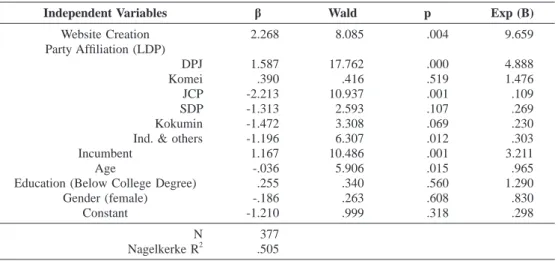
Our data show that 40.6 percent of candidates with websites (119 out of 297) won their seats. On the other hand, the percentage of candidates without websites winning seats was only 2.5 percent. For a more robust examination of the effect of websites, multivariate analysis was conducted, with electoral success or defeat as the dependent variable and Web presence of candidates as an independent variable. As shown in Table 1, Web presence had a positive effect (P<.01) on electoral success even after controlling for the impact of candidates’ party affi liation, incumbency status, and socioeconomic status.
For a more precise investigation of the relationship between electoral results and Web presence, we use the data on votes received by candidates. In studies conducted by D’Alessio (1997) and Gibson and McAllister (2006), it was found that having a website signifi cantly increased votes cast for a candidate.
Before turning to the multivariate analysis, the simple bivariate relationship between vote and website possession is explored. On average, candidates who went online received 248,135.1 votes (SE
= 250,583.9) in the 2007 election. In contrast, candidates without websites only received 37,888.3 votes (SE = 75,997.0). The result suggests that maintaining websites might have a positive effect for vote share.
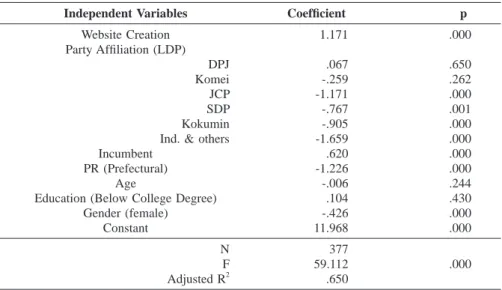
To test this hypothesis, we employ the number of votes cast for a candidate as a dependent variable (using the natural log of votes). Table 2 reports the result of multiple regression analysis that explores the effect of Web presence and other control variables. Maintaining a website, which is our
Table 1. Logistic Regression Result: Predicting the Impact of Website Creation on Electoral Success
Independent Variables β Wald p Exp (B)
Website Creation 2.268 8.085 .004 9.659
Party Affi liation (LDP)
DPJ 1.587 17.762 .000 4.888
Komei .390 .416 .519 1.476
JCP -2.213 10.937 .001 .109
SDP -1.313 2.593 .107 .269
Kokumin -1.472 3.308 .069 .230
Ind. & others -1.196 6.307 .012 .303
Incumbent 1.167 10.486 .001 3.211
Age -.036 5.906 .015 .965
Education (Below College Degree) .255 .340 .560 1.290
Gender (female) -.186 .263 .608 .830
Constant -1.210 .999 .318 .298
N 377
Nagelkerke R2 .505
*Reference categories in parentheses
key independent variable, has a signifi cantly positive impact on the vote share even after controlling for the effects of other factors linked to electoral success. Since the dependent variable here is transformed into logarithmic form, regression coeffi cient measures the constant proportional change in the dependent variable for a given absolute change in the value of the independent variable.
Maintaining a website increases a candidate’s vote by 1.17 percent.
Ⅳ.The frequency of website access
Results shown in the previous section are supportive of the positive impact of maintaining websites on electoral success. In this section we investigate the impact of the frequency of website access on electoral outcomes. It is only through voters’ access that candidates’ websites could make any difference to vote choice. According to Bimber and Davis (2003: 131), there is a possibility that voters can learn from being exposed to campaign websites. Voters might decide for whom to vote based on knowledge or information obtained from websites. Our results shown above offer evidence supporting this conjecture. In order to examine the impact of the Internet on voting in more detail, we should therefore focus not only on whether a candidate has a website but on how many people visit a candidate’s website.
Few attempts have been made to investigate the relationship between the frequency of visits to websites and voting. D’Alessio (1997) and Voerman and Boogers (2008) examined the pattern of frequency of access but did not go further into analyzing its effect on voting. We hypothesize a
Table 2. The Result of OLS Estimation: The Impact of Website Creation on Vote (ln)
Independent Variables Coeffi cient p
Website Creation 1.171 .000
Party Affi liation (LDP)
DPJ .067 .650
Komei -.259 .262
JCP -1.171 .000
SDP -.767 .001
Kokumin -.905 .000
Ind. & others -1.659 .000
Incumbent .620 .000
PR (Prefectural) -1.226 .000
Age -.006 .244
Education (Below College Degree) .104 .430
Gender (female) -.426 .000
Constant 11.968 .000
N 377
F 59.112 .000
Adjusted R2 .650
*Reference categories in parentheses
positive relationship between the frequency of access to a candidate’s website and the number of votes cast for him/her. In the following section we seek to test this proposition.
Ⅴ. Description of the Data
We measure the frequency of access to candidates’ websites as follows; we sought to identify how many candidates’ websites have a hit counter, which keeps track of how many visitors view the site.
We found that 78 out of 297 candidates’ websites contained a hit counter. Then we accessed each of the 78 websites in order to record the number of hit counter from July 12 to July 29, 2007, on a daily basis. The “full” data sets, which contain the number of hit counter during the entire 18-day period, were obtained from 72 websites.
We should note here that not every candidate put a hit counter on his/her website, which might lead to a biased sample selection. Before providing a descriptive analysis of the data, let us explore the characteristics of our samples in order to investigate whether there is any sampling problem.
Our sample consists of 19 candidates from the LDP (26.4 percent), 22 from the DPJ (30.6 percent), 9 from the JCP (12.5 percent), 4 from the SDP (5.5 percent), 1 each from Komei Party, Kokumin Shinto (1.4 percent), and 16 Independents or minor party candidates (22.2 percent). The DPJ is slightly over-represented, since the percentage of its candidates among all candidates was 22.2 percent (80 out of 377). This is partly because the website establishment rate of DPJ candidates was relatively high compared with that of other parties’ candidates.
With regard to incumbency, 22 incumbents (30.5 percent) are included in our sample. For a basis of comparison, the percentage of incumbent candidates among all candidates was 22.2 percent (84 of 377). Concerning candidacy type, 59.7 percent of our sample are from prefectural districts (where 73 seats were at stake, with district magnitude between one and fi ve), and the remaining 40.3 percent from a nationwide proportional representation (PR) district (48 seats at stake). These percentages match the averages for all candidates. Hence our sample is fairly representative of the population of the candidates, although DPJ candidates and incumbents are slightly over-represented.
The total number of hits on the 72 websites during the 18 days of observation was 601,963. The average number of hits was 33,442.4 per day, and 8360.6 per candidate. The maximum number was 54,573, the minimum 440. The standard deviation was 11,030.13, which shows a wide dispersion among websites’ hit count.
Let us investigate the hit count from several perspectives. Figure 2 displays the average hit count (per candidate per day, the same hereafter unless stated otherwise) by political party. The data for the previous four elections, from the 2001 Upper House election to the 2005 Lower House election, are
also shown for comparison. As the fi gure indicates, websites of independent candidates recorded the highest hit number in the 2007 Upper House election. We attribute this to the fact that a number of celebrity candidates, such as fi gures who appear frequently on television, were running for election as independents. The DPJ was in second place, followed by the SDP, and then the JCP. The governing LDP lagged slightly behind the JCP. In the 2007 election, the DPJ won 60 of the 121 contested seats, against just 37 seats won by the LDP. The contrast between the electoral fortunes of the DPJ and the LDP seemed to be refl ected in the difference in the number of website visits between the two parties.
Similar fi gures were reported for the 2004 Upper House election and the 2005 Lower House election (Okamoto, Ishibashi and Wakisaka 2006, 2008).
Regarding candidacy status, while the average hit number for incumbents was 310.2 (SE = 249.01), that for non-incumbents was 530.04 (SE = 731.14). This is presumably related to the fact that a few of the celebrity candidates mentioned above were included among non-incumbents.
Lastly, let us turn to candidacy type. The Japanese Upper House election is held every three years to elect 121 members, comprising of 73 elected from prefectural districts and 48 from a nationwide PR district. The number of contested seats in prefectural districts ranges from one to fi ve. For the PR component, an open-list (hi-kosoku-meibo-shiki) system is employed. Voters cast two ballots: one for a prefectural district candidate and another for a candidate or a political party in the PR list (Imai and Kabashima 2008: 280).
Focusing on the two candidacy types, namely prefectural district and PR district candidates, we investigate the difference in website visits between the two types. With respect to prefectural district candidates, the average number of hits was 430.5 (SE = 415.1), compared with an average of 514.9
Ind.&
Others SDP JOP Komei
Hit Number 㪈㪇㪇㪇
㪐㪇㪇 㪏㪇㪇 㪎㪇㪇 㪍㪇㪇 㪌㪇㪇 㪋㪇㪇 㪊㪇㪇 㪉㪇㪇 㪈㪇㪇 㪇
㪉㪇㪇㪈㪬㪅㪟 㪉㪇㪇㪊㪣㪅㪟 㪉㪇㪇㪋㪬㪅㪟 㪉㪇㪇㪌㪣㪅㪟 㪉㪇㪇㪎㪬㪅㪟
Figure 2. The average hit count by political party (per candidate per day)
hits (SE = 830.2) recorded for PR candidates.
Given that many voters have access to candidates’ websites for the purpose of deciding for whom to vote, all other things being equal, the more voters there are in a district, the more frequently candidates’ websites in the district would be viewed. In the Japanese Upper House election, there is only one PR district, but 47 prefectural districts. Thus the number of voters in each prefectural district is considerably fewer than in the PR district. The difference indicated above might partly refl ect a disparity in the number of voters between PR and prefectural districts, and may be considered as positive evidence for the proposition that candidate’s website served as a major tool for purposes of gathering information and deciding how to vote.
Ⅵ.The impact of website hit number on electoral results
Let us start by investigating the connection between the number of hits on candidates’ websites and their electoral fortune, namely whether they won or not. Of the 72 candidates whose websites we use in analyzing hit numbers, 28 candidates were elected in the 2007 election. The average hit number for winners’ websites was 8150.4 (SE = 10221.8). In contrast, the 44 losers’ websites recorded a higher average value at 8494.40 (SE = 11628.9). Although these results are not supportive of our prediction that more website visits have a positive impact on winning, the difference between winning and losing candidates was not statistically signifi cant even at 10 percent level.
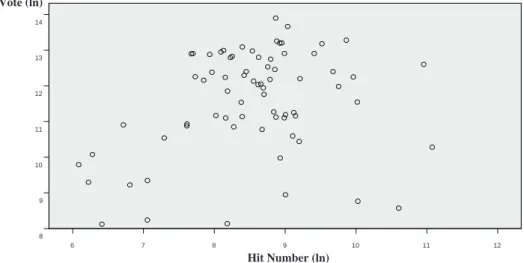
Next, we focus on the linkage between hit numbers and votes. Figure 3 displays a scatter plot of the hit number per website (natural logged value) and votes cast (natural logged value) for each
Figure 3. Scatter Plot of the Hit Number per Website (ln) and votes (ln) Vote (ln)
14
13
12
11
10
9
8
6 7 8
Hit Number (ln)
9 10 11 12
candidate. Although a clear connection is not observed at a fi rst glance, there appears to be a slightly positive relationship. The correlation coeffi cient between these two indicators is 0.280, which is statistically signifi cant at the 5 percent level.
We also examine whether there exists a positive connection between the number of website hits and votes, even after controlling for the effects of other factors that affect candidates’ vote share. We test the hypothesis that the more frequently a candidate’s website is accessed, the more vote candidate received. Our dependent variable is the number of votes cast for a candidate. The distribution of the data was skewed to the right, so the natural logged value is employed to overcome the problem of heteroscedasticity.
We should note here that there is a possibility that the causal relationship between website access and votes might be reciprocal. This is because a voter may access a candidate’s website for reasons other than to decide for whom to vote. Bimber and Davis (2003: 139) argued that most people visit websites of their preferred candidates. D’Alessio (1997) suggests that there would be a group of voters who access websites to gather information about the campaign because they are only interested in the election. We anticipate that this kind of voter is more likely to access websites of candidates who are
‘popular’, namely those expected to garner high support.
Consequently, we cannot rule out the possibility that it is the expected vote that affected frequency of access. In this case, frequency of access should be treated as an endogenous variable. Ordinary least squares (OLS), with frequency of access treated as an independent variable, is likely to produce biased estimate of the parameters because the independent variable is correlated with the error term (Jacobson 1990: 335). We therefore used a two-stage weighted least squares regression with the predicted value of vote cast as an instrumental variable. The result (details of which are not shown for reasons of space) demonstrates that it is not necessary to consider the simultaneity problem between frequency of access and vote. Therefore we employ OLS to estimate the effect of website access on vote.
The key independent variable is Frequency of Website Access (natural logged value). Also included as control variables are the followings: (1) Candidates’ party affi liation (dummy variables for DJP, New Komei, SDP, JCP, Kokumin Shinto [People’s New Party] candidates, and independent/other candidates, with LDP candidates as reference category); (2) Incumbency (dummy variable; coded 1 for incumbent candidates and 0 otherwise); (3) Candidacy (a dummy variable for PR candidates, with prefectural candidates as reference category). I also include an interaction term Frequency of Website Access * Incumbency to measure the joint effects between them while frequency of access captures a baseline effect.
In addition to the variables mentioned above, three socio-economic status variables are included in the analysis as control variables: Candidates’ Age, Educational Level, and Gender. Education is a
dichotomous dummy variable, coded 1 for candidates with a college degree or above, and 0 otherwise.
Gender is also a dichotomous variable, with 1 for male candidates and 0 for females.
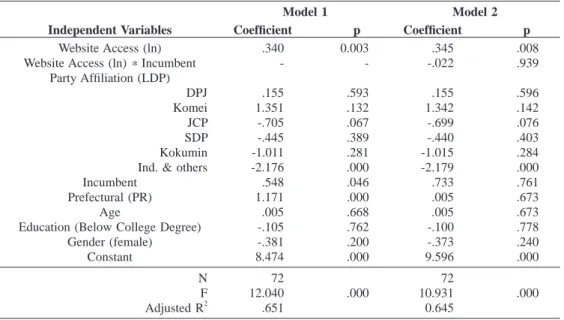
The results are displayed in Table 3, clearly demonstrating that Frequency of Website Access has a signifi cantly positive effect on a candidate’s vote share even after controlling for the effects of all other variables. The regression coeffi cient for the Frequency of Website Access stands for the percentage change in vote for a percentage change in the frequency of access, since both the dependent and independent variables were log-transformed. That is to say, a 1 percent increase in access to a candidate’s website led to a 0.501 percent increase in his/her vote share. Taking an example of Naoto Amaki (independent, PR candidate), whose website was the most frequently accessed among our sample, an increase of 645 hits produced about 146 additional votes. However, whether such an effect is substantial or not is open to debate.
Ⅶ. Discussion
This study analyzed the impact of candidates’ websites on their electoral performance. The fi ndings we obtained lend support to the argument that maintaining websites has a positive effect on vote share;
(1) Candidates with a website garnered more votes and were more likely to be elected than those without it, (2) The more frequently a candidate’s website was accessed during the campaign period, the
Table 3. The Result of OLS Estimation: The Impact of Website Access on Vote (ln)
Model 1 Model 2
Independent Variables Coeffi cient p Coeffi cient p
Website Access (ln) .340 0.003 .345 .008
Website Access (ln) * Incumbent - - -.022 .939
Party Affi liation (LDP)
DPJ .155 .593 .155 .596
Komei 1.351 .132 1.342 .142
JCP -.705 .067 -.699 .076
SDP -.445 .389 -.440 .403
Kokumin -1.011 .281 -1.015 .284
Ind. & others -2.176 .000 -2.179 .000
Incumbent .548 .046 .733 .761
Prefectural (PR) 1.171 .000 .005 .673
Age .005 .668 .005 .673
Education (Below College Degree) -.105 .762 -.100 .778
Gender (female) -.381 .200 -.373 .240
Constant 8.474 .000 9.596 .000
N 72 72
F 12.040 .000 10.931 .000
Adjusted R2 .651 0.645
*Reference categories in parentheses
more votes were cast for the candidate. Our research contributes to a growing literature examining the effect of the Internet on voting behavior.
We should acknowledge that our study contains some notable limitations. First, the sample that we employed in order to investigate the impact of access consists of candidates with hit counter put on their websites. This might lead to a biased sample problem. However it is important to note that the sample is fairly representative of the population of all candidates as indicated above.
Second, our analysis was based mainly on aggregate data, in particular regarding the frequency of website access. This kind of data reveal information about which candidates’ websites were accessed, and how frequently, but not who visited these websites. Hence we know little about the causal mechanisms by which exposure to websites affects voting behavior at the individual level. Analyses using micro-level data, such as surveys, could supplement our study.
Notes
* The earlier version of this article was presented at European Union Democracy Observatory Conference: Internet and Voting, at European University Institute, Florence, Italy, June 4, 2010 and stems from the following: Tetsukazu Okamoto, Shoichiro Ishibashi, and Tohru Wakisaka, “Kohosha ni yoru Website wa tokuhyo ni eikyo wo oyobosu noka:
2007 nen san-insen de-ta ni yoru bunseki (Do Candidates’ Websites Have an Impact on the Vote?: Empirical Evidence from the 2007 Upper House Election in Japan),” The Hogaku Ronshu (The Law Review of Kansai University), Vol.60, No.4, 2010, pp.279-315. I am grateful to Bernard Grofman, Alexander H. Trechsel, and conference participants at EUI for their thoughtful comments and suggestions.
This work was supported by MEXT.KAKENHI (22530145).
1) The Public Offi ces Election Law in Japan regulates campaign activities. It is very strict compared with similar laws in other industrial democracies. Candidates cannot hand out documents to the public, except for leafl ets and pamphlets in limited form and numbers. Posting campaign information on the web is considered equivalent to handing out documents to the public, which is prohibited by the Law. In addition, the Law does not allow candidates to update their sites or send any electronic information during the campaign period.
On the other hand, many candidates set up their websites even during the campaign period in recent years. The reason is that candidates can keep information on the Web that was posted before the offi cial campaign period begins and that is considered part of their regular political activities, rather than campaign activities. But websites cannot be updated or revised during the campaign period. The problem is that it is very diffi cult to distinguish regular political activities from campaign activities.
Faced with a growing demand to revise the Public Offi ces Election Law in order to allow candidates to use the Internet as campaign tools, the ruling Democratic Party of Japan and the opposition parties, including the ex-ruling Liberal Democratic Party, reached an agreement on the revision of the Law in May of 2010, which could have made it possible for candidates to use websites as a campaign tool in the 2010 Upper House Election to be held in July of the year.
The Japanese political landscape, however, had changed rapidly since Prime Minister Hatoyama announced to resign on July 2, which resulted in confusion in the governing party. The governing party, the DPJ, tried to pass only
‘important’ bills in order to get through the session. As a result of such a political turmoil, the bill to revise the Election Law to lift the ban on the Internet use for campaign was not even introduced. At this point of writing, the ban is not lifted.
Reference
Bimber, Bruce. and Richard Davis (2003). Campaigning Online: The Internet in U.S. Election, Oxford University Press.
D’Alessio, Dave. (1997). “Use of the World Wide Web in the 1996 US election.” Electoral Studies 16(4): 489-500.
Gibson, Rachel. K., Wainer. Lusoli, et al. (2007). “Nationalizing and Normalizing the Local? A Comparative Analysis of Online Candidate Campaigning in Australia and Britain.” Journal of Information Technology & Politics 4(4): 15-30.
Gibson, Rachel. K. and Ian. McAllister (2006). “Does Cyber-Campaigning Win Votes? Online Communication in the 2004: Australian Election.” Journal of Elections, Public Opinion and Parties 16(3): 243-263.
Imai, Ryosuke. and Ikuo Kabashima (2008) “The LDP’s Defeat in Crucial Single-Seat Constituencies of the 2007 Upper House Election,” Social Science Japan Journal 11(2): 277-293.
Jacobson, Gary. C. (1990). “The Effects of Campaign Spending in House Elections: New Evidence for Old Arguments.”
American Journal of Political Science 34(2): 334-362.
Okamoto, Tetsukazu (2008) “Use of Campaign Websites Based on Data from the 2003 Representatives election of Japan,”
Nomos 22:11-26.
Okamoto, Tetsukazu., Shoichiro Ishibashi, and Tohru Wakisaka (2006) “Access to Candidates’ Websites in the 2004 House of Councilors Election, (Senkyo kikan chu ni okeru kohosha website heno akusesu jokyo: 2004 nen saninsen de-ta niyoru bunseki),” The Law Review of Kansai University (Kansai Daigaku Hogaku Ronshu) 56(4): 40-74.
Okamoto, Tetsukazu., Shoichiro Ishibashi, and Tohru Wakisaka (2008) “Voters’ Access to Candidates’ Websites: An Analysis Using Data from the 2005 House of Representatives’ Election of Japan (Yukensha no kohosha website ni taisiru seshoku kodo),” The Journal of Policy Studies (Seisaku Sozo Kenkyu) 1:47-93.
Voerman, Gerrit., and Marcel Boogers (2008) “Netherlands: Digital Campaigning in the 2002 and 2003 Parliamentary Elections,” in Stephen Ward, Diana Owen, Richard Davis, and David Taras (eds.) Making a Difference: A Comparative View of the Role of the Internet in Election Politics, Lexington Books, 197-215.
Yannas, Prodromos. and Georgios. Lappas (2006). “Web Candidates in the 2002 Greek Prefecture Elections.” Journal of E-Government 3(1): 53-67.