DISCUSSION PAPER No.150
博士課程での研究指導状況とインパクト
-「博士人材追跡調査」による総合的な分析-
Impact of PhD Supervising Setting:
A Comprehensive Analysis based on
"Japan Doctoral Human Resource Profiling, JD-Pro"
2017
年7
月文部科学省 科学技術・学術政策研究所 第1調査研究グループ
柴山 創太郎 小林 淑恵
本DISCUSSION PAPERは、所内での討論に用いるとともに、関係の方々からの御意見を頂くことを 目的に作成したものである。
また、本DISCUSSION PAPERの内容は、執筆者の見解に基づいてまとめられたものであり、必ずし
も機関の公式の見解を示すものではないことに留意されたい。
The DISCUSSION PAPER series is published for discussion within the National Institute of Science and Technology Policy (NISTEP) as well as receiving comments from the community.
It should be noticed that the opinions in this DISCUSSION PAPER are the sole responsibility of the author(s) and do not necessarily reflect the official views of NISTEP.
【執筆者】
柴山 創太郎 ルンド大学 経済経営学部
Sten K. Johnson アントレプレナーシップセンター 上級講師
文部科学省科学技術・学術政策研究所 第1調査研究グループ 客員研究官
小林 淑恵 文部科学省科学技術・学術政策研究所 第1調査研究グループ 上席研究官
【Authors】
Sotaro SHIBAYAMA Senior Lecturer
Sten K. Johnson Centre for Entrepreneurship, School of Economics and Management, Lund University
Affiliated Fellow
1st Policy-Oriented Research Group, National Institute of Science and Technology Policy (NISTEP), MEXT
Yoshie KOBAYASHI Senior Researcher
1st Policy-Oriented Research Group, National Institute of Science and Technology Policy (NISTEP), MEXT
本報告書の引用を行う際には、以下を参考に出典を明記願います。
Please specify reference as the following example when citing this paper.
柴山創太郎・小林淑恵(2017) 博士課程での研究指導状況とインパクト-「博士人材追跡調査」によ る総合的な分析-,NISTEP DISCUSSION PAPER,No.150,文部科学省科学技術・学術政策研究 所.
DOI: http://doi.org/10.15108/dp150
Sotaro SHIBAYAMA and Yoshie KOBAYASHI (2017) “Impact of PhD Supervising Setting: A Comprehensive Analysis based on‘Japan Doctoral Human Resource Profiling, JD-Pro’”
NISTEP DISCUSSION PAPER, No.150, National Institute of Science and Technology Policy, Tokyo.
博士課程での研究指導状況とインパクト-「博士人材追跡調査」による総合的な分析-
ルンド大学 経済経営学部 Sten K. Johnson アントレプレナーシップセンター 柴山 創太郎 文部科学省 科学技術・学術政策研究所 第1調査研究グループ 小林 淑恵
要旨
フロンティアの知識労働者は、大学の研究室における博士の研究指導(トレーニング)により 供給されており、現代の知識基盤社会において不可欠なものである。それにもかかわらず博士 の研究指導に関する理解は、大学の研究室内部へのアクセスが限定的なため、これまで十分に なされていなかった。また博士課程修了者の初期キャリアの把握が難しいことから、博士課程 における研究指導の効果を評価することは困難であった。本研究では日本の大学院博士課程を 修了した約5,000人のコホート調査である「博士人材追跡調査」のデータを用いることで、こ れまでの研究上の限界を超え、大学の研究室における研究指導とその効果を明らかにすること を試みた。
結果は、1)博士課程修了者のキャリア選択について幾つかの変数をコントロールしてなお、
指導教員の指導頻度が高いことが、学位取得率、研究と仕事の関連度を高める、2)所属大学の その他の教員の指導頻度が、論文や賃金のパフォーマンスを高める、3)所属大学以外の教員の 指導が学位取得率やアカデミック・キャリアの選択率を高める、4)教員でない者(先輩・ポス ドク等)の指導頻度がアカデミック以外のキャリア選択率を高める、等が明らかになった。1991 年からの大学院の量的整備により教員1人当たりの学生数が増加し、また教育研究以外の組織運 営や研究費獲得に伴う申請・評価業務の増加により教員の負担が増している。本研究からも明ら かになったように、様々な指導者が高い頻度で博士学生の研究指導に当たることが、博士のその 後のキャリアや博士課程満足度にプラスの効果をもたらすことから、指導教員に代わる指導者や、
指導教員を支える専門能力を有するスタッフの整備が、今後一層、必要となって来るだろう。
Impact of PhD Supervising Setting: A Comprehensive Analysis based on "Japan Doctoral Human Resource Profiling, JD-Pro"
Sten K. Johnson Centre for Entrepreneurship, School of Economics and Management, Lund University Sotaro SHIBAYAMA
1stPolicy-Oriented Research Group, National Institute of Science and Technology Policy (NISTEP), MEXT
Yoshie KOBAYASHI
ABSTRACT
PhD training in academic labs offers the foundation for the production of frontier knowledge workers, indispensable for the modern knowledge-based society. Nonetheless, our understanding on PhD training has been insufficient due to limited access to the inside of academic labs. Furthermore, early careers of PhD graduates are often difficult to follow, which makes the evaluation of training outcome challenging. To fill in these limitations, this study aims to illustrate the settings of PhD training in academic labs and examine their impact on several aspects of training outcome, drawing on "Japan Doctoral Human Resource Profiling", a national survey of a cohort of 5000 PhD graduates from Japanese universities.
Our regression analyses controlling for several variables indicate the following results: (1) PhD students who received frequent instruction by their official supervisors are likely to successfully earn degrees and engage in jobs related to their dissertation subjects; (2) frequent supervision by internal faculty members is associated with high performance both in academia (based on publications) and in industry (based on wage rates); (3) frequent supervision by external faculty members is associated with successful degree attainment and academic career choice; and (4) frequent supervision by non-faculty members (e.g., postdocs and senior students) is associated with non-academic career choice. The expansion of postgraduate education since 1991 has increased the number of students per supervisor, which has added to the workload of faculty members, along with other duties such as administration and fundraising. The result indicates that frequent supervision by multiple faculty members improves career outcomes and students' satisfaction, suggesting the need for secondary instructors as well as expert staff supporting faculty members.
目次
概要 ... 7
本編 1. Introduction ... 1
2. Literature Review ... 2
3. Context of Academic Training in Japan ... 3
4. Data and Method ... 5
4.1. Survey data ... 5
4.2. Measures ... 5
4.2.1. Supervisory setting ... 5
4.2.2. Outcome of PhD training ... 6
4.2.3. Control variables ... 6
5. Result ... 7
5.1. Supervisory setting ... 9
5.2. Determinants of training outcome ... 12
5.2.1. Career outcome ... 12
5.2.2. Performance ... 17
5.2.3. PhD Satisfaction ... 21
6. Discussions ... 21
ⅰ~ⅲ
概要
i
博士課程での研究指導状況とインパクト-「博士人材追跡調査」による総合的な分析-
現代社会において我々が直面する社会的課題の解決には、科学的知識が必要とされており、
知識牽引型社会という傾向は益々強まっている。そのため知識フロンティア人材の育成は、持 続可能な社会において一層重要性を増している(Bozeman et al., 2001)。にもかかわらず、大 学等のアカデミアにおける高度知識人材の育成は、現実の社会的ニーズを十分に満たしていな いと批判されることが多い(National Research Council, 1998; Cyranoski et al., 2011)。
このようなアカデミアにおける人材育成の課題は、教育政策と科学政策の間のギャップに起 因している部分がある。また近年では、政策の説明責任(アカウンタビリティー)を重視する あまり短期的評価のみを強調し、人材育成のような長期的利益や効果が見落されがちになると いう傾向もある(Hackett, 1990)。
そこで本研究では、日本の博士課程修了者のコホート調査である「博士人材追跡調査」を用 い、教育政策と科学技術政策の間を繋ぐことを試みた。同調査は 2014年に実施され、2012年 度中に日本の博士課程を修了した者を母集団としている。サンプル数は5,052で、回収率38.1%
である。大学院研究室における研究指導状況(トレーニング)とその後のキャリアの状況を同 時に知ることが出来るデータとなっている。研究室において誰がどのくらいの頻度で指導する のかという「指導状況」を測定し、それが博士号取得を含むキャリア選択、その後のパフォー マンス、博士課程満足度等にどのように影響を及ぼすかを分析した。
サンプルの構成は、学生種別で見ると15%が課程学生、34%が社会人学生、15%が留学生で ある。また、博士課程での専攻分野は理学17%、農学7%、保健29%、人文8%、社会9%、
その他6%となっている。平均年齢は38歳、女性は全体の28%である(回答数ベース)。
本研究ではまず指導者の組み合わせと指導の頻度によって、「指導状況」を規定している。予 想通り、多くの学生は所属大学の指導教員によって指導されているが、一部には所属大学以外 の教員や、教員以外(先輩・ポスドク等)による指導を受けている者や、指導者がいないとい う場合もある。
概要図表1は指導者別の指導頻度を示したものである。博士課程学生の 52%は指導教員から 週に1回以上の頻度で指導を受けている。また所属大学のその他の教員から少なくとも月1、2 回以上の指導を受けている者は 35%、所属大学以外の教員から少なくとも半年に1回以上の指 導を上受けている者は13%、先輩・ポスドクといった教員以外から指導を受けている者は21%
いることが分かる。また指導頻度を見ると、概要図表2のように月1回以上の頻繁な指導に関 わった教員の数が1人の場合は53%、2人の場合は36%であり、月1回以上の指導がない者は11%
となっている。
基本統計量と回帰分析のどちらの結果からも、博士課程学生の属性による「指導体制」の違 いが明らかになっている。まず社会人学生の場合は課程学生と比較して、指導教員や先輩・ポ スドクといった教員以外の指導が少なく指導頻度も低い。外国人学生は指導教員や所属大学の その他の教員によって指導を受けることが多いが、外部の教員による指導は少ない。保健(医 学・歯学・薬学・看護)分野の学生は、指導教員によって指導されるよりも、所属大学のその他 の教員による指導頻度が高い。また人文・社会系も指導教員による指導頻度は低い。国内論文 シェアで見た大学グループ別にみると、研究力の高い大学では指導教員による指導が少なく、
先輩・ポスドクといった教員以外の指導頻度が高くなっている。
ii 概要図表1 指導者と指導頻度
概要図表2 指導者の人数
注)月1回以上の指導に関与した教員数(非教員は除く)
本研究では、これらの指導体制がどのように職業選択や博士課程の満足感に影響しているか について検証を行っている。分析の結果は概要図表3に纏めている。まず指導体制によるキャ リア選択に関連した影響を見ている。キャリアの第1段階としての学位の取得であるが、指導 教員による頻繁な指導は博士課程学生の学位取得に明らかにプラスの影響を与えている。
次に博士のアカデミック・キャリアの選択であるが、指導教員、または所属大学以外の教員 の頻繁な指導を受けた場合に、アカデミアに進路を取る傾向にある。また先輩やポスドクとい った教員以外の者から頻繁に指導を受けた場合に、アカデミア以外のキャリア選択率を高める。
研究と仕事の関連度については、指導教員の指導頻度が高いか、あるいは複数の教員による指 導の場合に、関連の強い仕事を得ているという結果を示している。
0%
20%
40%
60%
80%
100%
指導教員 所属大学の教員 所属大学 以外の教員
先輩・
ポスドク等
指導無し 半年に1回以下 3ヶ月に1回程度 月1−2回程度 週1回以上
0人 11%
1人 53%
2人 36%
iii 概要図表3 指導体制の影響a
被説明変数
説明変数 学位取得 アカデミック
・キャリア
研究と仕事
の関連度 c 論文数 d 賃金率 e,f 博士課程
満足度
各担当者の指導頻度
指導教員 ++++ (+) b +++ ++++
所属大学の教員 + + ++ ++++
所属大学外の教員 +++ +++ ++++
先輩・ポスドク等 - ++++
指導教員数g
0人(vs. 1人) ---- - ----
2人(vs. 1人) ++ ++ +++ ++++
a) 表内の各記号は、本編Table3 Model3/4(学位取得)、 Table4 Model1/3/4(アカデミック・キャリア)、 Table5 Model3/4(研究と仕事の関連度)、Table6 Model5/6(論文数)、Table7 Model3/4(賃金率)、Table8 Model1/2(博 士課程満足度)から、係数の符号と有意水準を示している。+/-: p < .10; ++/--: p < .05; +++/---: p < .01;
++++/----: p < .001。
b) 学位取得への効果を介した間接効果
c) アカデミック・キャリアを選択した修了生のみ。
d) 国内論文シェアの高い、大学第1グループのみ。
e) 国内論文シェアの高い、大学第1・2グループのみ。
f) 非アカデミック・キャリアを選択した修了生のみ。
g) 月1回以上の指導に関与した教員数。
次に、指導体制による博士のパフォーマンスへの影響を検証している。雇用先がアカデミア の場合に論文数で見ると、研究力の高い大学でのみ、所属大学の教員による指導頻度が高い場 合に論文数が増える傾向にある。非アカデミアの場合、論文数ではパフォーマンスを測るのに 適切ではない可能性があるため、代理変数として賃金率を用いている。結果はアカデミアの場 合と同様で、研究力の高い大学で、所属大学のその他の教員や複数の教員による指導が、賃金 率と正に相関することを示している。
最後に、指導体制による博士全体の満足度への影響を見ている。研究分野に関わらず、指導 頻度が高い場合に、博士課程満足度を有意に上げることを示している。また指導者の数が多い 場合に満足度は高く、指導者が1人以下の場合に満足度が低いことが明らかになっている。
1991年からの大学院の量的整備により教員1人当たりの学生数が増加し、また教育研究以外 の組織運営や研究費獲得に伴う申請・評価業務の増加により教員の負担が増している。本研究 からも明らかになったように、様々な者が高い頻度で博士学生の研究指導に当たることが、そ の後のキャリアや博士課程満足度にプラスの効果をもたらす。指導教員に代わる指導者や、指 導教員を支える専門能力を有するスタッフの整備が、今後一層、必要となるだろう。
本編
1
1. Introduction
The modern society is increasingly becoming knowledge-driven and major challenges our society faces today require solutions with scientific expertise, and thus, the development of human capital at the knowledge frontier is crucial for the sustainability of our society (Bozeman et al., 2001). The development of knowledge workers typically takes the form of postgraduate education, in which research training (academic training, hereafter) plays an essential role. Academic training is a significant investment that costs students several years or possibly longer and supervisors considerable time and efforts (Stephan, 2012). Nevertheless, the contemporary academic training practices have been criticized, for example, for failing to meet changing societal needs and for producing excessive PhDs (National Research Council, 1998; Cyranoski et al., 2011).
These problems in academic training are partly attributable to a gap between (mass) education policies and science policies. Further, recent policies have stressed accountability that is often translated into short-term and merit-based evaluation, and a relatively long-term payoff from academic training tends to be overlooked (Hackett, 1990). A similar gap exists in literature between studies on higher education and those on knowledge production. Though academic career design has been a popular subject (e.g., Allison and Long, 1990; Geuna, 2015; Stephan, 2012), early careers are relatively understudied. Among others, empirical difficulty in accessing two types of data has been compromising our understanding on academic training. First, prior studies had poor access to the inside of academic labs where training takes place. Ethnographies in sociology of science have illustrated the details of lab operation (Campbell, 2003; Delamont and Atkinson, 2001; Delamont et al., 1997 ; Salonius, 2007), but their implications are restricted to certain lab contexts. Second, tracing early careers of academics is often challenging. A few countries have implemented surveys to follow the careers of PhD graduates; such as Science and Engineers Statistical Data System (SESTAT) in the USA and Destinations of Leavers from Higher Education (DLHE) in the UK. These systematic efforts have contributed to our understanding on early careers of academics (Agarwal and Ohyama, 2012; Roach and Sauermann, 2010). Nonetheless, career data and training data have rarely been integrated, and thus, we still have insufficient understanding on how academic lab training leads to the development of S&T human capital.
The objective of this study is to address these gaps with the national survey of Japanese PhD graduates, which inquired into both PhD training settings and traced their careers. The population of the survey is a cohort of PhD students who graduated from Japanese universities in 2012, and 5,052 responses were collected in 2014. The result finds that supervisory settings -- a supervising team and frequency of supervision -- influence the PhDs' career decisions, scientific and economic performance, and their level of satisfaction on the PhD program.
The remainder of this article is organized as follows. Section 2 reviews previous literature. Section 3 overviews the Japanese postgraduate education system. Section 4 explains our data. Section 5 presents the
2 results. Section 6 discusses the results and implications.
2. Literature Review
Postgraduate education programs employ various education approaches, usually involving 1) a general component that provides students with knowledge commonly needed across the discipline, often through mass teaching, and 2) a specific component that aims to develop knowledge and skills concerning a certain area of expertise specific to the lab through a research project, or academic training. Prior literature on higher education has paid relatively limited attention to the latter compared to the former.
This is partly because of empirical difficulty in observing the inside of labs, where academic training occurs. A lab consists of a team of scientists including a supervising professor and junior members including students (Delamont and Atkinson, 2001; Latour and Woolgar, 1979; Owen-Smith, 2001). The core part of academic training employs the apprenticeship model, where students are tasked to solve research questions as a member of a research project under the supervision of professors (National Research Council, 1998). Some anthropological studies did investigate the inside of academic labs in depth, illustrating how academic science operates in specific labs in a great detail (Delamont and Atkinson, 2001; Delamont et al., 1997; Knorr-Cetina, 1999; Latour and Woolgar, 1979; Salonius, 2007), but academic training was not necessarily of their primary interest and a general picture is lacking (Shibayama et al., 2015). Scientometric techniques have been developed to identity student-supervisor relationships (Lariviere, 2012; Morichika and Shibayama, 2016), but they cannot reveal the details of the interpersonal relationships.
Tracing postgraduate careers of students presents another challenge. While identifying established academics is fairly feasible thanks to increasingly available career data of academics (Gaughan and Bozeman, 2002), early careers are still difficult to identify because academic jobs in early stages tend to change frequently and be made insufficiently public. Moreover, if graduates are employed outside academia, their career information is usually kept private, and even if it is publicly available, linking it with education record poses another challenge. Addressing these difficulties require systematic and perhaps authoritative efforts for data collection. Indeed, a few national surveys have been implemented, such as SESTAT in the USA and DLHE in the UK, and contributed to our understanding on higher education systems. For example, Agarwal and Ohyama (2012) used SESTAT to investigate the link between scientists' ability, preferences, and their career development. Roach and Sauermann (2010), drawing on Survey of Doctorate Recipients (SDR) in the USA, predicted the innovative performance of PhD graduates based on their motives. Nevertheless, the focus of these surveys is to follow postgraduate careers rather than to understand pre-graduate conditions. To link the two elements, therefore, scholars have needed to rely either on additional data sources or on their original surveys in smaller scales.
Addressing these issues, the current study aims to investigate the impact of academic training at three
3
aspects of training outcome such as PhD graduates' performance, their career choice, and their subjective evaluation on training programs. The third aspect has been relatively well studied. A line of higher-education literature evaluated PhD programs from students' perspective in various dimensions (e.g., Marsh et al., 2002). Among others, Morrison et al. (2011), based on a survey of PhD graduates in Social Sciences in the USA, found that the quality of advice from dissertation supervisors is associated with students' evaluation on the excellence of PhD programs. Similarly, Mainhard et al. (2009) suggested that the availability of PhD supervisors is a key determinant of the perceived quality of PhD supervision. These studies have confirmed that lab settings and the relationship between students and supervisors play a critical role, but they tend to be detached from the impact of training on career development and performance.
The link between higher education and later career development has been studied in the literature on sociology of science and education and on science policies (e.g., Geuna, 2015; Long et al., 1979). For the above-mentioned reasons, however, they have rarely examined the detail of supervisory settings but relied on more observable factors. Among others, many studies found that the prestige of degree-awarding departments determines the destination of academic careers (e.g., Baldi, 1995; Crane, 1965; Debackere and Rappa, 1995). Long et al. (1979), analyzing postgraduate careers of biochemical PhDs in the US, also found that the prestige of the first academic jobs is significantly influenced by the performance of PhD supervisors in addition to the prestige of the degree-awarding departments.
Similarly, studies in sociology and science policies have been studying the link between higher education and performance and found the organizational prestige and supervisors' performance to be strong predictors of students' postgraduate performance (Allison and Long, 1990; Geuna, 2015; Long and McGinnis, 1985). A line of literature on the organizational design of labs, either in industry or in academia, has also been investigating various organizational factors such as prestige, age, and size as determinants of performance (e.g., Heinze et al., 2009; Pelz and Andrews, 1966). Nevertheless, prior literature has rarely looked into the detail of supervisory settings with few exceptions (Shibayama et al., 2015).
3. Context of Academic Training in Japan
In Japan, approximately 700 universities offer four-year undergraduate programs, among which approximately 400 universities offer PhD programs. They are grouped into three types based on governing bodies: national, regional (of prefectures or cities), and private. Among the three types, national universities are the main player of scientific research and academic training while most private universities focus on undergraduate education. For example, national universities accounted for 75% of
4 12,000 PhD degrees awarded in 2013.1
Most postgraduate education programs in Japan consist of a two-year master program and a three-year PhD program.2 A majority of graduate students decide whether to proceed to a PhD program during a master program (Kato et al., 2012). Once students are admitted to PhD programs, the majority of students graduate with limited delay. For example, 50% of the students who enrolled in Science and Engineering PhD programs in 2008 graduated in three years, 79% within four years (plus one year), and 91% within six years (plus three years).3 Graduation in the Japanese PhD system does not necessarily mean that students have successfully earned degrees. That is, students can choose to graduate PhD programs as long as they meet certain credit conditions, and after graduation they can apply for degrees as soon as completing dissertations. In fact, 13% of PhD graduates in our sample did not have degrees at the time of the survey. This is relatively rare in Science, Technology, Engineering, and Mathematics (STEM) fields but fairly common in Humanities, Arts, and Social Sciences (HASS).
In most PhD programs, each PhD student is officially under the supervision of a single professor. In practice, however, there is a significant variation in the supervisory settings. The variation is attributed to a few sources, including the setting of the official supervisor's lab and the policies or the environment of the department that offers the PhD programs. As for the latter, multiple faculty members in the same department usually participate in the dissertation evaluation committee, and they sometimes play a proactive role in supporting PhDs from early program stages. As for the former, a lab usually involves other students and staff, who can also participate in the supervision of students. Particularly, national universities in STEM fields tend to adopt so-called chair system modelled on the German system, where a senior professor organizes a lab and supervises not only students but also junior professors. In this hierarchical structure, the supervision of students is often in part or whole delegated to junior professors, postdocs, and even senior students. The chair system sometimes causes organizational barriers between labs, restricting students' interaction with researchers in other labs.
PhD programs in Japan used to be mainly meant to train academic researchers, so most students enrolling in PhD programs pursued academic careers. However, around the 1980s and 1990s, the postgraduate education system was repositioned for the training of knowledge workers in general to satisfy diversifying societal needs (Ehara and Umakoshi, 2004: Ch.3). A series of system reform increased the admission quota for postgraduate programs, and many postgraduate programs were newly opened.4 It also allowed candidates who already have jobs to enroll in PhD programs and pursue degrees without quitting the jobs often in part-time. This so-called "professional" PhD has become common in applied fields such as
1 Source: School Basic Survey (http://www.mext.go.jp/b_menu/toukei/chousa01/kihon/1267995.htm).
2 A few universities offer 5-year integrated PhD programs. PhD programs in some fields take four years, such as in Medicine, Veterinary sciences, and Pharmacy.
3 The statistics about students are obtained from School Basic Survey.
4 Until a reform in 2005, the government controlled the admission quota of postgraduate courses in Japanese universities (MEXT, 2015).
5
Medicine and in Social Sciences. Recent years have also seen an increasing number of international PhDs.
Overall, the number of PhD students was doubled in 1991-2000. The rapid expansion of the postgraduate system, however, has been heavily criticized for compromising the quality of PhD training. In addition, employment conditions for recent PhD graduates are not necessarily sufficiently stable (Cyranoski et al., 2011), while increasing employment of PhDs in industry is consistent with the policy direction.5 Consequently, academic careers have become a less popular option for students, which partially contributed to a recent decline in PhD enrolment (Morichika and Shibayama, 2016).
4. Data and Method
4.1. Survey data
This study draws on a national survey, Japan Doctoral Human Resource Profiling (JD-Pro). The population of JD-Pro was the entire cohort of 16,445 PhD students who graduated from PhD programs in Japanese universities in the academic year of 2012. It covered all disciplines and all Japanese universities that offer PhD programs. The survey was carried out in 2014, 1.5 years after their graduation. JD-Pro included several lines of questions concerning PhD training programs, employment after graduation, research activities, and so forth. This study particularly draws on the questions about supervisory settings for PhD training and several outcome measures. The survey was conducted both on a web-based system and by mail and collected 5,052 effective responses (response rate = 38.1%). Kobayashi (2015) reports the detail of the survey.6 The sample consists of international PhDs (15%), professional PhDs (34%), and regular PhDs (52%); in the fields of Science (17%), Engineering (24%), Agriculture (7%), Health (29%), Humanities (8%), Social sciences (9%), and others (6%); and in Univ tier = 1 (38%), 2 (17%), 3 (5%), and 4 (20%). The mean age is 38, and 28% are female.
4.2. Measures
4.2.1. Supervisory setting
The survey inquired into a few questions regarding PhD supervisory settings. In particular, it asked about two main researchers who most frequently gave instructions in research projects, among the official supervisor, internal faculty members (in the same university) other than the official supervisor, external faculty members (in different universities), and non-faculty researchers (typically, senior students or postdocs in the same lab). It also inquired into the frequency of instruction given by the two researchers. Based on these measurements, we prepared two sets of variables. The first set is the
5 In STEM fields, a PhD degree is almost a requirement for professional academic careers currently. PhD graduates typically experience several years of a postdoc period before earning junior faculty positions. For example, 44% of Science PhD graduates in 2002-2006 became postdocs while only 6.2% obtained faculty positions immediately after graduation (Misu et al., 2010).
6 Kobayashi (2015) used response weights based on gender, birth year, PhD field, student type, and university tier in order to adjust response bias, whereas this study does not, which makes some differences in the results between two papers.
6
frequency of instruction given by the four categories of researchers: 1) the official supervisor (Official supervisor), 2) internal faculty members (Internal faculty), 3) external faculty members (External faculty), and 4) non-faculty researchers (Non-faculty). Each variable takes a five-point scale, 0: never, 1:
once a half year or less, 2: once a quarter, 3: once or twice a month, 4: once a week or more (Figure 1A).
The second set consists of a single variable, the number of faculty members (i.e., excluding non-faculty researchers) engaged in PhD instruction once a month or more frequently (#Faculty). The variable takes a value of 0, 1, or 2 (Figure 1C).7
4.2.2. Outcome of PhD training
This study draws on three sets of outcome variables. The first set consists of three variables concerned with PhDs' careers. First, the survey asked whether the respondents had earned a degree by the time of the survey. We coded a dummy variable 1 if a degree was awarded and 0 otherwise (Degree awarded).
Second, the survey inquired into several questions on the employment conditions of the respondents at the time of the survey.8 We coded a dummy variable 1 if one had a job in an academic organization -- i.e., university or a public research organization -- and 0 otherwise (Academic career). Third, the survey asked the link between the job and the subject of PhD dissertations. We coded a dummy variable 1 if a respondent's job is related to his or her PhD dissertation and 0 otherwise (Related job).
The second set consists of two variables concerned with performance. 75% of PhDs were engaged in research jobs after graduation. For those who had research jobs, we measured the number of their scientific articles published until the time of the survey (#Pub). While most PhDs who obtained jobs in academia continued research, only 56% of those at non-academic jobs were engaged in research. To address this limitation for non-academic workers, we also measured the wage rate as a proxy of performance (Wage rate).
The final set of outcome variable consists of a single measure based on the subjective evaluation by the respondents. Namely, the survey inquired into PhD students' satisfaction with the program in a five-point scale ranging from 1: not satisfied to 5: satisfied (PhD satisfaction).
4.2.3. Control variables
The regression analyses control for several factors. We include three dummy variables corresponding to the student types (regular PhD, professional PhD, and international PhD) and seven dummy variables
7 Note that the survey inquired into the first and the second instructors, and thus, both sets of variables lack precision.
For the first set, the survey ignores third and fourth instructors, if any. We assume that their instruction frequency was negligible and coded the variables 0 if the category was not included in the first and second instructors. The second-set variable is right-censored. In addition, it overlooks the possibility that a student is supervised by, for example, two internal faculty members. In this regard, precisely speaking, the variable may be associated with the diversity of supervisors rather than their number.
8 4.5% of the respondents were not employed.
7
for PhD fields (PhDs in Science, Engineering, Agriculture, Health, Humanity, Social Sci, and Others).
As a proxy of the performance of supervisors, we control for the university tier of degree-awarding universities. We grouped Japanese universities into four tiers on the basis of publication shares at the organization level and coded the top tier 4 and the bottom tier 1 (Univ tier).9
We also include several control variables for individual attributes. We control for the age (Age) and gender (Female) of the respondents. To proxy respondents' performance prior to PhD training, we include a dummy variable coded 1 if a respondent had a national PhD fellowship that is awarded on the basis of their performance before the PhD course (Fellowship).10 We also control for respondents' motives to pursue PhD degrees at the time of enrollment. In particular, we include a dummy variable coded 1 if the motive was "to become an academic teacher or researcher" (Academic motive) and another dummy variable coded 1 if the motive was "to delay job hunting" (Job motive).
5. Result
Table 1 presents the descriptive statistics and correlation matrix of the variables. Concerning the career outcomes, 87% of the respondents were awarded PhD degrees by the time of the survey; 57% chose academic careers; 89% had jobs somewhat related to their PhD dissertations. The median count of publications is three, and the average wage rate is 2,200 JPY per hour. 80% of PhDs were satisfied with the training they received.
9 University tier is based on the publication share of each university among all publications with Japanese addresses:>5%
(tier=4), 1-5% (tier=3), 0.5-1% (tier=2), and <0.5% (tier=1). Note that university tier does not necessarily indicate university ranking.
10 The national government offers a fellowship for three years. The selection is based on the applicant's performance before PhD (i.e., mostly during the master program).
8 Table 1. Descriptive statistics and correlation matrix
Note: N = 5,052
9 5.1. Supervisory setting
As expected, the majority of the PhDs were mainly instructed by their official supervisors while some were given instruction mainly by other faculty or non-faculty members. About half of the PhDs were given secondary instruction by internal faculty members. The frequency of instruction varies considerably; while 60% of PhDs received weekly or more frequent instruction, 10% did so quarterly or less. Figure 1A illustrates the instruction frequency given by instructors' categories: 52% of PhDs received instruction from their official supervisors weekly or more frequently; 35% were instructed by internal faculty members at least monthly; 13% received any instruction by external faculty members and 21% by non-faculty researchers. Overall, 53% of PhDs received frequent instruction -- once a month or more frequent -- from a single faculty member (i.e., one of the official supervisor, internal faculty member, or external faculty member); 36% received frequent supervision from two of them, and 11% received no frequent supervision from faculty members.
Figure 1B provides breakdowns by student types, PhD fields, and university tiers. To analyze the determinants of the supervisory settings systematically, Table 2 regress the supervisory settings on several contextual variables. Since the dependent variables are all ordinal, we draw on ordinal logistic regressions. Both descriptive and regression analyses indicate some noticeable patterns in the supervisory setting. Comparing student types, professional PhDs were less frequently instructed by official supervisors, presumably because they are less frequently present at the lab, and they were also less instructed by non-faculty researchers probably due to their higher social status. International PhDs were more often instructed by official supervisors and internal faculty members but less by external faculty members, perhaps because their network outside their main affiliation is limited. Comparing PhD fields, PhDs in Health less frequently received instruction by official supervisors but more frequently by internal faculty members. This may be because of the hierarchical chair system typical in the field, where the official supervisor delegates PhD supervision to junior lab members. Instruction by official supervisors was less frequent also in HASS, perhaps due to a less team-based nature of research activities in the field. Among university tiers, higher-tier universities were characterized by less frequent instruction by official supervisors but more frequent instruction by non-faculty researchers. This is probably because labs in higher-tier universities are larger and afford to use their lab members (e.g., senior students, postdocs) for PhD supervision.
10 Figure 1. Supervisory Setting
(A) Frequency by instructor category
(B) Frequency by instructor category - breakdown
(C) Frequently supervising faculty members
0%
20%
40%
60%
80%
100%
Official
supervisor Internal
faculty External
faculty Non-faculty Never
<1 per half year 1 per quarter 1-2 per month
>1 per week
0%
20%
40%
60%
80%
100%
Official supervisor
0%
20%
40%
60%
80%
100%
Internal faculty
Never
<1 per half year 1 per quarter 1-2 per month
>1 per week
0%
20%
40%
60%
80%
100%
External faculty
20%0%
40%60%
100%80%
Regular Professional International Science Engineering Agriculture Health Humanities Social sciences Tier=1 (<0.5%) Tier=2 (0.5-1%) Tier=3 (1-5%) Tier=4 (>5%)
Student type PhD Field University tier
Non-faculty
0%
20%
40%
60%
80%
100%
Regular Professional International Science Engineering Agriculture Health Humanities Social sciences Tier=1 (<0.5%) Tier=2 (0.5-1%) Tier=3 (1-5%) Tier=4 (>5%)
All Student type PhD Field University tier
2 1 0
11 Table 2. Prediction of supervisory setting (Ordinal logistic regression)
--- Model 1 Model 2 Model 3 Model 4 Model 5 Official supervisor Internal faculty External faculty Non-faculty #Faculty --- Age -.026*** (.004) -.002 (.004) -.007 (.006) -.043*** (.007) -.019*** (.004) Female -.084 (.066) -.103† (.063) .076 (.099) -.041 (.087) -.167* (.066) Fellowship -.110 (.119) -.361** (.124) -.129 (.174) .416*** (.121) -.248* (.115) Regular PhD
Professional PhD -.509*** (.075) -.192** (.073) .021 (.116) -.278* (.110) -.356*** (.078) International PhD .339*** (.097) .243** (.086) -.811*** (.170) .115 (.113) .117 (.090) PhD in Science
PhD in Engineering .031 (.094) .095 (.091) -.436** (.135) -.395*** (.108) -.018 (.090) PhD in Agriculture .019 (.136) .154 (.129) -.498* (.205) .082 (.147) -.038 (.130) PhD in Health -.391*** (.093) .657*** (.090) -.430** (.132) -.085 (.107) .296*** (.089) PhD in Humanity -.816*** (.119) .139 (.115) .146 (.161) -.782*** (.166) -.465*** (.124) PhD in Social Sci -.421*** (.118) .310** (.111) -.165 (.171) -.966*** (.179) -.163 (.119) PhD in Others -.410** (.133) .277* (.127) -.190 (.192) -.493** (.179) -.045 (.135) Univ tier -.189*** (.026) -.178*** (.025) .039 (.038) .274*** (.033) -.202*** (.026) --- Chi-squared stat 376.292*** 187.878*** 58.710*** 388.648*** 199.787***
Log likelihood -5530.903 -6650.746 -2774.724 -3448.492 -4494.770 N 4802 4809 4817 4814 4817 ---
Note: Unstandardized coefficients (standard errors in parentheses). Two-tailed test. †p < .10; *p < .05; **p < .01; ***p < .001. Regular PhD and PhD in Science are the reference groups for student types and for PhD field respectively.
12 5.2. Determinants of training outcome
5.2.1. Career outcome
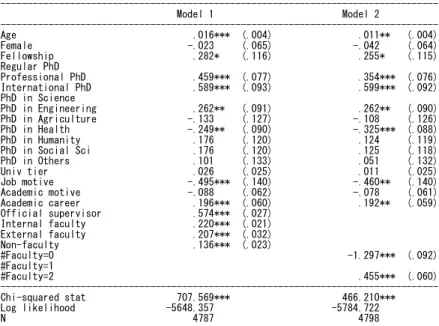
We examine the effect of the supervisory settings on the possibility of earning a degree in time (Table 3).
Model 1 shows that frequent supervisions by the official supervisor and by the external faculty members are significantly positively associated with degree attainment. Model 2, instead, uses #Faculty as the main independent variable. To distinguish the impact of having a single instructor and that of having a second instructor, Model 2 includes two corresponding dummy variables with #Faculty=1 as the reference group. The result shows that a lack of professional supervision is associated with failing to earning degrees, but that having multiple instructors has only insignificant impact. It is plausible that supervisors decided to give frequent instructions to PhDs who had seemed likely to earn degrees, so Models 3 and 4 control for PhDs' motives to pursue degrees. Indeed, PhDs whose motive was to delay job hunting are less likely to earn degrees, while those who aimed to attain academic jobs are more likely to do so. After controlling for these motives, the effect of the supervisory settings remains significant, implying that frequent supervision does increase the likelihood of earning degrees. We also ran the same model for several sets of subsamples, finding that the effect of the supervisory settings is rather consistent between student types, PhD fields, and university tiers. As to the control variables, the result suggests that young PhDs, PhDs with fellowship, and international PhDs are more likely to earn degrees than otherwise.
Second, Table 4 examines how the supervisory settings influence PhD's choice between academic and non-academic careers. As the dependent variable, academic career, is dichotomous, we use logistic regressions. Table 4A suggests that instructions by official supervisors and by external faculty members are positively associated (Model 1) -- or lack of it is negatively associated (Model 2) -- with academic career choice. Although PhDs who were not interested in academic careers might be unwilling to see supervisors frequently, the models have already controlled for PhD's motives, so the supervisory settings seem to influence the career choice. Because PhD degrees are often a precondition to obtain academic jobs, Models 3 and 4 additionally control for degree awarded. Though it somewhat weakens the effect of the supervisory settings, the magnitude of most coefficients remains unchanged, suggesting that supervisory settings affect the career choice independently from its influence on degree attainment.
Among the control variables, the result finds that females are more likely to pursue academic careers than males. Professional PhDs, who had jobs, are less likely to pursue academic careers than regular PhDs because many of them continued their original jobs. On the other hand, international PhDs are more likely to pursue academic careers as many of them explicitly aimed at degrees for academic career development.
Since Table 4A indicates significant differences between PhD fields, Table 4B splits the sample by PhD fields into STEM (Science, Engineering, and Agriculture), Health, and HASS (Humanities and Social
13
sciences). In STEM, non-faculty's supervision shows a significantly negative effect (Model 1). Frequent instruction by non-faculty researchers, presumably senior students and postdocs in the same lab, might imply that the lab was large and internal competition was severe, and thus, PhDs might find it difficult to pursue academic careers. In HASS, on the other hand, a lack of faculty's supervision shows a significantly negative effect (Model 6). This is perhaps because the less team-based nature of HASS research makes an instruction by a single faculty member all the more influential.
As the third measure of career outcomes, Table 5 examines how areas of jobs can be influenced by supervisory settings. Model 1 shows that the instruction by official supervisors is positively associated with job relatedness, implying that frequent instruction by supervisors reinforces PhDs' interest and encourages them to continue research in the same field. The model finds that academic career has a significantly positive effect because PhDs at academic jobs are obviously likely to continue related jobs.
Thus, we split PhDs who chose academic jobs (Models 3 and 4) and PhDs who chose non-academic jobs (Models 5 and 6), to find that the effect of supervisory settings is significant only for the academic subsample.
Models 5 and 6 also show that PhDs in Engineering, Agriculture, and Health tend to engage in related jobs in industry. As these three fields are applied, this result might suggest that these fields are successfully transferring knowledge workers to industry, as designed. Interestingly, the models show that PhDs who intended to delay job hunting are likely to find jobs unrelated to PhD subjects. Thus, training for PhDs with such a motive may be ineffective in transferring knowledge workers to industry.
14 Table 3. Prediction of degree awarded (Logistic regression)
--- Model 1 Model 2 Model 3 Model 4 --- Age -.016** (.006) -.017** (.006) -.015* (.006) -.016** (.006) Female -.136 (.104) -.143 (.104) -.130 (.105) -.136 (.104) Fellowship .947*** (.273) .951*** (.274) .924*** (.274) .931*** (.274) Regular PhD
Professional PhD .211† (.125) .204 (.125) .212† (.126) .206 (.126) International PhD .851*** (.165) .822*** (.163) .811*** (.166) .779*** (.165) PhD in Science
PhD in Engineering .274 (.186) .293 (.185) .307† (.186) .322† (.185) PhD in Agriculture .167 (.261) .122 (.257) .193 (.261) .148 (.257) PhD in Health .621*** (.184) .567** (.182) .619*** (.184) .562** (.183) PhD in Humanity -2.220*** (.174) -2.184*** (.172) -2.280*** (.176) -2.249*** (.174) PhD in Social Sci -1.613*** (.176) -1.601*** (.174) -1.663*** (.178) -1.653*** (.176) PhD in Others -1.235*** (.194) -1.224*** (.193) -1.301*** (.196) -1.294*** (.195) Univ tier .109** (.042) .098* (.042) .103* (.042) .092* (.042) Job motive -.501* (.237) -.513* (.235) Academic motive .257* (.102) .267** (.101) Official supervisor .246*** (.040) .246*** (.040) Internal faculty .060† (.036) .064† (.036) External faculty .165** (.056) .165** (.056) Non-faculty .001 (.041) .008 (.042)
#Faculty=0 -.644*** (.129) -.651*** (.130)
#Faculty=1
#Faculty=2 .162 (.106) .169 (.107) --- Chi-squared stat 746.997*** 736.271*** 756.285*** 745.811***
Log likelihood -1550.253 -1561.804 -1542.589 -1553.273 N 4800 4817 4792 4804 ---
Note: Unstandardized coefficients (standard errors in parentheses). Two-tailed test. †p < .10; *p < .05; **p < .01; ***p < .001. Regular PhD, PhD in Science, and #Faculty=1 are the reference groups for respective sets of independent variables.
15 Table 4. Prediction of academic career choice (Logistic regression)
(A) Base model
--- Model 1 Model 2 Model 3 Model 4 --- Age -.021*** (.005) -.020*** (.005) -.020*** (.005) -.019*** (.005) Female .325*** (.074) .336*** (.074) .338*** (.075) .350*** (.074) Fellowship .213 (.136) .184 (.135) .182 (.136) .153 (.136) Regular PhD
Professional PhD -.313*** (.086) -.308*** (.085) -.328*** (.086) -.322*** (.086) International PhD .280** (.106) .258* (.105) .241* (.106) .221* (.105) PhD in Science
PhD in Engineering -.335*** (.101) -.323** (.101) -.347*** (.102) -.336*** (.101) PhD in Agriculture .095 (.144) .069 (.143) .088 (.145) .063 (.144) PhD in Health .540*** (.101) .536*** (.100) .517*** (.102) .514*** (.101) PhD in Humanity .100 (.137) .135 (.136) .327* (.144) .362* (.144) PhD in Social Sci .205 (.135) .232† (.134) .344* (.138) .373** (.137) PhD in Others .568*** (.157) .583*** (.157) .672*** (.159) .687*** (.159) Univ tier .058* (.029) .052† (.029) .053† (.029) .047 (.029) Job motive -.499** (.160) -.509** (.160) -.478** (.161) -.487** (.160) Academic motive 1.119*** (.069) 1.125*** (.069) 1.113*** (.070) 1.118*** (.069) Degree awarded .558*** (.101) .564*** (.101) Official supervisor .059* (.028) .045 (.029) Internal faculty .032 (.024) .029 (.024) External faculty .114** (.036) .106** (.037) Non-faculty -.045† (.026) -.046† (.026)
#Faculty=0 -.222* (.104) -.177† (.105)
#Faculty=1
#Faculty=2 .078 (.068) .070 (.068) --- Chi-squared stat 634.000*** 620.651*** 664.694*** 652.177***
Log likelihood -2957.850 -2972.398 -2942.503 -2956.635 N 4792 4804 4792 4804 ---
(B) Field breakdown
--- Model 1 Model 2 Model 3 Model 4 Model 5 Model 6 STEM STEM Health Health HASS HASS --- Official supervisor .072 (.047) .067 (.047) .021 (.071) Internal faculty -.051 (.036) .120** (.041) .044 (.064) External faculty .026 (.056) .249*** (.065) .011 (.093) Non-faculty -.132*** (.037) .061 (.047) -.034 (.084)
#Faculty=0 -.116 (.174) -.197 (.197) -.484* (.204)
#Faculty=1
#Faculty=2 .124 (.101) .179 (.122) -.235 (.171) --- Chi-squared stat 439.050*** 423.198*** 124.745*** 109.928*** 75.878*** 81.075***
Log likelihood -1332.802 -1342.825 -875.494 -885.797 -525.423 -524.756 N 2240 2243 1408 1413 842 845 ---
Note: Unstandardized coefficients (standard errors in parentheses). Two-tailed test. †p < .10; *p < .05; **p < .01; ***p < .001. Regular PhD, PhD in Science, and #Faculty=1 are the reference groups for respective sets of independent variables. In Table (B), the control variables are omitted for parsimony.
16 Table 5. Prediction of job relatedness (Logistic regression)
--- Model 1 Model 2 Model 3 Model 4 Model 5 Model 6 All All Academic Academic Non-academic Non-academic --- Age -.009 (.007) -.010 (.007) -.015 (.013) -.012 (.013) -.009 (.009) -.011 (.009) Female -.320** (.117) -.316** (.117) -.081 (.198) -.019 (.197) -.426** (.149) -.421** (.148) Fellowship .441† (.248) .469† (.247) 1.204* (.604) 1.208* (.603) .232 (.287) .282 (.285) Regular PhD
Professional PhD .208 (.140) .225 (.139) -.477* (.243) -.483* (.241) .520** (.172) .521** (.170) International PhD .205 (.182) .203 (.180) .738* (.368) .756* (.367) -.050 (.225) -.065 (.222) PhD in Science
PhD in Engineering .423** (.157) .455** (.155) .450 (.336) .496 (.335) .405* (.181) .414* (.179) PhD in Agriculture .154 (.219) .134 (.217) -.497 (.347) -.542 (.347) .567* (.287) .538† (.282) PhD in Health .375* (.156) .336* (.154) .612* (.292) .457 (.288) .367† (.189) .364† (.187) PhD in Humanity .151 (.220) .120 (.220) .333 (.374) .236 (.372) .182 (.286) .144 (.285) PhD in Social Sci .061 (.208) .077 (.207) .294 (.374) .277 (.371) -.033 (.263) -.024 (.261) PhD in Others .416 (.253) .400 (.252) .731† (.438) .646 (.436) .317 (.323) .297 (.321) Univ tier .081† (.046) .072 (.046) .173* (.085) .153† (.084) .028 (.056) .026 (.056) Job motive -.808*** (.211) -.799*** (.210) -.571 (.446) -.552 (.446) -.829*** (.249) -.809** (.248) Academic motive -.076 (.117) -.077 (.117) .190 (.187) .214 (.186) -.270† (.150) -.270† (.149) Academic career 1.586*** (.115) 1.593*** (.114) Official supervisor .100* (.043) .204** (.072) .042 (.053) Internal faculty -.018 (.037) -.043 (.066) .021 (.046) External faculty -.078 (.054) -.001 (.097) -.099 (.067) Non-faculty -.019 (.041) -.110 (.073) .041 (.050)
#Faculty=0 .163 (.165) .416 (.322) .076 (.195)
#Faculty=1
#Faculty=2 .173 (.110) .462* (.201) .089 (.134) --- Chi-squared stat 284.524*** 279.759*** 57.227*** 52.244*** 61.827*** 56.832***
Log likelihood -1413.330 -1419.080 -511.399 -514.300 -869.655 -874.228 N 4559 4570 2721 2729 1838 1841 ---
Note: Unstandardized coefficients (standard errors in parentheses). Two-tailed test. †p < .10; *p < .05; **p < .01; ***p < .001. Regular PhD, PhD in Science, and #Faculty=1 are the reference groups for respective sets of independent variables.
17 5.2.2. Performance
Next, we examine the impact of supervisory settings on PhDs' performance drawing on two measurements. First, we use the publication count as the measure of scientific performance (Table 6).
Since this is a count variable, we use negative binomial regressions. Model 1 shows that instruction by external faculty members is positively associated with the publication count, suggesting that an external information source has positive impact on scientific performance. We suspect that the contribution of supervision should differ by the scientific performance of the instructors, so Models 3 and 4 add interaction terms of supervisory settings and the university tier. Model 3 finds positive interaction effects with instructions by official supervisors and by internal faculty members, suggesting that their instructions are effective only in high-tier universities. Similarly, Model 4 finds a positive interaction effect with instruction by multiple faculty members, suggesting that multiple instructors are effective only in high-tier universities.
Concerning control variables, Table 6 shows that female PhDs publish less than male PhDs. Fellowship is associated with more publications. Professional PhDs publish more than regular PhDs, perhaps because they have longer academic careers before enrolling in PhD programs. International PhDs also perform better than regular PhDs. Academic motive shows significantly positive coefficients and job motive negative coefficients, suggesting that scientific performance is predictable to some extent by their initial motives for PhD degrees.
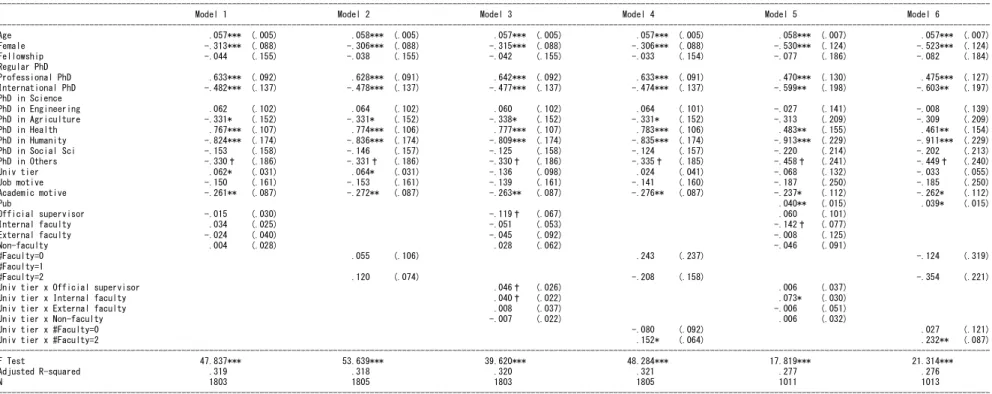
As publication performance may not be the best measure of non-academic performance, we also draw on the wage rate as a proxy of performance for a subsample of PhDs who found jobs outside academia (Table 7). Though Models 1 and 2 found no significant effect of supervisory settings, Models 3 and 4 show significant interaction effects with the university tier, similarly to Table 6, suggesting that instructions by official supervisors or by internal faculty members are effective only in high-tier universities. The wage rate can be determined on the basis of publication performance if one's job is research, so Models 5 and 6 additionally control for publication count using a subsample of non-academic PhDs whose job is research, which finds even clearer interaction effects.
As for control variables, age has a significantly positive effect because the salary system in Japan is often seniority-based. Females earn less than males. Professional PhDs earn more than regular PhDs for their supposedly higher skills and longer professional experience. International PhDs earn less than regular PhDs, even though the former exceeds the latter in publication performance. This is partly because the majority of international PhDs found jobs outside Japan, where the salary standard is lower.
Academic motive is negatively associated with the wage rate in non-academia, suggesting that those who initially intended to pursue academic careers but ended in non-academic careers earn less than those who did not have such initial intention.