KONAN UNIVERSITY
The CUBE English Program and a Content‑Based Approach to Instruction
著者(英) Brent Allen Jones, Roger W. PALMER journal or
publication title
Hirao School of Management review
volume 2
page range 30‑52
year 2012‑03‑30
URL http://doi.org/10.14990/00001642
Hirao
School of Management Review
本文情報
出版物タイトル: Hirao School of Management Review 巻: 第2巻
開始ページ: 30 終了ページ: 52
原稿種別: 論文(Article)
論文タイトル: The CUBE English Program and a Content-Based Approach to Instruction 第一著者: Brent A. Jones
第二著者: Roger Palmer
第一著者所属: 甲南大学マネジメント創造学部 教授 第二著者所属: 甲南大学マネジメント創造学部 専任講師
Hirao School of Management Review (2012), Vol.2, pp.30-52.
原稿種別:論文(Article)
30
Hirao School of Management Review 第 2
巻The CUBE English Program and a Content-Based Approach to Instruction
Brent A. Jones , Roger Palmer
【Abstract】
この論文では甲南大学のマネジメント創造学部、マネジメントコースの学生のための英 語プログラムについての概要を説明しています。この論文の目的はこの教育方法やプログ ラムに関心のある方々に学生のために言語習得を促進するためのカリキュラムと構成をよ り理解していただくことです。同時にこの機会に(1)プログラムの発展、(2)このプロブラ ムの使命達成部分、(3)改善点を検討します。 内容は私たちのプログラムと内容重視言語 学習(content-based instruction) の一般的な背景説明から始まり、学期ごとのフィー ドバックと調整、最後に提案された短期的、長期的な変更点と共に現在のプログラムの評 価方法で締めくくっています。
【Keywords】
content-based instruction, CBI, content and language integrated learning, CLIL, curriculum
1. Introduction
This paper is intended as an overview of the English language program for Management Course students at Konan University, Hirao School of Management (commonly referred to as CUBE). The main motivation for writing this paper was to provide stakeholders (students, teachers,
administrators) with a better understanding of the curriculum and how it is structured to promote language acquisition for our student body. At the same time, we have taken this opportunity to review (1) the evolution of the program, (2) where the program is succeeding in its mission, and (3)
Hirao School of Management, Konan University
Hirao School of Management, Konan University
31
plans for further improvement. Our narrative starts with some general background information on the program, proceeds to a general overview of both content-based instruction (CBI) and content and language integrated learning (CLIL), and concludes with our current assessment of the program together with suggested short- and long-term changes.
2. Early Stages
The seeds for the English program at CUBE were planted in 2004 and 2005, with the design and development of intensive intersession English programs for students in the Economics Department at the main campus of Konan University. These programs aimed at helping students develop their English language skills in a short-term, immersion-type program. The lectures, workshops and task- based activities were designed to provide exposure and practice with strategies and skills related to both business and language study. One key concept that emerged from these sessions was a shift from studying English (eigo wo benkyo suru) to studying “in” English (eigo de benkyo suru). The analogy that was used then and that has continued to serve the program is that we do not learn to ride a bicycle by reading and studying about bicycles (history, physics, engineering) but by actually getting on, peddling, steering, and even falling down sometimes.
Fast forward to 2007-08, plans began to emerge for the establishment of a new faculty on the occasion of the 90th anniversary of Konan Gakuen. One overall aim of the program was to draw on innovative teaching methodologies that provide students with more opportunities to apply and experiment with the knowledge and skills they are learning. Vision and mission statements emerged based on educational tenets outlined in writings by Konan’s founder, Hirao Hachisaburo, including
“nurturing civility,” “strengthening mind and body,” “respecting individual personality,” and
“fostering individual ability.” With the underlying educational philosophy of (1) fostering global citizens who are cultured, responsible and civil, (2) developing comprehensive management skills, and (3) nurturing young people who can contribute to local and global communities, the new department was intended as a hybrid between economics (keizaigaku) and business administration (keieigaku), with an emphasis on liberal arts education and practical English competencies. The name of the department in Japanese (manejimento sozo gakubu) highlights the aspiration for nurturing creativity, while the name in English (Hirao School of Management) aims to keep the passion of the school’s founder burning brightly.
With the help of key faculty in the Institute for Language and Culture (kokusai genbun bunka senta) at the main campus in Okamoto, a content-focused curriculum was outlined based on the principle of “the integration of general education with content-based English education,” delivered
32
via an English for Academic Purposes (EAP) program and integrated communicative approaches.
The primary goals were to (1) develop English communication skills for global communication, (2) foster cultural, cross-cultural and global literacy in order to contribute to local and global
communities, and (3) nurture critical and analytical thinking for effective self-expression in English.
The elements of CUBE English Courses are summarized in Table 1.
Table 1: Elements of CUBE English Courses
1 Content-based intensive and extensive reading for writing (from paragraph reading to paragraph writing and expository writing)
2 Process writing for coherent and cohesive multiple paragraph essays and research papers (compare/contrast, cause/effect, and pro/con paragraphs)
3 Public Speaking and Problem-solving, Discussions
4 Debate in English using reason, evidence and persuasion with effective delivery and visual aids 5 Research Paper (Scientific, analytical and critical perspectives)
6 Oral presentations based on research papers
7 Content-based English Education, English for Academic Purposes (EAP), Integrated Communicative Approaches
The English curriculum for Management Course students that emerged and was included in the proposal to the Ministry of Education, Science and Technology (MEXT) was as follows:
Required Courses (number in parentheses denotes koma or # of days per week):
First semester – American Studies (2), Speech and Discussion (2), Active Listening I (1) Second semester – Global Challenges (2), Discussion and Debate (2), Active Listening II (1) Third semester – Japan Studies (1), European Studies (1), TOEIC/TOEFL (1), Business Communication (1)
The initial student intake for the Management Course was 178 students, and eight sections of each course were created, with half of the students following one schedule (AS on Monday/Wednesday, and SD on Tuesday/Friday), and the other half having the reverse schedule (AS on Tuesday/Friday, and SD on Monday/Wednesday). All students met for AL on Thursdays, either first or second period.
Elective Courses (all classes meet once a week):
Fourth semester and beyond – Courses taught in English under the headings of (a) Regional Studies, (b) Media Studies, (c) Liberal Arts III, (d) Communication I, (e) Business Skills II
Early on, we adopted the following vision and mission statements for the English language program at CUBE:
33
Vision Statement: We aim to create and maintain a program that inspires students to reach for and achieve their language-learning potential. At the same time, we hope to foster a sense of wonder and develop critical thinking skills that will help students in their academic pursuits and beyond.
Mission Statement: Toward this vision, we will utilize the combined knowledge and skills of the faculty in offering a learner-centered, communicative approach to instruction in all classes. Courses will generally center on problem-based, project-based and task-based activities aimed at helping learners develop themselves as both individuals and as contributing members of various
communities of practice.
With the above pieces in place, we began designing and developing the courses in a way we felt best addressed and integrated the tenets of the overall program as well as the above vision and mission. Much of the groundwork for each course was done from early 2008 until the doors opened in April, 2009. Our main inspirations in designing the curriculum were Brown (1995), Van Leir (1996) and Brinton, Snow & Wesche (2003). The guiding principles and design decisions are outlined in Appendix 1.
3. Semester by Semester
Year One (2009/10) – Semester One
Two of our early decisions were to implement an English-Only policy for English classrooms and to try to establish as many links as possible among English courses and between the English courses and other topics or content students were learning each term. On the English side, we would
consider American Studies (AS) to be the core course and look for ways to support what they were learning there in the Speech and Discussion (SD) class as well as in Active Listening I (AL-I). We also encouraged AL-I teachers to look for listening material that connected with other semester one courses (i.e. Introductory Economics, IT Basics, WEB Basics, Fundamental Literacy).
Another early decision was to include work on all four language skills (reading, writing, speaking and listening) in each of our courses, but to have specific language skill emphasis in each. Although the focus would be on content, we designated AS as the course that would have an emphasis on reading and writing. SD would emphasize speaking, while AL-I would be heavy on listening. As for instructional method, we decided that all courses would include a combination of various activities (e.g., mini lecture, skills/concept workshop, student-led discussion, task-based or problem-based
34
activity). Appendix 2 includes the 2011-12 course description, course goals and lecture method for each of the semester one English courses for freshmen.
The textbook chosen for AS was An Illustrated History of the USA (Bryn O'Callaghan, 1990). We did have apprehensions that an emphasis on history would result, but tried to encourage instructors to connect ideas and issues from the textbook to modern society. We also understood and accepted that most instructors would not be experts in American Studies (history, society, culture, politics), but felt confident that an attitude of “let’s learn this together,” would be exciting and beneficial for both students and instructors. As for class activities and supplementary materials, the two tenured faculty members prepared mini lectures, scanning and skimming exercises, task-chains and other supplementary materials, and called on part-time faculty to create and share other teaching materials.
The hope was that we would build a repository of materials that could be added to each year (not only for AS but for other courses as well).
In terms of assessment, we strove for an equal weighting of Attendance/Participation,
Reading/Writing Assignments, Peer Review Assignments, Mini Quizzes, and an Individual Research Project. We also assigned learning portfolios, which were intended as a way to help learners keep track of their learning, demonstrate what progress they were making, and encourage both
personalization and creativity. An early draft of our extended syllabus for American Studies can be found on Wikispaces (http://cube-efl-program.wikispaces.com/american_studies).
For Speech and Discussion, we adopted the Speaking of Speech (Harrington & LeBeau, 2009) textbook, with the aim of introducing teacher- and student-led discussions on various topics as they naturally came up during the semester. One of the main supplements that was adopted by most instructors was an online video by Tony Buzan on the topic of mind maps as a thinking tool (http://www.youtube.com/watch?v=MlabrWv25qQ). The culminating event for semester one was the poster presentations based on content from American Studies and skills from Speech and Discussion.
As mentioned above, Active Listening was designed to establish links with other first semester courses. Three of the teachers taught two sections of this course, while two other teachers each taught one section. We intentionally chose not to assign a textbook for this course. Teachers instead prepared lessons based on online media found at YouTube, VOA Special English, and BBC Learning English.
On the administrative side, we decided not to stream students by language proficiency in any of the courses. Our hope was that more proficient students would provide a scaffold for lower proficiency students. We worried that students streamed at a lower level would be caught in a downward spiral
35
and suffer decreased motivation in their language studies. We also decided that all twice-a-week classes would be shared by two teachers. Additionally, teachers would have different partners for each of the twice-a-week classes they were assigned. This appealed to us in that it provided students with an opportunity to meet more teachers, and would encourage more interaction among teachers.
So, how did it work? The feedback we received (from both students and teachers) was mixed.
Some teachers and some groups of students had taken to our “study in English” approach, while others struggled and tuned out. The English-Only policy was not enforced in all classes, and the classroom atmosphere that developed among some groups encouraged the use of Japanese. Our own personal impression was positive. We enjoyed teaching the classes, and in general students
responded well to the high expectations that were placed upon them. Having said so, other teachers reported frustration and had trouble adjusting from other typical language-teaching contexts.
Some connections were made between classes, but this did not develop in any systematic or rational way. Looking back at the original Moodle site, we found lots of evidence of teacher creativity and investment in the program. The strongest connections were made to AS content via the AL-I classes.
For the AS course, we received lots of feedback that the textbook was too challenging and that many students could not keep up with the reading schedule, which had been set at roughly two (approx. 4-page) chapters per week. Also, several of the teachers seemed challenged in terms of how to use the textbook. The quality of research papers (set at 1,000 words) was also extremely varied. A rough estimate is that only ten to fifteen percent of the students fulfilled our expectations. Not because they students didn’t try, but because they didn’t have enough writing support.
The feedback we received on SD classes was encouraging. The textbook, Speaking of Speech (Harrington & LeBeau, 2009), was popular with most teachers and students. The lack of streaming seemed to be less of an issue in these classes. In general, students seemed to be making good
progress in public speaking. The one area of concern that emerged was that discussion was not being addressed in a consistent way.
The feedback we received on AL classes revealed that the materials and activities prepared by teachers were interesting, effective and topical.
Our overall impression was that the homework load (English and otherwise) for this first semester was too heavy for most students. Several students were spending three, four or more hours just on the reading for AS, some even translating whole units. We believe teachers in the English program and other courses went in with very high expectations, and that most students in the program were struggling to meet those expectations.
36
We also recognized that communication of CUBE English program policies and procedures to all of the teachers was not done in a systematic way, and that we did not have a framework for
observing classes and evaluating teachers.
Year One (2009/10) – Semester Two
Again, at this stage we still had only one cohort, and could keep our finger on the pulse of what was happening in various classes. The core course for semester two was Global Challenges (GC).
We had selected Topics for Global Citizenship (Peaty, 2005) for GC and Discussion Process and Principles (LeBeau & Harrington, 2006) for Discussion and Debate (DD). The link between the two courses was provided by Deliberative Polls (Appendix 3).
Active Listening II (AL-II) was basically an extension of AL-I. One adjustment was that some teachers assigned multimedia projects (slideshow movies or podcasts). Although the quality was limited, these projects were popular with students and boosted motivation.
Feedback from this semester highlighted that the GC textbook was limited in terms of both content and perspective. At the same time, the DD textbook was too complex in its structure and didn’t cover debating skills. Although we had a generally good impression of the Deliberative Polls, we soon realized that we needed more training and support for instructors.
Year Two (2010/11) – Semester One
This was the first semester when we had the entire curriculum up and running. Major adjustments included streaming for American Studies, using a Module format for Active Listening, and pairing teachers with only one partner. In general, we felt there was an across-the-board improvement in all courses for freshmen. In particular, AS seemed to have benefited from streaming, the lighter reading load and greater familiarity with the course and materials. SD saw incremental improvements and was again favorably commented on by both teachers and students. The module format (explained under Semester Two) also worked fairly well. Some cracks, however, began to appear in the program as duties and time demands on tenured faculty increased. With the increase in number of students on campus, some teachers reported increased discipline problems. We also experienced difficulty in answering all questions raised by instructors. It was already recognized that with an increasing load of responsibilities on the two tenured faculty overseeing the language programs, we would need help. We were able to hire one full-time instructor for the Management Course English program. One early contribution made by the full-time instructor was the introduction of the Sentence Verification Technique (SVT) as a measure of students’ comprehension in the reading
37
content for American Studies, and potentially for some listening content or any academic skills in reading and/or listening.
In brief, SVT can be used to assess the comprehension of texts by creating 4 sentences - an exact sentence
- a paraphrase with the similar meaning
- a meaning change where having some words changed alters the meaning - a distractor of similar syntax and complexity but unrelated to the reading
Although some instructors experimented with SVT, we did not have a structure in place to support and monitor its use.
In designing the Japan Studies (JS) course, we wanted to avoid the typical “uniqueness of Japan”
views. We selected the textbook Insights (Shaules & Miyazoe, 2005), which is based on a collection of essays by Karen Hill Anton for the Japan Times. The response to the textbook was not favorable, and we struggled to identify what we hoped to accomplish with this course.
For European Studies (ES), we were not able to find a suitable text. However, this worked out in our favor in that teachers collaborated and pooled resources. Together, we adopted and created mini lectures on European art, history, geography and philosophy. One approach we followed was to have each student become an expert on one or two European countries. Students also chose a theme and prepared and delivered a poster presentation. To boost student interest in the content, we contacted the Delegation of the European Union to Japan for support materials (maps, pamphlets, guidebooks, statistics, etc.) and invited a political analyst who spoke on issues and challenges in the EU.
We did not stream by language proficiency for the JS and ES courses, but did so for both TOEIC/TOEFL and Business Communication. The same students were studying together for these two classes.
For TOEIC/TOEFL (TT), we aimed at a balance of strategy awareness raising activities and skills practice. The two approved textbooks were Academic Connections 1 (Cassriel & Martinsen, 2010) published by Pearson, and Achieve TOEFL iBT Test Preparation (Rilcy & Wyatt, 2009) published by Marshall Cavendish. We did not receive any negative feedback on the textbooks other than the problem of covering all the material in fifteen classes.
We asked the full-time instructor to take the lead on the Business Communication (BC) course.
Our intention was to give students some practical experience in using the English skills they had been developing in our program. The approved textbooks for this course were the elementary and intermediate skills books from the Intelligent Business series published by Pearson. Other than some
38
missteps with some students buying the wrong book, we received generally favorable feedback for these classes.
Year Two (2010/11) – Semester Two
We changed the textbook for both GC and DD this semester. For GC, we selected a textbook from Facing the Future titled It’s All Connected (Wheeler, Wheeler & Church, 2005), which we felt was a better follow up to the AS textbook, and had supplementary materials. For DD, we adopted Discover Debate (Lubetsky, LeBeau & Harrington, 2000), which was judged to be a much better fit.
Teachers and students struggled with the GC text, with some teachers commenting that it was almost like an encyclopedia. Some teachers relied more on handouts and other supplementary material to make the contents accessible to students.
Two additions to the DD course, were discussion circles and writing logs. Discussion circles involved a rotating system in which one student would act as discussion leader and other students would prepare for discussions on a topic of the leader’s choosing. The mechanics of the activity were quite intricate, and conducting the discussions consumed large amounts of class time. Also, the activity breaks down when students don’t prepare. We do not have a clear understanding of how the writing logs were actually used by individual teachers. In general, teachers who shared a class either used the textbook and taught debate, or led the deliberative polls and discussion circles.
For AL-II, we again adopted a module format in which the teachers prepared lectures and activities on one of four topics (Business/Management, Global Issues, Current Events & Deliberative Polls), and then rotated around the different classes in 3-week cycles. Teachers returned to their original group of students on day 14 and a comprehensive test was administered. Learning portfolios
accounted for 20% of the grade, but we found a huge gap in how well the students were utilizing the portfolios. We interpreted this as showing that students did not know what was expected of them.
The quality of the portfolio also impacted on how well students performed on the test.
Year Three (2011/12 – Semester One
This semester got off to a rough start. Our review of the curriculum and adjustments were
drastically interrupted by the Great East Japan Earthquake, subsequent tsunami and nuclear disasters, as well as various personnel issues. Teams of instructors were working on different parts of the curriculum, but communications broke down in the incorporation and implementation of proposed changes. A proper orientation was not prepared for the new incoming full-time faculty member
39
(contract position), and much of the explanation and guidance for this teacher were shouldered by our other full-time, contract teacher in the management course.
We attempted to provide instructors with much more direction in terms of how to address each language skill in the AS curriculum. Three instructors experimented with a different textbook (Impressions 1), which includes more structure and targets part of the Academic Word List (AWL).
All three teachers reported favorably. Another development was the introduction of an American Studies Fair, which was designed to break up the semester and offer students an outlet for their creativity.
A conscious attempt was made to spread out the homework load and timing of major deliverables across the curriculum. Together with streaming in the AS course, this seemed to lighten the burden on students and had a positive impact on student and teacher satisfaction. One continuing challenge was the very top and very bottom AS classes. This will be discussed further in our conclusion.
The following activities were introduced into the Speech and Discussion curriculum:
Sustained Silent Reading (SSR) - Students bring graded readers they are reading for Active Listening I class, and spend 10 to 15 minutes focused on reading silently by themselves.
Discussion Circles - 15-minute discussions (4 – 5 people) of the graded readers being read outside of class. To prepare, students complete a discussion circle worksheet for the book they are reading.
Personal Writing Log - Using model paragraphs as examples, students identify patterns and phrases used to talk about themselves, their hometown, family and interests. They then substitute in their own details to create personalized paragraphs. These can then be used for short in-class speeches.
AL-I was again taught in modules (Study Skills/CUBE English, Economics, Current Affairs, Public Speaking). The final comprehensive test again proved challenging for students with poor study habits. Coordinating among teachers in regards to portfolios and reaction papers to each module was an administrative nightmare.
We felt that JS was the one third-semester course that lent itself to a module format. We chose not to continue with the Insights textbook, and instead assigned teachers with one of four three-week modules to develop (Business/Management, Society/Culture, Current Affairs, Environmental Issues).
Some students expressed satisfaction with the format and content, while others were not sure of the aims of JS within the CUBE English program.
40
In ES, we formalized the requirement to become an expert on one EU and one non-EU country. We continued with the poster presentations, and the general quality seemed to improve over the previous year. We believe the clearer expectations were at least partially responsible for this. We again invited a political analyst to speak on current issues related to the EU.
In TT, we required Academic Connections 1 (Cassriel & Martinsen, 2010) for all classes, and began using the online component. Again, we received conflicting reports on satisfaction and execution. We feel that targeting both tests may not be the best approach, and that offering students the choice of one or both might be preferable.
The major adjustments for BC were (1) to settle on one textbook (Intelligent Business Skills Book – Elementary), and (2) introduction of a Job Fair project which brought classes together somewhere around week 10. This provided students with practice with resumé preparation and interviewing.
Year Three (2011/12) – Semester Two
One bright spot for this semester was the shift to Making Connections (Face the Future) as the course book for GC. Although we were not able to secure enough teacher manuals in time for the start of the semester, teachers eventually had good things to say about the textbook, supplementary activities/materials and support. We will continue with this textbook for the 2012/13 school year.
We continued with the same textbook (Discover Debate) and the deliberative polls for DD.
Teachers have reported a clearer understanding and better flow to the deliberative polls. One problem arose when one of the teachers opted out of the final debates. This caused more than a little confusion and consternation. We do, however, plan to continue along the same lines with this course.
The one adjustment we made to AL-II was to have teachers administer a test on their material before moving on to the next group of students. This was a substantial improvement and seemed to help students consolidate their understanding before moving on to a new topic.
Before discussing our plans for curriculum improvement, we will provide short overviews of content-based instruction (CBI) and content and language integrated learning (CLIL) together with how we see these frameworks supporting our program.
4. Content-Based Instruction (CBI)
Our decision to adopt a content-focused curriculum was greatly influenced by findings and developments in the fields of language teaching and second-language acquisition related to Content- Based Instruction (CBI) and more recently Content and Language Integrated Learning (CLIL).
Although the practice of learning (and teaching) a new language via authentic subject matter has a
41
long history, it is only the past twenty years or so that empirical studies have been seriously undertaken and that clear examples and viable templates have been published (see, for example, Brinton, Snow & Wesche, 2003). The rationale outlined by Brinton, Snow and Wesche (2003) is that a CBI curriculum:
- offers learners the necessary conditions for second language learning by exposing them to meaningful language;
- builds on the learner’s previous learning experiences in the subject matter, the target language, and in formal educational settings;
- takes into account the interests and needs of the learners through their engagement with the academic subject matter and discourse patterns that they need to master;
- allows a focus on (communicative language) use as well as on (accurate) usage; and - incorporates the eventual uses the learner will make of the language through
engagement with relevant content and L2 discourse with a purpose other than language teaching.
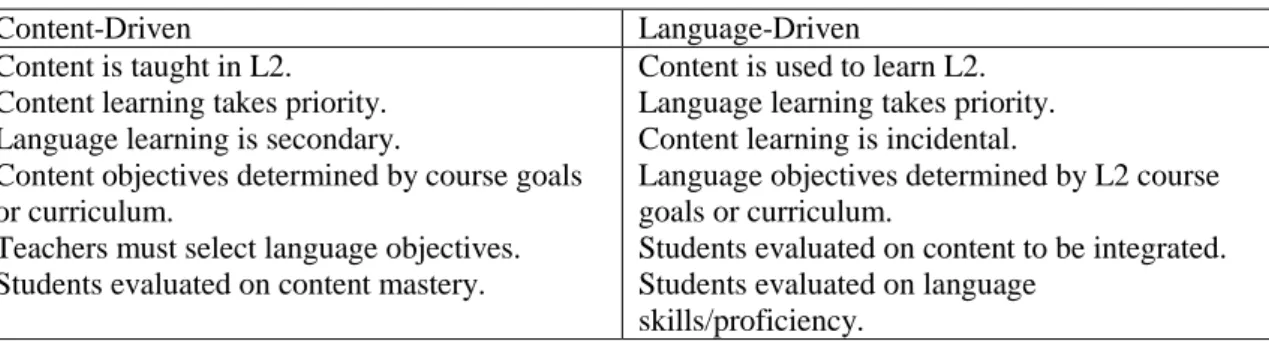
The dominant models of CBI that have appeared are (1) Theme-Based Language Instruction, (2) Sheltered Content Instruction, and (3) Adjunct Language Instruction. These and other CBI models differ from one another in terms of being content or language driven. Table 2 highlights some of the characteristics of each.
Table 2. Characteristics of Content and Language Driven CBI Curriculums
Content-Driven Language-Driven
Content is taught in L2.
Content learning takes priority.
Language learning is secondary.
Content objectives determined by course goals or curriculum.
Teachers must select language objectives.
Students evaluated on content mastery.
Content is used to learn L2.
Language learning takes priority.
Content learning is incidental.
Language objectives determined by L2 course goals or curriculum.
Students evaluated on content to be integrated.
Students evaluated on language skills/proficiency.
Theme or topic-based language courses are used to bring subject matter into the language classroom. The materials chosen provide a springboard for analyzing and studying language. In comparison, sheltered courses are content courses that include help with target language meaning and subtleties. Finally, the adjunct model involves separate but coordinated classes, one with a focus on the content and the other with language support related to that content. In terms of instructional
42
format, the three models differ in the degree of explicit integration of language and content (Brinton, Snow & Wesche, 2003). Figure 1 shows how each of these models fall on a CBI continuum.
Theme-Based Model
Sheltered Model
Adjunct Model
Language Class --- Mainstream Class Figure 1. A Content-Based Continuum.
Some key characteristics of each model are listed below.
Sheltered Model
- Learners are given special assistance.
- Sometimes two teachers can work together to give instruction in a specific subject.
- The Content Specialist will give a short lecture and then the English Specialist will check that the students have understood the important words by reviewing them later.
Adjunct Model
- Students are expected to learn content material while simultaneously acquiring academic language proficiency.
- Content instructors and language instructors share responsibility for student learning.
Theme-Based Model
- The goal of these courses is to help students develop L2 skills and proficiency.
- Themes are selected based on their potential to contribute to the learner’s language growth in specific topical or functional domains.
- Theme-based courses are taught by language instructors to L2 learners who are evaluated in terms of their language growth.
- Content learning is incidental.
The CBI approach is somewhat related to (1) English for Specific Purposes (ESP), which usually is for vocational or occupational needs, and (2) English for Academic Purposes (EAP). The goal of CBI is to help students acquire a new language using the context of specific subject matter. The assumption is that students learn the language by using it within the specific context. Rather than learning a language out of context, it is learned within the context of a specific academic subject.
CBI has also been gaining attention in the EU.
43
The integration of language & content teaching is perceived by the European Commission as "an excellent way of making progress in a foreign language". CBI effectively increases learners' English language proficiency & teaches them the skills necessary for success in various professions. With CBI, learners gradually acquire greater control of the English language, enabling them to participate more fully in an increasingly complex academic & social environment.
(Wikipedia)
In CBI, there is a move away from teacher as instructor to teacher as facilitator, with an emphasis on cooperative learning. This results in new arrangements and possibilities for learning, such as in the jigsaw classroom, where students become "experts" on one part of a group project and teach it to the others in their group. For example, in the European Studies course at CUBE, the syllabus is explicit about what is meant by cooperation and student responsibilities:
Student-led research and weekly schedule
Students will conduct ongoing individual research and are required to become experts on one EU and one non-EU European country. They are expected to keep up on its news throughout the term.
Putting learners at the heart of the learning process fits in with the aims of the entire program. The concept of CUBE from its inception has been to mesh instructional strategies such as:
PBL (Problem-based or Project-based Learning)
Learning via complex, multifaceted, and realistic problems
ABL (Activity-based Learning)
Learning through actively exploring and experience
SDL (Self-directed Learning) Learning through one’s own efforts
CBI is a way of putting these strategies to work and helping students realize their language learning potential. How CBI works in practice is harder to pin down, and some instructors have requested
44
more concrete, step-by-step support. Although CBI is still referenced in second language acquisition literature, some academics have taken to the concept of content and language integrated learning (CLIL).
5. Content and Language Integrated Learning (CLIL)
According to the Content and Language Integrated Learning page (2012) on the European
Commission Languages website, CLIL is an approach to teaching and learning that involves subjects being taught through the medium of a language other than that normally used in class, and in that respect is the heir to a number of successful partial immersion programs. A benefit for the learner is that they can gain new knowledge about subject content while at the same time coming into contact with, learning about, using and improving the L2 or other foreign language. Knowledge of the language in the context of the highly technological societies of the twenty-first century helps
students develop core skills and competencies in their L1 at the same time. The kinds of 21st century skills that are brought to mind are those of critical thinking, problem solving, creativity and
innovation, communication, collaboration, information and ICT literacies, self-initiative, social interaction, productivity, and leadership (for a related discussion, see Framework for 21st Century Learning, 2012 on the Partnership for 21st Century Skills website).
It is important to note in relation to the CUBE English program that while CLIL emphasizes the need to teach the subject and new language in tandem, it does not represent a top-down methodology welded on to the curriculum. In fact, it allows for a number of methods for language and content teaching.
The benefits of a CLIL approach are numerous, and may form a good match for our program aims moving forward. Increased motivation raises the potential for enhanced performance in and
production of both language and content, greater confidence in both English and the L1, and sharper thinking skills. A further advantage in an increasingly competitive job market, and especially given that our students are Management majors, appears to be in developing an intercultural mindset which will potentially make them more employable, while serving them well when embarking on their careers.
In sum, the strength of CLIL lies in its attempt to apply principles created through research on varieties of language immersion programs and their efficacy. Students are encouraged to use their language skills now, and learn new language “just in time.” As such, it differs markedly from learning first in a decontextualized “language for the sake of language” classroom, where students would only be applying or realizing their language skills later, if at all.
45 6. Current Assessment and Planned Improvements
To assess the CUBE English program, we have collected data in the form of scores on standardized tests (CASEC, GTEC, Michigan Test), writing samples, course grades, and semester-end reflections by instructors. Although we are still analyzing the data, we have ample anecdotal evidence that the majority of students are satisfied with the overall program and their individual classes, and that students exerting the effort to do well in the their English classes are making steady improvements in terms of fluency, accuracy and confidence. At the same time, we recognize that a significant number of students have been disenfranchised. We have identified several causes, the main of which are (1) insufficient understanding of the aims and rationale, (2) lack of involvement/enthusiasm on the part of classmates, (3) lack of language support, and (4) perceived lack of relevance of some
content/materials.
Although we continue to have trouble with both organization and communication, we have made incremental improvements from semester to semester and from year to year. The program is gaining attention among language teachers throughout Kansai and beyond, and hopefully this will help build our reputation among students.
The main challenges we have identified can be summarized as follows:
- Understanding (buy in) of the program still low among students, faculty, staff - Lower level students getting left behind
- Higher level students not fully satisfied/challenged
- Natural limitations on what we can achieve in only three semesters - Not clear what students can DO when they leave CUBE
- Limited out-of-class (self access) study by significant number of students - Limited support of other faculty
Based on our review of the Management Course English curriculum, we are proceeding with the following short and long-term adjustments:
- Moving all sections of twice a week courses (AS, SD, GC, DD) to the same two days (i.e. SD on Mon/Wed, AS on Tue/Thu). We believe this change will lessen the burden on teachers in terms of lesson planning and preparation, and allow them to better focus
46
their energies. We also believe this will help in terms of communication among teachers as well as between teachers and students.
- Include in our orientation for students an introduction to CBI and CLIL (explicit teaching of the concepts and language)
- Further emphasis on READING (ER & IR)
- Introduction of CEFR “Can Do” statements and Language Learning Portfolio - Three-tier (high, middle and low proficiency) structure for most classes - Support structure for low-level students (e.g. mentoring, writing help desk) - Incentive system for upper level students
- Introduce TOEIC and speaking assessment to supplement Michigan Test, GTEC and writing sample
Other Changes include the introduction of:
- Radar graphs (language learning & delivery) for each required course
- Improved curriculum mapping (where are students going, where do they get practice with each skill)
- Strengthened role of English O-Zone
- Clear list of roles and responsibilities for the coordinator, full-time teachers and part- time teachers
- Teachers handbook with policy and procedures
- Course handbooks with clear directives and suggestions - A “less is more” policy (depth vs. breadth) for some courses - Increased FD for all teachers
7. Conclusions
While the current curriculum can be both challenging and demanding for the teacher and the students, it has also proved to be very stimulating and rewarding. The degree to which we continue to adhere to this approach may well depend on the willingness of our students, the faculty, the institution and the availability of resources. We will need to continue trying to involve other faculty members, particularly teachers of core subjects. This could help us both in terms of identifying key subject matter and in having the support of others in helping evaluate the program. We also need to involve students more in deciding what topics and subjects the lessons are based around and find out
47
how they feel these kind of lessons compare to their other language learning experiences. In the end, they will be the measure of our success.
Although the process has been anything but smooth sailing, we still feel strongly committed to a CBI or CLIL approach for our English program at CUBE. We have identified some
weakness/shortcomings to this approach, but with better teacher training, communication,
stakeholder buy in and support, this program will help us fulfill our vision of helping each learning to achieve their language-learning potential.
8. References
Brinton, D. (2003). Content-based instruction. In D. Nunan (Ed.), Practical English Language Teaching (pp. 199–224). New York: McGraw Hill.
Brinton, D., Snow, M. & Wesche, M. (2003). Content-based second language instruction. Ann Arbor: University of Michigan Press.
Brown, J. D. (1995). The elements of language curriculum: A systematic approach to program development. New York: Heinle & Heinle.
Cassriel, B. & Martinsen, M. (2010). Academic connections 1. New York: Pearson.
Content and Language Integrated Learning. (January, 2012) In European Union Languages.
Retrieved Jan. 21, 2012, from http://ec.europa.eu/languages/index_en.htm.
Framework for 21st Century Learning. (February, 2012). In Partnership for 21st Century Skills.
Retrieved Feb. 1, 2012, from http://http://www.p21.org/
Harrington, D. & LeBeau, C. (2009). Speaking of speech, 3rd Edition. Tokyo: Macmillan Language House, Ltd.
LeBeau, C. & Harrington, D. (2006). Discussion process and principles. Eugene: Language Solutions.
Lubetsky, M., LeBeau, C., Harrington, D. (2000). Discover debate: Basic skills for supporting and refuting opinions. Medford, Oregon: Language Solutions, Inc.
O’Callaghan, B. (1990). An illustrated history of the USA. Essex: Longman.
Peaty, D. (2005). Topics for global citizenship. Tokyo: Kinseido.
Rilcy, R. & Wyatt, R. (2009). Achieve TOEFL iBT: Test preparation guide. London: Marshall Cavendish.
Shaules, J. & Miyazoe, T. (2005). Insights: Critical thinking through cross-cultural essays. Tokyo:
Nan'un-do.
48
Van Lier, L. (1996). Interaction in the language curriculum: Awareness, autonomy, and authenticity.
London: Longman.
Wheeler, B., Wheeler, G., & Church, W. (2005). It’s all connected: A comprehensive guide to global issues and sustainable solutions. Seattle: Facing the Future.
Content-Based Instruction. (October 2011) In Wikipedia: The Free Encyclopedia online. Retrieved Oct. 22, 2011, from http://en.wikipedia.org
Appendix 1 – Guiding Principles and Design Decisions
Guiding Principles
- Effective and efficient use of existing resources,
- Balance between face-to-face meetings and self-access materials, - Balance between concept learning and procedural learning, - Activities and materials that appeal to various learning styles, - Activities and materials that are intrinsically motivating,
- Teaching methodology based on accepted and emerging theories of learning, - Activities and materials that promote success and boost confidence,
- Get students active within the first five minutes of any encounter, - Include non-native varieties of English
Design Decisions
1. Clear performance objectives will be established at both the macro (curriculum) and micro (task/activity) levels (see, for example, Mager, 1997).
2. The curriculum will include work on all four language-skills (reading, writing, listening and speaking) but will concentrate more effort on improving the receptive skills of reading and listening at earlier stages and productive skills later in the program.
3. Criterion-referenced test items will be developed to clearly measure progress and performance (see, for example, Shrock & Coscarelli, 1989).
4. All components will have the underlying goal of increasing familiarity with the most frequent words in the English language. (Nation, 2002)
5. Attention will be focused on improving both language competencies (including communication strategies) and social skills.
49
6. Attention will also be directed at raising cross-cultural awareness and nurturing positive language learning attitudes and beliefs.
7. Individualized instruction will be implemented whenever possible.
8. Emphasis will be placed on transfer of knowledge/skills to outside pursuits.
Appendix 2 – Course Descriptions, Course Goals and Lecture Methods (Semester One)
Subject(科目)American Studies (Semester 1)
Course Description(講義内容)
American Studies is a required semester-long course for first year students. This course explores key areas of study related to America, with a focus on cultural, economic, historical, political and social issues in the United States. Where possible, students will be challenged to consider developments in America as they relate to Japan and the broader global context.
Course Goals(到達目標)
The main goal of the course is to provide students with a basic understanding of a broad range of topics and issues, including past and future challenges. Additionally, students will develop and refine reading, writing and critical thinking skills that will help them in their other studies and future endeavors. Upon completion of the course, students will demonstrate the ability to (1) explain major social and political currents in the U.S., (2) identify major historical figures and key geographic locations, (3) employ various strategies related to reading skills, and (4) write well-organized, multiple-paragraph passages on topics of interest in the field of American Studies.
Lecture Method(講義方法)This course will include a combination of the following:
(1) mini lectures (with note-taking) on specific topics related to American Studies, (2) practice with reading skills such as skimming and scanning,
(3) workshops focused on different stages of the writing process, (4) student-led discussions in pairs or small groups, and
(5) problem-based activities with the presentation of findings.
50 Subject (科目) Speech and Discussion (Semester 1)
Course Description (講義内容)
This course introduces key concepts and skills related to public speaking and other forms of communication. Students will prepare and deliver short speeches (informative, persuasive and entertainment) on topics of their choice. Attention will be focused on both content and delivery.
Students will also practice group discussions on topics from their extensive reading.
Course Goals (到達目標)
The main goal of the course is to build a foundation of confidence, knowledge and skills required to prepare and deliver effective presentations and participate in extended discussions. Upon completion of the course, students will demonstrate the ability to:
a. explain key public-speaking concepts,
b. deliver well-organized speeches (formal & informal) with various types of visual support, and c. use verbal and non-verbal communication effectively in a variety of settings.
Lecture Method(講義方法)
Class meetings will include a combination of the following: (1) short lecture on a topic or concept related to public speaking, (2) communicative exercise in pairs or small groups, (3) workshop for developing specific public speaking skills, (4) student presentations with peer review, and (5) task- based activity to highlight specific concepts such as the use of anecdotes, metaphor, etc., and (6) in- class sustained silent reading (SSR) and discussion.
Subject(科目)Active Listening I (Semester 1)
Course Description(講義内容)
This course introduces key concepts and sub-skills related to improved listening proficiency. A variety of materials and tasks will be used with the aim of developing effective listening strategies for a broad range of contexts. Topics will include contemporary issues that relate to material covered in other courses as well as current happenings in Japan and the world. Extensive reading and
listening input will be used to support English language development.
51 Course Goals(到達目標)
The main goal of the course is to help students along their path of development in the various learning domains (cognitive, affective and interpersonal) as related to listening strategies and skills in English. Upon completion of the course, students will demonstrate the ability to (1) identify key points including in short lectures or other presentations, (2) employ various strategies related to the listening sub-skills, (3) participate in extended discussions on topics from their other courses, (4) write clear notes when listening to a short lecture or presentation, (5) read smoothly at their own level and write book reports with summaries and impressions.
Lecture Method(講義方法)
Each meeting will include a combination of (1) a short lecture on a specific concept or sub-skill related to listening, (2) focused practice on listening sub-skills such as listening for gist, (3) internet searches for listening material on specific topics, (4) mini workshop focused on listening sub-skills and/or concepts, (5) discussions based on student-generated book reports.
Appendix 3 – Overview of Deliberative Polls
A one-page introduction to...Deliberative Polls
Teachers Key resources at Stanford.
http://cdd.stanford.edu/polls/
Students Watch the Japanese-language summary first from the Stanford site.
http://www.veoh.com/watch/v20358665FCSCdRD4
Be sure to walk the class through the graphic that can be downloaded from the Stanford site, entitled deliberative-polling-flyer-en.
Step-by-step Guide to CUBE Deliberative Polls
Action item Due date
- Brainstorm key public issues: select one issue for the class
52
- Carry out background reading on the issue (English, Japanese) - Design a poll/survey in groups. Narrow & refine questions.
Poll 1
- Administer survey on random sample of public and students - Analyze data. Research all sides of the arguments.
- Introduce mini-debates.
Balanced Information
- Students act as experts to design balanced briefing materials.
Small group discussions
- Students role-play a sample of public.
- Some act as members of randomly assigned groups.
- Others act as trained moderators.
Plenary sessions
- Participants pose questions - chosen by groups - to experts.
Poll 2
- Presentation Practice in groups with briefing materials.
- Presentations to other classes.
- Final Report: analysis of findings and the DP process