
Introduction
On 26 December 2004, the tsunami catastrophe which occurred off the coast of Sumatra caused a large number of deaths, displaced many families, and damaged numerous properties and infrastructures of the surrounding countries.
Sri Lanka was the second most seriously affected country after Indonesia, with more than 31,000 deaths, nearly one
million people left homeless and 4,000 children left without parents.
1Millions of children and adults were exposed to traumatic events and suffered morbidity primarily resulting from near-drowning and traumatic injuries. Human, physi- cal, social, and economic resources in Sri Lanka, especially in the southwest coastal belt, were hugely affected after the tsunami.
While physical health was of primary concern in the early
Address correspondence:Sumihisa Honda, Ph.D., Department of Public Health, Nagasaki University Graduate School of Biomedical Sciences, 1-12-4 Sakamoto, Nagasaki 852-8523, JAPANTEL: +81-(0)95-819-7067 FAX: +81-(0)95-819-7069 E-mail: [email protected] Received June 16, 2010; Accepted August 5, 2010
MS#AMN 07069
Post-Traumatic Stress Disorder Among Senior Victims of Tsunami-Affected Areas in Southern Sri Lanka
Ayumi N
OMURA,
1, 2Sumihisa H
ONDA,
3Hajime H
AYAKAWA,
4Sarath A
MARASINGHE,
5Kiyoshi A
OYAGI31Department of Nursing, Nagasaki University Graduate School of Biomedical Sciences, Nagasaki, Japan
2Doctoral Course of Infection Research, Nagasaki University Graduate School of Biomedical Sciences, Nagasaki, Japan
3Department of Public Health, Nagasaki University Graduate School of Biomedical Sciences, Nagasaki, Japan
4Keio Futsubu School, Yokohama, Japan
5Department of Sociology, University of Ruhuna, Matara, Sri Lanka
Background:On 26 December 2004, a large earthquake occurred off the coast of Sumatra, and a devastating tsunami struck surrounding countries. Sri Lanka was seriously affected, with more than 31,000 deaths and 4,000 people missing.
Objective:To elucidate the relationship between factors of tsunami-related exposure and mental health conditions among the senior residents of tsunami-affected areas in southern Sri Lanka.
Subjects:A total of 90 subjects (43 men, 47 women) aged 60 years or older who were living in the Matara district at the time of the tsunami attack.
Methods:A survey by interview using a structured questionnaire was conducted in 2008. The collected information included demographic factors, tsunami-related exposure and mental health conditions. The Impact of Event Scale-Revised (IES-R) was used to assess their post-traumatic stress disorder symptoms.
Results:The median of the IES-R score was significantly higher in those who were situated at home; those who saw anyone the dead or injured; those whose evacuations were delayed; those whose family member or friend was injured; those who were injured; those who lost their children, spouse or family members; those whose family member was missing; those who lost livelihood, compared with those who were not or those who did not. Multiple linear regression analysis showed that younger age and loss of or injury to family members due to the tsunami were significantly associated with an increase in IES-R score.
Conclusion:The results indicate that tsunami-related exposures have affected elderly survivors' mental health.
ACTA MEDICA NAGASAKIENSIA 55: 41−46, 2010 Keywords: Post-traumatic stress disorder; senior; tsunami; Sri Lanka
recovery phase, the mental effects of tsunami-related expo- sure have begun to receive much attention.
2-4The majority of people exposed to natural disasters have been found to be resilient, and show few mental sequelae. However, previous studies also suggest that serious mental health problems prevail among a substantial proportion of those exposed.
5-7For example, post-traumatic stress disorder symptoms in Sri Lankan teenagers have been shown to be related to the level of pain and suffering experienced during the tsunami.
8, 9However, studies on the mental effects of tsunami exposure in elderly residents have been limited. Also, according to those studies that have been done, the prevalence of post- traumatic stress disorder (PTSD) among the tsunami-exposed elderly varies across a wide range.
10, 11Older people are as- sumed to be more vulnerable to stress in general and thus tend to react more severely to disastrous events.
12, 13The tsunami-affected elderly may continue to exhibit severe level of traumatic reactions following the disaster exposure.
The need to focus on the mental health consequences of the tsunami-exposed elderly has been emphasized.
14-16The purpose of the present study was to elucidate the re- lationship between factors of tsunami-related exposure and mental health conditions among the senior residents of tsu- nami-affected areas in southern Sri Lanka. A survey by in- terview using a structured questionnaire was conducted to investigate mental health conditions among the affected residents.
Methods Study area
The present study was conducted in the Matara district, a southern area of Sri Lanka. The three villages of Thotamuna, Polhena and Madiha, which were severely damaged by the tsunami, were selected for the survey. Since the villages are located in coastal areas, inhabitants rely heavily on fishing as their main occupation.
The University of Ruhuna, located in the Matara district, conducted a survey on tsunami victims. According to the survey, the total number of tsunami affected families in the Matara District was 7648. Polhena, Thotamuna, and Madiha East are included in the region where the damage was most severe. In each of these areas more than 200 families were reported to have been affected. Polhena was one of the most affected villages in the district. The number of victims was 707 in Polhena alone. Polhena was a densely populated area in the Matara district where a considerable number of
families depended on tourism. Most of the tourist resorts, restaurants, and hotels were completely or partially dam- aged by the tsunami. Thotamuna was another village seri- ously affected in the Matara district. The number of af- fected families in the village was 409. Since Thotamuna is located close to the estuary of the Nilwala River, the tsu- nami waves came through the estuary and easily inundated the village. Like Polhena, the Madiha East village is very close to the beach. The absence of a natural barrier to break the tsunami wave attacks allowed severe damages to the village. The number of people affected by the tsunami was 491.
Survey
A structured questionnaire was designed to collect infor- mation from individuals about the damage caused by the tsunami. The questionnaire included questions about demo- graphic factors, tsunami-related exposure and mental health conditions. The questionnaire was translated from English into Sinhalese and back-translated into English by native Sri Lankans who can speak both languages. The students of Ruhuna University carried out the interviews under the su- pervision of the academic staff from April to June, 2008.
The interviews were administered in Sinhalese to assess tsunami-related exposure, mental health conditions and in- fluencing factors of mental health problems.
Study subjects
Since the random sampling was unable to implement, a convenience sample was selected in the present study. A total of 90 subjects (43 men, 47 women) who were living in the Matara district at the time of the tsunami and aged 60 years or older at the time of the survey were included. The subjects who were not able to respond to questions because of their cognitive impairment were excluded. The number of subjects in Thotamuna, Polhena and Madiha was 36, 18 and 36, respectively. The mean age of the subjects was 70.5 (SD 6.7) years.
Instruments
We assessed the mental health condition of the tsunami-
affected elderly using the Impact of Event Scale-Revised
(IES-R).
17, 18The IES-R is a 22-item self-report measure that
assesses subjective distress caused by traumatic events. It is a revised version of the older 15-item IES.
19The IES-R contains 7 additional items related to the hyperarousal symptoms of PTSD, which were not included in the origi- nal IES. Respondents are asked to identify a specific stress- ful life event and then indicate how much they were dis- tressed or bothered during the past seven days by each
"difficulty" listed. Items are rated on a 5-point Likert-scale ranging from 0 ("not at all") to 4 ("extremely"). The total IES-R score is defined as the sum of the 22 item scores.
The IES-R score thus takes an integer from 0 to 88 with a higher IES-R score indicating a higher level of PTSD.
Ethical considerations
The present study was approved by the Institutional Review Board of the Department of Sociology, University of Ruhuna. The survey was anonymous, and informed con- sent was obtained verbally from every participant with communication occurring in the potential participants' na- tive language.
Data analysis
To investigate the effects of tsunami-related experiences and exposure on post-traumatic stress disorders, the distribu- tion of IES-R score was compared among tsunami-related factors by using the Wilcoxon rank-sum test. Furthermore, simultaneous effects of tsunami-related factors on post- traumatic stress disorders were analyzed using a multiple linear regression model with these factors as well as sex and age as covariates. We selected the most appropriate model on the basis of Akaike's information criteria (AIC).
20NPAR1WAY and REG procedures in the SAS system, version 8.2 (SAS Institute Inc., Cary, NC, USA) were used for the calculations.
Results
Table 1 shows the characteristics of 90 subjects in the present study. Nearly all of the subjects were Buddhists (97%) and most of their homes were destroyed (17%) or partially damaged (68%). Their educational background was mainly primary school or junior high school with at least a few illiterate (data not shown). Nearly all of the sub- jects were living with their family (93%), and the median
of family size was 5 people. While the proportion of those who rated their health as poor was 29%, the proportion of those who rated their health as intermediate or fair was 70%.
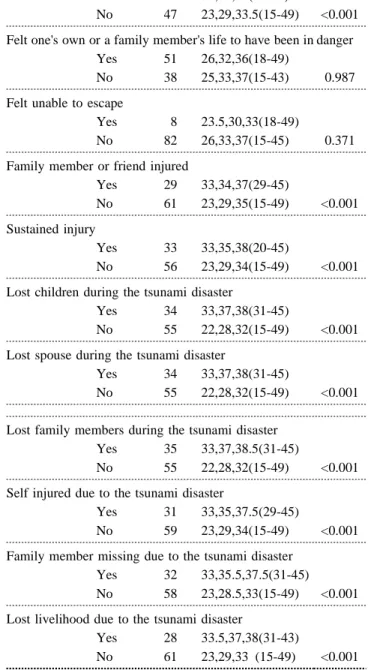
Table 2 shows the relationship between tsunami-related traumatic experiences and the IES-R score. The median of the IES-R score was significantly higher in those who were situated at home; those who saw anyone the dead or in- jured; those whose evacuations were delayed; those whose family member or friend was injured; those who had sus- tained injury; those who lost their children; those who lost their spouse; those who lost their family members; those who were injured; those whose family member was miss- ing; those who lost their livelihood, compared with those who were not or those who did not.
The factors of 'injury to family member or friend', 'loss of children', 'loss of spouse', 'loss of family member', 'injury to yourself' and 'being family member missing' were highly correlated each other. To avoid multicollinearity in the multiple linear regression model, we created a factor of 'loss of or injury to family members due to the tsunami' by combining the above factors of tsunami-related exposure.
'Loss of or injury to family members due to the tsunami' was coded as 0 for no experience of the tsunami-related ex- posure and 1 for one or more experience of the tsunami- related exposure.
The factors included in the model selected as the most
Table 1.Characteristics of the subjects in this studyFactors Number %
Age (years) -65 66-70 71-75 76-
25 20 22 23
27.8 22.2 24.4 25.6 Sex
Male Female
43 47
47.8 52.2 Religion
Buddhist Christianity Unknown
87 1 2
96.7 1.1 2.2 Damages to house
Destroyed Partly damaged No damaged Unknown
15 61 12 2
16.7 67.8 13.3 2.2
appropriate were age and loss of or injury to family mem- bers due to the tsunami (Table 3). Younger age and loss of or injury to family members due to the tsunami were sig- nificantly associated with an increase in IES-R score. The findings presented in Table 3 indicate that the IES-R score was approximately 0.27 points lower with every 10-year in- crease in age, and was approximately 6.12 points higher in those whose family members were lost or injured due to the tsunami compared with those whose family members were not.
Discussion
The present study indicates that catastrophic experiences at the time of the tsunami disaster caused post-traumatic stress disorders among the elderly residents of southern Sri Lanka.
4, 8, 9, 21The victims had experienced numerous trau- matic events and suffered from the tsunami, and they con- tinue to face uncertainty about their health and future.
11, 21Unexpectedly, however, the psychiatric damage was worse for younger residents compared to older residents. Previous studies reported that elderly people were more vulnerable to traumatic events and had higher risk of psychiatric disor- ders.
10, 22Among the victims of the Hanshin-Awaji Earthquake in Kobe, Japan, there were senior citizens living alone whose
"lonely deaths"
became a serious social problem.
23-27Since most of the subjects in the present study were not living alone, they may have received support from their family members and thus were somewhat sheltered from traumatic events. Actually, the median of IES-R score was signifi- cantly lower among the elderly living in larger family (5 or more family members), compared to the elderly living in smaller family (30 and 34.5, respectively; p=0.014). Moreover, younger people lost their livelihoods due to the tsunami disaster and had higher prevalence of PTSD, compared to elderly people.
2The findings of the present study indicate that there is a significant association between PTSD and traumatic tsunami- related experiences, such as loss or injury of family
Table 2.Relation between tsunami-related traumatic experiencesand IES-R score
IES-R score
Factors Number Quartiles(range) P
Sex Male 43 24.5,31,35.5(15-49)
Female 47 27,33,37(18-45) 0.282 Place you were situated at the time of tsunami
At home 41 31,34,38(18-49)
Other 48 23,29,33.5(15-43) 0.001 Saw anyone the dead or injured
Yes 31 33,36,38(29-45)
No 59 23,29,33.5(15-49) <0.001 Delayed evacuation
Yes 43 32,34,38(20-45)
No 47 23,29,33.5(15-49) <0.001 Felt one's own or a family member's life to have been in
Yes 51 26,32,36(18-49)
No 38 25,33,37(15-43)
danger 0.987 Felt unable to escape
Yes 8 23.5,30,33(18-49)
No 82 26,33,37(15-45) 0.371
Family member or friend injured
Yes 29 33,34,37(29-45)
No 61 23,29,35(15-49) <0.001 Sustained injury
Yes 33 33,35,38(20-45)
No 56 23,29,34(15-49) <0.001 Lost children during the tsunami disaster
Yes 34 33,37,38(31-45)
No 55 22,28,32(15-49) <0.001 Lost spouse during the tsunami disaster
Yes 34 33,37,38(31-45)
No 55 22,28,32(15-49) <0.001 Lost family members during the tsunami disaster
Yes 35 33,37,38.5(31-45)
No 55 22,28,32(15-49) <0.001 Self injured due to the tsunami disaster
Yes 31 33,35,37.5(29-45)
No 59 23,29,34(15-49) <0.001 Family member missing due to the tsunami disaster
Yes 32 33,35.5,37.5(31-45) No 58 23,28.5,33(15-49) <0.001 Lost livelihood due to the tsunami disaster
Yes 28 33.5,37,38(31-43)
No 61 23,29,33 (15-49) <0.001
Table 3.Multiple linear regression analysis: variables influencing IES-R score
Factor Comparison
Regression coefficient (standard error)
P Age
Loss of or injury to family members due to the tsunami
By 10-year increase Any loss or injury vs. no loss or injury
-0.27(0.13) 6.12(1.74)
0.04
<0.001
members, delayed evacuation and loss of livelihood.
Hollifield et al.
21reported that the prevalence of PTSD, de- pression and anxiety was 21%, 16% and 30%, respectively, 20-21 months after the tsunami disaster. It was also found that thinking that one's life was in danger was the most strongly associated experience with psychiatric symptoms.
21Another survey conducted among residents of tsunami- affected areas in southern Thailand revealed that displace- ment was significantly associated with higher prevalence of PTSD, depression and anxiety.
28-30In the present study, the median of the IES-R score was significantly higher in those who had delayed evacuation compared with those who did not. Those with delayed evacuation would be more likely to feel their lives were in danger and exhibit mental health problems.
The present study had some limitations. First, since the survey was conducted more than three years after the tsu- nami disaster, the subjects' mental states may have changed from what they had been soon after the disaster. Information about their tsunami-related exposure was also based on their memory. Some recall bias might have occurred in the study. Second, the Sinhalese version of the IES-R used in the present study was not validated for its accuracy in de- termining a diagnosis of PTSD. Further validation studies to verify the sensitivity and specificity of the Sinhalese ver- sion of the IES-R, and to find the cut-off point to determine a PTSD diagnosis should be needed.
In conclusion, the findings of the present study indicate that tsunami-related exposure continues to affect elderly survivors' mental health. Intervention programs for their psychosocial and mental health are important. Furthermore, a prospective study to assess the effectiveness of interven- tion program is needed.
Acknowledgments
This study was supported by Japan Society for the Pro- motion of Science (JSPS), Grant-in-Aid for Scientific Research (C), 18510218 and 18659184.
References
1. Sri Lanka Tsunami Operation Center. UNOPS Sri Lanka Operations Centre Factsheets. http://www.unops.org/SiteCollectionDocuments/Factsheets/
English/APO/OC/APO_OCFS_LKOC_EN.pdf.
2. Perera B, Torabi MR, Jayawardana G, Pallethanna N. Depressive symptoms among adolescents in Sri Lanka: prevalence and behavioral correlates.J Adolesc Health39(1): 144-146, 2006
3. Lee AC. Local perspectives on humanitarian aid in Sri Lanka after the
tsunami.Public Health122(12): 1410-1417, 2008
4. Lommen MJ, Sanders AJ, Buck N, Arntz A. Psychosocial predictors of chronic Post-Traumatic Stress Disorder in Sri Lankan tsunami sur- vivors.Behav Res Ther47(1): 60-65, 2009
5. Kessler RC, Sonnega A, Bromet E, Hughes M, Nelson CB.Posttraumatic stress disorder in the National Comorbidity Survey.Arch Gen Psychiatry 52(12): 1048-1060, 1995
6. McNally RJ. Psychological mechanisms in acute response to trauma.
Biol Psychiatry53(9): 779-788, 2003
7. Norris FH, Hamblen JL. Standardized self report measures of civilian trauma and posttraumatic stress disorder. InAssessing Psychological Trauma and PTSD, 2nd ed. (Wilson JP, Keane TM eds.; Guilford, New York) 63-102, 2004
8. Wickrama KA, Kaspar V. Family context of mental health risk in Tsunami-exposed adolescents: findings from a pilot study in Sri Lanka.
Soc Sci Med64(3): 713-723, 2007
9. Wickrama KA. Family context of mental health risk in Tsunami af- fected mothers: findings from a pilot study in Sri Lanka.Soc Sci Med 66(4): 994-1007, 2008
10. Charles E, Garand L, Ducrocq F, Clement JP. Post-traumatic stress disorder in the elderly.Psychol Neuropsychiatr Vieil3(4): 291-300, 2005
11. Neuner F, Schauer E, Catani C, Ruf M, Elbert T. Post-tsunami stress:
a study of posttraumatic stress disorder in children living in three se- verely affected regions in Sri Lanka.J Trauma Stress19(3): 339-47, 2006
12. Azarian A, Skriptchenko-Gregorian V. Trauma accomodation and an- niversary reactions in children.J Contemp Psychother29(4): 355-368, 1999
13. Ehlers A, Clark DM, Dunmore E, Jaycox L, Meadows E, Foa EB.
Predicting response to exposure treatment in PTSD: the role of mental defeat and alienation.J Trauma Stress11(3): 457-71, 1998
14. Krause N. Exploring the impact of a natural disaster on the health and psychological well-being of older adults.J Human Stress13(2): 61-69, 1987
15. Phifer JF, Norris FH. Psychological symptoms in older adults follow- ing natural disaster: nature, timing, duration, and course.J Gerontol 44(6): S207-S217, 1989
16. Phifer JF. Psychological distress and somatic symptoms after natural disaster: differential vulnerability among older adults.Psychol Aging 5(3): 412-420, 1990
17. Weiss DS, Marmar CR. The Impact of Event Scale-Revised. In:
Assessing Psychological Trauma and PTSD(Wilson JP, Keane TM, eds.; Guilford, New York) 399-411, 1997
18. Asukai N, Kato H, Kawamura N, et al. Reliability and validity of the Japanese-language version of the impact of event scale-revised (IES- R-J): four studies of different traumatic events. J Nerv Ment Dis 190(3): 175-82, 2002
19. Horowitz MJ, Wilner N, Alvarez W. Impact of Events Scale: a meas- ure of subjective stress.Psychometric Medicine41(3): 209 -218, 1979 20. Akaike H. A new look at the statistical model identification. IEEE
Transaction on Automatic Control19(6): 716-723, 1974
21. Hollifield M, Hewage C, Gunawardena CN, Kodituwakku P, Bopagoda K, Weerarathnege K. Symptoms and coping in Sri Lanka 20-21 months after the 2004 tsunami.Br J Psychiatry192(1): 39-44, 2008 22. Aldrich N, Benson WF. Disaster preparedness and the chronic disease
needs of vulnerable older adults.Prev Chronic Dis5(1): 1-6, 2008 23. Kato H, Asukai N, Miyake Y, Minakawa K, Nishiyama A. Post-
traumatic symptoms among younger and elderly evacuees in the early stages following the 1995 Hanshin-Awaji earthquake in Japan.Acta Psychiatr Scand93(6): 477-481, 1996
24. Krug EG, Kresnow M, Peddicord JP, et al. Suicide after natural disas- ters.N Engl J Med338(6): 373-378, 1998
25. Shinfuku N. Disaster mental health: lessons learned from the Hanshin Awaji earthquake.World Psychiatry1(3): 158-159, 2002
26. Maeda K. Twelve years since The Great Hanshin Awaji earthquake, a disaster in an aged society.Psychogeriatrics7(2): 41-43, 2007
27. Fujita Y, Inoue K, Seki N, et al. The need for measures to prevent
"solitary deaths" after large earthquakes - based on current conditions following the Great Hanshin-Awaji Earthquake.J Forensic Leg Med 15(8): 527-528, 2008
28. Morgan OW, Sribanditmongkol P, Perera C, Sulasmi Y, Van Alphen D, Sondorp E. Mass fatality management following the South Asian tsunami disaster: case studies in Thailand, Indonesia, and Sri Lanka.
PLoS Med3(6): e195, 2006
29. Van Griensven F, Chakkraband ML, Thienkrua W, et al. Mental health problems among adults in tsunami-affected areas in southern Thailand.
JAMA296(5): 537-548, 2006
30. Thienkrua W, Cardozo BL, Chakkraband ML, et al. Symptoms of posttraumatic stress disorder and depression among children in tsu- nami-affected areas in southern Thailand.JAMA296(5): 549-559, 2006

![ストレス関連精神疾患とエピジェネティクス 057 [ 総説 ] 行動医学研究 Vol.22, No.2, ストレス関連精神疾患とエピジェネティクス Stress related mental illness and epigenetics * 松澤大輔 Daisuke MATS](data:image/gif;base64,R0lGODlhAQABAIAAAP///wAAACH5BAEAAAAALAAAAAABAAEAAAICRAEAOw==)