令和2年度 9月修了
京 都 大 学 大 学 院 理 学 研 究 科
D C 3 回 生 研 究 発 表 会 要旨集
2020年7月14日(火)
物 理 学 第 一 分 野
物理学第一分野DC3回生研究発表会
場所:理学研究科5号館 5階・第四講義室 発表:20分(別に質問10分程度)
2020年7月14日(火)11:00~ 開始
目 次
1. Light-driven modulation of liquid-crystalline order in nematic phase
CHIEN, CHIAO-YING(11:00)・・・・・ 1 2.Non-Fermi liquid transport properties near the nematic quantum critical point of FeSe1-xSx
WENKAI HUANG(11:30)・・・・・ 2
Light-driven modulation of liquid-crystalline order in nematic phase
Soft Matter Physics Group Chiao-Ying Chien
Abstract We immobilize azobenzene through polymerization, fabricating the liquid crystal gels with azobenzene-containing copolymer microstructure and study their photo-induced spatial variation of birefringence (∆n). We clarify that the surface anchoring of microstructure is crucial in modulation of photo-induced change of ∆n.
© 2020 Department of Physics, Kyoto University
Recently, Samitsu et al. proposed a principle of the molecular manipulator which transport polymer through spatial variation of the scalar order parameter (S) in the nematic liquid crystal (LC) [1]. The spatial variation of S was generated by stimulating trans-to-cis isomerization of azobenzene derivatives in the nematic phase. Under UV light, the trans-azobenzene converts into cis form. The cis-azobenzene with a bent-like shape tends to destabilize the liquid-crystalline order, resulting in a decrease of S and the birefringence (∆n) of the nematic phase [2]. Based on this mechanism, the molecular manipulator provides a great potential to drive arbitrary nanometer-sized impurities in the nematic phase. However, this method has a limitation. The natural diffusion of azobenzene might cause poor spatial resolution of S, which obstructs the development of precisely-controlling the nm-sized impurities.
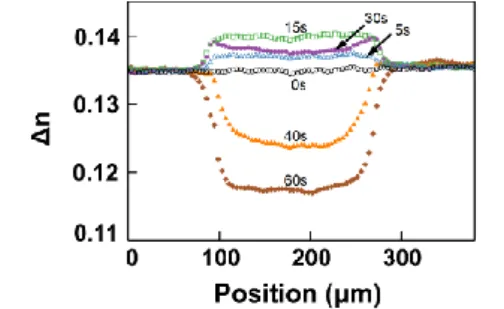
In this study, immobilization of azobenzene through polymerization is proposed to prevent the diffusion of azobenzene in the nematic phase. We fabricate nematic LC gels with phase-separation of azobenzene-containing copolymer microstructure. Unlike conventional photo-induced decrease of ∆n in the azobenzene/nematic mixture, an increase of ∆n is newly observed under UV irradiation in the LC gels (Fig. 1) [3]. To elucidate the anomalous increase of ∆n, the photo-induced change of ∆n and the morphology of the copolymer microstructure are investigated with the variant composition of LC gels. The shape of the copolymer microstructure, which have a finite anchoring strength on their surface, influence the LC director and result in a lower ∆n before the UV irradiation.
We find that the trans-to-cis isomerization of azobenzene weakens the surface anchoring of the copolymer microstructure. Hence, the LC directors recover their uniform
distribution, and the increase of ∆n appears.
We tune the composition of LC gels to eliminate the anchoring effect of the copolymer microstructure [3] and evaluate the spatial resolution of the LC gels [4]. The photo- induced spatial variation of ∆n of the non-polymerized and the polymerized samples are quantitatively compared through measuring their full-width-at-half-maximum (FWHM). The FWHM of the non-polymerized sample expands with time, while the polymerized sample remains the feature close to that of the stimulating light. The time evolution of ∆n clearly shows that the photo-induced change of S is highly constrained in the irradiated area in the polymerized sample (Fig. 2). Based on these results, we conclude that the LC material for modulating the scalar order parameter with high spatial resolution has been achieved by our method.
References
[1] S. Samitsu et al., Nat. Mater. 9, 816 (2010).
[2] T. Ikeda, J. Mater. Chem. 13, 2037 (2003).
[3] C.-Y. Chien et al., submitted.
[4] C.-Y. Chien et al., submitted.
Fig. 2. Time evolution of photo-induced spatial variation of ∆n in (a) non-polymerized and (b) polymerized samples, where red line is the UV light distribution.
Fig. 1. Photo-induced spatial variation of ∆n as a function of UV exposure time.
Non-Fermi liquid transport properties near the nematic quantum critical point of FeSe 1-x S x
Quantum Condensed Matter Group Wen-Kai Huang
Abstract To study how the nematic fluctuations affect the normal state transport properties, we have conducted charge transport measurements on FeSe1-xSx superconductors. We found that the quantum nematic fluctuations can cause similar transport phenomena that have been observed in the case of antiferromagnetic fluctuations. Our results suggest that different types of quantum fluctuations could result the same anomalous charge transport behaviors.
© 2020 Department of Physics, Kyoto University
Quantum phase transition is one of the central problems in strongly correlated materials. It has been discussed that quantum fluctuations of order parameter can become large when the system is near a quantum critical point (QCP), a point where a zero temperature transition happens by controlling some nonthermal parameters. It is believed that these quantum fluctuations can give rise to the non-Fermi liquid (NFL) behaviors and are responsible for unconventional superconductivity. Thus, understanding the physics associated with quantum fluctuations is of primarily importance [1]. One canonical example of such QCP is an antiferromagnetic (AFM) QCP, which has been realized in a variety of correlated materials, such as heavy fermion compounds and cuprates.
In this study, we focus on another type of QCP, i.e., a QCP of a nematic order that breaks the rotational symmetry of the underlying crystal lattice.
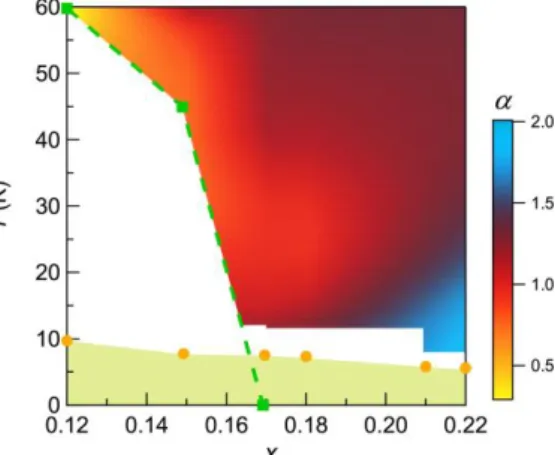
The iron-based superconductor FeSe1-xSx is a multi-band compound which has a nematic QCP without magnetic order. For x = 0, a nematic order appears below Ts ~ 90 K. As the sulfur doping increases, the transition temperature Ts decreases, and finally becomes zero at xc ~ 0.17. Around this nematic QCP, large nematic fluctuations have been observed by nematic susceptibility measurements, while AFM fluctuations are found to be negligible [2]. This indicates that FeSe1-xSx is suitable to study the impact of nematic fluctuations.
Here, to investigate how the nematic fluctuations affect the transport properties, we measured the dc-resistivity, Hall effect and magnetoresistance at various doping levels across the nematic QCP of FeSe1-xSx. Near xc = 0.17, we found that the resistivity shows linear dependence on
temperature at low temperatures, as shown in Fig.1, and the Hall angle cotθH (= ρxy/ρxx ) is proportional to T2. Moreover, the magnetoresistance obeys modified Kohler’s rule (∆ρxx/ρxx ∝ tan2θH).
These transport properties near xc = 0.17 provide evidence for the NFL behaviors due to nematic QCP. It should be note that the AFM fluctuations can also lead to the similar anomalous transport behaviors [3]. Our results suggest that different types of quantum fluctuations could result the same anomalous charge transport behaviors [4].
References
[1] H.v. Löhneysen et al., Rev. Mod. Phys. 79, 1015 (2007).
[2] P. Wiecki et al., Phys. Rev. B 98, 020507(R) (2018).
[3] H. Kontani, Rep. Prog. Phys. 71, 026501 (2008).
[4] W. K. Huang et al., submitted.
Fig. 1. Phase Diagram of FeSe1-xSx. Colors represent exponent α given by formula ρxx
= ρ0 + ATα. The green dot line represents nematic transition temperature Ts. α ≈ 1 near xc ≈ 0.17.
1