著者
G
AYN
O
R Br i an
j our nal or
publ i c at i on t i t l e
CALL: I r i s h J our nal f or Cul t ur e, Ar t s ,
Li t er at ur e and Language
vol um
e
1
num
ber
1
year
2016
U
RL
ht t p: / / hdl . handl e. net / 10258/ 00009596
Volume 1
Issue 1: Language, Migration and Diaspora Article 9
2016
Changing from Within: Immigration and Japan
Brian GaynorMuroran University, [email protected]
Follow this and additional works at:htp://arrow.dit.ie/priamls
Part of theArts and Humanities Commons, and theSociology Commons
his Article is brought to you for free and open access by the Journals Published hrough Arrow at ARROW@DIT. It has been accepted for inclusion in CALL: Irish Journal for Culture, Arts, Literature and Language by an authorized administrator of ARROW@DIT. For more information,
Recommended Citation
Gaynor, Brian (2016) "Changing from Within: Immigration and Japan,"CALL: Irish Journal for Culture, Arts, Literature and Language: Vol. 1: Iss. 1, Article 9.
doi:10.21427/D7J01J
Changing from within: Immigration and Japan
Brian Gaynor
Muroran University, Japan [email protected]
Abstract
Although Japan’s demographic decline is well known, the slow but steady increase in the country’s immigrant population has been less acknowledged. Despite this continuing influx of foreigners the Japanese state still has no coordinated immigration policy that clearly addresses such issues as residency, employment, education, and access to social services. Rather it is at the local level that towns and villages all across the country are having to develop ad hoc responses to the growing number of foreigners resident in their communities. Hitherto most research into immigrants’ lives has focused on what are known as ‘diversity points’, large urban areas with significant numbers of non-Japanese residents. However, the majority of immigrants live in small, ethnically dispersed communities spread across the entire country. This paper presents a case study of one such location, an industrial town in northern Japan.
Keywords: migration; Japan; multiculturalism; municipal government; language policy
Introduction
By now Japan’s demographic decline is well known. The country is home to the fastest aging society in recorded history, while conversely its birthrate is among the world’s lowest.1 The
Japanese Statistical Bureau has estimated that by 2020 the population will have decreased
from its current figure of 128 million to 122 million, and by 2060 projects the figure to be 79
million.2 This represents a loss of over a million people every year for 48 years.
However, buried within these figures is a small but significant source of growth. Over the
past two decades the number of non-Japaneseresiding in Japan has increased from 1.08
million in 1990,3 to 2.08 million in 2011, and they now account for 2.3% of the total
1 World Bank: Birth Rate per 1,000 people 2002-2006. Accessed on 23/10/2012 on
data.worldbank.org/indicator/SP.DYN.CBRT.IN.
2 National Institute of Population and Social Security Research: Population Projections for Japan (January
2012): 2011 to 2060. Accessed on 23/10/2012 on www.ipss.go.jp/site-ad/index_english/esuikei/gh2401e.asp.
3 Ministry of Internal Affairs and Communications: Registered Aliens by Nationality and Status of Residence
population.4 According to the UN’s population estimate, Japan will have to increase this
number by a total of 17 million if it wishes to maintain its current population.5
While small in comparison to immigration in demographically similar countries such as
France (10.1%) and Germany (12.3%), nevertheless the increasing number of non-Japanese
residents means that Japan is de facto a country of immigration.6 However, within national
political discourse de facto does not yet equal de jure. There is still no coordinated
immigration policy that clearly addresses such issues as residency, employment, education,
and access to social services.
This is particularly evident at the local, municipal level. The federalist nature of the country’s
public administrative system ensures that it is local governments at town and city levels who
are primarily responsible for administering those areas, such as education, health, social
welfare, and public spending, that most impact on their residents’ everyday lives. Local
governments are also responsible for their non-Japanese residents as, with the notable
exceptions of immigration and legal affairs, essentially all other interactions with the
Japanese state occur at the municipal level. This in turn means that non-Japanese residents’
interactions are as varied as they are geographically diverse; the experiences of a Nepali
family in Shinjuku ward in central Tokyo, with nearly 34,000 registered foreigners,7 is going
to differ considerably to what their fellow immigrants encounter in Muroran, a struggling
industrial port city in northern Japan, which is home to only 288 foreign residents.8
Yet, it may well be that the latter is more indicative of the immigrant’s experience
particularly from the perspective of education. Hitherto most research into immigrants’ lives has focused on what are known as ‘diversity points’, large urban areas with significant numbers of non-Japanese residents such as Hamamatsu in Shizuoka prefecture, Ota city in Gunma prefecture, as well as Japan’s principal cities of Tokyo and Osaka.9 However, if we
follow Burgess’s admittedly imperfect proxy of immigrant children requiring Japanese
4 National Statistics Center: Tourokugaikokujin toukei.
Accessed on 23/10/2012 on www.e-stat.go.jp/SG1/estat/List.do?lid=000001089591. It should be noted that this figure does not include undocumented or ‘illegal’ migrants of which there are estimated to be 59,000 (Ministry of Justice, January 2014). Accessed on 18/12/2014 on
http://www.moj.go.jp/nyuukokukanri/kouhou/nyuukokukanri04_00041.html.
5 United Nations Population Division: Replacement Migration - Japan. Accessed on 23/10/2012 on
www.un.org/esa/population/publications/RepIMigED/Japan.pdf
6 United Nations: International Migration 2006. Accessed on 23/10/2012 on
www.un.org/esa/population/publications/2006Migration_Chart/2006IttMig_chart.htm
7 Shinjuku City: Kuseijouhou. Accessed on 23/10/2012 on www.city.shinjuku.lg.jp/content/000111018.pdf 8 Muroran City: Gaikokujin tourokushazuu toukei. Accessed on 23/10/2012 on
www.city.muroran.lg.jp/main/org3600/gaih2409.html.
9 Particularly detailed accounts can be found in Ryoko Tsuneyoshi, Kaori H. Okano & Sarane Spence Boocock
(eds.): Minorities and Education in Multicultural Japan, London: Routledge, 2011; and Joshua H. Roth,
language instruction as indicative of the dispersion of immigrant families across Japan, then
80% of schools and half of villages, towns and cities have four or fewer such students.10
Thus, locations like Muroran are statistically more representative of the experiences of
immigrants with families than the more visible ‘diversity points’, yet have not garnered
nearly as much scholarly attention as areas such as Hamamatsu and Ota.
The aim of this chapter then is to go some way to rectifying this dearth by presenting a case
study of Muroran city and the experiences of its non-Japanese residents. In particular, I will focus on their interactions with the various administrative branches of the city’s government and highlight how, in lieu of a coordinated national policy for creating a multicultural Japan,
such policies are ad hoc and passive rather than proactive.
In order to situate Muroran within the wider national context, I will begin with a necessarily brief overview of the ideological debate surrounding the concepts of ‘Japanese’ and ‘foreign’. I will then outline how this distinction, both historically and contemporarily, has been
undermined by a consistent increase in multiethnic residents, resulting in a paradox between what the political state ‘imagines’ to be a homogenous Japan and what local municipalities know to be a diverse reality. In particular, I will examine the area of language provision to
immigrants, particularly those with school-aged children, and show how the lack of a clear,
practical policy in this area is merely storing up potential problems for the future. I then
incorporate all these issues into my examination of Muroran and how the city and its
non-Japanese residents interact. Following from this my conclusion will reiterate the main
argument; that the seemingly deliberate indifference at national level to the incipient
multiculturalism at local level continues to thwart the lives of those non-Japanese who have
made their homes here, and ultimately prevents Japan from realizing the full potential of all
its citizens, a potential it can ill afford to spurn.
Japan’s monocultural myth
Despite Japan’s pressing need to do something to alleviate the country’s accelerating
demographic decline, no political will to address the issue of immigration policy is currently
in evidence. As Gottlieb pointedly notes, “while the closed country sakoku policy ended long ago, its intellectual baggage has lingered to a considerable extent in national discourse”.11
10 Chris Burgess: ‘(Mis)managing diversity in non-metropolitan public schools: the lack of state-sponsored support for ‘newcomer’ children’. In: Tsuneyoshi et al., Minorities, p. 191.
Much of this ‘baggage’ has taken the form of Nihonjinron, literally ‘what it means to be Japanese’.12 For much of the past three decades, Nihonjinron has constituted a key discourse
through which various aspects of Japanese culture, society, and language have been
formulated.13 The proponents of Nihonjinron portray the Japanese language as somehow
uniquely different from other languages and conflate language with ethnicity, based on
mutually reciprocal definitions of both terms.14 Despite clear evidence to the contrary, they endorse what former prime minister Taro Aso described as Japan’s unique standing as the only country in the world having “one nation, one civilization, one language, one culture and one race”.15 It is Anderson’s ‘imagined community’ taken to an extreme.
Gottlieb rightly describes this ideological position as a “monolingual myth”, but, as she adds, it is an enduring myth, “what we might call [one of] the foundation myths of modern Japan”, and one that continues to influence official language policy. The continued promulgation of
this myth also obscures the contemporary existence of large ethnic communities from Korea,
China, Brazil, the Philippines and other countries; the historical existence of the indigenous
languages and cultures of the Ainu and Ryukyu peoples; and the increasing number of
international marriages between Japanese citizens and non-Japanese.
Research in this area has consistently shown a clear dichotomy between the practical
necessity of accommodating immigrants at the local level, and the continued opaqueness of
policy at the national level. At the state level where official language policy is determined
and enacted, there is still no comprehensive policy framework that takes into account the
national language, minority languages, indigenous languages and foreign language learning.
Rather, as Gottlieb points out,official language policy is formulated and administered within
separate areas with rigidly defined briefs, none of them devoted to community languages.16
For Liddicoat, this official passivity towards incipient multilingualism is evidence of the
continuing pernicious effect of the Nihonjinron discourse.17 However, others18 present
12 Yoshio Sugimoto: An Introduction to Japanese Society. Cambridge: Cambridge University Press, 2003. 13 Nanette Gottlieb: Japan: Language Policy and Planning in Transition. In: Current Issues in Language Planning 9/1 (2008), p.1-68.
Anthony Liddicoat: Internationalizing Japan: Nihonjinron and the intercultural in Japanese language-in-education policy. In: Journal of Multicultural Discourses 2/1 (2007), p.32-46
14 Harumi Befu: Hegemony and Homogeneity: An Anthropological Analysis of Nihonjinron. Melbourne: Trans
Pacific Press, 2001
15 Japan Times: Aso says Japan is a nation of ‘one race’. Accessed on 23/10/2012 on
http://www.search.japantimes.co.jp/cgi-bin/nn20051018a7.html
16 Gottlieb, Japan: Language Policy and Planning in Transition, p. 2. 17 Liddicoat, Internationalizing Japan.
18 Cf. Yoko Butler: Foreign Language Education at Elementary Schools in Japan: Searching for solutions
evidence of the increasing development of “bottom-up language planning”,19 a natural response, perhaps, to what Hornberger terms the ‘ecology of language’.20 Gottlieb cites the
case of Miyagi Prefecture, which in 2007 became the first local government to draft by-laws
(written in Japanese, English, Chinese, Korean and Portuguese) to officially promote
multiculturalism.
Yet, encouraging as such initiatives are, they must be contrasted with an ongoing ‘stasis’ at
the national level. For a national language policy to be formulated that encompasses both
Japanese and community language speakers, it is necessary to determine what languages are
spoken, and by whom. Yet, such data is not collected. The most recent census, in October
2010, despite being available in 28 different languages, contained no questions on respondents’ language use or ethnicity.21
Migrants in Japan
Current immigrant statistics are indicative of the historical trends that have shaped Japan’s
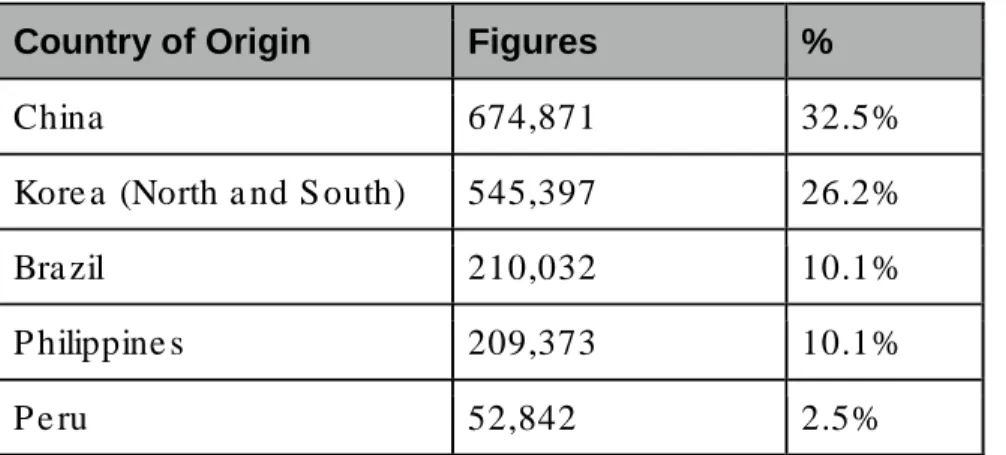
reluctant multicultural development. Ethnic Koreans make up the largest ethnic group,
followed by Chinese, Brazilians, Filipinos and Indonesians (see Table 1 below). Rather than
ethnic origin alone, however, such groups are usually discussed in terms of their historical
precedent, being commonly termed indigenous, oldcomer and newcomer.22
Table 1: Foreign Residents in Japan as of 201123
Country of Origin Figures %
China 674,871 32.5%
Kore a (North a nd S outh) 545,397 26.2%
Bra zil 210,032 10.1%
P hilippine s 209,373 10.1%
P e ru 52,842 2.5%
19 Gottlieb, Japan: Language Policy and Planning in Transition, p. 34.
20 Nancy Hornberger: Continua of biliteracy: An ecological framework for educational policy, research and practice in multilingual settings. Clevedon: Multilingual Matters, 2003.
21 Japanese Statistics Bureau: 2010 Census Form. Accessed on 23/10/2012 on
www.stat.go.jp/english/data/kokusei/pdf/census.pdf.
22 Ryoko Tsuneyoshi: ‘The ‘Internationalization’ of Japanese Education and the Newcomers: uncovering the
paradoxes’. In: David Blake Willis and Jeremy Rappleye (eds.): Reimagining Japanese Education. Oxford: Symposium Books, 2011, p.107-126.
Country of Origin Figures %
US A 49,815 2.4%
Othe r 336,150 16.2%
Indigenous minorities refer to the Ainu, the native peoples of Hokkaido in the north of the
country; and the Ryukyu people from what is now Okinawa, at the very south of Japan. Both
of these regions were annexed during the Meji expansion of the late nineteenth century, and
are now considered within official discourse as fully assimilated Japanese (there was, for
instance, no Ainu or Ryukyu ethnic category on the most recent census form).
‘Oldcomers’ refers to ethnic Koreans and Chinese, descendants of former colonial subjects who either moved or were forcibly relocated to Japan during the country’s colonial period. However, as Okano and Tsuneyoshi point out, the automatic labelling of all ethnic Koreans and Chinese as ‘oldcomers’ tends to obscure the diversity within this group conflating recent migrants with historical immigrants from the early to mid twentieth century. Citing the example of Koreans, they note that “there are said to be almost as many Japanese nationals of Korean (or mixed Korean) descent as Korean residents. The identification of nationality with
ethnicity, a long held assumption in post-war Japan, is therefore contested.”24
The term ‘newcomers’ refers to the influx of immigrants who entered Japan from the late 1970’s to the present. Again, diversity belies the catch-all phrase of ‘newcomers’; they include such groups as Indochine refugees, war-displaced returnees from China, migrant
labourers from Asia, spouses of Japanese citizens and, in particular, the influx of South
Americans of Japanese descent. Known as Nikkeijin, they came to Japan in sizable numbers
following the revision of the immigration law in 1990.
A final category could be added here, that of ‘transient migrants’. Japan’s demographic decline is fuelling an ever increasing need for labour in low-paid menial jobs. In addition, the country’s institutions of higher education are trying to offset the fall in enrollment of
Japanese students by attracting more overseas students. Yet, both plans fall foul of the strictly
utilitarian approach the state adopts towards immigration. The majority of immigrant
labourers who work in agriculture and manufacturing do so on restrictive, limited term ‘training schemes’, which are in essence a source of cheap labour as the immigrants,
ostensibly ‘trainees’, are paid considerably less than equivalent full-time Japanese employees.25 Similarly, strict visa rules preclude foreign students from seeking work in
Japan once they graduate - rather they are expected to return to their home countries.
‘Japanese and Alien’
Prior to July 2012, all foreigners resident in Japan were legally obliged to register with their
local government. This system was known as gaikokujin toroku, which was officially translated as ‘alien registration’.26 In all its dealings with immigrants, the State has always
striven to maintain this dichotomy between Japanese and non-Japanese, a purposeful divide
that even extends to the learning of the Japanese language. In the formal education system
Japanese students study kokugo, literally ‘the language of our country’. Foreigners, in
contrast, learn nihongo, ‘the language of Japan’. Hashimoto refers to this as “the emotional struggle with foreignness”, but such linguistic distinctions have wider implications.27 Non-Japanese are categorised in official discourse as gaikokujin, ‘foreigners’, who, by this
definition, are ‘outsiders’ within the concept of the nation-state. As we have seen, Japan does not permit dual nationality so what Tsuneyoshi terms “hyphenated Japanese”, such as
Korean-Japanese or Filipino-Japanese, do not officially exist.28 Thus third generation ethnic
Koreans who were born and raised in Japan and speak only Japanese are regarded as
foreigners, unless they naturalise, in which case they become ‘fully’ Japanese. For Tsuneyoshi this is evidence of “how the defining of border or boundaries between who is Japanese and who is not intertwines with what is ‘imagined’ (Japan as homogenous), and what is ‘real’ (the emergence of a pool of ethnic Japanese)”.He rightly terms this “a
paradox...that Japan can be seen as monocultural and multicultural at the same time”.29 Yet,
this is not a benign paradox; this deliberate othering has important ramifications for ethnic
minorities in all aspects of their lives in Japan, be it in terms of education, work, social
services, medical care, or pensions.
To give but one example of many: In 2005 the supreme court ruled in favour of the Tokyo
Metropolitan Government who barred the promotion of a second generation ethnic Korean
25 Jeff Kingston: Contemporary Japan. Oxford: Wiley-Blackwell, 2011. 26 Immigration Bureau of Japan. Accessed on 23/10/2012 on
www.immi-moj.go.jp/newimmiact_1/en/index.htm
27 Kayako Hashimoto: ‘Implications of the recommendation that English become the second official language in Japan’. In: Andy Kirkpatrick (ed.): Englishes in Asia: Communication, Identity, Power and Education. Melbourne: Language Australia, 2002, p.69.
(whose mother is Japanese) to a public sector management position. As a public health nurse
it was extremely improbable that she would be promoted to a position deemed sensitive to
national security, but the court upheld the city’s argument that non-Japanese should not be
permitted to exercise public authority. As Kingston acidly observes, “the senior civil service is, like some dodgy nightclubs and bath[houses], Japanese only”.30 Similar restrictions have
been experienced by foreign academic staff at Japanese universities who have been denied
tenure because of their nationality.31 As Tsuneyoshi ruefully concludes: “the image of
foreigners as outsiders, as people who come and go, is very strong; outsiders are never really
perceived as equal members of the community or society.”32
Language and Immigration
What these minority groups represent though, is a visible challenge to the hitherto reflexive
views of national homogeneity, both linguistic and ethnic. The presence of migrant
communities makes various demands on both national and local governments. This is
particularly true of language. The fact that Japanese is not an international language like
English and little used outside of Japan means that the majority of immigrants, particularly ‘newcomers’, do not speak Japanese upon arrival, “making the provision of JSL (Japanese as a Second Language) classes a key social issue as immigration continues to grow”.33
Figure 1: Number of non-Japanese children in public schools requiring assistance in Japanese language
instruction
30 Kingston, Contemporary Japan, p.170.
31 Akira Kuwamura: The Challenges of Increasing Capacity and Diversity in Japanese Higher Education
Through Proactive Recruitment Strategies. In: Journal of Studies of International Education 13/2 (2009), p. 189-202.
Besides nationality, the only other notable data the Japanese state collects on its ethnic
minorities are the number of children requiring assistance in Japanese language instruction.
The number of such children has been increasing annually and currently stands at 28,511 (see
Figure 1).34 Yet, even this figure is problematic; there is no clear, official definition of the term ‘requiring assistance’, judgement usually being left to the individual schools. In addition, once students are adjudged to have reached a certain level of Japanese (though
again, such criteria are not specified), they are no longer included in the official statistics.
Burgess also makes the point that such evaluative criteria usually only gauge students’
competence in basic interpersonal communication skills (BICS - see Cummins, 198135).36
Such language skills are quite different from cognitive academic language proficiency
(CALP), which is necessary for progression in educational settings and takes considerably
longer to obtain.37 The result is that “although the ‘problem’ of language and acculturation to
school life is often considered solved after a year or so, in fact such students increasingly fall
behind, unable to participate in or follow what is going on in class”.38
Such an ad hoc approach to JSL provision and assessment in lieu of a coordinated language
in education policy for minority language students can thus have a detrimental affect on their
34 Ministry of Education, Culture, Sports, Science and Technology (MEXT): nihongo shidou ga hitsuyona
gaikokujin jidousei no ukeire joutaito ni kan suru chousa (heisei 22 nendo) no kekka ni tsuite. Accessed on 23/10/2012 on www.mext.go.jp/b_menu/houdou/23/08/1309275.htm .
35 Jim Cummins: Empirical and theoretical underpinnings of bilingual education. In: Journal of Education
163/1, p.16-29.
36 Chris Burgess: ‘Diversity in non-metropolitan schools’. In: Tsuneyoshi et al., Minorities, p.193. 37 Cummins, Empirical, p. 16-29.
38 Harumi Ota: Nyuukama gaikokujin no kodomo no kyouiku kadai. In: T. Miyajima and T. Kajita (eds.):
Gaikokuroudousha kara shimin he: chiki shakai no shiten to sadai kara, Tokyo: Yuuhikaku (1996), p.128. 0 5000 10000 15000 20000 25000 30000 35000
2000 2001 2002 2003 2004 2005 2006 2007 2008 2010
education and future roles in society. As Gottlieb cogently argues, “the most pressing policy
issue is without doubt the need to provide nationally sponsored opportunities for JSL
education for foreign residents ... [as] it makes sense in the interests of present and future
harmony to ensure that they are linguistically proficient in the language of the host society in
order to enable them to act independently within it.”39 However, the current situation
demonstrates just how distant that prospect remains. There are still no officially recognised
teacher-training courses in JSL at universities, no official language assessment tests for
determining the language proficiency of JSL students, and, not surprisingly, no coordinated
national education policy for providing students with systematic curriculum in JSL. As
Tegtmeyer Pak has pointed out, the formulation of an immigration policy based on control
rather than assimilation means that any initiatives that do occur only do so at the local level.40
It is here, in the cities, towns and villages across Japan, where various forms of assimilation
take place. Local governments are the administrative bodies who must deal first hand with
the integration of foreign residents into their communities. While this involuntary devolution
of responsibility to those branches of the state most directly in contact with ethnic minorities
does enable a more nuanced approach to differing local conditions, it also means that
geography rather than need can determine the quality of JSL assistance minorities receive. The largest concentrations of minorities are found in Japan’s manufacturing heartland centred around the country’s three largest cities, Tokyo, Osaka and Nagoya. It is here that the most noteworthy progress towards multiculturalism can be found. Tsuneyoshi cites the case of Oizumi city, near Nagoya, where 16% of the city’s population are non-Japanese, most of them immigrants from South America. To meet the linguistic and cultural needs of this
sizable minority, the Oizumi Board of Education has established JSL classes for both
children and parents, and provides a range of educational and social support systems for
immigrants.41 In Kawasaki city south of Tokyo, the local government has established ‘multicultural coexistence’ (tabunka kyousei shakai) as one of its municipal goals, where diversity is respected and people of different nationalities, cultures and ethnicities can ‘coexist as autonomous citizens’.42
39 Gottlieb, Language Policy in Japan, p.124.
40 Katherine Tegtmeyer Pak: Towards Local Citizenship: Japanese Cities Respond To International Migration.
Accessed on 23/10/2012 on www.ccis-ucsd.org/PUBLICATIONS/wrkg30.PDF
41 Tsuneyoshi: The ‘Internationalization’ of Japanese Education and the Newcomers: Uncovering the
Paradoxes. p.115.
42 Kawasaki shi: Kawasakishi no tabunka kyosei shakai suishin shishin - tomoni ikiru chiiki shakai shakai o
As welcome as such initiatives are, unfortunately they are still the exception rather than the
rule. If we consider the statistics of children requiring JSL instruction as an approximate
indicator of the geographical distribution of minorities across Japan, then we find that almost
80% of schools and half of local municipalities have four or fewer of such students.43 In
other words, locations such as Muroran are statistically much more representative of the
experiences of non-Japanese children (and by implication their families) than concentrated
communities in large urban areas. Therefore, location clearly plays a significant part in
determining the nature and quality of JSL instruction and other necessary services to minority
residents. Highlighting this, Oga and Abe found that in those parts of Japan with few JSL
students there is a corresponding lack of urgency about the provision of JSL education, and,
moreover, many schools and teachers do not have the training or resources to provide an
effective JSL program.44
It is worth noting here the contrast with English as a foreign language (EFL) education,
particularly at the primary level. In Muroran, for instance, all of the teachers are
non-specialists in EFL but they can draw upon a preplanned curriculum and supplied teaching
materials, and are offered regular in-service training courses. In addition, the city employs
three native speakers of English as assistant English teachers who work in tandem with the
Japanese primary teachers in the classrooms - all this despite the fact that English is not an
academic subject and thus not formally evaluated, nor is there any literacy education for the
Japanese students. In fact, English is not even compulsory; the official title of the course is ‘Foreign Language Activities’ (gaikokugo katsudo) and thus in theory any foreign language can be taught. In practice, though, it means English, a situation replicated throughout Japan
even in areas like Oizumi and Kawazaki. It is not therefore a lack of resources per se that
inhibits the implementation of JSL programmes, but rather how the available resources are
allocated.
Muroran-shi: A case study
Muroran is an industrial port town of 93,000 inhabitants located in Hokkaido, the
northernmost of the four main islands of Japan. Akin to the country as a whole, its population
is both declining and aging rapidly, with those aged 65 or over accounting for close to a third
of the total. Nevertheless, as with the national trend, the number of foreigners resident in the
43 MEXT: nihongo shidou ga hitsuyona gaikokujin jidousei no ukeire joutaito ni kan suru chousa (heisei 22
nendo) no kekka ni tsuite.
44 Kyoko Oga and Jiro Abe: Development of academic language proficiency in Japanese as a second language.
town, although a very small minority, has experienced an incremental but consistent increase,
from 196 in 1990 to the present total of 288.45 There are two main reasons for this: first,
Muroran hosts two large steel mills and increased demand from overseas, particularly China,
has led to an increase in the number of foreigners being employed by the mills and in related industries. The second impetus comes from the ongoing efforts by the city’s university, Muroran Institute of Technology (MIT), to attract more foreign students. Currently there are
100 foreign students enrolled at the university full time, accounting for 35% of the city’s total
number of resident foreigners. Finally, it should also be noted that the city does not record
ethnic data so that children of marriages between foreigners and Japanese citizens are
registered solely as Japanese.46
Space does not permit an in depth analysis of foreigners’ lives in Muroran; rather, I will
divide my analysis into an examination of four public administrative bodies that have the
most significant influence on non-Japanese residents’ day-to-day lives in Muroran. These are:
the City Office, the International Exchange Centre, Muroran Institute of Technology, and the city’s Board of Education. Interwoven into my analysis will be the accounts of non-Japanese residents’ experiences and encounters with these institutions. These accounts are taken from an ongoing ethnographic study I am conducting into the lives of ten foreigners and their
families living in the city. I commenced my study in the autumn of 2010 and so far I have
conducted 48 semi-structured interviews, averaging 73 minutes each. The interviews were
conducted in either English or Japanese (or sometimes both) with respondents at six month
intervals.
The Muroran City Office
Under Japanese law all non-Japanese who reside in the country for more than 90 days must
register with their local municipal office. In Muroran this process occurs at the
tousekijuminkai (the family register department), where there is a section for foreign
residents. Necessary forms are available in English, Chinese and Korean; the staff at the
counter speak some English but no other languages. Matters relating to daily life in the city,
such as applying for utilities, social welfare assistance, rubbish collection, etc., are dealt with
at the shiyakusho, the city office, which is housed in a separate building. Besides the
registration process, all other administrative matters are conducted solely through Japanese.
45 Muroran City: Gaikokujin tourokushazuu toukei. Accessed on 23/10/2012 on
www.city.muroran.lg.jp/main/org3600/gaih2409.html.
Residents requiring bilingual assistance are expected to bring someone with them who can
act as an interpreter.
Besides visiting these offices in person, residents, both native and foreign, can access much
of the information via the web as Muroran, like most municipalities, has an extensive online site. However, information in English, Chinese and Korean is made available via a ‘machine translation’ by Google, with a disclaimer acknowledging the limitations of such a service.
Although somewhat helpful, the English translation is of variable quality and depends on the
clarity of the original Japanese page.47 For instance, information on the city’s rules regarding
rubbish disposal is rendered into fairly comprehensible English, whereas the more detailed
information about applying for child allowance is unfortunately rendered unintelligible.
Carroll has emphasized the need for accuracy in translations which in turn requires either
original material produced in the foreign language(s), or a skilled human translation of the
Japanese original.48 To these criteria I would also add the need for comprehensiveness. This
refers to the need for additional information to be provided to foreign residents so that they
can understand the seemingly common-sense, shared cultural and social knowledge that
Japanese residents possess such as the rules regarding rubbish disposal or paying residency
tax.
Unfortunately, as a report published by the Kokusai JP group noted, such human translations
are costly and time consuming, and it would be unrealistic to expect Muroran city to
accurately translate their entire website into multiple languages, particularly as much of the
content needs to be updated regularly.49 Rather, as the Kokusai JP report recommends, in situations like Muroran’s a combination of manual translation for important pages and machine translation for the rest is probably the most feasible alternative.
Muroran city and ‘international relations’
In 1986 national legislation was enacted compelling each municipality to establish an
International Exchange section (kokusai kouryuuka) and an International Exchange
Association (kokusai kouryuukyoukai). These bodies were charged with providing
information about their localities to overseas visitors, organising ‘international’ themed
cultural events, organising homestay programmes, and other types of ‘cultural diplomacy’.
47 For the purposes of this paper I have chosen the Japanese - English translation as my own foreign language
limitations preclude me from commenting on the accuracy of the Chinese and Korean translations.
48 Tessa Carroll: Local Government websites in Japan: International, Multicultural, Multilingual? In: Japanese Studies 30/3 (2010), p.373-392.
49 Kokusaika JP: Toukyou-to ku-shi-chou-zon webusaito no tagengoka taiou joukyou chousa. Accessed on
Muroran city duly established the Muroran International Communication Promotion Council
in 1987 which, at the time of writing, lists fifty local associations, ranging from businesses to
elementary schools, supporting its activities. On its homepage the Council lists as its
principal activities “environment and culture of foreign countries lectures”, “cooking classes by foreigners”, “beginning Chinese and Korean lessons”, “cultural guidance for foreign students at MIT”, and “local homestays for MIT and other foreign students”.50
In 1995 an International Community Centre was established in order to provide a focal point for the Council’s activities. According to the director of the centre its main activities are predominantly focused on “cultural exchange”, explaining Japanese culture to foreign residents and in turn inviting them to introduce their home countries to Japanese residents of
Muroran.51 While the centre does provide volunteer interpreting and translating the director
emphasized that these were usually only offered to tourists and foreign homestay students. Translation and interpretation of administrative matters relating to foreign residents’ lives in Muroran are not part of its remit.
This was made clear by the experiences of a Nepalese resident who, in 2010, wanted to open
a restaurant in the town. He approached the International Community Centre seeking advice
on how to go about opening his business, but was informed that the centre did not undertake
such roles. When he asked if there was anybody who could accompany him to city hall and
act as (Japanese-English) translator, he was given the contact details of a professional
translator in the city. Somewhat ironically a year later, after he had successfully opened his
business, he was asked by the centre if he would give a demonstration class on cooking
Nepali cuisine.
Muroran Institute of Technology (MIT)
MIT currently has 100 foreign students; 40 undergraduates, 44 postgraduates, and 16 doctoral
research students. For degree courses all undergraduate students must have obtained level 2
or above in the Japanese language proficiency test. For postgraduate students the
requirements differ on the qualification being sought; for master’s students they need “to have sufficient ability in Japanese” though this isn’t specified, whereas for doctoral students there is no Japanese language requirement.52 These varying language requirements thus
result in considerably different learning and living experiences depending on the academic
50 Accessed on 23/10/2012 on www.city.muroran.lg.jp/main/org1260/suisinkyougikai.html. 51 Personal communication.
qualification been sought. Whereas foreign undergraduate students have the language skills
to effectively adapt to college life and interact with their Japanese peers, this is not
necessarily the case with postgraduate students. Indeed, some of them may possess little more
than basic communicative Japanese as their research is conducted entirely through English.
Furthermore, research students tend to be older (the average age is 31) and some of them
have brought their families to Muroran while they undertake their studies. This is turn
requires a lot more interaction with the various administrative branches of Muroran city, which isn’t necessarily the case for undergraduate students.
The university has a Centre for International Relations which overseas the affairs of all
foreign students enrolled in the university, though their remit only goes so far. Although not
explicit, interviews with both the staff at the centre and foreign students with families make it
clear that there is a de facto separation between what the university considers to be its
responsibilities, and what is the domain of the individual students. The centre concerns itself
primarily with enrollment, academic performance, accommodation and visa matters; issues to
do with dependents, such as education, medical care, and part-time work, are the
responsibility of the individual students.
The experience of P., a graduate student from Indonesia, is a case in point. She enrolled as a
doctoral student in the university in 2007 and graduated in the spring of 2013. She was
accompanied to Japan by her then one-year-old daughter while her husband remained at his
teaching job in Indonesia. Initially her Japanese ability was not particularly strong, but she
had been assured by the university that this would not be a problem as her research (and
academic supervision) would be conducted in English. While this, for the most part, turned
out to be the case the situation was considerably more problematic vis-a-vis her daughter. P.
successfully enrolled her in a local nursery school but found the ongoing communication with
her daughter’s teachers quite stressful. In particular, the constant paper stream of notices,
forms and flyers were extremely time-consuming to translate and reply to. In addition,
unexpected events such as illnesses and trips to the hospital were further instances of stress
and worried incomprehension. Throughout all this she received minimal assistance from the
centre who cited privacy concerns as their reason for not getting involved more. A further
issue had to do with her scholarship funding. Her monthly living expenses were paid for by the town’s Rotary Club, but this in turn entailed regular involvement by P. in the
organization’s activities. The centre was anxious not to undermine their relationship with the Rotary Club as they funded scholarships for a number of foreign students at the university,
took place in the evening which meant a babysitter had to be found for her young daughter,
usually one of her fellow students.
What P.’s case highlights is the aforementioned lack of policy coordination between national
and local authorities. Whereas the Ministry of Education has set a target of enrolling 300,000
foreign students in Japanese tertiary institutions by the year 2020, there have been no related
policy initiatives detailing how municipalities like Muroran can best manage such students,
particularly those that come to Japan with their families.
Muroran Board of Education (BoE)
According to the most recent statistics, there are currently 99 ethnic minority students
enrolled in public primary and secondary schools in Hokkaido who need Japanese language
assistance.53 According to the Muroran Board of Education, there are no such students in the
city.54 In fact there are, but their circumstances and the lack of a clear, standardised
definition of what ‘Japanese language assistance’ is, means that they slip through the official policy cracks into a zone of administrative ambiguity.
The students in question are the daughters (7 and 9) of an Egyptian doctoral candidate at the
university. They are enrolled in the local elementary school in first and third class
respectively. They have both been in Japan for three years, but in this time have only
acquired basic communicative Japanese and the rudiments of literacy. As their father intends
to return to Egypt following the completion of his studies (most likely within the next year), neither the girls’ teachers nor their parents are too concerned about their lack of Japanese language development. As a consequence there is no specific JSL instruction provided to the
girls and they are not expected to maintain their language abilities to the same level as their
Japanese classmates. This though, as their teachers admit, has hampered their learning of
other academic subjects so that it is not only in Japanese, but also in maths, science and social
studies that they lag behind their peers. For their parents the expectation is that they will ‘catch up’ when they return to Egypt, but as studies in similar situations have shown this does not necessarily ensue.55
The factors giving rise to this situation are both political and practical. The former relates to
the lack of an effective national policy that has structures and programmes in place which
53 MEXT: nihongo shidou ga hitsuyona gaikokujin jidousei no ukeire joutaito ni kan suru chousa (heisei 22
nendo) no kekka ni tsuite.
54 Personal communication.
55 Guadalupe Valdez: Between support and marginalization: The development of academic language in
students, their parents, and their teachers can readily access. The practical refers to the
difficulty, particularly the financial difficulty, of Muroran BoE, in lieu of a national policy,
designing and implementing its own JSL programme.56 Given the city’s perilous finances
and the competing demands made on its educational budget, it would be extremely difficult
to justify the cost of such a programme to tax-paying residents. Similar reasons are proffered for the BoE’s inability to promote multiethnic education. The result therefore is default assimilation with children, regardless of ethnic background, expected to conform to the
educational requirements as set down by the Japanese state. This though involves issues
wider than mere language. Following the revision of the Fundamental Law of Education in
2006, elementary and junior high school education now includes mandatory classes on patriotism, and teachers are required to evaluate their students’ ‘love of their country’. That some students may ‘love’ another country in addition to, or even besides, Japan may seem to be a mere political oversight, but, I would contend, such a need to explicitly ‘teach’
patriotism derives from a deeper, latent insecurity at the country’s ongoing ethnic diversification.
Conclusion
The small number of non-Japanese living in Muroran should not obscure the fact that they are
still residents of Japan and they are, in fact, indicative of the diversity that can be found
throughout the country. Hitherto, much of the academic and media attention has been
directed at places such as Tokyo, Shizuoka and Kanagawa that have large resident
populations of particular ethnic groups. Yet, conversely such attention has overshadowed less
ethnically visible areas like Muroran that do not have sufficient foreign residents to justify
local measures to accommodate such diversity. The onus is therefore on the state to instigate
a coordinated policy that takes account of not just legal issues of immigration and residency,
but also involves education, social welfare, health care, employment, and ultimately a clearly
defined roadmap for acquiring citizenship.
The unstoppable force of demographic change and the resulting need for immigrants,
however reluctantly acknowledged, means that Japan finds itself having to deal with issues of
loss and gain: the loss of an imagined homogeneity and assumed shared heritage versus the
clear economic gains and cultural enlightenment that comes with the presence of foreign
residents in local communities. As Gottlieb has pointed out, “the old ideology of
monoethnicity and monolingualism with its binary distinction between ‘Japan’ and ‘foreign countries’ no longer works. Residents of these ‘foreign countries’ have come to Japan, often not to stay for a while and move on but to settle, and the social fabric of Japanese
communities has been changed as a result”.57
The task now is for the Japanese state to recognise the varied ethnic and linguistic realities at
the local level, and instigate a clear national policy that not only recognises and responds to the needs of the country’s increasing number of foreign residents, but also takes advantage of all the talents and skills such residents have to offer.