• 検索結果がありません。

Toric Rings and Toric Ideals Arising from Various Configurations

N/A
N/A
Protected

Academic year: 2021

シェア "Toric Rings and Toric Ideals Arising from Various Configurations"

Copied!
40
0
0

読み込み中.... (全文を見る)

全文

(1)

Dissertation

Toric Rings and Toric Ideals Arising from Various Configurations

Kazuki Shibata

Department of Mathematics Graduate School of Science

Rikkyo University

2014

(2)

Contents

Introduction 3

1 Background 6

1.1 Standard graded algebras . . . . 6

1.2 Koszul algebras . . . . 7

1.3 Gr¨ obner bases . . . . 8

1.4 Toric rings and toric ideals . . . 10

1.5 Toric fiber products . . . 12

1.6 Graphs . . . 13

1.7 Matroids . . . 15

2 Toric rings associated to cut ideals 19 2.1 Cut ideals . . . 19

2.2 Clique sums and strongly Koszul algebras . . . 20

2.3 Gr¨ obner bases for cut ideals . . . 22

2.4 Strongly Koszul toric rings of cut ideals . . . 25

3 Toric ideals associated to matroids 28 3.1 Operations on matroids . . . 28

3.2 A series and parallel extension of a matroid . . . 29

3.3 A series and parallel connection of matroids . . . 33

Bibliography 37

(3)

Introduction

A purpose of this thesis is to study properties of toric rings and toric ideals associated with various configurations. In particular, we study them targeted at configurations associated with a cut of graphs and matroids.

This thesis is concerned with the strongly Koszul property of the toric ring associated to a cut ideal and a Gr¨ obner basis for a toric ideal of a matroid.

Standard graded algebras R over a field K are said to be Koszul if the R-module K = R/m has a linear minimal free resolution over R, where m is the graded maximal ideal of R. Koszul algebras have been introduced by Priddy in 1970 [27].

A strongly Koszul algebra is the stronger notion of Koszulness and was introduced by Herzog, Hibi and Restuccia [13]. For a toric ring R and a toric ideal I, it is known that

I has a quadratic Gr¨ obner basis, or R is strongly Koszul

R is Koszul

I is generated by quadratic binomials.

In general, the converse hierarchy is not true.

The outline of this thesis is as follows.

In Chapter 1, we introduce notation and recall known results about Koszul al- gebras, Gr¨ obner bases, toric rings, toric fiber products, graphs and matroids.

In Chapter 2, we study properties of the toric ring associated to a cut ideal arising from a graph. A cut ideal was introduced by Sturmfels and Sullivant (see [34]). A cut ideal of a graph records the relations among the cuts of the graph. Cut ideals are used in algebraic statistics to study statistical models defined by graphs.

Let R G be a toric ring associated to a cut ideal I G arising from a graph G. The following facts are known for R G and I G :

R G is compressed if and only if G has no K 5 -minor and every induced cycle in G has length 3 or 4 [34];

If R G is normal, then G has no K 5 -minor [34];

If G has no (K 5 \ e)-minor, then R G is normal [21];

(4)

If I G is generated by binomials of degree 4, then G has no K 5 -minor [34];

I G is generated by quadratic binomials if and only if G has no K 4 -minor [11, 19, 34].

As stated above, ring-theoretic properties of R G and I G are classified in the class of a graph. Moreover Nagel and Petrovi´ c showed that the cut ideal I G associated with ring graphs has a quadratic Gr¨ obner basis [19]. However we do not know generally when the cut ideal I G has a quadratic Gr¨ obner basis and when R G is Koszul except for trivial cases. We give a necessary and sufficient condition for R G to be strongly Koszul, that is, we characterize the class of graphs such that R G is strongly Koszul.

The following are main results in Chapter 2.

Theorem 1 ([30]). Let G be a finite simple connected graph. If G has no (K 4 , C 5 )- minor, then I G has a quadratic Gr¨ obner basis.

Theorem 2 ([30]). Let G be a finite simple connected graph. Then R G is strongly Koszul if and only if G has no (K 4 , C 5 )-minor.

In Chapter 3, we study a Gr¨ obner basis for a toric ideal associated with bases of a matroid. A matroid was introduced by Whitney in 1935 [39]. A matroid is a structure that captures and generalizes the notion of linear independence in vector spaces. The bases of a matroid M with the ground set [d] = { 1, . . . , d } define a standard graded toric ring R M K[s 1 , . . . , s d ] which is generated by squarefree monomials whose support forms a basis of M . The toric ring R M is called the base monomial ring of M and was introduced by White [37]. White proved that, for any matroid M , the base monomial ring R M is normal, in particular, Cohen- Macaulay. White conjectured that, for any matroid M on [d], the toric ideal J M of M is generated by the quadratic binomials x i x j x k x l such that the pair of bases B k , B l can be obtained from the pair of bases B i , B j by a symmetric exchange (see [33, 38]).

Let M QG be the class of matroids such that the toric ideal J M has a Gr¨ obner basis consisting of quadratic binomials and M Q be the class of matroids for which J M is generated by quadratic binomials. Blum defined base-sortable matroids and proved that the class of base-sortable matroids is contained in M QG [2]. By using the theories of toric fiber products and combinatorial pure subrings, we have Theorem 3 ([31]). Classes M QG and M Q are closed under series and parallel extensions, series and parallel connections and 2-sums.

Chaourar showed that a matroid M is a minor of 1-sums and 2-sums of uniform

matroids if and only if M has no minor isomorphic to any of M (K 4 ), W 3 , Q 6 and

P 6 [5]. Since uniform matroids belong to M QG [32] and the class M QG is closed

under 1-sums and taking minors [2], by Theorem 3 and Chaourar’s result, we have

Theorem 4 ([31]). Let M be a matroid. If M has no minor isomorphic to any of

M (K 4 ), W 3 , Q 6 and P 6 , then the toric ideal J M has a Gr¨ obner basis consisting of

quadratic binomials.

(5)

The result in Chapter 2 is scheduled to be published (see [30]). The result in Chapter 3 is submitted (see [31]).

Acknowledgement

First of all, I would like to thank Professor Hidefumi Ohsugi for his warm encour-

agement and both spiritually and materially. Without his helps, I could not write

this thesis. I also would like to thank Professor Kazuhiro Yokoyama and Professor

Masayuki Noro for holding a seminar on a regular basis. I am grateful to Kazunori

Matsuda for useful comments and suggestions. Finally, I would like to thank my

parents for their support.

(6)

Chapter 1 Background

In this chapter, we introduce notation and give basic definitions and recall some results. A detailed introduction on the fundamental facts in Section 1.1 and Sec- tion 1.2 is in books by Eisenbud [9], and Ene and Herzog [10]. In Section 1.3 and Section 1.4, we consider the powerful tools of Gr¨ obner bases, toric rings and toric ideals (see [14, 32]). Toric fiber products, which we consider in Section 1.5, are introduced by Stullivant [36]. Section 1.6, which we consider the graph theory, is based on Diestel’s book [8]. The aim of Section 1.7 is to recall some basic facts about matroid theory. For a detailed introduction to matroid theory, see Oxley’s book [26].

1.1 Standard graded algebras

Let K be a field and S = K[x 1 , . . . , x n ] the polynomial ring with standard grading deg(x i ) = 1 for 1 i n. A polynomial f is said to be homogeneous of degree i if all monomials appearing in f are of degree i. We write deg(f ) = i. Let f = ∑

a ∈Z

n0

c a X a , where X a = x a 1

1

· · · x a n

n

for a = (a 1 , . . . , a n ) and c a K , be a polynomial. Then we set

f i = ∑

a ∈Z

n≥0

, | a | =i

c a X a ,

where | a | = a 1 + · · · + a n . Then f i is homogeneous of degree i and called the i-th homogeneous component of f. We have f = ∑

i 0 f i and this decomposition into homogeneous components is unique. It follows that

S = ⊕

j 0

S j ,

where S j is the K-subspace of S consisting of all homogeneous polynomials in S of degree j.

A graded ideal is an ideal I S which is generated by homogeneous polynomials.

Let I i denote the K -vector space spanned by all homogeneous polynomials in I of

(7)

degree i. Then the quotient ring R = S/I has a natural decomposition R = ⊕

i 0

R i ,

where R i = S i /I i . Each graded component R i is a finite dimensional K-vector space and R 0 = K. We have R i R j R i+j for all i, j Z 0 and R is finitely generated as a K-algebra by elements of R 1 .

Definition 1.1.1. A K-algebra R is said to be standard graded if it is of the form R = S/I , where I S is a graded ideal.

1.2 Koszul algebras

In this section, we introduce the definition of Koszul algebras and strongly Koszul algebras. Let R be a commutative ring. A maximal ideal of R is a proper ideal not contained in any other proper ideal.

Definition 1.2.1. Let K be a field and R be a standard graded K-algebra with graded maximal ideal m. The K-algebra R is said to be Koszul if the R-module K = R/m has a linear minimal free resolution over R.

Let R and R

be two standard graded K -algebras. The Segre product we denote with R R

is defined as the graded algebra

R R

= ⊕

i≥0

R i K R i

.

The tensor product R K R

is naturally standard graded with components (R K R

) i = ⊕

k+l=i

R k K R l .

For R = K[x 1 , . . . , x n ]/ f 1 , . . . , f r and R

= K[y 1 , . . . , y m ]/ g 1 , . . . , g s , it has a presentation of the form

R K R

= K[x 1 , . . . , x n , y 1 , . . . , y m ]/ f 1 , . . . , f r , g 1 , . . . , g s . Proposition 1.2.2. Let R and R

be two K-algebras.

(1) If R and R

are Koszul, then R R

is Koszul.

(2) R K R

is Koszul if and only if R and R

are Koszul.

Next, we introduce the following stronger notion of Koszulness given in [13].

(8)

Definition 1.2.3 ([13, Definition 1.1]). The homogeneous K-algebra R is said to be strongly Koszul if its graded maximal ideal m admits a minimal system of homogeneous generators u 1 , . . . , u n such that for all subsequences u i

1

, . . . , u i

r

of u 1 , . . . , u n with 1 i 1 < · · · < i r n, and for all j = 1, . . . , r, the colon ideal

u i

1

, . . . , u i

j1

: u i

j

of R is generated by a subset of elements of { u 1 , . . . , u n } . Theorem 1.2.4 ([13, Theorem 1.2]). Let R be strongly Koszul with respect to the minimal homogeneous system u 1 , . . . , u n of generators of the graded maximal ideal m of R. Then any ideal of the form u i

1

, . . . , u i

r

has a linear resolution. In particular, R is Koszul.

1.3 Gr¨ obner bases

Let Σ be a set. A partial order on Σ is a binary relation over Σ such that, for all x, y, z Σ, one has

(1) x x (reflexivity);

(2) if x y and y x, then x = y (antisymmetry);

(3) if x y and y z, then x z (transitivity).

We write x < y if x y and x ̸ = y. A partially ordered set is a set Σ with a partial order on Σ. A partial order on Σ is called a total order if, for any x, y Σ, one has x y or y x.

Let K[X] = K[x 1 , . . . , x n ] be the polynomial ring in n variables over a field K and M n denote the set of all monomials in K[X].

Definition 1.3.1. A monomial order on K [X] is a total order < on M n such that

1 < u for all 1 ̸ = u ∈ M n ;

if u, v ∈ M n and u < v, then wu < wv for all w ∈ M n . We introduce some monomial orders on K[X].

Example 1.3.2. Let u = x a 1

1

· · · x a n

n

and v = x b 1

1

· · · x b n

n

be two monomials in K[X].

For a fixed order x 1 > · · · > x n of the variables, we have

(1) the lexicographic order < lex : We set u < lex v if the leftmost nonzero component of the vector (b 1 a 1 , . . . , b n a n ) is positive.

(2) the reverse lexicographic order < rev : We set u < rev v if the rightmost nonzero component of the vector (b 1 a 1 , . . . , b n a n , | a | − | b | ) is negative, where

| a | = a 1 + · · · + a n , | b | = b 1 + · · · + b n .

(9)

For a nonzero polynomial

f =

m i=1

a i u i (0 ̸ = a i K )

of K [X], where u 1 , . . . , u m are monomials, the support of f is the set of monomials appearing in f. It is written as supp(f). For any nonzero polynomial f in K[X], the largest monomial u supp(f) with respect to < is called the initial monomial of f and written as in < (f). Let I K [X] be a nonzero ideal. The initial ideal of I is the monomial ideal

in < (I) = in < (f ) | f I, f ̸ = 0 .

If I = 0 , then in < (I) = 0 . In general, the initial monomials of a generating set of I do not generate in < (I).

Example 1.3.3. Let K[X] = K[x 1 , . . . , x 7 ] and < be the lexicographic order on K[X] with ordering x 7 < x 6 < · · · < x 1 . We set I = f, g , where f = x 1 x 4 x 2 x 3

and g = x 4 x 7 x 5 x 6 . Then in < (f) = x 1 x 4 and in < (g) = x 4 x 7 . However h = x 1 x 5 x 6 x 2 x 3 x 7 = x 7 f x 1 g I and in < (h) = x 1 x 5 x 6 ∈ ⟨ / x 1 x 4 , x 4 x 7 . Therefore { x 1 x 4 , x 4 x 7 } is not a generating set of in < (I).

Definition 1.3.4. We fix a monomial order < on K[X]. Let I be an ideal of K[X]

with I ̸ = 0 and let G = { g 1 , . . . , g s } be a finite set of nonzero polynomials belonging to I. We say that G is a Gr¨ obner basis of I with respect to < if { in < (g 1 ), . . . , in < (g s ) } is a generating set of the initial ideal in < (I).

Theorem 1.3.5. Let K[X] be the polynomial ring and I be an ideal of K[X]. If G is a Gr¨ obner basis of I with respect to some monomial order, then G is a generating set of I.

However the converse of Theorem 1.3.5 is not true in general.

We say that a Gr¨ obner basis G = { g 1 , . . . , g s } of I is a minimal Gr¨ obner basis if the following conditions are satisfied:

• { in < (g 1 ), . . . , in < (g s ) } is a minimal generating set of in < (I);

The coefficient of in < (g i ) is equal to 1 for 1 i s.

A minimal Gr¨ obner basis exists. However a minimal Gr¨ obner basis is not unique.

A Gr¨ obner basis G = { g 1 , . . . , g s } is said to be reduced if the following conditions are satisfied:

The coefficient of in < (g i ) is equal to 1 for 1 i s;

None of the monomials belonging to supp(g j ) is divided by in < (g i ) for i ̸ = j.

(10)

A reduced Gr¨ obner basis exists and is unique.

Let f and g be nonzero polynomials in K[X]. Let c f (resp. c g ) be the coefficient of in < (f ) (resp. in < (g)). Then the polynomial

S(f, g) = LCM(in < (f ), in < (g))

c f · in < (f) f LCM(in < (f ), in < (g )) c g · in < (g) g

is called the S-polynomial of f and g, where LCM denotes the least common multiple of two monomials in K[X].

Theorem 1.3.6 (Buchberger’s Criterion). Let I be an ideal of K [X] and G = { g 1 , . . . , g s } be a generating set of I. Then G is a Gr¨ obner basis of I with respect to some monomial order on K[X] if and only if, for all i ̸ = j, the S-polynomial S(g i , g j ) reduces to 0 with respect to g 1 , . . . , g s .

1.4 Toric rings and toric ideals

Let Z d × n denote the set of all d × n integer matrices. A configuration of R d is a matrix A Z d × n , for which there exists a hyperplane H ⊂ R d not passing the origin of R d such that each column vector of A lies on H . Let K be a field and K[T ± 1 ] = K [t ± 1 1 , . . . , t ± d 1 ] the Laurent polynomial ring in d variables over K. For each column vector a = t (a 1 , . . . , a d ) Z d , we denote T a = t a 1

1

· · · t a d

d

. Let A = (a 1 , . . . , a n ) Z d × n be a configuration of R d . The toric ring of A is the subalgebra K[A] of K[T ± 1 ] that is generated by the Laurent monomials T a

1

, . . . , T a

n

. Let K[X] = K[x 1 , . . . , x n ] be the polynomial ring in n variables over K. Then we define the surjective ring homomorphism

π : K[X] K[A], x i 7→ T a

i

for 1 i n.

We call the kernel I A of π the toric ideal of A.

Proposition 1.4.1. Let A Z d × n be a configuration. Then

I A =

⟨ ∏

b

i

>0

x b i

i

b

i

<0

x i b

i

Ab = 0

b = t (b 1 , . . . , b n ) Z n

.

Proposition 1.4.2. The reduced Gr¨ obner basis of I A consists of binomials.

In general, it is not easy to compute a generating set of I A . In the case of a toric ideal, there exists the following useful result.

Proposition 1.4.3 (See [25, 32]). Let A Z d × n be a configuration and G = { g 1 , . . . , g s } ⊂ I A . Let M n denote the set of monomials belonging to K[X] and in < ( G ) = in < (g i ) | 1 i s . Then the following conditions are equivalent.

(1) G is a Gr¨ obner basis with respect to <;

(11)

(2) { π(u) | u ∈ M n , u / in < ( G ) } is linearly independent over K;

(3) π(u) ̸ = π(v ) for all u, v / in < ( G ) with u ̸ = v , where u, v ∈ M n ;

(4) for any binomial u v I A , where u, v ∈ M n , either u or v is divided by in < (g i ) for some 1 i s.

In the case of a toric ring, there is the equivalent condition of a strongly Koszul algebra (see [13]).

Proposition 1.4.4 ([13, Proposition 1.4]). Let K[A] be a toric ring generated by u 1 , . . . , u n . Then K[A] is strongly Koszul if and only if the ideals u i ⟩ ∩ ⟨ u j are generated in degree 2 for all i ̸ = j.

In general, it is known that, for a toric ring K[A] and a toric ideal I A , I A has a quadratic Gr¨ obner basis, or K[A] is strongly Koszul

K[A] is Koszul

I A is generated by quadratic binomials.

The converse hierarchy is not true (for example, see [23, Example 2.1 and 2.2]).

Conjecture 1.4.5 ([13, 7]). Let K [A] be a toric ring and I A be a toric ideal. If K[A] is strongly Koszul, then I A has a quadratic Gr¨ obner basis with respect to some monomial order.

Hibi, Matsuda and Ohsugi showed that Conjecture 1.4.5 is true for edge rings [15].

Proposition 1.4.6. Let K[A] and K[A

] be toric rings, and Q be the tensor product or the Segre product of K [A] and K [A

]. Then Q is strongly Koszul if and only if both K [A] and K[A

] are strongly Koszul.

Definition 1.4.7 ([13]). We say that a toric ring K [A] is trivial if, starting with polynomial rings, K [A] is obtained by repeated applications of Segre products and tensor products.

It is clear that any trivial toric ring is strongly Koszul. However there exists a non-trivial strongly Koszul toric ring (for example, see [13]).

Let K[A] be a toric ring. Then K[A] is said to be squarefree if K[A] is isomorphic to a toric ring generated by squarefree monomials. A toric ring K[A] is said to be compressed [35] if the initial ideal of I A is squarefree with respect to any reverse lexicographic order.

Theorem 1.4.8 ([18]). Any squarefree strongly Koszul toric ring is compressed.

(12)

Let A = (a 1 , . . . , a n ) Z d × n be a configuration and K[A] K[t 1 , . . . , t d ] be a toric ring. For a nonempty subset T of { 1, . . . , d } , we set K [A T ] = K[A] K[t j | j T ]. Then a subring K [A T ] of K[A] is called a combinatorial pure subring of K[A]

(see [22]). If A T = (a i

1

, . . . , a i

r

), then we write K[X T ] = K [x i

1

, . . . , x i

r

]. Thus I A

T

= I A K[X T ] (see [32, Proposition 4.13]).

Proposition 1.4.9 ([20, 22]). If G is a generating set (resp. the reduced Gr¨ obner basis) for I A , then G K[X T ] is a generating set (resp. the reduced Gr¨ obner basis) for I A

T

.

Proposition 1.4.10 ([22]). Let K[A T ] be a combinatorial pure subring of K [A]. If K[A] is normal, Koszul or strongly Koszul, then K[A T ] has this property, too.

1.5 Toric fiber products

In this section, we introduce the toric fiber product which is defined by Sullivant [36].

Let r be a positive integer and α, β Z r >0 be two vectors. Let

K[X] = K[x i j | i [r], j i ]], K [Y ] = K[y i k | i [r], k i ]],

where α i (resp. β i ) is the i-th entry of α (resp. β), be multigraded polynomial rings subject to the multigrading

deg(x i j ) = deg(y i k ) = a i Z d .

We write A = { a 1 , . . . , a r } and assume that there exists a vector w R d such that w · a i = 1 for all i, where w · a i is the usual inner product of R d . This means that ideals in K [X] or K [Y ] which are homogeneous with respect to the multigrading are homogeneous in the usual sense. If I and J are homogeneous ideals of K[X]

and K[Y ] with respect to the grading A , then the quotient rings R 1 = K[X]/I and R 2 = K [Y ]/J are also multigraded by A . Consider the polynomial ring

K [Z ] = K[z i jk | i [r], j i ], k i ]]

and the ring homomorphism

ϕ I,J : K[Z] R 1 K R 2 , z jk i 7→ x i j y k i .

The toric fiber product I × A J of I and J is the kernel of ϕ I,J [36]. The following result is in [36, Theorem 12 and Corollary 14].

Theorem 1.5.1. Suppose that the set A of degree vectors is linearly independent.

Let F 1 and F 2 be homogeneous generating sets for I and J, respectively. Then N = Lift(F 1 ) Lift(F 2 ) Quad A

is a homogeneous generating set for I × A J. Moreover, if F 1 and F 2 are Gr¨ obner

bases of I and J, then there exists a monomial order such that N is a Gr¨ obner basis

for I × A J . The sets Lift(F 1 ), Lift(F 2 ) and Quad A are defined in [36].

(13)

On the other hand, if I and J are toric ideals, then I × A J is also a toric ideal.

Let B = { b i j | i [r], j i ] } ⊂ Z d

1

and D = { d i k | i [r], k i ] } ⊂ Z d

2

be two vector configurations. Let I B K[X] and I D K [Y ] be toric ideals of B and D . Toric ideals I B and I D are homogeneous with respect to the grading by A . We consider the following new vector configuration that is the toric fiber product of the vector configurations.

B × A D = {( b i j

d i k

) i [r], j i ], k i ] }

Z d

1

+d

2

. Then the toric fiber product I B × A I D is the toric ideal

I B × A I D = I

A

D . Indeed, if K [S] and K[T ] are polynomial rings, and

ϕ : K[X] K [S], x i j 7→ f j i (S), ψ : K [Y ] K [T ], y k i 7→ g k i (T )

are ring homomorphism, then we can form the toric fiber product homomorphism ϕ × A ψ : K[Z ] K [S, T ], z jk i 7→ f j i (S)g k i (T ).

If I = ker(ϕ) and J = ker(ψ) and both ideals are homogeneous with respect to the grading by A , then I × A J = ker(ϕ × A ψ) (see [12]).

1.6 Graphs

In this section, we introduce a graph and its several properties (see [8]).

A graph is a pair G = (V, E) of sets such that the elements of E are 2-element subsets of V . The elements of V are called the vertices of the graph G and the elements of E are called the edges of G. A graph with vertex set V is called a graph on V .

We say that two vertices u, v of G are adjacent or neighbours if uv is an edge of G.

Two different edges e, e

of G is said to be adjacent if they have an end in common.

A graph G is said to be complete if all the vertices of G are pairwise adjacent. The complete graph on n vertices is denoted by K n .

Let G = (V, E) and G

= (V

, E

) be two graphs. We set G G

= (V V

, E E

).

If V

V and E

E, then G

is called a subgraph of G. It is written as G

G.

If G

G and G contains all edges uv E with u, v V

, then G

is called an induced subgraph of G, or G

is induced by V

. It is written as G

= G[V

]. A clique in a graph G is a subset V

of V such that G[V

] is complete.

A path is a non-empty graph P = (V, E) with

V = { u 0 , u 1 , . . . , u k } , E = { u 0 u 1 , u 1 u 2 , . . . , u k 1 u k } ,

(14)

where u i ̸ = u j for i ̸ = j. The vertices u 0 and u k are linked by P and are called its ends. The number of edges of a path is called length of P . If u 0 = u k and k 3, then the graph (V, E) is called a cycle. The length of a cycle is its number of edges.

The cycle of length k is denoted by C k .

The minimum length of a cycle contained in a graph G is called the girth of G and the maximal length of a cycle in G is called the circumference. Note that if G does not contain a cycle, then we set the former to , the latter to zero. An edge which joins two vertices of a cycle but is not itself an edge of a cycle is called a chord of that cycle. Hence, an induced cycle in G, a cycle in G forming an induced subgraph, is one that has no chords.

A non-empty graph G is said to be connected if any two vertices of G are linked by a path in G. We say that connected subgraphs G 1 , . . . , G s of G are connected component of G if the following conditions are satisfied:

G = G 1 ∪ · · · ∪ G s ;

If k ̸ = l, then there exists no edge u k u l of G such that u k (resp. u l ) is a vertex of G k (resp. G l ).

A non-empty graph G = (V, E) is said to be k-connected, where k N , if | V | > k and G[V \ X] is connected for any set X V with | X | < k.

A 2-connected component is a maximal 2-connected subgraph. Any connected graph decomposes into a tree of 2-connected components called the block tree of the graph.

A graph that does not contain any cycles is called a forest. A connected forest is called a tree.

Let G = (V, E ) and G

= (V

, E

) be graphs. We say that G

G is a spanning subgraph of G if V = V

.

An edge uv of a graph G, where u, v are vertices of G, is called a loop if u = v. If G has several edges between the same two vertices u, v, then such edges are called multiedges. A graph G is said to be simple if G has neither loops nor multiedges.

A graph G = (V, E) is said to be r-partite if V admits a partition into r classes such that every edge has its ends in different classes: vertices in the same partition class must not be adjacent. We say that an r-partite graph is complete if every two vertices from different partition classes are adjacent. We write K l

1

,...,l

r

for the complete r-partite graph on V 1 ∪ · · · ∪ V r , where | V i | = l i for 1 i r and V i V j = for i ̸ = j. The complete r-partite graphs for all r together are the complete multipartite graphs.

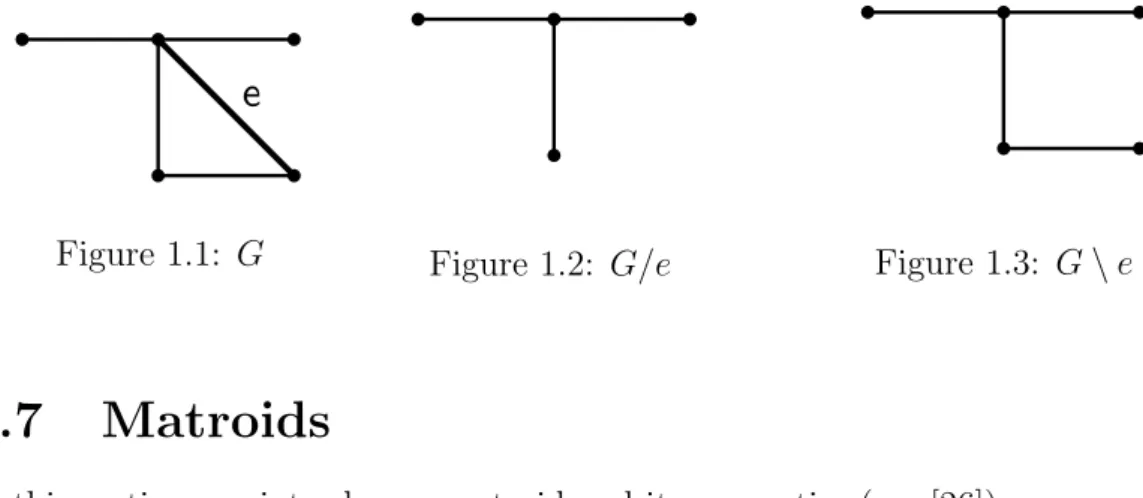
Let e = uv be an edge of a graph G = (V, E). By G/e = (V

, E

), we denote the graph obtained from G by contracting the edge e into a new vertex w e , which becomes adjacent to all the former neighbours of x and y, that is,

V

= (V \ { u, v } ) ∪ { w e } ,

E

= { ij E | { i, j } ∩ { u, v } = ∅} ∪ { w e k | uk E \ { e } or vk E \ { e }} .

(15)

By G \ e, we denote the graph obtained from G by deleting the edge e.

A graph H is a minor of a graph G if H can be obtained from G by a sequence of deleting and contracting edges of G.

Figure 1.1: G Figure 1.2: G/e Figure 1.3: G \ e

1.7 Matroids

In this section, we introduce a matroid and its properties (see [26]).

Definition 1.7.1. A matroid is a pair (E, I ), where E is a finite set and I is a collection of subsets of E, that satisfies the following conditions:

• ∅ ∈ I .

If I ∈ I and I

I, then I

∈ I .

If I 1 , I 2 ∈ I and | I 1 | < | I 2 | , then there exists e I 2 \ I 1 such that I 1 ∪ { e } ∈ I . We call a member of I an independent set of M . A subset of E that is not contained in I is said to be dependent. A dependent set C is called a circuit if any proper subset of C is independent and we write C (M ) for the set of circuits of M . Example 1.7.2. Let A = (a 1 , . . . , a 5 ) be a 2 × 5 matrix over the field R , where

a 1 = ( 1

0 )

, a 2 = ( 0

1 )

, a 3 = ( 0

0 )

, a 4 = ( 1

0 )

, a 5 = ( 1

1 )

.

We set E = { a 1 , a 2 , a 3 , a 4 , a 5 } and I denotes the collection of subsets X of E such that X is linearly independent in R , i.e.,

I = {∅ , { a 1 } , { a 2 } , { a 4 } , { a 5 } , { a 1 , a 2 } , { a 1 , a 5 } , { a 2 , a 4 } , { a 2 , a 5 } , { a 4 , a 5 }} . Then a pair (E, I ) is a matroid and it is written as M [A]. Hence the set of dependent sets of this matroid is

{{ a 3 } , { a 1 , a 3 } , { a 1 , a 4 } , { a 2 , a 3 } , { a 3 , a 4 } , { a 3 , a 5 }} ∪ { X E | | X | ≥ 3 } .

The set of circuits of this matroid is {{ a 3 } , { a 1 , a 4 } , { a 1 , a 2 , a 5 } , { a 2 , a 4 , a 5 }}

(16)

Proposition 1.7.3. Let C be a collection of subsets of a finite set E. Then C is the collection of circuits of a matroid on E if and only if C has the following properties:

• ∅ ∈ C / .

If C 1 , C 2 ∈ C and C 1 C 2 , then C 1 = C 2 .

If C 1 , C 2 ∈ C , C 1 ̸ = C 2 and e C 1 C 2 , then there is a member C 3 of C such that C 3 (C 1 C 2 ) \ { e } .

An independent set B is said to be maximal if there does not exist x E \ B such that B ∪ { x } is a member of I . A maximal independent set is called a basis of M and we write B (M ) for the collection of bases of M . The collection of bases in Example 1.7.2 is

B (M [A]) = {{ a 1 , a 2 } , { a 1 , a 5 } , { a 2 , a 4 } , { a 2 , a 5 } , { a 4 , a 5 }} . Each member of B (M [A]) is a basis of the vector space R 2 .

Proposition 1.7.4. All members of B (M ) have the same cardinality.

Proposition 1.7.5. Let M be a matroid on E and B be a collection of subsets of E. Then B is the collection of bases of M if and only if B satisfies the following conditions:

• B is nonempty.

For every B, B

∈ B , for any x B \ B

, there exists y B

\ B such that (B ∪ { y } ) \ { x } is a member of B .

Proposition 1.7.5 is called the exchange axiom. The exchange axiom is equivalent to the following stronger axiom, known as the symmetric exchange axiom.

Proposition 1.7.6. Let M be a matroid on E and B be the collection of bases of M . Then

for every B, B

∈ B , for any x B , there exists y B

such that (B ∪{ y } ) \{ x } and (B

∪ { x } ) \ { y } are in B .

Example 1.7.7. We give two examples:

(1) Let r, d be two integers with 0 r d and I be the collection consisting of all subsets with size r of E with | E | = d. Then a pair (E, I ) is a matroid.

This matroid is said to be uniform and it is written as U r,d . The collection of

bases of U r,d consists of all r-element subsets of E and the collection of circuits

of U r,d consists of all (r + 1)-element subsets of E.

(17)

(2) Let G be a finite connected graph on the vertex set V with the edge set E.

Let I be the collection consisting of edges of forests in G. Then a pair (E, I ) is a matroid. This matroid is said to be graphic and it is written as M (G).

The collection of bases of M (G) consists of edges of spanning trees in G and the collection of circuits of M (G) consists of edges of cycles in G.

Let M = (E, I ) be a matroid and X E. Let I| X = { I X | I ∈ I} .

Then (X, I| X) is a matroid. We call this matroid the deletion of E X from M. It is denoted by M \ (E X). We define the rank of X to be the cardinality of a basis of M \ (E X) and it is written as rk(X). The rank of a matroid M is defined by rk(M ) = rk(E). The function rk, called the rank function of M , maps 2 E to Z 0 . Proposition 1.7.8. Let E be a finite set. A function rk : 2 E Z 0 is the rank function of a matroid on E if and only if rk has the following properties:

If X E , then 0 rk(X) ≤ | X | .

If X Y E , then rk(X) rk(Y ).

If X, Y E, then rk(X Y ) + rk(X Y ) rk(X) + rk(Y ).

Let K be a field and K[X] = K [x 1 , . . . , x n ] the polynomial ring over K. Let B (M ) = { B 1 , . . . , B n } denote the collection of bases of M on E = [d] = { 1, . . . , d } . We consider the ring homomorphism

π M : K[X] K[S] = K[s 1 , . . . , s d ], x j 7→

l B

j

s l .

The toric ideal J M is the kernel of π M . The toric ring R M = K[X]/J M is called the bases monomial ring of M and it was introduced by N. White [37]. White proved that the bases monomial ring R M is normal, in particular, Cohen-Macaulay for any matroid M (see [37]). White presented the following conjecture.

Conjecture 1.7.9 ([38, 33]). For any matroid M , the toric ideal J M is generated by the quadratic binomials x i x j x k x l such that the pair of bases B k , B l can be obtained from the pair of bases B i , B j by a symmetric exchange.

It is natural to ask whether the following variant of White’s conjecture holds.

Conjecture 1.7.10. For any matroid M , the toric ideal J M has a Gr¨ obner basis consisting of quadratic binomials.

White’s conjecture can be posed as two separate conjectures (see [1]).

Conjecture 1.7.11. For any matroid M , the toric ideal J M is generated by quadratic

binomials.

(18)

Conjecture 1.7.12. For any matroid M , the quadratic binomials of J M are in the ideal generated by the binomials x i x j x k x l such that the pair of bases B k , B l can be obtained from the pair B i , B j by a symmetric exchange.

Conjecture 1.7.9 is true for

graphic matroids [1];

matroids with rank 3 [16];

sparse paving matroids [4]; and

strongly base orderable matroids [17].

Conjecture 1.7.10 is true for

uniform matroids [32];

matroids with rank 2 [24, 2];

graphic matroids with no M (K 4 )-minor [2]; and

lattice path matroids [29].

In [6], Conca proved that Conjecture 1.7.11 holds for transversal polymatroids.

Let M QG be the class of matroids such that J M has a Gr¨ obner basis consisting of quadratic binomials and M Q be the class of matroids for which J M is generated by quadratic binomials. In Chapter 3, we show that classes M Q and M QG are closed under the following operations:

series and parallel extensions;

series and parallel connections;

2-sums.

We prove that Conjecture 1.7.10 and Conjecture 1.7.11 are true if a matroid M

has no minor isomorphic to any of M (K 4 ), W 3 , P 6 and Q 6 .

(19)

Chapter 2

Toric rings associated to cut ideals

A cut ideal of a graph was introduced by Sturmfels and Sullivant [34]. In this chapter, we give a necessary and sufficient condition for toric rings associated to cut ideals to be strongly Koszul. In Section 2.1, we introduce the definition and known results of a cut ideal. In Section 2.2, we show that the set of graphs such that R G is strongly Koszul is closed under contracting edges, induced subgraphs and 0-sums.

In Section 2.3, we compute a Gr¨ obner basis for cut ideals without (K 4 , C 5 )-minor.

In Section 2.4, by using results of Section 2.2 and Section 2.3, we prove that the toric ring R G is strongly Koszul if and only if G has no (K 4 , C 5 )-minor.

2.1 Cut ideals

Let G be a finite simple connected graph on the vertex set V (G) = [n] = { 1, . . . , n } with the edge set E(G). For two subsets A and B of [n] such that A B = and A B = [n], the (0, 1)-vector δ A | B (G) Z | E(G) | is defined as

δ A | B (G) ij = {

1 if | A ∩ { i, j }| = 1, 0 otherwise,

where ij is an edge of G. Let X G =

{( δ A

1

| B

1

(G) 1

) , . . . ,

( δ A

N

| B

N

(G) 1

)}

Z | E(G) | +1 (N = 2 n 1 ).

As necessary, we consider X G as a collection of vectors or as a matrix. Let K be a field and

K[q] = K[q A

1

| B

1

, . . . , q A

N

| B

N

], K[s, T ] = K[s, t ij | ij E(G)]

be two polynomial rings over K. Then a ring homomorphism is defined as follows:

π G : K[q] K[s, T ], q A

l

| B

l

7→ s ·

| A

l

∩{ i,j }| =1 ij E(G)

t ij

(20)

for 1 l N . The cut ideal I G of G is the kernel of π G and the toric ring R G of X G is the image of π G . We put u A | B = π G (q A | B ).

In [34], Sturmfels and Sullivant introduced a cut ideal and posed the problem of relating properties of cut ideals to the class of graphs. For the toric ring R G and the cut ideal I G , the following results are known:

Theorem 2.1.1 ([34]). The toric ring R G is compressed if and only if G has no K 5 -minor and every induced cycle in G has length 3 or 4.

Theorem 2.1.2 ([11]). The cut ideal I G is generated by quadratic binomials if and only if G has no K 4 -minor.

Nagel and Petrovi´ c showed that the cut ideal I G associated with ring graphs has a quadratic Gr¨ obner basis [19]. However we do not know generally when the cut ideal I G has a quadratic Gr¨ obner basis and when R G is Koszul except for trivial cases.

On the other hand, in [28], Restuccia and Rinaldo gave a sufficient condition for toric rings to be strongly Koszul. In [18], Matsuda and Ohsugi proved that any squarefree strongly Koszul toric ring is compressed.

2.2 Clique sums and strongly Koszul algebras

In this section, we prove that strong Koszulness of the toric ring associated to the cut ideal is closed under the 0-sum, induced subgraphs and contracting edges but is not always closed under the 1-sum.

Recall that a graph H is a minor of a graph G if H can be obtained by deleting and contracting edges of G. We say that a subgraph H is an induced subgraph of a graph G if H contains all the edges ij E(G) with i, j V (H).

Proposition 2.2.1. Let G be a finite simple connected graph. Assume that R G is strongly Koszul. Then

(1) If H 1 is an induced subgraph of G, then R H

1

is strongly Koszul.

(2) If H 2 is obtained by contracting an edge of G, then R H

2

is strongly Koszul.

Proof. By [20] and [34], R H

1

and R H

2

are combinatorial pure subrings of R G . There- fore, by [22, Corollary 1.6], R H

1

and R H

2

are strongly Koszul.

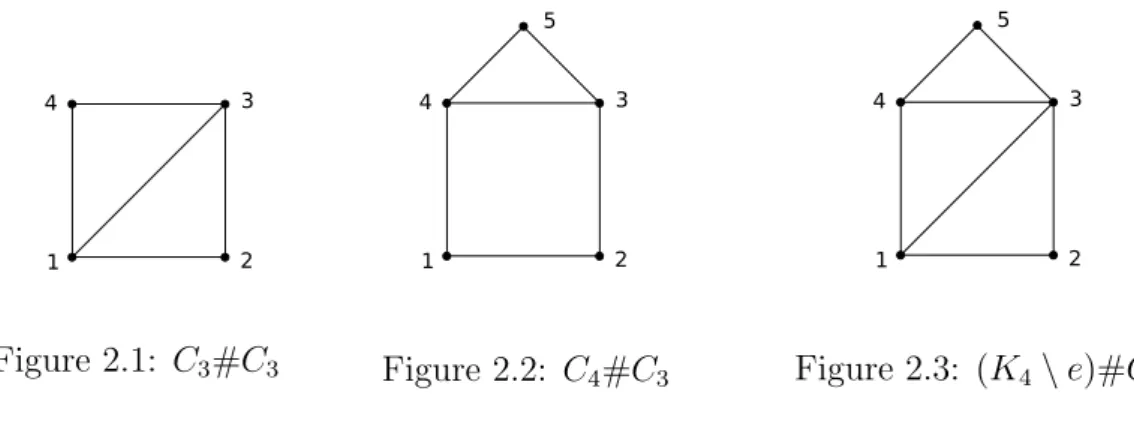
Let G 1 = (V 1 , E 1 ) and G 2 = (V 2 , E 2 ) be finite simple connected graphs such that

V 1 V 2 is a clique of both graphs. The new graph G = G 1 #G 2 with the vertex set

V 1 V 2 and the edge set E 1 E 2 is called the clique sum of G 1 and G 2 along V 1 V 2 .

If the cardinality of V 1 V 2 is k + 1, then this operation is called a k-sum of the

graphs. It is clear that if R G

1

#G

2

is strongly Koszul, then both R G

1

and R G

2

are

strongly Koszul because G 1 and G 2 are induced subgraphs of G 1 #G 2 .

Figure 1.1: G Figure 1.2: G/e Figure 1.3: G \ e
Figure 2.1: C 3 #C 3 Figure 2.2: C 4 #C 3 Figure 2.3: (K 4 \ e)#C 3

参照

関連したドキュメント

In this last section we construct non-trivial families of both -normal and non- -normal configurations. Recall that any configuration A is always -normal with respect to all

The purpose of the present paper is to investigate the structure of distance spheres and cut locus C(K) to a compact set K of a complete Alexandrov surface X with curvature

There is numerical evidence that if conformally K¨ ahler quasi-Einstein metrics with J -invariant Ricci tensor exist on CP 2 ]2 CP 2 , the K¨ ahler class of the metric is not the

In Section 3 using the method of level sets, we show integral inequalities comparing some weighted Sobolev norm of a function with a corresponding norm of its symmetric

In recent work [23], authors proved local-in-time existence and uniqueness of strong solutions in H s for real s &gt; n/2 + 1 for the ideal Boussinesq equations in R n , n = 2, 3

In the case of monomial valuations on toric varieties, we apply Theorem 0.1 to give a precise characterization in terms of a system of parameters. For simplicity, we present here

Dimitrios I. — This paper surveys, in the first place, some basic facts from the classifica- tion theory of normal complex singularities, including details for the low dimensions 2 and

We also give some characterizations of 0-distributive semilattices and a characterization of minimal prime ideals containing an ideal of a 0-distributive