ii
2018
年度 博士学位論文Consuming “Nostalgia Tourism”:
A Case Study of Domestic Tourism in Thailand
指導教授 豊田三佳
立教大学大学院観光学研究科博士課程後期課程
Monticha Jamjun
iii
ABSTRACT
This study aims to investigate the development of “nostalgia tourism” (Hooi Ha Adid in Thai) in Thailand after 2001, particularly why “nostalgia tourism” has been well received among Thai urban middle class and the young generation. In order to do so, I analyse the perspectives of both the supply and the demand side of nostalgia tourism. On the supply side, I argue that the Thai state promotes “nostalgia tourism”
in order to re-create national integrity and particularly to enhance its legitimacy at the time of political instability.
On the demand side, consumers engage in “nostalgia tourism” as a means of escaping the multiple on-going dilemma that challenges their Thai identity. The Thai society has experienced several nationwide crises due to the political divide after the Thaksin government (2001-2006) and more recently due to the demise of His Majesty King Bhumibol Adulyadej. The study reveals that “nostalgia tourism” serves to fulfill the desire of Thai domestic tourists who feel a loss of future certainty.
This study focuses on weekend recreational activities of consuming “nostalgia tourism” in “old markets” and “floating markets” , which are re-invented according to the popular images of the rural past. The simplicity is mainly consumed by the new urban middle class and young generation. In sum, the study suggests that in order to understand the construction of “nostalgia tourism” in Thailand, it is critical to examine the desires of Thai domestic consumers which are in turn shaped by current broader social transformations and stagnations that Thailand faces.
My fieldwork was conducted at the research sites of Amphawa floating market, Talingchan floating market and Khlong lad Mayom floating market, and other nostalgia tourism destinations in the central region of Thailand in 2013, 2014 and 2016.
iv
ACKNOWLEDGEMENTS
This is the hardest section to write, because along the five years journey of my PhD study life at Rikkyo University, the successful completion of this dissertation would not have happened without the kind support of many people who were involved and a part of my life and my dissertation.
I would like to express my sincere thanks and gratitude and appreciation to those whose generosity, guidance and expertise helped to alleviate many barriers throughout this research and assisted me to reach the final completion of this
I would like to start my acknowledgement by expressing my heartiest thanks to my supervisor, Prof. Toyota Mika, who has devoted her valuable advice all through the years from the middle towards the successful end of my dissertation. Her continuous assistance and invaluable contribution made my dissertation what it is. I‟m deeply indebted to Prof. Toyota Mika for her excellent efforts and encouragement in guiding me to achieve the success of this study.
I would like to extend my grateful acknowledgement to Phetchaburi Rajabhat University and theJapanese Ministry of Education, Science and Culture (Monbukagakusho) for providing me the scholarship for my studies and to live and experience the wonderful culture in Japan.
To Prof. Inagaki Tsutomu, my previous supervisor, who gave me a chance to pursue my PhD at Rikkyo University.For his generous and expert guidance from the beginning.
To Prof. Keyamura Eiji and Asst. Prof. Takaoka Fumiaki, who deserve my honored gratitude for their endless kind support and commitment to accomplish my dissertation.
To all Professors of the Graduate School of Tourism of Rikkyo University.
To all staff of the Graduate School of Tourism of Rikkyo University and other institutions.
To all the participants of my questionnaire survey and interviews, and people who helped me during my data collection in Thailand, and also my lovely students for the hard work they did helping with my question survey.
I would like to express my sincere thanks to Mr. and Mrs. Kase and their family to
v
be my host family for their great support and assistance during my stay in Japan and making me feel like I‟m one of their family.
To Mr. Koichiro Terashima and family, my host family for supporting and encouraging me during my stay in Japan.
I would like to thank Mr. Robert Moriarty for committing his busiest time for my dissertation‟s English editing and proofreading.
To all my Japanese and international students in graduate school of Tourism from 2013 until now, thanks for sharing your smiles, stories, laughter, encouragement and advice with me throughout the dissertation: Nirmara Narashingha, Lv Shuai, Xie Chang, Maruyama Motoshi, Itagaki Takeru, Li Gang, Nkalolang Ipelafatso, and Wu Chenfeng and others;
To my Thai friends who make me feel at home (especially Karn, Vee);
To my friends/ students in Thailand (especially to Dr. Pim, Dr. Mam, P‟ Meaw, Aj.
Som and Kate, Aui, J, K. Prapas and others);
More than everything, to my beloved family. I would like to remember all the love, and encouragement given to me by my mom, my sister, my husband, my parents-in- law and relatives. Especially, my mom who supports me in everything, and my sister for looking after mom while I am in Japan.
Last but not least, thank you to my beloved husband Takuya to being a part of my life, love, care, encouragement and who made my life comfortable by understanding and allowing me to spend much time on my study to achieve my success.
I have learnt that „Dissertation‟ could not be accomplished by only one person. Thank to you all who make my PhD come true. My greatest gratitude and appreciation go to you all.
Monticha Jamjun
Graduate School of Tourism Rikkyo University 2018/06/02
V
vi
CONTENTS
ABSTRACT………... iii
ACKNOWLEDGEMENTS………... iv
CONTENTS………... vi
LIST OF TABLES………. viii
LIST OF FIGURES………... ix
LIST OF MAPS………. ix
Chapter 1 Introduction………... 1
1.1 Background of the Study………. 2
1.2 Significance of Study……….. 8
1.3 Purpose of the study……… 9
Chapter 2 Methodology………. 11
2.1 Methodology………... 12
2.2 Research sites……….. 12
2.3 Data Collection……… 15
Chapter 3 Literature review………... 21
3.1 The Concept of Nostalgia in Thai context……….. 22
3.2 “Nostalgia” from postmodernism perspective……….. 33
3.3 Imagined community and “Nostalgia tourism”………... 37
3.4 Invented tradition and “Nostalgia tourism” in Thailand……… 40
Chapter 4 The construction of “nostalgia tourism” in Thailand ………... 51
4.1 Thai tourism policy after 2001……… 52
4.2 Crisis of Thainess and desire for “ Nostalgia tourism”……….. 91
4.3 The mechanism of the construction “Nostalgia tourism” in Thailand… 96 4.4 The markets and floating markets in Thailand……… 103
Chapter 5 Fieldwork: Findings and Analysis………. 118
5.1 The tourist behaviors toward “nostalgia tourism”……….. 120
5.2 Online questionnaire ……….. 131
5.3 Interviews ………... 137
vii
CONTENTS
Chapter 6 Conclusion ……… 149
6.1 Supply side of key actors……… 154
6.2 The crisis and the escape towards nostalgic imagined community …… 156
6.3 Demand side of key actors……….. 159
6.4 Experiencing “nostalgia tourism”………... 166
References……….. 168
Appendix……… 176
viii
LIST OF TABLES
Table 1-1: Participants category………... 17
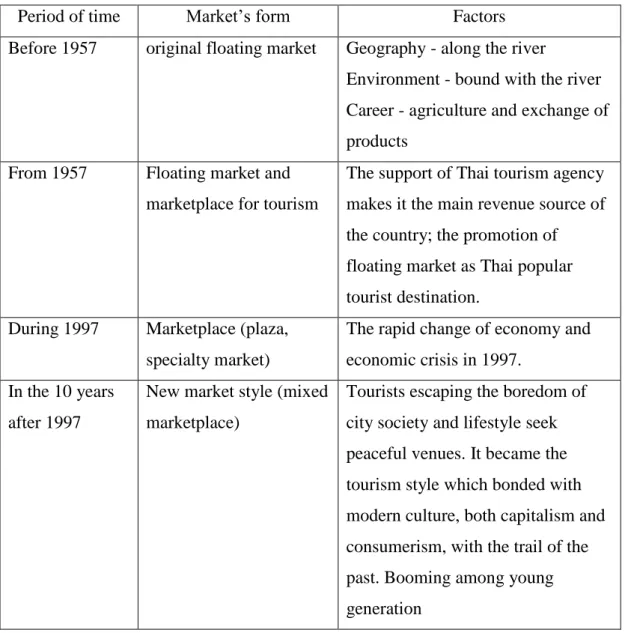
Table 4-1: Market‟s formation in chronological order………. 111
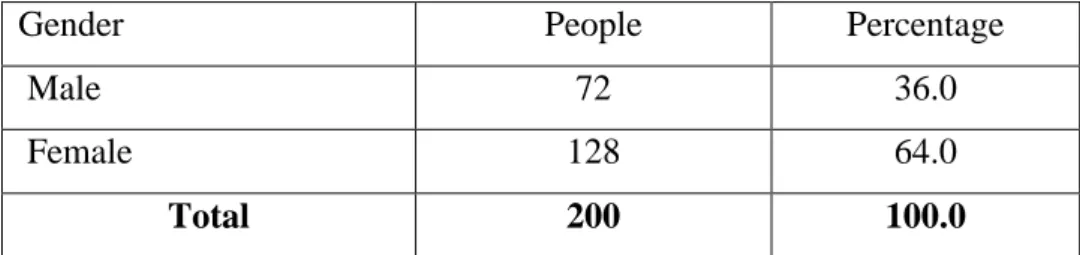
Table 5-1: Percentage of the sample groups categorized by gender………… 120
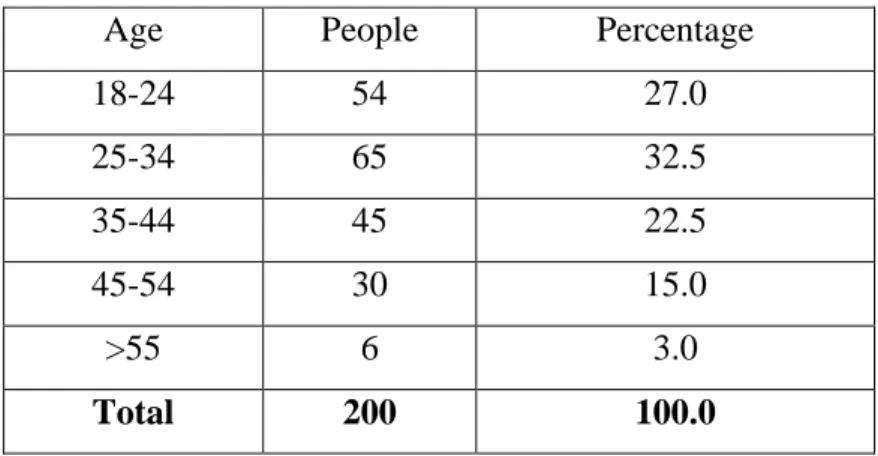
Table 5-2: number and percentage of the sample group categorized by age... 121
Table 5-3 : Number and percentage of the sample group categorized by hometown………... 121
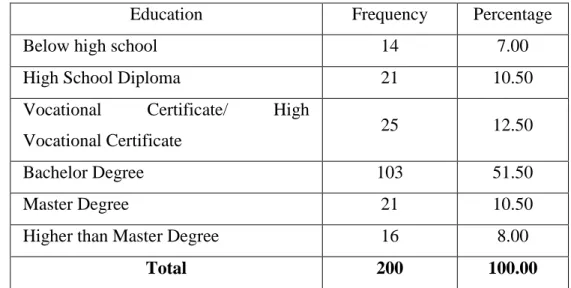
Table 5-4: Number and percentage of the sample group categorized by career…. 122 Table 5-5: Number and percentage of the sample group categorized by education……… 122
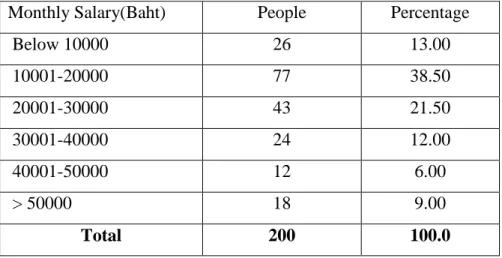
Table 5-6: Number and percentage of the sample group categorized by salary…. 123 Table 5-7: Number and percentage of the sample group categorized by travel duration………... 123
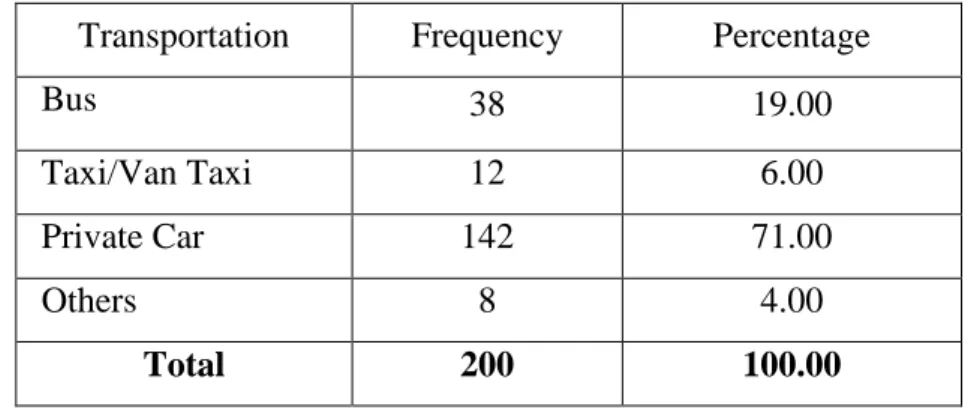
Table 5-8: Number and percentage of the sample group categorized by transportation method……… 124
Table 5-9: Tourists‟ perception of floating market………... 125
Table 5-10: Tourists „satisfaction……… 125
Table 5-11: Tourists‟motivation………... 125
Table 5-12: Frequency of visit……… 126
Table 5-13 : Accompanying persons in traveling……… 126
Table 5-14: Duration spent at the destination………. 127
Table 5-15: The highlights of the nostalgia tourism destinations………... 127
Table 5-16 : The items consumed……… 128
Table 5-17: Tourists‟ favorite activities……….. 128
Table 5-18: The familiarity of visiting floating markets……… 129
Table 5-19: Tourists‟ perception of floating market and old market………….. 132
Table 5-20 : The source of tourist information………... 134
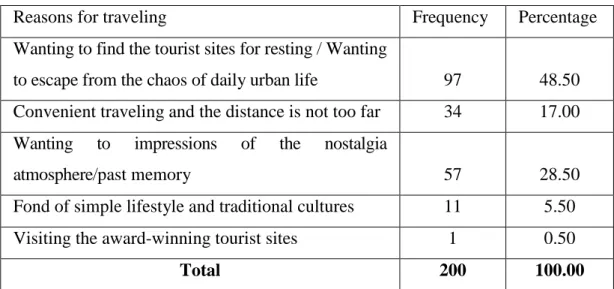
Table 5-21 : The motivations of visiting “nostalgia tourism destinations”……. 134
Table 5- 22 : Social profile………... 138
ix
LIST OF FIGURES
Figure1: Prelapsarian world……… 32
Figure2: Retro Invention………. 39
Figure3: “Nostalgia tourism” in Thailand………... 153
LIST OF MAPS
Map1: Map of Thailand………. 14
Map2: Map of 16 Floating market (16 TARAD NAM)……… 19 Map3: Map of 15 Old market (15 TARAD BOK)……… 20
1
Chapter 1
Introduction
2 1.1 Background of the Study
“Nostalgia tourism” has been discussed under the context of cultural tourism, heritage tourism, community based tourism from the first past of tourism development.Nostalgia can be seen as a primary driver of the recent popularity of heritage tourism (Canton & Santos, 2007; Dann, 1994; Kim, 2005). Heritage tourism sites are attractors for nostalgia – motivated tourism, in that they provide the requisite setting for giving tangible confirmation and context to nostalgic imagination (Janiskee,1996; Urry, 1990). The memory products such as commemorative events, museums and heritage sites are one manifestation of the burgeoning “industry of culture” to feed demand of an increasingly well-educated tourist class (Marshall, 2012).
Cultural tourism has been defined as “visits by persons from outside the host community motivated wholly or in part by interest in historical, artistic, scientific, or lifestyle/heritage offerings” (Silberberg, T.1995.) The nostalgic tourist segment is driven by a desire to fulfill their ancestral identity by consuming cultural experiences. The nostalgic desire for community is reflected in the popular fascination with furusato, which literally means old village, but in popular usage approximates the English
“hometown community” (Creighton, 1997).
The idea of “nostalgia tourism” provides a direction for development of Thailand domestic tourism. Additional terms for nostalgia include historical tourism, cultural tourism, rural tourism and also community based tourism.
The study of “nostalgia tourism” and floating market has been discussed but most of those studies are focused on ways that floating markets, 100 years markets and construction nostalgia can evoke memories of one‟s personal past with direct experience. This study draws on the young generation who lack personal experience, but who can have nostalgic feeling through the experience based tourism by the image of „the past‟, „tradition‟, „culture‟ and „Thainess‟.
Hence, this study examines how the young generation experience and consume the
“nostalgia tourism” through floating market, 100 years markets and the construction nostalgia destination. Additionally, it explores what effects and consequences it brings to the community and society as a whole and how it relates to their identity.
My question is why “nostalgia tourism” has become in Thailand and popular among the
3
young generation in Thailand. The social process enabling the construction and what these constructions can tell us about how our contemporary life is organized.
Before, tourism was very internationally oriented toward foreigners. Thailand is a tourist destination par excellence. In the 1960s, American GIs began coming for „rest and recreation‟; after that the number of international tourist arrivals has increased year by year. Whereas international tourism has been actively promoted all along, primarily to boost economic development, domestic tourism has been treated with a lower priority (Gunther, 2017).
The 1997 financial crisis, known as the Tom Yam Goong crisis, was a turning point of the development of tourism in Thailand, marking a shift towards domestic tourism.
The domestic rise was embedded firmly in urban-rural relations in contemporary Thailand. Domestic visitors were expected to generate less revenue due to their supposed lesser spending capability (Cohen, 2014; Peleggi, 1996). Domestic tourism was encouraged in order to compensate for fluctuations in the international market.
The worldwide economic crisis, regional natural disasters and uncertain factors, for instance the SARS outbreak in 2003, the Tsunami in 2004, the worldwide economic crisis, the devastating floods of 2011 and the political unrest between Red and Yellow shirts were followed by fears of decline in international arrivals and a call for the domestic visitors to bridge the gap (Gunther, 2017). In order to promote domestic tourism in Thailand, the Thai government launched a campaign under the concept
“Thai Teaw Thai” by Tourism Authority of Thailand. The main purpose of the promotion of domestic tourism has been the prevention of capital outflow (Gunther, 2017). Instead of travelling and spending money abroad, the Thai population was offered incentives to discover their own country (Kaosa-ard, Bezic & White, 2001).
For Thai tourists, sightseeing within Thailand nurtures identification with Thainess as it „involves feelings of loyalty to Buddhism, the monarchy and the nation‟ (Peleggi, 2002).
Nostalgia has been one of the most debated issues in tourism studies. Nostalgic feelings have opened up the countryside as a pleasurable amenity for city dwellers seeking relief from work and unbearable urban conditions (Gunther, 2017). It is assumed that tourists search for authenticity and places which differ from those found in their daily lives. However, though once a symptom of extreme homesickness, nostalgia has
4
become a key term to describe the modern and postmodern cultural condition (Davis, 1979).
Frederic Jameson has argued that nostalgia and pastiche are central features of late capitalist image production. Nostalgia is no longer what it was in the new postmodern age it has become the appropriation of „the past‟ through images (Jameson, 1991).
The development of communication technologies has intensified mediated contact with culture ; the past images are appropriated, and no longer restricted to one‟s own society but include the mediated images of other cultures. Nostalgia can be a form of cultural tourism (Watanasawad, 2013). As said by Mac Cannell (1993), „All tourism is a cultural experience‟ and by (Urry,1990), „Tourism is culture‟, so this assumption made some scholars believe that cultural tourism is either something new, or it is a postmodern phenomenon. However, by examining the definition of cultural tourism, it has become clear that „what has changed is the extent of cultural tourism consumption, and the forms of culture being consumed by cultural tourists‟ (Richards, 1996).
Nostalgia is a very complex concept; generally, “Nostalgia” is viewed as a complex whole, which delivers a unifying concept for nostalgic feeling or yearning for the past.
Nostalgia has been defined as a psychological obsession “to be back” that is, „a sentimental longing for the past‟, which people may develop with reference to things, significant others, places or experiences that are no longer extant or directly reachable.
The studies and nostalgia research have developed quite independently. Also nostalgia studies have largely advanced through identification of various facts of this emotion and its implication on consumption. It has been argued that nostalgia can be either a state of personal (Holbrook, 1992) or social emotion (Kim, 2005). Nostalgia can be activated from an idealization of memories (true or real nostalgia), from an indirect experience via the memories of people close to us (simulated nostalgia) or from the collective evocation of some pretended origins (collective nostalgia) (Baker
& Phongpaichit, 2014).
“Nostalgia tourism”, meanwhile, incorporates tourism and other social mechanisms.
It resembles in part, but is distinct from, other tourisms as “nostalgia tourism” can be divided into the following subcategories:
(1) Historical tourism, which refers to traveling to an archaeological or historical attraction to appreciate and enjoy the site, gain insightful knowledge of relevant
5
history and archeology of the local area in the basis of responsibility and preservation of cultural heritage and values of such environment where local people contribute to the management of tourism in their location.
(2) Cultural and traditional tourism refers to traveling to observe traditions at specific locations where local people organize or arrange for the tourists to enjoy and embrace the aesthetic of arts to learn more about the beliefs, faith, respect, and rituals, obtain insightful knowledge and understanding on social and cultural conditions, and gain new experiences (Silberberg, 1995).
(3) Rural tourism / village tourism refers to traveling to a village or rural area with unique and outstanding lifestyle and recreation to enjoy and learn about creativity and local wisdom as well as understand more about the local culture.
(4) Community based tourism refers to tourism that takes environmental, social and cultural sustainability into account. It is managed and owned by the community, for the community, with the purpose of enabling visitors to increase their awareness and learn about the community and local ways of life.
Since the 1990s, the urban “middle class” in Thailand has been identified as an affluent class of homogeneous urban-based elites, as distinct from agricultural workers, laborers or other people on the lower end of society‟s ladder (Trusuyo, 2000).
In Thailand, the middle class has been considered one of the most influential groups in political development, and the Thailand economic plan accordingly placed emphasis on developing the industry and basic infrastructure they demanded.
In 2011, Thailand‟s government was desperate to launch the policy of the first-time car buyer program, a populist scheme which ran between October 2011 and December 2012 and which still has a significant indirect influence on Thai people.
The scheme, launched by the government that was ousted in a military coup in 2014 following months of political unrest, was designed to encourage the country‟s low- and middle-income earners to shift from motorcycles to four wheels.
Under the scheme, the government committed to providing tax rebates equivalent to 10% of the maximum vehicle purchase price of 1 million THB. For cars, the maximum engine size was 1.5L, while no upper limit was given for commercial vehicles.
6
The scheme helped lift the Thai domestic vehicle market by over 80% to a record of 1,435m units in 2012, before falling to 1,325 m units in 2013 -still the second-best year on record for the vehicle market.
By 2012, the widening gap between the rich and poor in Thailand and other Asian countries had begun to threaten the region's economic and social stability, according to the Asian Development Bank. Income divisions were rising markedly in the region, where the richest 1 percent of households accounted for 60-80 percent of total income.
Close to 20 percent of total income went to the wealthiest 5 percent in most countries, according to the "Asian Development Outlook 2012".Steady economic growth since the 1960s has helped the Thai middle class of entrepreneurs, business people, professionals and white collar workers expand and become a significant portion of the Thai population. By some measures they have grown from 15 percent of the workforce in 1960 to 34 percent in 2000. If anything, the pace has picked up in recent years. In 1990, only 9 percent of Thai households had a monthly income of 15,000 baht or more. By 2004 this figure had risen to 29 percent.
Nostalgia policy corresponded with the management under the concept “Discover Thainess,” which was created from examining research studies by various institutions.
The study revealed that behaviors that were most paid attention to were those regarding the way of life. Curiously, the desire to have a shared mutual experience, spurring the want to get back to the past, was prominent, despite the influence of the digital society (Interview, 2017). Citizens were largely seeking “Happy days” in the past again.
„Happy days‟ here does not only include the past as the direct experience each tourist had in their childhood, but it is also including happy days jointly imagined by the society; in other words, any period of time in the past was the time of happiness.
The Tourism Authority of Thailand (TAT) mentions domestic travel for the first time in 2003. In terms of revenue, it has since then grown significantly. In 2006, domestic tourism accounted for about one third of tourism revenue: Of the total earnings in the amount of 2.52 trillion baht, 866 billion baht were generated by the domestic market alone. Noticeably, Thai people had become tourists of Thailand themselves.
In the modern society, people‟s lifestyle has been changed greatly by the development of technology, the industrial production system, capitalism, consumer culture, mobility and communication. The consumers do not consume and exchange
7
goods as their utility values, but they consume signs, image, and semiotics. This leads people to have no space to show themselves or their identities within the society. So the need of space, self, and identity are constructed through nostalgia.
In Thailand, recently nostalgia is shown almost everywhere in Thai people„s life such as TV programs, movies, music, advertisements, fashion, utensils, transportation like retro bicycles or motorbikes and in marketplaces such as 100 years markets or floating markets. Companies and communities endeavor to bring back or reconstruct the marketplace where exists the ancient way of life or shows the Thai „identity‟ or
„localism‟ as a model of nostalgia society, because the floating market or 100 years markets are the place where various actors, for instance the individual, the community, and the investor come to play their roles and carry out activities. This phenomenon continues to be an important element for Thailand domestic tourism.
The concept of nostalgia, compared to the broad concept of “nostalgia tourism” is perhaps an easier term to deal with, but one must still address both the conceptual definition of tourism dealing with the core meaning of tourism, and the technical definition of tourism.
The conceptual definition is “The temporary short term movement of people to destinations outside the places where they normally live and work, and activities during their stay at these destinations, including movement for all purposes”. The technical definition is “the activities of persons during their travel and staying in a place outside one‟s usual place of residence, for a continuous period of less than one year for leisure, business or other purposes”(Holloway,1978).
It is true it is very difficult to scientifically define what “nostalgia tourism” is, but there is something unique about it. In this case, nostalgia means something that we are familiar to, i.e., is not completely exotic, and not something one is shocked by in a foreign land. So the tourists feel a sense of relaxation and smoothness. A feature of
“nostalgia tourism” in Thailand is very much bodily experience: the tourists go there to eat/ taste/touch and can see how their predecessors cook the traditional foods. It means the tourists can interact with and participate in tourism activities, instead of just watching or sightseeing.
From the ethnographic point of view, there are features of familiarity and bodily experience. Nostalgia fulfills existential functions by acting as a stock of emotion and
8
experience. Exploring the complexity and richness of the concept of nostalgia can provide additional tools to better understand consumers and purchasers‟ behavior.
The growth of domestic tourist trips in Thailand represents one facet of “Asia‟s transformation from mere host destination into a region of mobile consumers”
(Winter, 2009). “Nostalgia tourism” in Thailand rearranged the market and floating market and also constructed the place to become worth travelling, and allowed for newly ordered urban - nostalgic feeling relationships.
This study draws on the consumption of “nostalgia tourism” in Thailand, seeking to answer the dilemmas of why nostalgia is become popular among the middle class, who are largely the young generation without direct experience, the social processes enabling this construction, and how they consume nostalgia in the postmodern society. The rising significance of domestic tourism reveals the need to critically rethink notions of familiar and strange in tourism studies. Based on the field work in the central region of Thailand, I explore why “nostalgia tourism” is become popular , for the young generation what is the point of their nostalgic feeling, as well as how the young generation consumes nostalgia.
1.2 Significance of Study
The major purpose of the study was to identify the new phenomenon for domestic tourism in Thailand, the mechanism of “nostalgia tourism” in Thai context and the main target group of “nostalgia tourism”. These elements were much more understanding the social process helps to understand Thai social phenomena.
The current “nostalgia tourism” is a new phenomenon for domestic tourism that is highly popular, offering image and uniqueness of places where middle-class people and teenagers feel they can belong. “Nostalgia tourism” in Thailand is constructed from imagination, not limited to the actual past experienced directly, but rather the social mutual imagination that a certain period in the past was the golden age of happiness, prosperity and beauty.
Thai society undergoes a lack of confidence amidst nationwide crises, resulting in identity loss in the present. Thai people feel desperation from these social conditions, worrying further that the crisis will become more and more severe as well.
9
Middle class people and teenagers are the main target group seeking “nostalgia tourism” and driving its expansion.
Besides the collection of available foundation data, and the mixed research methodology, in one case primarily qualitative and in the other primarily quantitative.
The study was conducted on such the topic as the consumption of “Nostalgia Tourism”:A Case Study of the Central Region in Thailand.
Thailand‟ “nostalgia tourism”, is now being promote by the government policy both of nation and local policy. The central region is appropriate place to investigate the roles that the “nostalgia tourism” can perform in tourist‟s rewarding experiences, geography and the campaign of Tourism Authority of Thailand. But the trend or phenomenon of nostalgia in Thai society will continue and expand to lower-class people, elderly people and other groups if after this a supporting policy from the government is pursued.
1.3 Purpose of the study
In the present, “nostalgia tourism” benefits from good feedback from customers, especially the middle class and teenagers. They believe that “Nostalgia tourism” are the vehicles for knowledge and experience which can fulfill them amidst the capitalism that has transformed the largely agricultural society to an industrial society with accelerated economic development.
“Thainess” is the semiotic meaning which is popularly used in Nostalgia Phenomenon in Thailand and the tourist industry. It clearly demonstrated by the restoration of old markets and floating markets promoted as the domestic attractions for Thai people.
Nostalgia society in Thailand is the result of the effort to find the identity, confidence of own identity, and connection with the true future of people in the current society.
Nostalgia of Thai people is the result of Neo-nationalism and Identity Crisis from the rapid movement of society. In other words, “nostalgia tourism” is the emotion and feeling of people to the past because the past cannot be reversed beside the simulation or redesign in different forms. Therefore, Nostalgia can occur in many people whether they used to have the past experience or not.
10
Therefore, “nostalgia tourism” is the new form of promoted domestically by integrating every life sequence systematically especially the middle class in the capital.
From this, the culture is the Semiotic goods and becomes the tourism product finally.
This paper is an attempt to explain “nostalgia tourism” as a new destination choice of the domestic tourism in Thailand. Thailand has modernized and the quality of life has improved to become more comfortable. There is higher education, higher salaries and a modern life style. Nostalgia involves a “collective search for identity” which “looks backward rather than through discovery” Many charming old markets in the central region of Thailand, both old markets and floating markets, have disappeared in recent years because of urban development. But some old markets still exist. Most of them are trying to transform themselves into tourism places in response to the growing trend of
“nostalgia tourism”.
This study aimed to examine why “nostalgia tourism” is become popular in Thailand, and why “nostalgia tourism” is popular among the middle-class citizens who are largely lacking direct experience of the target culture, as well the social processes enabling this construction, and how nostalgia is consumed in postmodern Thai society.
This study will demonstrate the reasons for the become popular of “nostalgia tourism” in Thailand, the main mechanism of the “nostalgia tourism” in Thailand development, how the middle class and teenagers play important roles in “Nostalgia tourism” in Thailand, and the consumption of “Nostalgia tourism” by those without personal connections to the past.
11
Chapter 2
Methodology
12
This chapter giving an outline of research methods that followed in the study. It provides information on the participants, that criteria for inclusion in the study, who the participants were and how the were sampled. Also described the research sites and data collection.
2.1 Methodology
This study uses qualitative and quantitative methodology to focus on the dynamic of
“nostalgia tourism” to understand Why “nostalgia tourism” is in Thailand, and Why
“nostalgia tourism” is popular among the middle class citizens who are largely lacking direct experience of the target culture, as well the social processes enabling this construction”, and “How nostalgia is consumed in postmodern Thai society”. The specific areas were the “nostalgia tourism” destinations located in the Central region of Thailand.
In order to achieve the targeted objectives, the researcher elected to conduct both qualitative and quantitative studies, and the research methodology consisted as follows: The first part discusses the scope of the study, including population and sample. The second part discusses data collection, instruments, and methods. The third part encompasses the analysis.
2.2 Research sites
My Research sites is in the central region of Thailand, where nostalgia construction is foremost. These regions are the largest subdivisions of the country. The central region is divided into 27 provinces Uthaitani, Chainat, Singburi, Angthong, Ayuttaya, Lobburi, Saraburi, Prachinburi, Sa Keaw, Chachoengsao, Chonburi, Rayong, Chantaburi, Trat, Bangkok, Nontaburi, Pratum Thani, Samut Prakan, Samut Sakorn, Samut Songkram, Nakhon Pathom, Supanburi, Kanchanaburi, Ratchaburi,Phetchaburi, Prachuab Khiri Khan. The central region of Thailand is one of the most accessible areas and features diverse tourist attractions.
In terms of areas for data collection, the study operated to collect the data from markets including Amphawa Floating Market, Khlong Lat Mayom Floating Market, and Taling Chan Floating Market, as these areas are popular tourist destinations attracting vast numbers of tourists in search of “nostalgia tourism”. In addition, the
13
three tourist attractions are also promoted as destinations for domestic tourism for being cultural attractions, especially in “nostalgia tourism” and included in the tourist recommendation book on important markets and floating markets. (TAT Guide book, 2009).
14
Map1: Map of Thailand
15
Map. 1 Shows the map of Thailand‟s 4 main regions including North, North east, Central and South. These regions are the largest subdivisions of the country. My case study is focusing on the Central region, which is divided into 27 provinces.
2.3 Data Collection
The data collection highlighted a case study of the nostalgia destinations in the central region of Thailand especially the old markets, the floating markets and constructed “nostalgia tourism” focused on domestic Thai tourists. Data collection for the “nostalgia tourism” in the central region of Thailand was undertaken by spending time in the nostalgia destination. Also in interviewing, the researcher gained an understanding about the mechanisms of nostalgia in the context of Thailand, as well as how official policies affected promotion and support, how to grasp the ideas of the community themselves and the investors, to learn about the history of the markets, and the process of nostalgia management of the markets and floating markets and the target tourists they were expecting.
This study employed a mixed research methodology, in one case primarily qualitative and in the other primarily quantitative. The researcher collected the data through a mixed method combined from both methods as per the following
2.3.1 Primary data
(1) In-depth interview: This method was conducted with key informants. This interview involved open-ended questioning with questions prepared in advance. The key issues were related to national policies on travel promotion in the form of
“nostalgia tourism”, “nostalgia tourism” management at floating markets, and their ongoing development.
(2) Informal interview: During the informal interview, the interview questions were unstructured and open-ended. The qualitative interview is different in the degree of emphasis on nostalgia, in the choice of area or boundaries of the study, and in the specific patterns of information that are studied. How the researchers interview are depends on what it is the researcher attempted to learn. Qualitative interviewing is a great challenge. Each phase of an interview brings new information and opens windows into the experiences of the people the researcher meets.
16 1. In-depth interview and Informal interview
There were other nostalgia floating markets that were mentioned by the Director of Central Region of Thailand Tourism Authority, and nostalgia destinations that were trendy at that time, for example Hua Hin floating market, Sampunnam Floating market in Prachuap Khiri Khan province, and Muang Mulika in Kanchanaburi province. All included were 13 places. I interviewed the leaders of Khong Lad Mayom Floating market, Amphawa Floating Market, Bangnoi Floating Market, Bang nam pung Floating Market, Plearn Waan, Huahin floating Market and Sampannam Floating Market, as I was able to arrange contact and appointments there.
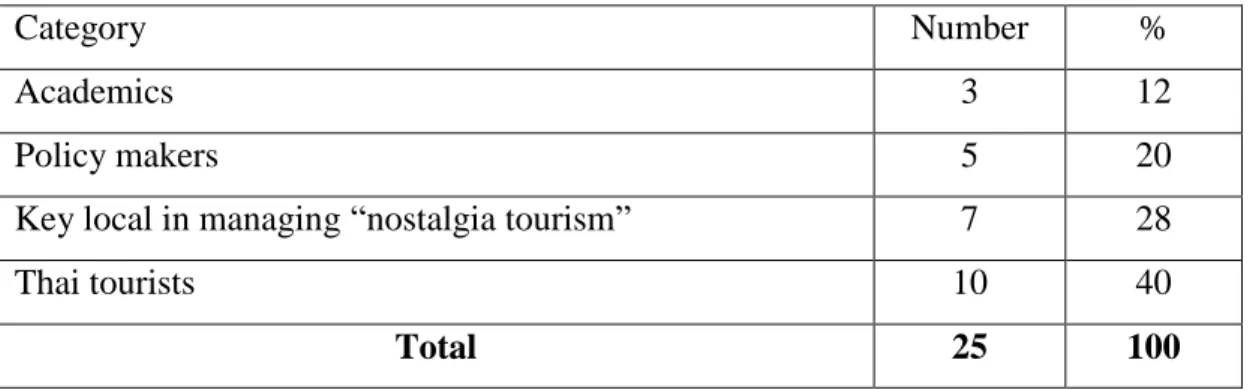
I interviewed 25 participants from all categories. For these interviews and questionnaires, I used Thai language to communicate with the interviewees. In August 2014,I spent one month to interview the key informants. The interview was conducted in about 20-40 minutes.
Interviewees were categorized into 4 main groups:
(i) The academics specialists and the people involved in tourism. A form of question guidelines was prepared in advance to facilitate the interviewees to grasp the ideas, and opinions regarding the management of “nostalgia tourism” that has widely occurred throughout Thailand modern society, focusing on the middle class, and young generation.
(ii) The policy maker. A form of question guidelines was prepared in advance to facilitate the interview to grasp the ideas, and opinions regarding the policies of
“nostalgia tourism”.
(iii) Key local actors in managing “nostalgia tourism”: For this group, the questions for interview were conducted to grasp the ideas of the community themselves and the investors, to learn about the history of the markets, and the process of nostalgia management of the markets and floating markets and the target tourists they were expecting, as well as the people concerned with “nostalgia tourism”. The representatives were sellers/ merchants in the Amphawa floating market, Khong Lad Mayom floating market and Taling Chan floating market.
(iv) The tourists were people who frequently visit nostalgia destinations. The questions were targeted toward their opinions toward markets and floating markets as
“nostalgia tourism” destinations.
17
Table 1-1: Participants category
Category Number %
Academics 3 12
Policy makers 5 20
Key local in managing “nostalgia tourism” 7 28
Thai tourists 10 40
Total 25 100
Population for the quantitative study section : 2. Survey questionnaire with 200 informants
In August 2014,I spent one month for the survey questionnaire. The researcher considered this means of gathering data to be the least time consuming for visitors, so as to efficiently obtain information from 200 tourists who traveled to the field study sites, Amphawa floating market, Talingchan floating market and Khlong lad mayom floating market. In addition, the questions in Thai language were designed to suit the visitor‟s limited time.
(i) Thai tourists visiting nostalgic tourist destinations: 200 tourists from Amphawa Floating Market, Khlong Lat Mayom Floating Market, and Taling Chan Floating Market were selected and the questionnaires contained the following three parts:
i) Part 1 contains multiple-choice questions with a single-choice permitted answer for each question designed to inquire about personal background information including gender, age, income, education, traveling, and travel companion.
ii) Part 2 contains multiple-choice questions with multiple permitted answers for each question designed to gain more insights on “nostalgia tourism” and their behavior regarding “nostalgia tourism”.
iii) Part 3 contains open-ended questions to enquire the attitude respect of data of the visiting tourists as well as the contributing factors to travel choice of travel and the travel experience regarding “nostalgia tourism”.
My field questionnaires were conducted in the top 3 nostalgia destinations:
18
1) Amphawa Floating market in Samut-Songkram province approximately 73 km from Bangkok,
2) Khonglad Mayom Floating Market in Bangkok and 3) Taling Chan Floating market in Bangkok.
(See map 2 and 3)
3. On-line questionnaire with 80 informants
In 2016, I did survey questioniares for Thai tourists visiting “nostalgia tourism”
destinations who were 35 years of age or younger. 80 visitors were selected and the data was collected using an online questionnaire via Google Forms.
(i) Part 1 contains multiple-choice questions with a single-choice permitted answer for each question designed to inquire about personal background information including gender, age, income, education, traveling, and travel companion.
(ii) Part 2 contains multiple-choice questions with multiple-choice permitted answer for each question designed to gain more insights on “nostalgia tourism” and their behaviors on “nostalgia tourism”.
(iii) Part 3 contains open-ended questions to enquire as to the attitude and respect of data of the visiting tourists as well as the promoting factors to traveling, the travel experience regarding “nostalgia tourism”, their opinions on the media that influence
“nostalgia tourism” and the reception of unique experience in “nostalgia tourism”
without having any prior direct experience.
4. Participant observation at 10 places
Participant observation: The researcher employed participatory observation on the general condition of the floating markets, old markets, constructed markets, and other tourist attractions created to simulate the old community atmosphere. The observation was conducted on both the environment and the atmosphere related to the issues in study. The derived data from this participant observation was analyzed in conjunction with in-depth interviews and non-formal interviews.
In August 2013, I spent one month of weekends surveying and
19
visiting the nostalgia destinations in the central region, identified from the guidebook of Tourism Authority of Thailand. “15 TARAD BOK 16 TARAD NAM” (See map 2,3). It listed in total 31 places, but I chose 10 places to visit as follows:
i) Plearn Waan, Prachuap Khiri Khan ii) Samchuk market, Suphan Buri
iii) Khlong Lat Mayom Floating Market, Bangkok iv) Taling Chan Floating Market, Bangkok
v) Pattaya Floating Market, Chon Buri
vi) Don Wai Floating Market, Nakhon Pathom
vii) Bang Nam Phueng Floating Market, Samut Prakar viii) Tha Kha Floating Market, Samut Songkhram ix) Bang Noi Floating Market, Samut Songkhram x) Amphawa Floating Market, Samut Songkhram
Map2: Map of 16 Floating market (16 TARAD NAM)
(Tourism Authority of Thailand Guide book “ 15 TARAD BOK 16 TARAD NAM
20
Map3: Map of 15 Old market (15 TARAD BOK)
(Tourism Authority of Thailand Guide book “ 15 TARAD BOK 16 TARAD NAM” ) 2.3.2 Secondary data
Secondary data was the data obtained from various studies and theses including concepts related to this study, such as cultural tourism, “nostalgia tourism”, artificial culture, and the policies of domestic tourism promotion, as well as other related publications, articles, documents, books, journals or websites.
21
Chapter 3
Literature review
22
This chapter explores the concept of “nostalgia tourism” in Thailand and discusses how the concept of nostalgia has been constructed in Thai society. It first looks at the significant factors of nostalgia knowledge in order to identify the new concept of
“nostalgia tourism” through the influence of many factors in the society in which we live. These include “nostalgia tourism” and its development, the invention of tradition, imagined community, representations in media such as films, TV programs, and period dramas, and the effects of social networks. This culminates in the invention of traditions that are reconstructed as nostalgia destinations by the effect of signs, images and semiotics.
3.1 The Concept of Nostalgia in Thai context Nostalgia and “Nostalgia tourism”
According to the Oxford English Dictionary, the term nostalgia is a relatively young neologism. Despite its Greek roots, the word was first used in 1688 by the Swiss medical student Johannes Hofer, who wrote his medical dissertation De Nostalgia about the condition of severe homesickness. The phenomenon which nostalgia describes, however, goes a long way back in history and was not a new discovery in the seventeen century.
Nostalgia or a yearning for the past is cultural society phenomenon that had first occurred in western society. The formation of the word “Nostalgia” consists of two Greek words, “Nostos” meaning “homecoming” and “Algia” meaning “pain,”
originally coined in 1688 by Johannes Hofer, a Swiss doctor, to refer to what he interpreted as a psychological malady of Swiss soldiers fighting abroad, whose pining for their homeland was judged to disrupt their grounding in the present (Boym, 2001).
Thus, originally, this word was a medical term describing psychological symptoms that was “the sorrow from longing to return home”( Scanlon, L. W. and Eheret,2008)
From its original meaning of longing for a place left behind, nostalgia has now come to refer more frequently for a longing for a particular time in the past (Gammon, 2002).
Davis (1997)sees nostalgia as a tactic used by people to hold on to a sense of identity despite transitions and discontinuities in their own life, and discerned three levels at which nostalgia is experienced: 1) naïve yearning for a supposedly more
23
ideal past, 2) critical interrogation of the past, and 3) attempting to understand the feeling of nostalgia itself. Holak and Havlena (1992) found that nostalgia feelings could be triggered by both tangible and intangible stimuli, including tastes and smells, as well as media such as a film or music.
Nevertheless, using this term in tourism context includes wider meaning. It is to say that it conveys not only the sentiment related to the places in the past but also the meaning of “The recollection or the sentimentality of the past experiences products, or services (Baker& Kennedy,1994).
Therefore, nostalgia is mainly related to sentimentality. The analysis shows that factors of nostalgia can be classified into three main categories:
- Sentiment - Nostalgia is the phenomenon that people express their “bittersweet”
emotion (Holak, S. L. and Havlena, W. J.,1992). In other words, this emotion happens when people wish to return to the past. Besides, nostalgia happens when people are unsatisfied with the current situation or society or discover some drawbacks. As a result, people would like to go back to the past.
- Place and Time - Nostalgia may be the longing for the past or previous experience aroused by the existent or imaginary places in a period different from the present time, (Lowental,1985). It is a linear time and undetermined future. From this reason, the story that occurred at certain time in the pat can re-occur (Chase& Shaw,1989).
- Motive - Nostalgia is similar to other cultural society phenomenon with varied motives. Scholars who study on this occurrence concluded and assured the findings from the researches that nostalgia was the occurrence caused by many types of motive such as appropriate well-prepared places with scent, sound, taste, persons, objects, or incident. Motives can be influenced by any of the five senses, by which the individual has different methods to connect to the past (Bower, M, 1995).
Thereby, floating market tourism in Thailand is a part of this phenomenon. When people are sick of urban lifestyle and unsatisfied with current state of society e.g. the crowded residence, working in restricted space or polluted environment, they would look back to the past. These reasons are the major factors why cultural tourism or nostalgic tourism becomes more popular.
In Thailand, “nostalgia tourism” is considered primarily as domestic tourism in which the concept of nostalgia is highlighted as a distinctive. A scholarstated that “If
24
the past were a distant land, nostalgia would turn that land into an affluent business”
(Lowental, 1985)
The goal of the nostalgia tourist is a “successful consumption experience” (Stern, 1992) in which they are able to transcend their own time and place and attain a feeling of connectedness with the flow of history by immersing themselves in the aura of the past. The relationship between nostalgia and consumption manifests itself differently in different cultures. Japanese tourists, for instance, have been said to use travel to affirm national identity (Graburn, 1983; Siegenthaler, 1999).
In summary, “nostalgia tourism” is the social trend because people are trying to create “identity” and escape from the monotony of daily life to look for “the truth” of life. This type of tourism, thus, is the answer for the new Thai society which can be concluded as follows.
1. Nostalgia is one major social phenomenon in Thai society. Tourists visit the tourist attractions that have cultural resources to fulfill their nostalgic feeling such as visiting floating markets which represent the image of the past which responds to their need. Additionally, most tourists are the people from the middle class and have residences in the city. They are able to afford to travel by themselves.
2. The truth of “nostalgia tourism” contains wide meaning. There is not only the physical meaning of cultural resources, which are the foundation of tourism resources, but also the meaning of the attractions the tourists encounter. For these reasons, it can be said that the truth of tourism is not only from visiting the original places but also from the experiences gained from the way of life and traditional culture, including buying nostalgic consumable products. This is one format of the truth. All these reasons convince the tourists to visit these nostalgia tourist attractions.
Nostalgia in Thai
“Ta Wil Ha Adiid ” or “Hooi Ha Adiid” originates from a person‟s past memories, and the English word to define this feeling is “Nostalgia”. However, in current Thai society, “Ta Wil Ha Adiid ” and “Hooi Ha Adiid” are not limited only to those that have direct memories of the past, but can apply even to groups of people that have never had direct experience in the past because nostalgia phenomenon is widely and incessantly expanded until it seems to be the mainstream of middle-class people and
25
teenagers in Thai Society. This is resulting from rapid changes finally met with a countercurrent of flashing back to the past, capitalized upon and reinforced by a number of period dramas, restoration of markets or even the implementation of local wisdom recovery policy of the government, emerging with great impacts on the economy. Nostalgia trend has been initiated systematically, infiltrating every step of life in Thai society.
“Thainess” is regarded as a symbolic meaning substantially used in nostalgia phenomenon in Thai society and widely disseminated in tourism industry which can be noticed from the restoration of old markets and floating markets to promote them as domestic tourist attractions for Thai people.
Nostalgic society in Thailand is a phenomenon to seek identity and gain confidence of being oneself, and seeking the past connected with the true future of people in current society.
Nostalgia of people in current Thai society is mainly caused by neo-nationalism and an identity crisis resulting from rapid movement of the society. As a result, people in the society have unclear memory and thus seek their origins and roots. In addition, Thai society has recent direct experience from the economic crisis in 1997, as well as political insecurity and awareness of monarchy due to illness of King Rama IX and that was why people in the society constructed a frame to defend themselves.
Hence, the trends of speaking of nostalgia as social phenomenon, the restoration and definition of invented culture, imagined community construction or creation of
nostalgic spaces as well as mutual feeling and consciousness emerge in the society.
Studies on nostalgia market in Thai tourism
Literature review of research studies relevant to “Strategies of Nostalgia Construction for Tourism of Traditional Way of Life Preservation Community” found that they referred to concepts and theories applied in previous research.
Studies relevant to nostalgia
The research studies about tourism and nostalgia, both for analyzing the construction of meaning and revitalization were those of (Songsiri, 2013) “A construction of
26
"Nostalgia" in The Variety Show Talad Sod Sanam Pao”, “The Use of Retro Principles in Print Corporate Advertising”, Dechkriangkraikul &Pheuaksakon (2005) “Retro Marketing: New Marketing Strategy”, (Somboonburana, 2003) “Cultural Heritage Revitalization for The Living of Mon Community in Sam Khok District, Prathum Thani Province”, (Techawiboonwong, 2000) “Symbolic Interactive Communication of Tourism in Postmodern Age of The Amazing Thailand Campaign”, (Lekngarm, 2009).
“The Social Construction of Nostalgia in the “Wan Warn Yang Wan Yoo” Television Program”, and (Pocapanishwong, 2003) and “The Community” on Pra Arthit Street Area among Habitable Urban Revitalization”.
Songsiri (2013) studied “A construction of "Nostalgia" in The Variety Show Talad Sod SanamPao”. The study showed that there were two strategies of nostalgia construction applied: the strategy to create the pattern of the program and the strategy to create the content. The strategies to create the pattern of the program were entertaining audiences with the antiques, enabling participation of audiences via their representatives, simulation, using image techniques, using sound effects, and comparing to see differences.
The strategies to create the content were displaying representations of fresh market and promoting lost traditional values. The representation of fresh market was to represent good relationships between people in the fresh market, rare foods, ways of transferring knowledge from generation to generation, examples of relationships between people of different lifestyles, and the underlying struggle of people living by way of the fresh market. In terms of the lost traditional values, they included being patient and diligent, valuing tradition and culture, love and warmth in family, pride in one‟s ethnicity, and upholding virtue.
From the research on “The use of retro principles in print corporate advertising,”
results showed that the most popular principles of retrospective concept in print media were the nostalgic concepts, interest in arts, music, and the historical education, natural preservation and returning to nature, and original/handmade goods, respectively. The most popular presentation patterns from nostalgia in print media design were the images focusing on the special techniques, the images focusing on visual art and art ideology, and the images focusing on sense of humor.
Dechkriangkraikul & Pheuaksakon (2005) published a study on “Retro Marketing:
New Marketing Strategy. It was found that many products and services utilized retro
27
feelings in marketing to customers, such as reproducing the successful products in the past called “retro products” such as traditional coffee and Royal Thai cuisine. In addition, retro scape was also applied in cases such as a concert to recall popular songs or retro services, in which a retro atmosphere was applied in providing services such as Thai traditional massage or spa with Thai herb scent.
Somboonburana (2003) conducted the research “Cultural Heritage Revitalization for The Living of Mon Community in Sam Khok District, Prathum Thani Province”.
The findings demonstrated that government and private sectors were encountering a lack of participation by local people in cultural heritage revitalization. This revitalization included things like giving knowledge of vanishing or rare local wisdom through school curriculum or local lessons, promoting culture as tourist attractions, and organizing activities or traditional festivals.
Techawiboonwong (2000) studied “Symbolic Interactive Communication of Tourism in Postmodern Age of The Amazing Thailand Campaign”. Results demonstrated that 12 types of symbols were employed in tourism advertisement: handicraft, cuisine, objects, construction, places, nature, activities, transportation, performance, people, animals, and plants. These symbols were used to convey impressions connecting Thai culture related to nature and commercial culture. Additionally, it was found that most tourists were from “the middle class” who consumed tourism products, wanted to preserve traditional heritage, and longed for the past.
Lekngarm (2009) reported on “The Social Construction of Nostalgia in the “Wan Warn Yang Wan Yoo” Television Program”. Results were that (a) It contained content from the past of people of all ages, (b) the content focused more on the past of the individual that that of the collective, (c) the content reflected the past in 2 ways:
the image that had already passed, and the image of what had existed plentifully in the past and was rarely found at present. The presentation of the content included the representation of retro and the representation of nostalgia.
In regard to representation of retro, five concepts were discovered: Hybrid, Simulation, Non-Linear, Cut and Past, and Repetition. In regard to the receiver, it was found that the audience of old generation and new generation were interested in watching the show for the same two reasons: they were interested in the style of the host, as well as the content presented of the past. In terms of interpretation, it was
28
found that (a) factors of the difference of the social knowledge from the experience related to the past of the audience and people affected the interpretation more than the difference of age, (b) most of the interpretation of audience was retro interpretation.
There was only a minority of audience who interpreted the nostalgia aspect, and (c) the most important factor of interpretation was the experience of the audience to identify with what was presented in the show.
Pocapanishwong (2003) conducted a study on The Community on Pra Arthit Street Area among Habitable Urban Revitalization. The results indicated that the mutual memory and history of people in the community were inconsistent with the image of the habitable city of the middle class people who gave the value of “traditional/ancient culture.” Therefore, the images and activities people from middle class had organized conveyed the meaning of nostalgia and utopia, which was unreal and without truly understanding the cultural society of the local people in “Bang Lamphu Community”
Nostalgia From the Time Perspective
Kaewthep (2006) mentioned about the study on “Time” that time was the one of the dimensions along with “Space”. That was to say, we could only refer to humans, objects, incidents, or ideas if “Time” was defined. When talking about the content of society and culture relative to human interaction, the perspective of time must be taken into account, especially when we talk about “change”; time is unavoidable. This was because the change happened from and to a point in time. “Time” is the fundamental dimension, while ideas and culture changed relative to time.
From the study on Time Perspective, people consider time in two aspects:
Retrospective, in which nostalgia is included, and Prospective. If considered from the point of view of ideologists, who are interested in the time perspective in terms of nostalgia, there are many explanations as follows
Views on the enchantment of the past
The viewpoint analyst on nostalgia considers it as the “enchantment with the past”
(Kittiar-sa, 2003). Nostalgia was the re-imagination of a world we had lost, the world
29
in which the individual and other members of cultural society had shared mutual experiences in the past. It was the real world that only remained in the memory. The only means to communicate with this world was via “imagination” that was formed from life experiences and cultural experience. Importantly, we could sense and experience the lost world again. Creating a representation by reproducing or remaking the memory by imitating the experiences in the past showed that nostalgia through the eyes of Kelly (1986) reflected “the sweet past”. It was to say that when the sweet past was no longer extant in the present world, people looked back to see it with admiration and enchantment and wanted to feel it again. Thus, this type of nostalgia reflected a positive sentimentality. It was consistent with other analysts such as Techawiboonwong (2000), who explained that nostalgia was the essential sorrow as we were trying to get back what we had destroyed. Therefore, nostalgia was the positive feeling toward the beauty, happiness, and enjoyment of the past.
Techawiboonwong (2000) studied on “Symbolic Interactive Communication of Tourism in Postmodern Age of The Amazing Thailand Campaign”. This research provided support for the association of nostalgia with enchantment. The study aimed to look for the symbols and meaning of symbols appearing in tourism advertisement messages published in the Amazing Thailand Campaign, and to explain the symbolic communication process of the modern tourism industry. Findings showed that the receivers, who were primarily middle class tourists, had a variety of needs, especially
“the need of old value preservation or nostalgia”. Thus, the symbol senders, who were the advertisement producers, were trying to attract the tourists by focusing on culture.
Cultural tourism was the background, so the presentation of this idea needed the support from the press in order to reach a large number of people quickly and used the symbols to convey the meaning of the message. Findings found that symbols in the tourism advertisement content published in the Amazing Thailand campaign could be grouped into two categories: cultural symbols, which were the main focus of this research, and natural symbols. I hypothesized that the cultural symbols were mostly present because the project was targeted more toward foreign tourists than Thai tourists.
Thus, the unique and irreplaceable identity of Thai culture was selected for attracting the target group. Another aspect that tourists wished to experience was the
30
old values of the past such as traditions, cultures, architecture, arts, and way of life, and Thailand was able to accommodate their requirements. Thus, travelling to Thailand was the channel to take them to experience a sort of Eden that had been lost from the current society they were living in. This research supports the idea of the enchantment of the past in a form of travelling to see the good of the past.
Looking forward and Looking backward
While modernism is the prospective perspective, nostalgia, which is the perspective of postmodernism, looks the opposite way. Modernism admires the present and aims for advancement. With this forward-looking perspective, nostalgia is in effect a backwards concept in the eyes of modernism. On the other hand, nostalgia concept takes retrospective ideology which changes from looking forward to looking backward.
Some background for this concept may be found in (Hinwiman, 1999) in her opinion on “time” in Thai culture. She explained that in American society since the 1950s, as time passed, the press‟s vision had changed from looking forward to looking backward. With regard to Thai belief, meanwhile, Thai vision did not have a distinct boundary between the past, present, and the future. It considered the present as a mixture of the past and looking forward to the future. Therefore, although the western theory explained the standpoint of looking forward and looking backward as contradictory directions, Thai context combined the concept of modernism with the postmodernism concept. To that end, (Kaewthep, 2009) clarified the time direction of television media that television had a special standpoint: looking backward, focusing on the present, and also looking forward, dubbed “Three times on the liner timeline”
and supported by television editing tools and technology. For example, in the present World Cup Tournament, television presented the previous match while predicting the tournament result of the next 4 years. As evidenced above, time perspective in Thai context was the mixture of looking both forward and backward.
McLuhan (1964), the western theory thinker presented the concept of “car‟s rear- view mirror” to explain the direction of television and other media creating the perception that the study of history could take us back to the past. McLuhan (1964) emphasized the “power” of images presented on television to create perspective and
31
procedure of event in the past. Furthermore, he proposed the influence of aspects of postmodernism in terms of television culture, namely that the contemporary understanding of history was presented in a form of representative image and images on television. The real history had been lost, but was replaced with and conveyed through imagination and illusion.
Politics of memory
If considering time as what has already passed, the experiences are collected in forms of memory. However, because of the human limitations of memory, it is virtually impossible to collect all life experiences in memory.(Kittiar-sa, 2003) explained that recollection was political. This was because recollection was not the complete unabridged record of the past, but the choices of the past affecting the present. The human brain simply cannot remember all past events. Recollection, thus, was the selection, negotiation, and presentation of partial truths. For example, out of years of childhood experiences, with the limitation of human memory, people remember only a select few of them.
The politics of memory asserts that human memory is social amnesia. Selecting whether to remember or forget something occurs at not just the individual level, but also at the social level, in what is deemed collective memory and collective amnesia.
Furthermore, (Hinwiman, 1999) highlighted the critique from modern sociologists that admiring and stepping forward to the future contributes to collective amnesia. It was not only the individual, but also the society who forgot the past, in some cases leading to disaster in the end.
There were some conditions that resulted from collective amnesia in which caused the nostalgia in people from the middle class. (Hinwiman, 1999) classified these conditions into two types.
(1) Nostalgia happened when the individual found that they were in an unstable situation. Thus, they were missing something in the past they believed to have been more stable. Additionally, scripts of plays concerned with culture of other countries (common in Thailand‟s past) was another example showing that Thai people from the