Shizuka Sakurai
*Introduction
The need to strengthen international competitiveness has been increasing in universities in Japan. Aiming to accelerate the globalization of Japanese higher education, universities are planning to increase the number of foreign educators, international students and classes taught in English. In future there will be more courses conducted in English, for both general and specialized education, and Japanese students will have more opportunities to participate in English-medium classes with foreign students (“Nikkei Asahi Review,” 2014). There are students who take standardized language tests such as TOEFL (iBT) and IELTS that require lecture listening and note-taking.
When taking content courses in English, important academic skills for students, among others, are lecture comprehension and note-taking. To succeed academically, it is vital to acquire the integrated skills to understand the content of the materials and teachers’ explanation, and to transcribe key information for reviewing in preparation for later exams or
* 福岡大学共通教育研究センター外国語講師
Promoting Skills and Strategies
quizzes. Although today's university students might be familiar with so-called slideware programs such as PowerPoint, and with receiving copies or handouts of lecture contents, the task of note-taking serves important academic and cognitive functions for students, e.g., external storage, active learning, and retention of information (Katayama, Shambaugh, & Doctor, 2005; Kiewra et al., 1991). This applies to both classes taught in L1 (first language) and L2 (second language), though the tasks inevitably become challenging in L2 learning contexts. Koren (1997) reported that taking notes in L2 (English) can be demanding for intermediate or lower level EFL learners. The present study analyzes the effects of strategy instruction and practice of lecture listening and note-taking. The study also reports Japanese students’ perceptions on carrying out these tasks in English (L2).
Literature on Lecture Comprehension and Note-taking
The EFL/ESL Contexts OverseasNote-taking includes a variety of processes: decoding, comprehending, identifying the main points, deciding when to recode, and writing quickly and clearly (James, 1975). The benefits of note-taking in academic contexts have been widely recognized among L1 learners. Notes serve as an external memory, which can be useful for reviewing, test preparation, and other tasks (Hartley, 2002; Kiewra, Benton, Kim, Risch, & Christensen, 1995; Laidlaw, Skok, & McLaughlin, 1993; Williams et al., 2013). The act of note-taking itself can also enhance learning by fostering retention, attention, and comprehension (Carrier, 1983; Kiewra, 1985).
times, severe time pressure.” Even for L1 speakers, the benefits of note-taking are reduced when the note-note-taking task detracts from information processing (Clark et al, 2013). Note takers are constrained by the speech rate of the lecture: writing speed is generally about 0.2 to 0.3 words per second, whereas speaking speed is about 2 to 3 words per second (Piolat et al., 2005). For L2 learners, the task is more challenging as the multiple tasks of lecture note-taking require greater cognitive effort than for L1 speakers (Piolat, Barbier, & Roussey, 2008).
Among studies examining the effects of note-taking in L2 lecture comprehension, inconsistent results were found. Bloomfield et al. (2011, p. 77) reported that “overall, the literature suggests that the ability to take notes can be advantageous for L2 listening comprehension under certain circumstances.” Carrell, Dunkel, and Mollaun (2002) found positive effects for note-taking in L2 (English), as well as significant interactions between note-taking and the topic. In addition, researchers investigated the relationship between quality and content of the notes in L2, as well as the positive impact on listening performance (Dunkel, Mishra, & Berliner, 1989; Song, 2012). They claimed that ESL/EFL students with “better” notes tend to perform better, indicating that note quality measures may be good indicators of test performance. For L2 note-takers, the types of note-taking format can also be influential; it is more effective to provide outlined sheets, consisting of partial lecture notes with structures to organize information, than providing blank sheets especially in the beginning (Song, 2012).
indicate that the availability of notes (for TOEFL listening parts) does not have an impact on the result of listening on immediate recall tests (e.g., Chaudron, Loschky, & Cook, 1994). Thus, previous L2 note-taking research reported inconclusive results, and indicated that note-taking while listening to a lecture in English can be cognitively demanding especially for EFL/ESL learners, and can hurt their comprehension. However, difficulties or benefits of note-taking in L2 (English) could vary depending on various factors such as the learners’ L2 proficiency levels, how they take notes, the difficulty of lecture contents, the speech rate, and lecturer’s accents. The effects of these factors on lecture listening comprehension and note-taking need to be explored further.
The Japanese Context
benefits of classroom pedagogy for note-taking during lecture listening have been found, these pedagogical merits can be further investigated in combination with measuring the gains in lecture comprehension. It is necessary to further observe learners’ note-taking patterns and to explore effective instruction for integrated tasks of understanding lectures and note-taking in L2.
Research Questions
Previous L2 note-taking research indicated that note-taking during lecture listening can be a very challenging task of selecting and recording oral information. However, if learners acquire efficient note-taking skills, the act of note-taking and the recorded information can have a positive impact on their academic learning. Generally, students recall more lecture contents and perform better on exams if they take notes (Johnston & Su, 1994; Kiewra et al., 1991). Japanese students will have more opportunities in future to attend English-medium courses at universities (“Nikkei Asian Review,” 2014). Scaffolding will surely be a beneficial part of a course. At the start or during a course in English, providing EFL learners with explicit instruction and sufficient practice will enable a bridging of the gaps between what students can do and what they are expected to do. By offering support on lecture listening and note-taking, the present study investigates the effect of the instruction on these skills in L2. The following research questions are addressed in the present study.
1. Does EFL students’ lecture comprehension improve over a semester? 2. Do learners’ note-taking skills improve qualitatively (total notation,
(note organization)?
3. What are the perceived difficulties in listening to lectures and note-taking?
Method
ParticipantsFifty-six Japanese female university students participated in the research. They belonged to two groups of intermediate-level first-year students, one of which was assigned to be the note-taking group (Note Group, n=27, TOEFL ITP Mean: 501.4, SD=16.6), the other to the Control Group (n=29, TOEFL ITP Mean: 472.3, SD=12.7). Between the pre-test and post-test of lecture listening, both groups had a semester (15 weeks) of regular English classes (90 minutes). Note Group received guidance on academic lectures and note-taking in English, and regularly practiced listening to lectures while taking notes in English. As for the previous experience of taking academic courses in English, the two groups did not differ. According to the survey conducted in the present study, for most participants, lecture listening and note-taking were unfamiliar tasks. Approximately two thirds of the participants (Note Group: 77.8%, Control Group: 72.4%) expressed their interest in taking content classes in English.
Treatment: Practice of Lecture Viewing and Note-taking
Widescreen images of realistic lectures were shown on a large display panel. Before and after viewing the lectures, the students learned strategies of how to listen to lectures and take notes. They received instructions on the selection of key points and the organization of notes using headings, outlines, symbols, abbreviations, color-coding, lines, arrows, spaces, and graphic organizers. They also learned typical structures, useful expressions for academic lectures, and cues to signal the main and supporting points, definition, and shifts in topics. As guided note formats with skeletal outlines and organizers were reported to be helpful for L2 listeners (Siegel, 2015; Song, 2012), Note Group students were sometimes provided with linear outline notes, charts, and diagrams, which included some blanks to fill out during the lecture viewing. On other occasions, they used lined blank sheets. For peer activities, they compared their notes and helped each other to improve their comprehension and notes. The use of abbreviations tends to be difficult in L2 (Piolat et al., 2008). Therefore, during classes, Note Group sometimes spent a part of the class time practicing using abbreviations and symbols.
Control Group, on the other hand, did not receive instructions and practice sessions to improve integrated skills of lecture viewing and note-taking. They studied from a textbook that targets general academic skills, both speaking and listening. The textbook used by Control Group was different from the one used by Note Group. The learners (Control Group) listened to short academic lectures and passages and dialogues on various daily topics. The listening materials are audio only and the duration was about two to five minutes long. They spent more time on speaking activities than Note Group did.
Pre-test and post-test
Note-taking
The students’ notes on the lecture were analyzed quantitatively and qualitatively. The following is a sample of the notes taken by a student (Control Group).
The notations were counted according to the following categories.
1. English words 2. Japanese words
3. Symbols (e.g., =, #, <, → , ∼, +, ≈, ・)
4. Abbreviations (e.g., w/o, s/t, i.e., K, def, min/max, int'l, c.f., thru, vs.) 5. Numbers
6. Total count (the sum of everything above)
7. Key points (the important main and supporting information of the lecture)
Twenty-five important words or phrases (“key points”) were selected from the lecture text, (e.g., “sleep deprivation,” “effects on the brain,” “get lower grades,” “car accidents,” and “weight gain.”) These key points represented important concepts or facts for the main and supporting ideas of the lecture, and were selected and confirmed by three EFL teachers.
Qualitative Measures: Organization
evaluated the students’ notes based on a scoring rubric below (Table 1); each participant’s notes were scored from 0 to 3. All participants’ notes were scored twice by two trained raters.
Questionnaire
At the end of the course, after the test, a survey was conducted to assess the difficulties of lecture comprehension and note-taking perceived by the participants. The questionnaire consisted of 18 questions with the answer choices in the four-point Likert scales (see Appendix B for the questions). In addition to the difficulties, this survey aimed to investigate the participants’ confidence and their views on the importance of note-taking for academic success, as well as their interest in taking lectures in English in future. Previous studies reported that Japanese students were likely to choose midpoint on rating scales and avoid extreme answers in filling out questionnaires (Chen, Lee, & Steveson, 1995; Lee et al, 2002). Therefore, a neutral option “neither agree nor disagree” was not included in the
Table 1
Scoring Rubric for Note Quality
Structure Criteria Well organized
(Score: 3) Clear hierarchical structure
Most major and supporting ideas are recorded in an organized way (ex. headings, sub-headings, numbering, and blank space). Notes show the relationships among words and concepts. Partially organized
(Score: 2) Some hierarchical structure
Some major and supporting ideas are recorded in an organized way (ex. headings, sub-headings, numbering, and blank space).
Poorly organized
(Score: 1) Only a little Only a few major and supporting ideas are recorded. Not organized
questionnaire of this study to elicit answers from the participants.
Results
Lecture Comprehension and Note-takingFirst, the scores of post-lecture (listening) comprehension tests were compared between Note Group and Control Group (Table 2). In Week 1, the mean scores of the pre-test did not differ between the two groups: Mean of Note Group, Week 1 = 14.3 (SD = 2.0) vs. Mean of Control Group, Week 1 = 13.5 (SD = 2.2), no significant difference, d = 0.38. However, the difference became significant in Week 15: Mean of Note Group, Week 15 = 16.4 (SD = 2.0) vs. Mean of Control Group, Week 15 = 14.0 (SD = 2.0), p < .001, d = 1.20. The gain obtained in Week 15 by Note Group was larger than that of Control Group: Mean of Note Group = 2.1 (10.7%, SD = 1.7) vs. Mean of Control Group = 0.5 (2.2 %, SD = 2.2), p < .01, d = 0.81. The results suggested that providing instruction and practice sessions on lecture viewing and note taking had a positive impact on the learners’ immediate recall after lecture listening.
Next, the participants’ notations were analyzed and classified into seven categories: ‘English words’, ‘Japanese words’, ‘symbols, ‘numbers’, ‘abbreviations’, ‘total count’, and ‘key points’. Table 3 (Note Group) and
Table 2
Performance on the Pre-test and Post-test (listening comprehension) for the Two Groups Note Group (n = 27) Control Group (n = 29)
Mean SD Mean SD
Week 1 (Pre-test) 14.3 (71.3%) 2.0 13.5 (67.6%) 2.2 Week 15 (Post-test) 16.4 (82.0%) 2.0 14.0 (69.8%) 2.0
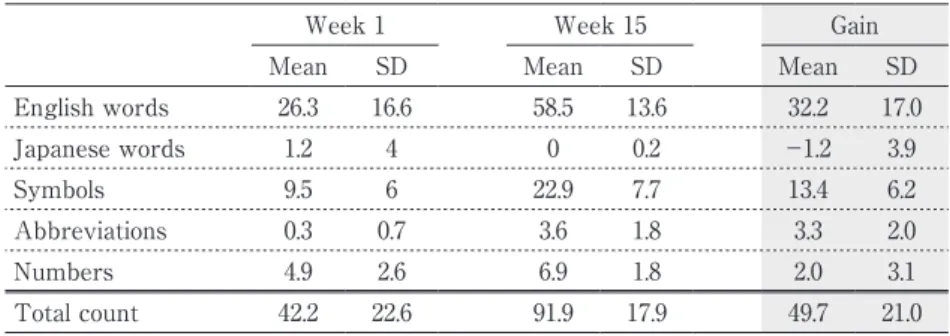
Table 4 (Control Group) present the descriptive statistics for each category except for ‘key points.’ In all, both groups had increased counts in Week 15 in all categories except for ‘Japanese words’ (Note Group) and ‘Abbreviations’ (Control Group). When comparing the raw gains of the two groups in each category (Tables 3 and 4), it was found that the gains in Week 15 were bigger for Note Group than for Control Group with respect to ‘symbols’ (Gain of Note Group=13.4 vs. Gain of Control Group=6.5, p < .01, d = 1.05), ‘abbreviations’ (Gain of Note Group=3.3 vs. Gain of Control Group=0.0, p < .01, d = 2.02), and ‘total count’ (Gain of Note Group=49.7
Table 3
Note-taking Performance for Note Group (n = 27)
Week 1 Week 15 Gain
Mean SD Mean SD Mean SD
English words 26.3 16.6 58.5 13.6 32.2 17.0
Japanese words 1.2 4 0 0.2 -1.2 3.9
Symbols 9.5 6 22.9 7.7 13.4 6.2
Abbreviations 0.3 0.7 3.6 1.8 3.3 2.0
Numbers 4.9 2.6 6.9 1.8 2.0 3.1
Total count 42.2 22.6 91.9 17.9 49.7 21.0
Table 4
Note-taking Performance for Control Group (n=29)
Week 1 Week 15 Gain
Mean SD Mean SD Mean SD
English words 22.4 13.3 48.2 19.2 25.8 15.1
Japanese words 0.6 1.9 1.1 0.4 0.5 2.0
Symbols 4.9 3.6 11.4 7.4 6.5 6.9
Abbreviations 0.4 0.9 0.4 0.7 0 1.2
Numbers 4.5 2.8 6.1 2.1 1.6 3.7
vs. Gain of Control Group=34.4, p < .05, d = 0.74). The learners (Note Group) tended to perform better in Week 15 when employing symbols and abbreviations, and generally they developed the skill to note down more information.
Table 5 presents the students’ total score for notations of ‘key points.’ There were 25 selected key points in total and one key item counted for 1 point, and a partial point (0.5) was given when the students missed one or two words or concepts in a phrase, for instance, “need health program” instead of “need stronger health education program.” The result showed that both groups had increased scores: the difference between Week 1 and 15 was significant: Note Group: Mean = 8.6, SD = 3.4 (week 1) vs. Mean = 14.6, SD = 1.2 (week 15), p < .01, Δ = 1.77 and Control Group: Mean = 7.7, SD = 3.4 (week 1) vs. Mean = 12.3, SD = 3.4 (week 15), p < .01, Δ =1.35. Note Group had a gain of 6.0, SD = 3.3 (relative gain: 23.6%), and Control Group had a gain of 4.6, SD = 3.7 (19.4%). There was no significant difference between the two groups with respect to the gain (d = 0.40). However, comparing the mean scores of Week 15, Note Group's result (score,14.6) was significantly larger than that of Control Group (score, 12.3) (p < .01, d = 0.89). Such effect was not observed in Week 1.
Table 5
Note-taking Performance on Key Points
Note Group (n = 27) Control Group (n=29)
Week 1 Week 15 Gain Week 1 Week 15 Gain
Mean SD Mean SD Mean SD Mean SD Mean SD Mean SD
Note Organization
Concerning note organization, each participant’s notes were scored from 0 to 3 (see Table 1 for the scoring rubric). The mean scores are shown in Table 6, and an example of notes by a Note Group student is shown below the table. Note Group utilized their learned strategies of how to organize the information efficiently. Most students in this group adopted outline formats. The score in Week 15 (Note Grope) were much higher than those of Control Group: Mean of Note Group, Week 15 = 2.3 (SD = 0.6) vs. Mean of Control Group, week 15 = 1.5 (SD = 0.6), p < .01, d = 1.33.
Table 6
Note-taking Performance on Organization
Note Group (n = 27) Control Group (n=29)
Week 1 Week 15 Gain Week 1 Week 15 Gain
Mean SD Mean SD Mean SD Mean SD Mean SD Mean SD
1.2 0.5 2.3 0.6 1.1 0.7 1 0.4 1.5 0.6 0.5 0.7
Similarly, the gain of Note Group was bigger: Gain of Note Group, Week 15 = 1.1 (SD = 0.7) vs. Gain of Control Group, Week 15 = 0.5 (SD = 0.7), p < .01, d = 0.86, showing the effectiveness of scaffolding activities to promote organizational skills in note-taking.
Questionnaire Results
According to the questionnaire results, regarding the lecture listening, Note Group had a better perception of comprehension than Control Group did. Note Group (70.4%) answered that they understood the lecture (the post-test) when only 37.9% of Control Group answered that they did (combining answers of “Yes, definitely” and “Yes,” Figure 1). 58.6 % of Control Group chose “Sort of” showing that they lack confidence in their comprehension.
The answers differed between the two groups for the question “What percent of the lecture did you understand?”: Mean of Note Group=69.3% (SD = 11.5) vs. Mean of Control Group= 53.8% (SD = 19.9), p < .01, d = 0.95. The majority of students in both groups thought that listening to lectures was
Yes,definitely 0 6.9
Yes 70.4
29.6 Note Group % (n= 27)
No 0 31
Sort of 58.6
Control Group %(n=29)
3.5
difficult (Note Group: 70.4%, Control Group: 75.9%, and the most commonly reported cause was a fast speech rate in the lectures, “speed”: 44.4% for Note Group and 58.6% for Control Group (Figure 2). Lecture note-taking was also perceived as difficult by the two groups: 88.8% for Note Group and 93.1% for Control Group. As shown in Figure 3, the participants considered the simultaneous tasks (writing while listening) as the major cause of difficulty: 63.0% for Note Group and 65.5% for Control Figure 2. The answers to “What were the diffi cult points in listening to the lectures in English?” 44.4 details
11.1 14.8 11.1
Note Group % (n=27)
11.1 speed 58.6 27.6 vocabrary 10.3 data 3.5 concentration 0 Control Group % (n=29)
Figure 3. The top four answers to “What were the most diffi cult points in taking the lecture notes in English?”
Note-taking while following lectures
Choose what to write 11.1 17.2 65.5 63.0 7.4 7.4 0 6.9
Spelling Use symbols,
abbreviations
Group. The answers of both groups were very similar. However, the students of Note Group showed more confidence in their improvement of note-taking skills: combining the answers “Yes, definitely” and “Yes,” 66.7% of Note Group vs. 34.5% of Control Group (p < .01). The data shown in Figure 4 represent the percentages.
Most participants acknowledged that note-taking helps them remember the lecture better (96.3% for Note Group and 82.8% for Control Group), and that it is one of the important academic skills (92.6% for Note Group and 96.6% for Control Group). However, 22.2% of Note Group and 20.7% of Control Group thought that note-taking prevented them from understanding lectures, which indicated that some learners needed intensive practice. The students of both groups reported that they were interested in taking content classes in English in the future (77.8% for Note Group and 72.4% for Control Group).
Discussion
The present study investigated measures that could be implemented to Figure 4. The answers to “Do you think your note-taking sill
improved over the semester?”
Yes, definitely 7.7
61.5
Yes Sort of
30.8
Note Group % (n=26)
No 0.0 7.1
28.6
46.4
Control Group % (n=28)
assists Japanese university students improve the skills of attending lectures and note-taking in English. According to research, learners tend to benefit from acquiring integrated skills and strategies to cope with cognitively demanding tasks such as following the speed of lectures, and selecting and writing down important information in an organized way. In this study, it was found that the learners benefitted from the scaffolding practices and improved integrated skills that are required to comprehend academic lectures and take notes in English.
Research Question 1
Regarding the first research question on lecture comprehension, the result showed that the treatment group (Note Group) had better scores and larger gains at the end of a semester than Control Group did. The control group did not improve the skills to comprehend lectures as shown in the post-listening test. This suggests that there were instructional effects that promoted the acquisition of lecture comprehension skills by EFL learners’ (Note Group). The control group did not have opportunities to regularly
to lectures and presentations in and outside class likely was one of the major factors contributing to the increase of comprehension.
There are other factors to consider: The students might have developed patience and strategies to deal with their anxiety when processing L2 auditory information that they do not understand perfectly. Additionally, it was probably helpful for learners to have general knowledge about the structure of lectures, and frequently used transitions, expressions, and cues. Previous research has claimed that the act of note-taking could engage students actively with the speech of their lecturers. It could be suggested that Note-Group students’ attention and retention of information were strengthened by the act of taking notes, which led to the better scores in the immediate recall test after the lecture.
Research Question 2
note-taking fluency and better listening comprehension. Although developing skills to utilize symbols and abbreviation seemingly requires more effort and practices from teachers and learners, its use for students wishing to develop their note-taking skills is evident.
Comparing the two groups on the notation of ‘key points’ (of the lecture), Note Group and Control Group did not differ in their gains made at the end of the semester. However, in the listening post-test Control Group performed poorer than Note Group did. This suggests that, for Control-Group students, capturing key points in notes did not help their comprehension or memory. The benefits of note-taking were probably mitigated because the demanding task of note-taking might have detracted from the initial processing of oral information. Note Group recalled these key points better in the listening tests (the learners of both groups were not allowed to look at their notes during the listening test.) Judging from these results, just writing down key points might not be sufficient for encoding the information in memory. There may be other important factors that contributed to Note Group's listening performance: For example, listening fluency, notation of supporting points, rapidity of note-taking, and organization of notes.
the post-test. However, some students reported in the questionnaire that it was difficult to organize information effectively to take clear notes: 33.3% of Note Group students chose “organization” as the second most difficult point in note-taking. As previously stated, effective note-taking is one of the vital academic skills, both in L1 and L2, and EFL students need an adequate amount of practice in lecture viewing in L2.
Research Questions 3
to supplement their comprehension and notes especially in the beginning. Several students (Note Group) mentioned, during personal communication after class, that post-listening collaborative activities, for example, conversation with their partners and comparison of their notes, helped their comprehension, memory, and deepening their knowledge.
To ease these difficulties of complex tasks, teachers of EFL courses and content courses in English could provide a variety of aids such as pre-organized lecture materials, skeletal notes to capture the main points, and a transcript of lectures. Follow-up activities such as pair or group discussion might be helpful. For some learners, it might be useful to receive an introduction to new terminologies or concepts, and speech accents. These efforts can make the task of taking lectures more manageable and lead to positive educational outcomes. Thus, lectures in English and note-taking presents a challenge for both students and teachers. Despite the difficulties, however, a number of learners in this study (approximately three quarters) are motivated to take English-medium courses. To answer the needs and promote internationalization of education in Japan, universities can prepare more intensive preparatory academic EFL courses than mere listening classes for students who are interested in enrolling in English-medium courses or studying abroad.
Future studies
differ depending on these variables. While this study focused on a classic style of note-taking with pen and paper, the adoption of digital technology such as using a laptop computer, software programs and/or e-learning systems can be looked into. Furthermore, there are various participation patterns observable among students in class. Especially, in courses taught by foreign teachers, active interaction may often be expected between students and teacher, and among students.
Conclusion
The lecture listening training had a positive impact on learners’ comprehension of academic lectures. It was found that the experimental group tended to take more extensive and more efficient notes than Control Group did, using a wider range of symbols and abbreviations. The use of abbreviations and symbols by the experimental group indicated that the learners had developed a skill to utilize strategies to cope with time-sensitive tasks of understanding lectures and note-taking. The learners also acquired some skills to organize notes clearly and efficiently. Such skills can be useful for reviewing the main points of lectures later. By helping EFL learners acquire appropriate strategies and integrated skills for lecture comprehension and note-taking, teachers can enhance the students’ academic learning and increase their interest and confidence in taking courses in English.
References
of language, publications. Retrieved form https://www.casl.umd.edu/publications/ what-makes-listening-diffi cult-5/
Carrell, P. L., Dunkel, P., & Mollaun, P. (2002). The eff ects of notetaking, lecture length and topic on the listening component of the TOEFL 2000. TOEFL® Monograph
Series (MS-23). Retrieved from https://www.ets.org/research/policy_research_ reports/publications /report/2002/ibeq
Carrier, C. A. (1983). Note-taking research: Implications for the classroom. Journal of Instructional Development, 6(3), 19-26. doi:10.1007/BF02906208
Chaudron, C., Loschky, L., & Cook, J. (1994). Second language listening comprehension and lecture note-taking. In J. Flowerdew (Ed.), Academic listening: research perspectives (pp. 75-92). New York, NY: Cambridge University Press.
Chen, C., Lee, S. Y., & Steveson, H. W. (1995). Response style and cross-cultural comparisons of rating scales among East Asian and North American students. Psychological Sciense, 6(3), 170-175. doi:10.1111/j.1467-9280.1995.tb00327.x Clark, M., Wayland, S., Osthus, P., Brown, K. G., Castle, S., & Ralph, A. (2013). The
eff ects of note taking on foreign language listening comprehension: An empirical study. University of Maryland center for advanced study of language, publications. Retrieved from http://www.govtilr.org/publications/notetaking.pdf
Crawford, M. J. (2015). A study on note taking in EFL listening instruction. In P. Clements, A. Krause, & H. Brown (Eds.), JALT2014 Conference Proceedings (pp. 416-424). Tokyo: JALT.
Dunkel, P., Mishra, S., & Berliner, D. (1989). Eff ects of note taking, memory, and language profi ciency on lecture learning for native and nonnative speakers of English. TESOL Quarterly, 23(3), 543-549. doi:10.2307/3586929
Hale, G. A., & Courtney, R. (1994). The eff ects of note-taking on listening comprehension in the test of English as a foreign language. Language Testing, 11 (1), 29-47. doi:10.1177/026553229401100104
Hartley, J. (2002). Notetaking in nonacademic settings: A review. Applied Cognitive Psychology, 16, 559-574. doi:10.1002/acp.814
and organization of lecture notes in intermediate English classes. Polyglossia, 24, 16-25. Retrieved from http://en.apu.ac.jp/rcaps/page/content0084.html/?path_info =content0084. html&content_id=84&cat_id=4&version=English&version=English James, K. (1975). Note-taking in lectures: problems and strategies. In A. P. Cowie and J.
B. Heaton (Eds.), English for academic purposes (pp. 89-98). Reading, Berkshire: BAAL/ SELMOUS.
Johnston, A. H., & Su, W. Y. (1994). Lectures - a learning experience? Education in Chemistry, 31(1), 75-76. doi:10.1016/0307-4412(94)90075-2
Katayama, A. D., Shambaugh, R.N., & Doctor, T. (2005). Promoting knowledge transfer with electronic note taking. Computers in Teaching, 32(2), 129-131. doi:10.1207/ s15328023top3202_9
Kiewra, K. (1985). Investigating notetaking and review: A depth of processing alternative. Educational Psychologist, 20(1), 23-32. doi: 10.1207/s15326985ep2001_4 Kiewra, K. A., DuBois, N., Nelson, F., Christian, D., McShane, A., Meyerhoff er, M., &
Roskelley, D. (1991). Note-taking functions and techniques. Journal of Educational Psychology, 83(2), 240-245. doi:10.1037/0022-0663.83.2.240
Kiewra, K. A., Benton, S. L., Kim, S., Risch, N., & Christensen, M. (1995). Eff ects of note-taking format and study technique on recall and relational performance. Contemporary Educational Psychology, 20, 172-187. doi:10.1006/ceps.1995.1011 Koren, S. (1997). Listening to Lectures in L2; Taking Notes in L1. TESOL-EJ 2 (4).
Retrieved from http://www.tesl-ej.org/wordpress/ issues/volume2/ej08/ej08a1/ Laidlaw, E. N., Skok, R. L., & McLaughlin, T. F. (1993).The eff ects of notetaking and
self-questioning on quiz performance. Science Education, 77(1), 75-82. doi:10.1002/ sce.3730770105
Lauwereyns-Sakurai, S. (2016). Extensive listening using online materials for EFL learners. Studies in the Humanities (Fukuoka Wowen's University), 80, 17-32. Lee, J. W., Jones, P. S., Mineyama, Y., & Zhang, X. E. (2002). Cultural diff erences
in responses to a likert scale. Research in Nursing and Health, 25(4), 295-306. doi:10.1002/nur.10041
Retrieved from http://asia.nikkei.com/Life-Arts/Education/ Japan-to-help-universities-boost-global-competitiveness?page=1
Piolat, A., Olive, T., & Kellogg, T. R. (2005). Cognitive eff ort during note taking. Applied Cognitive Psychology, 19, 291-312. doi:10.1002/acp.1086
Piolat, A., Barbier, M., & Roussey, J. (2008). Fluency and cognitive eff ort during fi rst- and second-language notetaking and writing by undergraduate students. European Psychologist, 13(2), 114-125. doi:10.1027/1016-9040.13.2.114
Siegel, J. (2015). A pedagogic cycle for EFL note-taking. ELT Journal, 70(3), 225-227. doi:10.1093/elt/ccv073
Solórzano, H., & Frazier, L. (2009). Contemporary topics 1. New York, NY: PEARSON Longman.
Song, M. (2012). Note-taking quality and performance on an L2 academic listening test. Language Testing, 29(1), 67-89. doi:10.1177/0265532211415379