Mapping
class
group, Donaldson-Thomas
theory
and
S-duality
Kentaro Nagao
Apri15,
2012
Abstract
We study Donaldson-Thomas theory associated to a triangulated
surface. We show that the generating function of the
Donaldson-Thomas invariants is “invariant“ under anaction of the mapping class
group, which is identified with the mapping class group action in the
(decorated) Teichm\"uller theory. This gives an example of constraints
of the generating function induced by the derived auto-equivalences.
From the view point of string theory, this is nothing but S-duality
of the BPS spectrum of the $4d$ gauge theory given by Gaiotto-type
construction.
Introduction
The DTinvariant fora Calabi-Yau3-fold $Y$is
a
countinginvariantofcoherentsheaves
on
$Y$, which isintroduced
in [ThoOO]as a
holomorphic analogue ofthe
Casson
invarianton a
rea13-manifold.
Although the categoryof
coherentsheaves
on
$Y$ isan
Abelian category, it has been known thatwe
take itas
acounting invariant of objects in the derived category.
An ideal application of this formulation might be the following: The
de-rived category sometimes have a non-trivial auto-equivalence group. In such
a case, the generating function might have
a
good transformation formulawith respect to this action, which would help us to determine the generating
function.
In this notes,
we
will show a newexamplel
of such a phenomenon. Westudy Donaldson-Thomas theory associated to
a
triangulated surface. Themapping
class group
actson
thederived category and the generating functionof the Donaldson-Thomas invariants is “invariant“ under this action.
Plan
In
\S 1,
we briefly review the construction in [FST08. LF09] of quivers withpotential associated to triangulated surfaces. In
\S 2,
we
study the mappingclass
group actionson
thederived category and the associated Poisson torus.The later is identified with the mapping class group action on the decorated
Teichm\"uller space
as
is shown in\S 5.
The main result of this paper appearsIn
\S 3.
Finally, we explainan
interpretation of the main result in terms ofS-duality ([Gai]) in
\S 4.
Acknowledgement
The author would like to thank Daniel Labardini-Fragoso for answering
his
questionson
[LF09], TakahiroNishinaka
and Masahito Yamazaki forex-citing
discussions.
The author is deeply grateful to YujiTachikawa
for hiselegant and mathematician-friendly talks on Gaiotto functor in New
devel-opments in Infinite analysis 2011.
1
QP for
a
triangulated
surface
In this section, we briefly explain how to associate a quiver with a potential
for
a
triangulated surface [FST08, LF09].1.1
Ideal triangulations of
a
surface
Let $\Sigma$ be a compact
connected oriented surface with (possibly non-empty)
boundary and $M$ be a finite set of points on $\Sigma$. called marked points. We
assume
that $M$ is non-empty and has at least one pointon
each connectedcomponent of the boundary of $\Sigma$. The marked points that lie in the interior
of $\Sigma$ will be called punctures, and the set of punctures of
$(\Sigma, M)$ will be
denoted P. 2
We decompose $\Sigma$ into “triangles“ (in the topological sense) so that each
edge is either
2We will always assume that $(\Sigma, M)$ is none of the following:
$\bullet$ asphere with less than five punctures; $\bullet$ an unpunctured monogon, digon or triangle; $\bullet$ a once-puncturedmonogon.
Here, by a monogon (resp. digon, triangle) we mean a disk with exactly one (resp. two, three) marked point(s) on the boundary.
$\bullet$ a curve (which is called an arc) whose endpoints are in $M$ or $\bullet$ a connected component of$\partial\Sigma\backslash M$.
Atriangle maycontains exactly twoarcs (see Figure 1). Sucha triangle (and
its doubled arc) is said to be
self-folded.
Figure 1: A self-folded triangle
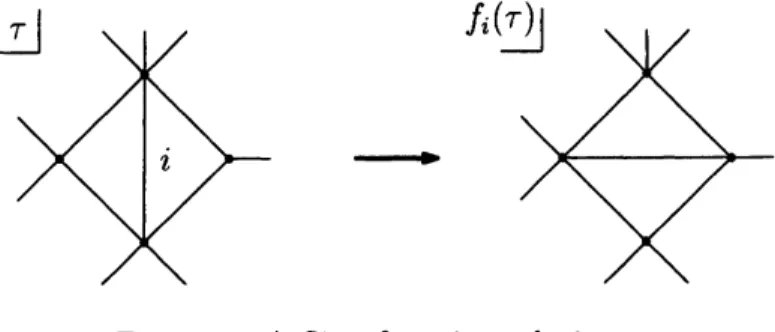
Given a triangulation$\tau$ and a (non self-folded) arc $i$, we can flip$i$ to get
a new triangulation $f_{i}(\tau)$ (see Figure 2).
–
Figure 2: A flip of atriangulation
Theorem 1.1 ([FST08]). Any two triangulations are related by a sequence
of
flips.1.2
Quiver for
a
triangulationLet $\tau$ be a triangulation. We will define a quiver $Q(\tau)$ without loops and
2-cycles whose vertex set $I$ is theset ofarcs in $\tau$.
Let $\pi:\tau_{1}arrow\tau_{1}$ be the map which is the identity on the set of
non-self-folded arcs and sends the a self-folded arc to the unique loop of$\tau$ enclosing
it.
For a triangle $\triangle$ and arcs $i$ and $j$, we define a skew-symmetric integer matrix $B^{\Delta}$ by
1 $\triangle$ has sides $\pi(i)$ and $\pi(j)$, with $\pi(i)$ following $\pi(j)$ in the clockwise order, $B_{i,j}^{\Delta}:=$ $\{$$-1$ the same holds, but in the counter-clockwise order,
We put
$B( \tau):=\sum_{\Delta}B^{\Delta}$
where the sum is taken
over
all triangles in $\tau$. Let $Q(\tau)$ denote the quiverwithout loops and 2-cycles associated to the matrix $B(\tau)$.
Theorem 1.2 ([FST08]). Given a triangulation $\tau$ and its (non self-folded)
arc
$i$,we
have$Q(f_{i}(r))=\mu_{i}(Q(\tau))$
where $\mu_{i}$ denote the mutation
of
the quiver at the vertex $i$.1.3
Potential
for
a
triangulation
For a triangle $\triangle$ in
$\tau$, we define apotential
$\omega_{\Delta}$
as
in Figure 3. For a puncture$Q(\lrcorner\tau)$
$arrow$
$\triangle$ $\omega_{\triangle}$
Figure 3: $\omega_{\triangle}$
$P$ in $\tau$, we define a potential
$\omega_{P}$ as in Figure 4. We omit the definitions of $\lrcorner\tau$ $Q(\lrcorner\tau)$
$e_{2}$ $e_{1}$ $e_{2}$ $e_{1}$
$e_{l}$
$arrow$
$-\cdot\cdot\cdot\cdot\cdot$ :
$P$ $\omega_{P}$
Figure 4: $\omega_{P}$
$\omega_{\Delta}$ and $\omega_{P}$ in the
cases
when self-folded arcs appear (see [LF09,\S 3]).
Finally, we put
Theorem
1.3
([LF09]).Given
a triangulation $\tau$ andits (non self-folded)arc
$i$,we
have$\omega(f_{i}(r))=\mu_{i}(\omega(\tau))$
where $\mu_{i}$ denote the mutation
of
the potential at the vertex$i$ in the
sense
of
$[DWZ08J$.
2
Mapping
class
group action
2.1
Mapping class
group
We define
Diffeo
$(\Sigma, M)$ $:=${
$\phi:\Sigmaarrow\Sigma|\phi$: diffeomorphism, $\phi(M)=M$}.
Let Diffeo$(\Sigma, M)_{0}$ denote the connected component of Diffeo$(\Sigma, M)$ which
contains id$\Sigma$
.
The quotientMCG$(\Sigma, M)$ $:=Diffeo(\Sigma, M)/Diffeo(\Sigma, M)_{0}$
is called the mapping class group.
2.2
Derived category for
a
triangulation
Let $\Gamma(\tau)$ be Ginzburg‘s dg algebra
associated
to the quiverwith the
potential$(Q(\tau), \omega(\tau))$ and $\mathcal{D}(\tau)=\mathcal{D}\Gamma(\tau)$ be the derived category ofright dg-modules
over $\Gamma$. By the result of Keller ([Kelll]), $\Gamma(\tau)$ and $\Gamma(f_{i}(\tau))$
are
equivalent3.
For
a
triangulation $\tau$ andanelement $\phi\in$ MCG$(\Sigma, M)$,we
get anothertri-angulation $\phi(\tau)$
.
Note that $(Q(\tau), \omega(\tau))$ and $(Q(\phi(\tau)), \omega(\phi(\tau)))$ (and hence$\mathcal{D}(\tau)$ and $\mathcal{D}(\phi(\tau)))$ are canonically
identified.
By Theorem 1.1, $\tau$ and $\phi(\tau)$
are
related bya
sequence of flips. Each flipsgives a derived equivalence. By composing the derived equivalences,
we
geta derived equivalence
$\Psi_{\phi}:\mathcal{D}(\tau)arrow^{\sim}\mathcal{D}(\phi(\tau))=\mathcal{D}(\tau)$ .
Thanks
to the result [FST08, Theorem 3.10] and the pentagonal identity forthe derived equivalences, $\Psi_{\phi}$ is independent of choices of a sequence of flips
and well-defined. Finally we get an action of the mapping class group
on
thederived category:
$\Psi$: MCG$(\Sigma, M)arrow$ Aut$(\mathcal{D}(\tau))$.
3Since we have two derived equivalences, we have to choose one of them. Given a
2.3
Cluster transformation
We put $T=T(\tau)$ $:=\mathbb{C}[x_{i}, x_{i}^{-1}]_{i\in I}$. We define $CT_{k}:T(f_{k}(\tau))arrow^{\sim}T(\tau)$ by
$CT_{k}(x_{i}’)=\{\begin{array}{ll}(x_{k})^{-1}(\prod(x_{j})^{Q(j,k)}+\prod(x_{j})^{Q(k,j)}) i=k,x_{i} i\neq k\end{array}$
where $Q(i, k)$ is the number of arrows from $i$ to $k$ and $x_{i}’$ is the generator of
$T(f_{k}(\tau))$.
In the
same
wayas
the previous section,we
get$CT_{\phi}:T(\phi(\tau))arrow^{\sim}T(\tau)$.
Under the identification $T(\phi(\tau))=T(\tau)$ induced by $\Psi_{\phi}$, we get
CT: MCG
$(\Sigma, M)arrow$Aut
$(T(\tau))$.Remark
2.1. Aswe
will explain in \S 5, this is compatible with the actionof
mapping class group on the decomted Teichmuller space.
3
Donaldson-Thomas
theory
Let $J_{\tau}$ be the Jacobi algebra associated to the quiver with the potential
$(Q(\tau), W(\tau))$.
Let $P_{\tau}^{i}$ be the indecomposable projective $J_{\tau}$-module associated to $i\in I$.
For $v\in Z_{\geq 0}^{I}$, we define
$Hilb_{\tau}^{i}(v)$ $:=\{P_{\tau}^{i}arrow V|\underline{\dim}V=v\}$.
This is called the Hilbert
scheme4.
Definition 3.1. We
define
$DT_{\tau}:Tarrow\sim T$ by$DT_{\tau}(x_{i}):=(x_{i})^{-1}\cdot\sum_{v}Eu(Hilb_{\tau}^{i}(v))\cdot y^{-v}$
where
$y^{-v}:= \prod_{i}(y_{i})^{-v_{i}}$ , $y_{i}:= \prod_{j}(x_{i})^{Q(i,j)}$.
As
a
direct application of the maintheorem
in [Nag],we
get the following:Theorem
3.2.
For any element $\phi\in$MCG
$(\Sigma, M)$,we
have$DT_{\tau}\circ CT_{\phi}=CT_{\phi}\circ DT_{\tau}$.
4The name comes from the Hilbert scheme in algebraic geometry whichparameterizes
4
S-duality
interpretation
4.1
Gaiotto
functor
Let
$\mathcal{F}$ isan
n-dimensional
quantum field theory.Then for any fixed
k-dimensional manifold
$K$, the correspondence$M\mapsto \mathcal{F}(K\cross M)$
provides
an
$(n-k)$-dimensional quantum field theory.We take
a
$6d\mathcal{N}=(2,0)$ quantum field theory $S_{G}$, where $G$ is compactLie
group
of type $ADE$. Fixinga
Riemann surface $C$,we
geta
$4d\mathcal{N}=2$theory by the construction above. Let $S_{G,C}$ denote this theory ([Gai]).
In summary, $6d\mathcal{N}=(2,0)$ theory provides the following correspondence
:
{Riemann surfaces}
$arrow$ $\{4d\mathcal{N}=2$ QFT$\}$$C$ $rightarrow$ $S_{G,C}$.
Following Y. Tachikawa,
we
call this “GaiottofUnctor”5
(see [MT]).4.2
$4d$BPS spectrum
In this paper,
we
have studied the DT theory associated toa
triangulationof
a
surface $C$. It is expected that the generating function provides theBPS
spectrum of the $4d$ QFT $S_{SU(2),C}$ $([GMN, ACC^{+}a, ACC^{+}b])$. $6$
Remark 4.1. For
$BPS$ spectrumof
the
$4dQFT$, thereshould
bea
wall-crossing
theorw
which is compatible with thoseof
$DT$ theory under theexpec-tation above $[GMN, Moo]$.
4.3
S-duality
Fixing a topological type of
a
2-dimensional manifold, the Teichm\"uller spaceis the space of complex structures
on
it. The mapping classgroup
acts onthe Teichm\"uller space
so
that the quotient space gives the moduli space ofcomplex structures.
Under
Gaiotto
functor, Teichm\"ullerspace
should give thespace
ofpa-rameters7
of 4-dimensional quantum field theories.Since
two pointson
a
mapping class
group
orbit in the Teichm\"uller space givea common
complex5This isnot a functor of categories in mathematical sense.
6For $S_{SU(N),C}$, we need to take the triangulations which appear in the higher
Te-ichm\"uller space ([FG06]).
structure, they provide
a
common
$4d$ theory. This is the S-duality in thesense
ofGaiotto
([Gai]).Remark 4.2.
The original S-duality is the duality between strongly/weaklycoupled regions in the space
of
pammeters. Strongly orweakly coupled regionsappear
as
neighborhoodsof
cusps $m$ thefundamental
regeon.Combining the observations in
\S 4.2, we
get an interpretation of Theorem3.2
as
the S-dualityon
the BPS spectrum.Remark 4.3. In this paper, we understand the mapping class group
ac-tion in $DT$ theory via wall-crossing. We can understand the S-duality as
a
consequence
of
wall-crossingof
$4dQFT$, without passing through $DT$ theory(Figure 5). $4d$ QFT $S_{SU(2),C}$ $=$ : : (wall-crossing) $=$ (wall-crossing)
:.:
Figure 5: Summary5
Appendix:
Teichm\"uller
theory
Let $\mathcal{T}(\Sigma)$ denote the Teichm\"uller space and $\tilde{\mathcal{T}}(\Sigma)$ denote the decorated
Te-ichm\"uller
space,
which isa
$(\mathbb{R}_{>0})^{s}$-bundleover
$\mathcal{T}(\Sigma)$ whosefiber
is the setof
s-tuples of horocycles around each of the marked points ([Pen87, Pen92]).
We
assume
thata
triangulation $\tau$ does not contain self-foldedarcs.
Let $\tau_{1}$ be the set of edges ofa
triangulation $\tau$. Each edge $e$ in $\tau_{1}$,we
takethe (unique) geodesic represents $e$
.
The coordinate $l_{e}(P)$ is defined as thehyperbolic length of the segment of the geodesic that lies between the two
horocycles surrounding the punctures connected by $e$, taken with positive
sign if the two horocycles
are
disjoint, with negative sign otherwise.(1) For
an
ideal
triangulation $\tau$without
self-folded
arcs,the
function
$l:arrow\tilde{\mathcal{T}}(\Sigma)arrow \mathbb{R}^{\tau_{1}}$, $P\mapsto(l_{e}(P))_{e\in\tau_{1}}$is
a
homeomorphism. (This is called the Penner coordinateof
thedec-omted Teichmuller space.)
(2) We put
$\lambda_{e}:=\sqrt{2}\exp(l_{e}/2)$
which is called the Lambda length
of
$e$. Let $\tau’$ be the triangulationobtained by flipping the edge $e$. The coordinates associated to $\tau$ and $\tau’$
agree
for
each edge which the two triangulations have in common, and$\lambda_{e’}=\frac{\lambda_{a}\lambda_{c}+\lambda_{b}\lambda_{d}}{\lambda_{e}}$
.
We define the inclusion
$\tilde{\mathcal{T}}(\Sigma)$ $\simeq$ $\mathbb{R}^{\mathcal{T}1}$ $\mapsto$ $(\mathbb{C}^{*})^{\tau_{1}}$ $\simeq$ $Spec(T(\tau))$
$(l_{e})$ $\mapsto$ $(x_{e})=(\lambda_{e})$
We call $T(\tau)$
as
the complexified decomted Teichmuller space. The mappingclass group action
on
$Spec(T(\tau))$ given in\S 2.3
preserves $\tilde{\mathcal{T}}(\Sigma)$. Ifwe can
realize all the mapping classes by
a
sequence offlips without self-foldedarcs
then
restrictedaction coincides
with the geometricone.
Remark 5.2. In [NTMJ,
we
studyhyperbolic structures on the mappingtorusof
a
pseudo-Anosov mapping class $g$of
asurface.
We show that afixed
pointon
$T(\tau)$ with respect to the actionof
$g$ gives a hyperbolic structureson
themapping torus, while the
fixed
point seton
$\tilde{\mathcal{T}}(\Sigma)$ is empty due to theNielsen-Thurston
classification.
References
$[ACC^{+}a]$ M. Alim,
S.
Cecotti, C.Cordova,S.
Espahbodi, A. Rastogi,and
C.
Vafa,BPS
Quivers and Spectmof
Complete $\mathcal{N}=$ 2,arXiv:
1109.4941.
$[ACC^{+}b]$ –, $\mathcal{N}=2$ Quantum Field Theo$r’ies$ and Their BPS Quivers,
arXiv:
1112.3984.
[DWZ08] H. Derksen, J. Weyman, and A. Zelevinsky, Quivers with potentials
[FG06] V. Fock and A. Goncharov, Moduli spaces
of
local systems andhigher Teichmuller theory, Publ. Math. IHES 103 (2006),
no.
1,1-211.
[FST08]
S.
Fomin, M. Shapiro, and D. Thurston, Cluster algebms andtrian-gulated
surfaces.
part $I$: Cluster complexes, Acta Math. 201 (2008),no. 1,
83-146.
[Gai] D. Gaiotto, $\mathcal{N}=2$ dualities, arXiv:0904.2715.
[GMN] D. Gaiotto, G. W. Moore, and A. Neitzke, Wall-cmssing, Hitchin
systems, and the $WKB$ approximation, arXiv:0907.3987.
[Kelll] B. Keller,
Deformed
Calabi-Yau Completions (withan
appendix by$m$.
van
den bergh), J. Reine Angew. Math.654
(2011),125-180.
[LF09] D. Labardini-Fragoso, Quivers with potentials associated to
trian-gulated surfaces, Proc. London Math. Soc. 98 (2009), no. 3,
797-839.
[Moo]
G.
Moore, $PiTP$ lectureson
$BPS$ states and wall-cmssing in $d=4$,$\mathcal{N}=2$ theories.
[MT] G. Moore and Y. Tachikawa, On $2d$ TQFTs whose values
are
holo-morphic symplectic varieties, arXiv:1106.5698, to appear in the
proceedings of String-Math
2011
conference.[Nag] K. Nagao, Donaldson-Thomas theory and cluster algebms,
arXiv:
1002.4884.
[NTM] K. Nagao, Y. Terashima, and M.Yamazaki, Hyperbolic
3-manifolds
and cluster algebras, arXiv:1112.3106.
[Pen87] R.C. Penner, The decorated Teichmuller space
of
puncturedsur-faces,
Comm.
Math. Phys. 113 (1987),299-339.
[Pen92] –, Weil-Petersson volumes, J. Differential Geometry 35
(1992),
559-608.
[ThoOO] R. P. Thomas, A holomorphic
Casson
invariantfor
Calabi-Yau3-folds, and bundles on $K3$ fibmtions, J. Differential
Geom.
54(2000), no. 2,
367-438.
Kentaro Nagao
Graduate School of Mathematics, Nagoya University