̶Its Projects and Investigations̶
Yasutomo N
ISHI 1 Introduction2 The inter-religious dialogue, and the establishment and activities of the Forum of Research Institutes Associated with Religious Organizations
3 Co-operation with the UK s Pali Text Society and the Sendai National College of Technology
4 Research Grant of Preservation and Study of Kuthodaw Pagoda Inscriptions in Myanmar (The University of Sydney, 2014-2016)
5 Progress of academic research into the Sanskrit version of the Lotus Sutra, Saddharmapund44arīka
〈Acknowledgement〉
1 Introduction
Here I will discuss the activities of Chuo Academic Research Institute (CARI), its projects and investigations, including the research which I myself am investigating.1
I will start by giving you some details of the activities done by the CARI.
The CARI was established in April 1969. It is affiliated with Rissho Kosei-kai (RKK). Our aim at CARI is to put into practice the teachings of Nikkyo NIWANO, the founder of RKK, through the activities that we carry out.
The topic of this paper has much in common with a talk I was invited to give in June 2015 by the European Network of Buddhist Christian Studies (ENBCS), held at the St. Ottilien monastery in Germany. The subject of that talk was “Founder NIWANOs fostering of inter-religious dialogue, and the establishment and activities of the Forum of Research Institutes Associated with Religious Organizations (the Forum)”.2
I will discuss this topic and the research of our founder NIWANO, in more detail later on. CARI s activities cover five key areas: research; publishing; research grants; contributing to society; and nurturing human talent.
1 This is a report of seminar talk at the 21st International Lotus Sutra Seminar on June 28, 2016.
2 Y. NISHI and K. FUJITA, “Christian Relations in Japan: A Buddhist Perspective”,
Buddhist-Christian Relations in Asia, the European Network of Buddhist-Christian Buddhist Studies in press; URL: http://www.
buddhist-christian-studies-europe.net/?page_id=22; Y. NISHI, “Inter-religious Dialogue and Practical
Cooperation in Japan: Research Institutes with Religious Organizations among the Religions as a Medium” (in Japanese), the Bulletin of Chuo Academic Research Institute No. 44, Tokyo 2015, 114-136.
Our research covers, amongst other things: our Founder NIWANO, RKK, our missionary work, the Lotus Sutra, the propagation of our religion, the tradition of Shakyamuni Buddha, bioethics, inter-religious dialogue and social ethics [see Fig. 1].
I will give you some examples of our studies on the Lotus Sutra later on.
Our institute provides grants and assistance to universities, research associations, and academic groups.
Of these, I will discuss the specific examples of our co-operation and assistance to the UK s Pali Text Society (PTS), and the Sendai National College of Technology (SNCT) ; and of the research grant we give to Australia s the University of Sydney, in its project for the Preservation and Study of Kuthodaw Pagoda Inscriptions in Myanmar, 2014-2016, as well as the study of the inscriptions of the Buddhist canon there.
In this paper I will also give you a specific example of the type of project and investigations for which I personally am responsible.
2 The inter-religious dialogue, and the establishment and activities of the
Forum of Research Institutes Associated with Religious Organizations
Our project and investigations we undertake is based on the teachings of our FounderNIWANO. At this point, I should explain his philosophy in a bit more detail.
Through our founder s research, his thinking, aspects of his character, his legacy, and his sermons are clearly manifest for everyone.
The foundation of his thinking and actions is the promotion of human welfare and world peace. The key points of his philosophy and actions can be summed up in the following five precepts [see Fig. 2]. These considerations are clearly evident in our founder s research: (1) Developing a philosophy of non-violence.
(2) The role of religion in transcending confrontation. (3) Mankind s quest for a path to link the East with the West. (4) Prosperity comes through devotion to peace.
(5) Religious Cooperation for a Revolution in Consciousness.
CARI uses the teachings of Nikkyo NIWANO as the basis for its contribution to society. To promote RKK worldwide, we have drawn up a set of principles and views, under the guidance of RKK s president Nichiko NIWANO. We took advice from various individual specialist scholars in the decision-making process for this.
One of the key results of this activity has been the setting up of the Forum. CARI s contribution and service through the Forum has been significant [see Fig. 2].
In respect of the Forum, the role of the NGO committee is to tackle and find a solution to the growing problems in society, with the co-operation and support of 27 different research institutes, affiliated with religious groups.
Last year I received an invitation from the ENBCS to speak on the topic of “Founder
NIWANOs fostering of inter-religious dialogue, and the establishment and activities of the
Forum of Research Institutes Associated with Religious Organizations.” I will show its abstract below:
Founder Nikkyo NIWANO of the lay Buddhist organization RKK began working on the Buddhist-Christian dialogue in the 1960s. He participated in the Second Vatican Council
opening ceremony in 1965 as the first Buddhist guest. He had an audience with Pope Paul VI. Then he founded several organizations such as the NIWANO Peace Foundation to support international peace and inter-religious dialogue.
Many incidents such as the subway sarin attack carried out by religious cults in the 1990s caused distrust of religious organizations. Professor Hideo YUKI of the National Christian Council in Japan together with CARI/RKK Former Director Tadao AMAYA founded the Forum in 2002. The Forum works to solve inter-religious distrust through fostering cooperation between religious organizations.
For more information on the distributed materials, please refer to Inter-religious dialogue and practical cooperation in Japan: Research Institutes with Religious Organizations among the Religions as a medium.3
3 Co-operation with the UK’s Pali Text Society and the Sendai National
College of Technology
Now I will give you an overview of our co-operation with the PTS and SNCT [see Fig. 3]. Initially, Professors YAMAZAKI and OUSAKA; latterly Professor OUSAKA and Associate Professor Sunao KASAMATSU have engaged in the production of indexes for the manuscripts of Indian Buddhism in co-operation with PTS.
SNCT has created a digital version of the results of their research. SNCT has also published
Fig. 3 Co-operation with the Pali Text Society and the Sendai National College of Technology (1993-)
Philologica Asiatica, 28 volumes, from 1994 to 2012, Jainism, early Buddhist scriptures - lexicon and Sanskrit pāda indexes, with CARI s assistance from 1993 onwards.4
CARI assisted PTS in the publication of the Index to the Milindapañha in 2013.5
PTS is now involved in a joint project with OUSAKA and KASAMATSU, and has begun work on investigating the Myanmar manuscripts.6 This project is being drawn up in electronic format. There is more detail about the results of this research on the PTS and SNCT websites.7 CARI maintains strong links with PTS and SNCT.
It continues to expand Philologica Asiatica’s content library, it publishes Philosophica Asiatica 8, and it also provides assistance for the research into the Myanmar manuscripts. CARI distributes Philologica Asiatica and Philosophica Asiatica to a variety of researchers and research organizations worldwide. CARI has made pdf s of Philologica Asiatica and Philosophica Asiatica publications available on its home page to enable researchers to access the documents online.
4 List of Philologica Asiatica Monograph Series No. 1-28 (1994-2012) :
Pāda Index and Reverse Pāda Index: (1) Dasaveyāliya (2) Isibhāsiyāim4 (3) Āyāran
4
ga (4) Sūyagad4a (5)
Uttarajjhāyā (12) Theragāthā (13) Therīgāthā (14) Sutta-nipāta (24) Sam4yutta-Nikāya I (27)
Saddharmapund44arīka (28) Parisistaparvan
Word Index and Reverse Word Index: (6) Dasaveyāliya (7) Isibhāsiyāim
4 (8) Āyāran
4
ga (9) Sūyagad4a (11)
Uttarajjhāyā (17) Prātimoks4asūtram (18) Bhiks4unī-vinaya (20) avadāna Vol. I (22)
Mahāvastu-avadāna Vol. II (23) Mahāvastu-Mahāvastu-avadāna Vol. III (25) Mahāvastu-Mahāvastu-avadāna
Other books: (10) Nirayāvaliyāsuyakkhandha Uvan4
gas 8-12 of the Jain Canon (15) A Word Index and Reverse
Word Index to Early Jain Canonical Texts -Āyāran4
ga, Sūyagad4a, Uttarajjhāyā, Dasaveyāliya, and
Isibhāsiyāim4- (16) A Word Index to Early Pāli Canonical Texts - Suttanipāta, Dhammapada, Theragāthā, and
Therīgāthā (19) Automatic Analysis of the Canon in Middle Indo-Aryan by Personal Computer with Object Files and their Programs for Macintosh and Windows OS on CD-ROM (21) Automatic Analysis of the Canon in Middle Indo-Aryan by Personal Computer II in both Japanese and English, with Jar Files and Their Java Programs by Java for Macintosh OSX, Windows XP, and Linux on CD-ROM (26) Toward a Critical Edition of
Sam4yutta-Nikāya
5 S. KASAMATSU, Y. NISHI, Y. KAWASAKI, and Y. OUSAKA, Index to the Milindapañha, the Pali Text Society,
Bristol 2013.
6 W. PRUITT, S. KASAMATSU, A. RUIZ-FALQUÉS, Y. KAWASAKI and Y. OUSAKA, Manuscripts in the U Pho
Thi Library, Sadhammajotika Monastery, Thaton, Myanmar, Philosophica Asiatica Monograph Series 1, Chuo
Academic Research Institute, Tokyo 2014; S. KASAMATSU and Y. OUSAKA, Jinālan4
kāra Pāda Index and Word Index, Philosophica Asiatica Monograph Series 2, Chuo Academic Research Institute, Tokyo 2015; W.
PRUITT, “The Project to Digitize Manuscripts in Myanmar”, the Bulletin of Chuo Academic Research Institute
No. 44, Tokyo 2015, 97-113.
7 The Pali Text Society s website: Project to Digitize Myanmar Manuscripts, URL: http://www.palitext.com/.
The Sendai National College of Technology s website: Digitizing Myanmar Manuscripts in Collaboration with the Pali Text Society, URL: http://hirose.sendai-nct.ac.jp/~ousaka/.
8 About the Publication of Philosophica Asiatica Monograph Series, September 2014
(Dr. Koichi KAWAMOTO, Director of CARI of RKK) : We, CARI of RKK, have published the Philologica Asiatica Monograph Series since 1994 in order to build up a corpus of fundamental data such as the pāda indexes and word indexes that are helpful for the linguistic study of various religious canons and traditional thought in Asia. By 2012 we had published twenty-eight
4 Research Grant of Preservation and Study of Kuthodaw Pagoda
Inscriptions in Myanmar (The University of Sydney, 2014-2016)
Next I will talk about the Research Grant of the Preservation and Study of Kuthodaw Pagoda Inscriptions in Myanmar. This is a three-year grant project for the University of Sydney, which began in 2014 [see Fig. 4].
Fig. 4 Research grant of Preservation and Study of Kuthodaw Pagoda Inscriptions in Myanmar (the University of Sydney, 2014-2016)
books, focusing on the production of pāda indexes and word indexes of early Pāli canonical texts, early Jain canonical texts, and Buddhist Hybrid Sanskrit texts. We are very pleased to hear that these books are very useful for all scholars engaged in the field of Indology and Buddhist studies.
Meanwhile, in the 21st century, more than ten years have passed. A new century should be a time for hope, but it seems the situation throughout the world is becoming more and more chaotic due to many problems. Now is the time that we should heed the teachings and wisdom of the ancient oriental sages. We have to carry out faithful, reliable investigations of their teachings, and we also need to explore the guiding principles to be adopted in the future.
Due to these circumstances, we will publish a new series: Philosophica Asiatica. We will study original texts philologically and investigate them thoroughly. We will provide the results of our research to scholars in order to advance future research concerning Buddhism.
We hope that the Philosophica Asiatica Monograph Series will be helpful for the work of scholars who will obtain the key to solving problems, based on the wisdom the ancient oriental sages acquired, and thereby become a lamp to light up the modern dark night.
The joint representative on this project is Dr. Mark ALLON, Director of the Buddhist Studies Program. Due to the poor state of the government s finances in Myanmar, a lack of proper maintenance means these precious stone stelae have been covered in graffiti and defiled. Also, because of deterioration through abrasion from the elements, they are now in dire need of repair and maintenance.
Dr. ALLON made a joint request with President Rupert GETHIN of PTS and Professor
OUSAKA to me at CARI/RKK for grant money. After consideration, the Board of CARI/RKK
gave its approval for the grant to be made. There are three major component parts to this project:
(1) Promotion of the research project: Dr. ALLON.
(2) Research project evaluation committee: OUSAKA, chairman of the committee; advice from committee member, KASAMATSU, and PTS.
(3) Management of project grant fund: we, RKK and myself are responsible for drawing up the grant agreement, signing the agreement work with the University of Sydney, and providing information on the project to the public.
We receive guidance on the grant from the committee, and put its recommendations into action.
ALLON submits a report on the project every fiscal year, along with the financial statements. The committee appraises it, and audits the financial statements. CARI/RKK then approves the continuation of the research grant.
Recently, on June 7th-11th, 2016, CARI Director KAWAMOTO and myself both visited the Kuthodaw Pagoda for a site inspection. As planned in the grant, the washing of the 729 marble inscriptions, the digital imaging and the repair work is now almost complete.9
5 Progress of academic research into the Sanskrit version of the Lotus
Sutra, Saddharmapund
4 4arīka
Finally, I will talk about the progress of our academic research into the Lotus Sutra.
The Holy Scripture on which RKK is founded is the Kumārajīva s Chinese translation of the Lotus Sutra, namely Myohōrenge-kyō. The original text is the Sanskrit version of the Lotus Sutra, namely the Saddharmapund44arīka (Saddhp).
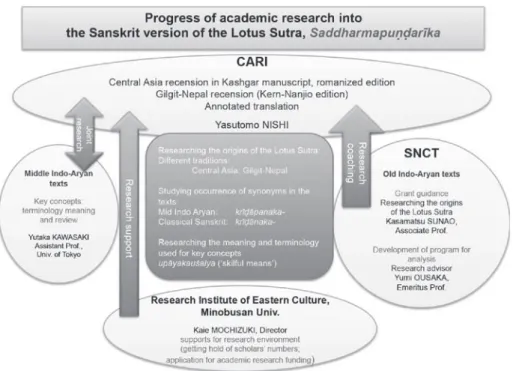
There are many different Saddhp manuscripts, but these can generally be classified into two traditions: the Central Asia recension in Kashgar manuscript, romanized edition (Th), and the recension from Gilgit-Nepal (Kern-Nanjio edition: KN). However, there is no unified view as to how the original text for the Chinese translation is [see Fig. 5].
9 M. ALLON, “The Conservation and Photographing of the Kuthodaw Pagoda Marble-stelae Recension of the
Pali Buddhist Canon in Mandalay, Myanmar”, the Bulletin of Chuo Academic Research Institute No. 43,
Tokyo 2014, 186-193; M. ALLON, “Progress Report for Kuthodaw Pagoda Project (Mandalay, Myanmar) for
Work Undertaken to September 2015̶Presented to Chuo Academic Research Institute of Rissho
Kosei-Kai̶”, the Bulletin of Chuo Academic Research Institute No. 44, Tokyo 2015, 188-199; M. Allon, W. READE,
C. CLARK, I. MCCRABB, T. DITRICH, R. WILES, and B. HUDSON, “The Kuthodaw Pagoda Marble-stelae
Inscriptions, Mandalay, Myanmar: Conservation Photographing, and Study of a Neglected Recension of the Pali Buddhist Canon”, the Bulletin of Chuo Academic Research Institute No. 45, Tokyo 2016, 222-249.
Fig. 5 To try to clarify the original text for the Chinese translation of the Lotus Sutra
To try to clarify this, I have begun work on an annotated translation which compares the two Saddhp recension s editions.10 In the course of this annotated translation, it is inevitable that I will also make some findings on 1) the study of the origins of the Lotus Sutra, and 2) the study of the terminology used for describing its key concepts, and what this means.
I have been able to receive guidance and support from the following researchers in my philological study of the Saddhp:
Associate Professor KASAMATSU, specialist in Vedic texts, has given me advice and guidance from a philological perspective, especially Old Indo-Aryan texts on how the Lotus Sutra originated from ancient Indian languages.
Professor OUSAKA, responsible for the program for the analysis of ancient texts, has given advice and guidance, and has helped me in my philological research on the Saddhp, with the help of ancient Indian texts lexicons and pāda indexes.
Assistant Professor Yutaka KAWASAKI, at Tokyo University, specialist in early Jain scriptures, has co-operated with me on research into terminology for the Lotus Sutra s key concepts as it appears in Middle Indo-Aryan texts.
Professor Kaie MOCHIZUKI, Minobusan University, Director of the Research Institute of Eastern Culture, specialist in the Chinese and Tibetan translations of the Lotus Sutra has also given advice and guidance. I am a researcher here myself [see Fig. 6].
1 ) About researching the origins of the Lotus Sutra: investigating the use of synonyms in the work.
In the Central Asian recension of the Saddhp, Middle Indo-Aryan (MIA), word formations and syntax are very prevalent.
Many scholars, including Hendrik KERN and Franklin EDGERTON, advocate the hypothesis that, in its original form of the Saddhp manuscripts was in MIA, and that it was changed to Classical Sanskrit during the process of compilation and editing.
I have an example in support of this thesis.
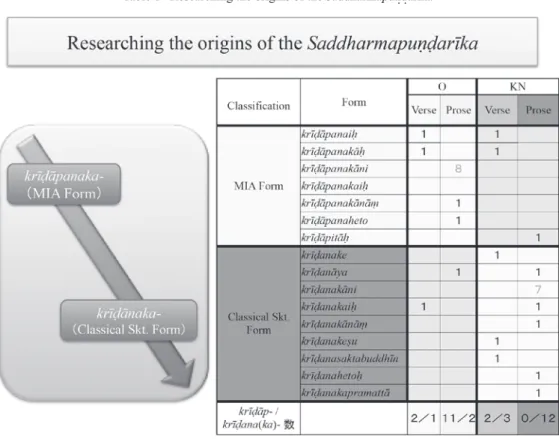
Hendrik KERN, Naoshiro TSUJI and Kobun TODA point out how two synonyms meaning “toy” or “plaything” change between the MIA form, krīd4āpanaka-, in the Central Asian
recension and the Classical Sanskrit form, krīd4anaka-, in the Gilgit-Nepal recension. I have
looked at all the examples of the usage of these words, using a variety of indexes, and I have checked for particularly high concentrations of these usages anywhere in the texts.
On the surface, it looks as if MIA form words appear frequently in verse, based on the restrictions of poetic meter. However, in the Central Asia recension, MIA language forms are common even in prose. It may be possible to explain this as follows: the Saddhp was originally compiled using the form, MIA krīd4āpanaka-, in both verse and prose. This format of
the word was then retained, even though the Kashgar manuscript is in prose. This is one example which supports this thesis [see Table 1].11
10 Y. Nishi, “An Annotated Translation of Saddharmapund
44arīka Kashgar Manuscript: ̶Upamā-parivarta̶”
(in Japanese), the Bulletin of Chuo Academic Research Institute No. 42, Tokyo 2013, 73-82; Y. Nishi, “An
Annotated Translation of Saddharmapund44arīka Kashgar Manuscript: ̶Upamā-parivarta (2)̶” (in
Japanese), the Bulletin of Chuo Academic Research Institute No. 43, Tokyo 2014, 145-159.
11 Y. NISHI, “'krīd
4āpanaka-' in Saddharmapund44arīka Central Asian Manuscript” (in Japanese), Journal of
2) About Researching the terminology used for describing the Lotus Sutra s key concepts. Numerous attempts have been made by scholars to clarify the meaning of the word upāyakauśalya, usually translated as “skilful means”.
Then, in which field do this “skilful means” work?
A great deal of effort has been made on the term, but it often fails to grasp a mysterious word, sam4dhābhās4ya, appearing together with upāyakauśalya.
I noticed these combination. The sam4dhābhās4ya is peculiar to the Saddhp. In research up
till now, it has been taken to mean “hidden word” or “word with intent”; we can infer that it appears to have lost its original meaning. I have looked at these precise differences, looking in particular at past research which argues this is a compound word formed from sam4-√dhā
(feminine noun) and bhās4ya.
According to KASAMATSU, sam4-√dhā is a word found in Vedic prayer, used when setting
broken bones, with the meaning of restoring or re-arranging something back to how it should be.12
Then, we can suppose that this is the usage of “arranging” or “setting” a lot of upāyakauśalyas in order to make people understood the truth rightly. There is more detail on
Table 1 Researching the origins of the Saddharmapund44arīka
12 S. KASAMATSU, “Saddhp samādapana- / samādāpana-: A Re-examination of the Kashgar manuscript” (in
Japanese), ‘Guiding Lights’ for the ‘Perfect Nature’: Studies on the Nature and the Development of
Abhidharma Buddhism, A Commemorative Volume in Honor of Prof. Dr. Kenyo Mitomo for his 70th Birthday, Tokyo 2016, note (14).
this in the results of the joint panel with Assistant Professor KAWASAKI on “Skilful Means: Developments in Indian and East Asian Buddhism”, in August last year at the 21st World Congress of the International Association for the History of Religions.13
In future, I will endeavor to shed further light on the origins of the Lotus Sutra and the terminology behind its concepts with my annotated translation from a philological perspective. For the results of research done by the Lotus Sutra research committee, please refer to our distributed material.14
〈
Acknowledgement〉
I am grateful to Director Koichi KAWAMOTO and Office Head Koichiro FUJITA of Chuo Academic Research Institute who have given me substantial information and advice.
I would like to give my thanks to Rev. Director Shoko MIZUTANI and Adviser Dr. Dominick
SCARANGELLO of Rissho Kosei-kai International for inviting me to the 21st International
Lotus Sutra Seminar 2016.
13 Y. N
ISHI, “On Skillful Means in Saddharmapund44arīka: Centered on Chapter II”, ibid, (545)-(556).
14 Paper List (Yasutomo Nishi) :
[2016] “On Skillful Means in Saddharmapund
44arīka: Centered on Chapter II”, ‘Guiding Lights’ for the ‘Perfect
Nature’: Studies on the Nature and the Development of Abhidharma Buddhism A Commemorative Volume in Honor of Prof. Dr. Kenyo Mitomo for his 70th Birthday, Tokyo 2016, (545)-(556).
[2015] “On Skillful Means in Saddharmapund
44arīka”, the Bulletin of Chuo Academic Research Institute No.
44, 2015, 545-556; “Inter-religious Dialogue and Practical Cooperation in Japan: Research Institutes with
Religious Organizations among the Religions as a Medium”, ibid, 114-136; “'krīd4āpanaka-' in
Saddharmapund44arīka Central Asian Manuscript”, Journal of Research Institute of Eastern Culture,
Minobusan Univ. No. 19, 2015, (1)-(18).
[2014] “On the Skilful Means in Saddharmapund
44arīka”, 21st World Congress of the International Association
for the History of Religion, Abstract, 2014, 1p; “Skilful Means: Developments in Indian and East Asian
Buddhism”, Y. NISHI, Y. KAWASAKI, T. TAKEMURA, R. SCHULZER, 21th World Congress of the International
Association for the History of Religion, Panel Abstract, 2015, 1p; “An Annotated Translation of
Saddharmapund44arīka Kashgar Manuscript: ̶Upamā-parivarta (2)̶”, the Bulletin of Chuo Academic
Research Institute No. 43, Tokyo 2014, 145-159; “A Reconsideration of sam4dhābhās4ya- in
Saddharmapund44arīka”, Journal of Japanese Asspciation for Religion Studies Vol. 87’s separation, Tokyo
2014, 325-326.
[2013] Index to the Milindapañha, S. KASAMATSU, Y. NISHI, Y. KAWASAKI, Y. OUSAKA, Pali Text Society,
Bristol 2013, 311p; “An Annotated Translation of Saddharmapund44arīka Kashgar Manuscript:
̶Upamā-parivarta̶”, the Bulletin of Chuo Academic Research Institute No. 42, Tokyo 2013, 73-82; “An Essay of
Research on the Origin of Saddharmapund44arīka”, Journal of Japanese Asspciation for Religion Studies Vol.