第 4 回「原子核殻模型の基礎と応用」
阿部 喬(東大
CNS) 京大基研
素核宇宙融合 レクチャーシリーズ
本講義の目的
•
対象:非専門家向け
•
内容:殻模型
<核構造
<低エネルギー原子核物理
•
目標:殻模型計算とは何かを(なんとなく)知ってもらう
2
参考文献(オンライン)
原子核物学理入門
• 高田健次郎:インターネットセミナー 「ミクロの世界ーその3ー(原子核の世界)」
http://www.kutl.kyushu‐u.ac.jp/seminar/MicroWorld3/MicroWorld3.html
殻模型の基礎
• 武藤一雄:講義資料(原子核物学理概論、原子核物理学I、原子核物理学)
http://www.th.phys.titech.ac.jp/~muto/
• 大塚孝治:サマースクール資料(第一日目)
http://www.cns.s.u‐tokyo.ac.jp/summerschool/cns‐efes08/lecture_note/Otsuka_Day1.ppt http://www.cns.s.u‐tokyo.ac.jp/summerschool/cns‐efes08/lecture_note/Otsuka_Day2.ppt
目次
• 核子の一粒子運動と原子核での殻構造
• 閉殻を仮定する(芯のある)殻模型計算の基礎
• 閉殻を仮定しない(芯のない)殻模型による 第一原理計算の概要
• モンテカルロ殻模型
4
目次
• 核子の一粒子運動と原子核での殻構造
• 閉殻を仮定する(芯のある)殻模型計算の基礎
• 閉殻を仮定しない(芯のない)殻模型による 第一原理計算の概要
• モンテカルロ殻模型
1日目
2日目
Single‐Particle Motion of the Nucleons
& Nuclear Shell Stcuture
6
原子核とは
• 原子核:自己束縛有限量子多体系
• 主な構成要素:核子(陽子 、中性子 )
• 核子:強い相互作用をするバリオン(ハドロンの一種)
• 核種の記法:陽子数(Z)と中性子数(N)で指定(A=Z+N:質量数)
• 表記法:
Fe
56
mass #
Nuclear Symbol isotope: 陽子数が同じ核種 isotone:中性子数が同じ核種
自己束縛有限多体系
•
原子核:
高々
300個程度の核子から構成される有限多体系
自己束縛系
– 原子核には中心となる核(芯)がない
– 原子のように中心に(電子に比べ非常に質量がある)原子 核がある系とは違う
8
非相対論的量子多体系
• 原子核の大きさ:1 ‐ 10 fm (1 fm = 10‐15 m) 量子力学
• 対象とするエネルギースケール:
– 原子核内の核子の運動エネルギー ~ 100 MeV (1 MeV = 106 eV) – 核子の質量 ~ 1 GeV (= 1000 MeV = 109 eV)
非相対論
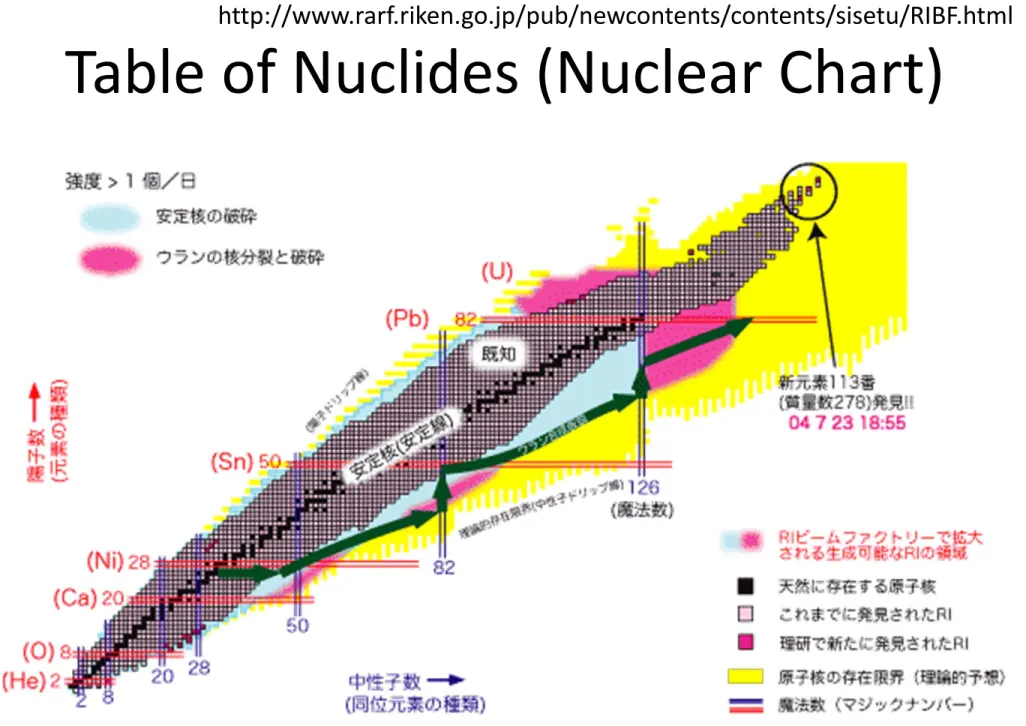
原子核の数
•
元素:天然には
92種(水素1からウラン92まで)
•
人工に作られたものを含めても約100程度
•
同位体(同位元素):今まで存在が確認されているもの で約
3000種
•
自然に(安定に)存在するものはそのうち
300種
•
人工的に作られた(不安定な)原子核は約
2000種
•
理論的には約
6000種の原子核が存在するといわれ、
いまだ約
3000種近くが未発見。
10
Table of Nuclides (Nuclear Chart)
http://www.rarf.riken.go.jp/pub/newcontents/contents/sisetu/RIBF.html
A = 5,8 の安定核は存在しない
• 4He原子核(α粒子)が非常に安定(束縛エネルギーが大きい)
http://www.th.phys.titech.ac.jp/~muto/lectures/NPI05/NPI05_chap03.ppt
A = 5 A = 8
12
What is the nuclear structure?
Electric Structure of the Chemical Elements
14
Periodic Table (of the Chemical Elements)
http://www.monominami.jp/gensi.html
ElemenTouch
http://www.ss.scphys.kyoto‐u.ac.jp/elementouch/
16
Wide periodic table
http://en.wikipedia.org/wiki/Periodic_table
Ionization Energy (of the Chemical Elements)
http://en.wikipedia.org/wiki/Periodic_table
2
10
18 36
54 86
Noble gases: stable @ Ne = 2, 10, 18, 36, 54, 86
18
• Shell structure of the electrons
Shell Structure of the Chemical Elements
電子軌道
• 電子のとり得る軌道:主量子数n、方位量子数l、磁気量子数mで分類
– 主量子数n:軌道の大きさとエネルギーを決定。1,2,3..と整数値をとり、これは電子殻K 殻、L殻、M殻…に対応。
– 方位量子数l:軌道の形を決定。0,1,2,...,n‐1の整数値をとり、これはs軌道、p軌道、d軌 道、f軌道…に対応。
– 磁気量子数m:各軌道を決定。‐l,‐l+1,...,0,...,l‐1,lの整数値をとる。
主量子数(電子殻) 方位量子数 磁気量子数 軌道名 収容できる電子数
1(K殻) 0 0 1s 2
2(L殻) 0 0 2s 2
1 0, +/‐1 2p 6
3(M殻) 0 0 3s 2
1 0, +/‐1 3p 6
2 0, +/‐1, +/‐2 3d 10
4(N殻) 0 0 4s 2
1 0, +/‐1 4p 6
2 0, +/‐1, +/‐2 4d 10
3 0, +/‐1, +/‐2, +/‐3 4f 14 20
Electron Configuration Diagram
http://ja.wikipedia.org/wiki/%E5%91%A8%E6%9C%9F%E5%BE%8B
Noble gases: stable (shell closure)
Electric Structure of the Chemical Elements
Atomic Nuclides
22
• Shell structure of the electrons
• Shell structure of the nucleons?
Nuclear Shell Structure
Periodic Table (of the Chemical Elements)
http://en.wikipedia.org/wiki/Periodic_table
Noble gases: stable @ Ne = 2, 10, 18, 36, 54, 86 24
Electron Configuration Diagram
http://ja.wikipedia.org/wiki/%E5%91%A8%E6%9C%9F%E5%BE%8B
Noble gases: stable (shell closure)
Magic Number ( 魔法数 )
• #(particle) @ the closed shell configuration
Noble gas (of the chemical elements):
– 2, 10, 18, 36, 54, 86
Magic Number (of the nuclei):
– 2, 8, 20, 28, 50, 82, 126
26
Experimental Evidences
1. Binding energy
2. Separation energy
3. 1st excited 2+ state of the even‐even nuclei 4. Electric quadrupole moment
1. Binding Energy
• Liquid drop model: Bethe‐Weizaecker mass formula
– Volume: CV = 15.6 MeV – Surface: CS = 17.2 MeV – Coulomb: CC = 0.70 MeV
– Asymmetry: Csym = 23.3 MeV – Pairing: δ(A)
http://www.kutl.kyushu‐u.ac.jp/seminar/MicroWorld3/3Part2/3P24/liquid_drop_model.htm
28
cont’d
• Binding energy
http://en.wikipedia.org/wiki/Semi‐empirical_mass_formula
Shell effect
http://www.kutl.kyushu‐u.ac.jp/seminar/MicroWorld3/3Part2/3P25/magic_numbers.htm
30
Odd‐even mass differences
Bohr ‐Mottelson
8
8
20 28
50 82
2028 50
82 126
2. Separation energy
Neutron separation energy
Proton separation energy 8
2 2028 50 82 126
8
2 20 28 50 82
N = 2, 8, 20, 28, 50, 82, 126
Z = 2, 8, 20, 28, 50, 82
Bohr ‐Mottelson
Sudden decrease @ the magic # Shell structure
32
3. Excitation Energy
• 1st excited 2+ state of the even‐even nuclei
http://www.th.phys.titech.ac.jp/~muto/lectures/NPI05/NPI05_chap06.ppt
Z = 14 Z = 16
N = 20 Z = 50
N = 60 N = 62
Relatively high excitation energies: shell closure
4. Electric quadrupole moment
電気四重極モーメントは球対称からのずれ(四重極変形)の尺度
閉殻をなす核子の集まりは球対称
Z = 奇数,N = 偶数の原子核 横軸には Z をとる
Z = 偶数,N = 奇数の原子核 横軸には N をとる
魔法数の近傍では 0,魔法数の間で大きな値をとる
http://www.th.phys.titech.ac.jp/~muto/lectures/NPI05/NPI05_chap06.ppt
Bohr ‐Mottelson
1 barn = 102 fm2 34
Nuclei have the magic #.
How can we describe the magic number of the nuclei?
36
The Nobel Prize in Physics 1963
http://www.nobelprize.org/nobel_prizes/physics/laureates/1963/
Maria Goeppert Mayer J. Hans D. Jensen
38
核子の1粒子ポテンシャル
原子核の殻構造が示唆すること
原子核には,核子が占める1粒子軌道がある
1粒子軌道は1粒子 Hamiltonian の固有状態として得られる
1粒子 Hamiltonian は運動エネルギーとポテンシャルからなる
核子は,エネルギーが低い1粒子軌道から順に占有していくと考えられる
どのようなポテンシャルを用いたら,魔法数が説明できるか?
簡単なポテンシャルから考えてみる
Single‐particle potential
• Shell structure (single‐particle orbits)
• ‐> single‐particle potential
Mean field
40
簡単な中心力ポテンシャル
1粒子状態の固有値方程式
1粒子ポテンシャルとして,次の3種類の中心力ポテンシャルを考える
調和振動子ポテンシャル : 解析的に解が得られる
井戸型ポテンシャル : 有限の深さをもつ
Woods‐Saxon ポテンシャル : 原子核の電荷密度分布と同じ形
Single‐particle Potentials
Bohr ‐Mottelson
Woods‐Saxon(WS) Potential
Harmonic Oscillator (HO) Potential HO is simpler,
and can be treated analytically.
WS is realistic, and has the same form as the charge‐
density distribution.
42
Quantum #’s of the single‐particle state
1粒子状態の量子数
演算子 : 1粒子 Hamiltonian と可換で,互いに可換
量子数 :
は動径波動関数のノード数(0 点の個数)
Energy eigenvalue of the single‐particle Hamiltonian
1粒子 Hamiltonian のエネルギー固有値
右図の左から順に,1粒子エネルギーの 縮退が解けていく
右端は,Woods‐Saxon ポテンシャルの場 合の1粒子軌道
量子数
占有できる核子の数
エネルギーが低い状態から全て占有 したときの核子の数
1粒子エネルギーの大きなギャップがあ るところが魔法数に対応する
44
スピン ‐ 軌道相互作用
Meyer,Jensen はスピン‐軌道相互作用を提案
1粒子状態の固有値方程式
1粒子状態の量子数
は の z 成分
は保存しない
スピン‐軌道相互作用
の効果(右図)
• spin‐orbit term:
Spin‐orbit force
46
中心力ポテンシャル
スピン‐軌道ポテンシャル
原子核の表面付近にピークをもつ
魔法数の再現
スピン‐軌道相互作用により
の縮退が解ける
軌道のエネルギーが 大きく下がり魔法数が再現できる
Z = 82 の魔法数の上
まで閉殻になると Z = 114
Neutron single‐particle energy
Bohr ‐Mottelson
8 2
2028 50
82 126
48
Summary
• Nucleon: Single‐particle motion
• Independent Particle Model
HO (central) potential + LS splitting
‐> Mayer‐Jensen’s magic #
Schematic picture of the single‐particle potential
2 8 20
Shell gap
Magic number Shell gap
Shell gap Closed shell
(Closed core) 0s1/2
0p3/2 0p1/2 0d5/2 0d3/2 1s1/2 0f7/2
s‐shell p‐shell sd‐shell
Single‐particle orbit NLJ
‐50 MeV
Spin‐orbit splitting WS (HO) central potential + spin‐orbit interaction
50