The Paramunnidae Vanhöffen, 1914 is one of the largest family in the suborder Asellota, con- sisting of about 125 species classified into 36 genera, all of which are tiny benthic dwellers known worldwide from shallow tidal to abyssal depths (Just and Wilson, 2004; 2006; 2007).
Among them, eleven species and one subspecies of six genera have been so far reported from Japanese waters: Ascionana rhipis (Shimomura and Mawatari, 1999), Tethygonium armigerum (Shimomura and Mawatari, 2000), Boreosignum orientale (Shimomura and Mawatari, 2000), Paramunna koreana Malyutina and Ushakova, 2001, Pleurogonium bifolium Shimomura and Mawatari, 2001, P. hispidum Shimomura and Mawatari, 2001, P. angustumKussakin, 1972, P.
inerme orientale Kussakin, 1962, Heterosignum mutsuensisGamô, 1976, H. elegans Shimomura and Mawatari, 2002, H. ohtsukaiShimomura and Mawatari, 2002, and H. otsuchiensisShimomura and Mawatari, 2002 (Shimomura et al., 2008).
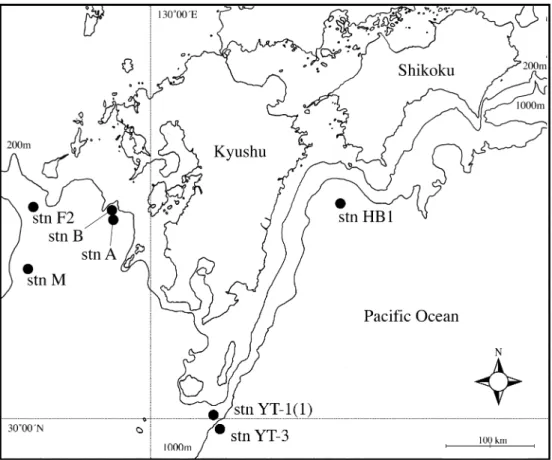
Collections of small crustaceans obtained dur- ing three research cruises around Kyushu, south- ern Japan (Fig. 1), by the RV Tansei-maruof the Japan Agency for Marine-Earth Science and Technology (JAMSTEC) (cruise KT-07-01) and the TS Nagasaki-maru of Nagasaki University
(cruises N237 and N251), contained ten unde- scribed species of the family. In this study, these ten new species are described and illustrated in detail, and compared with allied taxa. Two new genera are also described for the three new species.
Materials and Methods
The sampling gears used for collections were beam trawls of 3 m span opening. Samples were suspended on board, and the suspensions con- taining light particles such as small organisms were decanted through a sieve with a pore size of 0.5 mm. The processed sediment samples were fixed in 10% borate buffered formalin sea-water immediately. Thereafter, isopod specimens were sorted out under a stereomicroscope and pre- served in 70% ethanol. Each specimen was dis- sected and prepared for observation under a dif- ferential interference contrast microscope (Nikon E600) equipped with a camera lucida.
Terminology and measurements used herein follows those of Just and Wilson (2004; 2006).
The type specimens are deposited in the Ki- takyushu Museum of Natural History and Human History (KMNH) and the National Museum of
Ten New Species of Paramunnid Isopods (Peracarida: Asellota:
Paramunnidae) from Kyushu, Southern Japan
Michitaka Shimomura
Kitakyushu Museum of Natural History and Human History, 2–4–1 Higashida, Yahatahigashi-ku, Kitakyushu, 805–0071 Japan
e-mail: [email protected]
Abstract Ten new species of the asellote family Paramunnidae are described from Kyushu, south- western Japan, three of which are assigned to two new genera: Pleurogonium tanseimaruaesp.
nov., P. kyushuensesp. nov., Notoxenoides setosasp. nov., Austrogonium japonicumsp. nov., Het- erosignum hashimotoi sp. nov., Acutomunna minuta sp. nov., Ascionana bathyalis sp. nov., Dentigonium tantulumgen. et sp. nov., Spinogonium spinosumgen. et. sp. nov., and S. decoratum gen. et sp. nov. Systematic position of each species is discussed in detail.
Key words : Isopoda, Asellota, Paramunnidae, new genus, new species, Japan.
Nature and Science, Tokyo (NSMT).
Taxonomy
Genus PleurogoniumG. O. Sars, 1864
[New Japanese name: Menashi-hime-mizumushi-zoku]
Pleurogonium tanseimaruaesp. nov.
[New Japanese name: Tansei-menashi-hime-mizumushi]
(Figs. 2–3)
Material examined. Holotype: male (1.24 mm), KMNH IvR 500,287, RV Tansei-maru, KT07-01 cruise, stn YT-3, off Yakushima to Tanegashima islands, Ohsumi Islands, 1677–1769 m, 29°51.041N, 130°55.685E to 29°49.815N, 130°54.457E, 24 February 2007, beam trawl.
Allotype: female (1.27 mm, with 6 eggs), KMNH IvR 500,288, same data as holotype.
Paratypes: 2 ovigerous females (1.14 mm, with 3 eggs, KMNH IvR 500,289; 1.13 mm, with 6 eggs, NSMT-Cr 19565); 3 females (1.06 mm, NSMT-Cr 19566; 1.00 mm, KMNH IvR 500,292;
0.96 mm, KMNH IvR 500,293), same data as holotype.
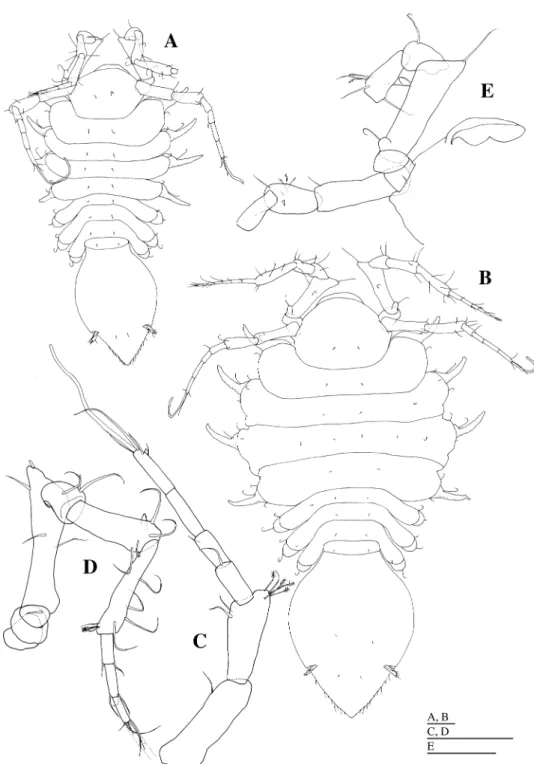
Description. Male (holotype). Body (Fig.
2A) widest at pereonite 3, width 0.4 times length.
Head (Fig. 2A) 0.6 times as long as wide. Frontal margin broadly rounded; eyestalks short, vesti- gial.
Pereonites (Fig. 2A) each with few setae later- ally, without dorsal setae; lateral margins broadly rounded. Coxae (Fig. 2A) visible in dorsal view on all pereonites, each with simple seta laterally;
coxae 1–4 each with single, short, spine-like pro- jection laterally; coxae 5–7 rounded laterally.
Pleon (Fig. 2A) 0.3 times as long as wide, with- out setae. Pleotelson (Fig. 2A) 1.2 times as long
Fig. 1. Sampling sites for beam trawl operations by the RV Tansei-maruand TS Nagasaki-maru.
Fig. 2. Pleurogonium tanseimaruaesp. nov. A, C–E, holotype, male (KMNH IvR 500,287); B, allotype, female (KMNH IvR 500,288). A, B, habitus, dorsal view; C, left antennula, dorsal view; D, left antenna, dorsal view;
E, right part of head, antennula, and antenna, ventral view. Scale bars: 100mm.
as wide, with 6 short setae dorsally and 20 short setae laterally.
Antennula (Fig. 2C, E) with article 1 bearing simple seta and broom seta laterally; article 2 0.8 length of article 1, with 2 simple setae laterally, 2 simple setae and 4 broom setae medially; article 3 0.6 length of article 2, with simple seta distally;
article 4 0.7 length of article 3, with 2 simple setae distally; article 5 1.9 length of article 4, with simple seta distally; article 6 0.8 length of article 5, with 2 short simple setae subapically, 2 short and 1 long simple setae and aesthetasc api- cally.
Antenna (Fig. 2D, E) with articles 1 and 2 combined 0.4 length of article 3; articles 1 and 2 without setae; article 3 with 3 simple setae later- ally and 1 simple seta mediodistally, without dis- tomedial projection; article 4 with 3 simple setae medially; article 5 1.6 length of article 4, with 3 simple setae and 1 broom seta distally; article 6 1.5 length of article 5, with 4 simple setae medi- ally, and 2 simple setae and 3 broom setae distal- ly. Flagellum consisting of 7 articles; proximal article 1.3 length of second article.
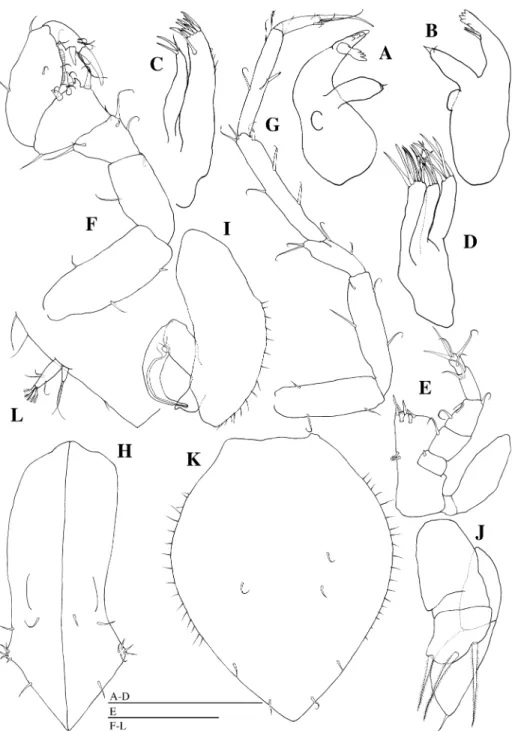
Left mandible (Fig. 3A) with 4-toothed lacinia mobilis on incisor process and 2 fine simple setae on molar process; right mandible (Fig. 3B) with 2 serrate setae on incisor process and 1 fine sim- ple seta and membranous seta on molar process.
Maxillula (Fig. 3C) with 2 stout simple setae and fine simple seta on inner ramus and 10 stout simple setae and few fine setae on outer ramus.
Maxilla (Fig. 3D) with 8 stout simple setae dis- tally on inner ramus; 4 stout simple setae on each lobes of outer ramus.
Maxilliped (Fig. 3E) with article 1 of palp bearing short seta medially; article 2 twice as long as article 1, with 1 seta medially; article 3 1.3 length of article 2, with 2 setae medially and 1 seta distolaterally; article 4 0.9 length of article 3, with 2 setae medially; article 5 0.6 length of article 4, with 5 setae. Endite with 2 fan-shaped setae and 4 serrate setae distally, and 2 coupling hooks medially; epipod ovate, apically blunt.
Pereopod 1 (Fig. 3F) with 1 simple dorsal and 2 simple ventral setae on basis; ischium 0.7
length of basis, with simple seta dorsally and dis- toventrally; merus trapezoidal, half length of is- chium, with 2 simple setae dorsally and 4 simple setae ventrally; carpus triangular, 1.1 length of merus, 0.5 times as long as wide, with 1 denticle and 4 robust setae on ventral margin and 1 sim- ple seta dorsally; propodus 2.5 length of carpus, with 4 simple setae and small fringe of scales on ventral margin, 2 simple setae dorsally and 1 simple seta medially; dactylus with 4 subapical and 2 apical simple setae, unguis as long as dactylus, supplementary claw almost half length of unguis. Pereopod 2 (Fig. 3G) with 1 dorsal and 2 ventral simple setae on basis; ischium 1.1 length of basis, with 1 dorsal, 2 ventral and 1 me- dial simple setae; merus half length of ischium, with 2 dorsal and 3 ventral simple setae; carpus 2.2 length of merus, with 3 simple setae dorsally and 3 robust and 1 simple setae ventrally; propo- dus 0.9 length of carpus, with 2 simple and 1 broom setae dorsally, and 1 robust and 3 simple setae ventrally; dactylus with 2 subapical and 2 apical simple setae, unguis and supplementary claw. Pereopods 2 to 7 slightly increasing in length posteriorly.
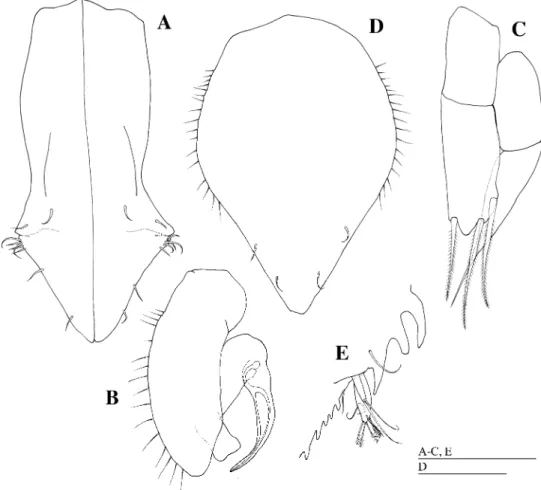
Pleopod 1 (Fig. 3H) with lateral lobes arising at level of 0.7 of its length; lateral lobe 0.3 times of total width of single ramus of pleopod; distal projection 0.3 times of total length of pleopod, acuminate. Pleopod 2 (Fig. 3I) with protopod 2.8 longer than wide, with 16 lateral simple setae;
second article of endopod moderately short, not reaching apex of protopod. Pleopod 3 (Fig. 3J) with endopod 0.5 length of second article of exo- pod.
Uropod (Fig. 3L) with endopod bearing 2 sim- ple setae laterally, 1 simple seta medially and 5 broom setae apically; exopod with 2 simple setae apically.
Female (allotype). Body half as wide as long (Fig. 2B). Pleotelson (Fig. 2B) 1.2 times as long as wide. Operculum (Fig. 3K) 0.8 times as wide as long, with 36 fine setae laterally and 7 simple setae ventrally.
Paratypes. The female paratypes are morpho- logically very similar to the allotype. Body width
Fig. 3. Pleurogonium tanseimaruaesp. nov. A–J, L, holotype, male (KMNH IvR 500,287); K, allotype, female (KMNH IvR 500,288). A, left mandible, ventral view; B, right mandible, ventral view; C, left maxillula, ven- tral view; D, left maxilla, ventral view; E, left maxilliped, ventral view; F, left pereopod 1, medial view; G, left pereopod 2, medial view; H, pleopod 1, ventral view; I, left pleopod 2, ventral view; J, right pleopod 3, dorsal view; K, operculum, ventral view; L, left uropod, dorsal view. Scale bars: 100mm.
0.5–0.6 times length.
Remarks. Pleurogonium tanseimaruae sp.
nov. is similar to P. intermedium Hansen, 1916, known from the northwestern Atlantic (north of Iceland and northwest of the Faeroes) in having a single spine-like projection on each coxae 1–4 and unarmed coxae 5–7. It differs from P. inter- mediumin having four robust setae and one ven- tral denticle on the carpus of the pereopod 1. In P. intermedium, there are three robust setae but no denticle on the carpus of the pereopod 1.
Etymology. The species is named after the RV Tansei-maruof JAMSTEC.
Pleurogonium kyushuensesp. nov.
[New Japanese name: Kyushu-menashi-hime-mizumushi]
(Figs. 4–5)
Material examined. Holotype: male (1.06 mm), KMNH IvR 500,294, RV Tansei-maru, KT07-01 cruise, stn YT-1(1), off Yakushima to Tanegashima islands, 565–723 m, 30°04.401N, 130°59.945E to 30°04.538N, 130°57.889E, 24 February 2007, beam trawl.
Allotype: female (1.49 mm, with 8 eggs, KMNH IvR 500,295), same data as holotype.
Paratypes: 4 ovigerous females (1.38 mm, with 5 eggs, NSMT-Cr 19567; 1.33 mm, with 6 eggs, KMNH IvR 500,296; 1.25 mm, with 3 eggs, NSMT-Cr 19568; 1.17 mm, with 6 eggs, KMNH IvR 500,298), 7 females (1.48 mm, KMNH IvR 500,299; 1.38 mm, KMNH IvR 500,300; 1.33 mm, KMNH IvR 500,301; 1.15 mm, KMNH IvR 500,302; 1.09 mm, KMNH IvR 500,303; 1.07 mm, KMNH IvR 500,304; 1.04 mm, KMNH IvR 500,305), same data as holotype; 1 male (1.31 mm, KMNH IvR 500,306), 1 female (1.39 mm, KMNH IvR 500,307), TS Nagasaki-maru, N237 cruise, stn B, 415–406 m, 32°15.09’N, 129°29.65E to 32°15.12N, 129°28.19E, 8 May 2007, beam trawl.
Description. Male (holotype). Body (Fig.
4A) widest at pereonite 3, width 0.4 times length.
Head (Fig. 4A) 0.7 times as long as wide, with pair of short setae dorsally; frontal margin broad- ly rounded; eyestalks short, vestigial.
Pereonites (Fig. 4A) broadly rounded, each with few lateral setae and pair of dorsal setae.
Coxae (Fig. 4A) visible in dorsal view on all pereonites, each with simple seta laterally; coxae 1–4 each with single, long, spine-like projection laterally; coxae 5–7 rounded laterally. Pleon (Fig.
4A) 0.3 times as long as wide, with pair of dorsal setae. Pleotelson (Fig. 4A) 1.4 times longer than wide, with pair of setae dorsally and some fine setae posterolaterally.
Antennula (Fig. 4C, E) with 1 medial simple seta on article 1; article 2 0.8 length of article 1, with 2 simple setae distolaterally, 1 simple seta and 4 broom setae distomedially; article 3 half length of article 2, with simple seta distally; arti- cle 4 0.9 length of article 3, with 1 simple seta distally; article 5 1.3 length of article 4; article 6 as long as article 5, with 3 short simple setae subapically, 1 short and 1 long simple setae and aesthetasc apically.
Antenna (Fig. 4D, E) with articles 1 and 2 combined 0.3 length of article 3; articles 1 and 2 without setae; article 3 projecting mediodistally, with 2 simple setae laterally and 1 simple seta ventrally, and 2 simple setae mediodistally; arti- cle 4 with 3 simple setae; article 5 twice length of article 4, with 4 simple setae and 1 broom seta distally; article 6 1.2 length of article 5, with 4 simple setae medially, and 1 simple seta and 3 broom setae distally. Flagellum consisting of 7 articles; proximal article 0.9 length of second ar- ticle.
Left mandible (Fig. 5A) with 4-toothed lacinia mobilis and 3 serrate setae on incisor process and 1 simple seta on molar process; right mandible (Fig. 5B) with 3 serrate setae on incisor process.
Maxillula (Fig. 5C) with 3 stout simple setae on inner ramus and 7 stout simple setae on outer ramus. Maxilla (Fig. 5D) with 6 stout simple setae distally on inner ramus; 4 stout simple setae on each lobes of outer ramus.
Maxilliped (Fig. 5E) with article 1 of palp bearing seta medially; article 2 twice as long as article 1, with 1 seta medially; article 3 1.1 length of article 2, with 2 setae medially; article 4 0.9 length of article 3, with 2 setae medially;
Fig. 4. Pleurogonium kyushuensesp. nov. A, C–E, holotype, male (KMNH IvR 500,294); B, allotype, female (KMNH IvR 500,295). A, B, habitus, dorsal view; C, left antennula, dorsal view; D, left antenna, ventral view; E, right part of head, antennula and antenna, ventral view. Scale bars: 100mm.
Fig. 5. Pleurogonium kyushuensesp. nov. A–J, L, holotype, male (KMNH IvR 500,294); K, allotype, female (KMNH IvR 500,295). A, left mandible, dorsal view; B, right mandible, dorsal view; C, left maxillula, dorsal view; D, left maxilla, dorsal view; E, right maxilliped, ventral view; F, right pereopod 1, medial view; G, left pereopod 2, medial view; H, pleopod 1, ventral view; I, left pleopod 2, ventral view; J, right pleopod 3, ven- tral view; K, operculum, ventral view; L, left uropod, dorsal view. Scale bars: 100mm.
article 5 0.6 length of article 4, with 5 setae. En- dite with 2 fan-shaped setae and 4 serrate setae distally, and with 2 stout simple setae and 2 cou- pling hooks medially; epipod ovate, apically blunt.
Pereopod 1 (Fig. 5F) with basis bearing simple seta dorsally and ventrally; ischium 0.8 length of basis, with 1 simple seta distoventrally; merus trapezoidal, 0.6 length of ischium, with simple seta dorsally and ventrally; carpus rectangular, 1.3 length of merus, 0.6 times as long as wide, with 4 robust setae on ventral margin and 1 sim- ple seta laterally and dorsally; propodus 1.6 length of carpus, with 1 simple seta and small fringe of scales on ventral margin, 2 simple setae dorsally, 1 simple seta laterally, and with 1 sim- ple seta and 7 simple scales medially; dactylus with 2 subapical and 2 apical simple setae, un- guis and supplementary claw. Pereopod 2 (Fig.
5G) with basis bearing 1 dorsal and 2 ventral simple setae; ischium 0.8 length of basis, with 2 simple setae dorsally and ventrally; merus half length of ischium, with 2 dorsal and 3 ventral simple setae; carpus twice length of merus, with 2 simple setae dorsally and 3 robust and 1 simple setae ventrally; propodus 0.7 length of carpus, with 1 simple and 1 broom setae dorsally, and 2 robust and 2 simple setae ventrally; dactylus with 3 subapical and 2 apical simple setae, unguis and supplementary claw. Pereopods 2 to 7 slightly in- creasing in length posteriorly.
Pleopod 1 (Fig. 5H) with lateral lobes arising at 0.7 of its length; lateral lobe 0.4 times of total width of single ramus of pleopod; distal projec- tion 0.3 times of total length of pleopod, acumi- nate. Pleopod 2 (Fig. 5I) with protopod 2.8 times longer than wide, with 17 lateral simple setae;
second article of endopod moderately short, not reaching apex of protopod. Pleopod 3 (Fig. 5J) with endopod 0.8 length of second article of exo- pod.
Uropod (Fig. 5L) with endopod with 2 lateral simple setae, 1 simple medial seta and 3 apical broom setae; exopod with 2 apical simple setae.
Female (allotype). Body width half of length (Fig. 4B). Operculum (Fig. 5K) 0.6 times as wide
as long, with 36 fine setae laterally and 6 simple setae ventrally.
Paratypes. The male paratype does not show any noteworthy differences from the holotype.
The female paratypes agree with the allotype in most characters. However, the pleotelson and the operculum are more setose in some paratypes.
Remarks. Pleurogonium kyushuense sp. nov.
is morphologically similar to P. tanseimaruaesp.
nov. in the possession of a single, spine-like later- al projection on each coxae 1–4 and the unarmed coxae 5–7. The most distinctive feature of P.
kyushuenseis the presence of a strong mediodis- tal projection on the article 3 of the antenna. Fur- thermore, the lateral projections on the coxae 1–4 of P. kyushuense are proportionally longer than those of P. tanseimaruae.
Etymology. The species is named after Kyushu, emblacing the type locality of the pre- sent new species.
Genus NotoxenoidesMenzies, 1962
[New Japanese name: Tsunotoge-hime-mizumushi-zoku]
Notoxenoides setosasp. nov.
[New Japanese name: Tsunotoge-hime-mizumushi]
(Figs. 6–8)
Material examined. Holotype: male (1.11 mm), KMNH IvR 500,308, RV Tansei-maru, KT07-01 cruise, stn YT-1(1), off Yakushima to Tanegashima islands, Ohsumi Islands, 565–723 m, 30°04.401N, 130°59.945E to 30°04.538N, 130°57.889E, 24 February 2007, beam trawl.
Allotype: female (1.37 mm, with 8 eggs, KMNH IvR 500,322), same data as holotype.
Paratypes: 22 males (1.20 mm, KMNH IvR 500,309; 2 exs., 1.19 mm, KMNH IvR 500,310, 500,311; 1.16 mm, NSMT-Cr 19569; 1.14 mm, NSMT-Cr 19570; 1.12 mm, KMNH IvR 500,314;
3 exs., all 1.10 mm, KMNH IvR 500,315–
500,317; 1.09 mm, KMNH IvR 500,318; 1.08 mm, KMNH IvR 500,319; 1.07 mm, KMNH IvR 500,310; 1.06 mm, KMNH IvR 500,311; 1.05 mm, KMNH IvR 500,312; 1.03 mm, KMNH IvR 500,313; 2 exs., 1.02 mm, KMNH IvR 500,314,
500,315; 0.99 mm, KMNH IvR 500,316; 0.98 mm, KMNH IvR 500,317; 2 exs., 0.96 mm, KMNH IvR 500,318, 500,319; 0.87 mm, KMNH IvR 500,320), 2 ovigerous females (1.45 mm, with 5 eggs, KMNH IvR 500,321; 1.35 mm, with 5 eggs, NSMT-Cr 19571), 23 females (1.62 mm, KMNH IvR 500,323; 1.49 mm, KMNH IvR 500,324; 1.39 mm, KMNH IvR 500,325; 1.38 mm, KMNH IvR 500,326; 1.37 mm, KMNH IvR 500,327; 2 exs., 1.36 mm, KMNH IvR 500,328, 500,329; 1.35 mm, KMNH IvR 500,330; 1.34 mm, KMNH IvR 500,331; 1.31 mm, KMNH IvR 500,332; 1.29 mm, KMNH IvR 500,333; 1.28 mm, KMNH IvR 500,334; 1.27 mm, KMNH IvR 500,335; 1.26 mm, KMNH IvR 500,336; 1.24 mm, KMNH IvR 500,337; 2 exs., 1.23 mm, KMNH IvR 500,338, 500,339; 1.22 mm, KMNH IvR 500,340; 1.17 mm, KMNH IvR 500,341; 2 exs., 1.16 mm, KMNH IvR 500,342, 500,343;
0.88 mm, KMNH IvR 500,344; 0.82 mm, KMNH IvR 500,345), same data as holotype; 2 ovigerous females (1.37 mm, with 5 eggs, KMNH IvR 500,346; 1.24 mm, with 7 eggs, KMNH IvR 500,347), 2 females (1.18 mm, KMNH IvR 500,348; 9.2 mm, KMNH IvR 500,349), TS Na- gasaki-maru, N237 cruise, stn F2, 501–498 m, 31°42.93N, 128°35.72E to 31°42.05N, 128°34.76E, 9 May 2007, beam trawl.
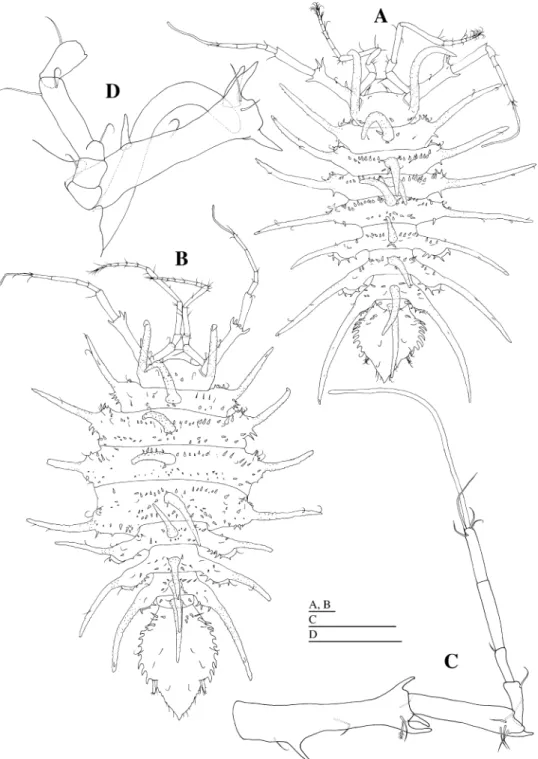
Description. Holotype (male). Body (Fig.
6A) widest at pereonite 3, width 0.4 times length (excluding lateral spine-like projections on pere- on). Head (Fig. 5A) half as long as wide, with pair of curved, long, spine-like projections later- ally; frontal margin slightly convex.
Pereonites 1–4 (Fig. 6A) each with many small, sharp denticles and fine setae dorsally and 1–3 larger denticles anterolaterally and with 0–2 larger denticles posterolaterally; pereonites 5–7 each with many small, sharp denticles dorsally and 1 or 2 larger denticles posterolaterally, with- out denticles anterolaterally. Lateral margins of pereonites each with very long, spine-like projec- tion. Coxae 1–3 and 5–7 (Fig. 6A) visible in dor- sal view, each with 2 or 3 denticles and simple seta laterally; coxa 4 not visible in dorsal view.
Pleon (Fig. 6A) 0.4 times as wide as long, with 1
elongate projection, 1 pair of denticles and short setae dorsally. Pleotelson (Fig. 6A) 1.3 times longer than wide, with few denticles and short setae dorsally and 8 pairs of denticles laterally, apex acute.
Antennula (Fig. 6C–D) with article 1 bearing 1 long spine medially, 2 long spines mediodistally and 1 long spine distolaterally, and with 2 simple setae dorsally and 2 simple setae and 1 broom seta distally; article 2 0.7 length of article 1, with 1 spine mediodistally and 5 simple setae distally;
article 3 0.4 length of article 2, with 1 simple seta mediodistally; article 4 0.8 length of article 3, with 1 simple seta laterodistally; article 5 1.9 length of article 4; article 6 0.8 length of article 5, with 2 short simple setae subapically, 2 short and 1 long simple setae and aesthetasc apically.
Antenna (Figs. 6D, 7A) with articles 1 and 2 combined 0.6 length of article 3; article 2 with 1 short seta medially; article 3 with 4 simple setae, including 2 lateral, 1 medial, and 1 dorsodistal in position; article 4 with 2 simple setae; article 5 2.7 length of article 4, with 4 simple setae and 1 broom seta; article 6 1.2 length of article 5, with 1 simple seta dorsally, and 3 simple and 4 broom setae distally. Flagellum consisting of 7 articles;
proximal article as long as second article.
Left mandible (Fig. 7B) with 3 serrate setae and lacinia mobilis on incisor process and 2 sim- ple setae on molar process; right mandible (Fig.
7C) with 5 serrate setae on incisor process and 2 simple setae on molar process.
Maxillula (Fig. 7D) with 5 stout simple setae on inner ramus and 12 stout simple setae and few fine setae on outer ramus. Maxilla (Fig. 7E) with 6 stout simple setae and some fine setae on inner ramus; 4 stout simple setae on each lobes of outer ramus.
Maxilliped (Fig. 7F) with article 1 of palp bearing short seta medially; article 2 1.3 length of article 1, with 2 setae medially; article 3 1.4 length of article 2, with 3 setae medially and 1 seta laterodistally; article 4 1.1 length of article 3, with 2 setae medially; article 5 0.6 length of article 4, with 5 setae. Endite with 2 fan-shaped setae, 1 simple seta ventrally, 5 stout simple setae
Fig. 6. Notoxenoides setosa sp. nov. A, C, D, holotype, male (KMNH IvR 500,308); B, allotype, female (KMNH IvR 500,322). A, B, habitus, dorsal view; C, right antennula, ventral view; D, left part of head, an- tennula and antenna, ventral view. Scale bars: 100mm.
distally and 2 fine setae, and 2 coupling hooks medially; epipod lanceolate, apically blunt.
Pereopod 1 (Fig. 7G) with basis having 1 sim- ple seta and 3 robust spines dorsally and 2 simple setae ventrally; ischium 0.6 length of basis, with 1 short spine mediodistally and 1simple seta ven- trally; merus trapezoidal, half length of ischium, with 1 simple seta and 3 setulate scales medially, 2 simple setae dorsally and 1 long simple seta ventrally; carpus triangular, 1.7 length of merus,
as long as wide, with 2 robust setae and 1 simple seta on ventral margin, 3 simple setae medially and 1 simple seta dorsally; propodus 1.4 length of carpus, with 1 simple seta and 2 robust setae on ventral margin, 1 simple seta medially and 2 simple setae dorsally; dactylus with 4 subapical simple setae, unguis and supplementary claw.
Pereopod 2 (Fig. 7H) with basis bearing 4 robust spines, and 1 dorsal simple and 2 ventral simple setae; ischium 1.4 length of basis, with 1 robust
Fig. 7. Notoxenoides setosasp. nov. Holotype, male (KMNH IvR 500,308). A, right antenna, ventral view; B, left mandible, ventral view; C, right mandible, ventral view; D, left maxillula, dorsal view; E, left maxilla, dorsal view; F, left maxilliped, ventral view; G, right pereopod 1, medial view; H, right pereopod 2, medial view. Scale bars: 100mm.
and 1 simple setae dorsally, and with 2 simple setae ventrally; merus 0.4 length of ischium, with 1 robust and 1 simple setae dorsally, and with 3 simple setae ventrally; carpus 2.4 length of merus, with 3 simple setae and 1 broom seta dor- sally, and with 3 robust and 2 simple setae ven- trally; propodus 0.7 length of carpus, with 1 sim- ple and 1 broom setae dorsally, and with 3 robust and 3 simple setae ventrally; dactylus with 2 sub- apical and 3 apical simple setae, unguis and sup- plementary claw. Pereopods 2 to 7 slightly in- creasing in length posteriorly.
Pleopod 1 (Fig. 8A) with lateral lobes at level of 0.7 of its length; lateral lobe 0.4 times of total width of single ramus of pleopod; distal projec- tion 0.3 times of total length of pleopod, acumi-
nate. Pleopod 2 (Fig. 8B) with protopod twice longer than wide, with 16 lateral simple setae;
second article of endopod moderately short, not reaching apex of protopod. Pleopod 3 (Fig. 8C) with endopod 1.2 length of second article of exo- pod.
Uropod (Fig. 8E) with endopod bearing 2 sim- ple setae laterally, 1 simple seta medially and 5 broom setae apically; exopod with 2 simple setae apically.
Female (allotype). Body width about half of length (Fig. 6B). Pleotelson (Fig. 6B) with 8 (left) or 9 (right) denticles on lateral margins, apex acute. Operculum (Fig. 8D) 0.7 times as wide as long, with 34 fine setae laterally and 4 simple setae ventrally.
Fig. 8. Notoxenoides setosa sp. nov. A–C, E, holotype, male (KMNH IvR 500,308); D, allotype, female (KMNH IvR 500,322). A, pleopod 1, ventral view; B, right pleopod 2, ventral view; C, left pleopod 3, ventral view; D, operculum, ventral view; E, right uropod, dorsal view. Scale bars: 100mm.
Paratypes. The paratypes agree well with the holotype and the allotype in most characters.
Body 0.4–0.5 times in female paratypes. Pleotel- son with 7–10 pairs of denticles on lateral margin in male paratypes, 8–10 pairs of denticles in fe- male paratypes.
Remarks. In the shape of the pleotelson, the new species is similar to Notoxenoides vemae Menzies, 1962 known from the South Atlantic and N. dentataMenzies and George, 1972 from the Peru-Chile Trench in the southeastern Pacific.
In these species, the apex of the pleotelson is pointed, but not strongly produced. However, No- toxenoides setosa sp. nov. appears distinctive in the genus in the possession of many setae on the dorsal surface of the pereon and the ventrally un- armed carpus of the pereopod 1. It is further dis- tinguished from N. vemaeby the following char- acters: the spine-like projections of the head is directed forward in N. setosa, rather than directed laterally in N. vemae; setae on the pereon are much more numerous in N. setosa than in N.
vemae; the second article of the antennula is armed with one mediodistal spine in N. setosa, whereas it is unarmed in N. vemae; the ventral margin of the carpus of the pereopod 1 is smooth in N. setosa, but there are four denticles on that margin in N. vemae. Notoxenoides dentatadiffers form the present new species in having laterally directed spine-like projections of the head, the spine-like projections on the pereonite 1 being shorter than half of those of the pereonite 2, and the carpus of the pereopod 1 armed with four denticles ventrally.
Etymology. From the Latin setosus, meaning bearing numerous setae, referring to the dense short setae on the dorsal surface of the pereon.
Genus AustrogoniumMenzies and George, 1972
[New Japanese name: Ashitoge-hime-mizumushi-zoku]
Austrogonium japonicumsp. nov.
[New Japanese name: Ashitoge-hime-mizumushi]
(Figs. 9–11)
Material examined. Holotype: ovigerous fe-
male (2.09 mm), KMNH IvR 500,350, RV Tan- sei-maru, KT07-01 cruise, stn HB1, Hyuga Basin, 1651–1677 m, 32°16.97N, 132°28.96E to 32°19.23N, 132°30.75E, 22 February 2007, beam trawl.
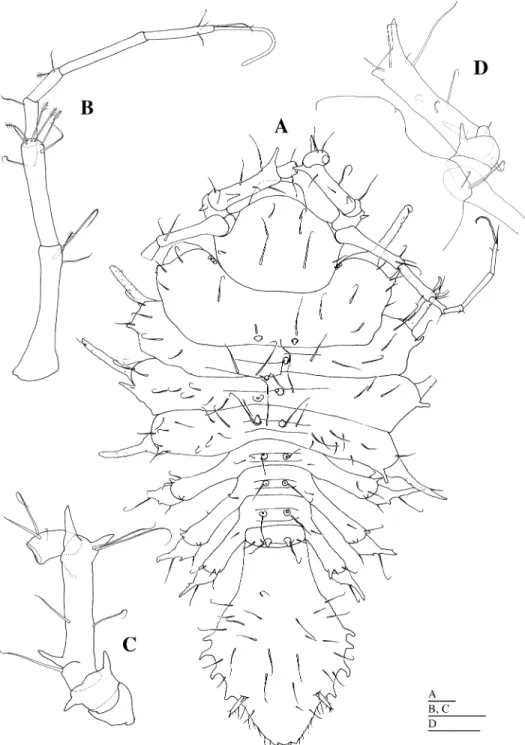
Description. Holotype (female). Body (Fig.
9A) widest at pereonite 3, half as wide as long, with many simple setae dorsally. Head (Fig. 9A) 0.8 times as long as wide; frontal margin broadly rounded; lateral margins smooth, without projec- tion.
Pereonites (Fig. 9A) each with pair of short spines dorsally; lateral margins of pereonites 1–3 each with pair of spine-like projections directed anteriorly; lateral margins of pereonites 4 and 7 with pair of spine-like projections directed poste- riorly; pereonites 5 and 6 each with 2 pairs of spine-like projections laterally. All coxae (Fig.
9A) visible in dorsal view; coxae 1–4 and 7 each with spine-like projections laterally; coxae 5 and 6 each with 2 greatly unequal spine-like projec- tions (anterior projection much longer than pos- terior projection). Pleon (Fig. 9A) 0.4 times as long as wide, with 1 pair of spines and 2 pairs of simple setae dorsally. Pleotelson (Fig. 9A) 1.5 times longer than wide, with 4 pairs of denticles laterally, and with 25 simple setae dorsally and 17 simple setae posterolaterally.
Antennula (Fig. 9B, D) with article 1 bearing 2 simple and 1 broom setae distally; article 2 0.8 length of article 1, with simple setae medially, laterally and dorsally, and with 1 simple and 4 broom setae distally; article 3 half length of arti- cle 2, with simple seta distolaterally; article 4 0.9 length of article 3, with 1 simple and 1 broom seta distolaterally; article 5 2.2 length of article 4; article 6 0.8 length of article 5, with 3 short simple setae subapically, 2 long simple setae and aesthetasc apically.
Antenna (Fig. 9C, D) with articles 1 and 2 combined 0.4 length of article 3; article 2 with 1 spine medially and laterally; article 3 with 1 spine proximolaterally and 2 spines distally, and with 1 simple seta laterally and dorsally, and with 3 simple setae medially and 2 simple setae later- ally; article 4 with 3 simple setae medially. Arti-
Fig. 9. Austrogonium japonicumsp. nov. Holotype, female (KMNH IvR 500,350). A, habitus, dorsal view; B, right antennula, ventral view; C, right antenna, ventral view; D, left part of head, antennula and antenna, ven- tral view. Scale bars: 100mm.
cles 5, 6 and flagellum missing.
Left mandible (Fig. 10A) with 4-toothed lacinia mobilis and 3 serrate setae on incisor process, and 2 short setae on molar process; right mandible (Fig. 10B) with 4 serrate setae on in- cisor process and 2 robust setae on molar process.
Maxillula (Fig. 10C) with 4 stout simple setae and few fine simple setae on inner ramus and 11 stout simple setae on outer ramus. Maxilla (Fig.
10D) with 8 stout simple setae distally on inner ramus; 4 stout simple setae on each lobes of outer ramus.
Maxilliped (Fig. 10E) with article 1 of palp
Fig. 10. Austrogonium japonicum sp. nov. Holotype, female (KMNH IvR 500,350). A, left mandible, dorsal view; B, right mandible, dorsal view; C, right maxillula, dorsal view; D, right maxilla, dorsal view; E, left maxilliped, ventral view; F, right pereopod 1, medial view; G, left pereopod 2, medial view. Scale bars:
100mm.
bearing 1 seta medially; article 2 1.7 length of ar- ticle 1, with 2 setae medially; article 3 1.6 length of article 2, with 3 setae medially and 1 seta dis- tolaterally; article 4 0.9 length of article 3, with 3 setae medially; article 5 0.6 length of article 4, with 2 subapical and 2 apical setae. Endite with 3 fan-shaped, 5 serrate and 2 stout simple setae dis- tally, and 2 coupling hooks medially; epipod ovate, apically blunt.
Pereopod 1 (Fig. 10F) with basis bearing 2 dorsal and 3 ventral simple setae; ischium 0.8 length of basis, with 1 simple seta dorsally and distolaterally and 2 simple setae ventrally, and with 1 denticle ventrally; merus trapezoidal, 0.6 length of ischium, with 1 simple seta distolateral- ly, 2 simple setae dorsally and 3 simple setae ventrally; carpus ovate, 2.3 length of merus, 1.3 times as long as wide, with 2 simple setae lateral- ly and 3 simple setae medially, dorsal margin with 1 simple seta, ventral margin with 1 denti- cle, 6 robust setae and 1 simple seta; propodus twice length of carpus, with 2 simple setae medi- ally and 4 simple setae dorsally, 5 robust setae ventrally; dactylus with 3 subapical and 2 apical simple setae, unguis and supplementary claw.
Pereopod 2 (Fig. 10G) partially broken, basis missing; ischium with 1 distolateral, 1 dorsal and 3 ventral simple setae; merus half length of basis, with 3 dorsal and 4 ventral simple setae; carpus 2.2 length of merus, with 3 simple setae and 1 robust seta dorsally, 3 robust and 1 simple setae ventrally and 1 simple seta laterally; propodus 0.7 length of carpus, with 2 simple and 1 broom setae dorsally, 3 robust setae ventrally and 2 sim- ple setae medially; dactylus with 1 ventral, 3 sub- apical and 2 apical simple setae, unguis and sup- plementary claw.
Operculum (Fig. 11A) 0.7 times as wide as long, with 50 fine setae laterally and 3 pairs of simple setae ventrally. Pleopod 3 (Fig. 11B) with endopod 1.5 length of second article of exopod.
Uropod (Fig. 11C) with endopod bearing 2 simple setae subapically and 4 broom setae api- cally; exopod minute, with 1 simple seta apically.
Remarks. This new species differs from the only other species in the genus Austrogonium, i.e.
A. abyssale Menzies and George, 1972 known from the Peru-Chile Trench in the southeastern Pacific by the following characters: pereonites 1 and 2 are each armed with a single spine on the
Fig. 11. Austrogonium japonicumsp. nov. Holotype, female (KMNH IvR 500,350). A, operculum, ventral view;
B, left pleopod 3, dorsal view; C, left uropod, dorsal view. Scale bars: 100mm.
posterolateral corners in the new species, instead of two spines in A. abyssale; the pleotelson is proportionally longer in A. japonicumthan in A.
abyssale (1.5 times longer than wide versus 1.3 times); there are four denticles on the lateral mar- gin of the pleotelson in A. japonicum, rather than seven denticles in A. abyssale; the uropod is bira- mous in A. japonicum, whereas it is uniramous in A. abyssale.
Etymology. The specific name is derived from the country where the present new species was discovered.
Genus HeterosignumGamô, 1976
[New Japanese name: Munetoge-hime-mizumushi-zoku]
Heterosignum hashimotoisp. nov.
[New Japanese name:
Hashimoto-munetoge-hime-mizumushi]
(Figs. 12–14)
Material examined. Holotype: male (1.74 mm), KMNH IvR 500,351, TS Nagasaki-maru, N237 cruise, stn F2, 501–498 m, 31°42.93N, 128°35.72E to 31°42.05N, 128°34.76E, 9 May 2007, beam trawl.
Paratypes: 2 males (1.86 mm, KMNH IvR 500,352; 1.79 mm, NSMT-Cr 19572), TS Na- gasaki-maru, N251 cruise, stn M, 524–533 m, 31°35.54N, 128°28.21E to 31°36.89N, 128°28.26E, 14 November 2007, beam trawl.
Description. Male (holotype). Body (Fig.
12A) widest at pereonite 3 (excluding lateral spine-like projections on pereon), width 0.4 times length. Head (Fig. 12A) 0.2 times as long as wide (including eyestalks), partly fused with pereonite 1; frontal margin convex, having pair of stout preocular lobes. Eyestalks (Fig. 12A, B) stout, 1.2 length of head, without ocelli, directed anterolaterally (angle against horizontal plane of head about 21°), surface strongly granulated.
Pereonites (Fig. 12A) scattered with short setae on dorsum. Pereonite 1 with broadly round- ed lateral margin. Pereonites 2–7 each with elon- gate, spine-like projections on lateral margins, surface of them granular. Pleon (Fig. 12A) 0.3
times as long as wide, with pair of fine setae dor- sally. Pleotelson (Fig. 12A) 1.5 times longer than wide, with 16 short setae dorsally, anterior 0.3 times of total length of pleotelson, narrow, sub- cylindrical, remainder distinctly broadened with convex lateral margins, bearing 6 pairs of denti- cles, posterior margin broadly triangular.
Antennula (Fig. 12B–D) with articles 1 and 2 combined surpassing distal margin of eyestalk;
article 1 with simple seta and broom seta distally;
article 2 1.1 length of article 1, with simple seta dorsally, 2 simple setae and 5 broom setae dis- toventrally; article 3 0.4 length of article 2, with 1 simple seta medially; article 4 shorter than arti- cle 3, with 1 simple seta distolaterally; article 5 as long as article 3, with simple seta distomedial- ly and distolaterally; article 6 1.3 length of article 5, with 2 short simple setae subapically, 1 short and 1 long simple setae and aesthetasc apically.
Antenna (Fig. 12C–D) with articles 1 and 2 combined 0.9 length of article 3; article 2 with 2 simple setae laterally and 1 simple seta medially;
article 3 with 1 simple seta laterally and ventral- ly, 2 simple setae distolaterally and 4 simple setae medially; article 4 with 4 simple setae; arti- cle 5 2.2 length of article 4, with 2 simple setae and 1 broom seta laterally, and 2 simple setae distomedially; article 6 1.2 length of article 5, medial surface with 3 simple and 3 broom setae, lateral surface with 2 simple and 2 broom setae.
Flagellum consisting of 7 articles; proximal arti- cle as long as second article.
Left mandible (Fig. 13A) with 4-toothed lacinia mobilis and 4 serrate setae on incisor process, and 2 short simple setae on molar process; right mandible (Fig. 13B) with 5 serrate setae on incisor process and 2 short simple setae on molar process.
Maxillula (Fig. 13C) with 1 serrate, 1 setulate and 3 stout simple setae on inner ramus and 11 stout simple and few fine setae on outer ramus.
Maxilla (Fig. 13D) with 2 setulate and 6 stout simple setae distally and many fine setae dorsally on inner ramus; 4 stout simple setae on each lobes of outer ramus.
Maxilliped (Fig. 13E) with article 1 of palp
Fig. 12. Heterosignum hashimotoisp. nov. Holotype, male (KMNH IvR 500,351). A, habitus, dorsal view; B, right antennula, ventral view; C, right antenna, ventral view; D, left part of head, antennula and antenna, ven- tral view. Scale bars: 100mm.
bearing 1 seta medially; article 2 1.6 length of ar- ticle 1, with 2 setae medially; article 3 1.1 length of article 2, with 3 setae medially; article 4 1.1 length of article 3, with 2 setae distally; article 5 half length of article 4, with 5 setae. Endite with 2 fan-shaped setae, 3 serrate setae and 1 fine seta distally, and 1 serrate seta and 2 coupling hooks medially; epipod subtriangular, pointed apically.
Pereopod 1 (Fig. 13F) with basis bearing 2 dorsal and 2 ventral simple setae; ischium 0.7 length of basis, with 2 spines dorsally and 2 sim- ple setae ventrally; merus trapezoidal, half length of ischium, with 1 spine and 1 simple seta dorsal- ly, and 3 simple setae distoventrally; carpus ovate, relatively narrow, 1.5 length of merus, 1.9 times as long as wide, with 4 denticles, 2 robust
Fig. 13. Heterosignum hashimotoi sp. nov. Holotype, male (KMNH IvR 500,351). A, left mandible, medial view; B, right mandible, dorsal view; C, right maxillula, dorsal view; D, right maxilla, dorsal view; E, right maxilliped, ventral view; F, right pereopod 1, medial view; G, right pereopod 2, medial view. Scale bars:
100mm.
setae and 2 simple setae on ventral margin and 1 simple seta on dorsal margin; propodus 1.1 length of carpus, with 2 denticles, 2 robust setae and 2 simple setae ventrally, 2 simple setae dor- sally and 14 setulate scales medially; dactylus with 3 subapical and 2 apical simple setae, un- guis and supplementary claw. Pereopod 2 (Fig.
13G) with basis bearing 1 dorsal and 3 ventral simple setae; ischium 0.8 length of basis, with 1 dorsal, 3 ventral and 1 lateral simple setae; merus half length of ischium, with 1 dorsal and 4 ven- tral simple setae; carpus 1.9 length of merus, with 3 simple setae dorsally and 3 robust and 2 simple setae on ventral margin; propodus 0.9 length of carpus, with 3 simple and 1 broom setae dorsally, 3 robust setae ventrally, and 1 sim- ple seta on each lateral and medial margin;
dactylus with 2 subapical and 2 apical simple setae, unguis and supplementary claw. Pereopods 2 to 7 slightly increasing in length posteriorly.
Pleopod 1 (Fig. 14A) with lateral lobes at level of 0.6 of its length; lateral lobe 0.2 times of total width of single ramus of pleopod; distal projec-
tion 0.4 times of total length of pleopod, acumi- nate. Pleopod 2 (Fig. 14B) with protopod 2.8 times longer than wide, with 18 simple setae on lateral margin; second article of endopod moder- ately short, reaching apex of protopod. Pleopod 3 (Fig. 14C) with endopod 1.3 length of second ar- ticle of exopod.
Uropod (Fig. 14D) with endopod bearing 2 simple setae laterally and 5 broom setae apically;
exopod with 2 simple setae apically.
Paratypes. The two male paratypes are simi- lar to the holotype in morphology. Head 0.2–0.3 times as long as wide. Eyestalks 1.2–1.3 length of head.
Remarks. The strongly elongate lateral pro- jections on the pereonites 2–7 link the new species to Heterosignum elegansShimomura and Mawatari, 2002 known from Yamaguchi Prefec- ture and the Nansei Islands, Japan (Shimomura and Mawatari, 2002; Shimomura and Ohtsuka, 2005). The present new species, however, is dis- tinguished from H. elegans by the following characters: in the new species, the eyestalk is
Fig. 14. Heterosignum hashimotoisp. nov. Holotype, male (KMNH IvR 500,351). A, pleopod 1, ventral view;
B, left pleopod 2, ventral view; C, left pleopod 3, ventral view; D, right uropod, dorsal view. Scale bar:
100mm.
1.2–1.3 times as long as the head, of which the surface is strongly granulated, whereas in H. ele- gans, it is 1.5 times as long as the head in males or 1.4 times in females, of which the surface is only sparsely granulated; the carpus of the pereo- pod 1 is armed with four denticles in the new species, instead of seven denticles in H. elegans;
the second article of the endopod of pleopod 2 only reaches the apex of the protopod, whereas distinctly overreaching it. It can be said that the eyestalk of this new species is much more stout than those of other congeneric species.
Etymology. The new species is dedicated to Prof. J. Hashimoto of Nagasaki University, who provided me with an interesting material for this study.
Genus AcutomunnaWinkler, 1994
[New Japanese name: Fuchidori-hime-mizumushi-zoku]
Acutomunna minutasp. nov.
[New Japanese name: Fuchidori-hime-mizumushi]
(Figs. 15–16)
Material examined. Holotype: male (1.08 mm), KMNH IvR 500,354, RV Tansei-maru, KT07-01 cruise, stn YT-3, off Yakushima to Tanegashima islands, 1677–1769 m, 29°51.041 N, 130°55.685E to 29°49.815N, 130°54.457E, 24 February 2007, beam trawl.
Allotype: female (1.22 mm, KMNH IvR 500,357), same data as holotype.
Paratypes: 1 male (1.02 mm, KMNH IvR 500,355), 1 ovigerous female (1.13 mm, with 4 eggs, KMNH IvR 500,356), 1 female (1.07 mm, NSMT-Cr 19573), same data as holotype.
Description. Male (holotype). Body (Fig.
15A) widest at pereonite 3, narrowest at pere- onite 7, denticulate laterally, remarkably cutic- ulized laterally; width 0.7 times length. Head (Fig. 15A) 0.4 times as long as wide; frontal mar- gin broadly rounded. Eyestalks conspicuous, bluntly pointed, without ocelli, directed anterolat- erally (angle against horizontal plane of head about 17°).
Pereonites (Fig. 15A) each with few fine setae
laterally, without dorsal setae; lateral margins of pereonites 1–3 broad, acutely pointed; pereonite 4 with nearly straight lateral margins; lateral pro- jections of pereonites 5–7 directed posteriorly.
Pleon (Fig. 15A) 0.2 times as long as wide. Pleo- telson (Fig. 15A) as long as wide, with pair of fine setae on dorsal surface and on lateral mar- gins; lateral margins each with 19 denticles.
Antennula (Fig. 15C, E) with article 1 project- ing distomedially, with 9 denticles and 1 simple seta mediodistally, and with 2 denticles laterodis- tally; article 2 0.7 length of article 1, with 2 sim- ple and 1 broom setae; article 3 0.4 length of arti- cle 2; article 4 0.8 length of article 3, with 1 broom seta distolaterally; article 5 1.7 length of article 4; article 6 0.8 length of article 5, with 3 simple setae subapically, 1 simple seta and aes- thetasc apically.
Antenna (Fig. 15D, E) with articles 1 and 2 combined 0.4 length of article 3; articles 1 and 2 without setae; article 3 subtriangular, projecting laterally, with 2 denticles and 3 simple setae lat- erally, and with 2 denticles mediodistally; article 4 with simple seta medially; article 5 missing.
Left mandible (Fig. 16A) with lacinia mobilis and 3 serrate setae on incisor process, and 2 fine simple setae on molar process; right mandible (Fig. 16B) with 5 serrate setae on incisor process and 2 simple setae on molar process.
Maxillula (Fig. 16C) with 5 stout simple setae on inner ramus and 8 stout simple setae on outer ramus. Maxilla (Fig. 16D) with 7 stout simple setae distally and some fine setae medially on inner ramus; 4 stout simple setae on each lobes of outer ramus.
Maxilliped (Fig. 16E) with article 1 of palp bearing short seta medially; article 2 1.2 length of article 1, with 2 setae medially; article 3 1.4 length of article 2, with 3 setae medially and 1 seta laterally; article 4 1.2 length of article 3, with 2 setae medially; article 5 0.6 length of arti- cle 4, with 5 setae. Endite with 2 fan-shaped setae and 5 serrate setae distally, 1 simple seta ventrally and 1 stout simple seta medially, and with 2 coupling hooks medially; epipod subtrian- gular, apically blunt.
Fig. 15. Acutomunna minuta sp. nov. A, C–E, holotype, male (KMNH IvR 500,354); B, allotype, female (KMNH IvR 500,357). A, B, habitus, dorsal view; C, left antennula, ventral view; D, right antenna, ventral view; E, left part of head, antennula and antenna, ventral view. Scale bars: 100mm.
Fig. 16. Acutomunna minuta sp. nov. A–J, L, holotype, male (KMNH IvR 500,354); K, allotype, female (KMNH IvR 500,357). A, left mandible, ventral view; B, right mandible, dorsal view; C, left maxillula, dor- sal view; D, left maxilla, dorsal view; E, left maxilliped, ventral view; F, left pereopod 1, medial view; G, right pereopod 2, medial view; H, pleopod 1, ventral view; I, right pleopod 2, ventral view; J, right pleopod 3, dorsal view; K, operculum, ventral view; L, left uropod, dorsal view. Scale bars: 100mm.
Pereopod 1 (Fig. 16F) with basis bearing 1 simple seta ventrally; ischium 0.6 length of basis, with simple seta dorsally and ventrally; merus trapezoidal, 0.7 length of ischium, with 2 simple setae ventrally, 1 simple seta dorsally, and with 1 simple seta and 2 setulate scales medially; carpus rectangular, relatively robust, 1.5 length of merus, 0.9 times as long as wide, with 2 robust setae and 2 simple setae on ventral margin, and with 2 simple setae medially; propodus 1.3 length of carpus, with 1 simple seta ventrally and 3 setulate scales medially; dactylus with 3 sub- apical and 2 apical simple setae. Pereopod 2 (Fig.
16G) with basis bearing 1 simple seta dorsally and ventrally; ischium 0.7 length of basis, with 1 simple seta dorsally and ventrally; merus half length of ischium, with 1 simple seta dorsally and ventrally; carpus 2.2 length of merus, with 1 simple seta and 1 broom seta dorsally and 1 ro- bust seta and 2 simple setae ventrally; propodus 0.7 length of carpus, with 1 simple and 1 broom setae dorsally, 1 robust and 2 simple setae ven- trally, and with 2 simple setae medially; dactylus with 2 subapical simple setae and 3 apical simple setae. Pereopods 2 to 7 subequal in length.
Pleopod 1 (Fig. 16H) with lateral lobes at level of 0.7 of its length; lateral lobe 0.4 times of total width of single ramus of pleopod; distal projec- tion 0.3 times of total length of pleopod, acumi- nate. Pleopod 2 (Fig. 16I) with protopod 2.2 times longer than wide, with 13 simple setae on lateral margin; second article of endopod moder- ately short, not reaching apex of protopod. Pleo- pod 3 (Fig. 16J) with endopod 0.8 length of exo- pod.
Uropod (Fig. 16L) with endopod bearing 4 simple setae and 1 broom seta apically; exopod with 1 simple seta apically.
Female (allotype). Body widest at pereonite 3 (Fig. 15B). Operculum (Fig. 16K) 0.7 times as wide as long, with 32 fine setae laterally.
Paratypes. The paratypes agree well with the holotype and the allotype in most characters.
Body 0.6 times as wide as long in male paratype, 0.7 times as wide as long in female paratypes.
Lateral margins of pleotelson each with 16 (left)
or 18 (right) denticles in male paratype, 19 or 20 (left) or 19 (right) denticles in female paratypes.
Remarks. Acutomunna minutasp. nov. is dis- tinguished from the only other congener A. foli- acea (Chardy, 1975) known from the Guinea Basin at the depth of 2470 m by the following minor characters: the head is proportionally shorter in A. minutathan in A. foliacea(0.4 times as long as wide versus 0.5 times); the eyestalk is less strongly directed anteriorly (the angle against the horizontal plane of the head is 17° in the new species, 33° in A. foliacea); the pleotel- son is as wide as long in A. minuta, rather than 0.9 times as wide as long in A. foliacea); the dis- tomedial projection of the article 1 of the anten- nula reaches half length of antennular article 2 in A. minuta, while this projection is directed later- ally, not surpassing the distal margin of article 1 in A. foliacea; the article 3 of the antenna is widest at the distal part in the new species, rather than widest at the midlength in A. foliacea; and the new species is much smaller than A. foliacea, attaining only 1.13 mm in the body length in ovigerous female. The maximal length of the ovigerous females of A. foliaceais 2.50 mm.
Etymology. The Latin minutus (very small) refers to the small size of the new species.
Genus AscionanaJust and Wilson, 2004
[New Japanese name: Hirata-hime-mizumushi-zoku]
Ascionana bathyalissp. nov.
[New Japanese name: Shinkai-hirata-hime-mizumushi]
(Figs. 17–19)
Material examined. Holotype: male (0.97 mm), KMNH IvR 500,359, RV Tansei-maru, KT07-01 cruise, stn YT-1(1), off Yakushima to Tanegashima islands, 565–723 m, 30°04.401N, 130°59.945E to 30°04.538N, 130°57.889E, 24 February 2007, beam trawl.
Allotype: ovigerous female (1.50 mm, with 7 eggs, KMNH IvR 500,362), same data as holo- type.
Paratypes: 2 males (1.19 mm, KMNH IvR 500,360; 1.08 mm, NSMT-Cr 19574), 2 oviger-
ous females (1.43 mm, with 4 eggs, NSMT-Cr 19575; 1.41 mm, with 3 eggs, KMNH IvR 500,364), 4 females (1.44 mm, KMNH IvR 500,365; 1.29 mm, KMNH IvR 500,366; 1.28 mm, KMNH IvR 500,367; 1.27 mm, KMNH IvR 500,368), same data as holotype.
Description. Male (holotype). Body (Fig.
17A) widest at pereonite 1, narrowest at pere- onite 4, maximal width 0.6 times length. Head (Fig. 17A) 0.4 times as long as wide; front divid- ed in 2 lobes by narrow, deep median slit, each anterolateral margin oblique; frontal lobe half times as long as total length of head. Eyestalks at posterolateral corner of head, terminally blunt, reaching anterolateral corner of front, directed laterally.
Pereonites (Fig. 17A) each with few fine setae on lateral margin, without dorsal setae; lateral margins of pereonites 1–3 quadrate, that of pere- onite 4 projecting laterally, those of pereonites 5–7 angular and projecting. Pleon (Fig. 17A) 0.2 times as long as wide. Pleotelson (Fig. 17A) sub- heptagonal in general outline in dorsal view, 0.8 times as long as wide; lateral margins between anterolateral angles and posterolateral angles nearly straight, latter with 2 denticles; postero- median margin rounded.
Antennula (Fig. 17C, E) with article 1 bearing simple seta medially; article 2 not reaching tip of eyestalk, 0.6 length of article 1, with 2 simple and 2 broom setae; article 3 0.8 length of article 2, with simple seta distally; article 4 0.9 length of article 3; article 5 1.2 length of article 4; article 6 1.4 length of article 5, with 3 short and 1 long simple setae and aesthetasc apically.
Antenna (Fig. 17D, E) with articles 1 and 2 combined 0.3 length of article 3; articles 1 and 2 without setae; article 3 with 1 simple seta lateral- ly; article 4 with simple seta medially; article 5 2.7 length of article 4, with simple seta laterally and medially; article 6 1.8 length of article 5, with some simple setae. Flagellum consisting of 7 articles; proximal article 1.3 length of second article.
Mandibles each with palp: left mandible (Fig.
18A) with 4 serrate setae on incisor process and
fine simple seta on molar process; right mandible (Fig. 18B) with 5 serrate setae on incisor process and 1 robust seta and 1 membranous seta on molar process.
Maxillula (Fig. 18C) with 3 stout simple and 1 fine simple setae on inner ramus and 8 stout sim- ple setae on outer ramus. Maxilla (Fig. 18D) with 7 stout simple setae distally and some fine setae medially on inner ramus; 4 stout simple setae on each lobes of outer ramus.
Maxilliped (Fig. 18E) with article 1 of palp bearing 1 short seta medially; article 2 1.3 length of article 1, with 2 setae medially; article 3 1.4 length of article 2, with 2 setae medially and 1 seta laterally; article 4 1.3 length of article 3, with 2 setae medially; article 5 0.6 length of arti- cle 4, with 5 setae. Endite with 2 fan-shaped setae and 6 serrate setae distally and 1 stout sim- ple seta medially, and with 2 coupling hooks me- dially; epipod small, lanceolate, apically blunt.
Pereopod 1 (Fig. 18F) with basis having cre- nate ridge dorsally, and with 1 simple seta dorsal- ly and 2 simple setae ventrally; ischium 0.6 length of basis, with simple seta dorsally; merus strongly projecting dorsally, half length of ischi- um, dorsal margin with 2 denticles and 1 simple seta, ventral margin with 4 denticles and 1 robust and 2 simple setae; carpus rectangular, 2.4 length of merus, 0.9 times as long as wide, with 2 ro- bust setae on ventral margin; propodus 1.1 length of carpus, with 2 simple setae on each medial, dorsal and ventral surfaces, and with 6 simple scales; dactylus with 3 subapical and 2 apical simple setae, unguis and supplementary claw.
Pereopod 2 (Fig. 18G) with basis bearing 2 ven- tral simple setae; ischium 0.8 length of basis, also with 2 ventral simple setae; merus 0.6 length of ischium, with 1 medial, 1 dorsal and 1 ventral simple setae; carpus 1.9 length of merus, with 2 simple setae dorsally and 3 simple setae ventral- ly; propodus as long as carpus, with 2 simple and 1 broom setae dorsally, and 1 robust and 2 simple setae ventrally; dactylus with 3 apical simple setae, unguis and supplementary claw. Pereopods 2 to 7 subequal in length.
Pleopod 1 (Fig. 18H) with lateral lobes at level
Fig. 17. Ascionana bathyalis sp. nov. A, C–E, holotype, male (KMNH IvR 500,359); B, allotype, female (KMNH IvR 500,362). A, B, habitus, dorsal view; C, right antennula, ventral view; D, right antenna, dorsal view; E, left part of head, antennula and antenna, ventral view. Scale bars: 100mm.
of 0.7 of its length, roundly triangular; lateral lobe 0.4 times of total width of single ramus of pleopod; distal projection 0.3 times of total length of pleopod, acuminate. Pleopod 2 (Fig.
18I) with protopod 1.9 times longer than wide, bearing 10 simple setae on lateral margin; second article of endopod moderately long, reaching apex of protopod. Pleopod 3 (Fig. 18J) with en-
Fig. 18. Ascionana bathyalissp. nov. Holotype, male (KMNH IvR 500,359). A, left mandible, dorsal view; B, right mandible, dorsal view; C, right maxillula, dorsal view; D, right maxilla, dorsal view; E, left maxilliped, ventral view; F, right pereopod 1, medial view; G, left pereopod 2, medial view; H, pleopod 1, ventral view; I, right pleopod 2, ventral view; J, right pleopod 3, ventral view. Scale bar: 100mm.
dopod 0.8 length of exopod.
Uropod (Fig. 19B) with endopod bearing 2 simple and 3 broom setae apically; exopod invisi- ble in dorsal view, with 1 simple seta apically.
Female (allotype). Body 0.6 times as wide as long (Fig. 17B). Head (Fig. 17B) 0.6 times as long as wide. Pleotelson (Fig. 17B) 0.9 times as long as wide. Operculum (Fig. 19A) 0.8 times as wide as long, with 24 fine setae on lateral mar- gin.
Paratypes. The paratypes agree well with the holotype and the allotype in most characters.
Body 0.6–0.7 times as wide as long in male paratypes. Head 0.5–0.6 times in female paratypes. Pleotelson 0.8–0.9 times in female paratypes.
Remarks. The present new species is mor- phologically similar to Ascionana rhipis(Shimo- mura and Mawatari, 1999) known from northern Japan and A. dentifera Just and Wilson, 2004 from southeastern Australia in the armature of the pleotelson. In these three species, the pleotel- son is armed with only two denticles at each pos- terolateral angle. Ascionana bathyalis sp. nov. is separated from A. rhipisby the following charac-
ters: the median slit of the frontal margin of the head is relatively broader in the new species than in A. rhipis; with regard to males, the pereonites 1 to 3 decreases in the width in A. bathyalis, whereas these three pereonites are subequal in the width in A. rhipis; the pereonite 4 is the nar- rowest among all pereonites in males of A. ba- thyalis, where as in A. rhipis, it is wider than pereonites 6 and 7; and the lateral margins of the pereonite 4 are broadly rounded in A. bathyalis, rather than quadrate in A. rhipis. The new species differs from A. dentiferain the presence of a me- dian slit on the frontal margin of the head, which is absent in A. dentifera, broadly rounded, rather than quadrate, lateral margins of the pereonite 4, and the relatively wider body in females (0.6 times as wide as long versus 0.5 times).
Etymology. The species name is derived from the Greek bathyalis, the deep-sea, referring to the depth zone where the new species was col- lected (upper bathyal zone of 565–723 m).
Fig. 19. Ascionana bathyalissp. nov. A, allotype, female (KMNH IvR 500,362); B, holotype, male (KMNH IvR 500,359). A, operculum, ventral view; B, left uropod, dorsal view. Scale bars: 100mm.
Dentigoniumgen. nov.
[New Japanese name: Giza-hime-mizumushi-zoku]
Type species. Dentigonium tantulumsp. nov.
Composition. So far monotypic.
Diagnosis. Body broadly ovate in general outline in dorsal view. Frontal margin of head with rounded median projection. Eyestalks short, apically pointed, with 1–3 spines. Pereonites dor- sally smooth, lateral margins projecting; pere- onites 1–6 denticulate posterolaterally. Pleotelson laterally rounded, marginally denticulate. Anten- nula article 1 about half length of article 2, with denticles dorsodistally. Antennal article 3 broad, with robust denticles laterally. Mandibular palp present; molar process well developed. Coxae dorsally invisible. Pereopod 1 with triangular car- pus; propodus without denticles or spines. Fe- male operculum ovoid. Uropodal endopod straight, apex truncate.
Remarks. Dentigonium gen. nov. resembles Pleurogoniumin the absence of prominent spines or spine-like projections on the dorsal margin of the pereon and long eyestalks on the head. How- ever, the new genus differs from Pleurogoniumin the possession of numerous denticles on the pos- terolateral margins of the pereonites 1–6, the presence of many marginal denticles on the pleo- telson and dorsally invisible coxae. In Pleurogo- nium, the pereonites 1–6 are unarmed on the pos- terolateral margins; the pleotelson is also un- armed marginally; and the coxae are visible in the dorsal view.
Etymology. The generic name includes the Latin dens meaning tooth, alluding to denticles on the pereon.
Dentigonium tantulumsp. nov.
[New Japanese name: Giza-hime-mizumushi]
(Figs. 20–22)
Material examined. Holotype: male (0.98 mm), KMNH IvR 500,369, RV Tansei-maru, KT07-01 cruise, stn St. YT-1(1), off Yakushima to Tanegashima islands, Ohsumi Islands, 565–723 m, 30°04.401N, 130°59.945E to
30°04.538N, 130°57.889E, 24 February 2007, beam trawl.
Allotype: ovigerous female (1.22 mm, with 4 eggs, KMNH IvR500,371), same data as holo- type.
Paratypes: 1 male (0.92 mm, KMNH IvR 500,370), 2 ovigerous females (1.10 mm, with 3 eggs, NSMT-Cr 19576; 1.07 mm, with 4 eggs, KMNH IvR 500,373), 5 females (1.17 mm, KMNH IvR 500,374; 1.13 mm, KMNH IvR 500,375; 1.10 mm, KMNH IvR 500,376; 1.05 mm, KMNH IvR 500,377; 1.04 mm, KMNH IvR 500,378), same data as holotype; 2 females (0.97 mm, KMNH IvR 500,379; 1.05 mm, KMNH IvR 500,380), TS Nagasaki-maru, cruise N237 cruise, stn F2, 501–498 m, 31°42.93N, 128°35.72E to 31°42.05N, 128°34.76E, 9 May 2007, beam trawl; 1 male (0.92 mm, NSMT-Cr 19577), 4 females (1.24 mm, KMNH IvR 500,382; 1.14 mm, KMNH IvR 500,383; 1.10 mm, KMNH IvR 500,384; 1.09 mm, KMNH IvR 500,385), TS Nagasaki-maru, N251 cruise, stn A, 482–489 m, 32°10.29N, 129°28.38E to 32°09.51N, 129°30.03E, 13 November 2007, beam trawl.
Description. Male (holotype). Body (Fig.
20A) widest at pereonite 3, narrowest at pere- onite 7, maximum width 0.6 times length. Head (Fig. 20A) 0.6 times as long as wide; frontal mar- gin broadly rounded. Eyestalks pointed apically, with 1 or 2 spines, without ocelli.
Pereonites (Fig. 20A) each with few fine setae dorsally and laterally; lateral margin of pere- onites 1–6 with many denticles posterolaterally;
pereonite 7 unarmed posterolaterally. Pleon (Fig.
20A) 0.27 times as long as wide. Pleotelson (Fig.
20A) as long as wide; lateral margins each with 29 denticles, with few fine setae dorsally and posteriorly.
Antennula (Fig. 20C, E) with article 1 bearing 2 denticles and 1 simple seta medially, and with 1 simple seta distolaterally; article 2 1.7 length of article 1, with 1 simple seta medially and 1 sim- ple seta and 3 broom setae distolaterally; article 3 0.4 length of article 2, with 1 simple seta dis- toventrally; article 4 0.7 length of article 3, with
1 broom seta distolaterally and 2 simple setae distomedially; article 5 1.1 length of article 4; ar- ticle 6 1.1 length of article 5, with 2 simple setae subapically, 3 simple seta and aesthetasc apically.
Antenna (Fig. 20D, 21A) with articles 1 and 2
combined 0.6 length of article 3; article 2 with- out setae or spines; article 3 with 4 large denti- cles laterally, and with 1 simple seta laterally and distomedially; article 4 with 2 simple setae medi- ally; article 5 2.4 length of article 4, with 2 sim-
Fig. 20. Dentigonium tantulumgen., sp. nov. A, C–E, holotype, male (KMNH IvR 500,369); B, allotype, female (KMNH IvR 500,371). A, B, habitus, dorsal view; C, right antennula, dorsal view; D, right antenna, dorsal view; E, left part of head, antennula and antenna, ventral view. Scale bars: 100mm.
ple setae and 1 broom seta laterally and 1 simple seta distomedially; article 6 1.2 length of article 5, with 7 simple setae dorsally and 2 simple setae laterally. Flagellum consisting of 7 articles; prox- imal article 1.4 length of second article.
Left mandible (Fig. 21A) with 4-toothed lacinia mobilis and 4 serrate setae on incisor process, and 2 fine simple setae on molar process; right mandible (Fig. 21B) with 5 serrate setae on incisor process and 2 simple setae on molar process.
Maxillula (Fig. 21C) with 5 stout simple setae and 1 fine seta on inner ramus and 8 stout simple setae on outer ramus. Maxilla (Fig. 21D) with 6
stout simple setae distally, 2 setulate setae and some fine setae medially on inner ramus; 4 stout simple setae also present on each lobes of outer ramus.
Maxilliped (Fig. 21E) with article 1 of palp bearing short seta medially; article 2 1.6 length of article 1, with 2 setae medially and 1 seta lat- erally; article 3 1.2 length of article 2, with 3 setae medially and 1 seta laterally; article 4 1.2 length of article 3, with 2 setae medially; article 5 0.6 length of article 4, with 5 setae. Endite with 2 fan-shaped, 4 serrate and 1 stout simple setae distally, and with 2 coupling hooks medially; epi- pod lanceolate, apically blunt.
Fig. 21. Dentigonium tantulumgen., sp. nov. Holotype, male (KMNH IvR 500,369). A, left mandible, dorsal view; B, right mandible, dorsal view; C, left maxillula, dorsal view; D, right maxilla, ventral view; E, left maxilliped, ventral view; F, left pereopod 1, medial view; G, left pereopod 2, medial view. Scale bar: 100mm.
Pereopod 1 (Fig. 21F) with basis bearing 5 un- equal, occasionally multifid denticles and 1 sim- ple seta on dorsal margin, and with 2 simple setae on ventral margin; ischium 0.6 length of basis, with 2 simple setae dorsally and 1 simple seta ventrally; merus trapezoidal, half length of ischium, with 2 simple setae on each dorsal and ventral margins, and also with 3 setulate scales medially; carpus triangular, 1.8 length of merus, 1.2 times as long as wide, with 2 robust setae and 2 simple setae on ventral margin, and with 1 sim- ple seta on medial surface; propodus 1.1 length
of carpus, with 2 simple setae dorsally; dactylus with 2 subapical and 2 apical simple setae, un- guis and supplementary claw. Pereopod 2 (Fig.
21G) with basis bearing 5 unequal, occasionally multifid denticles and 1 simple seta on dorsal margin, and with 2 simple setae on ventral mar- gin; ischium 0.8 length of basis, with 2 simple setae dorsally and ventrally; merus half length of ischium, with 1 robust seta and 1 simple seta dor- sally, and with 1 simple seta ventrally; carpus twice as long as merus, with 2 robust setae dor- sally and 3 robust setae and 1 simple seta ventral-
Fig. 22. Dentigonium tantulumgen., sp. nov. A–C, E, holotype, male (KMNH IvR 500,369); D, allotype female (KMNH IvR 500,371). A, pleopod 1, ventral view; B, right pleopod 2, ventral view; C, right pleopod 3, ven- tral view; D, operculum, ventral view; E, left uropod, dorsal view. Scale bars: 100mm.