彦坂 健児
1,2*・田邉 和行
3・北 潔
4,5 1千葉大学大学院医学研究院感染生体防御学教室
〒
260-8670
千葉県千葉市中央区
亥鼻
1-8-1
2帝京大学医学部微生物学講座
〒
173-8605
東京都板橋区加賀
2-11-1
3大阪大学微生物病研究所分子原虫学分野
〒
565-0871
大阪府吹田市山田丘
3-1
4東京大学大学院医学系研究科生物医化学教室
〒
113-0033
東京都文京区本郷
7-3-1
5長崎大学大学院熱帯医学・グローバルヘルス研究科
〒
852-8523
長崎県長崎市坂本
1-12-4
Mitochondrial genome structure of the phylum Apicomplexa
Kenji HIKOSAKA
1,2*, Kazuyuki TANABE
3and Kiyoshi KITA
4,51
Department of Infection and Host Defense, Graduate School of Medicine, Chiba University,
Chiba 260-8670, Japan
2
Department of Microbiology and Immunology, Teikyo University School of Medicine, Tokyo
173-8605, Japan
3
Department of Molecular Protozoology, Research Institute for Microbial Diseases, Osaka
University, Osaka 565-0871, Japan
4
Department of Biomedical Chemistry, Graduate School of Medicine, The University of
Tokyo, Tokyo 113-0033, Japan
5
School of Tropical Medicine and Global Health, Nagasaki University, Nagasaki 852-8523,
Japan
SUMMARY
Mitochondria are ubiquitous organelles in all eukaryotes that are essential for a range of
cellular processes and cellular signaling. Nearly all mitochondria have their own DNA or
*Corresponding author
Tel: +81-43-226-2073/Fax: +81-43-226-2076 E-mail: [email protected]
Received: 17 February 2015; Accepted: 24 September 2015.
いた cytochrome b 遺伝子を欠損していることが報告 された(Flegontov et al., 2015).以上は,原生生物 の mt ゲノム構造が想像を超えて多様であることを 示す.これら原生生物のうち,6 kb という最小サイ ズの mt ゲノムを持つものが住血胞子虫目の寄生性 原生生物(Plasmodium 属原虫とその近縁種)である
(Hikosaka et al., 2011b; Perkins, 2008; Vaidya and Arasu, 1987).我々は,この最小サイズの mt ゲノ ムの進化の軌跡を明らかにするべく,住血胞子虫目 が属するアピコンプレクサ門の mt ゲノム構造の解 析を行ってきた. アピコンプレクサ門は 5,000 以上の種を含み,な かには臨床的,経済的に重要な病原体が多く存在す る(Levine, 1988).主な病原体としてはマラリアの 起因病原体である Plasmodium 属原虫が有名だが, 他にも,Babesia 属および Theileria 属原虫(ウシな どの生産動物におけるバベシア症,熱帯タイレリア 症や東海岸熱など),Eimeria 属原虫(家禽における コクシジウム症),Toxoplasma 属原虫(免疫不全の ヒ ト や 妊 婦 に お け る 垂 直 感 染,ト キ ソ プ ラ ズ マ 症),Cryptosporidium 属原虫(ヒトの下痢症,特に 免疫不全のヒトの場合,致死的である)などが属 す.これらのアピコンプレクサ門は,それぞれの属 において形態学的に異なる様々な発育ステージをも ち,非常に複雑な生活環を形成する. アピコンプレクサ門の mt ゲノムには,3 つのタン パク質コード遺伝子(シトクロム c 酸化酵素サブユ
ニット I: cox1 およびサブユニット III: cox3,シトク
ロム b: cob)および高度に断片化されたリボソーム RNA(rRNA)遺 伝 子 が 存 在 す る の み で あ る(Fig. 1b).本稿では,多様なアピコンプレクサ門の mt ゲノム構造について紹介し,色素体ゲノムおよび核 ゲノム構造との比較から,本原虫類の mt ゲノム構 造の進化について俯瞰する. はじめに ミトコンドリアは真核生物において ATP 産生など のエネルギー転換の役割を担うオルガネラであり, 最近では,細胞のアポトーシスやオートファジーな ど に 重 要 な 働 き を も つ こ と が わ か っ て き て い る (Nunnari and Suomalainen, 2012)その起源は, プ ロテオバクテリアと考えられており,ミトコンドリ アには プロテオバクテリアに由来するゲノム,ミ ト コ ン ド リ ア ゲ ノ ム(mt ゲ ノ ム)が 残 存 す る. Anderson らが 1981 年にヒト mt ゲノム全長配列を 報告して以来(Anderson et al., 1981),近年のゲノム シーケンス技術の発展により,現在では 2,000 以上 の生物種で mt ゲノム の全長 DNA 配列が決定され ている(これらの DNA 配列は National Center for Biotechnology Information [NCBI] の web ペ ー ジ (http://www.ncbi.nlm.nih.gov/genomes/GenomesHome.c gi?taxid=2759&hopt=html)より入手可能).NCBI に 登録されている情報を見ると,ミトコンドリアが単 一起源であるにもかかわらず,mt ゲノムのサイズ, 構造および構成は多様であることがわかる.いくつ かの例を除き,ほとんどの脊椎動物の mt ゲノム は,サイズが 15~20 kb の環状構造をとり,37 の遺 伝 子 が 存 在 し(16S お よ び 12S サ ブ ユ ニ ッ ト rRNA,13 のタンパク質,22 の tRNA),脊椎動物 ではこれらの mt ゲノム構造はよく保存されている (Boore, 1999)(Fig. 1a).一方,原生生物の mt ゲ ノム構造は,環状もしくは直鎖状で,サイズは 6~69 kb,存在する遺伝子数は 5~100 と幅広い(Gray et al., 2004).また原生生物では,構造およびサイズが 不定の mt ゲノムが渦鞭毛藻類などで報告されてい る(Waller and Jackson, 2009).さらに最近では,サ ンゴに共生する原生生物である Chromera velia は,
これまでわかっていた mt ゲノムには必ず存在して
mitochondrial genome, which varies considerably in size, structure and organization. The phylum
Apicomplexa includes a variety of unicellular eukaryotes, some of which are parasites of clinical
or economic importance. Recent studies have demonstrated that apicomplexan mitochondrial
genomes, which include the smallest 6-kb genome of the malaria parasites, exhibit remarkably
diverse structures. Apicomplexan parasites are interesting model organisms in order to understand
the evolution of mitochondrial genomes. This review summarizes the structure of apicomplexan
mitochondrial genomes and highlights the unique features and the evolution of the mitochondrial
genome.
mt ゲノム構造 アピコンプレクサ門の mt ゲノムは,コンカテ マー構造をとるものと,単量体直鎖状構造をとるも のの 2 つに分けられる(Fig. 1b).以下の節では, 各々の原虫種の mt ゲノム構造について紹介する. Plasmodium および Leucocytozoon Plasmodium は生物界で最小の mt ゲノムをもち,6 kb の直鎖状分子が直列に連なったコンカテマー構造 をとる(Preiser et al., 1996).これらの 6 kb の mt ゲノムのコピー数は,ヒト熱帯熱マラリア原虫 Plas-modium falciparum(Preiser et al., 1996)で 20 コ
ピー,げっ歯類マラリア原虫 P. yoelii(Vaidya and
Arasu, 1987)で 150 コピーとの報告がある.mt ゲノ
ムには cox1,cox3,cob の 3 つのタンパク質コード
遺 伝 子,お よ び,12S お よ び 16S サ ブ ユ ニ ッ ト rRNA 遺伝子が存在する(Feagin et al., 1997)(Fig. 2a).これらの rRNA 遺伝子は高度に断片化されて おり,最近の P. falciparum の転写産物の網羅的解析
および rRNA の 2 次構造予測によって 28 の断片が 同定されている(Feagin et al., 2012; Feagin et al., 1997;
Hikosaka et al., 2011b).興味深いことに,Plasmodium 属原虫の mt ゲノムには,他の生物の mt ゲノムで コードされている tRNA 遺伝子が同定されておら ず,細胞質に存在する tRNA プールより供給される ことが示唆されている(Sharma and Sharma, 2015). mt ゲノム構造は,鳥類からヒトまで様々な宿主に寄 生する Plasmodium 属原虫 23 種において完全に保存 されており,これらの mt ゲノム全長 DNA 配列の 一 致 率 は,84~99% と 非 常 に 高 い(Hikosaka et al., 2011b). Leucocytozoon 属は Plasmodium 属と近縁な関係に あり,鳥類に広く寄生している原生生物である.生 物学的な相違点としては,Plasmodium とは異なり, ヘムを無毒化した代謝産物であるヘモゾインを産生 しないことが挙げられる.Leucocytozoon 属では 3 種
(Leucocytozoon caulleryi, L. fringillinarum, L. majoris)
において mt ゲノム全長配列が公開されており,こ れらのゲノム構造はよく保存されている(Omori et al., 2008; Perkins, 2008).さらに,Leucocytozoon の mt ゲノムのサイズおよび構成は Plasmodium 属のも のと一致する.
最近,P. falciparum の mt ゲノムにおいて,ほとん
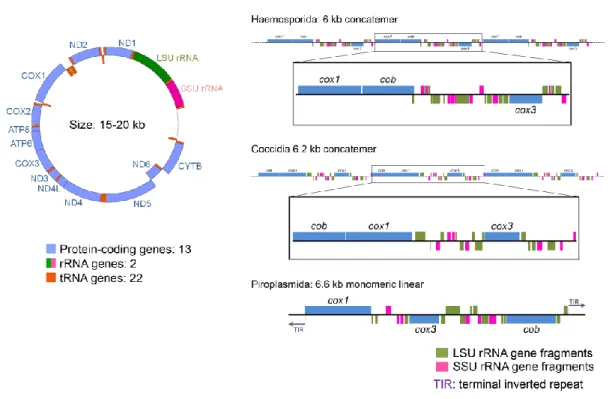
Fig. 1. Three types of mitochondrial genome structure. (a) The circular form is represented by a vertebrate mt DNA. (b) The concatemer and monomeric linear forms are represented by haemosporidian and coccidian mtDNAs, and piroplasm mt DNA in the phylum Apicomplexa, respectively. (Modified from Hikosaka et al. (2013), with permission of Elsevier)
子 を 含 む 3 kb の 領 域 に 逆 位 が 確 認 さ れ る(Fig. 2b).この逆位の境界領域には,T. orientalis 特異的 な挿入配列(左端に 21 bp および右端に 100 bp)が 存在している.このことより,過去にトランスポゾ ンと同様の機構による逆位が起こったことが予測さ れるが,これら 2 つの挿入配列には既知のトランス ポゾンが認識するような構造配列が確認されない. 今後,T. orientalis に近縁な種を調べれば逆位が起 こった過程が解明されるかもしれない.Clade II に属 する T. equi の mt ゲノムは,これまで述べてきた mt ゲノムと大きく異なる構造をとる(Fig. 2b).ゲ ノムサイズが 8.2 kb であり,これは Clade I の原虫 グループや Clade III の T. orientalis よりも 1.5~1.6 kb 大きい.また,cox3 および 2 つの LSU rRNA 断 片(LSU1 および LSU6)を含む TIR をもつ.さら に,タンパク質コード遺伝子および rRNA 遺伝子断 片の配置は,他の Babesia/Theileria とのシンテニー
が確認されない.Babesia/Theileria 属原虫の系統解析
に お い て 分 岐 年 代 の 最 も 古 い Clade VIII(Microti Group)に属する B. microti および B. rodhaini の mt ゲノムは,それぞれ 11.1 kb および 6.9 kb の単量体 直鎖状構造をとるが,遺伝子構成(3 つのタンパク 質コード遺伝子と 6 つの rRNA 遺伝子断片)は他の
Babesia/Theileria と同じである(Hikosaka et al., 2012).
しかし,これらの mt ゲノムには,1 分子の mt ゲノ ム中に 2 組の逆向き繰り返し配列(Inverted Repeat: IR)が存在し,それぞれの IR で挟まれた領域で逆 位が確認されるため,合計で 4 パターンの異なる mt ゲノム構造が存在するというユニークな構造をも つ.サザンブロット解析における DNA 断片の存在 量の比較から,これら 4 パターンの構造の存在比が それぞれ等しいことが推測された.これは,IR 領域 を認識する機構による逆位が頻繁に起きていること を示唆する.以上のように,Plasmodium/Leucocytozoon とは対照的に,Babesia/Theileria は 6.6~11.1 kb と幅 広いサイズの mt ゲノムをもち,ゲノム構造および 構成が多様化している. ど す べ て の 遺 伝 子 間 領 域 の 転 写 産 物 が 調 べ ら れ (Raabe et al., 2010),このうちのいくつかは LSU および SSU rRNA として同定された.この他の遺伝 子間領域転写産物の機能はよくわかっていないが, これらのサイズ,塩基配列および mt ゲノム上にお ける配置は,Plasmodium および Leucocytozoon でほ ぼ完全に一致している(Hikosaka et al., 2011b).こ のことは,これらの遺伝子間領域転写産物が機能性 RNA である可能性を示唆する. Babesia および Theileria
Babesia および Theileria 属は,系統的に Plasmodi-um/Leucocytozoon 属の姉妹群に位置し,Clade I から
Clade VIII の 8 つのグループに分類される(Lack et al., 2012).現在,Babesia/Theileria 属の 10 種におい て mt ゲノムの完全長シーケンスを得ることができ る.Clade I に属する Babesia bovis,B. bigemina,B.
caballi および B. gibsoni の mt ゲノム構造はよく保存
さ れ て い る(Brayton et al., 2007; Hikosaka et al., 2010).これらの 6.6 kb の mt ゲノムは,両末端に 逆 方 向 反 復 塩 基 配 列(Terminal inverted repeats: TIRs)をもつ単量体の直鎖状構造をとり(Fig. 1b お よび Fig. 2b),Plasmodium と同様のタンパク質コー ド遺伝子,cox1,cox3 および cob が存在するが,そ
れぞれの遺伝子配置と転写方向が大きく異なる.ま た,Clade I および Clade III にそれぞれ属する B.
bovis および Theileria parva では 23 の rRNA 遺伝子
断片が同定されており,断片化の様式は基本的には
Plasmodium とよく似ている(Feagin et al., 2012).し
かし,mt ゲノム上のこれらの断片の配置や転写方向 は全く一致しない.
Clade I の Babesia 属原虫とは対照的に,Clade II お よび III に属する Theileria 属原虫のグループでは異 なる mt ゲノム構造が確認されている(Hikosaka et al., 2010).T. orientalis の mt ゲノムは,遺伝子構成 は Clade I の Babesia 属原虫と同じであるが,ゲノム 中央部の cox3 および 4 つの断片化 LSU rRNA 遺伝
Fig. 2. Structure of the concatemer mitochondrial genomes (a) and the monomeric linear mt genomes (b). Mt-genome organization is perfectly conserved among 23 Plasmodium species and three Leucocytozoon species. In Babesia/
Theileria, the mt-genome organization is completely conserved among B. gibsoni, B. bigemina (data not shown), B. ca-balli (data not shown), B. bovis (data not shown), T. parva (data not shown) and T. annulata (data not shown). The T. orientalis mt genome has an inversion in the 3-kb central region. Vertical broken grey lines indicate the boundaries of the
3-kb inversion. The T. equi mt genome has a relatively long terminal inverted repeat (TIR) and contains a cox3 gene and rRNA gene fragments. B. rodhaini possesses four distinct mt genome structures. The inversions are shown by grey bro-ken lines with a circular arrow. The mt genome organization is highly conserved among six Eimeria species, including E.
tenella. Genes shown above the bold line in each genome have predicted transcriptional directions from left to right; and
those below, from right to left. Elements within the mt genomes of P. falciparum and E. tenella are tandemly repeated, so the designation of both termini is arbitrary. Light green and light magenta boxes indicate fragments of LSU and SSU rRNA genes, respectively. Abbreviations are: cox1, cytochrome c oxidase subunit I; cox3, cytochrome c oxidase subunit III; cob, cytochrome b; TIR, terminal inverted repeat. (Modified from Hikosaka et al. (2013), with permission of Elsevier)
全長配列は決定されていない.T. gondii の核ゲノム には,他のアピコンプレクサ原虫では mt ゲノムに コードされている cox1 および cob の断片配列が複 数存在しており,これらは偽遺伝子と考えられてい る(Ossorio et al., 1991).これらの核ゲノムに存在 する多数の偽遺伝子配列が,mt ゲノムの解読を困難 にしていると考えられている.cob の mRNA はミト コ ン ド リ ア か ら 分 離 さ れ る こ と か ら(Pino et al., 2010),T. gondii のミトコンドリアは尐なくとも cob をコードするゲノムをもっているようである. 今後,T. gondii のミトコンドリアの精製度を上げる ことができれば,mt ゲノムの完全長シーケンスの決 定が可能になると思われる. Cryptosporidium Cryptosporidium のゲノムは,ヒトおよびウシに感 染性を示す Cryptosporidium parvum,および,ヒトに のみ感染性を示す C. hominis について解読されてい
る(Abrahamsen et al., 2004; Xu et al., 2004).これら のゲノムには,mtDNA の複製やミトコンドリアのタ ンパク質翻訳に関わる遺伝子群が同定されていな い.また,cox1 もしくは cob の塩基配列をターゲッ トとした縮重プライマーを用いた PCR でも DNA の 増幅が見られない(Putignani et al., 2004).さらに, C. parvum および C. hominis のゲノム情報より,これ らの原虫は,リンゴ酸-キノン酸化還元酵素,ATP 合 成酵素 および サブユニットを除く全ての TCA 回路および酸化的リン酸化酵素を欠失しているよう である(Mogi and Kita, 2010).さらにクリステなど の構造を持つミトコンドリアが Cryptosporidium から 見つかっていない.しかし,電子顕微鏡および免疫 染色による解析では,ミトコンドリアマーカーであ るミトコンドリアシャペロニン 60(Cpn60)および ヒートショックプロテイン 70(HSP70)が Cryptos-poridium の二重膜をもつオルガネラから検出されて
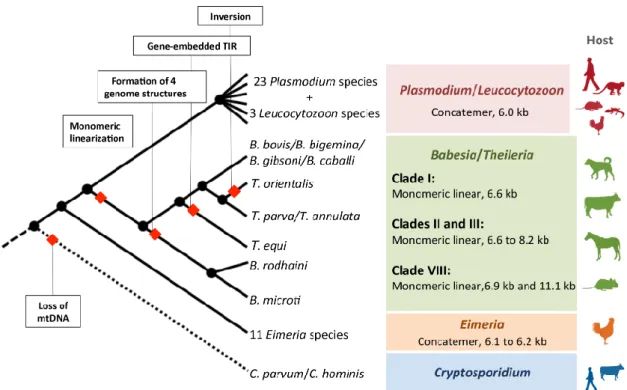
いるので(Putignani et al., 2004; Riordan et al., 2003; Slapeta and Keithly, 2004),Cryptosporidium は mt ゲ ノムを欠失したミトコンドリア様オルガネラである マイトソームをもつことが考えられている. アピコンプレクサ門のミトコンドリアゲノム構造の 進化 これまでに述べたアピコンプレクサ門の系統関係 と mt ゲノムの構造を Fig. 3 にまとめた.これらの 原虫の mt ゲノム構造は,コンカテマーと単量体直 鎖 状 の 二 つ に 分 け る こ と が で き る.Plasmodium/ Leucocytozoon,および Babesia/Theileria より分岐年 代の古い Eimeria は,共にコンカテマー構造の mt ゲ ノ ム を も つ こ と か ら,Plasmodium/Leucocytozoon/ Eimeria アイメリア亜目の Eimeria 属で初めて mt ゲノム の完全長が報告されたのは,ニワトリの腸管に寄生 しコクシジウム症を引き起こす Eimeria tenella にお
いてである(Hikosaka et al., 2011a).E. tenella の mt ゲノムは Plasmodium と同様のコンカテマー構造を
とり,1 ユニットはそれよりもやや長い 6.2 kb であ る(Fig. 2a).mt ゲノム上で同定されている遺伝子
は Plasmodium と同じ 3 つのタンパク質コード遺伝
子(cox1,cox3 および cob)と断片化された rRNA
遺伝子であるが,これらの遺伝子配置は 2 つの mt ゲ ノ ム で 大 き く 異 な っ て い る.最 近,Lin et al. (2011) および Ogedengbe et al. (2014) によって 10 種 のニワトリおよびシチメンチョウに感染する Eimeria の mt ゲノム完全長配列が決定された.これらのサ イズは 6.1~6.2 kb で,E. tenella を含む 11 種の遺伝 子配置および遺伝子構成は完全に保存されている. また,Eimeria 属に内包される鳥類寄生性の Isospora
sp. (Ogedengbe et al., 2015a) や Cyclospora cayetanensis (Ogedengbe et al., 2015b) の mt ゲノムが最近報告され たが,これらの mt ゲノムの構成も上述した Eimeria 属原虫の mt ゲノムと一致する.Eimeria 属原虫は, 両生類(Jirků et al., 2009)や海洋性生物(Molnár et al., 2012)も含め,幅広い脊椎動物に感染することが 知 ら れ て い る.こ の た め,Plasmodium お よ び Babesia/Theileria と は 遺 伝 子 配 置 の 大 き く 異 な る Eimeria 属の mt ゲノムの進化を解明するためには, 鳥類以外に寄生する Eimeria 属原虫の mt ゲノムに ついて調査する必要があるだろう.特に,魚類寄生 性の Eimeria 属原虫は,18S rRNA 遺伝子による系統 解析において分岐年代が最も古いことが知られてい るので(Molnár et al., 2012),これらの原虫の mt ゲノム構造の解析は興味深い.さらに近年,アイメ リア亜目に近縁なアデレア亜目に属する両生類寄生 性の Hepatozoon catesbianae の mt ゲノムが報告され た(Leveille et al., 2014).この mt ゲノムは,他の アピコンプレクサ門の mt ゲノムとサイズ(6.4 kb) や遺伝子構成(3 つのタンパク質コード遺伝子,お よび,高度に断片化された rRNA 遺伝子)は一致す るものの,遺伝子配置は異なる.よって,分岐年代 が古いと考えられる魚類や両生類に寄生するアデレ ア亜目の mt ゲノム構造を解明することは,アピコ ンプレクサ門の mt ゲノム構造の進化の軌跡を解明 するのに重要な鍵となることが推測される. Toxoplasma Toxoplasma gondii(Toxoplasma 属には,今のとこ ろ T. gondii 一種のみしか属さない)はゲノムシーケ ンスが完了しているものの(ゲノム情報は ToxoDB (Kissinger et al., 2003) より入手可能),mt ゲノムの
の姉妹群である渦鞭毛藻類の生物においても保存さ れており,これらの生物群の共通祖先で既に獲得さ れていた形質であると考えられる.共通の 3 つのタ ンパク質コード遺伝子のうち,cob はミトコンドリ ア呼吸鎖複合体 III において cytochrome c を還元す るタンパク質であり,cox1 および cox3 はミトコン ドリア呼吸鎖複合体 IV の cytochrome c の酸化に関 わるタンパク質である.古典的なミトコンドリア呼 吸鎖をもつ生物種では,尐なくとも mt ゲノム上に これら 3 つのタンパク質をコードする遺伝子が存在 microti: IR 間の逆位によって引き起こされる 4 つの 異なるゲノム構造)が確認されている(Fig. 2b). このため,Babesia/Theileria 属原虫の mt ゲノムの進 化の軌跡を探ることは非常に興味深い.しかしなが ら,Babesia/Theileria 属原虫では,サンプル入手の困 難さから解読されている mt ゲノム完全長シーケン スが尐ないため,進化の過程を推測することが難し い.今後,さらなる Babesia/Theileria 属原虫の mt ゲノム構造が明らかになれば,単量体直鎖状 mt ゲ ノムの構造進化についてのより多くの知見が得られ
Fig. 3. A scheme for the evolution of apicomplexan mitochondrial genomes. Plasmodium/Leucocytozoon and Eimeria have concatenated mtDNA. Babesia/Theileria possess a monomeric linear mt genome and the organization of their mon-omeric linear mt genomes is highly divergent: the T. orientalis mt genome has an inversion; the T. equi mt genome har-bors gene-embedded long TIR sequences; and B. rodhaini and B. microti have four distinct mt-genome organizations. The Cryptosporidium mitochondrion is degenerative and lacks any DNA. (Modified from Hikosaka et al. (2013), with permission of Elsevier)
microti (Garg et al., 2014),T. parva (Gardner et al.,
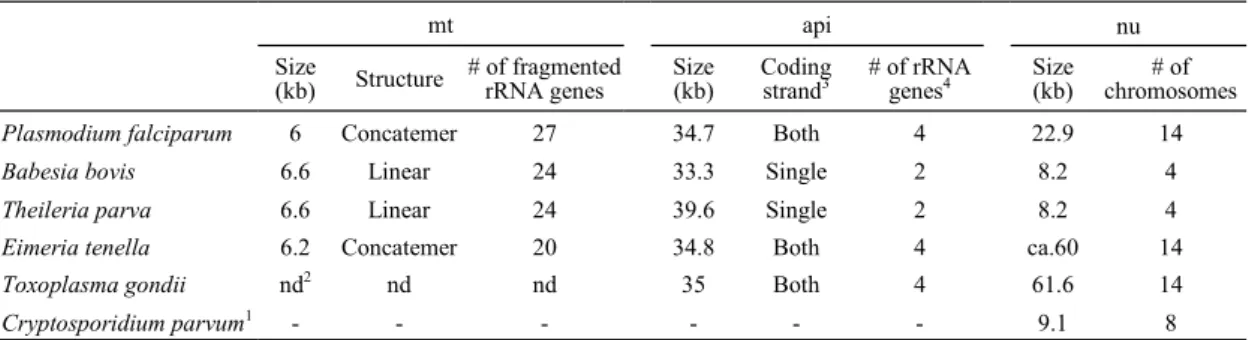
2005),E. tenella および T. gondii (Cai et al., 2003) で 完全長が報告されている.以上の情報と mt ゲノム の構造をまとめたものを Table 1 に示す.
アピコンプレクサ門において,mt ゲノムはコンカ テマー構造と直鎖状構造が存在し,これらの遺伝子 配置は大きく異なっている.api ゲノム構造は,P.
falciparum,L. caulleryi,E. tenella,T. gondii におい
て,サイズは 34.8~37.5 kb,遺伝子は両方向にコー ドされており,大きいサイズの逆向き繰り返し配列 が存在する.これらの構造は以上の 3 種ではほぼ完 全に保存されている.一方,逆向き繰り返し配列が 存 在 せ ず,遺 伝 子 が 一 方 向 に コ ー ド さ れ て い る Babesia/Theileria の api ゲノム構造は属内においても
多様である.B. bovis, B. microti, および T. parva の
api ゲノムサイズは,それぞれ 33.3 kb,28.7 kb,お よび 39.6 kb と幅広い.また,それぞれの原虫にお いて遺伝子配置が大きく異なる.さらに,筆者らの 最近の研究で,Babesia/Theileria の Clade VIII に属す
る B. rodhaini の api ゲノムと,同じ Clade VIII に属
する B. microti の api ゲノムとを比較したところ, サイズは同程度の 30.7 kb でタンパク質コード遺伝 子の配置は一致するが,tRNA 遺伝子の配置は異なる ことがわかっている(未発表).以上より,Babesia/ Theileria の api ゲノムの構造は,mt ゲノム構造と同 様に多様であることが予測される. 核ゲノムのサイズは,6.5 Mb から 61.6 Mb と幅広 く(Table 1),Babesia/Theielria (Brayton et al., 2007; Cornillot et al., 2012; Gardner et al., 2005) の核ゲノムは サイズ(6.5~8.3 Mb)および染色体数(3 もしくは 4 本)ともに,P. falciparum,E. tenella および T. gondii
の核ゲノムよりも小さい.Babesia/Thailria の系統に している.このことと,最も mt ゲノムの縮小化が 進んだアピコンプレクサ門の mt ゲノムにこれら 3 つの遺伝子が残っているという事実は,cytochrome c の酸化還元をミトコンドリア自身で制御することが ミトコンドリア呼吸鎖を維持するための最後の砦と なっていることを想起させる.アピコンプレクサ門 の Cryptosporidium のミトコンドリア様オルガネラで あるマイトソームは,呼吸鎖に関わる遺伝子群を欠 損しているので,アピコンプレクサ門の生物を用い て,ミトコンドリア自身における cytochrome c の酸 化還元の制御の重要性について解明できれば,と考 えている. アピコンプレクサ門における核ゲノムと核外ゲノム との構造の比較 Cryptosporidium 属および Gregarina 属を除くアピ コンプレクサ門は 3 つのゲノム(核ゲノム,mt ゲノ ムおよびアピコプラスト [api] ゲノム)を有する.こ れまでに,7 種の Plasmodium (Carlton et al., 2008; Carlton et al., 2002; Gardner et al., 2002; Hall et al., 2005; Pain et al., 2008; Tachibana et al., 2012),2 種 の
Cryptosporidium (Abrahamsen et al., 2004; Xu et al.,
2004),4 種の Babesia/Theileria (Brayton et al., 2007; Cornillot et al., 2012; Gardner et al., 2005; Pain et al., 2005),E. tenella (Wellcome Trust Sanger Institute, http:// www.sanger.ac.uk/resources/downloads/protozoa/eimeria-tenella.html),および T. gondii とその近縁種(Gajria et al., 2008)において核ゲノムのシーケンスが完了し ている.api ゲノムは,9 種の Plasmodium (Arisue et al., 2012; Wilson and Williamson, 1997),L. caulleryi (Imura et al., 2014),B. bovis (Brayton et al., 2007),B.
1C. parvum does not possess either mtDNA or apicoplast DNA. 2nd indicates data not determined. 3Both and Single indicate that
apico-plast genes are encoded in both directions and a single direction, respectively. 4Long inverted repeat sequences (IRs), which encode large
subunit and small subunit rRNAs, are present in the apicoplast genomes of P. falciparum, E. tenella and T. gondii. The number of rRNA genes are therefore four. In contrast to these parasites, B. bovis, B. microti, and T. parva do not have such a long IR and the number of rRNA gene are two.
Table 1. Characteristics of mitochondrial (mt), apicoplast (api) and nuclear (nu) genomes of representative apicomplexans
mt api nu
Size
(kb) Structure # of fragmented rRNA genes Size (kb) Coding strand3 # of rRNA genes4 Size (kb) chromosomes # of
Plasmodium falciparum 6 Concatemer 27 34.7 Both 4 22.9 14
Babesia bovis 6.6 Linear 24 33.3 Single 2 8.2 4
Theileria parva 6.6 Linear 24 39.6 Single 2 8.2 4
Eimeria tenella 6.2 Concatemer 20 34.8 Both 4 ca.60 14
Toxoplasma gondii nd2 nd nd 35 Both 4 61.6 14
おいて,ミトコンドリア,アピコプラストおよび核 の 3 つのゲノムは,多様化かつ縮小化しており,ゲ ノム進化を考える上で非常に興味深い現象である. 核ゲノムに存在する mtDNA および apiDNA 断片 一般的に,mt ゲノムの縮小化に関わる一つの要因 として,生存に必須な遺伝子領域または非コード領 域の配列が核ゲノムへ移行することが考えられてい る(Berg and Kurland, 2000).これらの核 DNA に移 行していると考えられる mtDNA に相同な配列の断 片は核 mtDNA(nuclear mtDNA: NUMT)と呼ばれ (Lopez et al., 1994),82 種以上の生物で検出されて いる(Bensasson et al., 2001).アピコンプレクサ門 の mt ゲノムのサイズはきわめて小さく最も縮小化 が進んでいると考えられたため,NUMT の検出を試 みた.既に E. tenella では NUMT が報告されている
ため(Hikosaka et al., 2011a),同様の解析方法を他 の原虫にも用いた.その結果,Table 2 に示すよう に,P. falciparum,B. bovis,お よ び T. parva で は
NUMT が検出されなかった.また,T. gondii におい ては mt ゲノムの配列の報告がないが,cox1 および
cob の断片配列が核ゲノムに複数存在することが報
告されているため(Ossorio et al., 1991),核ゲノム 上に多くの NUMT が存在することが予想される. 同様の解析を核 plastid DNA(nuclear plastid DNA; NUPT)についても行ったところ,NUMT の解析結 果と同じように T. gondii および E. tenella のみにお
いて,NUPT が検出された(Table 2).E. tenella お
よび T. gondii の核ゲノムのサイズは他のアピコンプ レクサ原虫に比べて大きいので,核ゲノムの縮小化 が進んでいないのかもしれない. おわりに アルベオラータは原生生物の主要な系統の 1 つで あり,アピコンプレクサ門,繊毛虫類,渦鞭毛藻, および,プロトアルベオラータの 4 つの生物群に分 稿で紹介した Babesia/Theileria 以外の種や Toxoplas-ma,魚類や両生類に感染するアイメリア亜目やアデ レア亜目に属する原虫など,さらなるアピコンプレ クサ門の mt ゲノム構造が決定されれば,mt ゲノム の縮小化や高度に断片化された rRNA 遺伝子の存在 意義についての理解が深まることと思う.特に,
Nephromyces など(Saffo et al., 2010)の分岐年代が古
いと考えられる海洋性の生物に寄生するアピコンプ レクサ門の mt ゲノムの解析は,mt ゲノムの構造進 化を知る上で重要であると考えられる.本分野の発 展を期待したい. あとがき 一昨年,共著者である故田邉和行先生は,国内 外,また研究分野を問わず多くの研究者に惜しまれ ながらご逝去されました.研究開始当初,情報量が 極めて尐なかったアピコンプレクサ門のミトコンド リアゲノムの構造を,ここまで体系立ててまとめる ことができたのも,先生のご指導があったためと心 から感謝しております.田邉先生のご冥福をお祈り 申し上げます. 引用文献
Abrahamsen, M. S., Templeton, T. J., Enomoto, S., Abra-hante, J. E., Zhu, G., Lancto, C. A., Deng, M., Liu, C., Widmer, G., Tzipori, S. et al. (2004) Complete genome sequence of the apicomplexan,
Cryptospor-idium parvum. Science, 304, 441–445.
Anderson, S., Bankier, A. T., Barrell, B. G., de Bruijn, M. H., Coulson, A. R., Drouin, J., Eperon, I. C., Nier-lich, D. P., Roe, B. A., Sanger, F. et al. (1981) Se-quence and organization of the human mitochondri-al genome. Nature, 290, 457–465.
Andersson, S. G. and Kurland, C. G. (1998) Reductive evolution of resident genomes. Trends Microbiol., 6, 263–268.
Arisue, N., Hashimoto, T., Mitsui, H., Palacpac, N. M., Kaneko, A., Kawai, S., Hasegawa, M., Tanabe, K.
and Horii, T. (2012) The Plasmodium apicoplast genome: conserved structure and close relationship of P. ovale to rodent malaria parasites. Mol. Biol. Evol., 29, 2095–2099.
Barth, D. and Berendonk, T. U. (2011) The mitochondrial genome sequence of the ciliate Paramecium
cauda-tum reveals a shift in nucleotide composition and
codon usage within the genus Paramecium. BMC genomics, 12, 272.
Bensasson, D., Zhang, D., Hartl, D. L. and Hewitt, G. M. (2001) Mitochondrial pseudogenes: evolution’s misplaced witnesses. Trends Ecol. Evol., 16, 314– 321.
Berg, O. G. and Kurland, C. G. (2000) Why mitochondrial genes are most often found in nuclei. Mol. Biol. Evol., 17, 951–961.
Boore, J. L. (1999) Animal mitochondrial genomes. Nu-cleic Acids Res., 27, 1767–1780.
Brayton, K. A., Lau, A. O., Herndon, D. R., Hannick, L., Kappmeyer, L. S., Berens, S. J., Bidwell, S. L., Brown, W. C., Crabtree, J., Fadrosh, D. et al. (2007) Genome sequence of Babesia bovis and compara-tive analysis of apicomplexan hemoprotozoa. PLOS Pathogens, 3, 1401–1413.
Cai, X., Fuller, A. L., McDougald, L. R. and Zhu, G. (2003) Apicoplast genome of the coccidian Eimeria
tenella. Gene, 321, 39–46.
Carlton, J. M., Adams, J. H., Silva, J. C., Bidwell, S. L., Lorenzi, H., Caler, E., Crabtree, J., Angiuoli, S. V., Merino, E. F., Amedeo, P. et al. (2008) Comparative genomics of the neglected human malaria parasite
Plasmodium vivax. Nature, 455, 757–763.
Carlton, J. M., Angiuoli, S. V., Suh, B. B., Kooij, T. W., Pertea, M., Silva, J. C., Ermolaeva, M. D., Allen, J. E., Selengut, J. D., Koo, H. L. et al. (2002) Genome sequence and comparative analysis of the model rodent malaria parasite Plasmodium yoelii yoelii. Nature, 419, 512–519.
Cornillot, E., Hadj-Kaddour, K., Dassouli, A., Noel, B., Ranwez, V., Vacherie, B., Augagneur, Y., Bres, V., Duclos, A., Randazzo, S. et al. (2012) Sequencing of the smallest Apicomplexan genome from the human pathogen Babesia microti. Nucleic Acids Res., 40, 9102–9114.
Feagin, J. E., Harrell, M. I., Lee, J. C., Coe, K. J., Sands, B. H., Cannone, J. J., Tami, G., Schnare, M. N. and Gutell, R. R. (2012) The fragmented mitochondrial ribosomal RNAs of Plasmodium falciparum. PLOS ONE, 7, e38320.
Feagin, J. E., Mericle, B. L., Werner, E. and Morris, M.
(1997) Identification of additional rRNA fragments encoded by the Plasmodium falciparum 6 kb ele-ment. Nucleic Acids Res., 25, 438–446.
Flegontov, P., Michalek, J., Janouskovec, J., Lai, H., Jirku, M., Hajduskova, E., Tomcala, A., Otto, T. D., Keel-ing, P. J., Pain, A. et al. (2015) Divergent mitochon-drial respiratory chains in phototrophic relatives of apicomplexan parasites. Mol. Biol. Evol., 32, 1115– 1131.
Gajria, B., Bahl, A., Brestelli, J., Dommer, J., Fischer, S., Gao, X., Heiges, M., Iodice, J., Kissinger, J. C., Mackey, A. J. et al. (2008) ToxoDB: an integrated
Toxoplasma gondii database resource. Nucleic
Ac-ids Res., 36, D553–D556.
Gardner, M. J., Bishop, R., Shah, T., de Villiers, E. P., Carlton, J. M., Hall, N., Ren, Q., Paulsen, I. T., Pain, A., Berriman, M. et al. (2005) Genome se-quence of Theileria parva, a bovine pathogen that transforms lymphocytes. Science, 309, 134–137. Gardner, M. J., Hall, N., Fung, E., White, O., Berriman,
M., Hyman, R. W., Carlton, J. M., Pain, A., Nelson, K. E., Bowman, S. et al. (2002) Genome sequence of the human malaria parasite Plasmodium
falcipa-rum. Nature, 419, 498–511.
Garg, A., Stein, A., Zhao, W., Dwivedi, A., Frutos, R., Cornillot, E. and Ben Mamoun, C. (2014) Sequence and annotation of the apicoplast genome of the human pathogen Babesia microti. PLOS ONE, 9, e107939.
Gray, M. W., Lang, B. F. and Burger, G. (2004) Mitochon-dria of protists. Annu. Rev. Genet., 38, 477–524. Hall, N., Karras, M., Raine, J. D., Carlton, J. M., Kooij, T.
W., Berriman, M., Florens, L., Janssen, C. S., Pain, A., Christophides, G. K. et al. (2005) A comprehen-sive survey of the Plasmodium life cycle by ge-nomic, transcriptomic, and proteomic analyses. Science, 307, 82–86.
Hikosaka, K., Nakai, Y., Watanabe, Y., Tachibana, S., Arisue, N., Palacpac, N. M., Toyama, T., Honma, H., Horii, T., Kita, K. and Tanabe, K. (2011a) Con-catenated mitochondrial DNA of the coccidian para-site Eimeria tenella. Mitochondrion, 11, 273–278. Hikosaka, K., Tsuji, N., Watanabe, Y., Kishine, H., Horii,
T., Igarashi, I., Kita, K. and Tanabe, K. (2012) Nov-el type of linear mitochondrial genomes with dual flip-flop inversion system in apicomplexan para-sites, Babesia microti and Babesia rodhaini. BMC Genomics, 13, 622.
Hikosaka, K., Watanabe, Y., Kobayashi, F., Waki, S., Kita, K. and Tanabe, K. (2011b) Highly conserved gene
rata, K., Holder, A. A. and Yukawa, M. (2014) The apicoplast genome of Leucocytozoon caulleryi, a pathogenic apicomplexan parasite of the chicken. Parasitol. Res., 113, 823–828.
Jirků, M., Jirků, M., Oborník, M., Lukes, J. and Modrý, D. (2009) A model for taxonomic work on homox-enous coccidia: redescription, host specificity, and molecular phylogeny of Eimeria ranae Dobell, 1909, with a review of anuran-host Eimeria (Apicomplexa: Eimeriorina). J. Eukaryot. Microbi-ol., 56, 39–51.
Kissinger, J. C., Gajria, B., Li, L., Paulsen, I. T. and Roos, D. S. (2003) ToxoDB: accessing the Toxoplasma
gondii genome. Nucleic Acids Res., 31, 234–236.
Lack, J. B., Reichard, M. V. and Van Den Bussche, R. A. (2012) Phylogeny and evolution of the Piroplasmida as inferred from 18S rRNA sequences. Int. J. Parasi-tol., 42, 353–363.
Leveille, A. N., Ogedengbe, M. E., Hafeez, M. A., Tu, H. H. and Barta, J. R. (2014) The complete mitochon-drial genome sequence of Hepatozoon catesbianae (Apicomplexa: Coccidia: Adeleorina), a blood para-site of the green frog, Lithobates (formerly Rana)
clamitans. J. Parasitol., 100, 651–656.
Levine, L. D. (1988) The protozoan phylum Apicomplexa. CRC Press, Boca Raton.
Lin, R. Q., Qiu, L. L., Liu, G. H., Wu, X. Y., Weng, Y. B., Xie, W. Q., Hou, J., Pan, H., Yuan, Z. G., Zou, F. C. et al. (2011) Characterization of the complete mito-chondrial genomes of five Eimeria species from domestic chickens. Gene, 480, 28–33.
Lopez, J. V., Yuhki, N., Masuda, R., Modi, W. and O’Bri-en, S. J. (1994) Numt, a recent transfer and tandem amplification of mitochondrial DNA to the nuclear genome of the domestic cat. J. Mol. Evol., 39, 174– 190.
Mogi, T. and Kita, K. (2010) Diversity in mitochondrial metabolic pathways in parasitic protists
Plasmodi-um and CryptosporidiPlasmodi-um. Parasitol. Int., 59, 305–
312.
Molnár, K., Ostoros, G., Dunams-Morel, D. and
Rosen-Nunnari, J. and Suomalainen, A. (2012) Mitochondria: in sickness and in health. Cell, 148, 1145–1159. Ogedengbe, M. E., Brash, M. and Barta, J. R. (2015a) The
complete mitochondrial genome sequence of an
Isospora sp. (Eimeriidae, Eucoccidiorida,
Coccidia-sina, Apicomplexa) causing systemic coccidiosis in domestic Canaries (Serinus canaria Linn.). Mito-chondrial DNA, doi:10.3109/19401736.2015.1018201. Ogedengbe, M. E., Qvarnstrom, Y. da Silva, A. J.,
Ar-rowood, M. J. and Barta, J. R. (2015b) A linear mitochondrial genome of Cyclospora cayetanensis (Eimeriidae, Eucoccidiorida, Coccidiasina, Apicom-plexa) suggests the ancestral start position within mitochondrial genomes of eimeriid coccidia. Int. J. Parasitol., 45, 361–365.
Ogedengbe, M. E., El-Sherry, S., Whale, J. and Barta, J. R. (2014) Complete mitochondrial genome sequences from five Eimeria species (Apicomplexa; Coccidia; Eimeriidae) infecting domestic turkeys. Parasit. Vectors, 7, 335.
Omori, S., Sato, Y., Hirakawa, S., Isobe, T., Yukawa, M. and Murata, K. (2008) Two extra chromosomal genomes of Leucocytozoon caulleryi; complete nucleotide sequences of the mitochondrial genome and existence of the apicoplast genome. Parasitol. Res., 103, 953–957.
Ossorio, P. N., Sibley, L. D. and Boothroyd, J. C. (1991) Mitochondrial-like DNA sequences flanked by direct and inverted repeats in the nuclear genome of
Toxoplasma gondii. J. Mol. Biol., 222, 525–536.
Pain, A., Bohme, U., Berry, A. E., Mungall, K., Finn, R. D., Jackson, A. P., Mourier, T., Mistry, J., Pasini, E. M., Aslett, M. A. et al. (2008) The genome of the simian and human malaria parasite Plasmodium
knowlesi. Nature, 455, 799–803.
Pain, A., Renauld, H., Berriman, M., Murphy, L., Yeats, C. A., Weir, W., Kerhornou, A., Aslett, M., Bishop, R., Bouchier, C. et al. (2005) Genome of the host-cell transforming parasite Theileria annulata compared with T. parva. Science, 309, 131–133.
Perkins, S. L. (2008) Molecular systematics of the three mitochondrial protein-coding genes of malaria para-sites: corroborative and new evidence for the origins of human malaria. Mitochondrial DNA, 19, 471– 478.
Pino, P., Aeby, E., Foth, B. J., Sheiner, L., Soldati, T., Schneider, A. and Soldati-Favre, D. (2010) Mito-chondrial translation in absence of local tRNA ami-noacylation and methionyl tRNA Met formylation in Apicomplexa. Mol. Microbiol., 76, 706–718. Preiser, P. R., Wilson, R. J., Moore, P. W., McCready, S.,
Hajibagheri, M. A., Blight, K. J., Strath, M. and Williamson, D. H. (1996) Recombination associated with replication of malarial mitochondrial DNA. EMBO J., 15, 684–693.
Pritchard, A. E., Seilhamer, J. J., Mahalingam, R., Sable, C. L., Venuti, S. E. and Cummings, D. J. (1990) Nucleotide sequence of the mitochondrial genome of Paramecium. Nucleic Acids Res., 18, 173–180. Putignani, L., Tait, A., Smith, H. V., Horner, D., Tovar, J.,
Tetley, L. and Wastling, J. M. (2004) Characteriza-tion of a mitochondrion-like organelle in
Cryptos-poridium parvum. Parasitology, 129, 1–18.
Raabe, C. A., Sanchez, C. P., Randau, G., Robeck, T., Skryabin, B. V., Chinni, S. V., Kube, M., Reinhardt, R., Ng, G. H., Manickam, R. et al. (2010) A global view of the nonprotein-coding transcriptome in
Plasmodium falciparum. Nucleic Acids Res., 38,
608–617.
Riordan, C. E., Ault, J. G., Langreth, S. G. and Keithly, J. S. (2003) Cryptosporidium parvum Cpn60 targets a relict organelle. Curr. Genet., 44, 138–147.
Saffo, M. B., McCoy, A. M., Rieken, C. and Slamovits, C. H. (2010) Nephromyces, a beneficial apicomplexan symbiont in marine animals. Proc. Natl. Acad. Sci. U.S.A., 107, 16190–16195.
Sharma, A. and Sharma, A. (2015) Plasmodium
falcipa-rum mitochondria import tRNAs along with an
active phenylalanyl-tRNA synthetase. Biochem. J., 465, 459–469.
Slapeta, J. and Keithly, J. S. (2004) Cryptosporidium
par-vum mitochondrial-type HSP70 targets homologous
and heterologous mitochondria. Eukaryot. Cell, 3, 483–494.
Tachibana, S., Sullivan, S. A., Kawai, S., Nakamura, S., Kim, H. R., Goto, N., Arisue, N., Palacpac, N. M., Honma, H., Yagi, M. et al. (2012) Plasmodium
cynomolgi genome sequences provide insight into Plasmodium vivax and the monkey malaria clade.
Nat. Genet., 44, 1051–1055.
Vaidya, A. B. and Arasu, P. (1987) Tandemly arranged gene clusters of malarial parasites that are highly conserved and transcribed. Mol. Biochem. Parasi-tol., 22, 249–257.
Waller, R. F. and Jackson, C. J. (2009) Dinoflagellate mi-tochondrial genomes: stretching the rules of molec-ular biology. Bioessays., 31, 237–245.
Wilson, R. J. and Williamson, D. H. (1997) Extrachromo-somal DNA in the Apicomplexa., Microbiol. Mol. Biol. Rev., 61, 1–16.
Xu, P., Widmer, G., Wang, Y., Ozaki, L. S., Alves, J. M., Serrano, M. G., Puiu, D., Manque, P., Akiyoshi, D., Mackey, A. J. et al. (2004) The genome of