DISCUSSION PAPER No.170
日本とドイツの中小企業における
国際化とイノベーション:
統合的な国際化戦略の重要性
Internationalization and Innovation in
Japanese and German SMEs:
The Importance of an Integrative Strategy
2019 年 4 月
文部科学省 科学技術・学術政策研究所
第 1 研究グループ
本 DISCUSSION PAPER は、所内での討論に用いるとともに、関係の方々からの御意見を頂く ことを目的に作成したものである。
また、本 DISCUSSION PAPER の内容は、執筆者の見解に基づいてまとめられたものであり、 必ずしも機関の公式の見解を示すものではないことに留意されたい。
The DISCUSSION PAPER series is published for discussion within the National Institute of Science and Technology Policy (NISTEP) as well as receiving comments from the community.
It should be noticed that the opinions in this DISCUSSION PAPER are the sole responsibility of the author(s) and do not necessarily reflect the official views of NISTEP.
【執筆者】 クリスティアン・ラマー 欧州経済研究センター (ZEW) イノベーション経済学・産業動態学研究 部門 副部門長 文部科学省 科学技術・学術政策研究所 国際客員研究官 池内 健太 独立行政法人経済産業研究所 研究員 文部科学省 科学技術・学術政策研究所 客員研究官 レベッカ・リウ ランカスター大学マネジメント・スクール講師 【Authors】
Christian Rammer Deputy, Department of Economics of Innovation and Industrial Dynamics, Centre for European Economic Research (ZEW) International Affiliated Fellow, National Institute of Science and Technology Policy (NISTEP), MEXT
Kenta Ikeuchi Fellow, Research Institute of Economy, Trade and Industry
Affiliated Fellow, National Institute of Science and Technology Policy (NISTEP), MEXT
Rebecca Liu Lecturer, Lancaster University Management School
本報告書の引用を行う際には、以下を参考に出典を明記願います。 Please specify reference as the following example when citing this paper. クリスティアン・ラマー,池内健太,レベッカ・リウ (2019) 「日本とドイツの中小企業における
国際化とイノベーション:統合的な国際化戦略の重要性」,NISTEP DISCUSSION PAPER,
No.170,文部科学省科学技術・学術政策研究所. DOI: http://doi.org/10.15108/dp170
Rammer, Christian, Kenta Ikeuchi and Rebecca Liu (2019) “Internationalization and Innovation
in Japanese and German SMEs: The Importance of an Integrative Strategy,” NISTEP
DISCUSSION PAPER, No.170, National Institute of Science and Technology Policy, Tokyo. DOI: http://doi.org/10.15108/dp170
日本とドイツの中小企業における国際化とイノベーション: 統合的な国際化戦略の重要性 文部科学省 科学技術・学術政策研究所 第1 研究グループ クリスティアン・ラマー(ZEW),池内健太(RIETI),レベッカ・リウ(ランカスター大学) 要旨 中小企業にとって事業活動の国際化は挑戦であり、同時に機会である。資源制約に直面しがちな中小 企業にとって事業活動の国際化はリスクが高い。その一方、海外市場での経験は中小企業のイノベーシ ョン活動の進展を決定づけるかもしれない。そこで本研究は、中小企業におけるイノベーションの成果に 対する国際活動の影響を分析する。日本とドイツのデータを用いた本研究の分析結果は、海外市場へ の進出とイノベーション活動における国際的な連携を並行して行う「統合的な国際化戦略」が、新規性の 高いプロダクト・イノベーションの成果を高める可能性を示している。日本とドイツには地理的な違いがあ るにも関わらず、これらは日独の中小企業で共通する傾向である。
Internationalization and Innovation in Japanese and German SMEs: The Importance of an Integrative Strategy
First Theory-Oriented Research Group, National Institute of Science and Technology Policy (NISTEP), MEXT
Christian Rammer (ZEW), Kenta Ikeuchi (RIETI), Rebecca Liu (Lancaster University) ABSTRACT
Internationalization in SMEs is both a challenge and an opportunity. While the costs of internationalization may be high for resource-limited SMEs, the input from international markets can be decisive in advancing innovations. This paper analyses the role of internationalization in innovation performance of SMEs. Data from Japan and Germany indicate that an integrative strategy which combines international market expansion and international cooperation yields higher sales with new-to-market product innovations. The results are consistent for both Japanese and German SMEs, despite the distinct geographical differences of the two countries.
論文の概要 1.問題意識と本研究の目的 中小企業のイノベーション活動における海外活動の役割にはメリットとデメリットの両面が ある。一方で、海外市場への参入により、中小企業のイノベーション活動において有用な様々 な追加的な資源の利用可能性が高まる。他方、“liability of foreignness”(よそ者の不利益)と言 われるように、海外活動のマネジメントにはコストがかかり、資源制約に直面する中小企業に とっては国際化がイノベーション活動の進展を阻害する恐れもある。 中小企業が成長の機会を最大化するためには、このような国際化のメリットとデメリットを 考慮に入れて、国際化戦略とイノベーション戦略を調和させる必要がある。国際化には海外市 場への進出、海外の組織との連携、海外直接投資(海外子会社の買収や新規設立)など、いく つかの方法があるが、中小企業にとって、海外直接投資はハードルが高い。 そこで本研究は、中小企業の 2 つの国際化戦略(海外市場進出と海外の組織との連携)がプ ロダクト・イノベーションの成果に与える影響を明らかにすることを目的とする。本研究の特 徴は以下の3点である。 ① 海外市場への進出と海外の組織との連携の相互作用に注目すること これまで、海外市場展開と海外の組織との連携はそれぞれ別の研究の潮流の中で、イノベーシ ョンのパフォーマンスの関係が分析されてきた。著者の知る限り、2 つの相互作用を分析した研 究はほとんどない。本研究では、これら 2 つの国際化戦略の相互作用が中小企業のイノベーシ ョンの成果に与える効果を分析する。 ② イノベーションの新規性の違いに注目すること 新規性の高いイノベーションを実現するためには、より多様な知識や資源が必要である可能性 が高い。そのため、国際化戦略の効果は、イノベーションの新規性によって異なる可能性があ る。本研究では新規性の違いを考慮して、国際化戦略がイノベーションの成果に与える効果を 分析する。 ③ 日独の中小企業の国際比較を行うこと 中小企業の置かれた環境の違いによって、イノベーションにおける国際化戦略の役割が異なる 可能性がある。そのため、本研究では、日本とドイツのデータを用いて国際比較分析を行う。 ドイツは欧州大陸に位置している一方、日本は島国である。さらに、ドイツは近隣諸国と経済 統合された欧州連合に属している。日本とドイツでは、中小企業の国際化戦略のための地理 的・制度的な障害に大きな違いがあると考えられる。 2.データと分析方法 本研究では、2012 年と 2015 年の 2 回の日本とドイツの「イノベーション調査」のデータを 用いて分析を行い、結果を比較する。両国の調査はそれぞれ独立して実施されているが、質問 票や調査方法は同一のガイドライン(OECD「オスロ・マニュアル」及び欧州委員会統計局 「Community Innovation Survey」)に準拠しており、分析結果は比較可能である。また、両国
の調査はともに全国の企業の母集団を代表するように標本設計されている。分析対象は、過去 3 年間にプロダクト・イノベーションを実現した従業者数(又は常用雇用者数)250 人未満の中小 企業である。 国際化戦略がプロダクト・イノベーションの成果に与える影響を明らかにするため、プロダ クト・イノベーションによる売上高の比率を被説明変数とし、企業が実施する国際化戦略のタ イプを主な説明変数とする回帰分析を行う。国際化戦略のタイプは海外市場展開の有無と海外 及び国内組織との連携の有無によって 6 つのタイプに分類し、国際化戦略のタイプの違いがイ ノベーションの成果に与える効果を推定する。 日独両国のイノベーション調査において「過去 3 年間に海外の市場で製品・サービスを販 売・提供した」と回答した企業を、海外市場展開を行っている企業として定義し、海外組織及 び国内組織との連携の有無は「イノベーション活動における協力相手の所在国・地域」が海外 であるか否かによって識別した。これら 2 つの情報に基づき、概要表 1 のように企業の国際化 戦略のタイプを以下 6 種類に分類した。 概要表 1:国際化戦略のタイプの分類方法 国際化戦略のタイプ 海外 市場展開 イノベーション活動にお ける協力相手の所在地 海外 国内のみ 統合的な国際化 (1)海外市場&国際連携 ✔ ✔ 非統合的国際化 (2)海外市場&国内連携のみ ✔ ✔ (3)海外市場&連携なし ✔ (4)国内市場のみ&国際連携 ✔ 非国際化 (5)国内市場&国内連携のみ ✔ (6)国内市場のみ&連携なし プロダクト・イノベーションの新規性の違いを考慮するため、複数の被説明変数を設定す る。新規性の高いプロダクト・イノベーションの成果の指標としては「市場にとって新しい製 品・サービス」の売上高の比率を用い、漸進的なプロダクト・イノベーションの成果の指標と しては「企業自身にとってのみ新しい製品・サービス」の売上高の比率を用いる。 その他、イノベーションの成果に影響を与えると考えられる R&D 集約度や企業規模、企業年 齢、産業の効果をコントロール変数として加えている。また、プロダクト・イノベーションに よる売上高比率は 0 を下回らないため、トービット・モデルを用いた回帰分析を用いている。 3.分析結果とその含意 本研究の主な分析結果は以下のとおりである。 ① 海外市場展開と海外組織との連携を同時に行う統合的な国際化戦略は中小企業のイノベーシ ョンの成果を高める。これら 2 つの国際化戦略はそれぞれ個別にもイノベーションの成果 (プロダクト・イノベーションによる売上比率)を高める効果が見られるが、2 つの国際化 戦略を同時に用いるとその効果がより高まることが確認された(概要図1)。
② このような統合的な国際化戦略は漸進的なイノベーションではなく、新規性の高いイノベー ションのパフォーマンスに対する貢献が大きい。国際化戦略は中小企業の「企業自身にとっ て新しい製品・サービスによる売上比率」には統計的に有意な効果は見られず、「市場にと って新しい製品・サービスによる売上比率」に対しては統計的に有意な正の効果が確認され た。 ③ 日本とドイツは地理的・文化的・制度的な環境の違いが大きいにも関わらず、上記①と②の 傾向は一致している。これは技術の発展やグローバル化によって、国際化の障壁が小さくな っていることを示している可能性がある。 概要図1:国際化戦略と市場にとって新しいプロダクト・イノベーションによる売上比率の関 係性 (トービットモデルによる回帰分析結果) これらの結果は中小企業のイノベーション活動にとっての「統合的な国際化戦略」の重要性 を示唆するものである。さらには、海外市場展開と海外組織との連携は中小企業の新規性の高 いイノベーションにとって、特に強く補完的な作用を及ぼすことがわかる。このことから、中 小企業の国際化の政策的な支援にあたっては、海外市場展開と海外組織との連携の両面を考慮 することにより、新規性の高いイノベーションの促進につながることが期待される。
Internationalization and Innovation in Japanese and German SMEs: The importance of an integrative strategy
Abstract
Internationalization in SMEs is both a challenge and an opportunity. While the costs of internationalization may be high for resource-limited SMEs, the input from international markets can be decisive in advancing innovations. This paper analyses the role of
internationalization in innovation performance of SMEs. Data from Japan and Germany indicate that an integrative strategy which combines international market expansion and international cooperation yields higher sales with new-to-market product innovations. The results are consistent for both Japanese and German SMEs, despite the distinct geographical differences of the two countries.
1. Introduction
There is continuing interest in the role of internationalization of small and medium-sized enterprises (SMEs) in their innovation performance. Indeed, entering foreign markets can help resource-limited SMEs to access additional resources (Cavusgil and Knight, 2015; Golovko and Valentini, 2011; Gassmann and Keupp; 2007). The input from international markets can be decisive for more advanced innovations that firms are not able to pursue otherwise (Alcacer and Oxley, 2014; Hitt et al., 1997). And yet, a paradox arises. The liability of foreignness inherited in a firm’s internationalization approaches can cause
tensions to its innovation development (Sui and Baum, 2014; Lu and Beamish, 2001), impose substantial cost to coordinate and control international activities (Eriksson et al., 2015), resulting in disappointing outcomes (Lhuillery and Pfister, 2009; Johnson, et al., 2013). This can be problematic to smaller firms, especially when following internationalization and innovation strategies jointly in order to maximize the chances of growth.
The purpose of this paper is to better understand how internationalization strategy associates with product innovation performance in SMEs. We focus on three issues that have been largely under-addressed. First, we consider two types of internationalization strategies that are most commonly used by SMEs – market expansion and inter-firm cooperation in foreign markets1 and their integrative form. Research upon international market expansion (e.g. exporting) and international cooperation has long been studied in different literature streams. In more recent years, some studies (see e.g. Hessels and Parker, 2013; Johnson et al., 2013) however have noticed that the combination of these two approaches is highly possible in SMEs’ practice, aiming to capitalise the mutual benefit embedded in such an interplay
1 Both activities involved relatively lower cost, risk and management resources when comparing other forms of
internationalization (e.g. foreign direct investment); see e.g. Cassiman and Golovko (2011), Palmié et al. (2016) and Mudambi and Zahra (2007).
approach. As such, we suggest it is necessary to address this combined internationalization strategy when considering the link between internationalization and innovation performance in SMEs.
Second, the way firms discover, enact and exploit in their internationalization process significantly influences the degree of innovativeness in their new product development (see e.g. Prange and Verdier, 2011; Jonsson and Foss, 2011). Nevertheless, the relevant
theoretical constructs and empirical studies rarely provide much insight into the novelty of the concerned product innovation (see e.g. Kriz and Welch, 2018). We believe the role of internationalization in firm innovation performance cannot be fully understood without reference to its relevance of innovativeness. To do so, we borrow the concept of
international ambidexterity (see Prange and Verdier, 2011), looking into the ambidextrous nature of explorative (novel) and exploitative (incremental) innovations in the context of internationalization.
Third, prior studies suggest that the link between internationalization and innovation in firms can be subject to some conditional factors. Yet, conclusions are far from consistent, often raising more questions than they answered (see e.g. Laforet, 2013; O’Cass and
Weerawardena, 2009; Leiponen, 2012). To address the issue, we take a more holistic view and investigate the specific role of SME internationalization in three different settings: geography, sector and firm size. For geography, two countries (Japan and Germany) of similar size and industry structure serve as our test ground. While both countries are highly industrialised and innovation oriented economies, SMEs in Germany face much lower costs of internationalization compared to their Japanese counterpart, owing to the central
geographic location of Germany within Europe and the existence of a single market within the European Union. For Japanese SMEs, internationalization always requires overseas
activities in a very different regulative setting, often connected with trade barriers. For sectors, we separate services from manufacturing as the former faces significantly higher barriers to trade due to the intangible character of services (Leiponen, 2012). For size, we distinguish small firms (with less than 50 employees) from medium-sized ones (50 to 249 employees) as the former may be more resource constrained.
We draw upon data from two waves (2012 and 2015) of the National Innovation Surveys in Japan and Germany. Their harmonized survey design allows us to conduct a cross-county time-series analysis of two distinct institutional environments2 with clear culture differences (East and West) and apparent geographic divergence (one on an island, another in mainland). The survey also provides us with rare data to observe a purported objective of product
innovation – the commercial success of innovation of two different types (novel and incremental) of product innovations.
Our study offers three major contributions. First, by adopting an integrative view of the internationalization process of firms, we propose and evidence that a combined
internationalization strategy can contribute more to innovation in SMEs than an individual approach does. Second, by following the exploration-exploitation paradigm, we shed light upon the hypothesized international ambidexterity. Specifically, we show that the empirical accounts of a subtle relationship of internationalization, not for exploitative (incremental) but for explorative (novel) innovations in SMEs. Finally, by considering geography, firm size and industrial sector, we contextualise the link between internationalization and innovation. This paper is structured as follows. We first present the literature background and
hypotheses. We then describe our research method, followed by a discussion of the
2 Institutional environment is defined as the set of political, economic, social and legal conventions that establish
the foundational basis for production and exchange. See e.g. Oxley (1999) for the definition of institutional environment.
estimation results. Finally, we summarize the theoretical and managerial implications and point to the limitations and areas for further investigations.
2. Theory and Hypotheses
2.1 An integrative internationalization strategy in SMEs
The entrepreneurial and resource-based view of the firm suggests that internationalization can help SMEs to generate additional resources (Cavusgil and Knight, 2015; Westhead et al., 2001; Kobrin, 1991; Kotabe, 1990) which can be used to pursue more ambitious innovation efforts (Alcacer and Oxley, 2014; Hitt et al., 1997). To overcome the inherited liability of smallness, SMEs are more prone to approaches that require fewer resources in their
internationalization process (Love and Roper, 2015; Golovko and Valentini, 2011). To this end, two approaches are among the most studied – market expansion (e.g. through exporting) and inter-firm cooperation (see e.g. Love and Roper, 2015; Johanson and Vahlne, 2009; Kriz and Welch, 2018).
In the extant literature, Caves (1982) was one of the first to argue that firms that expanded to foreign markets enjoyed higher returns to innovations. In more recent years, the ‘dynamic virtuous circle’ argument (Autio, Yli-Renko and Salonen, 1997; Golovko and Valentini, 2011) strongly advocates SMEs’ presence in the international markets drives the success of new products. The emphasis is that ‘a “virtuous, reinforcing circle” of learning and asset exploitation facilitates firms to acquire new knowledge in foreign markets that is then utilised in product improvement (Kriz and Welch, 2018). There are at least two standing arguments. A first one relates to the role of knowledge sources. In international markets, SMEs can access diverse innovative ideas, get in contact with new customer requirements and can approach different types of expertise (Kafouros et al., 2008; Cheng and Bolon, 1993). The
second argument stresses the financial resources for innovation. Diversifying their customer base internationally is a promising way to expand sales. If SMEs are able to utilise
economies of scale when increasing their production volume, they can generate additional financial resources (Bellone et al., 2010). All these can stimulate more innovative
approaches and guide SMEs to new ways of business.
In a different strand of research, various theories deal with firm cooperation within an internationalization context. For example, the business network view of the Uppsala Model (Johanson and Vahlne, 2009) suggests that cooperation with foreign partner benefits
innovators through interdependence of technology, resources and the access complement, so that uncertainties can be mitigated and resource/knowledge constraints can be improved (McAdam et al., 2014; Baker et al., 2016; Whittaker et al., 2016). Similarly, the theory of strategic alliances suggests that participating in international cooperative alliances expedites a firm’s respond to markets. To this end, cooperative coalition has been studied as an essential part in the international business literature (van Beers and Zand, 2014; Johnson et al., 2013; Hagedoorn, 1993). More importantly, this stream of studies stresses that
participating in collaborative arrangement and strategic alliances in foreign markets ‘could substantially improve the ability of small companies to quickly explore and exploit
opportunities, thus improving their competitiveness’ (Vasilchenko and Morrish, 2011:89). On the other hand, the contrasting arguments are well established in the extant literature. We were told that a high degree of internationalization increases the risk of knowledge leakage (Jonsson, 2008), the likelihood of know-how spillovers to competitors (Sanna-Randaccio and Veugelers, 2007), and imposes substantial cost to coordinate and control international
and global competition, along with short product life cycles, have made product innovation more difficult for SMEs (Johnson et al., 2013).
While international market expansion and international firm cooperation has been studied in different streams of literature, only recently some studies (see e.g. Hessels and Parker, 2013; Johnson et al., 2013) have noticed that smaller firms are likely to adopt a combined approach of market internationalisation and firm cooperation, especially for those facing resource constraints. One prominent argument is that international markets offer access to knowledge and resources which are not available in the home country, so motivating firms to cooperate with foreign partners (Barge-Gil, 2010; Johnson et al., 2007). Alternatively, in reverse, when firms engage in international business activities they are more likely to involve and work with specialized knowledge providers in their innovation activity (Tether and Tajar, 2008).
Taken together, prior research seems to suggest that SMEs may spur higher product innovation success in both competence and resource terms when combining international markets expansion together with international cooperation. More importantly, whilst the combination of these two approaches is highly possible in practice, the relevant literature insofar has not yet fully addressed this interplay strategy (Hessels and Parker, 2013; Johnson et al., 2013). As a result, the understanding into such a combined internationalization
strategy remains under-understood. As such, we hypothesise that an integrated strategy better links with innovation performance in SMEs than a discrete approach does. Therefore, we posit:
H1: An integrative internationalization strategy of market expansion and firm cooperation has stronger association with innovation performance in SMEs than an individual approach does.
2.2 International ambidexterity in SMEs
Building on a resource-based and knowledge-based view, the international business studies has offered much knowledge into the development of capabilities (Jonsson and Foss, 2011), emphasising that cross-border involvement promote learning, reduce uncertainties, and thus enhance innovation performance (e.g. Golovko and Valentini, 2011; Kriz and Welch, 2018). Nevertheless, none has yet given sufficient attention to the nature of the studied innovation. The emphasis here is that the development of more novel innovations requires more diverse knowledge and new inputs whereas the process into incremental innovations tend to be relatively homogenous and path dependent (Prange and Verdier, 2011; Knudsen and Madsen, 2002; Prange and Pinho, 2017). To this end, the concept of international ambidexterity (Prange and Verdier, 2011) offers a helpful lance to observe the phenomenon.
Building on the exploration/exploitation paradigm (March, 1991), the concept of international ambidexterity has its root from the organisational ambidexterity3 theory. In innovation studies, organizational ambidexterity emphasizes a firm’s ability to simultaneously pursue exploratory (novel) and exploitative (incremental) innovations (Tushman and O’Reilly, 1996; Jansen et al., 2005). Drawing on this view, international ambidexterity proposition considers the fundamental properties of cross-border learning and capabilities in developing product innovation, suggesting that ‘companies need to balance the dysfunctional effects of a single-sided focus on exploitative internationalization capabilities or explorative internationalization capabilities’ (Prange and Verdier, 2011:131). Here, Prange and Verdier (2011) further explain that explorative internationalization reflects a firm’s ability to achieve new and innovative capabilities in order to develop novel products; whereas exploitative
internationalization links to path-dependent learning and knowledge accumulation through
3 See e.g. O’Reilly and Tushman (2013) and Raisch and Birkinshaw (2008) for a review of the organisational
international experience to develop incremental innovations. More importantly, Prange and Verdier (2011) suggest firms require a balanced, rather than a trade-off, strategy between explorative and exploitative internationalization. Along this line, Zou and Cavusgil (1996) and Knudsen and Madsen (2002) pinpoint that firms seek to explore new ideas or processes for product innovation; at the same time, to leverage current competences to exploit existing products through effective interaction in foreign markets. Taken together, prior research seems to suggest that successful internationalised firms are ambidextrous that firms create and sustain advantages through both novel and incremental innovations. Therefore, we assume:
H2a: International market expansion strategy is positively associated with the performance of both novel and incremental product innovations in SMEs. H2b: International cooperation strategy is positively associated with the performance
of both novel and incremental product innovations in SMEs.
H3b: An integrative internationalization strategy (marketing expansion and firm cooperation) is positively associated with the performance of both novel and incremental product innovations in SMEs.
2.3 Conditional factors
In studying SMEs’ internationalization strategy, the issue of resource constraints is a
paradoxical one, for it promotes as well as demotes firms’ intention in searching for external resources. Among which, firm size has been viewed as a decisive factor. To this end, many conclude that larger firms are more likely to go international markets, and smaller firms, owing to ‘resource poverty’, are more likely to stay in the domestic market (see e.g. Wakelin, 1998; O’Cass and Weerawardena, 2009; Park et al., 2002). For example, O’Cass and
are more opted to international activities than smaller firms because larger firms are able to generate stronger competitive capability than their smaller peers. Along the same vein, Park et al. (2002), who studied SMEs in the US semiconductor industry, evidenced that bigger firms, with richer resources, were more active in foreign alliances than smaller firms. We follow this line of research and assume:
H3a: Internationalization strategies are positively associated with innovation performance in medium-sized but not in small firms.
Another important resource issue rests in industry differences, in which the differences between manufacturing and services are among the most studied. An underlying argument is that, when engaging in foreign markets, physical products can be traded at lower cost than intangible services. Consequently, internationalization would be easier for manufacturing companies while service firms are faced with extra cost and resources when
internationalizing their business activities. For example, Leiponen (2012), drawing on data collected from Finnish firms, evidenced that firm externalization strategy benefits
manufacturing, but not services firms. She explains this by superior R&D management capabilities of manufacturing firms (Leiponen, 2012:19). Along this line, Miles (2007) also sees advantages for manufacturing over services firms when considering foreign market access. He argues that this is due to extra service innovations require many transformative and reshaping processes and costs in order to better respond to new market needs, resulting in high transactional costs. We therefore assume:
H3b: Internationalization strategies are positively associated with innovation performance in manufacturing but not in services SMEs.
Finally, an important constraint to internationalization activities, cooperative alliances in particular, relates to distance barriers4. These include physical distance where geographical gap incurs cost of transport and communication and psychic distance where the differences in culture, language and customers acquire extra resources and work force in
internationalization process. Delerue and Lejeune (2011) study mimetic behaviours (i.e. a market position adoption is likely to be imitated in a geographically proximate market) and have evidenced a positive relationship between mimetic behaviour and international alliance formation. With a similar token, Bell (2005) also showed that a mimetic process within proximate markets plays an important role in fostering forms’ innovation activity. On the other hand, Murray et al., (2011), through a study of exporters in China, showed that psychic distance has significant effects on new product development and Manolova and Yan (2002) studied the institutional environment in Bulgaria and concluded that institutional environment has significant influence on firms’ strategic decisions. This stream of literature explicitly suggest that ‘distance’ factors play a vital role in making internationalization strategy and approach in firms. In our study, Japan and Germany, with their distinct ‘distance’ differences as mentioned earlier, serve as our test ground. Hence we assume
H3c: Internationalization strategies are positively associated with the product innovation performance in German SMEs but not in Japanese SMEs.
3. Research Method 3.1 The Study
In this empirical study, we use an innovation output model frequently used in the literature that relies on CIS-type data (Laursen and Salter, 2006; Leiponen and Helfat, 2010; Klingebiel and Rammer, 2014; Crépon, Duguet and Mairesse, 1998; Czarnitzki and Lopes-Bento, 2015). The model relates product innovation performance to innovation inputs, a firm's
internationalization strategy, and other firm characteristics that may affect product innovation success. The performance of novel innovation is observed through sales generated by new-to-market innovations whereas incremental innovations’ is estimated through new-to-firm innovations.
The dependent variable of the model is the share of sales generated by product innovation (inn_out). Innovation input is measured by R&D expenditure over sales (inn_inp). With respect to the internationalization strategy, we distinguish five types: (1) firms which are present in foreign markets and cooperate with foreign organisations for innovation (fma_fco), (2) firms present in foreign markets but cooperating only domestically (fma_dco), (3) firms present in foreign markets but not cooperating at all (fma_nco), (4) firms only serving their domestic market but cooperating with partners abroad (dma_fco), and (5) firms only serving the domestic market and cooperating with domestic partners (dma_dco). The sixth group, firms only serving their domestic market and not cooperating, is the reference group. In general terms we write the innovation production function as:
inn_outi = α + β1 fma_fcoi + β2 fma_dcoi + β3 fma_ncoi + β4 dma_fcoi + β5 dma_dcoi + χ inn_inpi + δ X + εi
α is a constant, β, χ and δ, are the parameters to be estimated, X is a vector of control variables and ε is a firm-specific error term.
3.2 Data
We utilize data from the German and Japanese official innovation surveys. Both surveys follow the methodology of the Community Innovation Survey (CIS). The CIS is a data collection activity initiated by the European Commission in 1992 which has since become an international standard in collecting firm-level innovation data and which is applied beyond Europe, including a number of Asian countries. The CIS applies the definitions of innovation in the business enterprise sector as laid down in the Oslo Manual (OECD and Eurostat, 2005). Although the surveys are conducted for each country independently, they build upon the same harmonized questionnaire and comparable procedures with respect to sampling, survey instrument and data processing. We use the two most recent waves, which is 2012 and 2015 for Japan, and 2013 and 2015 for Germany.
In line with the literature, we focus on firms with product innovations and ignore non-innovative firms as well as firms with innovations in other areas (e.g. process innovation). This allows us to better observe innovation performance from product innovators. The firm sample is restricted to SMEs, using a lower size threshold of 10 employees and an upper one of 250 employees. The lower size threshold follows the common practice in innovation surveys to exclude micro-firms and reflects the special situation in micro-firms both with respect to organising and realising cooperation and innovation (Baumann and Kritikos 2016, Tu et al., 2014), and to engage in international markets (Martín-Tapia et al., 2010). The upper size threshold is in line with the European Commission's definition of SMEs. We recognise firms with 10 to 50 employees as small firms and with 50 to 249 employees as medium-sized firms.
3.3 Variables
All model variables are measured using information from the innovation surveys: - inn_out: share of sales generated in year t by product innovations that have been
introduced in the years t-2 to t.
- inn_inp: R&D expenditure in year t per employee.
- Foreign market presence (fma): selling products to customers outside the domestic market (i.e. Japan or Germany) in years t-2 to t.
- Only domestic market presence (dma): selling products only to customers in the domestic market in years t-2 to t.
- Foreign cooperation (fco): Cooperating with other firms or institutions on innovation activities during the years t-2 to t that are located outside the SMEs' own country; cooperation partners may include customers, suppliers, competitors, universities, public and private research institutes, and consultants.
- Domestic cooperation (dco): Cooperating with other firms or institutions on innovation activities during the years t-2 to t that are located in the SMEs' own country.
- Control variables (X): size (logarithm of number of employees), age (logarithm of years since firm foundation), sector dummies (2-digit ISIC industries), year dummy; for size and age, likely non-linear effects are captured by included also the squared term of the variables.
In order to identify the role of internationalization on product innovation performance for different degrees of product novelty, we split the dependent variable into two sub-measures: the sales share of new-to-market innovations refers to an SME's new products for which no similar products have been available in the SME's market at the time of introduction, while only new-to-firm innovations are products introduced by an SME for which similar offers
have been available on the SME's market at the time of introduction. We hence estimate three model variants: one for total new product sales (tot), one for new-to-market sales (ntm), and one for only new-to-firm sales (ntf).
In order to investigate the role of internationalization strategies on innovation output of SMEs for different resource constraints and different product characteristics, we apply a split-model approach. First, we split the models by firm size and separate small firms and medium-sized firms. Secondly, we split by product category and separate manufacturing firms from service firms.
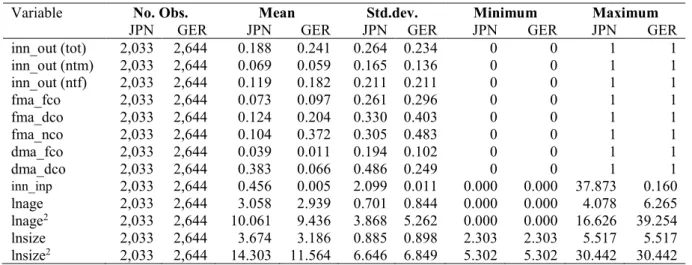
As the dependent variable includes a large share of zero observations, i.e. SMEs that either did not introduce a single new-to-market product innovation, or they did not generate any sales with such innovations in the reference year, we apply Tobit models that explicitly take into account the censored nature of our data. Table 1 and 2 provide a summary of statistics and variable description and their correlation coefficients.
4. Results
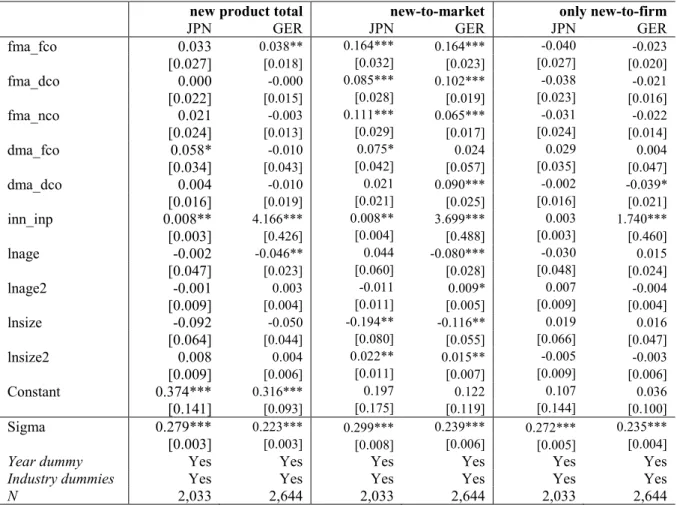
Our Tobit model results are shown on Table 3-5. Table 3 presents our estimation results of the base model (full samples), testing the relationships between the extent of
internationalization activities (i.e. foreign market presence + foreign cooperation, foreign market presence + domestic cooperation, foreign market presence only, foreign cooperation, and domestic cooperation) and product innovation performance. Column 1 shows the results upon how firms’ internationalization activities associate with the total product (new-to-market plus only new-to-firm) innovation performance, while column 2 shows the estimation results of these associations with novel (new-to-market) innovation and column 3 incremental (only new-to-firm) innovation performance. Table 4 presents the results of the split models
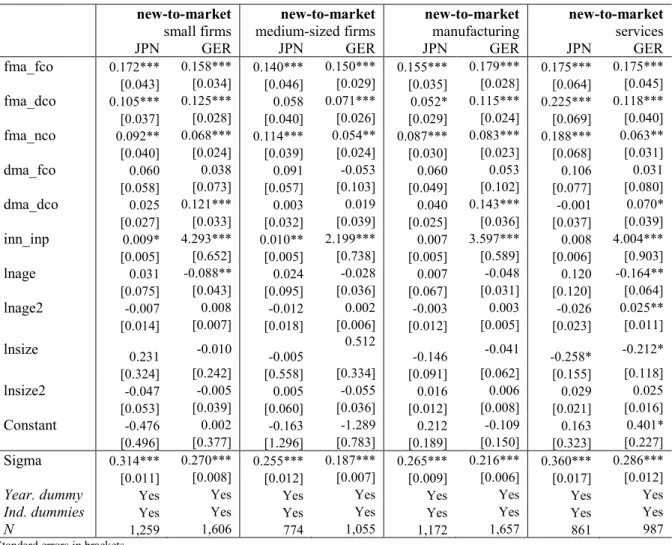
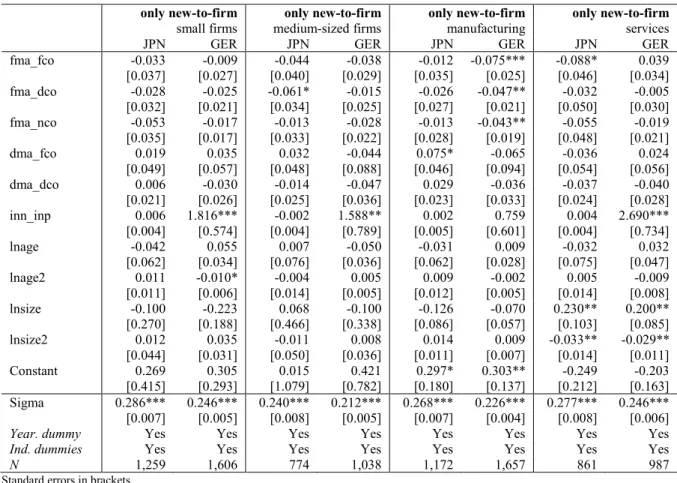
by size and industry for novel (new-to-market) product innovations. Column 1 and 2 report the estimations based on small- and medium-sized firms whereas column 3 and 4 are based on manufacturing and services SMEs. Table 5 shows the results of the split models for incremental (new-to-firm) product innovation. Again, Column 1 and 2 are based on small- and medium-sized firms, column 3 and 4 manufacturing and services SMEs.
4.1 Internationalization strategies and innovation performance in SMEs
We hypothesised (H1) that a combined internationalization strategy (market expansion and firm cooperation) has stronger association with innovation performance than a single
approach does. Our estimations show robust results that this combined strategy increased the share of sales with new-to-market (novel hereafter) products by 16.4 percentage points both in Japan and Germany (across all firms in the sample). In comparison, market
internationalization without foreign cooperation leads to an increase by 11.1 percentage points (Japan) and only 6.5 (Germany). Only foreign cooperation without market
internationalization has a weakly significant effect of 7.5 percentage points in Japan and no effect in German SMEs. We however do not find evidence upon the new-to-firm
(incremental hereafter) product innovations. Therefore, H1 is supported on the account of novel product innovation performance. The estimations upon different types of innovations is presented further below.
We hypothesised that SMEs’ international markets expansion strategy (H2a), international cooperation (H2b), and an integrative strategy of both (H2c) would positively associate with both novel and incremental innovation performance. Our data however provide only partial support. That is, firms’ international market expansion do not appear to be related to their performance in incremental innovation. Instead, our estimations show a robust and consistent association (Japan: 0.111***; Germany: 0.065***) between market internationalization and
novel innovation performance. H2a therefore is supported when considering novel
innovations, but on no account of incremental innovations. Interestingly, we however do not find evidence upon the link between international cooperation and innovation performance, neither on novel nor on incremental ones. H2b thus is rejected.
Here, perhaps a more intriguing finding is the link between a combined internationalization strategy and innovation performance. While our estimations do not suggest international cooperation associates with innovation performance, we find evidence (Japan: 0.164***; Germany: 0.164***) that an integrative strategy positively links with novel (but not with incremental) innovation performance. As such, H2c is supported on the account of novel innovations.
4.2 Conditional factors
In this study, we hypothesised SMEs’ internationalization strategies are positively associated with innovation performance in medium-sized but not in small-sized firms (H3a). We assumed this positive association only to occur in manufacturing but not services SMEs (H3b). In contrast to our expectation, our estimations are somewhat consistent across firm size and industrial sectors. Therefore, H3a and H3b are not supported.
Finally, the role of distance (both geographic and psychic) should not be underestimated when considering small firms’ internationalization endeavours. However, contrary to expectation, the distance barriers do not appear to have clear influence in our study, as our estimations show rather consistent patterns between two distinct institutional environments – Japan and Germany. Therefore, H3c (internationalization strategies are positively associated with the product innovation performance in German SMEs but not in Japanese SMEs) is not supported.
In sum, our estimation results suggest international market expansion strategy and its combined form with international cooperation are positively associated with novel (but not with incremental) innovation performance, whereas we cannot claim international
cooperation alone is too helpful for either type of innovations. Furthermore, despite the extant arguments upon the differences of firm size and industrial sector, the estimation results are rather synchronised with the base-model as summarized above. Finally, these results are rather consistent across German and Japanese SMEs – with one exception, a positive link between domestic cooperation and novel innovations is evidenced in German (but not Japanese) small manufacturers.
5. Discussion and Conclusion
The growing globalization of markets, international competition, and increasingly dispersed knowledge have led many firms to tap into foreign knowledge and stay proximate to key markets, no more so in the area of product innovation. This is likely to be particularly important for smaller innovators who face the limits of their knowledge and capabilities quicker than their larger peers. The emphasis here is engaging in internationalization
activities allows firms to access a larger and more diverse pool of complementary knowledge and related resources that enables smaller innovators to overcome their liability of smallness. Yet, the high involvement of internationalization has its drawbacks such as a lack of control and knowledge leakage. To date, how internationalization of firms relates to their innovation remains imperfectly understood. This gap gives way to this study in searching a better understanding.
Given the strategic importance of internationalization and innovation in firms, our findings carry important implications for managers of SMEs, complementing previous literature. First, we consider an important contribution of this study is the integrative
internationalization strategy. As mentioned earlier, previous studies provide an important impetus for further research upon the practicability of an external coalition strategy, yet, none of them has precisely focused on performance implications. The emphasis of our study is on the potential of a ‘combined’ strategy and its likelihood to unlock the highest innovative capacity of firms. Clearly, in open economies, cooperative alliances for innovation
development is very likely to be inevitable yet it can be a risky business, with management and control costs on one hand and the trust and opportunistic issues on the other. To this end, we support Hessels and Parker (2013) who believe SME managers’ engagement in
international markets could help to search for economical ways to minimize market and technology uncertainties from cooperative activities. We believe a combined
internationalization approach provides SME managers a key to harvest better innovation results. So much as, we urge SME managers and policy makers may wish to pay greater attention to an integrative strategy in their internationalization policies. For SMEs,
combining the business presence in the international market together with active cooperation with the foreign partners could be a way to build trust and strengthen commitments, so that better sharing and learning for more advanced innovations. Here, policy makers and governments could encourage internationalized innovators to develop and strengthen cooperative coalitions with foreign business partners.
Perhaps the most intriguing finding of our study is that internationalization relates to novel, but not to incremental, innovations in SMEs. While most previous learning theories and resource-based view studies conclude a positive effect of internationalization on innovations, our data indicates that it is not that straightforward. In our study, there is simply no evidence that this is the case on the grounds of incremental innovations. Instead, the link is likely to run from internationalization to novel innovations in SMEs. Several important implications are noteworthy. First, this may reflect the notion that novel innovation requires more diverse
and new knowledge whereas incremental innovation tends to be path dependent and homogenous as suggested by Prange and Verdier (2011) and Greve (2007). In this sense, firms’ internationalization strategy opens a door for more novel and diverse knowledge that firms can not pursue otherwise. Another important underlying implication relates to the exploration-exploitation paradigm. While the value of organizational ambidexterity ought not to be underrated, our findings lead us to assume that it can be difficult, at lease for smaller firms, to reconcile exploration and exploitation simultaneously in an internationalization context. So much as, to overcome the liability of smallness, SMEs may consider a trade-off (rather than an ambidextrous) strategy, focusing on building exploratory capabilities through internationalization activities for more novel innovation success.
An important contribution of this cross-country empirical study rests in its investigation into two institutional environments with contrasting physical and psychic distances. As discussed earlier, theory suggests (in our case, is resource-based view), in order to acquire and maintain critical resources and know-how, the institutional environment plays a central role in the process in which firms are required to effectively manage distance barriers and power differentials with partners. Strikingly, our findings from two different institutional
environments are robustly consistent, despite a couple of sporadic discrepancies. This may reflect a number of important factors embedded in the global business environment. For instance, the advancement of technology and the prevalence of globalization reduces the barriers from physical and psychic distances. For smaller innovators, this can be an
opportunity as well as a threat – for it can be easier for them to engage in internationalization on one hand, yet it makes harder to compete a larger pool of innovators from all sorts of institutional environments on the other.
Furthermore, Dickson et al. (2006:509) have suggested that SME size is a critical factor in the relationship between institutional environment, constraints and behaviour of firms. For our SMEs, this does not seem to be the case as our results do not suggest appealing
differences between small- and medium-sized firms. Equally (if not more) importantly, the consistent results between services and manufacturing sectors in our study bring in another important message. In the extant literature, innovation research insofar have been explored largely in the manufacturing context (e.g. Rosenkopf and Nerkar, 2001; Katila and Ahuja, 2002; Laursen and Salter, 2006; Leiponen and Helfat, 2010). More than 65 per cent of GDP in industrialized economies is now produced in the service sector, however (World Bank 2016). More notably, the boundaries between services and manufacturing are getting blurred (Christensen and Drejer, 2007). Much innovation in the manufacturing sector actually involves service activities, and many physical goods are starting to be offered as services. In light of the economic importance of the service sector, we believe a much greater attention on innovation in services is deemed appropriate. Finally, an unexpected finding is the
significant link between domestic cooperation and novel innovations in German small manufacturers. This result seems to enhance our previous standing that a ‘friendly’ physical and psychic distance (Delerue and Lejeune, 2011; Murray et al., 2011) entices some German small manufacturers to fully engage in domestic cooperation without worrying about extra cost and risk occurred in the internalization process.
In closing, we recognise limitations to our work. In the first instance, one may notice that we have focused on the circular relationship, consciously avoiding strong causal statements. One may plausibly argue that our models contain a potential endogeneity, that is, past innovation performance impact on internationalization strategy. We recognise that this is likely to be the case. However, we believe that any relationship between internationalization and innovation is likely to be circular rather than linear. In this way, while it is attractive, having access to
panel data is unlikely to be conclusive. In addition, it can be a controversial decision to choose Japan and Germany in our study. Two distinctive institutional environment advances the understanding in the areas of internationalization and innovation. Yet, the fact that both are top performers in globalization and innovative activities may limit our observations. To broaden our understanding, a further study with more diversified samples, for example, developed vs. developing economies could deepen our understanding. Finally, data considerations have constrained us to group SMEs only between small vs. medium, and services vs. manufacturing. A more fine-grade differentiation would be beneficial,
particularly with respect to different service markets, and for the group of very small firms (micro firms) as they may be particularly exposed to increasing globalization of markets and increasingly challenging product innovation.
References
Alcacer, J., & Oxley, J. (2014). Learning by supplying. Strategic Management Journal, 35(2), 204–223.
Autio, E., Yli-Renko, H., & Salonen, A. (1997). International growth of young technology-based firms: A resource-technology-based network model. Journal of Enterprising Culture, 5(1), 57–73.
Baker, W. E., Grinstein, A., & Harmancioglu, N. (2016). Whose innovation performance benefits more from external networks: entrepreneurial or conservative firms? Journal of Product Innovation Management, 33(1), 104–120.
Barge-Gil, A. (2010). Open, semi-open and closed innovators: towards an explanation of degree of openness. Industry and Innovation, 17(6), 577–607.
Baumann, J., & Kritikos, A. S. (2016). The link between R&D, innovation and productivity: Are micro firms different? Research Policy, 45(6), 1263–1274.
Bell, G. G. (2005). Clusters, network and firm innovativeness. Strategic Management Journal, 26(3), 287–295.
Bellone, F., Musso, P., & Nesta, L. (2010). Financial constraints and firm export behaviour. The World Economy, 33(3), 347–373.
Cassiman, B., & Golovko, E. (2011). Innovation and internationalization through exports. Journal of International Business Studies, 42(1), 56–75.
Cavusgil, S. T., & Knight, G. (2015). The born global firm: An entrepreneurial and
capabilities perspective on early and rapid internationalization. Journal of International Business Studies, 46(1), 3–16.
Cheng, J. L., & Bolon, D. S. (1993). The management of multinational R&D: a neglected topic in international business research. Journal of International Business
Studies, 24(1), 1–18.
Christensen, J. L., & Drejer, I. (2007). Blurring Boundaries between Manufacturing and Services. Aalborg University, Aalborg.
Crépon, B., Duguet, E., & Mairesse, J. (1998). Research, innovation and productivity: An econometric analysis at the firm level. Economics of Innovation and New Technology, 7(2), 115–158.
Czarnitzki, D., & Lopes-Bento, C. (2015). Innovation subsidies: Does the funding source matter for innovation intensity and performance? Empirical evidence from Germany. Industry and Innovation, 21(5), 380–409.
Delerue, H., & Lejeune, A. (2011). Managerial secrecy and intellectual asset protection in SMEs: The role of institutional environment. Journal of International Management, 17(2), 130–142.
Dickson, P. H., Weaver, K. M., & Hoy, F. (2006). Opportunism in the R&D alliances of SMES: The roles of the institutional environment and SME size. Journal of Business Venturing, 21(4), 487–513.
Eriksson, K., Johanson, J., Majkgård, A., & Sharma, D. D. (2015). Experiential knowledge and cost in the internationalization process. In Forsgren, M., Holm, U., & Johanson, J. (eds). Knowledge, Networks and Power, 41–63. Palgrave Macmillan, London. Gassmann, O., & Keupp, M. (2007). The competitive advantage of early and rapidly
internationalising SMEs in the biotechnology industry: A knowledge-based view. Journal of World Business, 42(3), 350–366
Golovko, E., & Valentini, G. (2011). Exploring the complementarity between innovation and export for SMEs’ growth. Journal of International Business Studies, 42(3), 362–380. Greve, H. R. (2007). Exploration and exploitation in product innovation. Industrial and
Corporate Change, 16(5), 945–975.
Hagedoorn, J. (1993). Understanding the rationale of strategic technology partnering: Interorganizational modes of cooperation and sectoral differences. Strategic Management Journal, 14(5), 371–385.
Hessels, J., & Parker, S. C. (2013). Constraints, internationalization and growth: A cross-country analysis of European SMEs. Journal of World Business, 48(1), 137–148. Hitt, M. A., Hoskisson, R. E., & Kim, H. (1997). International diversification: Effects on
innovation and firm performance in product-diversified firms. Academy of Management Journal, 40(4), 767–798.
Jansen, J. J., Van den Bosch, F. A., & Volberda, H. W. (2005). Exploratory innovation, exploitative innovation, and ambidexterity: The impact of environmental and organizational antecedents. Schmalenbach Business Review, 57(4), 351–363.
Johanson, J., & Vahlne, J. E. (2009). The Uppsala internationalization process model revisited: From liability of foreignness to liability of outsidership. Journal of International Business Studies, 40(9), 1411–1431.
Johnson Jr, J. H., Arya, B., & Mirchandani, D. A. (2013). Global integration strategies of small and medium multinationals: Evidence from Taiwan. Journal of World
Business, 48(1), 47–57.
Johnson, S., Webber, D. J., & Thomas, W. (2007). Which SMEs use external business advice? A multivariate subregional study. Environment and Planning A, 39(8), 1981– 1997.
Jonsson, A. (2008). A transnational perspective on knowledge sharing: Lessons learned from IKEA's entry into Russia, China and Japan. The International Review of Retail,
Distribution and Consumer Research, 18(1), 17–44.
Jonsson, A., & Foss, N. J. (2011). International expansion through flexible replication: Learning from the internationalization experience of IKEA. Journal of International Business Studies, 42(9), 1079–1102.
Kafouros, M. I., Buckley, P. J., Sharp, J. A., & Wang, C. (2008). The role of
internationalization in explaining innovation performance. Technovation, 28(1-2), 63– 74.
Katila, R., & Ahuja, G. (2002). Something old, something new: A longitudinal study of search behavior and new product introduction. Academy of Management Journal, 45(6), 1183–1194.
Klingebiel, R., & Rammer, C. (2014). Resource allocation strategy for innovation portfolio management. Strategic Management Journal, 35(2), 246–268.
Knudsen, T., & Madsen, T. K. (2002). Export strategy: A dynamic capabilities perspective. Scandinavian Journal of Management, 18(4), 475–502.
Kobrin, S. J. (1991). An empirical analysis of the determinants of global integration. Strategic Management Journal, 12(S1), 17–31.
Kotabe, M. (1990). The relationship between offshore sourcing and innovativeness of US multinational firms: An empirical investigation. Journal of International Business Studies, 21(4), 623–638.
Kriz, A., & Welch, C. (2018). Innovation and internationalization processes of firms with new-to-the-world technologies. Journal of International Business Studies, 49(4), 496– 522.
Laforet, S. (2013). Organizational innovation outcomes in SMEs: Effects of age, size, and sector. Journal of World Business, 48(4), 490–502.
Laursen, K., & Salter, A. (2006). Open for innovation: The role of openness in explaining innovation performance among UK manufacturing firms. Strategic Management Journal, 27(2), 131–150.
Leiponen, A. (2012). The benefits of R&D and breadth in innovation strategies: A comparison of Finnish service and manufacturing firms. Industrial and Corporate Change, 21(5), 1255–1281.
Leiponen, A., & Helfat, C. (2010). Innovation objectives, knowledge sources, and the benefits of breadth. Strategic Management Journal, 31(2), 224–236.
Lhuillery, S., & Pfister, E. (2009). R&D cooperation and failures in innovation projects: Empirical evidence from French CIS data. Research Policy, 38(1), 45–57.
Love, J. H., & Roper, S. (2015). SME innovation, exporting and growth: A review of existing evidence. International Small Business Journal, 33(1), 28–48.
Lu, J. W., & Beamish, P. W. (2001). The internationalization and performance of SMEs. Strategic Management Journal, 22(6-7), 565–586.
Manolova, T. S., & Yan, A. (2002). Institutional constraints and entrepreneurial responses in a transforming economy: The case of Bulgaria. International Small Business Journal, 20(2), 163–184.
March, J. G. (1991). Exploration and exploitation in organizational learning. Organization Science, 2(1), 71–87.
Martín-Tapia, I., Aragón-Correa, J. A., & Rueda-Manzanares, A. (2010). Environmental strategy and exports in medium, small and micro-enterprises. Journal of World Business, 45(3), 266–275.
McAdam, M., McAdam, R., Dunn, A., & McCall, C. (2014). Development of small and medium-sized enterprise horizontal innovation networks: UK agri-food sector study. International Small Business Journal, 32(7), 830–853.
Miles, I. (2007). Research and development (R&D) beyond manufacturing: The strange case of services R&D. R&D Management, 37(3), 249–268.
Mudambi, R., & Zahra, S. A. (2007). The survival of international new ventures. Journal of International Business Studies, 38(2), 333–352.
Murray, J. Y., Gao, G. Y., & Kotabe, M. (2011). Market orientation and performance of export ventures: The process through marketing capabilities and competitive advantages. Journal of the Academy of Marketing Science, 39(2), 252–269.
O’Cass, A., & Weerawardena, J. (2009). Examining the role of international entrepreneurship, innovation and international market performance in SME internationalization. European Journal of Marketing, 43(11-12), 1325–1348.
O’Reilly III, C. A., & Tushman, M. L. (2013). Organizational ambidexterity: Past, present, and future. Academy of Management Perspectives, 27(4), 324–338.
OECD, & Eurostat (2005). Oslo Manual. Guidelines for Collecting and Interpreting Innovation Data, 3rd Edition. OECD Publishing, Paris.
Oxley, J. E. (1999). Institutional environment and the mechanisms of governance: The impact of intellectual property protection on the structure of inter-firm alliances. Journal of Economic Behavior & Organization, 38(3), 283–309.
Palmié, M., Zeschky, M., Winterhalter, S., Sauter, P. W., Haefner, N., & Gassmann, O. (2016). Coordination mechanisms for international innovation in SMEs: Effects on time-to-market and R&D task complexity as a moderator. Small Business
Economics, 46(2), 273–294.
Park, S. H., Chen, R. R., & Gallagher, S. (2002). Firm resources as moderators of the
relationship between market growth and strategic alliances in semiconductor start-ups. Academy of Management Journal, 45(3), 527–545.
Prange, C., & Pinho, J. C. (2017). How personal and organizational drivers impact on SME international performance: The mediating role of organizational innovation.
International Business Review, 26(6), 1114–1123.
Prange, C., & Verdier, S. (2011). Dynamic capabilities, internationalization processes and performance. Journal of World Business, 46(1), 126–133.
Raisch, S., & Birkinshaw, J. (2008). Organizational ambidexterity: Antecedents, outcomes, and moderators. Journal of Management, 34(3), 375–409.
Rosenkopf, L., & Nerkar, A. (2001). Beyond local search: Boundary-spanning, exploration, and impact in the optical disk industry. Strategic Management Journal, 22(4), 287–306. Sanna-Randaccio, F., & Veugelers, R. (2007). Multinational knowledge spillovers with
decentralised R&D: A game-theoretic approach. Journal of International Business Studies, 38(1), 47–63.
Sousa, C. M. P. & Bradley, F. (2006) Cultural distance and psychic distance: Two peas in a pod? Journal of International Marketing, 14(1), 49-70.
Sui, S., & Baum, M. (2014). Internationalization strategy, firm resources and the survival of SMEs in the export market. Journal of International Business Studies, 45(7), 821–841. Tether, B. S., & Tajar, A. (2008). Beyond industry–university links: Sourcing knowledge for innovation from consultants, private research organisations and the public science-base. Research Policy, 37(6-7), 1079–1095.
Tu, C., Hwang, S.-N., & Wong, J.-Y. (2014). How does cooperation affect innovation in micro-enterprises? Management Decision, 52(8), 1390–1409.
Tushman, M. L., & O'Reilly, III, C. A. (1996). Ambidextrous organizations: Managing evolutionary and revolutionary change. California Management Review, 38(4), 8–29. van Beers, C., & Zand, F. (2014). R&D cooperation, partner diversity, and innovation
performance: An empirical analysis. Journal of Product Innovation Management, 31(2), 292–312.
Vasilchenko, E., & Morrish, S. (2011). The role of entrepreneurial networks in the
exploration and exploitation of internationalization opportunities by information and communication technology firms. Journal of International Marketing, 19(4), 88–105. Wakelin, K. (1998). Innovation and export behaviour at the firm level. Research Policy,
26(7-8), 829–841.
Westhead, P., Wright, M., & Ucbasaran, D. (2001). The internationalization of new and small firms: A resource-based view. Journal of Business Venturing, 16(4), 333–358.
Whittaker, D. H., Fath, B. P., & Fiedler, A. (2016). Assembling capabilities for innovation: Evidence from New Zealand SMEs. International Small Business Journal, 34(1), 123– 143.
World Bank (2016). The World Bank National Accounts Data, Washington, USA. Zou, S., & Tamer Cavusgil, S. (1996). Global strategy: A review and an integrated
Table 1: Descriptive statistics of model variables
Variable No. Obs. Mean Std.dev. Minimum Maximum JPN GER JPN GER JPN GER JPN GER JPN GER inn_out (tot) 2,033 2,644 0.188 0.241 0.264 0.234 0 0 1 1 inn_out (ntm) 2,033 2,644 0.069 0.059 0.165 0.136 0 0 1 1 inn_out (ntf) 2,033 2,644 0.119 0.182 0.211 0.211 0 0 1 1 fma_fco 2,033 2,644 0.073 0.097 0.261 0.296 0 0 1 1 fma_dco 2,033 2,644 0.124 0.204 0.330 0.403 0 0 1 1 fma_nco 2,033 2,644 0.104 0.372 0.305 0.483 0 0 1 1 dma_fco 2,033 2,644 0.039 0.011 0.194 0.102 0 0 1 1 dma_dco 2,033 2,644 0.383 0.066 0.486 0.249 0 0 1 1 inn_inp 2,033 2,644 0.456 0.005 2.099 0.011 0.000 0.000 37.873 0.160 lnage 2,033 2,644 3.058 2.939 0.701 0.844 0.000 0.000 4.078 6.265 lnage2 2,033 2,644 10.061 9.436 3.868 5.262 0.000 0.000 16.626 39.254 lnsize 2,033 2,644 3.674 3.186 0.885 0.898 2.303 2.303 5.517 5.517 lnsize2 2,033 2,644 14.303 11.564 6.646 6.849 5.302 5.302 30.442 30.442
Table 2: Correlation coefficients of model variables
a. Japan
inn_out
(tot) inn_out (ntm) inn_out (ntf) fma_fco fma_dco fma_nco dma_fco dma_dco inn_inp lnage lnage2 lnsize lnsize2 inn_out (tot) 1.000 inn_out (ntm) 0.601 1.000 inn_out (ntf) 0.780 -0.032 1.000 fma_fco 0.031 0.085 -0.028 1.000 fma_dco -0.013 0.014 -0.027 -0.106 1.000 fma_nco 0.015 0.046 -0.018 -0.096 -0.128 1.000 dma_fco 0.033 0.022 0.024 -0.057 -0.076 -0.069 1.000 dma_dco -0.010 -0.038 0.017 -0.222 -0.297 -0.268 -0.160 1.000 inn_inp 0.068 0.076 0.026 0.124 0.023 0.058 0.013 -0.072 1.000 lnage -0.025 -0.049 0.008 -0.025 0.042 0.019 -0.034 0.048 -0.057 1.000 lnage2 -0.021 -0.051 0.013 -0.024 0.045 0.031 -0.035 0.050 -0.060 0.981 1.000 lnsize -0.115 -0.091 -0.072 0.033 0.076 0.057 0.027 -0.069 -0.018 0.129 0.127 1.000 lnsize2 -0.111 -0.085 -0.072 0.034 0.080 0.059 0.031 -0.071 -0.012 0.126 0.125 0.994 1.000 b. Germany inn_out
(tot) inn_out (ntm) inn_out (ntf) fma_fco fma_dco fma_nco dma_fco dma_dco inn_inp lnage lnage2 lnsize lnsize2 inn_out (tot) 1.000 inn_out (ntm) 0.452 1.000 inn_out (ntf) 0.817 -0.146 1.000 fma_fco 0.096 0.125 0.026 1.000 fma_dco 0.049 0.049 0.022 -0.166 1.000 fma_nco -0.037 -0.023 -0.026 -0.252 -0.389 1.000 dma_fco -0.003 -0.026 0.014 -0.034 -0.052 -0.080 1.000 dma_dco -0.003 0.020 -0.016 -0.087 -0.135 -0.205 -0.028 1.000 inn_inp 0.247 0.236 0.121 0.215 0.175 -0.096 0.015 -0.010 1.000 lnage -0.156 -0.141 -0.081 -0.058 -0.008 0.085 -0.020 -0.027 -0.119 1.000 lnage2 -0.157 -0.129 -0.091 -0.066 -0.019 0.102 -0.027 -0.028 -0.128 0.973 1.000 lnsize -0.093 -0.071 -0.058 0.069 0.071 0.086 -0.021 -0.074 -0.054 0.223 0.231 1.000 lnsize2 -0.091 -0.066 -0.058 0.069 0.069 0.084 -0.022 -0.073 -0.054 0.220 0.229 0.994 1.000