Introduction
Smallmouth bass(Micropterus dolomieu)are freshwater fish native to North America that were introduced to Japanese lakes in the mid-1990s and have been successfully reproducing since then(IGUCHIet al., 2001).The introduction
of this competitive species likely has serious con-sequences for native species(IGUCHIet al., 2004).
Bio-logging tools have proven useful for behav-ioral ecology research, specifically to assess be-havior in marine mammals, seabirds, and other free-living species that are difficult to study (KATOet al., 1996; SUZUKIet al., 2009; NAITOet al.,
2010). Micro-accelerometer tags are efficient tools to remotely quantify rates of behaviors such as resting, swimming, or migrating, and can Société franco-japonaise dʼocéanographie, Tokyo
Measuring burst movements of smallmouth bass
(Micropterus dolomieu)in Lake Kizaki, Japan, using
micro-acceleration data loggers
Hideaki TANOUE1)*, Takayuki AOYAMA2), Teruhisa KOMATSU3),
Sandrine RUITTON4), Sebastián Biton PORSMOGUER4), Fanny NOISETTE4), Masahiko MOHRI1),
Ippei SUZUKI2)and Nobuyuki MIYAZAKI2)
Abstract: This study used micro-acceleration data loggers to measure burst movements, such as feeding behavior, of smallmouth bass(Micropterus dolomieu).Data loggers were attached to the dorsal side of seven bass released into Lake Kizaki, Japan, during summer 2007Ȃ2008. From 220.7 total hours of data, the burst movement rate was 0.7 ± 0.3 events/hour(mean ± s.d.)(range: 0.4Ȃ1.1 events/hour).All bass showed burst movements during both daytime and nighttime, but four fish had higher event rates during the day. For two individuals, the mean event depth was significantly deeper during the daytime than the nighttime.
Keywords : invasions, fish behavior, bio-logging, micro-acceleration data logger
1)National Fisheries University, Japan Fisheries Re-search and Education Agency, Shimonoseki 759Ȃ 6595, Japan;
2)Atmosphere and Ocean Research Institute, The University of Tokyo, 5Ȃ1Ȃ5, Kashiwanoha, Kashi-wa, Chiba 277Ȃ8564, Japan;
3)Department of Commercial Science, Faculty of Commerce, Yokohama College of Commerce, 4Ȃ 11Ȃ1, Higasi Terao Tsurumi-ku, Yokohama,
Kana-gawa 277Ȃ8564, Japan;
4)Aix-Marseille University, Mediterranean Institute of Oceanography(MIO),CNRS/INSU, IRD, UM 110, Campus universitaire de Luminy, case 901, 13288 Marseille cedex 09, France;
*Corresponding author: Tel: + 81Ȃ83Ȃ227Ȃ3886 Fax: + 81Ȃ83Ȃ286Ȃ7432 E-mail: [email protected]
1)Institute of Marine Science, Burapha University, Bangsaen, Chon Buri 20131, Thailand
2)Department of Aquatic Science, Faculty of Sci-ence, Burapha University, Bangsaen, Chon Buri 20131, Thailand
3)Atmosphere and Ocean Research Institute, The
University of Tokyo, 5Ȃ1Ȃ5, Kashiwanoha, Kashi-wa, Chiba 277Ȃ8564, Japan
*Corresponding author: Thidarat Noiraksar Tel: + 66(0)38 391671
Fax: + 66(0)38 391674
be used to estimate activity and energy budgets (FØREet al., 2011; ALABSIet al., 2011; BROELLet al.,
2013).These devices allow the measurement of swimming intensity and active events(AOKI et
al., 2012), which can be used to estimate the quantity of food eaten(TANOUEet al., 2012)and
indicate the ecology of fish species.
This study explored the activity of small-mouth bass and investigated the potential of bio-logging devices for acquiring data on their burst movements such as feeding behavior. We also collected data on spatiotemporal swimming be-havior of smallmouth bass to extrapolate their potential threats to native fish populations in Lake Kizaki.
Materials and methods
Smallmouth bass were caught by lure fishing from Lake Kizaki (36°32Ȃ34ʼN, 137°49Ȃ50ʼE, shoreline length: 7 km, surface area: 1.4 km2,
vol-ume: 0. 02 km3, height: 764 m, maximum water
depth: 29. 5 m, transparency: 4 m,)in Nagano Prefecture, Japan, during the summers of 2007Ȃ 2008. In May, nests of smallmouth bass were vis-ually located. Individuals with IDs A-I were caught in in 2007, and IDs J-X were caught in 2008.
They were housed in a fish cage(3 × 3 × 1 m) in the lake to identify burst movements
includ-ing feedinclud-ing events via direct visual observation and video camera put from the cage side. Indi-viduals(n = 7)were tagged with a micro-accel-eration data logger M190ȂD2GT(Little Leonar-do Co., Tokyo, Japan)to measure burst move-ments and other variables. Less than 24 h after the logger was tagged, three or five live loach (Misgurnus spp.), goldfish(Carassius auratus),
and Japanese smelt(Hypomesus nipponensis) were introduced to the cage to allow the tagged fish to feed ad libitum. After the caged experi-ments, the tagged fish(n = 2 in 2007, n = 5 in 2008)were released into Lake Kizaki(Table 1).
The data loggers(53 mm × 15 mm, 6 g in water)measured depth and temperature in 1 s intervals, and both static and dynamic accelera-tion along the lateral ‘swayʼ and longitudinal ‘surgeʼ axes at 32 Hz. A soft nylon mesh(6 × 4 cm)was sewed onto the dorsal side of each fish using biodegradable thread made of polyglycolic acid(Matsuda Medical Technology Co., Tokyo, Japan).The data logger was wrapped in copoly-mer foam to keep it slight positive buoyancy in the water(KOMATSU et al., 2011), and was
at-tached to the nylon mesh with plastic bands. Da-ta loggers had an automatic scheduled release system included VHF radio transmitter to de-tach from the nylon mesh and float to the sur-face(WATANABE et al., 2008), where they were
Table 1. Logger data of burst movements of smallmouth bass in Lake Kizaki. Data were collected from 130.3 nighttime and 90.4 daytime hours.
ID Capturedate (cm)TL (g)BW (℃)Water temp. Daytime Nighttime Total
N RT(h) Rate N RT(h) Rate N RT(h) Rate F 2007/5/20 34.1 640 14.3 ± 0.1 14 13.7 1.0 5 9.7 0.5 19 23.4 0.8 I 2007/8/10 42.1 Ȃ 26.3 ± 0.3 18 27.5 0.7 12 20.2 0.6 30 47.7 0.6 Q 2008/6/12 40.4 Ȃ 18.8 ± 0.2 12 14.5 0.8 5 9.2 0.5 17 23.6 0.7 R 2008/6/12 40.3 1080 19.0 ± 0.1 5 14.3 0.4 4 9.2 0.4 9 23.5 0.4 S 2008/6/16 38.2 Ȃ 20.2 ± 0.5 6 14.6 0.4 5 9.2 0.6 11 23.7 0.5 U 2008/8/13 38.3 Ȃ 26.5 ± 0.2 15 26.5 0.6 13 20.5 0.6 28 47.0 0.6 X 2008/8/24 40.1 Ȃ 25.0 ± 0.3 23 19.2 1.2 13 12.4 1.1 36 31.6 1.1 Mean ± s.d. 39.1 ± 2.6 Ȃ 21.4 ± 0.2 13.3 ± 6.4 18.6 ± 6.0 0.7 ± 0.3 8.1 ± 4.3 12.9 ± 5.2 0.6 ± 0.2 21.4 ± 10.2 31.5 ± 11.2 0.7 ± 0.3 TL: total length, BW: body weight, N: number of burst movements, RT: record time, Rate: burst movement rate per hour, -: no data
retrieved by the signal. One of the loggers tag-ged to nesting individuals(F)was detached in the same nest where the fish was caught.
Data were downloaded from the data loggers and analyzed using Igor Pro(v.6.0 J, WaveMe-tricks, Lake Oswego, OR, USA)and Igor Filter-ing Design Laboratory(IFDL: v. 4, WaveMet-rics). Ethographer v. 1. 2 was used to detect specific waveforms among the large dataset of acceleration records(SAKAMOTO et al., 2009).
Power spectral densities(PSD)were calculated from swaying acceleration records from loggers to determine the dominant stroke cycle frequen-cy using fast Fourier transformation. Tail beats were derived by high-pass filtering the swaying acceleration(TANAKAet al., 2001).The body
an-gle was extracted by low-pass filtering the surge acceleration. To remove higher frequency accel-eration caused by tail beats, a low-pass filter was applied, with the threshold being the predomi-nant frequency of tail beats to surging accelera-tion.
Results
Caged experiments
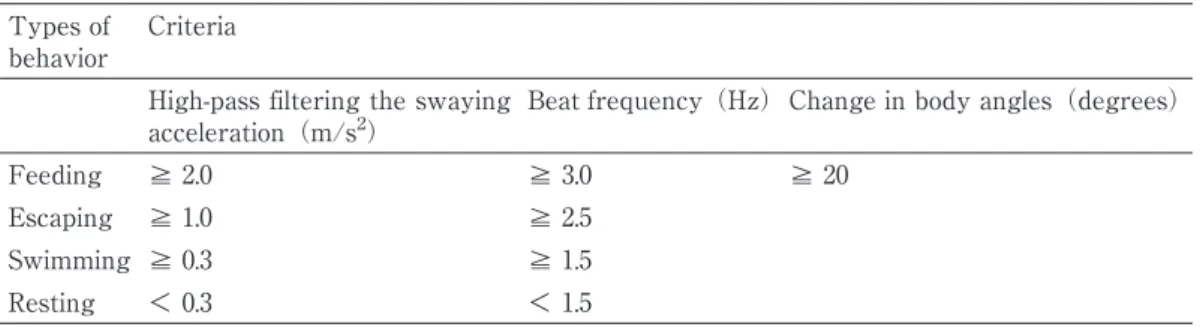
There were no observed differences in behav-ior between tagged and untagged fish in the cage 1 h after tagging. During the daytime, fish alternated between slow and rapid(burst) swimming events that characterize chase and predation behaviors. During feeding events, 95
% of high-pass filtering the swaying accelera-tions were more than 2 m/s2, beat frequencies
were more than 3 Hz, and changes in body an-gles were more than 20 degrees based on the ac-celeration waveforms measured using the logger (Table 2).As such, burst movements were de-fined as high-pass filtering the swaying accelera-tion ≧ 2 m/s2, beat frequency ≧ 3 Hz, and
changes in body angle ≧ 20 degrees in this study.
Field experiments
All loggers fitted to free-swimming fish were retrieved, and 220. 7 data hours were collected (Table 1).The bass were more active in August (0.8 ± 0.3 burst movements per hour(mean ± s.d.))than in June(0.5 ± 0.2).On average, burst movements occurred 0.7 ± 0.3 times per hour (range: 0.4Ȃ1.1; Table 1).All fish appeared to ex-hibit burst movements during both daytime and nighttime. The fish often swam before and after burst movements during the day but were inac-tive at night(Fig. 1).Four individuals(F, I, Q and X)showed a significantly higher rate of burst movements during the day than at night (Table 1). Two individuals(F and X)showed burst movements at a mean depth that was sig-nificantly deeper during the day than at night(t-test, p < 0.01).There were no significant differ-ences among other individuals(Fig. 2).
Table 2. Activity patterns obtained by the data logger of smallmouth bass in a fish cage Types of
behavior Criteria
High-pass filtering the swaying
acceleration(m/s2) Beat frequency(Hz) Change in body angles(degrees)
Feeding ≧ 2.0 ≧ 3.0 ≧ 20
Escaping ≧ 1.0 ≧ 2.5
Swimming ≧ 0.3 ≧ 1.5
Discussion
Micro-acceleration data loggers enabled us to monitor the swimming behavior and activity pat-terns of introduced smallmouth bass in Lake Ki-zaki. Smallmouth bass are generally diurnal, of-ten inactive at night except during spawning season(EMERYet al., 1973).The fish in our study
were also more active during the day while in cages and free swimming(Fig. 1).
Smallmouth bass begin spawning once water temperatures exceed 14°C(RIDGWAYet al., 1991).
According to AZUMA and MOTOMURA(1998)a
spawning fish is greater than 20 cm in length, which may be reached 1Ȃ2 years after hatching. In May, we caught nesting individual(F)that was more than 20 cm in length. After being tag-ged and released, the individual returned to the nest and displayed burst movements at 14.3 ± 0.1°C. These bursts may be indicative of defense
behavior, as smallmouth bass defend their eggs both during the day and at night(SCOTT and
NICHOLAS, 1991).
Introduced smallmouth bass can alter the hab-itat and reduce the abundance of many small-bodied species in freshwater environments (MACRAE et al., 2001; JACKSON., 2002).Our study
reveals the significant role that data-logging de-vices can play in researching fish behavior. Based on the behavior recorded in this study, we hypothesize that smallmouth bass display oppor-tunistic and aggressive behaviors, and may act as competitors to other predators and stressors to small fish populations in Lake Kizaki. Future research should utilize micro-acceleration data loggers to study prey items and their capture, coupled with examinations of stomach contents. Fig. 1 Comparison of one fishʼs(ID: U)burst movements associated with swimming and resting
Acknowledgments
We would like to thank Ms. H. Arakawa, Mr. T. Arakawa, Dr. K. Aoki, Dr. M. Kikuchi, Mr. T. Tsujino, and Mr. A. Kaneko for their assistance in preparing the data loggers and data analyses. We also thank Dr. S. Watanabe, Dr. Y. Watanabe, and Mr. M. Suzuki for their technical support, and Dr. K. Sakamoto for providing the computer program of microlibrary for the ethographer. This work was funded by Bio-logging Science of The University of Tokyo(UTBLS).
References
ALABSI, N. M., H .TANOUE, T. KOMATSU, A. CHAREF, I.
MITANI, M. KATO, T. HORII, I. AOKI and N.
MIYAZAKI(2011): Measurement of the
swim-ming behavior of a deep-water fish, the splendid alfonsino(Beryx splendens), in captivity using micro data loggers. J Fish Aquat Sci, 6, 309Ȃ321. AOKI, K., M. AMANO, K. MORI, A. KOUROGI, T. KUBODERA
and N. MIYAZAKI(2012):Active hunting by
deep-diving sperm whales: 3D dive profiles and ma-neuvers during bursts of speed. Mar Ecol Prog Ser, 444, 289Ȃ301.
AZUMA, M. and Y. MOTOMURA(1998):Feeding habits
of largemouth bass in an non-native environ-ment: The case of small lake with bluegill in ja-pan. J Fish Biol, 52, 379Ȃ389.
BROELL, F., T. NODA, S. WRIGHT, P. DOMENICI, J. F.
STEFFENSEN, J. P. AUCLAIR and C. T. TAGGART
(2013):Accelerometer tags: Detecting and iden-tifying activities in fish and the effect of sam-pling frequency. J Exp Biol, 216, 1255Ȃ1264. EMERY, A. R.(1973):Preliminary comparisons of day
and night habits of freshwater fish in Ontario lakes. J Fish Res, 30, 761Ȃ774.
FØRE, M., J. A. ALFREDSEN and A. GRONNINGSATER
(2011): Development of two telemetry-based systems for monitoring the feeding behaviour of Atlantic salmon(Salmo salar L.)in aquaculture sea-cages. Comput Electron Agric, 76, 240Ȃ251. IGUCHI, K., T. YODOand N. MATSUBARA
(2001):Spawn-ing habit of introduced smallmouth bass, Micro-pterus dolomieu. Suisanzosyoku 49, 157Ȃ160(in Japanese with English abstract).
IGUCHI, K., K. MATSUURA, K. M. MCNYSET, A. T.
PETERSON, R. SCACHETTI-PEREIRA, K. A. POWERSand
T. YODO(2004): Predicting invasions of North
American basses in Japan using native range Fig. 2 Comparison of burst movement depth between daytime and nighttime in Lake Kizaki. Circles
in-dicate mean. Error bars inin-dicate standard deviation. Asterisks inin-dicate significative difference be-tween day and night(t-test results, p < 0.01).
data and a genetic algorithm. Trans Am Fish Soc, 133, 845Ȃ854.
JACKSON, DA.(2002): Ecological effects of
Micropte-rus introductions: The dark side of black bass. In: Ecology, Conservation, and Management Black Bass. PHILLIP DP et al.(eds.), American
Fisheries Society, Bethesda, USA, p. 221Ȃ232. KATO, A., Y. NAITO, Y. WATANUKI and P. D.
SHAUGHNESSY(1996): Diving pattern and
stom-ach temperatures of foraging king cormorants at Subantarctic Macquarrie Island. Condor, 98, 844Ȃ848.
KOMATSU, T., H. TANOUE, N. ALABSI, K. WATARIGUCHI, T.
OSSWALD, D. HILL and N. MIYAZAKI
(2011):Rela-tion between body tilt angle and tail beat accel-eration of a small fish, Parapristipoma trilinea-tum (threeline grunt), during mobile and immobile periods measured with a micro data logger. In Global Change: Mankind-Marine Envi-ronment Interactions. CECCALDI, H. J. et al.(eds.),
Springer, Netherlands, p. 261Ȃ264.
MACRAE, P. S. D. and D. A. JACKSON(2001):The
influ-ence of smallmouth bass(Micropterus dolomieu) predation and habitat complexity on the struc-ture of littoral zone fish assemblages. Can J Fish Aquat Sci, 58, 342Ȃ351.
NAITO, Y., H. BORNEMANN, A. TAKAHASHI, T. MCINTYRE
and J.PLÖTZ(2010):Fine-scale feeding behavior
of Weddell seals revealed by a mandible acceler-ometer. Polar Sci, 4, 309Ȃ316.
RIDGWAY, M. S., J. A. MACLEARN and J. C. MACLEOD
(1991):Nest-site fidelity in a centrar child fish, the smallmouth bass, Micropterus dolomiteu. Can J Zool, 69, 3103Ȃ3105.
SAKAMOTO, K. Q., K. SATO, M. ISHIZAKI, Y. WATANUKI, A.
TAKAHASHI, F. DAUNTand S. WANLESS(2009):Can
ethograms be automatically generated using body acceleration data from free-ranging birds? PLoS ONE, 4, e5379.
SCOTT, G. H. and C. C. NICHOLAS(1991):Importance of
diurnal and nocturnal nest defense in the energy budget of male smallmouth bass: Insights from direct video observations. Trans Am Fish Soc, 120, 657Ȃ663.
SUZUKI, I., Y. NAITO, L. P. FOLKOW, N. MIYAZAKIand A.
S. BLIX(2009): Validation of a device for
accu-rate timing of feeding events in marine animals. Polar Biol, 32, 667Ȃ671
TANAKA, H.; Y. TAKAGI, and Y. NAITO
(2001):Swim-ming speeds and buoyancy compensation of mi-grating adult chum salmon Oncorhynchus keta revealed by speed/depth/acceleration data log-ger. J. Exp. Biol, 204, 3895Ȃ3904.
TANOUE, H., T. KOMATSU, T. TSUJINO, I. SUZUKI, M.
WATANABE, H. GOTO and N. MIYAZAKI(2012):
Feeding events of Japanese lates Lates japonicus detected by a high-speed video camera and three-axis micro-acceleration data-logger. Fish Sci, 78, 533Ȃ538.
WATANABE, Y., Q. WEI, D. YANG, X. CHEN, H. DU, J.
YANG, K. SATO, Y. NAITOand N. MIYAZAKI(2008):
Swimming behavior in relation to buoyancy in an open swimbladder fish, the Chinese sturgeon. J Zool, 275, 381Ȃ390.
Received: October 12, 2018 Accepted: May 10, 2019