The Japanese Psychonomic Society
NII-Electronic Library Service
TheJapanesePsychonomicSociety
1vee
1at)anese
Jb"'"nqi
Qt'FVy'chono"iic
2002,
VoL21,
No.
I,S5 56Science
Prizewinner's
SummaryP-2B-6
Depth
perception
of
spatio
superimposed
gratings
:
-temporal
configuration
'
Junji
YANAGi
Chiba
Uiniversity'
The
effects
of
This
study
concerned
the
effects
of
spatio・temporal
configuration
ef
superimposed
grating
stimuli onthe
depth
attractionfrepulsionphenomena.
When
a sinusoidalgrating
of ambiguousdepth
(a
"targeti')was superimposed
on
another
grating
ef
unambiguous
depth
<an
"inducer"),the
inducer
had
either an attractive or repulsive effect onthe
target's
depth
perception,
depending
onthe
spatial-frequency
relationship.
In
the
first
experiment
depth
attraction
still
occurred
but
depth
repulsion vanished when atarget
did
nottemporally
overlap with aninducer.
The
result suggestedthat
different
mechanisms contributedthe
attraction and repulsion.In
the
second experiment atarget
ofthe
sameheight
as aninducer
was always attracted, regardlessof
the
otherparameters.
The
result
suggested
that
there
was a contribution of shapeprocessing.
Key
words :binocular
stereopsis,grating,
depth
attraction,depth
repulsion
Introduction
When
a sinusoidalgrating
with an arnbiguousdepth
(a
"target")js
superimposed on another with an unambiguously
perceived
depth
(an
"inducer"),the
depth
of
the
target
can
be
perceived
as
either
in
the
same
direction
as
the
inducer
("attraction"),
or
in
the
opposite
direction
<"repulston"),
depending
unthe
spatial-frequency relationship ofthe
gratings
(Yanagi
&
Sato,
1999),
A
depth
attraction occurredwhen
the
spatial
frequency
of
the
inducer
was
lower
than
that
ofthe
target.
A
depth
repulsionoccurred
whenthe
spatialfrequency
ofthe
inducer
was
higher
than
that
ofthe
target.
Smallman
(1995)
reportedthat
a
higher-frequency
inducer
had
an attractiveeffect
on alower-frequency
target.
But
the
spatio-temporal
configuration ofthe
stimu!us usedby
Small-man
(1995)
wasdifferent
from
that
usedin
our study(Yanagi
&
Sato,
1999).
The
present
studyinvestigat-ed
the
infiuence
of
the
spatio-temporal
configuration
on
the
depth
attraction/repulsion.
*
Department
of
Psychelogy,
Division
of
Behavior-alScienees,
Faeulty
ofLetters,
Chiba
University.
1-33
Yayoi-cho,
Inage-ku,
Chiba,
263-8522
Methods
An
inducer
(either
O.23
or1.67
cldeg) and atarget
(either
O.93
orO.42c!deg)
werepresentecl
on agamma-corrected
munitortemporally
interleaved
at
a
refresh
rate
of
100Hz.
Each
grating
randonily
changcdits
spatialphase
at evcryframe.
Thc
binocu-lar
phase
disparity
of atarget
was approximately18e
deg
andthe
inducer
had
an either crossed or uncros・ sedphase
disparity,
The
subjects were requiredto
judge
the
depth
direction
("Near"
or
"Far")of
the
target
with respectto
the
fixat'ion
pojnt.
Results
The
response raties ofthe
"Near"judgments
wereplotted
as afunction
of atarget's
phase
disparity
according
to
the
inducer's
depth
conditions
and
each resultingplot
wasfitted
with alogistic
function.
A
target's
phase
disparity
wherethe
""Near" responseratio
became
50%
wasdetermined
onthe
fitted
logis-tic
function
ofthe
crossed-disparityinducer
and subtractedfrom
that
ofthe
uncrossed-disparityin-ducer.
This
value canbe
regarded as anindicator
ofthe
induction
effect
of
the
inducer,
i.e.,
the
"depthinduction
index".
A
positive
or
negative
value
oi
this
The Japanese Psychonomic Society
NII-Electronic Library Service
TheJapanesePsychonomic Society
56
The
Japanese
Journalof
PsychonomicScience
Vol.
21,
No.
1
(a)
X
?
E
g
e
E
-a
e
n
14012010080604020
o-20
o
TargetlLnducerSF(eldeg}-o-
ti,g3io.23-・
i- O,4211.67E."21.]li;;lr.=T=2'"
'i:;;:';';vT
(b}
ts
50
2
4o
=
30
.9
6
20
g
lo
so
=
'a
-10
o
a
-2o
iX
-TargetSF=O.42ddeg [nducerSF・=1.67eldeg TargetHeigNfeOarcmLn×
-opa
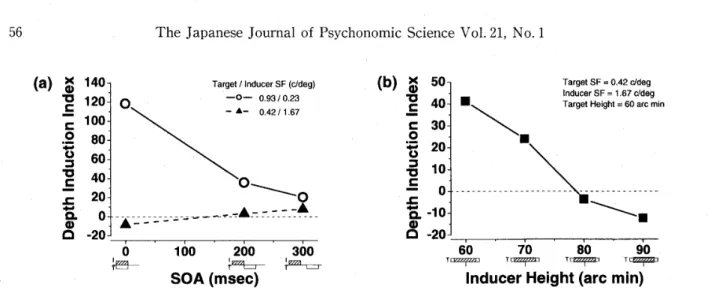
Figure
1.
{a)
The
depth
spatial-frequency
combinations.100
200
300
l
+4mu
SOA
(msec}
inductien
index
as
a
function
of
<b)
The
depth
induction
60
70
.80
90
Tmp Tmp Tmp
'Tmp
lnducer
Height
(arc
min}
SOA.
Different
symbols
corresponcl
to
different
index
as afunction
ofinducer
height,
index
indicates
the
occurrence
of
depth
attraction
or
repulsionrespectively.
Figure
1(a}
il]ustrates
the
effect of stimulus onset asynchrony(SOA)
between
target
andinducer.
Both
the
target
andinducer
werepresented
for
200msec.
In
atypical
conditienfor
depth
attraction(open
circles),depth
attraction
occurred
when
two
gratings
were nbt
temporally
superimposed(SOA=200
msec).
The
attraction waspreserved
even when abrief
blank
was
inserted
between
the
twe
gratings
(SOA=300
msec),In
contrastin
atypical
conditionfor
depth
repulsion(filled
triangles),
the
repulsion
vanished
when
the
two
gratings
were nottemporally
super-imposed.
In
acldition,
depth
attraction occurred whena
brief
blank
wasinserted.
Figure1(b)
showshow
in
atypieal
conditienfor
depth
repulsionthe
inducer
height
affectsthe
depth
induction
index.
Depth
attraction occurredwhen
the
inducer
had
the
same
height
asthe
target.
The
index
changed
from
positive
(attraction)
to
negative(repulsion),
as
the
inducer
height
increased.
'
'
Diseussion
The
resultshown
in
Figure1(a>
suggests
that
over-lapping
ofthe
target
with
the
inducer
in
the
time
domain
is
critical
for
depth
repulsionbut
not neces・ saryfor
depth
attraction.Although
a simultaneeuspresentation
wasthe
best
temporal
conditionfor
depth
att'raction,because
the
depth
induction
index
decreases
asSOA
increases,
simultaneity
itself
might
notbe
critical
for
depth
attraction,
The
difference
in
temporal
characteristicsbetween
depth
attractionand
depth
repulsion
might
refiectthe
possibility
that
'
they
are
mediated
by
different
mechanisms.'
The
results shownin
Figure
1
(b)
could
be
interpret-ed as evidencefor
the
importance
ofan
area
of
only
an
inducer
adjacent
to
an area ofboth
atarget
and aninducer.
So
that
this
possibility
couldbe
verified asupplementary
experiment
was
conducted.The
experirnent used aninducer
adjacentto
atatget
without an overlapping area.Depth
repulsiondid
not occur withthis
adjacentgrating
stimulus.It
canbe
concluded
that
a
non-overlapping
area
of
inducer,
by
itself,
cloes
not
give
rise
to
depth
repulsion,
Perhaps
a spatio-temporal superimpositionis
rather critical.There
is
anotherpossibility.
Due,
to
the
difference
in
shapebetween
the
two
gratings,
the
existence of a non-overlappingarea
mightprompt
a
target
to
be
perceptually
independent
of
a
superimposed
inclucer
and
so
lead
to
a
transparent
perception.
Given
that
the
depth
perception
of atarget
couldbe
infiuenced
by
whether or nottwo
gratings
areperceived
asthe
same shape,it
is
possible
that
a
relativelyhigh-]evel
processing,
such
as
shape
perception,
rr}ight
contrib-uteto
the
induction
of
depth
perception.
References
'
Smallman,
H.S.
1995
Fine-to-coarse
scale
disam-biguation
in
stereopsis,Vtsion
ReseaJTh,
35,